====================
This sermon was preached on Sunday, December 30, 2012, at St. Paul’s Episcopal Church, Medina, Ohio, where Fr. Funston is rector.
(Revised Common Lectionary, Christmas 1, Year C: Isaiah 61:10-62:3; Psalm 147:13-21; Galatians 3:23-25;4:4-7; and John 1:1-18. These lessons can be read at The Lectionary Page.)
====================
 “No matter how big and bad you are . . . when a two-year-old hands you a toy telephone, you answer it.” That piece of wisdom showed up on my Facebook newsfeed recently and I will return to it in a moment, but first I want to share some more Christmas poetry with you.
Many of you may know the work of the late Madeleine L’Engle, the author who died in 2007. She was best known for her young-adult series called “The Time Quartet”: A Wrinkle in Time, A Wind in the Door, A Swiftly Tilting Planet, and Many Waters.
She was also a first-rate theologian and a poet. Her poem about the Nativity of Christ, First Coming, is among my favorites:
He did not wait till the world was ready,
till men and nations were at peace.
He came when the Heavens were unsteady,
and prisoners cried out for release.
He did not wait for the perfect time.
He came when the need was deep and great.
He dined with sinners in all their grime,
turned water into wine.
He did not wait till hearts were pure.
In joy he came to a tarnished world of sin and doubt.
To a world like ours, of anguished shame
he came, and his Light would not go out.
He came to a world which did not mesh,
to heal its tangles, shield its scorn.
In the mystery of the Word made Flesh
the Maker of the stars was born.
We cannot wait till the world is sane
to raise our songs with joyful voice,
for to share our grief, to touch our pain,
He came with Love: Rejoice! Rejoice!
The first lines of that last verse speak to me most clearly: “We cannot wait till the world is sane to raise our songs with joyful voice.” Those lines speak to me of our Gospel lesson today, which is the prolog of the Gospel of John: “In the beginning was the Word, and the Word was with God, and the Word was God.”
John’s prologue is also the Gospel lesson, shorter by four verses, for the Eucharist on Christmas morning. It is for me a much more meaningful Gospel of the Incarnation than Luke’s sweet story of innkeepers, shepherds, angels, and the virgin birth: “In the beginning was the Word, and the Word was with God, and the Word was God.” (v. 1) These words speak to me of a God who communicates and through communication creates, redeems, and saves. It reminds us of the story of creation in Genesis: “God said . . . .” God spoke the creative word and everything came into being. Through the prophets and in the birth of Jesus, God spoke the redeeming word and guaranteed our salvation. When another speaks we must respond, as L’Engle wrote, “We cannot wait till the world is sane;” we must raise our voices.
On the Calendar of Saints, we remembered John as apostle and gospel writer on Thursday; his feast day is December 27. In the Daily Office readings for his commemoration we heard from the Prophet Isaiah:
Thus says the Lord, the King of Israel
and his Redeemer, the Lord of hosts:
I am the first and I am the last;
besides me there is no god.
Who is like me? Let them proclaim it,
let them declare and set it forth before me.
Who has announced from of old the things to come?
Let them tell us what is yet to be.
Do not fear, or be afraid;
have I not told you from of old and declared it?
You are my witnesses!
Is there any god besides me?
There is no other rock; I know not one.
(Isaiah 44:6-8, NRSV)
Isaiah’s prophecy in the reading for John’s feastcay, underscores John’s Gospel. Isaiah, speaking on God’s behalf, demands communication from other gods who would seek to supplant the Almighty: “Let them proclaim . . . let them declare . . . who has announced? . . . let them tell.” And God reminds us that God is a communicator: “Have I not told you from of old and declared it?” Our God is a God who communicates, who is in relationship with his people, who comes among them to speak and to listen. The other gods are nothing but mute idols.
Or, at least, in Isaiah’s time, they were. Have you watched any TV the past few days? There are as many advertisements now as there were before Christmas. They are sprinkled among “new” stories of post-Christmas sales, politics, and “the fiscal cliff”. They come every 13 minutes as we watch programs and movies in which brand-name consumer goods are strategically placed on the set or used by the characters. The gods of greed and consumption are communicating most loudly; the objects of modern worship are promoting themselves wantonly.
But are they listening? Do these gods hear the cries of the poor and homeless? Do these idols listen to the moans of the hungry and the sick? Do these objects demanding our devotion pay heed to the needs of those who have no resources, who cannot pay homage in their temples of commerce?
These are gods for whom communication is one-way. They tell of themselves and they expect their worshipers to come . . . come and buy, come and consume, come and be consumed. But they do not listen. They do not listen anymore than the idols of the nations against which Isaiah prophesied. Only one God listens. Only God the Word who became incarnate in that Baby celebrated in Luke’s sweet story . . . only the God who communicates, who “became flesh and lived among us” . . . only the God who communicates, who is still speaking, listens to us. The God who communicates wants to listen to us, wants to hear from us; God would love to hear from us!
“In the beginning was the Word, and the Word was with God, and the Word was God. . . . . And the Word became flesh and dwelt among us.” God spoke the redeeming word and guaranteed our salvation, and we must respond. The God who communicates is calling. The Baby in the manger is a two-year old handing us a telephone . . . . and when a two-year old hands you a telephone, you answer it! You cannot wait till the world is sane! Answer the phone and “Rejoice! Rejoice!”
====================
A request to my readers: I’m trying to build the readership of this blog and I’d very much appreciate your help in doing so. If you find something here that is of value, please share it with others. If you are on Facebook, “like” the posts on your page so others can see them. If you are following me on Twitter, please “retweet” the notices of these meditations. If you have a blog of your own, please include mine in your links (a favor I will gladly reciprocate). Many thanks!
====================
Father Funston is the rector of St. Paul’s Episcopal Church, Medina, Ohio.
 New Year’s Eve and our epistle lesson in the Daily Office lectionary focuses on the old passing away and everything becoming new. It’s purely serendipitous, but what an opportunity to affirm our faith in God’s on-going and constant re-creation of the world.
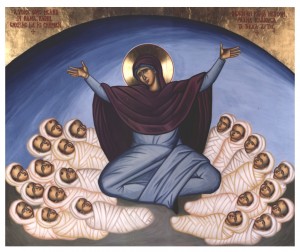 Today is the Feast of the Holy Innocents and the Daily Office Lectionary again chooses lessons that underscore the day’s commemoration. In the midst of Christmas joy, we are reminded of the little children killed by Herod’s soldiers in the king’s attempt to do away with a perceived rival. I am not the first nor the only preacher or pastor to have thought of this story when, two weeks ago, gunman Adam Lanza opened fire at Sandy Hook Elementary School in Newtown, Connecticut. The wanton murder of children at any time makes the country where it occurs desolate and devastated. So today, again, we pray for the repose of the souls of those who died:
 On the third day of Christmas the church calendar directs our attention to St. John the Evangelist and, again, the Daily Office lectionary falls in line. John is the gospeller whose wonderful prologue serves as the Gospel lesson at the Eucharist on Christmas Day (1:1-14) and on the first Sunday after Christmas (1:1-18). It is for me a much more meaningful Gospel of the Incarnation than Luke’s sweet story of innkeepers, shepherds, angels, and the virgin birth: “In the beginning was the Word, and the Word was with God, and the Word was God.” (v. 1)
 On the second day of Christmas the church remembers a murder, the martyrdom of Stephen, and our Daily Office lectionary won’t let us forget it. Often the readings of the Daily Office seem to have nothing to do with the season and they seldom are tied to a saint’s commemoration, but today the morning and evening readings tell the whole story in gruesome detail.
 I was born and raised in the desert. The image of wilderness and dry land blossoming is one that touches my heart and excites my imagination. I love the desert. I love its stark and barren beauty, when the rains of spring kiss it and it blossoms . . . there’s nothing like it anywhere else.
  I want to ask you to read along as I re-read the collect for the day, the particular prayer of the Fourth Sunday in Advent: “Purify our conscience . . . . ” That’s enough, just those three words: “Purify our conscience . . . . ” Don’t you think that’s asking a lot of God? I mean really . . . purify the human conscience, that place in ourselves where we know all the wrongs we have done. Tall order, purifying that! But that’s what the prayer asks and in doing so it draws on the language of the Letter to Hebrews from which our second lesson today is taken.
 Sort of buried in Jude’s moralizing about false teachers and those who follow them is an Advent message: “Look forward to the mercy of our Lord Jesus Christ that leads to eternal life.” As I’ve been saying pretty consistently throughout the season, here and in my sermons, Advent is not so much about celebrating the birth of Jesus, wherever it was and whenever it was about 2,000 years ago, as it is about getting ready for his return, the parousia as seminary-educated folks like to say.

