Occasional thoughts of an Anglican Episcopal priest

Category: Lectionary (Page 87 of 99)

Brotherly Advice – From the Daily Office – August 29, 2012

From John’s Gospel:

Now the Jewish festival of Booths was near. So [Jesus’] brothers said to him, “Leave here and go to Judea so that your disciples also may see the works you are doing; for no one who wants to be widely known acts in secret. If you do these things, show yourself to the world.”

(From the Daily Office Lectionary – John 7:2-4 – August 29, 2012)
 
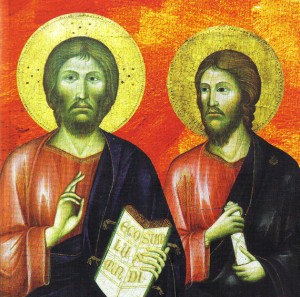
Icon of Jesus and his brother JamesThe picture of Jesus getting advice from his brothers just tickles me. John makes such a deal of it (while pointing out that his brothers did not believe in him – as the Messiah, I suppose – at the time). It seems so at odds with John’s otherwise oh-so-perfect, oh-so-divine Jesus!

It isn’t clear who these brothers are; there are some who suggest they are older half-brothers. Although there’s no biblical warrant for this, there is this pious invention of a first family for Joseph. The story is that Joseph was a lot older than Mary, had been married before, and had sons from that first marriage. Thus, Mary became a step-mother and Jesus had a bunch of older half-brothers. The reason for this invention is a belief in the “perpetual virginity” of Mary which seems to have originated in the 2nd Century with Irenaeus; his contemporary Origen came up with the step-brothers theory. What I always wonder about is why there’s no mention of these other kids in the few stories we have of Christ’s infancy and childhood. Where were they when Joseph and Mary made the trip to Bethlehem? Did they go along (then why aren’t they portrayed in Luke’s Gospel)? Or were they left home with relatives? What about the flight to Egypt? Surely Joseph wouldn’t have left them behind while he moved to another country! Were they with the family in Jerusalem when, instead of joining the return party, Jesus stayed behind to dazzle the Temple intellectuals? If they were, why didn’t they help in the search for the missing boy? Anyway, as this probably makes fairly clear, the whole perpetual virginity thing seems suspect to me.

So if these brothers aren’t Joseph’s boys from a first marriage, they must be Joseph’s and Mary’s subsequent issue; after all, Jesus is described by Luke as Mary’s “firstborn” (Luke 2:7). Presumably they are “James and Joses and Judas and Simon” (named in Mark 6:3 and Matthew 13:55), and they are Jesus’ younger brothers.

I never had a younger brother. I had an older brother (nearly a decade older, in fact). He passed away several years ago and I often miss his brotherly advice. We were not close during my childhood, but once I was in college we got close and became good friends. It helped that we lived in the same metropolitan area; I was a student at UC:San Diego and later at California Western School of Law in San Diego; my brother was on the faculty at San Diego State University. We saw each other often, enjoyed each other’s company, and I often turned to him for counsel.

Jesus getting advice from his brothers (whether they were older or younger doesn’t really matter) appeals to me. I can relate to that picture of Jesus and it helps me to believe that Jesus can relate to me. I believe Jesus can (and does) give me brotherly advice.

====================

Father Funston is the rector of St. Paul’s Episcopal Church, Medina, Ohio.

To Whom Can We Go? – From the Daily Office – August 28, 2012

From John’s Gospel:
 

Jesus asked the twelve, “Do you also wish to go away?” Simon Peter answered him, “Lord, to whom can we go? You have the words of eternal life. We have come to believe and know that you are the Holy One of God.”

(From the Daily Office Lectionary – John 6:67-69 – August 28, 2012)
 
"Angry Jesus" from "Here's Looking At Jesus"Several years ago, when I still earned my living by practicing law, I represented a man who was a sculptor; that was his hobby, not his profession. He was really very talented at carving stone. One of the pieces he showed me was a crucifix; the face of Jesus was contorted in rage. I told him that I had never imagined that look on Jesus’ face at that time. He referred me to Luke 23:34 in which Jesus says, “Father, forgive them; for they do not know what they are doing.” He told me he’d imagined that Jesus was angry at that moment, that the import of his words something like, “Father, you forgive them! I can’t, not right now! They have no idea how stupid and cruel this is!” It was an Aha! moment for me, a moment when I had an insight into Christ that has stuck with me all the years since. That artist and his crucifix forever changed the way I hear Luke’s version of the Crucifixion, and to be honest I think I hear the story more clearly as a result. (Accompanying this meditation is another “angry Jesus” from a Brazilian artist who had been tortured. The picture links to another person’s blog post, a sermon about images of Jesus that is really quite good.)

In the first of several eucharistic prayers in the Episcopal Church’s Book of Common Prayer, the presider at Holy Communion gives praise to God for the mission of the Son, sent by the Father, “to share our human nature, to live and die as one of us, to reconcile us to you, the God and Father of all.” That phrase, “to share our human nature,” it seems to me, picks up on a theological point made by the writer of the Letter to the Hebrews, the description of Christ who “in every respect has been tested as we are, yet without sin.” (Heb. 4:15) It is the same point made in the Nicene Creed when we insist that the Son “by the power of the Holy Spirit . . . became incarnate from the Virgin Mary and was made man.” It is the same point made in the Chalcedonian Definition that insists that Christ is not only “truly God” but also “truly man.” Jesus was a human being! And what human being undergoing the intense and excruciating pain of crucifixion would not be angry?

So you wonder (I’m sure), what has that to do with Jesus asking the Twelve if they, like others offended by his bread/body metaphor, want to turn away from him?

John’s portrayal of Jesus has always troubled me. He’s just a little too divine for me. He knows ahead of time what is going to happen; he seems to read the minds of the people around him. In fact, elsewhere in today’s reading from John’s Gospel, we are told that he was “aware that his disciples were complaining about” the bread/body allusion and that “Jesus knew from the first who were the ones that did not believe, and who was the one that would betray him.” This Jesus actually isn’t a whole lot like me; he’s not in every respect as I am or as most other people in my experience are. We are not aware of what those around us are thinking and we generally do not know “from the first” the way things are going to turn out. And if Jesus is as we are, then he wasn’t as all-knowing and all-seeing as the Gospel of John seems to make him out. But if he is like us when he questions the Twelve, “Do you also wish to go away?” then I suspect there might be a little irritation, a little frustration, a little anger in his tone of voice.

Not, perhaps, the outrage portrayed by my sculptor client in his version of the Crucifixion, but the everyday peevishness of hard-working human beings who have done their level best only to see things go not quite as hoped for, the simple annoyance of someone who has patiently explained things only to find him- or herself misunderstood, the vexation that accompanies the common experience of unrealized expectations. That’s what I hear in Jesus’ voice in today’s reading.

And I hear it, too, in Peter’s reply. (I hear the same exasperated tone of voice in Peter’s response to Jesus when he makes the comment about rich people getting into heaven in all three of the Synoptic Gospels: “Look, we have left everything and followed you.” [Mark 10:28]) “To whom can we go?” he asks. The whole conversation just sounds like the tired, worn-out men who have traveled far, done much, worked hard, and still don’t quite see the fruits of their effort they had hoped to see. They are frustrated with the situation and they are ill-tempered with one another. And you know what? I love that! I love it that Jesus and Peter and the others are that real, that human, that honest with one another that they can show their feelings and vent their frustrations. These are not superheroes; these are not emotionless automata; these are not people who are always in control. They are, in every respect, as we are. Peter, and James, and John, and (most importantly) Jesus have been there where we often find ourselves, ill-tempered, snappish, and a bit out of sorts.

“To whom can we go?” To whom else would we want to go than to someone who knows us as we are because he’s been there, who knows us as we are because he’s experienced even worse?

====================

Father Funston is the rector of St. Paul’s Episcopal Church, Medina, Ohio.

Bread? Body? Questions Without Easy Answers – From the Daily Office – August 27, 2012

Jesus said:
 

Those who eat my flesh and drink my blood have eternal life, and I will raise them up on the last day; for my flesh is true food and my blood is true drink. Those who eat my flesh and drink my blood abide in me, and I in them.

(From the Daily Office Lectionary – John 6:54-56 – August 27, 2012)
 
The Jews, John tells us, disputed among themselves as Jesus was delivering the lengthy dissertation on bread from which these statements come. Earlier he had introduced this idea that his flesh was bread to be eaten by his followers: “I am the living bread that came down from heaven. Whoever eats of this bread will live for ever; and the bread that I will give for the life of the world is my flesh.” (v. 51) The very idea of consuming human flesh is off-putting, even disgusting, and would have been extremely objectionable to the Jews; no wonder they grumbled and mumbled, complained and disputed. Even as a metaphor, the statement demands a lot from Jesus’ followers!
Church-going Episcopalians (and others who participate weekly in Holy Communion) are perhaps overly familiar with the metaphor. It’s not that we have somehow explained it away, I don’t think we have. Rather we have made it routine. Weekly (or more frequent) communion, with sweet wine and tasteless little cracker we laughingly call “bread” seems to have weakened the impact of this shocking metaphor. I mean, really, to someone who does not hear these words through 2,000 years of eucharistic practice, eating flesh and drinking blood sound a whole lot like cannibalism and vampirism.

How can we recapture the power of this metaphor? How can we make it make sense both to ourselves and to the non-church world in the 21st Century? As a ministry colleague has put it, “How would we explain this to a person who has watched Buffy the Vampire Slayer and read every word of the Twilight Series, but never stepped foot in a church or even know what the Bible is?”

I wish I had the answer to these questions, but the answers are less important than the questions themselves. Simply knowing that there are questions, acknowledging that they are real, that they are troubling, that they are important, and that there are no easy answers is the first step in our calling to show that Christ is real, and troubling, and important to the world, that Christ is relevant in the 21st Century.

Questions are much more important than answers, especially the hard ones.

====================

Father Funston is the rector of St. Paul’s Episcopal Church, Medina, Ohio.

Will God Dwell on the Moon? – Sermon for Pentecost 13, Proper 16B – August 26, 2012

====================

This sermon was preached on Sunday, August 26, 2012, at St. Paul’s Episcopal Church, Medina, Ohio, where Fr. Funston is rector.

(Revised Common Lectionary, Proper 16B: 1 Kings 8:1,6,10-11,22-30,41-43; Psalm 84; Ephesians 6:10-20; and John 6:56-69.)

====================

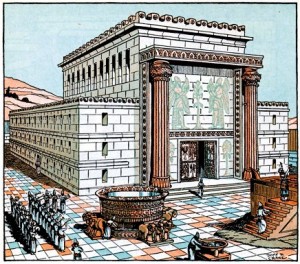
Temple of SolomonOn the cover of our worship bulletin this morning is a depiction of King Solomon’s Temple. It’s an artist’s rendering of someone’s reconstruction of the Temple based on the description of its construction in the Old Testament record. Our first reading today (from the First Book of Kings), as long as it was, is just a small part of the dedicatory prayer that King Solomon offers when the Temple is finished and consecrated.

The building of the Temple marked a very significant change in the Jewish religion. Well, really, let’s not call it the Jewish religion because it wasn’t that, yet. Let’s just say, “The religion of the people of Israel.” These people were not, though we often imagine them to be, strict monotheists. Even in this prayer Solomon leaves open the question of whether there might be gods other than their God: “O Lord, God of Israel, there is no God like you in heaven above or on earth beneath.” There might be other gods, lesser gods perhaps, demigods, or even demons, part of a heavenly pantheon of gods, but this God, the God of the People of Israel is greater than any of those others.

At this time, all the different nations, sometimes even different clans or families, had their own religions, their own gods. And nearly all of these religions believed the gods to be sort of tied to the land. If you moved from one place to another, you stopped worshiping the god of the first place and took up the worship of the god of your new residence. If a woman married outside of her family or tribe, married into a different clan, she would give up the religion of her family and take up that of her husband.

The People of Israel’s God, however, was different. Their God was not tied to a particular place. Their God was connected to a holy object, instead. God was associated with the Ark of the Covenant which they had created in the desert to contain God’s holy relics, the tablets of the Law given to Moses at Sinai (together with a pot of manna and Aaron’s staff). They carried the Ark with them, actually before them, as they traveled through the desert, as they crossed into the Holy Land, as they conquered the Canaanites and took possession of the country.

You may recall that in those first years, the People of Israel had no monarch: they considered God to be their king. The histories are silent as to where the Ark was kept during the period of the Judges, or during the reign of the first monarch, King Saul. But we know that David wanted to build a permanent location for it; he wanted to build a Temple. But God refused. He told David, through the prophet Nathan,

Are you the one to build me a house to live in? I have not lived in a house since the day I brought up the people of Israel from Egypt to this day, but I have been moving about in a tent and a tabernacle. (2 Sam. 7:5-6)

So David did not build the Temple, but he did build a special tent in his city, Bethlehem, and brought the Ark there. We are told

David danced before the Lord with all his might; David was girded with a linen ephod. So David and all the house of Israel brought up the ark of the Lord with shouting, and with the sound of the trumpet. . . . They brought in the ark of the Lord, and set it in its place, inside the tent that David had pitched for it. (2 Sam. 6:15, 17)

David designed the Temple, but he never built it. His son Solomon was the one to do that.

So the Temple was finished, the sacred implements from David’s tent had been moved into it, the Ark of the Covenant was installed into the Holy of Holies where only the High Priest would be allowed to go and Solomon offers this long prayer of dedication. In it he asks a very important question: “But will God indeed dwell on the earth?” (1 Kings 8:27) By building the Temple, Solomon sought to provide God a place to dwell on earth and, in so doing, he made the religion of his people more like that of their neighbors than it had been.

Remember their religions had tied their gods to particular places whereas the God of Israel had moved about the countryside with his People. Now God had a permanent home and, over time, the Jews would centralize God’s worship in the Temple and they would eventually decree, in the Book of Deuteronomy, that the cultic part of their faith could only be performed in that place. Sure, people could gather anywhere for prayer, they could go synagogues for religious instruction, but they could only offer sacrifice and perform the Temple rites in the Temple at Jerusalem. God had become tied to a place. (This was one of the differences the Jews had with Samaritans with whom they shared a devotion to God and who also followed the Law as set out in Genesis, Exodus, Numbers, and Leviticus, but who rejected the restrictions of Deuteronomy and had their own temples, primarily at Mt. Gerazim.)

By the time of Jesus, Solomon’s question had been firmly answered by the Jews. Yes, said their religion, God will dwell on earth, in this place, this Temple in Jerusalem. In the birth of Jesus, however, God gave a different answer: God will not dwell in a building in a particular place; God will dwell with and among God’s People: as the Gospel of John affirms, “The Word became flesh and lived among us.” (John 1:14) Will God indeed dwell on earth? Yes, God will live among God’s people as one of us. God lived among us as an infant born in Bethlehem. God lived among us as an itinerant rabbi who had no home. God lived among us as a rabbi accused of being a rabble-rouser. God lived among us as a rabble-rouser condemned to die a criminal’s death. God lived among us as a criminal executed on a cross.

On the night before he died, he gathered with his friends for a Passover meal. There is some debate as to whether it was a Seder, the sacred meal of Judaism, but if it was he radically changed its nature, just as Solomon building the Temple had radically changed the nature of the religion of Israel. In the Passover meal, Jews become one with their ancestors; the Passover story is brought present to them in the ritual of the Seder and they, in turn, live through the Passover story, but the meal does not bring God into their midst. When Jesus took the bread of affliction and said, “This is my body,” when he took the cup of blessing and said, “This is my blood,” when he told his followers, “Do this when you remember me,” when he promised, “Where two or three gather, I am there,” Jesus gave us a power and an obligation unlike any given before to any people by God. We have the privilege to bring God present among us in the Bread and Wine of the Eucharist, the Christ’s Body and Blood.

Moon Rock Window, Washington D.C. National CathedralWhere were you on July 20, 1969? In July of 1969 I was living in a boarding house and studying in Florence, Italy. The boarding house or pensione in which I lived, Pensione Frati, did not have a television. My landlord, Colonello Roberto Frati, arranged for me and the other Americans living there to go to his sister-in-law’s home where we could watch Neil Armstrong’s and Buzz Aldrin’s moon landing on her TV – this great big box of a television set with a tiny black-and-white screen. We all gathered around that box peering into that tiny screen listening to the Italian news commentators and struggling to hear the American commentary behind them. I’m sure that when we heard of Commander Armstrong’s death we all thought about wherever we were on that day at that moment when he stepped out of the lunar lander and became the first human being to walk on another world.

What almost nobody knew until a long time afterward was that something else happened on the moon that day. Buzz Aldrin, a devout Christian and an ordained elder in his Presbyterian congregation, had taken a communion kit with some bread and wine to the moon. In the Presbyterian Church, the lay elders of the church who serve a function similar to our vestry members, are actually ordained by their congregation, and that ordination empowers them to bless the elements of Holy Communion. At the time Aldrin and Armstrong landed on the moon, the pastor and members of his Presbyterian church were watching TV but unlike most of us, they were also celebrating communion. Armstrong joined them across space, blessing the bread and wine on the moon and partaking there of Holy Communion.

In the act of Holy Communion we are joined with Christians everywhere and everywhen — with all those in every place who also take part in the Eucharistic feast, with all those who have done so at ever Eucharist since Christ’s last supper with his disciples, with all those who will celebration Communion in the future. We are joined with them and we are joined with God in Christ as we eat of his Body and drink of his Blood, no matter where we are on earth or even on the moon.

Will God indeed dwell on the earth? Yes! Will God dwell on the moon? Yes! God dwells with God’s People wherever the memory of Jesus is invoked in the Holy Communion, wherever bread and wine are blessed and consecrated the Body and Blood of God incarnate in Christ. God will dwell with God’s People across time and across space, even on the moon, and wherever else in this Solar System or beyond we may go, so long as we do this in memory of Jesus. Amen.

Playing My Harp in the Voting Booth – From the Daily Office – August 25, 2012

From the Book of Psalms:

By the rivers of Babylon —
there we sat down and there we wept
when we remembered Zion.
On the willows there
we hung up our harps.
For there our captors
asked us for songs,
and our tormentors asked for mirth, saying,
“Sing us one of the songs of Zion!”
How could we sing the Lord’s song
in a foreign land?

(From the Daily Office Lectionary – Psalm 137:1-4 – August 24, 2012)
 
This is one of my favorite psalms, not so much for its own import, but because of the reggae song Rivers of Babylon which is based on it. Here’s a YouTube recording of the Melodians singing the song. (My favorite version is a live performance by Jimmy Cliff, but I couldn’t find a good video of it.)

It is the plaint of the refugee: how can we sing the Lord’s song in a foreign land? How can we do anything that is normal to us? How can we be the people we are meant to be in a context not our own?

This is the life of the Christian according to St. Paul! We who are members of the Body of Christ are not in our “native land”; we are not at home in this world. To the Philippians he wrote, “Our citizenship is in heaven.” (Philip. 3:20) And to the Ephesians, “You are citizens with the saints and also members of the household of God.” (Eph. 2:19)

This is difficult for us to accept. We like to think that the context in which we find ourselves, our worldly situation, is where we are supposed to be! I was born and reared in the United States of America; I was educated in its schools, worked in its industry, worship in its churches, vote in its elections. I am an American! And yet Paul and Psalm 137 insist that I am a “stranger in a strange land”, that I am a citizen of somewhere else, that my values are not necessarily those of the world and the society in which I find myself, leaving me with the question asked in the Psalm: How can I sing the Lord’s song in this foreign land? How can I apply the values of the gospel in my daily life in this place-other-than-heaven? How do those values influence the way I vote, the choices I make, the activities i do, the way I spend money?

And let’s be honest and take a step back to an earlier question . . . . Do gospel values influence my daily life, my vote, my choices, my activities? Or have I hung up my harp on the willows and given up trying to sing God’s song in this strange place? I hope that I have not, and I hope over the next several weeks to tune my harp and take it with me into the voting booth in November.

====================

Father Funston is the rector of St. Paul’s Episcopal Church, Medina, Ohio.

God! You Need to Change! – From the Daily Office – August 24, 2012

From the Book of Job:
 

One day the heavenly beings came to present themselves before the Lord, and Satan also came among them to present himself before the Lord. The Lord said to Satan, “Where have you come from?” Satan answered the Lord, “From going to and fro on the earth, and from walking up and down on it.” The Lord said to Satan, “Have you considered my servant Job? There is no one like him on the earth, a blameless and upright man who fears God and turns away from evil. He still persists in his integrity, although you incited me against him, to destroy him for no reason.” Then Satan answered the Lord, “Skin for skin! All that people have they will give to save their lives. But stretch out your hand now and touch his bone and his flesh, and he will curse you to your face.” The Lord said to Satan, “Very well, he is in your power; only spare his life.”

(From the Daily Office Lectionary – Job 2:1-6 – August 24, 2012)
 
Time for ChangeWow! Does this look familiar? The second chapter of Job begins with a scene nearly identical to that which we considered yesterday. Satan (with other heavenly beings) presents himself in the heavenly throne room and, once again, God and Satan have a conversation about Job and, once again, the bet is made. In fact, it’s sort of “double down” time! Yesterday, I argued that although the Book of Job is fiction it (like the other forms of literature found in Holy Scripture) embodies truth.

So what is the truth behind this scene? It’s a legitimate question. This picture of God wagering with Satan is important enough to the story that it is repeated. It must be telling us something. As I ponder it, I am struck by a “What if . . . . ?” A big “What if . . . . ?” What if God really does gamble with our lives? What if God really is a . . . jerk? Now, understand please, I don’t think that that is the truth behind this fictional scene, but what if . . . . ?

When I was reading theology in preparation for ordination, one of the modern theologians I most related to was the French Reformed theologian Jacques Ellul. My favorite of his works was L’Esperance Oubliee (“Hope Forgotten”) which was published in English under the title Hope in a Time of Abandonment. Writing from a conviction that “we have entered upon the age of abandonment, that God has turned away from us,” Ellul nonetheless asserts, “Hope is a protest before this God, who is leaving us without miracles and without conversions, that he is not keeping his Word … It is Job’s great declaration, ‘my eye pours out tears to God, that he would maintain the right of a man with God’ (Job 16:20-21).” Prayer, says Ellul, is how we give voice to this hopeful protest; prayer is how we, empowered by hope, insist that God fulfill God’s promise. Hope and prayer is how we demand that

It is God who needs to change. It is God who must return to enlighten his Church and to make our hearts shout for joy . . . It is God who has to change, and hope is the resolute will to make God change . . . It is to bring about once again the implementation of that wonderful statement of the Old Testament, “and God repented”.

If God (to return to my “What if . . . . ?”) is being a jerk, we have the hopeful protesting power to say, “God! You need to change!”

====================

Father Funston is the rector of St. Paul’s Episcopal Church, Medina, Ohio.

Job Is Fiction, But It’s True – From the Daily Office – August 23, 2012

From the Book of Job:
 

One day the heavenly beings came to present themselves before the Lord, and Satan also came among them. The Lord said to Satan, “Where have you come from?” Satan answered the Lord, “From going to and fro on the earth, and from walking up and down on it.” The Lord said to Satan, “Have you considered my servant Job? There is no one like him on the earth, a blameless and upright man who fears God and turns away from evil.” Then Satan answered the Lord, “Does Job fear God for nothing? Have you not put a fence around him and his house and all that he has, on every side? You have blessed the work of his hands, and his possessions have increased in the land. But stretch out your hand now, and touch all that he has, and he will curse you to your face.” The Lord said to Satan, “Very well, all that he has is in your power; only do not stretch out your hand against him!” So Satan went out from the presence of the Lord.

(From the Daily Office Lectionary – Job 1:6-12 – August 23, 2012)
 
Realistic Dice IllusionA later selection from the Book of Job was called up by the Sunday Eucharistic Lectionary several weeks ago. In my sermon I said to the congregation that the Book of Job is fiction (which it is). You should have seen the look on one of my parishioners’ face! There’s a fellow in the congregation who is, shall we say, conservative with regard to the Bible. While I don’t believe he actually considers the Bible to be the inerrant word of God per se, he’s pretty sure that it is to be taken with the highest degree of certainty and words like “myth” or “fiction” applied to Scripture are not to his liking. I swear I thought he might have an apoplectic fit right there in his pew! But let’s be honest: do we really think that God and Satan are engaged (or have ever been engaged) in a game of chance involving the lives of human beings?

Because, when you get right down to it, that is the set up of the Book of Job – a bet between God and the Devil as to whether this good man, Job, will curse God if his life turns to garbage. If someone in the church does think that that’s the way God runs the universe, perhaps that person is following the wrong religion because that surely is not the way the Christian faith sees the world! In this, Christianity is not at odds with science. Albert Einstein once famously remarked, “God does not play dice with the universe.” And while quantum mechanics, chaos theory, superstring theory, and a whole host of new scientific and mathematical suppositions rely on the concept of probability rather than certainty, they still don’t posit a game of chance as determining the structure of reality.

If a game of chance is not the way the universe runs, then what are we to make of these verses from today’s Old Testament reading? If they are not factually accurate, then we have only two choices: they are a lie, or they are fiction.

If they are a lie, then they undermine the whole concept of Holy Scripture as an embodiment of Truth. If they are fiction, however, there is no problem. The Bible is not, as everyone ought to acknowledge, so much a book as it is a library. It is a collection of books, as we readily admit whenever we refer to the works found in this collection. We don’t refer to the “chapter of Genesis” or the “section of Isaiah”; we refer to them as “books”, books within a library. Just like a library, the Bible includes many kinds of literature. There are histories (the Books of Kings, Chronicles, and the Acts of the Apostles, for example). There are works of poetry (Psalms). There are books of etiquette and advice on good living (Proverbs and Ecclesiastes). There are memoirs (the Gospels). There are collections of letters (the Pauline and other Epistles). There are law books (Leviticus and Deuteronomy). And among various other forms of writing, there is fiction (Job is both an example of fiction and of poetry).

The question for the student of Biblical literature is “Does fiction embody truth?” Do any of these non-historical, non-scientific forms of literature embody truth? What is the truth of a poem, for instance? Well, as an early 20th Century writer on the subject of poetry put it, poetry expresses the truth that

behind our daily occupation, beyond the business of the market and the pleasure of the circus, there lies an unexplored world of beauty – a world of complete satisfaction for the highest human capacity, a world from which we may derive courage, and hope, and faith, to help us in this world we live in. (Laurie Magnus, Introduction to Poetry, London:1902, pg. 68)

Fiction does the same thing. Ralph Waldo Emerson once said, “Fiction reveals truth that reality obscures.” Among the reasons fiction is worth writing, reading, and studying is not that it’s entertaining (although good fiction truly is), but rather that it teaches us important lessons about the world, about human beings, and (the religious person says) about God. It does so even if we’re not actively studying, not trying to learn these things; they get into us and into our thinking in unconscious ways. That’s what Scripture is supposed to do, too. And that’s why Scripture includes fiction and poetry along with history, memoir, and correspondence. And that’s why it’s perfectly OK to say, “Job is fiction.” It may be fiction, but it’s nonetheless true!

====================

Father Funston is the rector of St. Paul’s Episcopal Church, Medina, Ohio.

Straining to See God – From the Daily Office – August 22, 2012

From the Psalms:

Out of the depths have I called to you, O Lord; Lord, hear my voice;
let your ears consider well the voice of my supplication.

If you, Lord, were to note what is done amiss,
O Lord, who could stand?

For there is forgiveness with you;
therefore you shall be feared.

I wait for the Lord; my soul waits for him;
in his word is my hope.

My soul waits for the Lord, more than watchmen for the morning,
more than watchmen for the morning.

O Israel, wait for the Lord,
for with the Lord there is mercy;

With him there is plenteous redemption,
and he shall redeem Israel from all their sins.

(From the Daily Office Lectionary – Psalm 130 (BCP version) – August 22, 2012)

Marble Arch Cave, County Fermanagh, IrelandPsalm 130 is one of the seven “pentitential psalms” of the church (Psalms 6, 32, 38, 51, 102, 130, and 143), a tradition that stretches back to the Sixth Century if not earlier. It is also one of the “songs of ascents” (Psalms 120-134) that are believed to have been sung by pilgrims making their way up to Jerusalem or possibly when climbing up the Temple Mount for festival celebrations. Somehow it strikes me as both odd and poignant that a song or poem beginning “Out of the depths” is called a song of “ascent” – from the deepest sloughs of despond the poet calls out the Highest. Ascent, indeed!

This is a song of longing: my favorite verse is Verse 5, “My soul waits for the Lord, more than watchmen for the morning, more than watchmen for the morning.” Sometimes when this psalm is sung or chanted I find myself wanting just to stop at the verse. In the repetition of the words “more than watchman for the morning” I want to lower my voice, slow my words, shake my head, stare into space, give play to the longing in my soul, sigh deeply, acknowledge the sense that God sometimes seems to be absent, wallow in abandonment.

And yet it is not a psalm of resignation and surrender. It does not end with those words, but forcefully pleads its case that God will appear, that God will have mercy, that God will offer redemption. This is a song of God’s Presence, not of God’s absence. Even in the depths, God in some way is there.

Last year my daughter and I toured the Marble Arch Caves in County Fermanagh, Northern Ireland. At one point during the tour, the guides extinguished all of the lights and we were plunged into the deepest darkness I have ever experienced. But in that blackness the eye continues to seek for light; you can almost feel the optic nerves at the back of your eyeballs, the rods and cones of the retina, straining to find light. This psalm is like that; the soul of the psalmist is convinced, even in that deepest, darkest, pitch black slough of despond, that the Light of God is still to be found. The soul strains to see God.

====================

Father Funston is the rector of St. Paul’s Episcopal Church, Medina, Ohio.

He Will Not Let Your Foot Be Moved – From the Daily Office – August 21, 2012

From the Psalms:

I lift up my eyes to the hills;
from where is my help to come?

My help comes from the Lord,
the maker of heaven and earth.

He will not let your foot be moved
and he who watches over you will not fall asleep.

Behold, he who keeps watch over Israel
shall neither slumber nor sleep;

The Lord himself watches over you;
the Lord is your shade at your right hand,

So that the sun shall not strike you by day,
nor the moon by night.

The Lord shall preserve you from all evil;
it is he who shall keep you safe.

The Lord shall watch over your going out and your coming in,
from this time forth for evermore.

(From the Daily Office Lecionary – Psalm 121 (BCP Version) – August 21, 2012)

Rocky Mountain TrailI think this may be my favorite psalm. It is the psalm appointed for use on the feast of St. Francis of Assisi. It is one of the psalms approved in The Book of Common Prayer for use at a funeral; it was selected by my mother to be used at her funeral.

It is one of the most intimate of the psalms for it constantly names God; each time the words “the Lord” appear in this English translation, the Hebrew actually sets out the Tetragrammaton, YHWH, the Name of God. The translation follows the Jewish custom of never saying that Name, of replacing the Name with other words to avoid any hint of familiarity with or disrespect for the Lord. Although I understand the piety behind that tradition, I find it here to be a bit sad, for in following it one loses the intimacy which makes this psalm so powerful.

As a college student, one of my recreations was hiking and camping; my circle of friends and I would take off for some wilderness area or mountain range for a weekend, backpacking all of our needs and supplies, exploring trails and seeing sights many people never see. In Southern California, many of the mountain trails are quite treacherous. The soil is rocky and loose and one can easily slip and lose one’s footing. The pathways are not unlike those of the Holy Land – steep, rocky, covered with loose stones and gravel, footing unsure. For safety and support, we often walked close together, helping one other up or down steep slopes.

I thought of those hikes recently when, in my own backyard (which is on a rather steep slope) I slipped while doing yard work, went down, and tore the meniscus of my right knee necessitating surgery. No one else was home and I had to crawl back to the house by myself. If that had happened in the Southern California wilderness, it could have been disastrous. That’s why we supported one another, and that’s why the third verse of this psalm speaks so loudly to me. “He will not let your foot be moved.” Yahweh is with us, close to us, supporting us in the same way my hiking companions were with me on those college-day backpacking trips.

And that’s why I find it sad that the psalm does not name God. You don’t refer to or address the one who supports you along a steep, slippery slope by formal titles. Your companion on the difficult path is your buddy, your friend, your intimate companion. As the opening anthem of the Burial Office in The Book of Common Prayer says of God, he is “my friend and not a stranger.” He is Yahweh, and he will not let my foot be moved.

====================

Father Funston is the rector of St. Paul’s Episcopal Church, Medina, Ohio.

Preaching Like Stephen, Making People Angry – From the Daily Office – August 20, 2012

From the Acts of the Apostles:

When they heard these things, they became enraged and ground their teeth at Stephen. But filled with the Holy Spirit, he gazed into heaven and saw the glory of God and Jesus standing at the right hand of God. “Look,” he said, “I see the heavens opened and the Son of Man standing at the right hand of God!” But they covered their ears, and with a loud shout all rushed together against him. Then they dragged him out of the city and began to stone him; and the witnesses laid their coats at the feet of a young man named Saul. While they were stoning Stephen, he prayed, “Lord Jesus, receive my spirit.” Then he knelt down and cried out in a loud voice, “Lord, do not hold this sin against them.” When he had said this, he died. And Saul approved of their killing him.

(From the Daily Office Lecionary – Acts 7:54-8:1 – August 20, 2012)

Martyrdom of Saint StephenSaint Stephen, one of the first deacons of the church, has just preached a sermon in which he has reminded his hearers, Jewish authorities in Jerusalem, that the Jews had a history of mistreatment of prophets, Their ancestors, he has said, “killed those who foretold the coming of the Righteous One, and now [his listeners] have become his betrayers and murderers.” No wonder they were angry with him.

I’m increasingly coming to the opinion that Christian preaching ought to anger those who hear it. If it doesn’t make them angry at the preacher, it should make them angry at someone or something else, angry enough to do something . . . though maybe not a fatal stoning.

We who preach the gospel of Jesus Christ should have the courage and conviction of Stephen, if not that of Jesus himself. There is a lot in our society that needs to be “called out” – the obvious racism of the way Ohio’s voting hours are being limited, for example, or the obvious sexism of a senate candidate in another state who can conceive of something he labels “legitimate rape” or the callous disregard for the needs of poor children deprived of nutrition be the defunding of school meal programs. These are not merely political issues; these are moral, ethical, and spiritual issues about which the church – and the church’s preaches – need to speak out. There are no “merely political” issues; every issue has moral, ethical, and spiritual dimensions, and of those the gospel has much to say. It will not say it to our world, however, unless preachers address the issues. And if that makes someone angry, so much the better.

A 19th Century Chicago journalist named Finley Peter Dunne wrote under the pseudonym of an Irish bartender named Mr. Dooley. One of Mr. Dooley’s observations concerned the role of the press:

Th’ newspaper does ivrything f’r us.
It runs th’ polis foorce an’ th’ banks,
commands th’ militry,
controls th’ ligislachure,
baptizes th’ young,
marries th’ foolish,
comforts th’ afflicted,
afflicts th’ comfortable,
buries th’ dead,
an’ roasts thim aftherward.

In the 1960 movie Inherit the Wind, Gene Kelly played an H.L. Mencken-like newspaper editor saying, “It is the duty of a newspaper to comfort the afflicted and afflict the comfortable.” Clare Booth Luce used a variation of this sentiment in her eulogy for Eleanor Roosevelt and numerous churchmen, including Reinhold Niebuhr, have applied similar words to the Christian faith, arguing that the preacher’s job, indeed the very nature of the gospel, is to comfort the afflicted and afflict the comfortable. Our job as ministers of the gospel is to offer hope and consolation to those who are hurting, while standing strong against the evils of injustice and oppression and selfish pursuit. And if that makes someone angry, so much the better.

The first deacon, Stephen, should be the patron saint of this kind of preaching, of which there should be much, much more.

====================

Father Funston is the rector of St. Paul’s Episcopal Church, Medina, Ohio.

« Older posts Newer posts »