====================
This sermon was preached on Sunday, January 20, 2013, at St. Paul’s Episcopal Church, Medina, Ohio, where Fr. Funston is rector.
(Revised Common Lectionary, Epiphany 2, Year C: Isaiah 62:1-5; Psalm 96:1-10; 1 Corinthians 12:1-11; John 2:1-11. These lessons can be read at The Lectionary Page.)
====================
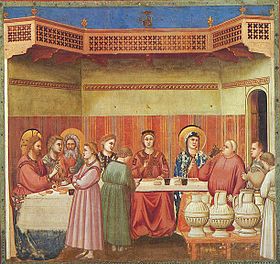
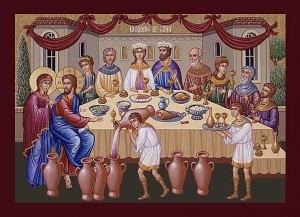 In our gospel lesson today, Jesus turns water into wine. He does so, somewhat unwillingly it seems, because he and his mother are at a wedding banquet and the couple is about to run out of wine for their guests. Mary brings this to Jesus’ attention because she apparently believes he can do something to save the hosts from embarrassment. At first, however, he seems disinclined to do anything about it. Not the least bit phased by her son’s reluctance, Mary tells the servants to do whatever he tells them, and she goes back to the party. I have always imagined that as she turned away Mary gave Jesus the same sort of look my mother would give me when I tried to not do as she wanted, the same sort of look I’ve seen my wife give our children. So . . . Jesus turns water into wine, and (as you will see) not just any water into not just any wine, but really good wine! Now, one supposes that Jesus could have done something else to assist the wedding couple, but he chooses to do this, to turn water into wine.
Wine is a very special sort of drink, especially in the Jewish tradition and, thus, in our own Christian faith. Wine gets a special mention in Psalm 104, which is a long song of praise to God for all the things God has created, especially those things that are good for human beings. Along about the middle of the psalm, the singer gives praise to the Almighty that among the “plants to serve mankind” are those from which we get “wine to gladden our hearts.” (Ps 104:15-16) In Jewish tradition, grape wine is considered such a gift to humankind that it alone of all alcoholic beverages has a special prayer of thanksgiving: Barukh atah Adonai Eloheinu Melekh ha’olam, bo’re p’ri ha’gafen (“Blessed are you, O Lord our God, Sovereign of the universe, who creates the fruit of the vine”).
I would like you to keep that in mind. I’ll return to the subject of wine and glad hearts in a short while, but first I want to share with you a news story that crossed my desk a couple of days after Christmas. It is from the Jewish publication, The Tablet:
Climate change has been blamed for a host of devastating events, from Hurricane Sandy to the evaporation of Greenland’s glaciers. But earlier this year, a dramatic weather event had a small but important impact on the Jewish community: In July, as a drought brought the effects of global warming to the Midwest, the only mikveh in Omaha, Neb., went dry.
The mikveh, a ritual bath, is an essential part of any Orthodox Jewish community, so when one goes dry, it’s a serious issue — especially in Omaha, where the next nearest mikveh is a state away. “The mikveh is one of the most basic institutions of any Jewish community,” explained Jonathan Gross, the rabbi of Beth Israel Synagogue, Omaha’s Orthodox congregation. “How are you supposed to have young families if you don’t have a mikveh?”
Refilling a mikveh isn’t a simple matter of turning on a faucet; there are rules about what kind of water can and cannot be used. The community in Omaha prayed for rain – one of the approved methods for replenishing the water in a mikveh – and their prayers were eventually answered. But by the time those rains came, another solution was already in place, a solution that involved one ton of ice.
Mikvehs typically serve multiple purposes. The first and most important is as a place for women to purify themselves after completing their menstrual cycles; immersion in a mikveh is a critical part of the laws of Taharot HaMishpacha, family purity, and without immersion a woman is forbidden to have sex with her husband. New vessels, like pots and pans, must be immersed before they can be considered kosher and thus usable. And converts need to immerse to conclude their conversions. Customarily, men also dunk, before holidays and before their wedding day, although this isn’t mandated by modern Jewish law.
Like many mikvehs, the Omaha Community Mikvah is composed of two below-ground pools. The first pool fills with rainwater through a hole in the roof, and the second, larger pool is used for the actual bathing. To be considered halachically valid, a mikveh is required to have at least 40 se’ah of natural water. A se’ah, a unit of halachic measurement, corresponds to roughly five gallons of water, according to one stringent opinion – meaning that 200 gallons of natural water are required for a kosher mikveh. The water must fill the mikveh through naturally occurring sources, either by rain or through a connection to a spring or river. Water that is transported to the mikveh through direct human means – in buckets, for instance – is called she’uvim, drawn water, and cannot be used to fill a mikveh. Tap water is also forbidden, though this wasn’t always the case—and tap water can be added to the mikveh once the required 200 gallons of natural water are present.
[Preacher’s Note: The author is being generous in equating 40 se’ah to 200 gallons. A se’ah is 12.128 litres. Doing the math yields a more accurate conversion of 40 se’ah to just under 130 gallons. This is the approximate volume of water changed to wine in today’s gospel lesson. See The Jewish Encyclopedia.]
In July, Omaha’s mikveh was accidentally emptied when a maintenance crew member thought that cleaning the mikveh meant emptying it completely. In most circumstances, a mikveh can be refilled relatively easily through rain or snow, but this summer’s drought made that impossible. “Had this happened in January with all the snow we would have been filled up in a week!” Gross lamented on his blog.
The mikveh was out of service for almost two months. Women traveled to the next closest mikveh in Des Moines, Iowa, or Kansas City, Kan., each more than two hours away. Dishes went unpurified. The receptionist at the Rose Blumkin Jewish Home, where Omaha’s mikveh is located, received calls every time it rained an inch, asking if the pool had somehow miraculously filled. As the weeks passed, different ideas were thrown around: The supervising rabbi of the mikveh suggested the community pray for rain. They did. Another rabbi tried to open up a larger hole in the roof to allow more water, but that didn’t work. Some scientific-minded congregants suggested lighting giant Bunsen burners, evaporating water and then allowing it to condense over the mikveh; this was deemed impractical and was never tried.
The town finally turned to Rabbi Yaakov Weiss, 34, the pastoral service coordinator of the Blumkin Home and one of the supervisors of the mikveh. Another rabbi brought up the idea of using ice to fill the mikveh, and Weiss began looking into it. Using ice was a sort of loophole or leniency: Since the ice was solid and not liquid, if it was moved into the mikveh while still in its frozen state, when it melted it would be considered non-she’uvim water, and the mikveh would be kosher. This procedure, while not common, is almost universally accepted.
“I know it had been done in Nova Scotia once, but I had never heard much about it prior or since,” Weiss said.
Weiss called Rabbi Hershel Schachter and Rabbi Zvi Sobolofsky, two important legal minds at Yeshiva University in New York. They referred him to a mikveh expert, Rabbi Yirmiya Katz, who went through the exact requirements of filling the mikveh with ice.
Weiss’ first thoughts were to use the large ice machines in the Blumkin Home, but that plan was quickly vetoed since the ice would have melted too much by the time they put it in the mikveh. Weiss, with Katz’s help, figured out that he’d need a lot of very frozen ice put in the mikveh very fast.
Weiss called every ice company in Omaha (“Did you know that while there are many ice companies – Arctic Ice, Omaha Ice, Glacier Ice – they are all actually the very same place?” he wrote on Gross’ blog) and finally found one that could deliver the required amount: 250 10 pound blocks of ice. The ice was paid for by the Jewish Federation of Omaha, on whose campus the Blumkin Home is located.
On Friday, Aug. 24, Weiss and a group of volunteers wearing special gloves that wouldn’t melt the ice amassed outside the mikveh at 8:15 in the morning. But the truck showed up an hour late, and by the time Weiss opened the first package, the ice melted in his hands.
“Apparently this was their version of solid blocks of ice: It was a block of crushed ice pushed together in a brick,” explained Weiss. “It doesn’t stay as cold as a real block of ice.”
Weiss went back to the drawing board where he found Muzzy Ice, an ice company that makes blocks of ice for ice sculptures. He had found them earlier but decided against using them given the large size of their ice blocks. “I didn’t want to risk damaging our mikveh,” Weiss said, but he relented once he realized that was the only option.
Three weeks later, on Sept. 11, a Muzzy Ice truck pulled up to the mikveh. Inside the truck were seven 300-pound blocks of ice. An extra 100 pounds of dry ice was shoved inside the truck to ensure that nothing melted.In less than an hour, staff members of the Jewish Federation moved the ice into the mikveh. Along the way, little pieces of ice would chip off and fall on the stairs; Weiss and a colleague would rush to pick them up to make sure that the chips wouldn’t liquefy and contaminate the mikveh water. “It was very intense and very stressful,” recalled Weiss. “[But] it was quite an experience. I’ve never dealt with a ton of ice in a small contained area.”
Once all seven 300 pound blocks were moved, the question became how long the ice would take to melt. Estimates ranged from two days to a week.
They never got to find out.
The next evening a huge torrential storm hit the Midwest. In several hours, the bor z’reih, the place where the rainwater collected, was filled to capacity and the first pool was filled. “I went in the next day and said, ‘Wow.’ ” Weiss told me. “Now our only problem was our mikveh was filled with ice.”
Both Weiss and Gross said that the whole effort pulled Omaha’s roughly 6,000 Jews together and led to a newfound curiosity about the mikveh, even among those who don’t really use it.
“Was it a waste of energy and time? Or conversation and money?” Weiss considered. “We often say that our efforts and actions have repercussions for good and bad and perhaps this was a repercussion. It’s a community mikveh and it’s integral to us. Perhaps by showing how much it means to us, I think . . . we saw a response or sign from God. For our action, we have God’s reaction: ‘I’ll give you the rainfall you were looking for.’ ” (The Day the Mikveh Went Dry, The Tablet, December 27, 2012)
I wanted to read that article to you because it gives you a picture of how seriously the Orthodox Jews of our time treat what John in today’s gospel lesson calls “the Jewish rites of purification.” Modern Orthodox Judaism is the direct descendent of, and the closest thing we have in our world to, the village religion of Jesus’ time and place. The seriousness with which the Orthodox Jews of Omaha, Nebraska, dealt with the filling of their mikvah gives us clue to how gravely the Jews of Cana, and Jesus himself, would have regarded the 130 or so gallons of water that Jesus just sort of willy-nilly turns into wine for the wedding banquet.
OK. Yes, I’m being facetious. There is nothing willy-nilly about this. Jesus isn’t just turning water into wine. Jesus is doing something called an “enacted parable”. An “enacted parable” is one told through actions rather than words. The prophet Hosea, for example, married a prostitute to illustrate the unfaithfulness of Israel; the prophet Jeremiah wore a yoke to symbolize the oppression of the Babylonians. An “enacted parable” has been described as “an extravagant action which upsets the conventions of life” (A. Richardson, Westminster Dictionary of Christian Theology, Westminster:1983, p. 426). This is precisely what Jesus is doing when he changes the water of ritual purification into wine to celebrate newlywed love; he is upsetting the religious conventions of Jewish life.
Jesus is enacting the distinction that St. Paul will later explicate into a theological contrast between Law and Grace. Now don’t get me wrong, Jesus is not overthrowing the Jewish religion! Jesus was, himself, a good and faithful Jew, and the Law’s insistence upon ritual purity is not, in and of itself, a bad thing. But the point Jesus seems to be making here is that given a choice between Law and love . . . choose love! Given a choice between worrying about water for purification on the one hand or enjoying wine to gladden the heart on the other . . . choose gladness. By changing the water intended for the mikvah into wine for the party, Jesus is saying that joy ranks higher in the scheme of things than purity. Given a choice between celebration and seriousness, says this action . . . choose celebration.
Judaism, of course, is not a religion entirely of Law, ritual purity, and seriousness. As anyone who has been to a Passover supper or a Chanukah party or a Jewish wedding feast knows, there are occasions of great merriment and fun, of joy and celebration. Here, at the beginning of his public ministry, the Son of God makes it plain, that these are the higher ranking values of the reign of God. He will do so again at the end of his earthly life when, in the joyful context of the Passover banquet, he will take bread and wine, wine which gladdens the human heart, and tell his friends to do the same again and again, “whenever you do it,” in his memory.
One of my very favorite motion pictures is Auntie Mame starring Rosalind Russell; I just love that movie. There is a scene in it in which Mame is speaking to her stenographer Miss Agnes Gooch (played by Peggy Cass):
Mame — Oh, Agnes! Here you’ve been taking my dictations for weeks and you haven’t gotten the message of my book: live!
Agnes — Live?
Mame — Yes! Live! Life’s a banquet and most poor suckers are starving to death!
I want to suggest to you today that Mame was preaching the gospel, that that is a Christian sentiment fully in keeping with miracle at the Wedding in Cana of Galilee, that it is a Christian sentiment fully in keeping with Lord’s Passover supper in the Upper Room, that it is a Christian sentiment fully in keeping with our weekly gathering for the Lord’s Supper in Holy Communion.
Choose wine over water, choose love over Law, choose gladness over worry, choose joy over gravity, choose celebration over seriousness, choose a party over purity! Life’s a banquet! Enjoy it! Amen.

 Jesus son of Sirach offered a lot of good advice in his little book sometimes called Liber Eccesiasticus, a book not included in the canon of inspired Scripture recognized by Protestants, but found in that selection of texts called the Apocrypha. Anglicans decline to use these texts to settle matters of doctrine, but read them ” for example of life and instruction of manners.” (Articles of Religion, Article VI, BCP 1979, page 868)
 This passage is one of my favorites in the book of the prophet Hosea. (I’m a fan of that prophet for a number of reasons and this little-remarked verse is one them.) Hosea’s major metaphor for the relationship of God with Israel is that of marriage. Hosea portrayed God as Israel’s “husband” and condemend the nation because of the “adulterous” relationship it had had with other gods. As a “prophetic act” Hosea married a prostitute named Gomer, with whom his relationship parallels that of God with Israel. He tells of Gomer running away from him and having sex with another man, but he loves her and forgives her. Similarly, even though the people of Israel worshiped other gods, Hosea prophesied that Yahweh continues to love his people and does not abandon the covenant with them. This verse, however, departs from that metaphor and presents, instead, a maternal and feminine image of God.
 A year ago I was in Ireland, camped out in a cottage outside of the village of Banagher, County Offaly, on sabbatical. As my study project, I was translating old Irish hymns into metrical, rhyming English such that they could be sung to the music of the original. The hymns were published in the early 20th Century in a collection titled Dánta Dé Idir Sean agus Nuadh compiled by Uná ní Ógáin. Dánta Dé includes a communion hymn which elaborates on John’s story of the wedding feast; it is entitled The Blessed Wedding at Cana and is attributed to Maighréad ní Annagáin. I found I could not directly translate the hymn, so instead I wrote a poem of my own. Reading this story today, I recall working on that piece and offer it again.
 OK. I know I shouldn’t get into this . . . I know that someone is going to give me a hard time; I can almost predict that someone will tell me they are planning to “leave the church” over this. But here goes.
  In our lessons today, we have two stories about silencing the prophetic voice. First, a snippet of the not-very-familiar story of the Prophet Amos which is, frankly, cut from its context so badly that some explanation really is necessary. Second, the almost-too-familiar story of the beheading of John the Baptizer.
  God had made it abundantly clear to Moses that he wasn’t going to be allowed to cross over into the Holy Land. He would be allowed to see the Promised Land from the opposite side of the river, but not to enter it. Despite Moses’ requests, God’s mind was not going to be changed, as this divine outburst of temper makes clear. ~ There have been times in my career – maybe I should say “careers”, because it was true when I was a businessman and when I was a lawyer, as well as during my ministry as a parish priest – that I have felt like Moses standing on Mt. Pisgah: I can see where this business, firm, community is (or ought to be) headed, but I am pretty sure I’m not going to get there with them. ~ A colleague and I once made note of a common occurrence in parish ministry: the aftermath of a building program. It seemed to us (and later we both personally experienced) that once a pastor has led a congregation through a building program and the building is up and running, the pastor leaves. Like Moses’ life, his or her ministry among that people is at an end. We were never sure why that was, and even having been through the experience I’m still not sure. ~ Moses (and his brother), of course, died without entering the Promised Land because of his lack of faith: the Lord said to Moses and Aaron, “”Because you did not trust in me, to show my holiness before the eyes of the Israelites, therefore you shall not bring this assembly into the land that I have given them.” (Num. 20:12) Is it because clergy lose faith (maybe faith in their communities) during a building program? Is it because the community loses faith in the clergy? I remember reading (several times) about how the stress of designing and building a home can be a cause of divorce; maybe something of the same dynamic is at work in the pastor/parish relationship during a church building program. ~ In any event, whether a building program or a change of ministry direction or a shift in church style, I’m pretty sure that every church leader (clergy and lay, I’m sure, but probably more the clergy) has felt, at some time, that he or she could see a vision of the church’s future that he or she was probably not going to be joining in. And if it hasn’t happened yet, I’m confident that it eventually will. When that happens, clergy, know that you are in good company! You are standing with Moses atop Mt. Pisgah!
 We’ve been following the story of Balak and Balaam from the Book of Numbers for a few days, although I’ve not been writing about it here. In truth, I find it a little dull. But Balaam’s words this morning strike me as pertinent to what’s going on in my denomination (the Episcopal Church) in Indianapolis this week: “What the Lord says, that is what I will say.” Balaam will not simply parrot whatever blessing or curse Balak wants; he will say what he understands God to want him to say. ~ A lot of resolutions are being debated at the General Convention and many of them will be referrals to standing or special committees and task forces with instructions for study and report. That’s all well and good, some actions of the church need study and careful consideration before they are taken. But all too often these referrals are not for disinterested and unbiased reflection. Take, for example, the question of whether the church should bless the committed relationships of couples who are of the same sex (“same-sex marriage” as some call it). ~ Before I continue, I need to be on record as believing that the church should offer such blessings, just as we do for committed couples of opposite sexes. ~ It is likely that some committee (the Standing Liturgical Commission, probably) will be asked to study the question of our theology and understanding of marriage. Good. But it will probably, in the same resolution, be tasked (in fact, I think there’s a resolution pretty much saying) to report back with suggested liturgies for such blessings. Bad. The outcome of the theological study is simply presupposed in the task! This isn’t a resolution to study the theology of marriage; it’s a resolution to provide a theological justification for same-sex marriage. ~ I suspect that another issue before the Convention, whether Holy Communion should be open to those who are not yet bapized members of the Christian faith, will result in a similar “study-and-report” referral. ~ Committees and task forces asked to do that should not also be given the job of preparing materials which can only be based on a pre-supposed outcome. When the Convention does so, it stands in the same position as Balak demanding that Balaam utter the blessings and curses of his choosing. Committees and task forces need to be free, like Balaam, to say not what the General Convention presupposes they will say, but what they understand God wants them to say. ~ By the way, Balaam had a donkey who could see angels and who tried to steer him away from danger. Most committees also have an ass or two who can do the same thing; pray God they do their job! ~ (Parenthetical closing remark: I don’t otherwise suggest that our committees emulate the confused, untrustworthy, and idolatrous Balaam, a man whom Peter described as being one who “loved the wages of iniquity” [2 Peter 2:15]. But insofar as he spoke God’s message without bias, go for it!)
 Our first reading this morning is from a little book from the Apocrypha called The Book of Wisdom. At one time church tradition ascribed authorship to King Solomon, but it is now believed to have been written sometime in the first or second century before Christ by a Greek-speaking Jew of the Diaspora. It is found in the Greek-language version of Jewish scriptures, not in the Hebrew version, and is therefore not considered as canonical scripture by Jews or by Protestants. Roman Catholics and the Eastern Orthodox do accept it, and we Anglicans take a middle course, saying that we read them “for example of life and instruction of manners; but yet [we do] not apply them to establish any doctrine.” (Articles of Religion, Art. VI, BCP 1979, pg. 868). Well, here’s an example of life, then:

