 One of the things I try to do when I read the stories of Jesus in the Gospels, when he uses an odd or striking metaphor like “I will make you fishers of people”[1] or, as it is put in this Gospel, “from now on you will be catching people,”[2] is to figure out if he’s referring back to Law or the Prophets, and whether it might be the lectionary’s choice for a first lesson. Sometimes that helps me figure out whether there is a thematic link between the lessons and, if so, what it’s supposed tell us, but unfortunately that’s not the case today. Jesus doesn’t seem to have had Isaiah in mind when he summoned Peter and his business partners.
So for the past week or so, I’ve been pondering what might be the reason for putting the Isaiah reading –– which, although it comes in the sixth chapter, is the story of Isaiah’s initial call to be a prophet –– together with Luke’s version of Jesus recruiting Simon Peter and the sons of Zebedee, James and John, to be disciples. The simple answer, of course, is that they are both stories of calls to ministry, but they are so different!

 “They’re eating the dogs, they’re eating the cats.”
 Again this week as last, our first reading today is from the First Book of Kings and like last week’s, it is a prayer spoken by King Solomon. Last week, it was a private prayer spoken in a dream late at night. Today, it is a public prayer. As long as it was, this reading is just a small part of the dedicatory prayer that Solomon offered when the Temple was finished and consecrated. In it, Solomon asks an important question, “[W]ill God indeed dwell on the earth?”
 Our gospel reading this morning is taken from the Fourth Gospel, the Gospel according to John, which I’m sure you know is the sort of odd-man-out of the gospels. The other three gospels, the so-called Synoptic Gospels (a Greek word meaning that they see the Jesus story in the same way), pretty much agree and present the events of Jesus’ ministry in the same order over a one-year time-line. John tells the story in a completely different way, with a three-year time span and a different order of events.
  The United States is, at least ostensibly, a very religious country. Nearly two hundred years ago, Alexis de Tocqueville wrote that “there is no country in the world where … religion retains a greater influence over the souls of men than in America; and there can be no greater proof of its utility and its conformity to human nature than that its influence is powerfully felt over the most enlightened and free nation of the earth.”
 We have had more than enough of contempt,
 Are you a music fan? A classical music fan? I am. I love the great symphonies – Beethoven’s Fifth, his Ninth, Tchaikovsky’s Fifth, Dvorak’s From the New World, and many others – they just bowl me over. I can sit down in a concert venue and no matter what emotional state I may be in, a good symphony or concerto can overcome it – cynicism, depression, grumpiness, whatever my condition may be it will be conquered by the music and I will be uplifted. It doesn’t even have to be live in a concert hall. Sometimes when I’m feeling a bit out of sorts, I’ll put on a CD or an MP3 and just let the music fill me. At its best, music literally lifts me up and sets me dancing. In fact, in the proper setting, even badly played band music can have that effect.
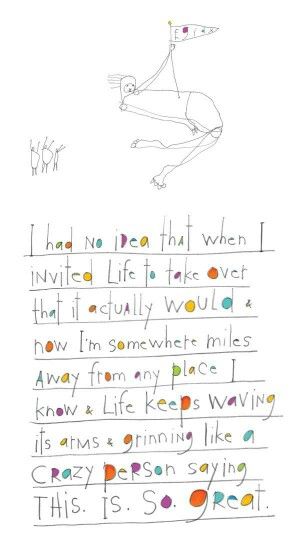 There is a graphic artist named Brian Andreas whose work I can’t really describe to you. He uses a lot of primary colors, representational but non-realistic images, and words to create prints called “StoryPeople.” In one of them that I saw a while back is this quotation (I don’t know if it’s original to Mr. Andreas or quoted from someone else):
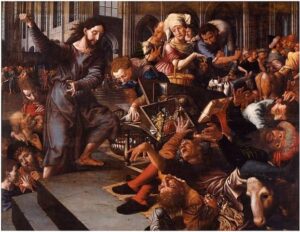 When I was about 8 or 9 years of age, my grandparents gave me an illustrated bible with several glossy, color illustrations of various stories. They weren’t great art, but they were clear and very expressive. My favorite amongst them was the illustration of today’s gospel lesson.

