Occasional thoughts of an Anglican Episcopal priest

Category: Ministry (Page 22 of 59)

Living Generously: Sermon for Pentecost 19 – Proper 21C, Track 2 (September 25, 2016)

====================

A homily offered by the Rev. Dr. C. Eric Funston on the Nineteenth Sunday after Pentecost, September 25, 2016, to the people of St. Paul’s Episcopal Church, Medina, Ohio, where Fr. Funston is rector.

(The lessons for the day are Proper 21C of the Revised Common Lectionary: Amos 6:1a,4-7; Psalm 146; 1 Timothy 6:6-19; and St. Luke 16:19-31. These lessons may be found at The Lectionary Page.)

====================

Dives and Lazarus. Psalter (Munich Golden Psalter). England [Gloucester?], 1st quarter of the 13th century.We could, I suppose, spiritualize the story of Lazarus and the rich man. We could, but if we did we would be twisting it out of shape. This is not a spiritual story. This is a bare-knuckled street-brawl of a story about wealth, about money and possessions, about someone who had plenty and about someone who had none. If we are going to honor the biblical text, we cannot spiritualize this tale; we have to deal with it as it is given us, as a story about money.

Did you know that the rich man has a name? Not in the Bible, I grant you that, but in the tradition of the church he is known as “Dives” – D-I-V-E-S pronounced “Dye-veez”. That name comes from the Latin “Vulgate” translation completed by St. Jerome in the late 4th Century in which he translated the Greek word for “rich,” plousios – which means “one who possesses wealth” – with the Latin word dives (pronounced “Dee-vase” in this context) – which comes from the same root as our word “divine” and means “one who is favored by the gods.”

In the Bible, of course, only the poor man is actually given a name, Lazarus. This is the Latinized version of the Greek transliteration of a Hebrew name, Eliezer. This name, it turns out, means “one who is aided by God.”

So, in the church’s tradition, both biblical and magisterial, these men have the same name! “Favored by God” . . . “Aided by God” . . . they are both named as beloved children of God, helped by God, bestowed by God with God’s grace and love. That is why we cannot spiritualize this story. Spiritually, there is no difference between these two men; they stand in the same relationship to God who, interestingly enough, isn’t even mentioned in the story. This not a story about God; it’s a story about money.

Which makes perfect sense when we consider where it comes in Luke’s gospel and in our lectionary sequence of readings. Let’s just go back a few chapters:

In chapter 12 Jesus told the story of Barn Guy, the rich man who had a great year with bumper crops and lots of lambs and calves, thought he could keep his earnings all to himself, and built bigger barns to keep it in . . . only to be told that he was going to die and learns, as Paul writes to Timothy in today’s epistle, “we brought nothing into the world, so that we can take nothing out of it,” so the best we can do is use our wealth to do good in this world.

In chapter 13, he talks about two trees both understood to be metaphors for God’s people and God’s kingdom: a barren fig tree which the owner decides to cut down and a mustard tree which starts from small beginnings but soon grows to provide shelter not only for the one who sowed it but for everyone.

In chapter 14, Jesus commands his followers to count the cost of following him and then tells them (that is to say, us) what that cost is: that until we sell all of our possessions and give the proceeds to the poor we are not worthy to follow him.

In chapter 15, we heard the parables of the shepherd who sought one lost sheep to complete his herd of 100 and of the woman who cleaned her whole house to find the one missing coin to complete her purse of 10, and then Jesus told us about the Prodigal who squandered all his wealth . . . but was nonetheless welcomed home with love and respect!

Now in chapter 16, we had last week’s weird story in which Jesus praised the dishonest steward who told his boss’s debtors to falsify the record of what they owed; Jesus’ punchline was that we should use our earthly wealth to win friends to welcome us “into the eternal homes.” Now he tells us this story about Dives who didn’t do that and wasn’t welcomed by Lazarus whom he might have helped or by Father Abraham, who (by the way) was quite a wealthy guy himself but clearly not sympathetic to Dives. (You know, it occurred to me that Dives could be Barn Guy. Jesus could have said, “Remember that guy who was really well off, had that great harvest, and built those new barns, but didn’t share his good fortune with anyone? Well, let me tell you about what happened after he died that night . . . .”)

Now, as I said, we could spiritualize all these stories and try to make them about God, but if we did that we’d have to wonder about Jesus, wouldn’t we? I mean the man has used stories about money so often that we would have to think that he must be unable to come up with another metaphor . . . or we would have to conclude that he doesn’t mean it to be a metaphor, at all. I think we have to reach the second conclusion and to understand, as Paul does, that Jesus believes “the love of money is a root of all kinds of evil,” and that those who have wealth are expected “to do good, to be rich in good works, generous, and ready to share, thus storing up for themselves the treasure of a good foundation for the future, so that they may take hold of the life that really is life.”

“What’s implied here is that places in the kingdom [‘the life that really is life’] are not given out according to what we have, but according to what we give away. What counts is solidarity; what counts is love. [Dives] who made a name for himself but didn’t care enough to share his wealth has no name any more. [Lazarus] who couldn’t achieve a thing all his life has been given a name of honor.” (Wendt, F., The Politics of a Name)

So let’s talk about money. Throughout his life, Jesus showed love, compassion, and care for those who didn’t have any, those who were at the bottom of society, namely the poor, the sick, the outcast, the foreigner, and those whom others considered to be sinners because of their poverty. However, he never condemned anyone for having money; what Jesus seems to have been most concerned about in regard to the wealthy was their reliance on money to provide security, a security which is ultimately temporary because wealth cannot provide that ultimate security found only in God. What is condemned is the love of money, the putting of wealth into that place in our lives where God ought to be.

Therefore, it would be “inappropriate to affirm in a wholesale fashion that [Jesus or the] early Christians criticized material wealth. Instead, of crucial importance is the attitude of the person owning it. Material wealth can get in the way of putting one’s trust in God, and it can be a hindrance to following Jesus. Yet [we must admit that all of our] church ministries and services depend on the financial resources of those who are willing [and able] to share them.” (Eberhart, C.A., Commentary on 1 Timothy 6:6-19)

I want to repeat here what I wrote in this week’s parish up-date email and what I will publish again in the October issue of our newsletter:

It is this sharing of resources that God wants of us. Clearly, God doesn’t want us to be self-reliant and, frankly, selfish rich people like Dives, but God also doesn’t want us all to be poor, sore-covered, gutter-dwelling beggars like Lazarus. What God does want us to do is to share with one another and with God in the ministries of the church.

When Bishop Hollingsworth visits here in a month (on October 30), we will, as we do at each service of baptism or confirmation, affirm our agreement to that partnership by reciting five vows from the Baptismal Covenant:

  • Will you continue in the apostle’s teaching and fellowship, in the breaking of bread, and in the prayers?
  • Will you persevere in resisting evil, and, whenever you fall into sin, repent and return to the Lord?
  • Will you proclaim by word and example the Good News of God in Christ?
  • Will you seek and serve Christ in all persons, loving your neighbor as yourself?
  • Will you strive for justice and peace among all people, and respect the dignity of every human being?

To each question, we respond: “I will, with God’s help.”

When we recite our baptismal vows, we are renewed in and reminded of God’s call in our lives and the life of St. Paul’s Parish. We are all God’s partners by virtue of our baptism, and we are all called by God to proclaim, in word and action, God’s justice, love and mercy for all creation, to do God’s work right here on earth.

Ministry, outreach, worship, baptisms, marriages, funerals, visiting the sick, praying for family and friends, offering spiritual and religious formation, helping those less fortunate than ourselves – doing these things in and through our church is part of our partnership with God. And each one of them costs money. God provides us with inspiration, skill, vision, and determination. But we have to provide the money.

Over the next six weeks, we will talking a lot about money. You will be asked to think about your support of St. Paul’s Parish for the next year. You will be asked to make your pledge of financial support for 2017. You will be asked to act on your promised partnership with God. Think of all your regular gift of money can do for our church, for our families, and (most importantly) for our neighbors. Think of all it can do for our partnership work with God here on earth. It is through our pledges, faithfully made and faithfully kept, that we partner with God to tell the good news, take care of children, visit the elderly, heal the sick, house the homeless, feed the hungry, and (yes) maintain our most important tool in doing all of that, this lovely building within which we worship today.

That’s what our pledged financial support does; that is what our sharing of our wealth does: God’s work in which we are partners. God expects us to live generously as God lives generously with us.

Like Dives, we are all favored by God. Like Lazarus, we are all aided by God. We stand in the same relationship to God as they did. In a sense, we are Dives’ siblings, those five brothers he asked that Father Abraham send Lazarus to warn. “We who are still alive have been warned about our urgent situation, the parable makes clear. We have Moses and the prophets; we have the scriptures; we have the manna lessons of God’s economy, about God’s care for the poor and hungry. We even have someone who has risen from the dead. The question is: Will we – [Dives’] sisters and brothers – see? Will we heed the warning, before it is too late?” (Rossing, B., Commentary on Luke 16:19-31) Will we who have the God of Jacob for our help, whose hope is in the Lord our God, whose God richly provides us with everything for our enjoyment . . . will we live generously and fulfill our promises of partnership with God?

I believe we will.

Let us pray:

Gracious and generous God,
your Son came that we might have life
and have it abundantly,
we pledge our trust in you and each other,
and we accept your invitation to be partners in ministry.
We acknowledge that your call requires us
to be stewards of your gifts,
shaping our lives in imitation of Jesus,
whom we have promised to follow.
As stewards, we receive your gifts gratefully,
cherish and tend them in a responsible manner,
share them by living generously with others,
and return them with increase to you, our Lord.
We pledge to attend to our ongoing formation as stewards
and our responsibility to call others to that same endeavor.
Almighty and ever-faithful God,
we are grateful
that you who have begun this good work in us
and will bring it to fulfillment
in Jesus Christ, our Lord. Amen.

[The illustration is “Dives and Lazarus” from the Munich Golden Psalter, dating from the 1st quarter of the 13th century.]

====================

A request to my readers: I’m trying to build the readership of this blog and I’d very much appreciate your help in doing so. If you find something here that is of value, please share it with others. If you are on Facebook, “like” the posts on your page so others can see them. If you are following me on Twitter, please “retweet” the notices of these meditations. If you have a blog of your own, please include mine in your links (a favor I will gladly reciprocate). Many thanks!

====================

Father Funston is the rector of St. Paul’s Episcopal Church, Medina, Ohio.

Restoring Wholeness: Sermon for Pentecost 17, RCP Proper 19C (11 September 2016)

====================

A homily offered by the Rev. Dr. C. Eric Funston on the Seventeenth Sunday after Pentecost, September 11, 2016, to the people of St. Paul’s Episcopal Church, Medina, Ohio, where Fr. Funston is rector.

(The lessons for the day are Proper 19C of the Revised Common Lectionary: Exodus 32:7-14; Psalm 51:1-11; 1 Timothy 1:12-17; and St. Luke 15:1-10. These lessons may be found at The Lectionary Page.)

====================

little-lost-lamb-59319I’d like you all to take your Prayer Books in hand and turn with me to page 855 which is way in the back of the book in the section called The Catechism or Outline of the Faith. At the top of the page are three questions about the mission of the church and the answers to those questions that we as Episcopalians teach. I’m going to read the questions; I’d like you to read the answers:

Q. What is the mission of the Church?
A. The mission of the Church is to restore all people to unity with God and each other in Christ.
Q. How does the Church pursue its mission?
A. The Church pursues its mission as it prays and worships, proclaims the Gospel, and promotes justice, peace, and love.
Q. Through whom does the Church carry out its mission?
A. The church carries out its mission through the ministry of all its members.

Following those questions are a few more about the specific ministry of the various orders (lay persons, bishops, priests, and deacons); I invite you to read those on your own.

For now, just keep in mind that the church’s mission is to restore people to unity with God and one another; we have a word for that – it’s called reconciliation. Remember that the church carries out that mission in prayer, worship, and proclamation, and by promoting justice, peace, and love. And, finally, remember that the church does so not as an institution, but through the individual ministries of its members, not as a collective like the Borg of Star Trek but as individuals with distinctive skills, talents, and interests (as Capt. Kathryn Janeway of the USS Voyager often instructed the former Borg drone Seven-of-Nine).

As you keep all that in mind, let me tell you a story about myself as a younger man, about thirty years younger. Back then I was not ordained; I was a practicing attorney living in Las Vegas, Nevada, with Evelyn and our children. Patrick was three years of age and Caitlin was one. One day I decided to take my son to the circus; more accurately, I took him to Circus Circus Casino. Now normally one does not take a 3-year-old to a casino, but Circus Circus is (or at least was) a special sort of casino. Housed in a building made to look like a “big top”, it had a mezzanine circling the gaming floor and on this mezzanine was an arcade filled with all the circus and carnival attractions you can name. Over the gaming floor was a trapeze rig on which gymnasts swung and flew with reckless abandon, while on the mezzanine midway barkers sought to attract patrons to shooting galleries, ring-toss games, and the like. My toddler was in awe of the whole thing.

We stopped for a few minutes to watch the trapeze artists and at some point I looked down and discovered that my son was no longer at my side. He was right there – and then he wasn’t! I know that most, if not all parents, have experienced something similar. That moment when your child has gone missing and you begin to experience every emotion known to humankind . . . in spades! Adrenaline courses through not only your body but your soul; you are in a physical and spiritual panic! “Where is my child!?!?” Fear and worry, hope and hopelessness, confusion and sadness . . . it’s all there, all jumbled together. It’s almost impossible to function and yet function you must; you have to find your child!

As it turned out, Patrick was only about eight feet away. The trapeze wasn’t nearly as exciting as the ring-toss game where, if his father had a good eye and a steady hand he might throw a plastic ring around a jelly jar and Patrick would get the gold fish living therein. When, after an eternity of maybe two or three minutes, I finally found him, a whole new rush of mixed emotions set in – relief, anger, joy, love – and I found myself kneeling on the floor holding him by the shoulders and yelling at him, adding to the circus noise of the crowded casino.

A security guard about my age, probably a father himself, had seen my panicked search and started to come over, arriving about the same time that I’d found Patrick. As I was shouting my lecture about not leaving Dad’s side, the guard put his hand on my shoulder . . . and that’s all it took. It calmed me down; the anger fled and the relief, joy, and love flooded in. I hugged my son tightly to me and vowed never to lose him again.

If you’re a parent, perhaps you’ve had a similar experience; as I said, I imagine most if not all parents have done so. Or perhaps you’ve been through that situation where you’ve worked for days on a project at work or school only to have a co-worker or a fellow student do something that renders all your effort of no worth at all. You’ve just lost all that time and work, and the feeling of futility that washes over you is just mind-numbing and drains you of all sense of worth and well-being. If you could, you’d drop-kick that colleague right out the front door. But then, perhaps another workmate, perhaps a supervisor or a teacher, makes a gesture or says a word and you realize that you really have no reason for anger. This is just the way things go sometimes and whatever the other worker or student may have done probably wasn’t done to hurt you; that’s just life. You pick up and you move on.

If you’ve had experiences like these, you know how the shepherd or the woman in Jesus’ parables this morning felt. You know how Yahweh felt at Sinai in our story from the Book of Exodus.

In the latter, Moses has left the Hebrews encamped at the base of Mt. Sinai while he has climbed the mountain to converse with Yahweh; he will eventually be bringing down the Law, the Commandments etched on stone by God’s own self. Moses is on the mountain for forty days and forty nights during which the Hebrews begin to feel themselves abandoned. They probably go through that whole gamut of emotions that a lost child, or a parent looking for a lost child, feels . . . but this story really isn’t about them . . . . Anyway, they feel abandoned because of Moses’ long absence and so they turn to his brother, Aaron the Priest, and say, “Make us a god!”

Aaron complies; Aaron seems like the type who is always easy going and willing to compromise and so he does as they ask, taking their jewelry and gold money and fashioning a god for them, the Golden Calf. This comforts them and so they begin to celebrate with revelry, the Bible tells us; that’s singing and dancing and some things we don’t generally talk about in church.

Meanwhile, Yahweh distracted by his conversation with Moses doesn’t notice his children wandering off. When he looks down, however, he finds them gone and, worse, when he finds them they aren’t just distracted by a ring-toss game and some goldfish. They are worshiping an idol!

Shauna Hannan, Associate Professor of Homiletics at Pacific Lutheran Theological Seminary in Berkeley, California, says that we should stop referring to this text as the “golden calf” incident and begin calling it the “God changes God’s mind at the request of Moses” incident. (Hannan) One of the things that strikes me about this incident is how very much Yahweh acts like an angry parent in this episode.

Something I found myself doing early in parenthood was referring to our kids as “my son” or “my daughter” when they were behaving well, but when they misbehaved I would turn to Evelyn and say, “Do something about your son (daughter)!” Back in Chapter 20, Yahweh said to the Hebrews, “I am the Lord your God, [I’m the one] who brought you out of the land of Egypt,” (v. 2) but now he says to Moses, “Your people, whom you brought up out of the land of Egypt, have acted perversely.” (32:7) I can really relate to Yahweh’s doing that!

And not only does God sort of disown these folks! Prof. Hannan points out that

God calls them names: stiff-necked people. And worse, God wants to be left alone to wallow in anger and to “consume” the idolaters. If that is not enough, God seems to bribe Moses to leave him alone (32:10). If Moses does so, God will make of him a great nation. Anger, tirade, blame, name-calling, destruction, bribery; this is not God at God’s best. (Hannan)

But Moses steps in like that security guard at Circus Circus, or like the supervisor at work or the teacher at school, and says a calming word. “Turn from your fierce anger,” he says, “Calm down. Remember your promises to Abrahan, Isaac, and Jacob.” Moses figuratively lays a hand on Yahweh’s shoulder. Callie Plunket-Brewton, who teaches at the University of North Alabama, says Moses here serves as a model for the Church, bearing witness to God’s faithful compassion and urging reconciliation between God and God’s people, although in this peculiar circumstance it is Yahweh himself to whom Moses is witnessing! (Plunket-Brewton)

Five years ago, on the Sunday closest to the anniversary of the September 11 tragedy at the World Trade Center, at the Pentagon, and near Shanksville, Pennsylvania, of which today is the 15th anniversary, I was invited to preach at St. Paul’s Church of Ireland Parish in the town of Banagher, County Offaly, Ireland. The lessons for that day were from the first chapter of the Book of Proverbs, in which Lady Wisdom cries out to passersby, “How long will you love being naive?” (Prov. 1:22) and from the eighth chapter of Mark’s Gospel in which Peter tries to stop Jesus from going to Jerusalem and Jesus responds, “Get behind me, Satan! For you are setting your mind not on divine things but on human things.” (Mk 8:33)

I suggested to my Irish audience that there is a parallel between the way the British authorities responded to Ireland’s Easter Uprising of 1916 and the way we in America responded to the actions of Al-Qaeda on September 11. They and we were naive, and when they and we experienced the tragic loss of life and the overwhelming loss of control that those events represented, we did, indeed, set our minds on human things, on revenge and retribution, rather than on divine things, on restoring all people to unity with God and each other, on promoting justice, peace, and love. So Ireland found itself in nearly a century of sectarian strife and eventually the deadly and devastating Troubles of Northern Ireland. And we have found ourselves 15 years later still battling terrorists, still fighting in the Gulf States, still engaged in Afghanistan and Iraq in the longest armed combat in our nation’s history, and trying not to get deeply involved in the directly consequent civil war in Syria.

If only someone had raised their voice, if only someone had laid their hands on our nations’ shoulders and said, “Turn from your fierce anger. Calm down. Remember your promises . . . .” Eventually the Irish and the British were able to end their bitter relationship and the Troubles which made Northern Ireland a hell-on-earth; we hope and pray that we will be able to do the same in and with the Gulf States and those who live there.

I said that the reading from Exodus is really not a story about the Hebrews. It is a story about God, about Yahweh, a god who understands those feelings of loss, who knows what it is to feel loss-engendered anger and to want retribution and revenge, and who turns away from those things to seek reconciliation instead.

The parables that Jesus tells in our selection from Luke’s Gospel are also stories about God, about God and loss, and not (as we often think) about us. Though they are often called the parables of the “lost sheep” and the “lost coin,” they ought to be called the parable of the shepherd who went in search of a sheep and of the woman who cleaned her house looking for a coin. That would take the focus off the thing that is loss and put it properly on the one who does the finding.

However, we do have to consider the things that are lost and what that means. Karoline Lewis, who writes a weekly internet column about the lectionary texts entitled Dear Working Preacher, noted this week that “the state of being lost is a rather ambiguous determination in life.” Being lost can mean being misplaced, or misdirected, or misguided, or wasted. “A definition of ‘lost’ seems as broad as its incidences: unable to be found; not knowing where you are or how to get to where you want to go; unable to find your way; no longer held, owned, or possessed.” (Lewis)

On Thursday afternoon I was driving to Brook Park and listening to Terry Gross’s NPR show Fresh Air as she interviewed an author named Steve Silberman about his book NeuroTribes: The Legacy of Autism and the Future of Neurodiversity. (Available online) As they talked about the autism spectrum, it occurred to me that there might be a similar continuum of “lostness” that could help us understand these bible lessons. It seems to me that at one end of such a lostness spectrum are the Hebrews at the foot of Mt. Sinai. They are lost by reason of their own decision; they are, as Yahweh said, stiff-necked people and their lostness is the consequence of their own actions, their own impatience, rejection, and alienation. In short, the Hebrews at the foot of Mt. Sinai are lost because of sin.

At the other end of the spectrum is the coin, about which we might ask, “How does a coin sin? How does a coin lose itself?” and the simple answer is that it can’t.

And somewhere in the middle of our lostness continuum is the sheep, who wandered away from the flock not out of rejection or alienation, but simply because sheep are rather dull-witted and naive. It has wandered off not through sinful intent, but through silly innocence.

The wonderful thing that these stories demonstrate is that the mechanism of lostness, the reason the Hebrews, the sheep, or the coin are lost, is irrelevant. What these stories show is that the one who feels their absence, the one who is concerned about their lostness, God, is going to find them. Influenced by the intervention of Moses, by his witness to God’s own ministry of reconciliation, “the Lord changed his mind about the disaster that he planned to bring on his people,” and instead restored Godself to unity with them. The shepherd sought and found the lost sheep and rejoiced. The woman sought and found the lost coin and rejoiced. The emphasis in all these stories is on the finding and the restoration of relationship, on the one committed to that end.

Jennifer Copeland, a Methodist minister, wrote several years ago in The Christian Century magazine:

The lost sheep and the lost coin are more than the prized possessions of their owners; they are also parts of a whole. The sheep belongs to the flock and the coin to the purse; without them the whole is not complete. The search, then, is a quest for restoration and wholeness. In this sense, all of us who are part of God’s creation should be just as anxious as God until the lost are restored and we are made whole again by their presence. (Clean Sweep, The Christian Century, September 7, 2004, p. 20)

Prof. Hannan suggests that this emphasis on wholeness is also the “shocking and profoundly hopeful news” of the Exodus passage, the news “that God sticks with us; God continues to claim us as God’s own despite” everything. (Hannan)

On this 15th anniversary of those terrible events that are summed up in the simple numbers “9-11,” in this 13th year of armed conflict that has flowed from them, let us remember that our mission as a church, our mission as individual members of the church, has that same emphasis of reconciliation and wholeness:

The mission of the Church is to restore all people to unity with God and each other in Christ. The Church pursues its mission as it prays and worships, proclaims the Gospel, and promotes justice, peace, and love. The church carries out its mission through the ministry of all its members.

In today’s Daily Office gospel reading from Matthew, Jesus admonishes his hearers, “Be reconciled to your brother or sister.” (Matt 5:24b) I can think of no better way to memorialize all who died September 11, 2001, and in the conflict and violence that has followed.

To close, I would like to offer a prayer for this anniversary co-authored by my friends Deacon Scott Elliott of the Diocese of Chicago and Fr. Bob Winter, a retired priest of this diocese.

Let us pray:

O God of mercy, justice, and love, you have taught us to love even those with whom we are at enmity: As we gather in the Name of your Son to celebrate your goodness and grace, we remember the great evil done in your Name on this day. In your mercy, relieve our hearts of the burden of shock and horror and help us to remember that we, your children, are likewise called to be merciful; help us, as children of the Just One, to respond to your call to be people of justice; help us, as the beneficiaries of your love, to remember your command to love the whole world in your Name. All this we ask in the Name of the Prince of Peace. Amen.

====================

A request to my readers: I’m trying to build the readership of this blog and I’d very much appreciate your help in doing so. If you find something here that is of value, please share it with others. If you are on Facebook, “like” the posts on your page so others can see them. If you are following me on Twitter, please “retweet” the notices of these meditations. If you have a blog of your own, please include mine in your links (a favor I will gladly reciprocate). Many thanks!

====================

Father Funston is the rector of St. Paul’s Episcopal Church, Medina, Ohio.

Division Happens: Sermon for Pentecost 13, RCL Proper 15C (14 August 2016)

====================

A homily offered by the Rev. Dr. C. Eric Funston on the Thirteenth Sunday after Pentecost, August 14, 2016, to the people of St. Paul’s Episcopal Church, Medina, Ohio, where Fr. Funston is rector.

(The lessons for the day are Proper 15C of the Revised Common Lectionary: Jeremiah 23:23-29; Psalm 82; Hebrews 11:29-12:2; St. Luke 12:49-56. These lessons may be found at The Lectionary Page.)

====================

division-sign-clip-art-divide-clipart-t48bPp-clipartIn philosophy and theology there is an exercise named by the Greek word deiknumi. The word simply translated means “occurrence” or “evidence,” but in philosophy it refers to a “thought experiment,” a sort of meditation or exploration of a hypothesis about what might happen if certain facts are true or certain situations experienced. It’s particularly useful if those situations cannot be replicated in a laboratory or if the facts are in the past or future and cannot be presently experienced. St. Paul uses the word only once in his epistles: in the last verse of chapter 12 of the First Letter to the Corinthians, he uses the verbal form when he admonishes his readers to “strive for the greater gifts. And I will show you [deiknuo, ‘I will give you evidence of’] a still more excellent way.” It is the introduction to his famous treatise on agape, divine love, a thought experiment (if you will) about the best expression, the “still more excellent” expression of the greatest of the virtues.

Today I would like to do a thought experiment with you, actually three short experiments, in which I will ask you to envision some interpersonal interactions to test the hypothesis of Jesus that his message, which he claimed was the message of God recorded in the Law and the Prophets, would bring division.

So make yourselves comfortable and, if it helps, close your eyes and envision yourself a 16-year-old high school student completing your secondary education at a church-affiliated institution which includes the study of religion in its curriculum. You have just completed a course in which you studied the creation myths of Genesis, the notion that all of humankind is descended from a single pair of proto-parents, Adam and Eve, or later from one family, that of Noah, after all other people were wiped out by a universal flood. Your class has explored what this means in a world divided by nations and cultures, into races and ethnic groups, and you have come to believe that all human beings are related one to another and to be treated with equal dignity and respect. Suppose also that you come from a family with some of its roots deep in the antebellum South and that your grandmother, a proud inheritor of those origins, employs an African-American maid whom she regularly refers to as her “house nigger.” Imagine that you start a conversation with Grammy about your new biblically based understanding of race relations . . . .

Now let’s have you imagine yourself a few years older, your early twenties. You are working your way through college or graduate school in the housekeeping department of a Southern California hospital and many of your coworkers are Mexican-American. So, too, is the pastor of your church which is culturally diverse and makes an effort to model its life and ministry on Jesus’ acceptance of the Syro-Phoenician woman who came seeking healing for her daughter, the Samaritan woman with whom he talked at Jacob’s well, the Roman centurion who asked that his servant be healed, Levi the outcast tax collector, and the woman sinner who anointed his feet in the home of Simon the Pharisee. At work, your supervisor who, like you, is of northern European ancestry, often talks with you about the other housekeepers and janitors calling them “wet backs” and “spics.” You confront her about that language and ask her not to use it when conversing with you . . . .

Finally, you are in your late thirties, a practicing attorney, a partner in a prestigious law firm. You are also a vestry member and a Sunday School teacher in your church. You’ve just spent several weeks studying the biblical concepts of debt and ownership in your adult Sunday School class. Coincidentally, your law firm is considering taking on a potentially very lucrative book of business from a pay-day lender. You attend a meeting with several of your partners and representatives of potential client. As you listen to the lender’s representative talk of interest rates and profit margins and enforcement of loan contracts, you remember the words of Deuteronomy: “You shall not charge interest on loans . . . , interest on money, interest on provisions, interest on anything that is lent.” (Dt 23:19) You hear, too, Jesus saying, “Do not store up for yourselves treasures on earth, where moth and rust consume and where thieves break in and steal.” (Mt 6:19) After the potential client leaves, you tell your partners that you can’t vote in favor of taking on the pay-day loan business . . . .

Well . . . I’m sure you can play out the rest of those scenarios for yourselves, that you can see that the “thought experiment” suggests that Jesus’ hypothesis that the message of biblical faith brings dissent is correct. But, indeed, Jesus was not stating a hypothesis; he was making a bald-faced assertion of fact.

Jesus said that he came to bring not peace, but division: “From now on five in one household will be divided, three against two and two against three; they will be divided.” This makes us uncomfortable, I know; it’s not what we want to hear from Jesus, but division “is a part of the biblical tradition and [it] is not foreign to Christian tradition. . . . Sadly, religious divisions are . . . seen within the church today, which is divided along racial, political, class, and denominational lines. * * * [W]e might say that Christianity offers the prospect of unity, [but] this reality cannot be forced upon a free people. As a result there will inevitably be division in churches and even families.” (Richard A. Davis, The Politics of Unity, Division, and Discernment) It has ever been so.

The prophet Jeremiah is sometimes called the “weeping” prophet because of the way his message was rejected by the people and his many laments about that rejection, such as we hear in today’s lesson when, speaking for God, he cries, “How long?” The people of Israel, particularly the leaders of the people, during Jeremiah’s time did not want to hear messages that recalled them to the Law of Moses. They wanted to hear (as one commentator, Alphonetta Wines, put it) “feel good” sermons; they wanted to hear that they were the chosen race, the People of God, the one’s favored by the Almighty who would never let anything bad happen to them. Ms. Wines writes:

Much like people today who only want to hear “feel good” sermons, people of his day preferred false hopes presented by false prophets dreaming about a short road to peace. While even in the worst of circumstances God’s word includes a word of hope and restoration, the word spoken by these “dreamers” was no word from God. God does sometimes communicate through dreams, but this is not one of those times. No more than wishful thinking, these pipedreams gave people false hopes and an unrealistic view of what lay ahead. (Alphonetta Wines, Working Preacher Commentary)

Jeremiah dissents! “Am I a God near by, says the Lord, and not a God far off?” he asks on God’s behalf, “Who can hide in secret places so that I cannot see them?” His question reminds the people that their relationship with God is not one-way; it’s not all just God doing for them. This is a covenant relationship with obligations on both sides; their faith in Yahweh should be a belief upon which they stake their lives and, thus, should determine how they live their lives. If that covenant obligation was not met, not only would God not extend God’s protection, God would instead exact punishment. Jeremiah’s dissent from these “feel good” pronouncements was not a welcome message; it caused division.

Our reading from the Letter to the Hebrews follows on last week’s lesson in which the writer defined faith as “the assurance of things hoped for, the conviction of things not seen.” He has gone on to recount stories of Abel, Enoch, Noah, Abraham and his family, and Moses as examples of ancestors who held such faith; today he adds many others all of whom “were commended for their faith, [even though they] did not receive what was promised.” They all “trusted God even if they could not fully imagine what God’s promises would entail.” (Amy Peeler, Working Preacher Commentary) For the author of Hebrews, as for Jeremiah, “faith comprises not only mental assent, but indicates that belief upon which you stake your life, this life and the next.” (Ibid.) In other words, faith and belief have behavioral consequences! The covenant is not one-way! There are obligations! And when you start practicing the faith, as did the heroes described by the author of Hebrews, there is division as promised by Jesus. It is inevitable.

John Wesley, the Anglican priest responsible for the birth of the Methodist movement and eventually the Methodist Church, insisted that inward holiness must lead to outward holiness, that a heart transformed by faith must be evidenced in a life transformed. Our discipleship is dependent on, formed by, and flows out of our Christian character. It is evidenced both by works of piety, that is to say corporate worship and private devotion, and works of mercy which embody our love for our neighbor. Such works of piety and mercy are the means through which the Holy Spirit empowers our growth; they are means of grace. And it is to the purifying fire of grace that Jesus calls us.

Jesus called his first hearers hypocrites because they could interpret the weather, but could not read the signs of the “present time,” the needs of the society around them for the works to which their covenant with God obligated them. “Jesus demands attention to one’s time and place. For this reason, there is something deeply incarnational and worldly about Jesus’ expectation of his listeners. This is not looking to the sky for God, but analyzing [and responding to] the here and now.” (Davis)

And when one does so, division happens:

The division of which Jesus speaks is a result of the purifying fire he bears. The kingdom of God he proclaims represents a new order governed not by might but by forgiveness (hence the import of forgiveness in the Lord’s prayer, 11:4), not by fear but by courage (“be not afraid” in 1:13, 30, 2:10, 5:11, 8:50, 12:4, 7, 32,), and not by power but by humility (see Mary’s song, 1:46-55). Yet those invested in the present order; those lured by the temptations of wealth, status, and power; and those who rule now will resist this coming kingdom for it spells an end to what they know and love (or at least have grown accustomed to). Hence Jesus – though coming to establish a rule of peace – brings division, even to the most intimate and honored of relationships, that among family. (David Lose, Working Preacher Commentary)

Our expectation of the peace, harmony, and unity notwithstanding, we must understand that division will happen.

When it does, we must have faith to see that God is “at work in all realities, and that division is not the problem.” Instead of our own naive expectations, instead of our wishful thinking, our pipedreams, and our false hopes, we should hear Jesus’ talk about division which points “to a broken reality for Christianity no matter how hard we work toward unity. Perhaps this is Jesus’ point: that human togetherness is not what the gospel is about. Rather, the gospel preached into the life of an individual person will do its work, and we are left to trust that it is God at work, and resist our attempts to control the outcome.” (Erick J. Thompson, Working Preacher Commentary)

We must “lay aside every weight and the sin that clings so closely,” including our fear of and our concern about division, and “run with perseverance the race that is set before us,” remembering our covenant obligations, our works of piety and our works of mercy.

As you might have guessed, the three deiknumoi, the “thought experiments” with which we began are drawn from my own life experience. Each of them did, as you might also have guessed, cause some division and conflict. But in each of them, also, the division was eventually overcome. My grandmother and I reconciled and she came to (and was one of the oldest people to attend) Evelyn’s and my wedding. My supervisor and I continued to work together and became good friends, and she stopped calling Mexican-Americans by derogatory terms (at least at work). And, after some loud and heated discussion, my partners eventually agreed with me and we did not take on the pay-day lender’s work. Yes, trying to live according the principles of our faith, living up to the obligation to offer not only works of piety in the church but also works of mercy in the world, can (and Jesus tells us in today’s gospel lesson that it will) bring division. But division can be – and the gospel’s promise is that it will be – overcome by love. Remember what St. Paul wrote in his deiknumi in the First Letter to the Corinthians:

Love is patient; love is kind; love is not envious or boastful or arrogant or rude. It does not insist on its own way; it is not irritable or resentful; it does not rejoice in wrongdoing, but rejoices in the truth. It bears all things, believes all things, hopes all things, endures all things. Love never ends. (1 Cor. 13:4-8a)

Amen.

====================

A request to my readers: I’m trying to build the readership of this blog and I’d very much appreciate your help in doing so. If you find something here that is of value, please share it with others. If you are on Facebook, “like” the posts on your page so others can see them. If you are following me on Twitter, please “retweet” the notices of these meditations. If you have a blog of your own, please include mine in your links (a favor I will gladly reciprocate). Many thanks!

====================

Father Funston is the rector of St. Paul’s Episcopal Church, Medina, Ohio.

A Pope, a Dog, and a Venn Diagram: Sermon for Pentecost 12, RCL Proper 14C (7 August 2016)

====================

A homily offered by the Rev. Dr. C. Eric Funston on the Twelfth Sunday after Pentecost, August 7, 2016, to the people of St. Paul’s Episcopal Church, Medina, Ohio, where Fr. Funston is rector.

(The lessons for the day are Proper 14C of the Revised Common Lectionary: Genesis 15:1-6; Psalm 33:12-22; Hebrews 11:1-3,8-16; and St. Luke 12:32-40. These lessons may be found at The Lectionary Page.)

====================

In your bulletins this week, I have added three pictures to illustrate this sermon. These pictures kept coming back to mind as I read and re-read the lessons. The pictures are as follows:

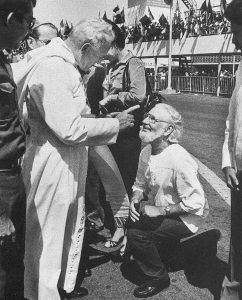
  1. A photograph of Pope John Paul II’s arrival in Managua, Nicaragua, on July 5, 1983. Fr. Ernesto Cardenal, who served in the Nicaraguan government as Minister of Culture, kneels before the Pope who is wagging his finger at him.
  2. One of my favorite cartoons, a four-panel Peanuts offering first published on August 9, 1976, in which the beagle Snoopy is writing a book of theology with the planned title “Has It Ever Occurred to You That You Might Be Wrong?”
  3. A generic Venn diagram

I will refer to these pictures later in the sermon.

Most exegeses of today’s Genesis text focus on the last sentence, “And [Abraham] believed the Lord; and the Lord reckoned it to him as righteousness,” and treat this story as one of faith. But, in all honesty, this is a story of doubt. It is the story of Abraham questioning God’s promise of a posterity; it is a story of tribalism and concern for bloodline, ethnicity, and inheritance.

We humans have a predisposition to tribalism, to congregating in social groupings of similar people. I was at a continuing education event this week in which one of the exercises explored the issue of economic segregation in our society; the facilitator asked each of us to describe the home in which we live and the neighborhood and community within which it is situated. One of the uniform characteristics was that no matter what our race or ethnic type might have been, our home neighborhoods were made up of people for the most part similar to ourselves. We in modern 21st Century America may not consciously organize ourselves into tribal groupings, but if we take time to look at ourselves honestly we will find that we do: like attracts like. As individuals we initially, we situate ourselves within nuclear families, then as we grow we broaden our social interactions to extended families, then clan, tribe, ethnic group, nation . . . .

This has been so from the beginning of time. Those of us who accept the notion of natural selection and evolution can look at our nearest genetically similar relatives, the apes and chimpanzees, and see this family and clan predilection. Those of us who accept the notion of divine handiwork can look to our traditional religious literature and see it in the stories of creation and God’s interactions with this chosen people. Today’s lesson from Genesis is a case in point.

God has chosen Abram, an elderly, childless man in the city of Ur to be “God’s guy,” so to speak. God has promised Abram that he will be the father of nations; in fact, God changes Abram’s name to “Abraham” which means “father of a multitude.” It is not, however, clear to Abraham how this will happen . . . and at the time of our reading, it hasn’t happened and Abraham is getting anxious. He challenges God with this very tribal sort of concern: “Who will inherit my estate? Will it be this slave, Eliezer of Damascus?”

Although our New Revised Standard version translates the ambiguous Hebrew to describe Eliezer as “a slave born in my house,” there is considerable scholarly debate over whether that is the meaning of the Hebrew text. Why would Eliezer be described as “of Damascus” if he had been born in Abraham’s home? The New International Version renders the description as “a servant in my household,” which is probably the better reading. Eliezer, rather than being a native of Abraham’s domestic unit, is from another city, Damascus, from another clan, another tribe, perhaps even a different ethnic group . . . yet according to the custom of the time, he would inherit his master’s fortune were Abraham to die childless. This is rank tribalism.

Snoopy-might-wrongGod’s response to Abraham’s challenge is to take Abraham outside and show him the stars and ask him, “Has it ever occurred to you that you might be wrong?” Well, God doesn’t, actually . . . but that’s what it boils down to. God’s response to Abraham is, “Thank again!”
Many social scientists today use the word “tribalism” to describe the fracturing of our society. The economist Robert Reich, for example, wrote an essay two and a half years ago entitled Tribalism Is Tearing America Apart. In it, Dr. Reich wrote:

America’s new tribalism can be seen most distinctly in its politics. Nowadays the members of one tribe . . . hold sharply different views and values than the members of the other . . . .

Each tribe has contrasting ideas about rights and freedoms . . . Each has its own totems . . . and taboos . . . . Each, its own demons . . . ; its own version of truth . . . ; and its own media that confirm its beliefs.

Five years ago, writer Wade Shepherd asserted, “The new tribal lines of America are not based on skin color, creed, geographic origin, or ethnicity, but on opinion, political position, and world view.” In other words, where Abraham’s tribalist concern (and subsequently that of the Old Testament Law) was about bloodline and ethnic purity, in the modern world our tribalist tendency centers on ideology and philosophical purity. As Shepherd put it, people “are selecting a singular point of view and isolating themselves within its barricade.” (The New American Tribalism) And although Reich and Shepherd were looking specifically at the situation in the U.S., their observations are valid around the world and have been for some time.

JP2-CardenalWhen Pope John Paul II scolded Fr. Cardenal upon the his arrival in Nicaragua, it was because Cardenal had collaborated with the Marxist Sandinistas and, after the Sandinista victory in 1979, he became their government’s Minister of Culture. His brother, Fr. Fernando Cardenal S.J. also worked with the Sandinista government in the Ministry of Education, directing a successful literacy campaign. There were a handful of other priests working in the government, as well.

They were all influenced by a school of thought called “liberation theology” which taught, among other things, that Christians could work alongside of non-Christians, even atheists, on the shared the goal of improving the lives of the poor. As Leonardo and Clodovis Boff, theologians from Brazil, put it, “The Church has the duty to act as agent of liberation.” (Salvation and Liberation, Robert R. Barr, trans., Orbis Books:New York: 1984)

The pope, however, with his personal background in Communist Poland, was intolerant of liberation theology and forbade Cardenal and the others to be involved in the Sandinista government. Ernesto Cardenal ignored this order, and thus the finger-wagging rebuke. Eventually, in February 1984 John Paul defrocked Cardenal because of his liberation theology, but that decision was overturned 30 years later in August 2114 by the current Pope Francis.

The picture thus illustrates for me the kind of tribalist insistence on ideological purity that is our modern equivalent of Abraham’s challenge to God. God’s response to Abraham’s tribalism was essentially, “Think again!” And God’s response to our tribalism, to our insistence on our own ideas, our own totems, our own demons, our own versions of the truth, is the same; it’s Snoopy’s question, “Has it ever occurred to you that you might be wrong?”

Which brings me to the reading from the Letter to the Hebrews and, especially, its first sentence which defines what faith is: “Faith is the assurance of things hoped for, the conviction of things not seen.” The rest of the lesson betrays why it was chosen in the lectionary; it exegetes the story of Abraham’s faith – the faith which came after the challenge of his doubt, after God had answered his tribalist concern about bloodlines and ethnicity and inheritance. But it’s that first sentence, the definition of faith that I think is the important part for us to consider.

The first part of the definition says faith is “the assurance of things hoped for.” The word translated as “assurance” is the Greek word hypostasis, a compound word – hypo meaning “under” and stasis meaning “to stand” – thus an “under standing.” But not in the sense of intellectual comprehension, rather in the literal, physical sense of something that “stands under,” that is foundational or bedrock. Thus, hypostasis “is something basic, something solid, something firm;” it “provides a place to stand from which one can hope.” (Amy L.B. Peeler, Wheaton College)

In one of the exercises at the continuing education seminar I was at this week we were given a large sheet of drawing paper and asked to draw a map or picture of our personal spiritual growth with a focus on that which provides stability in our lives, and then to describe our artwork to the group. Of course, nearly all of us attempted to depict God as the stable center, or unchanging goal or beginning, the whatever of our spiritual journeys, but one participant didn’t do that. In fact, he didn’t draw anything at all on his paper before standing in front of the group. He drew some squiggles and boxes and whatever on the sheet as he described his spiritual autobiography, but then said, “What is stable in all of this is the paper!” Brilliant! The paper represented the hypostasis, the bedrock standing under his life, the foundation of faith on which the details played out and changed and developed over time, and that is really true for all of us.

The second part of the definition is that faith is “the conviction of things not seen.” We hear that word “conviction” as synonymous with “belief” or “firm opinion,” but the Greek original, elegchos, carries the sense of “proof” or “evidence” such as would be presented in a court of law, such as would be used to convict a defendant in the dock. Faith is the evidence which establishes the existence of that which cannot be seen, the proof that there is an invisible foundation for one’s life, one’s beliefs and opinions, one’s actions. “What is stable in all of this is the paper!”

Our modern ideological tribalism insists that everyone in the tribe have the same life, the same beliefs, the same opinions, and undertake the same actions, but more than that it insists that anyone who differs to any significant degree in any of those things is outside the tribe. If we were to draw the tribes as circles on that sheet of paper, ideological tribalism insists that each tribe is a circle that does not even touch another, and yet we all know that that’s simply not true.

VennDiagramWe know that if there are tribal circles on that foundational paper, they are more like the circles on a Venn diagram, not only touching but overlapping. That was true of the ancient Hebrews; their tribalism might demand ethnic purity, but they never achieved it; the Old Testament demonstrates that, again and again! Modern ideological tribalism is no different. Ideologies, religious beliefs, political opinions differ in many ways, but in many others they share much in common; they overlap. People’s lives and opinions overlap, but ideological tribalism encourages us to hear only the differing opinions and blinds us to our similar lives.

During the Republican National Convention in Cleveland a man named Benjamin Mathes sat outside the convention center with a sign reading “Free Listening.” His goal was to engage convention goers on a personal level, to hear without judgment what they had to say about controversial topics. He was mostly disappointed, but on the Urban Confessional website he related listening to a woman who had a strong opinion on topic about which he disagreed vehemently.

He was asked, “How do you listen to someone with whom you disagree?” His answer is instructive: “It takes a lot of forgiveness, compassion, patience, and courage to listen in the face of disagreement. I could write pages on each of these principles, but let’s start with the one thing that makes forgiveness, compassion, patience, and courage possible. We must work to hear the person not just the opinion.” He then quoted the Christian rapper David Sherer who performs under the stage name Agape. In one of his pieces Agape sings, “Hear the biography, not the ideology.”

Mathes continues, “When someone has a point of view we find difficult to understand, disagreeable, or even offensive, we must look to the set of circumstances that person has experienced that resulted in that point of view. Get their story, their biography, and you’ll open up the real possibility of an understanding that transcends disagreement.”

Which brings me to today’s gospel lesson in which Jesus admonishes us to be like servants who keep their lamps lit for their master on his wedding night. I suspect that most people who hear this admonition are reminded of the parable of the five wise and five foolish bridesmaids, but this week what I remembered was Jesus command in Matthew’s Gospel, “Let your light shine before others, so that they may see your good works and give glory to your Father in heaven.” (Mt 5:16)

The purpose of the lit lamps is not simply to have lit lamps! It is to have light by which something can be done, something can be seen. The purpose of the servants’ lamps is to light the way for the bride and bridegroom, to illuminate the pathway and allow them to see the door. The purpose of keeping our lamps lit is so that people may see our “good works and give glory to [our] Father in heaven.” It is our works, our lives and actions, which matter, not our ideologies, or religious beliefs, or political opinions.

That was the point of Fr. Cardenal’s theology and belief that as a Christian he could work with Marxists, with atheists to improve the lives of the poor in Nicaragua. He saw the overlap of their circles on the political Venn diagram. Their ideologies differed, but their goals, their actions and works in regard to the poor, the point where their circles overlapped, did not. Underlying it all was the foundational bedrock of things hoped for, the evidence of things not yet seen. The pope apparently could not see that overlap; his disciplining of Fr. Cardenal and other Latin American priests came out of modern ideological tribalism, an insistence on purity of belief which made it impossible to work toward a common goal with someone of a differing opinion. Our modern American ideological tribalism is doing the same thing to us.

I look at that picture and just wish that someone, God or Snoopy or anyone, might have stepped in and just whispered in his Holiness’s ear, “Has it ever occurred to you that you might be wrong?” My prayer is that God might whisper that in everyone’s ears from time to time. It might shine some light on our ever changing Venn diagrams of ideological tribalism; it might remind us that the diagrams, the circles on the paper, move all the time and that “what is stable in all this is the paper,” the foundational bedrock, the “assurance of things hoped for, the conviction of things not seen.” Amen.

====================

A request to my readers: I’m trying to build the readership of this blog and I’d very much appreciate your help in doing so. If you find something here that is of value, please share it with others. If you are on Facebook, “like” the posts on your page so others can see them. If you are following me on Twitter, please “retweet” the notices of these meditations. If you have a blog of your own, please include mine in your links (a favor I will gladly reciprocate). Many thanks!

====================

Father Funston is the rector of St. Paul’s Episcopal Church, Medina, Ohio.

The Foolishness of Selfishness: Sermon for RCL Proper 13C (Pentecost 11, 31 July 2016)

====================

A homily offered by the Rev. Dr. C. Eric Funston on the Eleventh Sunday after Pentecost, July 31, 2016, to the people of St. Paul’s Episcopal Church, Medina, Ohio, where Fr. Funston is rector.

(The lessons for the day are Proper 13C of the Revised Common Lectionary: Ecclesiastes 1:2,12-14;2:18-23; Psalm 49:1-11; Colossians 3:1-11; and St. Luke 12:13-21. These lessons may be found at The Lectionary Page.)

====================

188347-barnSome translations of the Bible like to add to it. They insert explanatory headings and titles into the teachings of the authors of scripture or before the parables or important elements in Jesus’ life and teachings. The New International Version, for example, adds the title “The Parable of the Rich Fool” to our gospel text for today. It breaks up our reading from Ecclesiastes with three such headings: “Everything Is Meaningless,” “Wisdom Is Meaningless,” and “Toil Is Meaningless.” If you have a bible like that, take those titles and subheadings with a very large grain of salt because they are simply not accurate!
Even though Ecclesiastes is famous for its many repetitions of “Vanity of vanities! All is vanity!” and its apparent judgment that nearly all human activity is a “chasing after wind,” meaninglessness is not, in the end, the message of Qoheleth the Preacher, as the author of this book is sometimes called.

Elizabeth Webb, an Episcopal theologian who teaches at William Jewell College in Missouri, writes that to find meaninglessness and hopelessness to be the message of Ecclesiastes is to give in to a “profound lack of faith in the God who delights in our very being, and in whom we are to find our delight.” Such an understanding, she asserts, is far from the message this book has for us. Instead, she suggests, the message of the Preacher is that

The cure for despair and hopelessness, and the desire of God for human beings, is to find joy precisely in this wearying life. Several times (2:24-25; 3:12-13; 5:18) Qoheleth asserts that, when confronted with the apparent meaninglessness of life, the best we can do is enjoy ourselves – take joy in eating, drinking, even in our work. A particular joy is to be found in companionship with one another; two are better than one, he writes, “For if they fall, one will lift up the other” (4:9-10). We are to see such enjoyment in play, in work, and in relationships as gifts from God; indeed, enjoyment comes “from the hand of God” (2:24). (Webb)

It looks like that is exactly what the rich farmer in Jesus’ parable is trying to do! He has had the good fortune to enjoy a bumper crop and has great plenty, so he builds larger barns in which to store it and says to himself, “Soul, you have ample goods laid up for many years; relax, eat, drink, be merry.” That seems to be precisely the advise of Qoheleth, so why is this man called “a fool”? Indeed, it is God who so addresses him, so we ought to take this question seriously.

So let’s begin by acknowledging that this not a parable in which Jesus in anyway criticizes the accumulation of wealth. This parable does not, for example, have the moral overtones of lamenting the relative positions of rich and poor such as in the story of Lazarus and Dives (Lk 16:19–31), nor the outright spiritual condemnation of our Lord’s observation that “it is easier for a camel to go through the eye of a needle than for someone who is rich to enter the kingdom of God.” (Mt 19:24) No, the rich man is not foolish nor immoral simply because he is wealthy. Something very different is at play here.

This gospel lesson is a short one and the parable itself is only a couple of sentences long, so bear with me as I read it again and listen carefully to how Jesus tells the story:

“The land of a rich man produced abundantly. And he thought to himself, `What should I do, for I have no place to store my crops?’ Then he said, `I will do this: I will pull down my barns and build larger ones, and there I will store all my grain and my goods. And I will say to my soul, `Soul, you have ample goods laid up for many years; relax, eat, drink, be merry.'” (Lk 12:16-19)

It is at this point that God addresses the man as “You fool!” (v. 20)

So let’s have a short pop quiz. The man had a bumper crop and wondered what to do with it; with whom did he consult? Only himself. When he reached his decision to pull down his barns and build bigger ones, whose advice did he take? Only his own. And when he had stored his grain and his goods, with whom did he plan to enjoy them? Himself alone! “When the rich man talks in this parable, he talks only to himself, and the only person he refers to is himself.” (Johnson) He is, in the truest sense of the word, selfish. He has no thought of family or community; he has no thought of God. He’s all “I alone,” and it’s a fearful loneliness. Meda Stamper, a Presbyterian theologian in England, suggests that underlying this parable and many of Jesus’ other stories is a recognition that underlying excessive accumulation of goods and possessions is most often personal anxiety and fear.

It is said that the person who represents himself in court has a fool for a client; in the case of the man in this parable, the person who consults only himself on how to handle wealth has a fool for an advisee.

Elisabeth Johnson, a Lutheran who teaches theology in Cameroon, writes: “The rich farmer is a fool not because he is wealthy or because he saves for the future, but because he appears to live only for himself, and because he believes that he can secure his life with his abundant possessions.” Meda Stamper says the rich man, whom she calls “the barn guy,” is a fool because of his selfishness, because of his “earthbound, inward-looking way” of seeking happiness.

But “is ‘life’ to be equated with happiness?” Jesus’ First Century society exemplified by “the barn guy” certainly thought so, and so does our own. “Western society abounds with seductive invitations to happy lifestyle, usually promoting new products and promising that ‘good feeling’,” writes Australian theologian Bill Loader. “Markets manipulate the modes so that regular dissatisfactions can be exploited as people just must have the latest. For some the problem is blindly building bigger barns. For others it is building bigger wardrobes, possessing fancier gadgets, sporting flashier cars.” There is, says Loader, “a deep human anxiety about being worthwhile which reaches to the heart of the self.”

In his book Following Jesus in a Culture of Fear (Brazos Press: Grand Rapids, 2007), University of Scranton theologian Scott Bader-Saye, points out that the Christian faith has long understood this:

In this context [the 13th Century theologian Thomas] Aquinas uses the Greek term systole, from which we get our English term systolic (referring to the contracting of the heart muscle as it pumps blood into the arteries). Fear, for Aquinas, can cause a kind of contraction of the heart. By imagining some future evil, fear draws us in on ourselves so that we “extend” ourselves to “fewer things.” This, in turn, becomes a hindrance to Christian discipleship, which calls us not to contract but to expand, not to limit ourselves to a few things but to open ourselves charitably and generously to many things, not attack that which threatens us but to love even the enemy. (Page 28)

At the heart of the rich man’s foolishness is this selfish, “I alone” fear which asks the fearful question “Is my life worthwhile?”

The answer to that question, the courage which answers that fear, the wisdom which counters rich man’s foolishness is found in “a kind of Christian defiance which says: only in life towards God, a life participating in God’s life is peace. That will be a peace that weeps, knows anguish, sometimes does not know and does not have answers, but keeps believing in the worth God wants us to have and wants us to give and live towards others.” (Loader)

The rich man is foolish because, although he seems to follow Qoheleth’s advice in Ecclesiastes and prepares to “eat, drink, and be merry,” he stores up treasures for himself alone and not for his community or for God. The translators of scripture who insert titles and subheadings into scripture and suggest that Qoheleth’s message is one of meaninglessness are also foolish because nothing is further from the truth; yes, the Preacher decries wisdom, and toil, and accumulation of wealth as “vanities,” but in the end he says that the purpose of these things is to allow us, together in community, to eat, drink, and be merry, not as an act of selfishness, but as a communal act of faith toward God.

After telling them this parable, Jesus says to his listeners:

Consider the ravens: they neither sow nor reap, they have neither storehouse nor barn, and yet God feeds them. Of how much more value are you than the birds! And can any of you by worrying add a single hour to your span of life? If then you are not able to do so small a thing as that, why do you worry about the rest? Consider the lilies, how they grow: they neither toil nor spin; yet I tell you, even Solomon in all his glory was not clothed like one of these. But if God so clothes the grass of the field, which is alive today and tomorrow is thrown into the oven, how much more will he clothe you? (Lk 12:24-28)

It is the Father’s good pleasure to give the kingdom itself to us, his flock, in companionship with one another. So the way to collect treasure suitable for the kingdom isn’t, as Meda Stamper said, “the earthbound, inward-looking way of the barn guy but the soaring, beautiful way of the one who lives and loves generously, lavishly, and with joy.” Not foolishly, selfishly alone, but wisely, gratefully together. Amen.

====================

A request to my readers: I’m trying to build the readership of this blog and I’d very much appreciate your help in doing so. If you find something here that is of value, please share it with others. If you are on Facebook, “like” the posts on your page so others can see them. If you are following me on Twitter, please “retweet” the notices of these meditations. If you have a blog of your own, please include mine in your links (a favor I will gladly reciprocate). Many thanks!

====================

Father Funston is the rector of St. Paul’s Episcopal Church, Medina, Ohio.

Hospitality Creates Covenant: Sermon for Pentecost 9, Proper 11C (17 July 2016)

====================

A homily offered by the Rev. Dr. C. Eric Funston on the Ninth Sunday after Pentecost, July 17, 2016, to the people of St. Paul’s Episcopal Church, Medina, Ohio, where Fr. Funston is rector.

(The lessons for the day are Proper 11C of the Revised Common Lectionary: Genesis 18:1-10a; Psalm 15; Colossians 1:15-28; and St. Luke 10:38-42. These lessons may be found at The Lectionary Page.)

====================

Trinity-EHPSt. Paul’s Parish hosted the weekly “ice cream social” that accompanied the Community Band Concerts on Friday evening on the Town Square during summer. We’ve done this before although not for a few years (we tried for three years running to be host, but each Friday we were assigned during those years there was a thunderstorm and the event was rained out).

Whenever we do this, I always stress out about it! I’m just sure we won’t have enough pies, or enough ice cream, or enough volunteers . . . or that if we have all of those things, there won’t be enough people at the concert to buy all the pies and ice cream we have . . . or that it will be rained out. Although the latter has (as I said) proven to be the case more than once, none of the other worries has ever materialized. We always have more than enough pies baked by parishioners, more than sufficient ice cream, and enough volunteers that we trip over one another. And, when it doesn’t rain, the event is a great success, as it was on Friday. So why do I worry?

On Friday evening, Ray Sizemore and I worked the pay station, as we have done before, and during a lull in business he asked, “What are you preaching about on Sunday?” I borrowed a line from a good friend of whom I have often asked that question and gave a one-word answer, “Jesus.” But then I followed up that the theme is likely to be hospitality inasmuch as the Old Testament lesson is the tale we have just heard of Abraham entertaining the three angels of God at the “oaks of Mamre” and the Gospel lesson is the story of Mary and Martha of Bethany hosting Jesus at dinner.

And it has occurred to me that those pre-event worries I always experience are not unlike the pre-dinner-party jitters many hosts or hostesses may have (and that I certainly have) before receiving guests into our homes. We want to make a good show. And yet hospitality is not about us; it’s not about the host. Hospitality is about the other, the guest; it’s all about the guest.

The root of the word hospitality is the Latin word for “stranger,” which occurs in ancient literature in two forms: hospes or hostes. From hospes, we get our words “hospital,” “hospitable,” and “hospitality.” From hostes, we get our words “host,” “hostel,” or “hotel;” interestingly, we also get our words “hostile,” hostility,” and “host” meaning an army of enemies from the same root. Thus, two different ways to interact with “the stranger.” We can treat him or her as a guest or as an enemy, with hospitality or with hostility. The biblical value, as illustrated by our scripture readings today, is hospitality.

In the first story we have Abraham and Sarah, together with their servants (including Sarah’s handmaiden Hagar and her son by Abraham Ishmael) camped out at what our text calls “the oaks of Mamre.” The Hebrew actually says that the trees in question are not oaks but terebinths, a relative of the pistachio which was grown for its berry; the family is camped in an orchard owned by a friend of Abraham, Mamre the Amorite.

It is the hottest part of the day, the family are reclining in the shade of the pistachio trees, Abraham at the opening of his tent. This seems a reasonable thing for a 99-year-old man to do, especially one who may be recovering from a recent circumcision! If we read the Book of Genesis as telling Abraham’s story in chronological order and with events relatively close together, as the rabbis tell us we should, it was just a few verses before this story that Abraham, together with Ishmael and all the men of his household, has just (as Prof. Samuel Giere of Wartburg Seminary puts it) “had his foreskin lopped-off,” probably with a stone knife. Thus, it is somewhat surprising and perhaps meant to be a funny story that, upon seeing travelers approach at this out-of-the-ordinary, extremely hot time of day, this post-circumcision 99-year-old man leaps up and runs to greet them. (Commentary on Genesis 18:1-10a)

But this is no joke! The story underscores “the high value placed on hospitality in the Ancient Near East. * * * Suffice it to say, the physical mark of the covenant does not prevent Abraham from extending lavish hospitality: the washing of feet, rest, freshly baked cakes, a roasted calf, curds, and milk. Abraham assured that these guests were welcomed most properly.” (Ibid.)

Dennis Bratcher of the Christian Resource Institute reminds us:

Hospitality customs in the biblical world related to two distinct classes of people: the traveler and the resident alien. In most translations of the Bible, there is little attempt to try to separate the two. Even in the original Hebrew and Greek, different word are sometimes used interchangeably for the two groups. Either is called a stranger, one who does not belong to a particular community or group. Other terms applied to either or both are: foreigner, alien, sojourner, wayfarer, or gentile. In Israel, the law protected the resident alien, a foreigner who had settled permanently in the land. He could not own land, but he could participate in communal activities. The traveler, however, was extremely vulnerable. Only the force of the customs of hospitality protected him. (Travelers and Strangers: “Hospitality” in the Biblical World)

This particular story is part of a larger, novel-like narration about Abraham, toward the end of which in Chapter 21 of Genesis, we learn that Abraham “planted a tamarisk tree in Beer-sheba.” (v. 33) The Hebrew word for the tree in question is aishel which is made up of three Hebrew letters – aleph, shin, and lamed. These letters, the rabbis tell us, form an acronym for the three major components of hospitality: eating (achilah), drinking (shtiyah), and escorting (leviyah). Abraham’s memorial tree, dedicated to God, underscores the importance of hospitality, of the proper treatment of the stranger, the traveler, and the resident alien. (See Daniel Lasar, Southern Hospitality, Torah from Dixie)

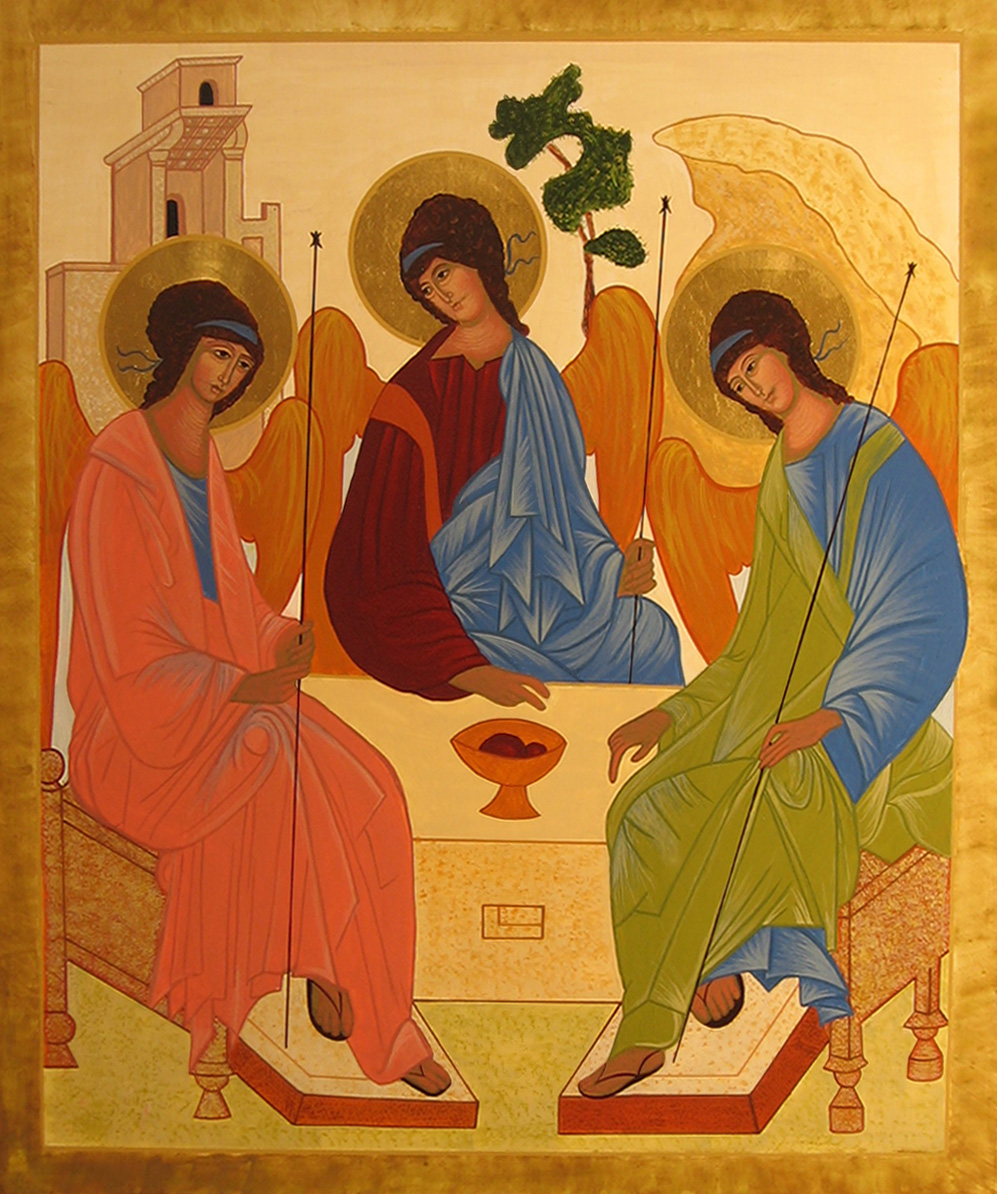
On the cover of your bulletin is a version of the 15th Century Russian monk Andrei Rublev’s beautifully composed icon of this story, sometimes referred to as “The Icon of the Holy Trinity.” The alternate title for the icon on is “The Hospitality of Abraham,” which highlights the effort Abraham puts into welcoming these strangers who turn out to be angels of God, or in Christian understanding, God’s own self in the three Persons of the Holy Trinity. Rublev’s point seems to be that hospitality is about the other, the guest, especially, it is about the guest who may be unknown to us. The writer of the Letter to the Hebrews reminds us, “Do not neglect to show hospitality to strangers, for by doing that some have entertained angels without knowing it.” (Heb 13:2)

In our Gospel story, Mary and Martha entertain the One whom we know and believe to be not merely an angel, but God Incarnate. In Jesus’ time, “hospitality was a highly valued and presumably widely practiced custom among pagans, Jews, and Christians. Hosts were expected to provide food, shelter, amenities, and protection to … traveling strangers, who [as the Letter to the Hebrews suggests] sometimes turned out to be gods incognito. In Greek culture, Zeus was celebrated as the god of hospitality, and the practice of hospitality (among other things) separated high Greek civilization from the ‘barbarians.’” (Mikeal C. Parsons, Commentary on Luke 10:38-42)

The story is a familiar one to us, rather simple in the telling: Martha extends hospitality to Jesus, bustling about doing all of the tasks of playing host. Mary, on the other hand, sits at Jesus feet and listens to his teachings. Martha, attending to the details of hospitality, complains that Mary has neglected those duties and asks Jesus to tell Mary to help her. Jesus responds that Mary has chosen what our translation calls “the better thing.”

However, many if not most New Testament scholars urge us, as Karoline Lewis of Luther Seminary does, to see this as a story not “about comparison but completion.” She says this story is not an invitation “to pit one expression of belief, of discipleship, of service, of vocation, against the other.” Rather, she argues that “this story has nothing to do with who is better and everything to do with who matters . . . this story is not preoccupied with proper acceptance and has everything to do with whom you accept.” “To favor Mary,” Lewis says, “is to say Jesus discounts service. Which, if you read the Gospel of Luke, makes no sense at all. And makes Jesus make no sense at all. To favor Martha would be to say service is all that matters. Clearly, both matter, if you read the Gospel of Luke carefully.” (Dear Working Preacher, “No Comparison”)

What both of our scriptural stories teach us is that hospitality is not about the things we do for the guest so much as it is about the gift of ourselves to the guest. Mikeal C. Parsons of Baylor University says of the Gospel story, and I would say the same is true of the Genesis reading, that its

social ethic provides a solid foundation for Christian habits and practices both within the community (we have unlimited responsibilities to fellow believers) and with the world (we are called to provide Christian hospitality to those unlike us in nationality, faith, or ethnicity and assistance to those in immediate crisis). Christians are called to extend hospitality both as hosts and guests, and to fellow believers and non-believers alike. Such hospitality calls for personal and intimate engagement in a way that an insipid value such as “tolerance” does not. We are not called simply to “tolerate” or “endure” those not like us; rather the ancient “Christian virtue” of hospitality demands that we engage and interact with the Other, whether we are guest or host. (Commentary on Luke 10:38-42)

The extension of hospitality in its three major component forms – eating, drinking, and escorting – is more than a token of friendship. Dr. Bratcher asserts that by extending hospitality we form “covenantal commitment” between ourselves and the other. ” One of the most despicable acts in the ancient world,” he reminds us, “was to eat with someone and then betray them” (Obadiah 7; Ps 41:9; John 13:18). This code of hospitality is the basis of that warning: “Do not neglect to show hospitality to strangers, for thereby some have entertained angels unawares” (Heb 13:2). You do not want to fail to form that covenant of hospitality with the angel of the Lord, with God’s own self.

It is that covenant relationship to which Paul refers when he writes in today’s epistle reading, “Christ Jesus is the image of the invisible God, the firstborn of all creation,” and “in him all the fullness of God was pleased to dwell, and through him God was pleased to reconcile to himself all things, whether on earth or in heaven.” In Jesus, God has extended a gracious hospitality to us, and it is now our calling to extend the same reconciling hospitality to others. Remember last week’s summary of the Law: “Love God. Love your neighbor. Change the world.”

I know it seems a small thing, no matter how much I may have worried and stressed out about it before hand, but that is what we did by hosting the ice cream social. We served about 300 pieces of pie and nine gallons of ice cream to the good people of Medina; we told them about our church and invited them to worship with us; we informed some teens about our youth group and we invited music lovers to attend one of our Brown Bag Concerts. If we brought a little light into just one person’s life, I think we did a good thing; I think we changed the world.

And that’s an important thing to remember this week as our region hosts one of the major political party conventions. There are going to be a lot of opportunities to disagree with people about politics; remember that they are also opportunities for hospitality. Remember, we are not called to argue or debate with people nor are we called to convince them of our view points; we are not called simply to “tolerate” those not like us nor are we called to “endure” them; rather, “the ancient ‘Christian virtue’ of hospitality demands that we engage and interact,” that we chose “the better thing,” that we enter into covenantal commitment. In the words of that simply stated summary, the code of hospitality bids us to love God, love our neighbor, and change the world.

Let us pray:

Gracious God, as we enter into the final months of the presidential election cycle, we pray in the spirit of St. Francis, that you would make us instruments of your peace, sowing seeds of merciful love and fierce hope; may we be servants of your holy, creative will, always and ever mindful that as you blessed Abraham, you bless us in order that we might be a blessing to the world; may we, like Abraham and Sarah, like Martha and Mary, offer gracious hospitality to those we welcome to our region as they assemble here this week at the Republican National Convention; guide their work and grant them and us wisdom, courage, a moral imagination, and the capacity for civility and grace to disagree without disrespect; in the name of Jesus who summarized your holy Law reminding us that the greatest commandments are to love you and to love all our neighbors as ourselves. Amen.

====================

A request to my readers: I’m trying to build the readership of this blog and I’d very much appreciate your help in doing so. If you find something here that is of value, please share it with others. If you are on Facebook, “like” the posts on your page so others can see them. If you are following me on Twitter, please “retweet” the notices of these meditations. If you have a blog of your own, please include mine in your links (a favor I will gladly reciprocate). Many thanks!

====================

Father Funston is the rector of St. Paul’s Episcopal Church, Medina, Ohio.

The Promenade and the Pokémons – A Reflection for the Parish Newsletter

====================

A “Rector’s Reflection” offered by the Rev. Dr. C. Eric Funston in the August 2016 issue of “The Epistle,” the newsletter of St. Paul’s Episcopal Church, Medina, Ohio, where Fr. Funston is rector.

====================

pokemongoSometime during the summer of 1969 (for the life of me, I can’t recall exactly when) and again in August of 1973, I was privileged to walk along the Promenade des Anglais on the Mediterranean waterfront of Nice. I was very young (or so I now consider myself to have been) and, on that second occasion, very much in love (or so I then considered myself) with a young French woman named Josienne. We quickly lost touch when that summer and my time as a student at the Sorbonne came to an end, but I have always fondly remembered her. Nice was her home town and, I suspect, is probably her home now. And I wonder, now, where she was on the evening of Bastille Day 2016. I pray she was not on the Promenade.

Political and religious violence is difficult to understand. One may understand having strong, even vehement, political opinions and beliefs, but the need some have to act out of their political or religious beliefs in ways that are harmful, often fatal, to others may seem unfathomable. We have seen a number of these incidents since the turning of the century. The new millennium began with the horrendous tragedy of September 11, 2001, and has continued with bombings, mass shootings, and multiple casualty events such as happened in Nice. And one need not even mention kidnappings and murders of hostages . . . and wars which seem never to end. What makes violence, especially lethal violence, so attractive?

Many theorists of religion have posited something called “the myth of redemptive violence.” Scholars who have written about this myth include Joseph Campbell, Rene Girard, and Carl Jung. Seminary professor Walter Wink wrote a short essay about “redemptive violence” in 1999 in which he wrote:

The belief that violence ”saves” is so successful because it doesn’t seem to be mythic in the least. Violence simply appears to be the nature of things. It’s what works. It seems inevitable, the last and, often, the first resort in conflicts. If a god is what you turn to when all else fails, violence certainly functions as a god. What people overlook, then, is the religious character of violence. It demands from its devotees an absolute obedience-unto-death.

This Myth of Redemptive Violence is the real myth of the modern world. It, and not Judaism or Christianity or Islam, is the dominant religion in our society today. When my children were small, we let them log an unconscionable amount of television, and I became fascinated with the mythic structure of cartoons. This was in the 1960s, when the ”death of God” theologians were being feted on talk shows, and secular humanity’s tolerance for religious myth and mystery were touted as having been exhausted. I began to examine the structure of cartoons, and found the same pattern repeated endlessly: an indestructible hero is doggedly opposed to an irreformable and equally indestructible villain. Nothing can kill the hero, though for the first three quarters of the comic strip or TV show he (rarely she) suffers grievously and appears hopelessly doomed, until miraculously, the hero breaks free, vanquishes the villain, and restores order until the next episode. Nothing finally destroys the villain or prevents his or her reappearance, whether the villain is soundly trounced, jailed, drowned, or shot into outer space.

* * *

The myth of redemptive violence is the simplest, laziest, most exciting, uncomplicated, irrational, and primitive depiction of evil the world has even known. Furthermore, its orientation toward evil is one into which virtually all modern children (boys especially) are socialised in the process of maturation. Children select this mythic structure because they have already been led, by culturally reinforced cues and role models, to resonate with its simplistic view of reality. Its presence everywhere is not the result of a conspiracy of Babylonian priests secretly buying up the mass media with Iraqi oil money, but a function of values endlessly reinforced by the Domination System. By making violence pleasurable, fascinating, and entertaining, the Powers are able to delude people into compliance with a system that is cheating them of their very lives. (Walter Wink, The Myth of Redemptive Violence, in The Bible in TransMission, Bible Society of the UK, Spring 1999)

As I contemplate the tragedy of Nice (and Baghdad and Istanbul and Dakha and Orlando and . . . the list goes on) and the pervasiveness of violence seen as a “solution,” the Medina Town Square is filled with teens and millennials (20-somethings and 30-somethings) staring at their smartphones chasing down cartoon monsters. Pokémon Go is an “augmented reality” game in which players capture, battle, and train virtual creatures, called Pokémons, which appear (through the game’s use of the GPS and camera on the player’s smartphone) superimposed upon the real world image on the player’s phone’s screen.

I’m not about to suggest that the violence done to Pokémons in Uptown Park is in any way like the slaughter of Bastille Day revelers or of Pulse nightclub patrons, nor that the players of Pokémon Go are equivalent to the Orlando shooter, the Baghdad bomber, or the Nice truck driver. Nonetheless, the coincident vision of people fighting and capturing “augmented reality” cartoon characters with other people fighting and killing human beings in “real reality” bothers me; the game augments my reality! Wink’s analysis of cartoons as reinforcing a “simplistic view of reality” thus promoting the myth of redemptive violence seems particularly applicable to the Pokémon Go phenomenon.

Maybe I’m over-reacting to the recent mass casualty attacks, particularly to what happened in Nice because of my fond memories of Josienne and the city itself, but maybe not. Jesus told us to “turn the other cheek” (Mt 5:39) and “put down [our] sword[s]” (Mt 26:52). I’m troubled by games that teach our children a different and contradictory lesson. My hope is that users and parents of users will play the game responsibly and always remember that it is a game, not real life; my hope is that the real life lessons of the Gospel will prevail in their lives.

I believe that video games and their progeny (like this new craze) are fine as far as they go, this one actually better than its predecessors since it gets people up and outside, actually getting some exercise as they walk to and through the parks and public spaces (including churches) that the game populates with its characters. Still, I think users and parents of users should be aware of the potential power and consequences of such games (and not just the danger of walking off a cliff, as two players did in Southern California)!

I am sure that you are as troubled by political and religious violence as I am. I hope that my struggles to articulate misgivings and concerns, to work through the attendant theologies, and to express the hope that is always present are helpful to you; it helps me to write them out.

====================

A request to my readers: I’m trying to build the readership of this blog and I’d very much appreciate your help in doing so. If you find something here that is of value, please share it with others. If you are on Facebook, “like” the posts on your page so others can see them. If you are following me on Twitter, please “retweet” the notices of these meditations. If you have a blog of your own, please include mine in your links (a favor I will gladly reciprocate). Many thanks!

====================

Father Funston is the rector of St. Paul’s Episcopal Church, Medina, Ohio.

Receiving Hospitality: Sermon for Pentecost 7, RCL Proper 9C (3 July 2016)

====================

A homily offered by the Rev. Dr. C. Eric Funston on the Seventh Sunday after Pentecost, July 3, 2016, to the people of St. Paul’s Episcopal Church, Medina, Ohio, where Fr. Funston is rector.

(The lessons for the day are Proper 9C of the Revised Common Lectionary: Isaiah 66:10-14; Psalm 66:1-8; Galatians 6:1-16; and St. Luke 10:1-11,16-20. These lessons may be found at The Lectionary Page.)

====================

Cajun Stir Fried Liver and Okra (Dirty Rice)Take just a quick look at me and you will know that I like to eat, probably too much. I like to cook; I like to entertain and have dinner parties; I like to go to dinner parties; I like to enjoy good restaurants; I like to go to not very good restaurants, too. I like to eat. So when I read a story in which Jesus tells his followers, not once but twice, to eat, it makes me happy. Except for the part where he tells us to not be picky. “Eat and drink whatever they provide . . . eat what is set before you.” (Lk 10:7,8) Yeah . . . but, Jesus, what if it’s, like, okra or liver or raw oysters?

I have a friend who is a priest in the Anglican Church of Canada. He grew up in the cattle country of Alberta, studied and was ordained in Ontario, and took his first solo assignment on the coast of Labrador, where he served three small seaside parishes. On his arrival, he was quickly invited to dinner by nearly every family in the three congregations and scheduled several of these in rapid succession. Unlike me, my friend loves seafood and was looking forward to feasting on the fresh catch from off the maritime coast. But instead of fresh seafood, his first hosts fed him canned beef. So did the next . . . and the next . . . and at the end of his first week in Labrador, a place known for its fishing industry, he’d had four canned beef dinners.

He also got a call from the bishop at the end of that first week and, when asked how things were going, expressed his disappointment in these dinner offerings. The bishop laughed out loud and then explained to my friend that his parishioners were fisher folk. Seafood was cheap and abundant for them, so that’s what they had every day at nearly every meal. For them, a special occasion, like dinner with the vicar, required a special meal and “special” to them meant beef; most of them couldn’t afford fresh meat from the butcher, so next best was a canned beef roast. The priest might be disappointed, but his parishioners were paying him the highest compliment of hospitality, serving what for them was the most festive of meals. “Eat whatever they provide; eat what is set before you.” Receive hospitality graciously for you do not know the circumstances from whence it is extended.

Paul K. Palumbo, a Lutheran missionary, has written of his similar experience among the poorest of the poor in Latin America:

[E]very time we sat to eat rice and beans, we received . . . a steady diet of honor and humility. To be served rice and beans prepared over a stone oven fueled by wood in dirt-floor houses on the only little table in the house was an honor. To be told the stories of our host families’ lives over the meal was an honor. To have the tiny house in which we were guests rearranged so that we might have a bedroom to ourselves was an honor. The tendency, of course, was to raise one objection or another, that what was set before us was not to our taste or, more typically among our group, that it was too much for a poor family to spend on rich North Americans. These objections were both true, perhaps, but for the sake of the gift and for the sake of learning to receive, it was important to eat what was set before us. (Texts in Context: Eating What Is Set before You)

And that, I think, is the point of this admonition that Jesus gives the 70 (or the 72) not once but twice, to eat what they are provided; they are to learn to receive. They had a lot to give, teaching and admonition, the good news of the nearness of the kingdom of heaven, healing of infirmities both physical and spiritual, but they also had to learn, learn to receive.

That’s a very hard lesson to learn. As some of you know, my wife was hospitalized for several days week before last and being with her in the hospital reminded me of my own experiences being a patient, and how difficult that is! You’re lying in bed (a strange electrical bed all sorts of controls that, even if you can reach them, you can’t figure out). Usually you’re tethered by a needle in your arm to a bag of something hanging out of reach behind your head; you may be wired up to some sort of monitor or connected by a plastic tube to an oxygen valve in the wall. You can’t even get out of bed without assistance, let alone do anything else. You can’t just go to the kitchen and make yourself a meal or a late-night TV snack. You can’t wander down the hall to find something to read in the next room. You can’t do anything for yourself. You must receive the ministrations, the ministry of others. And some of us are just not very good at that because we’ve never learned how to do it. We hear Paul tell the Galatians, “Bear one another’s burdens,” and what we understand is that we must be the burden-bearers; we seldom, if ever, understand that sometimes we must receive the gift of others bearing our burdens.

This is why, instead of sending his messengers out fully equipped and prepared, Jesus sends them with “no purse, no bag, [not even] sandals,” (Lk 10:4) and instructs them to “eat whatever is put before you.” In order to learn to receive, we have to eat whatever we are served, even if it is our own sense of self-sufficiency; we have to swallow our pride and in doing so we receive a precious gift.

Melissa Bane Sevier is a Presbyterian pastor who writes of her experience traveling abroad as an illustration of this gospel passage:

Jesus tells the seventy to receive whatever hospitality is offered. That’s odd. We expect to be told to share hospitality, not to receive it. How happy we are when someone thanks us for a nice meal or is grateful to have a place to stay. When the worshiping community extends hospitality to the stranger, the person on the margins, the immigrant, that community finds itself warmed and renewed by the act of giving.

And yet, receiving is also a gift to oneself and to the giver. Some of the most memorable travel moments I’ve ever experienced happened in some of the poorest places, when my friends and I were offered a simple meal of homemade tortillas, bananas and papayas picked from village trees, and ice cold Coke bought from the local tienda.

Thousands of miles from home, we were served a meal that transcended language and culture with its hospitality and welcome. It was more than we could have asked or expected, and it made us feel at home.

Jesus knew what he was doing when he sent out the seventy in twos. We don’t have to go to a foreign country to be on the journey together. We share memories and adventures. Sometimes we remember the wolves, and can laugh together at the ones who were mean but not really dangerous. We encourage each other to watch out for the truly alarming. But mostly, we talk about those lovely situations where we were given incredible hospitality, where we were welcomed. Sometimes it is hard for us to accept those gifts of hospitality, for we have been trained to give rather than to receive. But Jesus wanted the seventy to know the joy of receiving. (Melissa Bane Sevier, Two-Way Blessing)

And why do we have to learn this joy, this lesson of receiving from others?

Do you remember the old television show All In The Family. The main character, Archie Bunker, was fond of saying, “As the Good Book says . . . .” and then he would quote Poor Richard’s Almanac, or an Aesop’s Fable, or Ann Landers, or any number of other sources, but never anything that actually came out of Scripture. How many of us grew up believing that “God helps those who help themselves” was straight out of the Bible? Well . . . it isn’t! And, in fact, it’s diametrically opposed to the lessons of Scripture! “There is no king that can be saved by a mighty army; a strong man is not delivered by his great strength,” says the Psalmist (33:16; BCP version). In Proverbs we read, “Trust in the Lord with all your heart, and do not rely on your own insight.” (3:5, NRS) And again the Psalmist says, “It is better to rely on the Lord than to put any trust in flesh,” (118:8, BCP version) even – or perhaps especially – our own!

We have to give up our sense of self-sufficiency; we have to learn to receive the ministry of others so that we can receive the ministry of God, so that we can trust in the Lord with all our heart. “For thus says the Lord:

I will extend prosperity to [Jerusalem] like a river,
and the wealth of the nations like an overflowing stream;
and you shall nurse and be carried on her arm,
and dandled on her knees.
As a mother comforts her child,
so I will comfort you;
you shall be comforted in Jerusalem.
You shall see, and your heart shall rejoice;
your bodies shall flourish like the grass . . . .
(Is 66:12-13)

Theologian Elizabeth Webb (an Episcopalian, by the way) writes about this passage from the Book of Isaiah, echoing Pastor Sevier’s observation that the joy of receiving hospitality “makes us feel at home:”

The comfort that Mother God provides for her people is the comfort of home; restoring the people to the place they belong, rebuilding their ruins, and washing them in riches and security (see also 49:13, 51:13, 52:9, and 54:11). Under God’s nurturing care, the very bodies and spirits of God’s people receive restoration (verse 14).

The word translated “bodies” in the NRSV should more properly be translated “bones,” which speaks to the sense that despair can settle in and take over our very essence, and which emphasizes that God can reach in and restore that essence to joy. The home in this world that God provides for us is within the circle of God’s own arms, and in that place the tired old bones of humanity flourish again. Deep within our bones we are weary and broken, and deep within our bones God’s nurturing love reaches in and restores.

Joy and comfort. Milk and water. Weary bones refreshed and restored. In the midst of the thundering of condemnation and retribution, it is this quiet passage of maternal care and human delight that gestures more particularly to the presence of God with God’s people that their bone-tired bodies and spirits might flourish again, like the grass. (Elizabeth Webb, Commentary on Isaiah 66:10-14)

It is precisely that sort of internal transformation that Paul writes about in today’s passage from the Letter to the Galatians when he says that, by “the cross of our Lord Jesus Christ, . . . the world has been crucified to me, and I to the world.” In their book The First Paul: Reclaiming the Radical Visionary (HarperCollins:New York, 2010), Marcus J. Borg and John Dominic Crossan, argue that what Paul means is that he has left behind “the world of imperial normalcy,” the world characterized by “‘domination systems,’ societies ruled by a few who used their power, wealth, and ‘wisdom’ to shape the social system in their own self-interest.” (Pg 136)

In its place, transformed by God’s maternal hospitality in Jesus, Paul embarks on what Prof. Sarah Henrich calls the “crazy project” of imagining a world where human beings “eschew the measurements of value used in the everyday world,” where people “devote themselves to one another’s well being, confident that there would be others who would care for them.” In other words, Paul urges the Galatians and us to imagine (and create!) a world where we have learned the lesson of receiving hospitality, where we know how to accept the ministration and the ministry of others, and thus can receive the maternal hospitality of God.

Henrich writes:

Perhaps the best way to fire our imaginations and live in accord with [Paul’s vision] requires us to do the burden bearing more graciously. That is, we are privileged to hear one another’s dreams and desires, to continuously extend the tables at which we sit, the suppers we call Holy, to make room for folk who will see gifts and challenges that surprise us. In listening, in surprise, in hospitality for a moment we catch a richer glimpse of God’s reality and find the energy of the Spirit, lest we grow weary. (Sarah Henrich, Commentary on Galatians 6:[1-6]7-16)

“Carry no purse, no bag, no sandals.” When you enter a house, say first “Peace to this house!” “Eat and drink what is provided; eat what is set before you.” It may be okra or oysters or canned beef, but whatever it is it will be more than you could have asked or expected, and it will make you feel at home. Receive from others the gift of their bearing your burdens, and you will know the comfort that Mother God provides for her people. “As a mother comforts her child, so [God] will comfort you;” your bone-tired body and spirit will flourish again; and your name will be written in heaven. Amen.

(Note: The accompanying illustration is a plate of Cajun “Dirty, Dirty Rice” which includes sautéed pork liver and okra. This is definitely not something I would ever want to eat, but my readers may be interested. The recipe can be found here.)

====================

A request to my readers: I’m trying to build the readership of this blog and I’d very much appreciate your help in doing so. If you find something here that is of value, please share it with others. If you are on Facebook, “like” the posts on your page so others can see them. If you are following me on Twitter, please “retweet” the notices of these meditations. If you have a blog of your own, please include mine in your links (a favor I will gladly reciprocate). Many thanks!

====================

Father Funston is the rector of St. Paul’s Episcopal Church, Medina, Ohio.

A Meditation on Mortality (for the parish newsletter)

====================

A “Rector’s Reflection” offered by the Rev. Dr. C. Eric Funston in the July 2016 issue of “The Epistle,” the newsletter of St. Paul’s Episcopal Church, Medina, Ohio, where Fr. Funston is rector.

====================

firefliesThe week of the summer solstice was an interesting one in the Funston household.

The night of the solstice there was what is known as a “strawberry moon,” a phenomenon which only occurs when a full moon coincides with the northern hemisphere’s summer solstice, longest day of the year. The moon takes on an amber or pinkish glow which astronomers explain is caused by the setting sun’s positioning, affecting the angle at which the sun’s rays pass through Earth’s atmosphere and, thus, the apparent coloration of the moon.

The name “strawberry moon” was given by the Native American Algonquin tribes of northern Michigan and Canada. They believed that a full moon in June signified that it was time to start picking fruits, including strawberries. It is also known as the Rose, Hot, or Honey Moon (the latter being the origin of the name given a newly married couple’s post-wedding get-away). The last time there was a “strawberry moon” was during the so-called “summer of love” in 1967.

Biblically, the summer solstice and the nearest full moon are associated with punishment and death. It was taught by the rabbis in their commentaries on Scripture that this was the time when Moses disobeyed God and was told he could not enter the Promised Land with the rest of the Hebrews, but would die instead.

I made note of the “strawberry moon” as I took Dudley for his last walk of the evening before going to bed. I also noticed a large number of fireflies winking in the trees and lawns of our neighborhood. Fireflies always remind me of two things: summers spent with my grandparents in Winfield, Kansas, during the 1950s, and burying my late brother in 1993, also in Winfield which was his home town. The night after his burial in late June, the fireflies were more numerous and more active than I had ever seen them before, nor have I ever seen that many since!

So the “strawberry moon” and the fireflies were, in a sense, a reminder of mortality. The next day, I was scheduled to visit a urologist at the request of my primary care physician. The reason: elevated prostate specific antigen levels in my blood. “Not a big deal,” I thought. I have always had a high PSA level. However, after taking my history, asking a lot of personal questions, and conducting an examination, the urologist told me that I have the classic signs and symptoms of prostate cancer and referred me for a biopsy. That will happen later this month.

“Still,” I thought, “No big deal.” Prostate cancer is slow growing and can often be left untreated without any real impact on a man’s health. However, given my family history of various sorts of cancers, it’s a matter of some (though not a lot of) concern.

I thought that would be the big medical news of the day until late that night. I had gone to bed and was sound asleep when Evie woke me up gasping for breath and obviously very anxious. We headed for the hospital where, eventually, it was discovered that she had two pulmonary emboli, blood clots, in her left lung. (See note below.)

That was yesterday. As I write, she is still in the hospital and will be for a few days while the doctors try to determine how and why she developed these clots.

So in the course of 24 hours, we have both been reminded of our own mortality and, I have to say, I think we’re taking it rather well. Several years ago, the New York Times Magazine ran an article about how we modern human beings face the reality of our own mortality (Facing Your Own Mortality, 9 Oct 1988).

The article contrasted a 60-year-old woman “stricken by two life-threatening ailments – insulin-dependent diabetes and breast cancer” – with a man in his 60s, a doctor “crippled by amyotrophic lateral sclerosis – Lou Gehrig’s disease.”

The woman, the author wrote, “stares death down every day. Despite the odds against her, she accepts the possibility of her imminent death with astonishing serenity. When she was diagnosed with cancer, she did not ask, as many patients do, ‘Why me?’ Instead, she thought, ‘Why not me? Rather than crying about your affliction, you have to live every minute you have as a gift.’”

The man, on the other hand, was described as “unable to overcome his anger at being crippled.” He “refused to acknowledge his encroaching impairment. He became hostile toward those around him. As his condition forced him to give up his practice, his anger often exploded. His wife, his full-time caretaker, bears the brunt of his fury. She has confided to friends with great sadness that she awaits the time when both of them will be released from the prison of terminal illness.”

What is it that makes it possible for some of us to face our own deaths with equanimity while others become anxious and angry? I believe the answer is faith, not necessarily the Christian (or even religious) faith, but that sense that life has meaning and that there is a greater purpose in the universe than simply our own meagre existence.

As I write on June 23 for the July issue of The Epistle, today’s Daily Office Lectionary texts included a selection from the Letter to the Romans in which Paul writes, “Suffering produces endurance, and endurance produces character, and character produces hope, and hope does not disappoint us, be-cause God’s love has been poured into our hearts through the Holy Spirit that has been given to us.” (Rom 5:3b-5) That, it seems to me, is the essence of faith, the sure and certain hope that (as Paul writes later in the same letter) “all things work together for good for those who love God.” (8:28)

I used to have a congregant (in another parish) who frequently asked me, “What will happen when I die?” I would answer her, “Martha, I don’t know and I don’t care. I don’t know because I haven’t been there yet; I don’t care because there’s not much I can do about it.” Jesus asked his followers, “Can any of you by worrying add a single hour to your span of life?” (Matt 6:27) He clearly didn’t think so, for his follow up instruction was, “Do not worry about tomorrow, for tomorrow will bring worries of its own. Today’s trouble is enough for today.”

It is that attitude of faith, to live for today and not worry about tomorrow, that I think allows some to face death with calmness and composure. I commend it to you.

Live for today! Enjoy the summer!

(Note: Yesterday, the day after this was written, I was told by the attending physician that Evie had “a lot of clots, so many clots” in both her lungs. He said that if I hadn’t brought her to the emergency room on Wednesday night, but had opted to wait until morning, she would probably have died. So, take it from me, don’t dismiss even a little unexplained shortness of breath! – Return to Text)

====================

A request to my readers: I’m trying to build the readership of this blog and I’d very much appreciate your help in doing so. If you find something here that is of value, please share it with others. If you are on Facebook, “like” the posts on your page so others can see them. If you are following me on Twitter, please “retweet” the notices of these meditations. If you have a blog of your own, please include mine in your links (a favor I will gladly reciprocate). Many thanks!

====================

Father Funston is the rector of St. Paul’s Episcopal Church, Medina, Ohio.

A Priest (And My Demons) – Homily for Proper 7, RCL Year C (19 June 2016)

====================

A homily offered by the Rev. Dr. C. Eric Funston on the Fifth Sunday after Pentecost, June 19, 2016, to the people of St. Paul’s Episcopal Church, Medina, Ohio, where Fr. Funston is rector.

(The lessons for the day are Proper 7C of the Revised Common Lectionary: Isaiah 65:1-9; Psalm 22:18-27; Galatians 3:23-29; and St. Luke 8:26-39. These lessons may be found at The Lectionary Page.)

====================

EricOrangeStoleTwenty-four years and 363 days ago I was made a priest; some what more than a year more than that, I have been a deacon. I have been in parish ministry for more than 26 years and on Tuesday I will celebrate the 25th anniversary of my ordination to the Sacred Prebyterate.

I am good at what I do. I know well how to craft liturgy; I take care in what I do and the choices I make in creating the outline of a worship service, and I do a good job. I run a tight ship when it comes to parish administration and management of the church’s resources.

I have been a Diocesan Chancellor, and served on Diocesan Councils, Standing Committees, Commissions on Ministry, Constitution and Canons Committees, and other interim bodies of the church. I have been a deputy to General Convention, an alternate Deputy, and a participant in the church’s deliberative and legislative processes.

I have shepherded aspirants through the church’s ordination process and mentored the newly ordained and the newly assigned; one of my apprentices is now the rector of a major parish in this diocese; another is now bishop in an important and historical diocese; my own son is rector of an important congregation in his diocese.

People tell me I preach a pretty good sermon, though sometimes I don’t recognize the homilies they tell me I have delivered. They tell me I’m good with death, that they want me to officiate at their funerals when the time comes. Others compliment me on the beauty of weddings at which I preside.

I’m a good priest.

And yet I have my demons. Visiting someone in the hospital, or sitting with a family planning a funeral, or counseling a couple prepare for marriage (or a couple in the midst of a marriage possibly coming to an end) … I’m never sure that I have said the right thing. In fact, I’m often positive that I’ve been a complete failure, that nothing I’ve said has made any difference, except perhaps to have made things worse.

Sometimes I get cards, or letters, or emails thanking me for my ministry. I treasure those; I keep them in a special drawer in my desk. More often, I get letters and emails telling me how I have failed, how someone is disappointed in what I have said or done or failed to say or haven’t done, or (worse) I am forwarded a note or email telling someone else like a church warden or a vestry member what a disappointment the rector is.

I don’t keep those – I don’t have to; every single one of them is etched into my consciousness, engraved on my heart; every single one of them hurts as much today as when first read however recent or long ago it may have been. Every one of them is a constant reminder of how I have failed to live up to my ordination vows.

But I’m a good priest; I know I’m a good priest.

I love the people of my parish – you. Sometimes, I don’t like some of you very much, but I love you. I pray for you every morning; I lay awake at night worrying about you; I cry myself to sleep when I feel that I have failed you.

I love you, but I don’t do what I do for you. And when I fail you, when I don’t live up to you expectations, when I preach a word that discomfits you and you push back … it isn’t you to whom I answer. It is the one who sets me free from my demons.

Jesus says to me, as he said Gerasene demoniac, “What is your name?” And demons begin to name themselves, “Parishioner complaint. Parishioner disappointment. Self-criticism.” And then, of course, there’s “Disappointing son. Inadequate father. Second-rate spouse. Poor excuse for an attorney.” The demons are legion. And Jesus gives me permission to let go of them, and gives them permission to leave. Because what I do, I do for him. I do what I do for God. I don’t know where those names, those demons go … maybe into a herd of swine; I don’t know. They go away … sometimes they seem to come back, but mostly they go away.

And sometimes I just want to go away, too; I want to go away with Jesus. I beg that I might just go away and be with him; but Jesus won’t let me. He says to me, “Return to your home, and declare how much God has done for you.” So I preach. I preach about gun violence; I preach about mental health; I preach about community, and fellowship, and love; and I preach about what I read in the newspaper and what I read in the Scriptures. But always, no matter what the subject may seem to be, I preach about how much Jesus has done for me. For 25 years.

For 25 years. And I’m grateful to Jesus who called me to this ministry, who has sustains me in this vocation, and who frees me from my demons. Because of him, I’m a good priest.

====================

A request to my readers: I’m trying to build the readership of this blog and I’d very much appreciate your help in doing so. If you find something here that is of value, please share it with others. If you are on Facebook, “like” the posts on your page so others can see them. If you are following me on Twitter, please “retweet” the notices of these meditations. If you have a blog of your own, please include mine in your links (a favor I will gladly reciprocate). Many thanks!

====================

Father Funston is the rector of St. Paul’s Episcopal Church, Medina, Ohio.

« Older posts Newer posts »