Occasional thoughts of an Anglican Episcopal priest

Category: Ministry (Page 33 of 59)

Sabbath with Frank Lee – From the Daily Office – May 23, 2014

From the Book of Leviticus:

For six days shall work be done; but the seventh day is a sabbath of complete rest, a holy convocation; you shall do no work: it is a sabbath to the Lord throughout your settlements.

(From the Daily Office Lectionary – Leviticus 23:3 (NRSV) – May 23, 2014)

Rest Area Highway SignI am an absolutely faithful believer in the biblical concept of sabbath. I am also one of its worst offenders. No matter what day I choose to be my day “away from the office,” at least 50% of the time I will end up doing something work related. Today, for example, a Friday, is supposed to be my day off. What will I be doing? Giving my time to the church as a volunteer working on the refurbishment of the undercroft which is being converted to office space (laying peel-and-stick carpet tiles, to be precise). — This raises the interesting issue: “Can one volunteer at one’s place of employment?” I suspect the answer is “No” because whenever I am on the church property or in the church building I am “the rector,” not just some Joe who’s helping out.

If there isn’t something of that nature to do, there are (potentially) wedding rehearsals, Friday evening social events, Good Fridays (OK, only one of those each year), and other things that interfere. But is any other day a good day for clergy to take off? If there is, I haven’t found it in 24 years of ordained ministry. No matter what day I have selected as my “day off,” it has been subject to interruption and disruption. So keeping sabbath is rather difficult to do. One has to be very intentional about it, which is why God enjoined it on everyone in the Hebrew community in the Law of Moses. Left each to our own devices, we fail to do it; if everyone is doing so, one has lots of community support.

Several years ago I had a colleague whose appointment book a couple of times each week included some time with “Frank Lee.” Her parish staff were told in no uncertain terms that when she was away for her meeting with Mr. Lee she was not to be called, ever. Nothing was important enough to disturb her time with him. After a couple of years working with her, the parish secretary became very curious as to who this Mr. Lee was. He wasn’t on the parish rolls; he never came to the church office; he never called; the rector never called him. Who was this strange man the rector would go away to spend a few hours with?

My friend informed her that Frank Lee was nobody. Not a nobody, but quite truthfully nobody. He didn’t exist. He was simply a place marker for some inviolable personal sabbath time. His name was derived from a famous movie line: “Frank Lee, my dear, I don’t give a damn.” My colleague had determined that her sabbath time was so important that she truthfully did not give a damn about anything else during those few hours.

The parish secretary breathed a sigh of relief, my friend says. She’d thought the rector was having an affair! Which is both funny and sad. It’s sad that a priest has to resort to subterfuge of this sort to get that personal sabbath time; it’s sad that taking it could lead to suspicion of infidelity.

I’m not able to sustain the effort needed to maintain a “Frank Lee” of my own. Like most clergy, I’m too willing to set aside personal time to attend to the needs of my parishioners, the diocese, the clergy association, or whatever. I don’t say “No” when and as often as I should and then I end up resenting my lack of personal time. I know that this is common among parish priests and pastors because I hear my colleagues saying the same things when we get together for coffee, conversation, and mutual support.

It’s funny, though, that in those conversations no one calls anyone to account! As supportive colleagues in ministry what we ought to be doing is not commiserating with one another; we ought to be supporting one another in claiming those times with Frank Lee and strongly, forcefully encouraging one another to do so. As the ancient Hebrew community of old supported (and Jewish communities of today support) one another in honoring the sabbath, we should support and encourage one another to take our personal sabbath times. (Our denominational judicatories should do the same, but often do not.)

So, brother and sister priests and pastors, get some time of complete rest, hold for yourself a holy convocation, do no work, take personal sabbath time, get together with Frank Lee!

====================

A request to my readers: I’m trying to build the readership of this blog and I’d very much appreciate your help in doing so. If you find something here that is of value, please share it with others. If you are on Facebook, “like” the posts on your page so others can see them. If you are following me on Twitter, please “retweet” the notices of these meditations. If you have a blog of your own, please include mine in your links (a favor I will gladly reciprocate). Many thanks!

====================

Father Funston is the rector of St. Paul’s Episcopal Church, Medina, Ohio.
I’m Done with the Cassock-Alb – From the Daily Office – May 22, 2014

From Gospel according to Matthew:

Why do you worry about clothing? Consider the lilies of the field, how they grow; they neither toil nor spin, yet I tell you, even Solomon in all his glory was not clothed like one of these. * * * Do not worry, saying . . . “What will we wear?”

(From the Daily Office Lectionary – Matthew 6:28-29,31 (NRSV) – May 22, 2014)

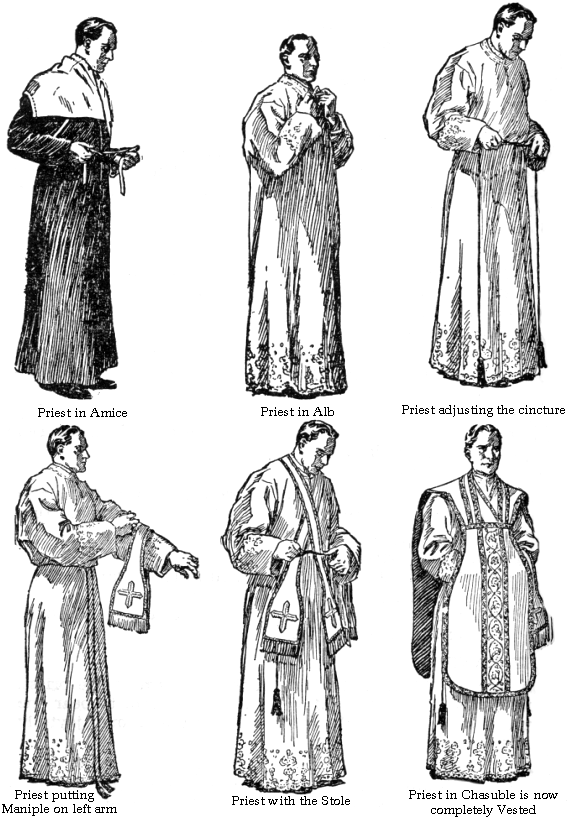
Priest Vesting for Mass“In essentials unity, in non-essentials liberty, in all things charity.” This aphorism has been variously attributed to St. Augustine of Hippo, to Menno Simons the spiritual father of the Mennonites and the Amish, to Richard Baxter of the Moravians, and various others.

To the best of my knowledge, it has never been attributed to an Anglican or an Episcopalian. And with good reason! Witness a current dust-up over the cassock-alb.

Yesterday, a colleague and fellow ecclesiastical blogger posted a humorous but serious entry entitled Cassock Albs Are Destroying the Church. Cassock-albs are a modern bit of liturgical vesture which combine the virtues of two medieval garments (the cassock and the alb) and permit the abandonment of a third (the amice), which is rendered unnecessary. They have become ubiquitous since their introduction several decades ago; nearly every church supply company offers one or more versions of the garment. They are what I wear and what our altar servers and liturgical assistants wear, as well.

My colleague’s opinion piece argues that the cassock-alb symbolizes sloppiness, laziness, haste, and lack of care in preparation for worship; calling it “the strip mall of vestments,” he decried the cassock-alb as “an innovation for the sake of comfort that too much resembles other short-cuts we might take in our spiritual and devotional life.” His Facebook notice of this essay resulted in a slurry of posts either agreeing with him (most did since he seems to be followed mostly by a high church Anglo-Catholic crowd many of whom cherish many things about the ritual of an earlier era in the church) or arguing the merits of the cassock-alb (not many modernists, however).

I considered writing a humorous point-by-point rebuttal, but decided not to for a variety of reasons including lack of time and my conviction that debating things like vestments is one of the shortcomings of our tradition. As I have often said, we Anglicans and Episcopalians get our knickers in a twist over really very silly things; there was a time when members of this church excommunicated each other because one or the other either put candles on the altar or didn’t. (In the 1800s, at least one bishop-elect — James DeKoven — failed to receive sufficient canonical consents because of his support of candles and other elements of catholic ritual in the celebration of Holy Communion.)

In the past four decades we have fought about the rather more serious issues of prayer book revision, ordination of women, and the full inclusion of homosexual and transgendered persons, but we have also wrangled over such ridiculous issues as which direction clergy should face while leading worship, whether communicants should stand or kneel, and what position a person’s hands should be in while at prayer. It occurred to me that if anything is “destroying the church,” it is our inability to agree to disagree, to treat as irrelevant and unworthy of debate those minor things on which we differ and concentrate on those matters central to the faith on which we agree. So, I decided not to write in the cassock-alb’s defense.

Indeed, even though I posted a comment or two on my colleague’s Facebook entry, I simultaneously thought what that string of remarks about the merits or demerits of a bit of priestly vesture would look like to a non-church member. If I were a non-Christian (or even a non-Episcopalian) happening upon that conversation (and I’m sure each of the participants has non-Christian friends who might have taken a look at it; I know I do), I would have shaken my head in disbelief at the pettiness of it. If this is what Episcopalians consider important enough to argue about vehemently, I would want nothing to do with those people! So I determined to add nothing further to the evidence that Episcopalians fail to allow liberty in non-essentials and certainly do not practice charity in all things (especially not in regard to vestments and ritual).

Then I came upon today’s Daily Office gospel lesson and I am encouraged to say at least one more thing about the cassock-alb debate. In this lesson from Matthew, Jesus tells his followers, “Do not worry about your life, what you will eat or what you will drink, or about your body, what you will wear.” (Mt 6:25) Jesus goes on to assure his hearers that God will provide. I’m not convinced, however, that Jesus is referring simply to concern about food and clothing, in general. Certainly, I don’t believe that he is telling them to do nothing about taking care of their own health and well-being; on several occasions he advised his disciples to attend to preparations, to be alert, to take care of that which God has entrusted to them, so this is not a man to instruct people to abandon common sense self-care! What I think he is referring to are the ritual concerns about food and clothing in the Law of Moses, rituals that had become overly important in the teachings of the Pharisees, for example.

Most non-Jewish people are aware of kosher restrictions on diet which derive from the Torah: not to eat pork or shellfish, not to eat red meat with dairy, and so forth. Many may not be aware that there are ritual rules regarding clothing, as well. For example, “You shall not wear clothes made of wool and linen woven together.” (Dt 22:11) Some of these rules came to be applied specifically to ritual clothing, the tallit (prayer shawl), for example: “Speak to the Israelites, and tell them to make fringes on the corners of their garments throughout their generations and to put a blue cord on the fringe at each corner.” (Num 15:38)

I believe it is overweening concern for these ritual niceties of food and clothing that Jesus is criticizing in his admonition not to worry about what one will eat or what one will wear. Sometime later, Jesus did so explicitly, condemning the scribes and Pharisees because “they do all their deeds to be seen by others; for they make their phylacteries broad and their fringes long.” (Mt 23:5) Cassocks, albs, amices, surplices, and cassock-albs are the tallits, the phylactories, and the fringes of our tradition. Our concerns about them are very much the same as the Pharisees’ concerns, and I suspect that Jesus is just about as impressed with our vestment debates as he was with theirs.

So I’m done with the cassock-alb. I’m still going to wear them and provide them for my liturgical staff and volunteers; I believe they are a perfectly acceptable modern alternative to medieval garments that are no longer convenient, meaningful, or necessary. But I’m done debating about it, and about whether and when to wear eucharistic vestments versus choir garb, whether and when to kneel, whether and when to raise one’s hands, whether and when to use candles, and all the rest of that.

It is not the cassock-alb that is destroying the church! It is public disagreement over vesture and other equally silly things that is doing so. Let’s stop it, shall we?

(By the way, the aphorism about unity, liberty, and charity most likely was first penned by Rupertus Meldenius, a 17th Century Lutheran, during the Thirty Years War.)

====================

A request to my readers: I’m trying to build the readership of this blog and I’d very much appreciate your help in doing so. If you find something here that is of value, please share it with others. If you are on Facebook, “like” the posts on your page so others can see them. If you are following me on Twitter, please “retweet” the notices of these meditations. If you have a blog of your own, please include mine in your links (a favor I will gladly reciprocate). Many thanks!

====================

Father Funston is the rector of St. Paul’s Episcopal Church, Medina, Ohio.

What Is Joy? – From the Daily Office – May 19, 2014

From Book of Psalms:

The pastures of the wilderness overflow,
the hills gird themselves with joy,
the meadows clothe themselves with flocks,
the valleys deck themselves with grain,
they shout and sing together for joy.

(From the Daily Office Lectionary – Psalm 65:12-13 (NRSV) – May 19, 2014)

Joy Carved on StoneWhat is joy? A bible study group at church grappled with that question recently and I’m still thinking about the question, so these concluding verses of today’s evening psalm got my attention. It’s not just a matter of defining emotion. Joy is a religious attitude, a stance toward God mentioned numerous of times in the Holy Scriptures; according to St. Paul, it is one of the “fruits of the Spirit.” (Gal 5:22) It’s important to know what we mean when we name it.

In the bible study discussion, I found it amazing that, although “laughter” was mentioned as we tried to answer this question, the common synonyms “happiness,” “mirth,” “giddiness,” and the like (even “gladness”) were not. We wrestled with the issue by exploring such questions as: “When do you feel it?” “Who are you with?” “Where does it come from?” “Where are you when you know joy?” and a really tough one “How do you feel when you experience it?”

That question almost seems redundant, doesn’t it? But as we tried to answer that in some meaningful way another question was asked, “Did Jesus feel joy on the cross?”

Catholic philosopher Peter Kreeft says that joy “is more than happiness, just as happiness is more than pleasure. Pleasure is in the body. Happiness is in the mind and feelings. Joy is deep in the heart, the spirit, the center of the self.” If he’s right, and I think he is, then the answer to our question about Jesus must be “Yes.” Jesus felt joy on the cross!

Consider Christ’s “seven last words”:

“Father, forgive them; for they do not know what they are doing.” (Lk 23:34)
“Truly I tell you, today you will be with me in Paradise.” (Lk 23:43)
“Woman, here is your son” . . . “Here is your mother.” (Jn 19:26-27)
“My God, my God, why have you forsaken me?” (Mk 15:34; Mt 27:46)
“I am thirsty.” (Jn 19:28)
“It is finished.” (Jn 19:30)
“Father, into your hands I commend my spirit.” (Lk 23:46)

Read in this, the traditional order in which they are presented in Good Friday meditations, only one simply cannot be read or understood as containing any joy: Mark’s and Matthew’s report of his cry of despair, “Why have your forsaken me?”

Jesus had told his disciples that joy is the result of a relationship with God:

I am the true vine, and my Father is the vinegrower. He removes every branch in me that bears no fruit. Every branch that bears fruit he prunes to make it bear more fruit. You have already been cleansed by the word that I have spoken to you. Abide in me as I abide in you. Just as the branch cannot bear fruit by itself unless it abides in the vine, neither can you unless you abide in me. I am the vine, you are the branches. Those who abide in me and I in them bear much fruit, because apart from me you can do nothing. Whoever does not abide in me is thrown away like a branch and withers; such branches are gathered, thrown into the fire, and burned. If you abide in me, and my words abide in you, ask for whatever you wish, and it will be done for you. My Father is glorified by this, that you bear much fruit and become my disciples. As the Father has loved me, so I have loved you; abide in my love. If you keep my commandments, you will abide in my love, just as I have kept my Father’s commandments and abide in his love. (Jn 15:1-10)

He concluded this discourse saying to them, “I have said these things to you so that my joy may be in you, and that your joy may be complete.” (v. 11)

In the Psalms, the hills, the sheep, the trees, all of nature is described as experiencing and giving voice to joy. This makes sense only if joy is a relationship with God. On the cross, only once, only in that cry of “why have you forsaken me,” do we find Jesus unable to sense that connection. In fact, the “seven last words” in their traditional order evince the very human journey every person has experienced at one time or another during a time of trouble, a journey from trust in God (“Forgive them”) into the valley darkness where God seems absent and back out again with a renewed sense of kinship with God (“Into your hands, I commend my spirit”).

What is joy? A connection with God, a relationship in which we are fulfilled not by our own efforts, not by the circumstances in which we find ourselves, not by anything other than the Presence and grace of God. Even in the hardest and most troubling of situations, even hanging on a cross, we can know joy.

====================

A request to my readers: I’m trying to build the readership of this blog and I’d very much appreciate your help in doing so. If you find something here that is of value, please share it with others. If you are on Facebook, “like” the posts on your page so others can see them. If you are following me on Twitter, please “retweet” the notices of these meditations. If you have a blog of your own, please include mine in your links (a favor I will gladly reciprocate). Many thanks!

====================

Father Funston is the rector of St. Paul’s Episcopal Church, Medina, Ohio.

Psalms Are Not Science – From the Daily Office – May 17, 2014

From Book of Psalms:

For it was you who formed my inward parts;
you knit me together in my mother’s womb.
I praise you, for I am fearfully and wonderfully made.
Wonderful are your works; that I know very well.
My frame was not hidden from you,
when I was being made in secret,
intricately woven in the depths of the earth.
Your eyes beheld my unformed substance.
In your book were written
all the days that were formed for me,
when none of them as yet existed.

(From the Daily Office Lectionary – Psalm 139:13-16 (NRSV) – May 17, 2014)

Human FetusLet me make one thing clear: I do not want to get into the abortion debate! I never want to get into the abortion debate!

Whether and when to end a pregnancy is a personal and painful decision, one which I believe is ultimately to be made by one person, the pregnant one. Others may offer her advice and counsel, but when it comes right down to it no one other than her has any business making the decision. Abortion should not be a debate; it should be a private, medical decision by one person.

But I find myself rather frequently pummeled by those who do want to get into the abortion debate, beaten over the head by one side or the other with their particular arguments — most often, I must admit, by the so-called “Pro-Life” side. As a Christian pastor, I get mail, emails, and phone calls from (mostly) the anti-abortionists encouraging me to support their current efforts to restrict access to medically supervised termination of pregnancy.

And nearly every piece of literature they provide includes somewhere the assertion that “human life begins at conception.” And very often that statement is coupled with a citation to this part of Psalm 138.

So let’s make another thing clear: the psalms are not science. The Psalter is poetry and metaphor; the purpose of the psalms is primarily to praise God and secondarily to teach God’s people that the Almighty is to be praised because of the intimacy with which God loves us. These verses simply do not mean that God creates the inmost parts or the unformed substance of every fetus in every womb; nor do they address the issue of when human life begins! Even taken literally, all that this psalm is saying is that God made plans for David; it has nothing to do with when David’s, or any, life began or begins.

That is, basically, what the entire abortion controversy boils down to: when does human life begin? When does a fertilized ovum become a human person? That is a question with so many dimensions — theological, legal, moral, scientific, medical, spiritual, and more — that I’m not sure I can count them!

What I notice about these verses today is that all they name are the physical parts of the body: inmost parts, frame, substance. The spiritual aspect of human life is not mentioned; there is no thought given here to the soul, the spirit, the breath.

In Jewish and Christian theology a human person is only a human person when there is unity of the physical body with the spirit. In the Old Testament, the Hebrew noun nephesh is often translated as “soul,” but it is most often found in combination with adjective hayyah, meaning “living” or “alive.” In combination, the two are rendered “living being” or “soul alive,” but perhaps the best translation is “person.” There is human personhood only when there is both physical body and living spirit.

So when do they come together? The technical theological term is ensoulment. To ask “When does human life begin?” is to ask when ensoulment occurs.

In Jewish tradition, a baby is not considered to be a human person until its head emerges from the birth canal. According to the Talmud, “the fetus is the thigh of its mother,” which means that it is not considered an independent person until after birth. Indeed, some medieval Jewish sages held a child was not a bar kayyama or “lasting being,” i.e., a viable human being, until a month after being born. Obviously, traditional Jewish law and medieval Jewish wisdom did not give Psalm 138 the meaning our contemporary “Pro-Lifers” give it.

Christian tradition has been all over the board on the question.

Some sects (Mormons, for example — and another debate I don’t want to get into is whether members of the Latter-Day Saints are Christians) believe that the soul pre-exists the body, that God has parented or created numerous “spirit children” who await physical bodies in this world.

Some of the earliest theologians, e.g., Clement of Alexandria, Tertullian, and Gregory of Nyssa, taught that the egg and the sperm each carried a soul derived from the souls of the mother and the father, and that at conception these two proto-souls merged to form a new and distinct soul. This theory, called traducianism, is a direct and necessary development of the doctrine of Original Sin, which teaches that our sinful nature is passed from parent to child via concupiscence (sexual desire) and its (sinful?) satisfaction.

Interestingly, Augustine, who was responsible for much of the formulation of Original Sin, rejected traducianism; he favored what came to be known as Creationism, which is not the creationism which today does battle with evolutionary science.

Traducianism was rejected by the theologians of the Middle Ages — Thomas Aquinas, especially — and in favor of creationism. This view, based in part on Genesis 2:7 (“The Lord God formed man from the dust of the ground, and breathed into his nostrils the breath of life; and the man became a living being”) and Hebrews 12:9 (which distinguishes between our “human parents” and God who is the “Father of spirits”), holds that while the body is formed gradually the soul is directly created by God and enters the body when it is ready to receive it (a determination made by God).

Creationism was the accepted teaching of the church from the Fifth Century on . . . until recent times. In fact, from the late Middle Ages until the end of the 19th Century, the official teaching of the Roman Catholic Church (and the generally accepted position of most of Christianity) was that the soul enters the body of the fetus at the time of “quickening,” when the mother first feels movement.

So when does the soul enter the physical body? When does a fertilized ovum become a human person?

I don’t know.

Years ago I sat on a panel discussing abortion law and religion with an older colleague from the Eastern Orthodox tradition. He made this statement which I will never forget: “I would rather counsel a woman about legal abortion than bury a woman who’s resorted to an illegal one. And I’ve done both.” I have had to do the former, both before and after the procedure; that’s why I know so much (and so little) about this theology. Fortunately, unlike my colleague, I’ve not had to do the latter and I hope I never will.

I don’t know when “human life” begins, but I do know this: I do not want to get into the abortion debate, ever, even though I am often forced to. And I know this: abortion is a private, personal, and painful decision which is ultimately to be made by only one person, the pregnant one. And I know this: the psalms are not science.

====================

A request to my readers: I’m trying to build the readership of this blog and I’d very much appreciate your help in doing so. If you find something here that is of value, please share it with others. If you are on Facebook, “like” the posts on your page so others can see them. If you are following me on Twitter, please “retweet” the notices of these meditations. If you have a blog of your own, please include mine in your links (a favor I will gladly reciprocate). Many thanks!

====================

Father Funston is the rector of St. Paul’s Episcopal Church, Medina, Ohio.

Howling and Prowling – From the Daily Office – May 15, 2014

From the Book of Psalms:

Each evening they come back, howling like dogs and prowling about the city.

(From the Daily Office Lectionary – Psalm 59:6 (NRSV) – May 15, 2014)

Feral Dog PackI usually prefer the Prayer Book Psalter to the NRSV translation of the Psalms, but in today’s readings I find the latter rather more compelling. The NRSV makes it clear who the “they” is in this verse (which is repeated again at verse 14). “They” are “the nations,” which in the Hebrew bible always refers to ethnic groups other than the tribes of Israel. The BCP version refers to “the ungodly,” which is decidedly unclear; it could refer to individuals and, further, could refer even to persons from within the Jewish people, neither of which understandings would be accurate.

With regard to this specific verse (which is numbered 7 or 16 in the BCP), the notion of returning late in the day from some unspecified and perhaps unknown other location is lost: “They go to and fro in the evening; they snarl like dogs and run about the city.” They (whoever they are) could have been at rest within the city during the day, but the Hebrew shuwb ‘ereb is clear: “They return at sunset.” The nations have been somewhere else during the light of day, but where is unknown (at least, it is not stated in the psalm).

The NRSV text is also much more poetic than the BCP version (which is something of a surprise, frankly). The evocative rhyming of “howling . . . and prowling” is so much more effective than “snarl . . . and run about.” It casts a disturbing vision of a dog pack roaming, possibly hunting, through the darkened city streets.

Dogs, of course, are considered unclean in Judaism. They are scavengers which will eat any sort of refuse and carrion, even excrement. Although mothers do tenderly care for their young, dogs do not pair bond and have no sexual loyalty. They urinate and defecate wherever they wish. Left on their own and untrained, dogs are pretty unsavory characters!

They also have a social order that is decidedly not a human one. 21st Century research into the organization of packs of both canis lupus (wolves) and canis familiaris (dogs) has demonstrated that the “alpha male” aggression-dominance model of pack behavior is nothing more than a human projection. Dog packs are (I use the word very loosely) organized in a much more fluid and changing way, a way not easily appreciated by human observers. For all intents and purposes, dog packs mostly appear to us to be disorganized mobs.

So these are the ungodly (to use the BCP’s word): gone when it is light, showing up in the darkness, decidedly unclean in their habits, leaderless, disorganized, and dangerous. They are like feral, untamed dogs. And, yet, dogs have shown themselves not only willing but eager to give up these ways! Dogs are more than happy to associate with humans, to acknowledge humans as their leaders, to behave in ways humans deem acceptable. And we have been happy to accept them on those terms as pets, as friends, and as co-workers.

Last Sunday’s Gospel lesson was from John — Jesus declaring himself to be the good shepherd. Shepherds are nearly always assisted by dogs to whom none of the negative characteristics implicit in this psalm could be ascribed. My pastoral theology instructor (as I told my congregation in my extemporaneous children’s sermon) objected to the word pastor as a descriptor of clergy; pastor, he pointed out, means “shepherd” and there is only one shepherd. Clergy, he insisted, should be thought of as sheepdogs.

The good shepherd made a few other claims for himself. “I am the light of the world,” for example, and “I am the way.” (Jn 9:5, 14:6) For those who are leaderless, living in darkness, howling and prowling the night-time streets, Jesus offers an alternative of light and direction.

Years ago, when I was a college student in southern California, my friends and I would visit the border towns of northern Mexico. There always seemed to be plenty of ownerless, feral dogs running about. From time to time, I would notice that a feral dog would gingerly approach and befriend (possibly another human projection) a domesticated dog and, with and through that dog, would approach its owner. More often than not they were kicked and shooed away, but occasionally the human would be willing to share some food; perhaps this was the beginning of a longer relationship — I don’t know; I never stuck around or went back to find out.

Remembering those wild dogs seeking, through a domestic dog, the friendship and protection of a human being . . . thinking about the picture of dogs set out in the psalm today . . . and putting meat on the bones of my theology professor’s objection to pastor, I think there is a lesson for me and my fellow sheepdogs here. Or, more correctly, there is a question: are we in the right place?

Are we (and the flocks we are tending) in the places where the howling and prowling, the wild and feral, the leaderless, those in darkness and hunger, can gingerly approach and possibly, through us, meet the good shepherd?

====================

A request to my readers: I’m trying to build the readership of this blog and I’d very much appreciate your help in doing so. If you find something here that is of value, please share it with others. If you are on Facebook, “like” the posts on your page so others can see them. If you are following me on Twitter, please “retweet” the notices of these meditations. If you have a blog of your own, please include mine in your links (a favor I will gladly reciprocate). Many thanks!

====================

Father Funston is the rector of St. Paul’s Episcopal Church, Medina, Ohio.

I Don’t Know – From the Daily Office – May 13, 2014

From the Book of Exodus:

Moses said to Aaron, “What did this people do to you that you have brought so great a sin upon them?” And Aaron said, “Do not let the anger of my lord burn hot; you know the people, that they are bent on evil. They said to me, ‘Make us gods, who shall go before us; as for this Moses, the man who brought us up out of the land of Egypt, we do not know what has become of him.’ So I said to them, ‘Whoever has gold, take it off ‘; so they gave it to me, and I threw it into the fire, and out came this calf!”

(From the Daily Office Lectionary – Exodus 32:21-24 (NRSV) – May 13, 2014)

Golden Calf“I threw it into the fire, and out came this calf!”

I chuckle every time I read this story and get to this point. In fact, when the story of the golden calf has been read in church and the reader gets to Aaron’s disclamation of responsibility, I’ve been known to laugh out loud.

Once, years ago, in a bible study group reading Exodus, I asked, “How old was Aaron?” No one knew, but we were all pretty certain that Moses and his brother were not young children at the time of this story. Nonetheless, a young child is exactly what Aaron sounds like: “I threw the gold in the fire, and out came this calf!” No mention of his forming the mold, pouring the molten the gold, breaking the mold, polishing the casting, and all the rest that goes into the making of a metal statue. The calf just “came out.”

There was a phantom in our house when my children were very young. We’d find that someone had opened the orange juice and not only taken some, but also spilled a good deal on the kitchen counter and floor. “Who did this?” we would ask. “I don’t know,” would be the answer. The contents of my wife’s purse were spilled there was lipstick smeared on things. “Who did this?” we demanded of the little girl with red all over her face. “I don’t know,” she told us. Someone once tried to make sand castles in the cat box. “Who did this?” we asked the little boy with sand fingers. With a straight face he replied, “I don’t know.”

We never caught I Don’t Know doing any of these things (or many others), but there was plenty of evidence of his (or was it “her”?) existence. I Don’t Know was a very active sprite! Apparently, I Don’t Know was much older than we thought. He or she appears to have been with the Hebrews in the desert. — “Who made this golden calf?” — “I don’t know. I threw the gold in the fire and out came this calf!”

In the modern adult world, I Don’t Know has gotten more adapt at hiding his or her identity. “Who made that decision?” we ask. The answer is often one of I Don’t Know‘s alter egos: a committee, the vestry, the (unnamed) higher-ups, the council, management, the administration. Could it be that I Don’t Know is being scapegoated?

Imaginary friends are a healthy part of maturing. Research shows that children with imaginary companions tend to be less fearful, laugh more, smile more, engage more with peers, and are better able to imagine how someone else might think. An imaginary friend can aid a child to handle fear, explore ideas, or gain a sense of competence, but children with imaginary friends will sometimes blame them for misbehavior in an attempt to dodge the displeasure of adult authority. I Don’t Know is not exactly an imaginary friend, but disclaiming responsibility and deflecting blame is certainly child-like (if not childish) behavior.

“When I was a child, I spoke like a child,” wrote St. Paul, “I thought like a child, I reasoned like a child; when I became an adult, I put an end to childish ways.” (1 Cor 13:11) Jesus once told a story about someone who decided to stop blaming I Don’t Know. The man in the story “put an end to childish ways” and said to himself, “I will get up and go to my father, and I will say to him, ‘Father, I have sinned against heaven and before you.'” (Lk 15:18)

We human beings of all ages when challenged still seem invoke I Don’t Know to avoid personal responsibility on a pretty regular basis. Christian maturity, coming (as Paul said) “to the measure of the full stature of Christ,” (Eph 4:13) no longer laying things at the feet of I Don’t Know is something for which we all need to strive. We need to give up being like Aaron; we need to put an end to childish ways.

Is that going to happen on a general basis any time soon?

I could answer, “I don’t know.” But the truth is, I think I do.

====================

A request to my readers: I’m trying to build the readership of this blog and I’d very much appreciate your help in doing so. If you find something here that is of value, please share it with others. If you are on Facebook, “like” the posts on your page so others can see them. If you are following me on Twitter, please “retweet” the notices of these meditations. If you have a blog of your own, please include mine in your links (a favor I will gladly reciprocate). Many thanks!

====================

Father Funston is the rector of St. Paul’s Episcopal Church, Medina, Ohio.

Wrestling in Prayer – From the Daily Office – May 12, 2014

From the Letter to the Colossians:

Epaphras, who is one of you, a servant of Christ Jesus, greets you. He is always wrestling in his prayers on your behalf, so that you may stand mature and fully assured in everything that God wills.

(From the Daily Office Lectionary – Colossians 4:12 (NRSV) –May 12, 2014)

Hercules and Diomedes by Vincenzo de Rossi“Wrestling in his prayers” seems such an odd turn of phrase! Aren’t prayers supposed to be peaceful? The image of prayer as athletic competition (and vigorous, muscular, and very personal competition, at that) just seems contradictory. But the contradiction calls to mind two thoughts.

The first is that I remembered Jacob: “Jacob was left alone; and a man wrestled with him until daybreak. When the man saw that he did not prevail against Jacob, he struck him on the hip socket; and Jacob’s hip was put out of joint as he wrestled with him.” (Gen 32:24-25)

Doing early morning study of Koine Greek is probably a mistake . . . but I wondered, “Does Paul use the same word to describe Epaphras as the Septuagint uses to describe Jacob?” Short answer — no. Long answer — In Genesis, the wrestling contest is described using the word palaío; in Colossians, the word is agonizomai. The former is specific; the latter refers in general to athletic competition and may also mean “to struggle” or “to labor.”

Nonetheless, I wonder if Paul is calling Jacob’s late-night wrestling match with God to mind. If Jacob’s dream-time contest is a metaphor for prayer (and I think it is), then there is a striking contrast between first-party prayer (petition) which leaves the supplicant limping, and third-party prayer (intercession) which permits the subject to “stand mature and fully assured.” I don’t know what to make of this. Is there a suggestion that the prayers of others are more effective for our well-being than our own?

An Indian guru once said, “Prayer is not asking. It is a longing of the soul. It is daily admission of one’s weakness.” Was Jacob’s hip put out of joint by his encounter with God? Or was it always out of joint and the encounter merely led to a recognition or an admission of that fact? Prayer for oneself always does, in my experience, bring one up face-to-face with one’s own inadequacies. And, I have to say, I rely much more upon the prayers and prayerful support of others than upon my own. So perhaps there is something in the contrast Paul may be making.

The second, unrelated thought, is how often I struggle to find the “right words” with which to pray, both in private meditation and in public worship. As a priest, I am often asked to pray in public and, when that happens, I am grateful that, as an Episcopalian, I have been steeped in the language and cadences of The Book of Common Prayer. When I cannot think of anything original to say, I can rely on the prayerful words of generations of Anglicans and, from memory of the prayer book’s beautiful phrases, cobble something quickly together.

It is not always so in my private devotions. But that same Indian guru said of prayer, “It is better in prayer to have a heart without words than words without a heart.” So if my struggle to find the right words is unsuccessful, I just let it go and sit quietly, sure that God will understand me.

====================

A request to my readers: I’m trying to build the readership of this blog and I’d very much appreciate your help in doing so. If you find something here that is of value, please share it with others. If you are on Facebook, “like” the posts on your page so others can see them. If you are following me on Twitter, please “retweet” the notices of these meditations. If you have a blog of your own, please include mine in your links (a favor I will gladly reciprocate). Many thanks!

====================

Father Funston is the rector of St. Paul’s Episcopal Church, Medina, Ohio.

The Sacrament of Money – From the Daily Office – May 9, 2014

From the Book of Exodus:

The Lord said to Moses: Tell the Israelites to take for me an offering; from all whose hearts prompt them to give you shall receive the offering for me. This is the offering that you shall receive from them: gold, silver, and bronze, blue, purple, and crimson yarns and fine linen, goats’ hair, tanned rams’ skins, fine leather, acacia wood, oil for the lamps, spices for the anointing-oil and for the fragrant incense, onyx stones and gems to be set in the ephod and for the breastpiece. And have them make me a sanctuary, so that I may dwell among them.

(From the Daily Office Lectionary – Exodus 25:1-8 (NRSV) – May 9, 2014.)

Gold silver and bronze barsADDED LATER: Oops!!! I just realized late on May 9 that I had read the lessons for May 10 one day ahead of time. This lesson is actually for the next day . . . . mea culpa, mea culpa, mea maxima culpa! Apologies, faithful readers!

It occurred to me as I read this passage this morning that God is ordering Moses to conduct the first capital campaign.

In 24 years of ordained ministry I have been involved in three major capital campaigns in as many parishes. Each time, the parish leadership turned to professional fundraising consultants to assist them and each consultant told us the same thing: capital campaigns do not impact regular financial stewardship because people give to the operating budget out of income, but they give to the capital campaign out of wealth. In other words, our regular weekly support of our churches comes from our paychecks, but what we give to capital projects we take from savings and investments.

How is it that the Hebrews have all this wealth? These people are wandering around Sinai not carrying enough food to feed themselves — hence the manna and the quail in Exodus 16 — and yet they have gold, silver, bronze, spices, incense, and precious stones? That raises all sorts of issues for me about human priorities and the spirituality of possessions and wealth.

So, too, does Tuesday’s report that the 25 highest-earning hedge fund managers in the United States took home a total of $21.15 billion in compensation last year! That’s an average annual take-home for those investment advisors of $860 million each! That kind of compensation blurs the distinction between “income” and “wealth.” I would argue that this is not “income;” it is, rather, transfer of “wealth.”

In my most recent experience of capital campaigning, our goal was $500,000; we didn’t quite make it – we raised about 76% of the goal in five-year pledges. Because the work we were undertaking could not be postponed, our governing board made the “leap of faith” decision to finance the rest. For us, this was a difficult and painful decision. For any of those 25 hedge fund managers, it would have meant spending less than 6/10 of one percent of their annual compensation.

It has been suggested that money is a sacrament: it is a sign of the work we do, a symbol of our sweat and toil, an indicator of our values. I think I would refine that argument, however, to say that income is a sacrament of these things. Which then raises the question, of what is wealth a sacrament? Our security? Our faith in the future? Our faith in God? And just how sacramental (either as income or wealth) is a transfer of more millions of dollars than most people can even imagine, or an expenditure of less than one percent of our compensation?

I figured it out. 6/10 of one percent of my wife’s and my combined annual income is almost exactly what I spent a couple of days ago on a tankful of gasoline. That purchase was not a gut-wrenching decision; it required no thought at all, no spiritual or emotional investment, no “leap of faith” like the vestry’s decision to go forward with our recent capital improvement project. One of those hedge fund managers could have paid for that project with as little thought or spiritual reflection as I spent pumping gas into my car.

And, I suggest, that lack of thought and reflection about income and wealth permeates our society. A confession: This is the second time in a few months that I’ve read this passage of Exodus. The first was in the context of a bible study group at church. The first time the question of what the Hebrews were doing carting around that sort of wealth as they wandered the desert for forty years never occurred to me. It didn’t occur to me until it was juxtaposed with the report of hedge fund manager compensation and the inordinate wealth transfer it represents. But it should have. I should have, we all should have a spirituality of money, a theology of wealth and income.

And a theology of money, at the very least, should demand that we pause and engage in at least a bit of thought and spiritual reflection on what we do routinely — filling our tanks, buying books for leisure reading or study, letting the bank automatically pay our internet access fees. It requires us to get some perspective, to step back and think about the course we are charting, to consider what our spending says about us, what our saving says about us. What is money as a sacrament saying? What are the gold, silver, bronze, spices, incense, and precious gems we cart around our particular deserts saying about us?

====================

A request to my readers: I’m trying to build the readership of this blog and I’d very much appreciate your help in doing so. If you find something here that is of value, please share it with others. If you are on Facebook, “like” the posts on your page so others can see them. If you are following me on Twitter, please “retweet” the notices of these meditations. If you have a blog of your own, please include mine in your links (a favor I will gladly reciprocate). Many thanks!

====================

Father Funston is the rector of St. Paul’s Episcopal Church, Medina, Ohio.

Pain – From the Daily Office – May 8, 2014

From the Letter to the Colossians:

I am now rejoicing in my sufferings for your sake, and in my flesh I am completing what is lacking in Christ’s afflictions for the sake of his body, that is, the church.

(From the Daily Office Lectionary – Colossians 1:24 (NRSV) – May 8, 2014.)

Hip PainToday, the Feast of Dame Julian of Norwich, is the 24th anniversary of my ordination to the diaconate. I am spending it, at least the morning, in the company of several fellow presbyters and a few deacons at a clergy conference. I am also spending it in some discomfort because yesterday morning I slipped and fell in the hotel bath; I wrenched my back and it appears I did something (only soft-tissue-ish, I hope) to my right hip.

I am also discomfited by Paul who “rejoiced” in his suffering and claims in this verse to do something I really don’t think needed to be done nor was (nor is) possible to do: “complete what is lacking in Christ’s afflictions.” In fact, I’m not even sure I understand what he is trying to say by that phrase and I find it so annoying I’m not even sure I can! Just who does Paul think he is? Who is he to suggest that something is “lacking” in the afflictions of the Lord? Who is he to think he can “complete” them?

It has been argued that this verse is more rhetorical than substantive. Paul, it is suggested, is not implying that Christ’s suffering and death failed in some way or fell short. Rather, he is simply submitting that Christ left work for us (Paul and all subsequent disciples through the ages) to do, and that whatever suffering Paul has been put through is a part of that work. OK . . . maybe so. I don’t have as much confidence in Paul’s humility as the commentator who made that argument seems to have had, but I’ll be charitable and give Paul the benefit of the doubt.

Does that mean I can claim my hip and back pain, the result of taking part in a clergy conference, are also contributing in some manner to the work of the church, to the world’s salvation? I certainly hope so, although I would never really make that claim. But perhaps my brother and sister clergy and I can make that claim about the deep-seated pain we often feel as we go about our ministry, the misery and turmoil we feel as we empathize with and enter into the pains of our parishioners, the doubt and conflict we feel about whether what we do and how we are doing it make any difference at all, the soul sickness we feel when we know that we have failed in some way to address the needs of those among whom we minister, the anger (and then the remorse and spiritual malaise) we feel when the expectations of the church are unwarranted and unreasonable. Perhaps some of that pain is salvific.

I love being a priest. There is great joy in ordained ministry. That was what I expected when I was made a transitional deacon 24 years ago and a priest a year later. I thought I knew there would be discomfort; I had no idea it would be as frequent or as painful as it has been. I wish there were a way to convey to ordinands that that is going to be the way it is, but I don’t think that can be done. You have to live through standing at a bedside with a family “pulling the plug” on a beloved parent or child, leaving the hospital convinced that everything you did and said was hopelessly inadequate. You have to live through watching an active parishioner abandon your congregation because of some stupid, silly thing you did or said. You have to live through being treated badly by people you thought were friends and being excluded from the social events and parties of parishioners who didn’t think you were. You have to live through shrinking budgets, declining attendance, and cold shoulders. You have to live through the pains of ordained ministry. Being told about them just isn’t enough.

After I’d been in parish ministry as a priest for about seven years, I started working with a spiritual director who was also a parish rector and had been in ministry for many years. When I would bemoan the pains of ministry (like making that list in previous paragraph), he’d ask, “And how did they treat Jesus?” and give me a look that fairly shouted, “And you expect them to treat you any better?” It was therapeutic. With his guidance, I came to believe that that pain is actually hope. It’s hopeful caring. I once broke down in tears telling my late mother about the difficulties I had experienced as a priest. Her response was, “If you didn’t care so much, it wouldn’t hurt so much.”

So I know who Paul was to make the statement he made in this verse; he was a fellow worker in ordained ministry and I suspect his suffering and pain was not just hip pain from falling in the shower; I think it was the soul-deep pain of hoping beyond hope that something you are doing is “completing what is lacking in Christ’s afflictions for the sake of his body, that is, the church.”

At clergy conferences we tell each other our stories; we share the pains we have lived through and we share the joys we have known. The science fiction author Spider Robinson once wrote, “Shared pain is lessened. Shared joy is increased. Thus we refute entropy.” Or, as Dame Julian might have said, “All shall be well, and all shall be well, and all manner of things shall be well.”

There are great benefits to clergy conferences. Shared joy is one of them. Shared pain is one of them. Hip pain from falling in the shower is not.

====================

A request to my readers: I’m trying to build the readership of this blog and I’d very much appreciate your help in doing so. If you find something here that is of value, please share it with others. If you are on Facebook, “like” the posts on your page so others can see them. If you are following me on Twitter, please “retweet” the notices of these meditations. If you have a blog of your own, please include mine in your links (a favor I will gladly reciprocate). Many thanks!

====================

Father Funston is the rector of St. Paul’s Episcopal Church, Medina, Ohio.

Getting Older – From the Daily Office – April 29, 2014

From the Gospel according to John:

Jesus said to his disciples: “Peace I leave with you; my peace I give to you. I do not give to you as the world gives. Do not let your hearts be troubled, and do not let them be afraid. You heard me say to you, ‘I am going away, and I am coming to you.’ If you loved me, you would rejoice that I am going to the Father, because the Father is greater than I. And now I have told you this before it occurs, so that when it does occur, you may believe.”

(From the Daily Office Lectionary – John 14:27-29 (NRSV) – April 29, 2014.)

Nursing Home HallwayMy mind really isn’t on the scriptures this morning . . . except this idea of being informed of something before it occurs, so that when it does occur, one will be ready to accept it.

A few weeks ago our son and daughter-in-law told us that they are expecting, but swore us to secrecy, forbade us from telling anyone until the news was “FBO” (“Facebook official”), and then told us their plans for telling various people and when it would be public. They put their FBO announcement on his page last night. Of course, I misunderstood and told someone before they put their announcement on Facebook, who then mentioned it on Facebook before they did and let the cat out of the bag (so to speak), and I got in trouble. Story of my life with my kids, really . . . I’ve spent a lot of the last thirty years in that sort of trouble.

Anyway, I’m now faced with impending grandfatherhood — I have been told before it occurs, so that when it does occur, I may be ready. Except I don’t actually have the vaguest idea how to do this, how to grandparent, or how to get ready to grandparent, and I’m not even sure I want to.

My own father died long before I could see how he might have grandparented (I suspect he would have been terrible at it). Of my maternal grandfather, almost the only memories I have are of someone sick with colon cancer for several years. And my paternal grandfather, about whom I wrote yesterday, was a very stern, but kind man who taught me many things (gardening, penmanship, fly fishing), but then disinherited my brother and me because of a 40-year-old grievance against my parents — not the best model of honest intrafamily relationship. My stepfather did as good a job as a stepparent can being grandfather to the children of his wife’s kids with whom he had a rocky relationship; not a good foundational model, although perhaps the best I have available.

The truth is, as I said, I’m not sure I want to be a grandparent! It’s nothing I have aspired to (despite obligatory public kidding with my son and his wife). I think of grandparents as old and I’m not ready to be old. My heart is troubled by and I am, to be honest, afraid of old age. My definition of that term — “old age” — has been a flexible, changing one over the years, but at nearly 62, I am forced to admit that if I haven’t arrived there quite yet, I am ambling down the hallway toward it. The current life expectancy of American males is 76 years; I am 81.6% of the way there. I may not have one foot in the grave, but one foot is definitely starting to stroll down that corridor! I’m not ready to walk the rest of the way and sit in the wheelchair, at least not yet.

This child’s other grandfather has practice — my daughter-in-law is one of three sisters and both of her sisters have had children — so maybe I’ll just let him take the lead on this. I’ll be the grandfather who sends money on birthdays and holidays; he can be the one who embarrasses the child while on summer vacations, camping trips, ski outings, weekends at the beach, grandparents’ day at school, and that sort of thing. He’s closer, anyway (just a couple hours’ drive away).

Obviously, I’m not at peace with this development in our lives. And I suppose it has as much to do with my feelings about the way our society treats the elderly (which is to say, grandparents) as anything else. I’ll admit to having unresolved issues arising from my own mother’s, stepfather’s, and gay bachelor uncle’s last years of life — researching, rejecting, choosing, and finally rejecting nursing homes for my mother, settling instead for expensive in-home round-the-clock private duty nursing; hospice care in my stepsister’s home for my stepfather; an intensive care home for my bed-ridden uncle. One of the hardest things for me to do in my pastoral work is visit older people in nursing homes and assisted living facilities; those places give me the willies, especially when I’m there during a visit by someone’s grandchildren! Impending grandparenthood raises the specter of the nursing home . . . and that is not a vision I relish.

I love my children and I rejoice that my son and daughter-in-law are going to be parents. I think they’ll be very good at it. Is there a way they could do that that wouldn’t involve my being a grandparent?

I have been told about it before it occurs, so that when it does occur, I will be ready to accept it . . . I hope.

====================

A request to my readers: I’m trying to build the readership of this blog and I’d very much appreciate your help in doing so. If you find something here that is of value, please share it with others. If you are on Facebook, “like” the posts on your page so others can see them. If you are following me on Twitter, please “retweet” the notices of these meditations. If you have a blog of your own, please include mine in your links (a favor I will gladly reciprocate). Many thanks!

====================

Father Funston is the rector of St. Paul’s Episcopal Church, Medina, Ohio.

« Older posts Newer posts »