Occasional thoughts of an Anglican Episcopal priest

Category: Ministry (Page 34 of 59)

Flesh and Blood – From the Daily Office – April 24, 2014

From the First Letter to the Corinthians:

What I am saying, brothers and sisters, is this: flesh and blood cannot inherit the kingdom of God, nor does the perishable inherit the imperishable.

(From the Daily Office Lectionary – 1 Corinthians 15:50 (NRSV) – April 24, 2014.)

Human BodyI think I know what Paul is trying to say here, but I don’t like the way he’s saying it. I mean, I really have a theological issue with the assertion that “flesh and blood cannot inherit the kingdom of God.” I think the statement is just plain wrong. It states a dualism that relegates the material, specifically the human body, to realm of the damned, the unclean, the unworthy. In light of a creation story in which the Creator “saw everything that he had made [including that human flesh and blood], and indeed, it was very good,” I cannot accept the condemnation of our material being.

We have in our scriptural tradition an understanding that there have been human beings bodily “ascended” into the spiritual realms. “Elijah, because of great zeal for the law, was taken up into heaven,” says the First Book of Maccabees (1 Mac 2:58), and that is what Second Book of Kings describes: “Elijah ascended in a whirlwind into heaven.” Elisha watched it happen and kept staring up until he could no longer see his master. (2 Kg 2:11-12) And then there is Enoch who “walked with God; then he was no more, because God took him,” (Gen 5:24) a statement which has always been understood to mean that he was taken, flesh and blood, into God’s eternal Presence.

Of even greater significance is the Ascension of Christ! As the Apostles stood “watching, he was lifted up, and a cloud took him out of their sight,” and then a couple of angels assured them that he had “been taken up from you into heaven.” (Acts 1:9,11) This was Jesus in the same body that had been executed! That body still bore the wounds of crucifixion; he had invited Thomas, “Put your finger here and see my hands. Reach out your hand and put it in my side.” (Jn 20:27) That flesh-and-blood body which ascended had sat at table with his friends; after his Resurrection, that same flesh-and-blood body had eaten a piece of honey and shared some grilled fish. Paul goes on and on about earthly bodies and heavenly bodies, physical bodies and spiritual bodies, perishable bodies and imperishable bodies . . . but Jesus lived, died, rose, and ascended in one and same body!

I’m rather fond of the body I’ve lived in. It’s fat and out of shape and, truth be told, I wish it were better looking! But I’ve done a lot of stuff with this body and, like Henry Higgins with regard to Eliza Dolittle’s face, I’ve grown accustomed to it. It has been useful — it’s climbed holy mountains and visited sacred places; it’s lifted babies from their cribs and cuddled them; it’s hugged my wife and children; it’s helped old people into and out of bed; it’s held the hands of dying parents; it’s fed the hungry and built shelters for the homeless; it’s stood at the altar of God and ministered the Flesh and Blood of Christ. This flesh and blood has done some holy things. If I’m going to be gifted with life eternal, I’ll be happy to do so in this flesh and blood that has served me well, and with which I have done my best to serve God and God’s people.

I think I know what Paul was trying to say, but I wish he’d found a different way to say it because I think what he said is just wrong. Flesh and blood can inherit the kingdom of God. Indeed, I believe that flesh and blood have already inherited the kingdom of God. Here and now.

====================

A request to my readers: I’m trying to build the readership of this blog and I’d very much appreciate your help in doing so. If you find something here that is of value, please share it with others. If you are on Facebook, “like” the posts on your page so others can see them. If you are following me on Twitter, please “retweet” the notices of these meditations. If you have a blog of your own, please include mine in your links (a favor I will gladly reciprocate). Many thanks!

====================

Father Funston is the rector of St. Paul’s Episcopal Church, Medina, Ohio.

Religious Leadership – From the Daily Office – April 23, 2014

From the Gospel according to Matthew:

After the priests had assembled with the elders, they devised a plan to give a large sum of money to the soldiers, telling them, “You must say, ‘His disciples came by night and stole him away while we were asleep.’ If this comes to the governor’s ears, we will satisfy him and keep you out of trouble.” So they took the money and did as they were directed.

(From the Daily Office Lectionary – Matthew 28:12-15 (NRSV) – April 23, 2014.)

Bribe SilhouetteTwice in Easter week this story of the Jewish Temple authorities bribing the Roman soldiers to get them to say the followers of Jesus had stolen Jesus’ body is found in the lectionary. It is here in the Prayer Book’s Daily Office readings today; on Monday, it was the Eucharistic lectionary’s gospel lesson.

Surprisingly, it is not a very well known part of the Easter story — or perhaps it’s not so surprising since in none of the three-year cycle of Sunday readings does it occur, and for most people their familiarity with the biblical text starts and stops with what they hear in church.

In any event, it came up on Monday and, as a result, it was something our vestry wrestled with during the time of our regular meeting when we work on spiritual formation.

So . . . thinking about it since Monday evening, I find myself sympathizing with the priests. They have to have been beside themselves with worry. They could just see this whole situation blowing up. Although they didn’t know that something like it would eventually happen 40 years or so later anyway, but they knew that if this story of a risen messiah gained too much credence the people might revolt, the Romans would take action, and their reasonably stable religious institution would be endangered. What they were doing was taking leadership action to prevent a disaster. It wasn’t the best action they could have taken; it certainly had some rather negative moral and ethical implications. But what leadership action is ever unmixed? What leadership action is ever (as one of my law school professors was fond of saying) “pure as the driven slush”? Indeed, what human action is ever thus?

Putting myself into their shoes, what would I have done? I’d like to think that I would have recognized the holiness of what had happened. I’d like to think that I would have realized that, had I not done so earlier, that Jesus was the Anointed One. I’d like to think that I’d have gotten it right. But I suspect I would have agreed with the other priests and elders, would have tried to contain the situation, and would have bribed the soldiers to keep things quiet. I suspect I would have tried to maintain the status quo.

That’s what religious leadership tends to do.

====================

A request to my readers: I’m trying to build the readership of this blog and I’d very much appreciate your help in doing so. If you find something here that is of value, please share it with others. If you are on Facebook, “like” the posts on your page so others can see them. If you are following me on Twitter, please “retweet” the notices of these meditations. If you have a blog of your own, please include mine in your links (a favor I will gladly reciprocate). Many thanks!

====================

Father Funston is the rector of St. Paul’s Episcopal Church, Medina, Ohio.

Ask Questions – From the Daily Office – April 7, 2014

From the Gospel of Mark:

They went on from there and passed through Galilee. He did not want anyone to know it; for he was teaching his disciples, saying to them, “The Son of Man is to be betrayed into human hands, and they will kill him, and three days after being killed, he will rise again.” But they did not understand what he was saying and were afraid to ask him.

(From the Daily Office Lectionary – Mark 9:30-32 (NRSV) – April 7, 2014.)

Red Question MarksAs a parish priest, part of my ministry is teaching. I’ve also been a teacher in the more formal sense as an adjunct college instructor, and as a practicing attorney I mentored young lawyers just entering practice. In every setting I have found, as Jesus experiences here, that students are reluctant to ask questions. Mark ascribes their hesitancy to fear, but there are other reasons the disciples might not have asked questions. It seems to me that there are at least three possible reasons why students don’t ask questions:

  1. They understand everything so completely that questions aren’t necessary. Mark tells us that isn’t the case here and the witness of the gospel accounts, his and the others, makes it pretty clear that the disciples are often “clueless.” In my own experience, especially in church settings, this is seldom the reason students fail to seek further instruction.
  2. They are so utterly lost that they don’t even know where to begin asking, what to ask first. If this were a formal educational setting and this were the case, the student would be in a lot of trouble. Once someone has gotten thoroughly lost with regard to the subject of instruction, it’s virtually impossible to catch up with the rest of the class. But it’s probably not the reason in this case; the disciples have been with Jesus for a long time now and they at least have some idea what’s going on.
  3. They don’t want to embarrass themselves. This is probably the most common reason students fail to seek clarification; they don’t want to look silly or stupid before their peers, or they don’t want to disappoint the instructor. No matter how often I have told my students that “there are no stupid questions,” they still won’t ask. The sensitive ego afraid of embarrassment gets in the way of learning. I suspect that this is the source of the disciples fear in this story.

That question-fearing sensitive ego is a particularly adult problem.

Anyone who has ever spent time with a 4-year-old knows that it is not a problem for them; children that age ask questions. Lots of them.

  • “Why does the dog do that?”
  • “What makes the sun stay up?”
  • “Why is the sky blue?”
  • “Where is the moon in the daytime?”
  • “How did God make birds?”

And every answer leads to another question. Many an adult dealing with a curious toddler knows that this can get pretty annoying, but we also know that this is how children learn — it’s how adults learn, too — by asking questions.

Immediately after this episode the disciples began an argument about which of them was the greatest. In response to that argument, Jesus told them, “Whoever wants to be first must be last of all and servant of all.” Then he set a child among them and said, “Whoever welcomes one such child in my name welcomes me, and whoever welcomes me welcomes not me but the one who sent me.” (Mk 9:35-37) A short while later, as people were bringing children to him for a blessing, he said, “Truly I tell you, whoever does not receive the kingdom of God as a little child will never enter it.” (Mk 10:15)

These admonitions are usually thought to refer to leadership, but I think we can also hear them as responses to the disciples’ fearful failure to ask questions when they lacked understanding. Children ask questions. Be like a child. Ask questions.

====================

A request to my readers: I’m trying to build the readership of this blog and I’d very much appreciate your help in doing so. If you find something here that is of value, please share it with others. If you are on Facebook, “like” the posts on your page so others can see them. If you are following me on Twitter, please “retweet” the notices of these meditations. If you have a blog of your own, please include mine in your links (a favor I will gladly reciprocate). Many thanks!

====================

Father Funston is the rector of St. Paul’s Episcopal Church, Medina, Ohio.

Given First by God – From the Daily Office – April 5, 2014

From the First Letter to the Corinthians:

Love is patient; love is kind; love is not envious or boastful or arrogant or rude. It does not insist on its own way; it is not irritable or resentful; it does not rejoice in wrongdoing, but rejoices in the truth. It bears all things, believes all things, hopes all things, endures all things.

(From the Daily Office Lectionary – 1 Corinthians 13:4-7 (NRSV) – April 5, 2014.)

Agape in Greek LetteringThere are six Greek words translated “love” in English: eros (sexual passion), philia (deep friendship), ludus (playful love), pragma (longstanding or mature love), philautia (self love), and agape (unconditional or selfless love). It is the sixth which Paul uses here and which is used extensively throughout the New Testament and in early Christian texts.

It is perhaps perhaps the most radical. This is the love that one extends to all people, whether friends, family members, or strangers. Agape was translated into Latin as caritas, which is the origin of our word “charity.” C.S. Lewis referred to it as “gift love,” the highest form of Christian love. It is similar in nature to concepts appearing in other religious traditions. For example, it has been suggested that the idea of metta or “universal loving kindness” in Theravada Buddhism is the same thing.

Agape is used in the Gospels to describe the love that God has for humanity in general: “For God so loved the world, he gave his only Son” (John 3:16).

It is also used to name the human response to God’s love and to describe the love that Jesus commands be shared and expressed between human beings. In Matthew 5:43-44, agape is used to describe both one’s love of neighbor and the love we are extend to our enemy.

It is not, despite the popularity of this passage as a reading at weddings, about marital love. This is Paul’s instruction to the Corinthians (and through them to all Christians) about “the more excellent way” mentioned at the end of Chapter 12, the manner in which they are to exercise their spiritual gifts.

Chapter 13 does not stand alone. It continues Paul’s discussion of spiritual gifts that begins in the previous chapter and continues through the next. Agape here is to be the guiding principal Christians employ in deciding when, where, and how to use the gifts God has given them. They are to be offered to the community with the same sort of self-sacrificing love exhibited by God to all of humankind: “For God so loved the world that he gave his only Son.”

Agape has nothing to do, as romantic love — eros — does, with attractiveness or attraction; it has nothing to do, as marital love — pragma — does, with compromise; it has nothing to do with any prior relationship, as familial or brotherly love — philia — does. It is to be bestowed on the unloved and the unlovely; it is to be given without regard to whether it is deserved or merited; it is to be given without thought of reciprocity or payback. It is, in a word, to be given as God gives it. It is something human beings are incapable of giving but for the fact that it is first given them by God.

====================

A request to my readers: I’m trying to build the readership of this blog and I’d very much appreciate your help in doing so. If you find something here that is of value, please share it with others. If you are on Facebook, “like” the posts on your page so others can see them. If you are following me on Twitter, please “retweet” the notices of these meditations. If you have a blog of your own, please include mine in your links (a favor I will gladly reciprocate). Many thanks!

====================

Father Funston is the rector of St. Paul’s Episcopal Church, Medina, Ohio.

Bodies, Bees, Ants, Trees – From the Daily Office – April 3, 2014

From the First Letter to the Corinthians:

The body does not consist of one member but of many. If the foot were to say, “Because I am not a hand, I do not belong to the body,” that would not make it any less a part of the body. And if the ear were to say, “Because I am not an eye, I do not belong to the body,” that would not make it any less a part of the body. If the whole body were an eye, where would the hearing be? If the whole body were hearing, where would the sense of smell be? * * * If one member suffers, all suffer together with it; if one member is honored, all rejoice together with it.

(From the Daily Office Lectionary – 1 Corinthians 12:14-17,28 (NRSV) – April 3, 2014.)

Leaf Cutter AntsThe “body analogy” is so deeply engrained in Christian theology through Paul’s use of it in his epistle to the Corinthians and elsewhere that it may be heresy to suggest that its usefulness in the modern world may have come to an end. It was, perhaps, an apt description of the church in a time when church communities were small and close-knit, but does it work in the modern age of the mega-church, or in an age of decentralization?

I ask the question because I truly don’t know . . . .

At a conference I attended recently, a speaker talked about the church as “hive” and described the way in which communities of bees and ants are similar and different, and how that model might be used to understand the modern church. I didn’t buy that argument. Churches are not colonies or hives.

For example, ants are simple creatures following simple rules, each one acting on local information; no ant sees the big picture. No leadership is required; no ant tells any other ant what to do. Even complex behaviors of the colony may be coordinated by relatively simple interactions. No generals command ant warriors. No managers boss ant workers. The queen plays no role except to lay eggs. Even with half a million ants, a colony functions just fine with no management at all. It relies instead upon countless interactions between individual ants, each of which is following simple rules of thumb. Scientists describe such a system as self-organizing.

In many ways, today’s church can seem like this. No single member sees the big picture; when the church community functions smoothly, no leadership is needed. Unfortunately for the analogy, however, human beings are not ants; they are possessed of individual identities and free will, so collections of humans, including churches, seldom run “smoothly.” Furthermore, the thing about ants is that they are pretty much interchangeable; an ant might be a nest worker one day, a trash collector the next, a forager the following day. And one ant can easily say to another, “I have no need of you” because there are plenty of replacements.

Beehives are a bit different from ant colonies, and the insects’ means of communication and “hive-mind” decision making differ, but as an analogy for the church, I think the beehive is as problematic as the ant colony.

More recently, another writer suggested the diffused process of creating computer code by several programmers all connected by a “tree” of files and directories, each working a peace of the bigger project, as an analogy for the church. This overcomes some of the objections to ant colony or beehive metaphors in that one programmer cannot easily take the place of another on the project. I’m not sufficiently familiar with the way teams of code writers work to engage the metaphor, however, so I don’t know how well it works.

Does the body analogy still work? Maybe . . . perhaps to a much less effective degree than when Paul first used it, however. Does the insect community work? Maybe . . . but not sufficiently to provide a true model. Does the programmer tree work? Maybe . . . it may speak to a new generation in ways analogies from nature do not.

What I do know is that each of these metaphors is limited (as any analogy is) and while any one of them may help us understand who we are as a community, they can also mislead us. What is common to them all, however, is that each points toward some form of organization, some type of communication, and a common purpose. Those are the hallmarks of entities — bodies, colonies, hives, communities, churches — that flourish.

====================

A request to my readers: I’m trying to build the readership of this blog and I’d very much appreciate your help in doing so. If you find something here that is of value, please share it with others. If you are on Facebook, “like” the posts on your page so others can see them. If you are following me on Twitter, please “retweet” the notices of these meditations. If you have a blog of your own, please include mine in your links (a favor I will gladly reciprocate). Many thanks!

====================

Father Funston is the rector of St. Paul’s Episcopal Church, Medina, Ohio.

Compartmentalization – From the Daily Office – April 2, 2014

From the First Letter to the Corinthians:

Now there are varieties of gifts, but the same Spirit; and there are varieties of services, but the same Lord; and there are varieties of activities, but it is the same God who activates all of them in everyone. To each is given the manifestation of the Spirit for the common good. To one is given through the Spirit the utterance of wisdom, and to another the utterance of knowledge according to the same Spirit, to another faith by the same Spirit, to another gifts of healing by the one Spirit, to another the working of miracles, to another prophecy, to another the discernment of spirits, to another various kinds of tongues, to another the interpretation of tongues. All these are activated by one and the same Spirit, who allots to each one individually just as the Spirit chooses.

(From the Daily Office Lectionary – 1 Corinthians 12:4-11 (NRSV) – April 2, 2014.)

Compartmented BoxThe genius of Paul is his holistic approach to understanding the gifts of the Spirit, the talents and skills of human beings. Yes, he says, there are all sorts of talents and skills, but they all come from the same source – God the Spirit – and they are all to be used for the same purpose – building up the community. It is a genius that is lost in the modern world, I’m sorry to say.
I spend some time on social media sites such as Facebook and I see people posting the silliest of comments (including some surprisingly stupid quotations from some otherwise intelligent people) which lay down hard-and-fast, black-and-white assertions about things that are clearly false. For example, on Facebook recently the philosophy Bertrand Russell, famously an atheist, was quoted as saying, “So far as I can remember, there is not one word in the Gospels in praise of intelligence.” I don’t know the accuracy or source of the quotation, but there it is. It’s a ridiculous statement on several levels, not the first of which is that it is clearly inaccurate.

Although Jesus or the gospel writers may never have specifically said or written, “Intelligence of good” or something of that nature, Jesus often praises those who understand his parables, or expresses frustration with those who don’t, which is a way of praising intelligence. Further, to limit the Christian message to the Gospels alone leaves out the greater part of the New Testament, including Paul who (as here) praises wisdom and knowledge as gifts of God.

In any event, the posting of that quotation led to a discussion in which one person asserted that “faith and reason are two entirely different things and have nothing to do with one another.” If the writer had been an atheist, I’d have chalked that up to polemic . . . . but the writer claimed to be a Christian! As a Christian, I would debate that proposition fully; faith and reason are neither different nor separate! I would not be alone, either. The late Pope John Paul II began one of his many encyclicals with these words:

Faith and reason are like two wings on which the human spirit rises to the contemplation of truth; and God has placed in the human heart a desire to know the truth – in a word, to know himself – so that, by knowing and loving God, men and women may also come to the fullness of truth about themselves. (Fides et Ratio, 14 Sept. 1998)

Another participant who self-identified as an American citizen asserted in the conversation that “religion has no place in public politics.” Coming from someone whose country’s foundational document, the Declaration of Independence, asserts “that all men are created equal, that they are endowed by their Creator with certain unalienable Rights, that among these are Life, Liberty and the pursuit of Happiness,” a clearly religious sentiment in a public political document, the participant’s argument was not only ridiculous, it could be considered hypocritical! Religion may have no place in government (the U.S. Constitution’s First Amendment is based on that premise), but that is a different thing from saying it has no place in politics.

I tried to suggest that these black-and-white generalizations were inaccurate and did not help to further rational consideration of Bertrand Russell’s assertion, the quotation which had started the conversation. Unfortunately, the discussion became so heated and counterproductive (what at one time back in the days of email list-serves would have been called a “flame war”) that I discontinued participation. Eventually, the original poster closed the discussion and deleted the entire thread.

Finally, this morning, I read a news report in which the first paragraph asserted: “Religion has never fully accepted the LGBT community. It goes against their doctrine, which in and of itself is an issue.” That’s so broad a generalization as to be laughable. “Religion” encompasses every faith system ever adopted by human beings and there is no common “doctrine” amongst them! Furthermore, as an Episcopalian whose church has elected and ordained gay and lesbian bishops, who works regularly with LGBT colleagues both lay and ordained, and whose denomination has come down squarely in favor of marriage equality, I can point to at least one religion about which this generalization is false.

Would that people who write for publication, who produce “content” for the internet, and who take part in the “flame wars” that erupt in social media could adopt St. Paul’s more holistic approach! Instead, we see the tendency to compartmentalize and separate, to insist on a division of public from private, politics from religion, faith from reason, gay from straight, black from white, this from that, whatever from something else, and on and on and on.

The world, however, isn’t black and white; it’s all sorts of grays and other colors. The world isn’t compartmentalized and neither are human beings. The world and the people in it are a fascinating mix of talents, skills, gifts, abilities, positions, attitudes, beliefs, and opinions that cross our arbitrary lines and divisions, that spill from one compartment to the next. We Christians believe all of this flows from one source and all of it has one purpose, to build up community. When we try to compartmentalize and separate, community suffers.

====================

A request to my readers: I’m trying to build the readership of this blog and I’d very much appreciate your help in doing so. If you find something here that is of value, please share it with others. If you are on Facebook, “like” the posts on your page so others can see them. If you are following me on Twitter, please “retweet” the notices of these meditations. If you have a blog of your own, please include mine in your links (a favor I will gladly reciprocate). Many thanks!

====================

Father Funston is the rector of St. Paul’s Episcopal Church, Medina, Ohio.

Blind to Community – Sermon for the Fourth Sunday in Lent (Year A) – March 30, 2014

====================

This sermon was preached on the Fourth Sunday in Lent, March 30, 2014, at St. Paul’s Episcopal Church, Medina, Ohio, where Fr. Funston is rector.

(The lessons for the day were: 1 Samuel 16:1-13; Psalm 23; Ephesians 5:8-14; and John 9:1-41. These lessons can be read at The Lectionary Page.)

====================

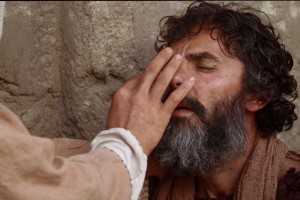
Jesus Heals the Man Born BlindTwo weeks ago our Gospel lesson was the story of Nicodemus with whom Jesus discussed birth. Jesus talked about being born anew, being born of spirit, but Nicodemus could only think of physical birth and talked about crawling back into his mother’s womb. The words were all about birth, but the lesson wasn’t really about birth, at all. It was, as we all know, about a new life in Christ, about becoming a new person through the power of God.

Last week, we heard the story of the Samaritan woman at Jacob’s well. Jesus asked her for a drink and they talked about water. Jesus said that he could supply living water and that whoever drank it would never be thirsty and would live forever; she thought he was talking about physical water, so she asked for some so that she wouldn’t have to come to the well everyday. The words were all about water, but the lesson wasn’t really about water, at all. It was, as we all know, about sustaining the life of begun in new birth, about the constant refreshment of one’s spirit through the power of God.

Today, we have the story of the man born blind whom Jesus cures by applying a poultice of mud made with dust and spittle. The disciples want to know why he is blind: is it because he sinned or because his parents sinned. The people who knew the man as a blind beggar want to know if it’s really him: they don’t recognize him when he comes back to them sighted. The Pharisees want to know if any law was broken when his sight was restored: it happened on a sabbath and the healing might have constituted work. The words are all about blindness and sight, but . . . guess what? . . . the lesson isn’t really about sight or blindness, at all. So what’s this story about?

Let’s leave that question for a moment and remember what day this is, why it is we have flowers on the altar in the middle of Lent, why (if we had them) we would be using rose colored vestments today, and why (if we were the Crawleys of Downton Abbey) the servants would be away today. The answer to all those questions is that today is Mid-Lent, the fourth Sunday of the season, sometimes called Laetare Sunday or Refreshment Sunday or Mothering Sunday.

That Latin name (which means “Rejoicing Sundy”) comes from the practice of the medieval church which used, on Fourth Lent, an opening sentence derived from the Prophet Isaiah to begin the Mass

Laetare Jerusalem: et conventum facite omnes qui diligitis eam . . . .

Rejoice, O Jerusalem: and come together all you that love her . . . .

With this admonition to “rejoice,” the sobriety of Lent was lessened which was liturgically symbolized by replacing the penitential purple or violet vestments with rose colored garb for the clergy. Of interest to us in connection with our Gospel lesson, however, is the second admonition of the medieval introit: “Come together all you who love her.” Keep that in mind.

The name “Mothering Sunday” may come from the traditional epistle lesson read on this Sunday prior to the advent of the new lectionaries. In the English church, that lesson came from the Letter to the Galatians in which St. Paul refers to Jerusalem as “our mother” (Gal. 4:26). Perhaps because of that lesson, a tradition began in the early Renaissance (if not earlier) of people returning to their mother church, either the place where they were raised or the cathedral of their diocese. This was a particularly British and Irish tradition, but it was also observed in some places in continental Europe. Those who made the trek were commonly said to have gone “a-mothering,” hence the name Mothering Sunday. As the tradition continued, it became a custom of the aristocracy to give the day to their domestic servants as a day off to visit their mother church, and their own mothers and families. It also became a tradition for children to pick wild flowers along the way to place in the church or to give to their mothers, so we have flowers in church. Visiting one’s place and family of origin, then, is another hint, I think, to the meaning of today’s Gospel lesson.

Because of the gathering of families on Mothering Sunday, the Lenten fast was relaxed and it became known as “Refreshment Sunday.” There are special baked treats made for this day called “Simnel Cakes” and “Mothering Buns.” The first is an almond paste and candied fruit bread similar to, but not as heavy as, fruitcake. The second are sweet rolls topped with white icing and multi-colored sprinkles known in England as “the hundreds and thousands.” It’s believed that both traditions, like others I’ve mentioned, stem from a biblical passage traditionally used on this Sunday, in this case the feeding of the five thousand (John 6:5-14). Another old name for this day is “the Sunday of the Five Loaves” which these cakes represent.

A last “fun fact” about the Fourth Sunday in Lent. There is, for example, a very peculiar English custom associated with it called “clipping the church.” The word “clipping,” however, has nothing to do with cutting or with coupons in the newspaper; it is apparently from the an old Anglo-Saxon word meaning to clasp or to embrace. In “clipping the church,” the congregation form a ring around their church building and, holding hands, embrace it. If the weather were better (and the building smaller), I’d suggest we do that! (Apparently, “clipping the church” is also done on Shrove Tuesday and on the Monday of Easter week. I’m not sure why it’s ever done!)

So what do all these traditions of the Fourth Sunday in Lent have in common: an introit admonishing those who love Jerusalem to gather together; a tradition of return home and gathering with one’s family; special cakes commemorating the feeding of 5,000 people on a hillside in the Holy Land; and the members of a congregation holding hands and embracing their church building. If I were to suggest one word to name the commonality, it would be “community.” And I want to suggest to you that community is what the story of the healing of the man blind from birth is all about, although everyone in the story (other than Jesus) is unable to appreciate that, just as Nicodemus did not appreciate that the conversation about birth was not about birth and the Samaritan woman did not understand that the discussion of water was not about water.

So it’s about community in a sort of negative way . . . when the blind man is healed he goes back home to his neighborhood, and what happens?

The neighbors and those who had seen him before as a beggar began to ask, “Is this not the man who used to sit and beg?” Some were saying, “It is he.” Others were saying, “No, but it is someone like him.” He kept saying, “I am the man.” But they kept asking . . . . (Jn. 9:8-10)

They don’t even recognize him! Without the defining characteristic of his handicap, they can’t relate to him; they don’t even know who he is! Some community, huh?

And then, once he convinces them that he is who he says he is, what do they do? They question the process and the procedure and the legality of the healing. They take him to the Pharisees, to whom he has to give a detailed explanation of the mud, and even with that the Pharisees suggest that he’s lying to them, or that his parents were lying, that he wasn’t ever really blind: “The Jews did not believe that he had been blind and had received his sight until they called the parents of the man who had received his sight and asked them.” (Jn 9:18) And when they are finally convinced that he was blind and has been given his sight, they say it isn’t legal because Jesus did it on the Sabbath. And, in the end, this poor man, whose healing should be a source of rejoicing and celebration, is not embraced by his community; he is expelled! “And they drove him out.” (Jn. 9:34)

It’s really quite sad. This miraculous thing happens in their midst — “Never since the world began has it been heard that anyone opened the eyes of a person born blind” (Jn. 9:32) — and not a single one of them praises God for the healing. No one says, “Hallelujah!” No one congratulates the man who now has his sight! No one, not even his parents, says, “That’s great! We’re pleased.” The eyes of one man were opened . . . but because those around him could not see the wonder there was nothing but turmoil. Some community, huh?

In this awful way, this negative way, this story is not about blindness; it’s not about sight. It’s about community or, really, the failure of community. It underscores by their pronounced absence the terrible important of all the things the old medieval and renaissance traditions of this Fourth Sunday of Lent emphasize: gathering with family, rejoicing with friends, embracing the church, being in community.

Let us pray:

Heavenly Father, open our eyes that we may see you in our families, in our churches, in our communities, in the lives of all our sisters and brothers; open our minds that we may understand their sorrows and their pain, their hopes and their dreams, their triumphs and their joys; open our hearts to give generously of ourselves; grant us wisdom to respond effectively to the needs of your people with grace and compassion, to their blessings with thanksgiving and delight; give us the courage to speak your words of life, peace, love, mercy, gratitude, and human community; through him with whom in the company of the Holy Spirit you form the community we call the Trinity, our Lord Jesus Christ. Amen.

====================

A request to my readers: I’m trying to build the readership of this blog and I’d very much appreciate your help in doing so. If you find something here that is of value, please share it with others. If you are on Facebook, “like” the posts on your page so others can see them. If you are following me on Twitter, please “retweet” the notices of these meditations. If you have a blog of your own, please include mine in your links (a favor I will gladly reciprocate). Many thanks!

====================

Father Funston is the rector of St. Paul’s Episcopal Church, Medina, Ohio.

No Words – From the Daily Office – March 29, 2014

From the First Letter to the Corinthians:

No testing has overtaken you that is not common to everyone. God is faithful, and he will not let you be tested beyond your strength, but with the testing he will also provide the way out so that you may be able to endure it.

(From the Daily Office Lectionary – 1 Corinthians 10:13 (NRSV) – March 29, 2014.)

Tear on CheekA couple of months ago, a friend mine published a list of the ten things Christians can’t say while following Jesus. One of those things was “God never gives us more than we can handle.” My friend explained, “Ever tried saying this to a person contemplating suicide? No? Well, of course not. Why? Because it is just wrong. It’s wrong for the reason that #10 (Everything happens for a reason) is wrong and it’s wrong because factual circumstances of living prove that sometimes this life does bring with it more than we can handle.”

And here is Paul, in Paul’s own verbose inimitable way, saying exactly that, or is he? I’ll admit that I first read Paul as saying what my friend says Christians can’t say, but on reflection I think Paul is rather more nuanced than that. “God will not let you be tested beyond your strength” does not (as the thing we can’t say does) suggest that it is God doing the testing; further, Paul adds that God provides us additional strength (“the way out”) that should allow us to endure the testing.

The issue for us is whether we are able to recognize and take advantage of that “way out.”

I’ve known too many people who couldn’t, family members and friends who when faced with the trials and tribulations of life couldn’t handle them and simply cracked, became broken people. My father, who killed himself in a single-car motor vehicle accident while driving drunk, was probably one of them. My mother, who weathered that event and pulled herself and her children up out poverty into relative economic comfort, was not, although in retrospect I believe she waged a life-long battle with depression. How is one person able to contend with what life throws at us and one not?

Paul assures us that “no testing has overtaken you that is not common to everyone.” In other words, we all face the same trials; they are part of life, part of being human. They are not something “God gives us” to test us; God doesn’t give them to us at all. Some might not buy Paul’s assurances, but I think what he is saying is that the differences are of degree not kind, or perhaps that the differences have to do with our differing abilities and willingnesses to tap into “the way out” provided all of us by God.

Something I learned early in my ministry is that “the way out” has nothing to do with words, teaching, talking, writing, reading, or any of that. It has nothing to do with anyone hearing or anyone else saying “the right words.” Sometimes there are no right words. “The way out” has to do with human companionship, presence, and community.

When I was first ordained a deacon, a family in my congregation lost a teenage daughter to sudden and tragic death in a car accident. I couldn’t reach them by telephone when I first heard the news so I went to the family home thinking I could at least leave a note on the door. I found the parents just arriving home from the hospital. I had no idea what to say so I said virtually nothing; we simply sat together an wept. I felt like a complete pastoral failure; I had offered nothing that would “make it all make sense.” But several weeks later the girl’s mother sent me a short note thanking me for being there; specifically, she thanked me for not saying anything, for just being there to share their grief.

When Paul says that “no testing has overtaken you that is not common to everyone,” he is reminding us of the centrality of human community. When he says that God “will provide the way out,” that is what he is again referring to. God doesn’t send the test, the trial, or the tribulation. God, indeed, does not give us more than we can handle; he doesn’t give us these things at all! They are not from God. But the people around us, who weep with us when there are no words, who support us through the troubles, they are.

====================

Father Funston, a retired Episcopal priest, was last the rector of St. Paul’s Episcopal Church, Medina, Ohio.

Jesus’ Cellphone – From the Daily Office – March 27, 2014

From the Gospel of Mark:

Immediately he made his disciples get into the boat and go on ahead to the other side, to Bethsaida, while he dismissed the crowd. After saying farewell to them, he went up on the mountain to pray.

(From the Daily Office Lectionary – Mark 6:45-46 (NRSV) – March 27, 2014.)

Jesus with CellphoneJesus sure spends a lot of time on mountains! And I can understand why. They are generally inaccessible to all but the most determined making them the perfect place for someone who needs a little “down” time, a little bit of “I’m exhausted by all of this and need to recharge” time, a little “leave me be for a while” time.

It may be cynical of me, but my first thought reading these two verses was, “I hope he remembered to turn off his cellphone.” I have learned that lesson well, even though I sometimes fail to follow my own advice and answer the phone on my day away from church business and usually regret it when I do.

Why is it that we take little note of, and often ignore, these last two verses of the story of the feeding of the 5,000? When Matthew’s version of the tale is used in the Sunday readings (as Proper 13 in Year A of the Revised Common Lectionary), his similar statement is cut off from it:

Immediately he made the disciples get into the boat and go on ahead to the other side, while he dismissed the crowds. And after he had dismissed the crowds, he went up the mountain by himself to pray. (Matt 14:22-23)

Luke does not mention Jesus’ behavior after the miracle of the loaves and fishes, but neither Luke’s nor Mark’s versions are read in the Sunday rotation. John’s version ascribes a motive other than prayer to Jesus’ climbing the mountain: “When Jesus realized that they were about to come and take him by force to make him king, he withdrew again to the mountain by himself.” (John 6:15, RCL Year B, Proper 12)

I don’t give John’s political twist much credence. It may be that people wanted to “make him king,” after all the Jews were anticipating that sort of Messiah, but I suspect that exhaustion and the need for privacy were much bigger motives for Jesus at the moment.

When in public worship we end the story with the report that “those who ate were about five thousand men, besides women and children” (Matt. 14:21, cf. Mk. 6:44), we get an incomplete picture of Jesus. And John’s “I don’t want to be king” motivation for his departure just makes it worse! He becomes a superman who does incredible miraculous things with little or no effort and with no cost to himself, and then (like some super-spy) thwarts the political designs of the ignorant and ill-informed; as a model for life or ministry, he is an impossible paradigm. Being Christ-like becomes an impossible task beyond the ken of mortal human beings.

But what if we include these two verses, this post-script about depleted reserves, this acknowledgement of Jesus’ weariness and need to replenish? What a richer, more nuanced vision we are given! Jesus becomes a much more accessible savior! He truly is seen to be (as the writer of the Letter to Hebrews insisted) someone who is able “to sympathize with our weaknesses . . . in every respect . . . as we are.” (Heb. 4:15) He is seen as a model of healthy ministry, of self-care following service to others. We see him as someone who really would turn off his cellphone!

====================

A request to my readers: I’m trying to build the readership of this blog and I’d very much appreciate your help in doing so. If you find something here that is of value, please share it with others. If you are on Facebook, “like” the posts on your page so others can see them. If you are following me on Twitter, please “retweet” the notices of these meditations. If you have a blog of your own, please include mine in your links (a favor I will gladly reciprocate). Many thanks!

====================

Father Funston is the rector of St. Paul’s Episcopal Church, Medina, Ohio.

Questions from the Press – Sermon for the 3rd Sunday in Lent – Year A – March 23, 2014

====================

This sermon was preached on the Third Sunday in Lent, March 23, 2014, at St. Paul’s Episcopal Church, Medina, Ohio, where Fr. Funston is rector.

(The lessons for the day were: Exodus 17:1-7; Psalm 95; Romans 5:1-11; and John 4:5-42. These lessons can be read at The Lectionary Page.)

====================

Russian Icon: Woman at the Well and ZacchaeusFour interesting things happened this week. The first was our monthly Brown Bag Concert. During the construction of our Gallery addition to the Parish Hall, the attendance at the concerts had dropped off. Tuesday’s was the first since construction has been completed and we were unsure what sort of turn out we would see. Well, as it happened, we had over 100 people in this church for that concert! What a great thing!

The second thing was the death of Fred Phelps on Wednesday, March 19. The so-called Reverend Mr. Phelps was the so-called pastor of the so-called Westboro Baptist Church. I say “so-called” so many times because I believe Mr. Phelps was essentially self-ordained, and he founded the Westboro congregation which, despite its name, is not recognized by any national or regional Baptist convention. If you don’t recognize those names, Fred Phelps and his congregation are the people who show up with picket signs at the funerals of servicemen and other notable people, picket signs which read “God Hates [Homosexuals]” (only they use a much viler term on their signs). There’s a meme floating around the internet that reads, “Live your life in such a way that Fred Phelps will picket your funeral.” I recommend that.

In the days surrounding his death, my gay and lesbian friends were having quite a discussion of whether anyone should picket his funeral. Another Facebook meme answered that question: it was a cartoon of God saying, “I give you a new commandment: you shall not stoop to Fred Phelps’ level.” That’s where I came down on the question. We pray for the repose of Mr. Phelps’ soul, as we do for anyone who died; we pray that he find in death the peace he seemed not to find in life and which he denied to so many.

His death nearly coincided with what would have been the 86th birthday of another Fred, Fred Rogers, the man who assured children that everyday “it’s a beautiful day in the neighborhood.” What a contrast these two Freds present: the man who invited everyone to be his neighbor and the man who wanted almost no one to be his. I had a little vision when I heard of Fred Phelps’ death that he had arrived at the Pearly Gates to be greeted by Fred Rogers saying, “It’s a beautiful day in the neighborhood, Fred, and everybody’s here!”

The third thing was our “St. Patrick’s Last Gasp” Irish Festival yesterday. It was a great party and a smashing success. Ray and I were trying to figure out how many people actually attended and we think that, at the highest point, we probably had more than 250 people in this building – here in the church, in the parish hall, in the dining room – if we’d had 25% more people, we couldn’t have moved. That’s a great problem to have!

The fourth interesting thing that happened was that our diocesan communications office contacted me and asked if I would be one of seven Episcopal clergy in the Cleveland metropolitan area to answer some questions posed by the Cleveland Plain Dealer. “Sure,” I said and set about answering their questions. After doing so, I thought I ought to share my answers with you so you won’t be surprised when you open the paper someday soon and see what your rector is quoted as saying . . . because although their questions start innocently enough, they escalate rather quickly to address some thorny issues in our tradition and in our society.

I will get to addressing today’s Gospel lesson, trust me, but I want to share those answers with you first. So here they are . . . .

What is my favorite Easter tradition?

My favorite tradition is the Great Vigil of Easter celebrated as an evening service on Saturday evening or as a sunrise service on Resurrection Sunday. At St. Paul’s, Medina, we celebrate the Vigil in even numbered years on Resurrection Eve Saturday evening, and in odd numbered years on Sunday at sunrise. This year is our Saturday evening year and the service will begin after sundown at 8 p.m. Beginning the service in the dark with the lighting of the new fire, processing the Paschal Candle through the dark church, the church coming to light as other candles are lighted one from another, and finally the sanctuary fully lighted as the cry of “Alleluia! Christ is risen!” is sounded, the sun just rising (when we do it at sunrise), and the bells ringing . . . all of that brings me great joy. It speaks to me more clearly of the Light of Christ than any other tradition we observe at Easter or at any time during the church year. Of course, the Sunday morning Festival Eucharist (which will start at 10 a.m.) is great fun, as well!

How do I feel about the way Easter is celebrated in popular/secular culture?

I think the secular traditions of Easter (bunnies, eggs, new bonnets, a new set of dress clothes for the kids, lots of candy) are fine. They are celebrations of the new life of springtime. I’ve gotten out of the habit of calling our church celebration “Easter” and more often refer to it as “Resurrection Sunday” or “Resurrection Season,” so the term “Easter” actually speaks more to me of the secular festivities than of church observance, but the popular Easter traditions and the Christian celebration of Christ’s Resurrection all celebrate the joy of life returning. Human beings in all religious traditions (and those in none) have been celebrating springtime for millennia, and all that we do is good fun and spiritually uplifting. I don’t think the popular traditions detract from the religious significance at all.

What is the relationship between the Episcopal Church and the Anglican Communion (including the Church of England)?

The Episcopal Church is one of the many churches around the world which trace their lineage to Christ and the Apostles through the historic Church of England, a family of churches called “the Anglican Communion.” The U.S. Episcopal Church is the second such offshoot of the Church of England; the Scottish Episcopal Church, which ordained our first bishop, was the first. As Anglicans, we are a part of a reformed catholic tradition which separated from the Roman Catholic Church as a political act during the reign of England’s King Henry VIII, not as a result of theological reform or protest. The Episcopal Church is the only Anglican church in the United States officially recognized as such by the Archbishop of Canterbury, the Lambeth Conference, and the Anglican Consultative Council (our international “instruments of unity”).

What does it mean for the Episcopal Church to allow gay & lesbian weddings when the state of Ohio does not legally recognize these unions?

In considering this question, I think we should make a distinction between the civil contract of marriage, which is a creature of law defined by state statutes and constitutions, and the Sacrament of Holy Matrimony, which is the church’s blessing of a committed, loving relationship of two adult persons. Currently, the Episcopal Church does not offer this sacramental blessing to same-sex couples; we offer a service of blessing and life-long commitment. A study group has been appointed by our highest governing body, the General Convention, to reflect upon our theology of matrimony and make recommendations as to whether the sacrament can and should be extended to same-sex couples; I believe that it should.

Although state law (wrongly, in my opinion) currently denies same-sex couples the right to form the civil contract, that law cannot prohibit the church from offering its blessing to anyone or for any purpose; that would be a violation of the U.S. Constitution’s First Amendment. Therefore, the church is free to and does offer a service of blessing to couples who wish to make solemn vows of life-long commitment one to the other. The church’s blessing does not (and should not be understood to) constitute the formation of the legal contract of marriage. When in a traditional wedding ceremony the husband and wife make their promises, in the Episcopal Church, the first part of the service before the reading of Scripture and the making of the religious vows, is the formation of the contract; after that is done, Scripture is read, prayers are offered, and the religious vows are made and sanctified during the sacramental service of blessing.

By the way, I don’t like to use the term “gay wedding” or “lesbian wedding” because the wedding or commitment ceremony is just that, a ceremony, regardless of the gender or sexual orientations of the persons involved; the couple may be both of the same sex or of opposite sexes, but the nature of the commitments they make to each other in the religious vows — to rely upon God, to love and support one another, to care for each other, and so forth — are the same, neither gay nor lesbian nor straight.

What does “God loves you. No exceptions.” mean to me in a culture that’s spiritual but not religious or with little to no religious affiliation?

Well, I think the statement speaks for itself and would mean the same thing whether the surrounding culture were highly religious or completely secular; God’s love for everyone is not culture dependent. As a statement of belief of the Episcopal Church in this diocese, it means that everyone is welcome. As a former Presiding Bishop of our church once said, “There will be no outcasts in this church,” meaning no one is excluded from participating in our worship, our educational programs, or the social life of the church community. A few weeks ago we put up on our church sign this invitation: “You can belong before you believe.” There is welcome here for the “spiritual but not religious,” the unaffiliated, the disaffiliated, the questioner, the doubter . . . everyone. We don’t pretend to have all the answers, but we love exploring the questions and we offer a safe place for those with questions to do so. Although he’s not an Episcopalian, the author Brian McLaren speaks for our tradition when he writes in one of his books that the church should offer responses to questions, not answers; answers cut off conversation, while responses invite further discussion. The Episcopal Church offers responses. We think that’s what God does, too; God responds.

Considering the Gospel story of the Samaritan woman at Jacob’s well

Which brings us to today’s Gospel reading, a very long reading setting out the longest conversation Jesus has with anyone in any of the four Gospels. It’s amazing that Jesus had this conversation at all. First of all, he is speaking with a Samaritan. The Samaritans were the descendants of those who were left behind when the important families of Jerusalem and the country were taken into exile in Babylon. Those who got to stay in Israel had intermarried with the surrounding Canaanite peoples and continued to worship God according to the first four Books of Moses; they built a temple on Mt. Gerizim not far from the city of Sychar where this conversation took place and offered their sacrifices there. When the exiles returned and restored the temple in Jerusalem, they launched a campaign of “racial purity” demanding that those with “foreign” wives divorce them; adding the Book of Deuteronomy to the Scriptures, they also insisted that sacrifices could only be made at the Jerusalem temple. The Samaritans rejected these demands and “bad blood” existed between the two groups. By Jesus’ time, there was real hatred and enmity between them; John is a master of understatement when he says, “Jews do not share things in common with Samaritans.”

Not only was Jesus’ conversational partner a Samaritan, she was a woman! If we accept the Gospel’s naming of Jesus as a Rabbi, he was breaking all sorts of laws and traditions by conversing with a woman, even if she were a good and faithful Jew. Rabbis simply did not speak to any woman to whom they were not related; it just wasn’t done. And this particular woman, apart from being a Samaritan, was also a woman of (shall we say) besmirched reputation. She had been through five failed relationships and had entered into yet another with a man not her husband (how Jesus knows this I’m not sure, but he knows it).

So this poor woman was everything Jesus should have had nothing to do with, and yet there he is carrying on a conversation as if they were old friends. No wonder the disciples were astonished when they returned.

A fifth interesting thing happened this week. I was introduced to a Russian Orthodox icon depicting this Gospel story, and the interesting thing about it is that the icon writer chose to depict not only this story, but also the story of Zacchaeus. Zacchaeus, you remember, was the Jewish tax collector who climbed a tree so that he could get a look at Jesus as he walked through a crowd in the Jewish city of Jericho. (Luke 19:1-27) Just as with the woman at the well, Jesus spoke to Zacchaeus. And he didn’t just talk to him; he walked up to the tree and said, “Zacchaeus, come down because I’m going to have dinner with you.”

Now, Zacchaeus was a tax collector, a lacky of the hated Roman occupiers of Israel. We all, I’m sure, have our opinions of the agents of the I.R.S. and as we get closer to April 15, that opinion is probably going to get pretty bad. But whatever we may think of contemporary revenue agents, what the Jews thought of Jewish tax collectors was a thousand times worse. They were collaborators working with oppressive Roman Empire which had invaded and occupied the Jewish nation. They were given what was for practical purposes a license to steal. The Roman authorities would tell them what they were to collect, but they could take more and did; they excess was what they lived on. So they were as hated and as outcast among their own people as a Samaritan would have been.

I believe that is the reason the Russian iconographer depicted the two stories on the same panel; he was illustrating that for Jesus there were no outcasts. For God incarnate in Jesus, there are no outcasts. Despite what Fred Phelps may have taught in his church, the Gospel story we heard this morning and the story of Zacchaeus demonstrate that God hates no one. As that diocesan bumper sticker and billboard about which the Plain Dealer asked says, “God loves everyone. No exceptions.” In Christ’s church, in this church there will be no outcasts. Ever.

Amen.

====================

A request to my readers: I’m trying to build the readership of this blog and I’d very much appreciate your help in doing so. If you find something here that is of value, please share it with others. If you are on Facebook, “like” the posts on your page so others can see them. If you are following me on Twitter, please “retweet” the notices of these meditations. If you have a blog of your own, please include mine in your links (a favor I will gladly reciprocate). Many thanks!

====================

Father Funston is the rector of St. Paul’s Episcopal Church, Medina, Ohio.

« Older posts Newer posts »