 When I was 19 years old, my parish priest, Fr. John Donaldson, died of cancer. I was privileged to be the acolyte and crucifer at his requiem and burial. It was a very formal, high-church affair. In all honesty, I remember very little of Fr. John’s funeral. I don’t remember Bishop Bloy’s homily at all, but I do remember the committal at the graveside. You see, it was my first experience of a burial using the liturgy of the Episcopal Church.
I had been to plenty of funerals by then: my father died when I was five, my grandfather when I was eight, my paternal uncle when I was twelve. But I had been an Episcopalian for only five years when Fr. John died and until then I’d never been to a Prayer Book funeral and I’d never heard the words spoken as dirt is tossed onto the coffin:
Unto Almighty God we commend the soul of our brother departed, and we commit his body to the ground; earth to earth, ashes to ashes, dust to dust; in sure and certain hope of the Resurrection unto eternal life, through our Lord Jesus Christ….[1]
Those words, “in sure and certain hope,” really hit me and have stuck with me through the years. They have been used in Anglican burials since Archbishop Cranmer first penned them for the original Prayer Book in 1549. We still use them in the Prayer Book of 1979. They are fundamental to the Anglican expression of the Christian faith.
 This is an old and familiar story, a comfortable story if you will … the parable of the sower.
 What are we to do with our first lesson today? The story of the testing of Abraham and the binding of Isaac, called the Akedah in Hebrew, “exudes darkness and mystery, and it brings before us a thousand questions, most of which have no answers.”
 Do any of you know the story of Tubby the Cocker Spaniel? Well . . . remember Tubby’s name. We’ll come back to him, but first let’s put today’s gospel lesson in perspective.
 “As Jesus was walking along, he saw a man called Matthew sitting at the tax booth; and he said to him, ‘Follow me.’ And he got up and followed him.”
 “Put things in order, … agree with one another, live in peace.”
 “[W]e had hoped that he was the one to redeem Israel . . . and . . . it is now the third day since these things took place.”
 We “boast in our sufferings,” writes Paul to the Romans, “knowing that suffering produces endurance, and endurance produces character, and character produces hope, and hope does not disappoint us….”
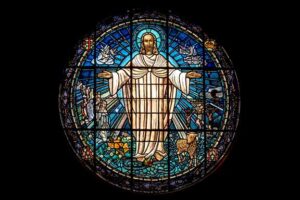 It’s the last Sunday of the Christian year, sort of a New Year’s Eve for the church. We call it “the Feast of Christ the King” and we celebrate it by remembering his enthronement. Each year on Christ the King Sunday we read some part of the crucifixion story. As Pope Francis reminded the faithful in his Palm Sunday homily a few years ago, “It is precisely here that his kingship shines forth in godly fashion: his royal throne is the wood of the Cross!”

