Occasional thoughts of an Anglican Episcopal priest

Category: Ministry (Page 43 of 59)

What Is A Church Building? – Sermon for a Ground Breaking on the 7th Sunday after Pentecost (Proper 9C) – July 7, 2013

====================

This sermon was preached on the Seventh Sunday after Pentecost, July 7, 2013, at St. Paul’s Episcopal Church, Medina, Ohio, where Fr. Funston is rector. The worship that morning included breaking ground on an expansion of the church’s parish hall.

The lessons were taken partially from the readings suggested in the rubrics of The Book of Occasional Services for a ground breaking liturgy and partially from the Revised Common Lectionary for Pentecost 7 (Proper 9, Year C). The Old Testament reading was Genesis 28:10-17; the Gradual was Psalm 132:1-9. The epistle was Galatians 6:1-16; the gospel lesson was Luke 10:1-11,16-20. The latter two lessons can be read at The Lectionary Page.

====================

Church Interior with Superimposed Question MarkWhat is a church building? It’s a holy place. It’s a place where people gather to worship. It’s a place where people encounter God. It’s a place where God’s people enjoy one another’s company. It’s a place where people get married, where babies are baptized, where funerals are held, where memories are made and lives remembered. It’s a place where the stories of faith are told and retold. It’s a place we teach and it’s a place where we learn.

Our reading from Genesis this morning is a small part of the story of Jacob, the son of Isaac who will later be called “Israel.” Jacob is the least likely of patriarchs. Of all the biblical patriarchs, he is the most enigmatic. He never exhibits either the awesome faith of Abraham or the level-headedness of Isaac. He is, in fact, a scoundrel. He’s tricked his father and cheated his brother out of the blessing of the first-born; his character emerges through a series of deceptions, intrigues, and conflicts. He will wrestle with God and be given the name “Israel,” the name that will identify his descendants for the rest of time. He must be taught by God; he has some learning to do.

In the story we heard today, he is on the run. He is afraid of his brother, whom he has cheated, so he has taken off. His father has told him to flee to Haran (his grandfather Abraham’s original home) and there find a wife. Along the way, he camps near a town called Luz and has this dream that we have all heard of before, the vision of a ladder on which angels are traveling back and forth between heaven and Earth. He learns that, like Moses before him, he is standing on holy ground. He says, “How awesome is this place! This is none other than the house of God, and this is the gate of heaven,” and so he renames it, Bethel, “House of God.” A lot of sermons have been preached about Jacob and his character flaws, or about this vision and what the angels coming and going might mean.

But, today, what I want to call to our attention is what God says to Jacob: “Your offspring [God says] shall be like the dust of the earth, and you shall spread abroad to the west and to the east and to the north and to the south; and all the families of the earth shall be blessed in you and in your offspring.”

The descendants of Jacob would go forth from that place to spread blessing to all the corners of the earth – to west, to east, to north, to south. They would go out from that place to change the world.

I’m particularly fond of an Orthodox Jewish translation of this text: “Your seed shall be as the dust of the earth; and you shall burst forth to the west, and to the east, and to the north, and to the south; and in you and in your seed shall all the families of the earth be blessed.” I love that image – Jacob and his descendants would not, could not stay in that awesome place; they could not stay in the house of God or at the gate of heaven. They had to leave, to spread from the Holy Land, to “burst forth” bringing a transformation to the world that would be explosive and dramatic.

We are not gathered in a desert wilderness. We have not gone to sleep on holy stones. We have not seen angels climbing to rocks to heaven . . . but we have gathered in a church building, a place that for many for generations has been an awesome place, a house of God, and a gate of heaven, a place where children have been blessed, where children have been told the stories of God, the stories of Jesus, where hymns of joy have been sung. We are gathered in this place to reaffirm our commitment that heritage and that ministry, to renew this place and to renew the ministry done here.

But like Bethel where Jacob camped for the night, this is not a place to stay; it is a place to leave. It’s a place from which the people of God are sent into the world.

Church buildings are centers of ministry, places of assembly, where God’s people gather to worship, to hear the good news, and to be transformed, not for themselves but in order to be sent back out into the world, to “burst forth” and change the world. Jesus’ last words to his followers were, “Go . . . and make disciples!” (Matt. 28:19)

In our gospel lesson today, Jesus gives his followers their marching orders. “The Lord appointed seventy [followers] and sent them on ahead of him in pairs to every town and place where he himself intended to go.” Some commentators suggest that seventy disciples were chosen because in rabbinic tradition, seventy represents the total number of nations in the world. Just as the children of Jacob were to spread to every corner of the earth, the disciples of Jesus are to go to every nation in the world. As the descendants of Israel are to be a blessing to others, the disciples of Jesus are to go into the world and announce that “the kingdom of God has come near.”

Church buildings, worship spaces and fellowship halls, are the bases from which the church is sent out to do that, as the disciples in today’s reading from Luke were sent out by Jesus. The Rev. Edward Markquart, pastor of Grace Lutheran Church in Seattle, Washington, writes this about our gospel lesson today:

What happened is that those disciples first went to a village or town. Those first disciples planted a church, and then went to a second village or town, and planted a church. They went to a third village or town and planted another church. They … whoops. We have to go back to that first village or town and look more carefully. We have to go back to that first village, because before the disciples went onto the second village, they left a group of people in that village who were committed to Jesus Christ. The Greek word is “laos.” They were called the “laos,” which means, “the laity,” “the people,” “the people of God.” The Apostles always left common and ordinary townspeople and villagers whose hearts were on fire, whose tongues were on fire, who hadn’t gone to the seminary, who hadn’t seen Jesus face to face, who hadn’t talked with him in the flesh. These were not the Apostles. These were not the twelve disciples. These were the people of God in each village who spread the Gospel from house to house, and neighbor to neighbor and friend to friend and family to family. That’s the way it always is. That fundamental principle is always true; it is the laity, the people of God, who become inspired by the Holy Spirit. They are the ones, not the twelve, not the Apostles, not the pastors. It is the laity, the people of God, who go about winning souls to Jesus Christ and nurturing those souls into maturity. (Sermons from Seattle)

Church buildings don’t change the world. They may be awesome; they may be houses of God; they may be gates of heaven. But by themselves, they don’t win people to Jesus, nurture souls to maturity, or change the world. Church buildings are meant to be the bases from which the people of God do that. Church buildings are meant to be places of life, living, breathing, growing, exciting places of life. Church buildings are meant to be centers of ministry, places of assembly, where God’s people gather to worship, to hear the good news, to celebrate the meaning of life, and to be transformed, and then “burst forth,” back out into the world to share that life and transform the lives of others.

We have broken ground today on our Inviting the Future project; after four years of visioning and planning, we have, at last, begun this project to improve this center of ministry, not as a monument to ourselves, but as a place from which we might better serve the world, that we might “burst forth” and tell the world that the kingdom of God is at hand.

Poet and priest Sheila Nelson-McJilton, offers a poetic retelling of our Old Testament reading in her poem Who Sleep on Holy Stones: A Meditation on Genesis 28:10-17.

Bearer of curse and blessing,
I left home to stumble into the desert,
Exhausted and empty
I watch fierce sun set over silent stones.
Stars ascend toward midnight,
The wind moans through desert canyons,
And clouds drift across a full moon like shimmering angels.
Broken and empty I come to you, O Lord God.
In a desert midnight,
There is no smell of blessed fields
No grain
No wine
No fatness of earth
No sweet dew of heaven.
Alone I sleep on holy stones,
Under stars that blaze fierce and countless as dust.
The wind moans high above me, through desert canyons.
Clouds veil the moon.
Strong shining faces of angels appear.
Michael Gabriel Raphael
Lean down to earth.
Their glittering swords carve stones into steps to heaven.
Angels descend in silence to gaze into my face.
Angels ascend in silence to bear my deceit away.
Then in a shimmering celestial dance
Of turning wings,
Swirling wings
They sweep aside clouds.
I see a heavenly host as countless as dust.
I hear a heavenly host, their voices joined by joyous stars.
Glory to God in the highest,
And on earth . . . peace.
Their alleluias echoing high above desert canyons,
The Holy One descends from the gate of heaven
To stand beside my stone pillow.
To wrap my empty fears
In an eternal mantle of blessing.
To hallow the ground on which I sleep.
Michael veils the moon with his wings
And the only light I see is God.
I left home, soul that raged with wild emptiness
And in this desert wilderness, angels carve holy names for sleep.
They dance a path between me and You, O Lord God.
You have found me, broken and empty,
On holy stones that ascend to the very gates of heaven,
And you have not cursed me.
In a desert midnight, I know the smell of blessed fields, grain.
I will tell of you, O Lord God,
To laughing children who bless my tent,
To strong children who become tribes as countless as dust.
I will tell them of desert midnights filled with blazing stars
Of fierce angels who carve holy stones
And dance with glittering swords among clouds
Of hymns sung by joyous stars over Bethel
And over Bethlehem.
(from Anglican Theological Review, Winter, 2000)

What is a church building? A church building is a place to leave. From this place, this improved place, this living, breathing and growing place, we will leave. We will “burst forth” to tell in story and in song, in words and in deeds, in actions and in ministries, of the love of God. We will tell of God to laughing children, to strong children, to hungry children, to mourning children, to children in need, to all of God’s children; we will tell them of desert midnights and blazing stars; we will tell them that the kingdom of God has come near!

As we do so, let us never forget the prayer which has guided us throughout this project, a prayer written by Archbishop Desmond Tutu adapted from an original by Sir Francis Drake.

Let us pray:

Disturb us, O Lord
when we are too well-pleased with ourselves
when our dreams have come true because we dreamed too little,
because we sailed too close to the shore.
Disturb us, O Lord
when with the abundance of things we possess,
we have lost our thirst for the water of life
when, having fallen in love with time,
we have ceased to dream of eternity
and in our efforts to build a new earth,
we have allowed our vision of Heaven to grow dim.
Stir us, O Lord
to dare more boldly, to venture into wider seas
where storms show Thy mastery,
where losing sight of land, we shall find the stars.
In the name of Him who pushed back the horizons of our hopes
and invited the brave to follow,
our Lord Jesus Christ. Amen.

====================

A request to my readers: I’m trying to build the readership of this blog and I’d very much appreciate your help in doing so. If you find something here that is of value, please share it with others. If you are on Facebook, “like” the posts on your page so others can see them. If you are following me on Twitter, please “retweet” the notices of these meditations. If you have a blog of your own, please include mine in your links (a favor I will gladly reciprocate). Many thanks!

====================

Father Funston is the rector of St. Paul’s Episcopal Church, Medina, Ohio.

Does “Journey” Make Sense? – From the Daily Office – July 5, 2013

From the Gospel according to Luke:

As they led him away, they seized a man, Simon of Cyrene, who was coming from the country, and they laid the cross on him, and made him carry it behind Jesus.

(From the Daily Office Lectionary – Luke 23:26 (NRSV) – July 5, 2013.)

Start of a JourneyDo you know where Cyrene was? Its location was in the same place as present day Shahhat, a town in northeastern Libya, about 80 miles northeast of Benghazi and about five miles from the Mediterranean coast. It’s nearly 1300 miles from Jerusalem. Simon had “come from the country” a fair distance! And at the end of that very long journey, he was made to carry the cross up the hill to Golgotha. The journey is a common metaphor of the Christian life; Simon’s long journey could stand as an example. But does the metaphor, does Simon’s example make sense anymore?

In other reading today, I learned that although the United States as a whole has only 87 people per square mile, the average American lives in a metropolitan area with more than 5,000 people per square mile. Two-thirds of Americans live in metropolitan areas with half-a-million or more residents. The long journey may be a Christian metaphor, but it is probably not one that resonates with the personal experience of most modern Americans. Long journeys are no longer part of our everyday corporate experience.

Certainly Americans travel; last year we spent $597 billion on leisure travel and $259 billion on business trips. But living in cities with nearly every need, and most of our family and friends, close at hand, and without a religious or social tradition of pilgrimage, the long journey is not a common practice.

Paradoxically, we seem to be an increasingly mobile and transient society. We don’t do journeys, but we do seem to move about quite a bit. While my small-town (pop. 28,000) church has several long-term members who have been here most, if not all, of their lives, a significant part of our worshiping community is made up of those who have recently relocated to the area because of job transfers, and who expect to leave within just a few years. Indeed, many of those who have left the congregation in the past ten years have done so for the same reason. The long-term leadership of the congregation (and now that I’ve been here more than ten years, I feel like that includes me) has seen many active church members come and go as breadwinners are transferred into the area, work here for three to five years, and are then transferred elsewhere.

As I ponder these contradictory data, a mobile population lacking in experience of journeying, it seems to me that what we lack may be rootedness, a sense of permanent “home place,” an anchoring in space and time. There is a difference between a “journey” and a “trip” – and that difference is time. There is a difference between a “journey” and a life of constant work-related relocation – and that difference is the home place, the anchor point in space.

My family is as un-rooted as most; my personal history more so. Not quite half my lifetime ago, I was required to fill out an FBI background check form; doing so, I realized that by the time I was 35 years of age, I had had 37 addresses! When my children were in the fifth and third grades, we relocated from Las Vegas, Nevada, to an exurban, Kansas-side community of the Kansas City metroplex, where we lived for ten years; the home we owned there is still the place I have lived the longest in my life! Although they were born in San Diego and Las Vegas, it’s very clear that my kids think of Kansas as “home.” My wife and I moved to Ohio after the children had completed high school and they have never lived here. From time to time someone will ask one or the other, “Are you coming home for Christmas?” Their typical reply makes it very clear that they do not consider Ohio “home.” They have a sense of rootedness, and that root is not sunk into this soil.

Unlike my children, I do not have that sense of rootedness. I was born in Las Vegas, but left the place when I was only 8 years of age. For the next several years, my family relocated (always within the Los Angeles area) every twelve to eighteen months. I continued that pattern after leaving home, sometimes moving after only three or four months. As I aged and became employed, my length of stay in any one place grew. But it is only at more than 60 years of age that I can look back and make sense of life through the metaphor of “the journey.” I do wonder how useful this metaphor is for those still in the throes of an unrooted life, relocating every few years as jobs change, perhaps taking “business trips,” and maybe finding time for vacation travel.

Simon had a home, a place where he was rooted, Cyrene. He was on a journey when he encountered Christ on the way to Calvary. He was not on a “trip”; he was not relocating. What can we learn from Simon? Does the journey metaphor make sense anymore?

====================

A request to my readers: I’m trying to build the readership of this blog and I’d very much appreciate your help in doing so. If you find something here that is of value, please share it with others. If you are on Facebook, “like” the posts on your page so others can see them. If you are following me on Twitter, please “retweet” the notices of these meditations. If you have a blog of your own, please include mine in your links (a favor I will gladly reciprocate). Many thanks!

====================

Father Funston is the rector of St. Paul’s Episcopal Church, Medina, Ohio.

Honor Upon the Lawgiver – From the Daily Office – July 4, 2013

From the Book of Sirach:

A wise magistrate educates his people,
and the rule of an intelligent person is well ordered.
As the people’s judge is, so are his officials;
as the ruler of the city is, so are all its inhabitants.
An undisciplined king ruins his people,
but a city becomes fit to live in through the understanding of its rulers.
The government of the earth is in the hand of the Lord,
and over it he will raise up the right leader for the time.
Human success is in the hand of the Lord,
and it is he who confers honor upon the lawgiver.

(From the Daily Office Lectionary – Sirach 10:1-5 (NRSV) – July 4, 2013.)

American FlagIndependence Day is one of the few secular holidays to have lessons of its own in both the Eucharistic and Daily Office Lectionaries of the Episcopal Church. There is a set of lessons in the regular Daily Office schedule of readings for today, as well, and I am intrigued that the way the calendar falls this year the Gospel for that set is the unjust trial of Jesus. One could meditate for hours on the meaning to be drawn from that juxtaposition.
However, the reading from the apocryphal book The Wisdom of Jesus, Son of Sirach (a book also called “Ecclesiasticus”) has caught my attention because of a recent (and unfortunately repeated) incident at my church. The lines of particular import are: “As the ruler of the city is, so are all its inhabitants;” and “It is [God] who confers honor upon the lawgiver.”

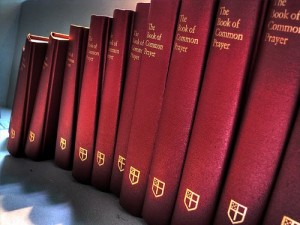
In every form of the Prayers of the People in the American Book of Common Prayer (1979) there is a petition included for our civil leaders. According to the rubric in the service of Holy Communion (page 359 of the BCP), we are bidden to pray for “the Nation and all in authority.” At my church, we do so by name, listing our president, state governor, and city mayor, and conclude with a general petition for other elected legislators, judges, and executive department officials.

At my church, as well, we share leadership of the prayers. A single person reads the major biddings of the various forms, but additional petitions are read by members of the congregation. As worshipers arrive, our ushers and greeters ask if they would like to read a sentence or two of additional intercessions. Most readily agree.

However, from time to time someone will decline to do so and occasionally someone will specifically (and sometimes venomously) refuse to read the petition naming the president. This has only happened since the election of the current incumbent. My heart sinks when I hear these refusals or when I am told about them later. It’s an indication of how poorly I have taught the Christian ethos to this congregation.

“As the ruler of the city is, so are all its inhabitants.” If Jesus ben Sirach is correct, then we should very definitely be praying for our rulers and leaders, for they set the example and the tone for the entire populace. And yet people decline to do so . . . .

My parish is dedicated to St. Paul, the writer of most of the New Testament, and Paul was very clear on the duty Christian folk have with respect to secular authorities and civic leaders. He wrote to the young bishop, Titus of Crete, instructing him to teach his congregation to respect civil rulers:

Remind them to be subject to rulers and authorities, to be obedient, to be ready for every good work, to speak evil of no one, to avoid quarreling, to be gentle, and to show every courtesy to everyone. For we ourselves were once foolish, disobedient, led astray, slaves to various passions and pleasures, passing our days in malice and envy, despicable, hating one another. But when the goodness and loving kindness of God our Savior appeared, he saved us, not because of any works of righteousness that we had done, but according to his mercy, through the water of rebirth and renewal by the Holy Spirit. (Titus 3:1-5)

He wrote to the Romans in a similar vein:

Let every person be subject to the governing authorities; for there is no authority except from God, and those authorities that exist have been instituted by God. Therefore whoever resists authority resists what God has appointed, and those who resist will incur judgment. For rulers are not a terror to good conduct, but to bad. Do you wish to have no fear of the authority? Then do what is good, and you will receive its approval; for it is God’s servant for your good. But if you do what is wrong, you should be afraid, for the authority does not bear the sword in vain! It is the servant of God to execute wrath on the wrongdoer. Therefore one must be subject, not only because of wrath but also because of conscience. For the same reason you also pay taxes, for the authorities are God’s servants, busy with this very thing. (Romans 13:1-6)

And with regard to praying for our secular leadership, he was very clear in his instructions to another young bishop, Timothy of Ephesus:

First of all, then, I urge that supplications, prayers, intercessions, and thanksgivings be made for everyone, for kings and all who are in high positions, so that we may lead a quiet and peaceable life in all godliness and dignity. This is right and is acceptable in the sight of God our Savior, who desires everyone to be saved and to come to the knowledge of the truth. (1 Timothy 2:1-4)

I quite understand disliking secular authorities; I don’t understand disliking one so much that we refuse to follow the clear mandate of Holy Scripture and the tradition of our church! Anyone who has ever had even the shortest political conversation with me knows that, in my opinion, George W. Bush was the worst president in U.S. history. Nonetheless, every day of his eight years in office I prayed for him by name, twice a day. (I even pray for the vice-president by name and during those years that was an even more difficult thing to do!) I prayed for Bill Clinton even though his sexual pecadillo with Monica Lewinsky was more than a little off-putting. I pray for Barack Obama even though I am very disappointed with many aspects of his performance as president.

The point is that my prayers have nothing to do with my personal dislike or approval of any of these politicians. My prayers have nothing to do with them at all! My prayers have everything to do with me and my discipline as a follower of Jesus Christ. I am pretty sure that Jesus had some personal problem with the political authorities of his day, with Caiaphas the High Priest, with Herod the Tetrarch, with Pilate the Roman governor, and yet he prayed for them: “Father, forgive them; for they do not know what they are doing.” (Luke 23:34) As a disciple of Christ, I can do no less than to pray for the civil authorities in power over me!

“As the ruler of the city is, so are all its inhabitants.” If Jesus ben Sirach is correct, and I think he is, our prayer for our leaders is a prayer for ourselves. Any prayer is, in truth, a prayer for ourselves. We do not pray to bring to God’s attention something God has overlooked, nor do we pray to change God’s mind about something, to get God to do what we want. We pray to conform our wills to God’s Will; we pray that we might have what Paul called “the mind of Christ.” (1 Cor. 2:16) We pray that we might be like him who, on the cross, prayed for the civil authorities who hung him there.

On this day especially, let us pray for the Nation and all in authority; let us pray for them by name! For “human success is in the hand of the Lord, and it is he who confers honor upon the lawgiver.”

====================

A request to my readers: I’m trying to build the readership of this blog and I’d very much appreciate your help in doing so. If you find something here that is of value, please share it with others. If you are on Facebook, “like” the posts on your page so others can see them. If you are following me on Twitter, please “retweet” the notices of these meditations. If you have a blog of your own, please include mine in your links (a favor I will gladly reciprocate). Many thanks!

====================

Father Funston is the rector of St. Paul’s Episcopal Church, Medina, Ohio.

Seven Times a Day? – From the Daily Office – July 3, 2013

From the Psalter:

Seven times a day do I praise you, because of your righteous judgments.

(From the Daily Office Lectionary – Psalm 119:164 (BCP Version) – July, 2013.)

Book of Common Prayer (1979)The Book of Acts, the earliest church history, tells us that the followers of Jesus practiced daily prayer: “Day by day, as they spent much time together in the temple, they broke bread at home and ate their food with glad and generous hearts.” (Acts 2:46) Eventually, the Christians were excluded from Jewish worship assemblies, either by their own choice or by action of the authorities, and in an unrelated development, the Temple was destroyed in 70 AD. Where, then, did Christians pray together? Or, for that matter, alone?

It is likely that there were ascetics who sought solitude away from the cities and what they perceived as a sinful society around them from the start of the Christian community. They may have emulated John the Baptizer and his followers, the Jewish Essenes, or other esoteric communities. However, the first historically verifiable hermit (or “anchorite”) seems to be St. Anthony of Egypt. Unfortunately for him, others were attracted to his lifestyle and he found himself surrounded by disciples following his example. During Anthony’s lifetime, one of his followers, St. Pachomius established the first community for ascetics living together, “cenobites,” during the early part of the Fourth Century. By the end of the Fifth Century, these monks had developed the practice of gathering together for prayer and the early outlines of a Liturgy of the Hours composed of seven “offices” had emerged. It is possible that number of services was chosen because of this (and similar) verses in Scripture.

The foundation of modern western monasticism was the Rule of St. Benedict, authored by Benedict of Nursia in the 6th century. As part of his design for monks living in community, he adopted the practice of regular hours of prayer, adding an eighth. The eight monastic hours are the following:

  • Matins (during the night, usually at midnight; sometimes called Nocturns)
  • Lauds (at dawn, or 3 a.m.)
  • Prime (approximately 6 a.m.; this is the hour added by Benedict)
  • Terce (approximately 9 a.m.)
  • Sext (approximately 12 noon)
  • None (approximately 3 p.m.)
  • Vespers (approximately 6 p.m., “at the lighting of the lamps”)
  • Compline (approximately 9 p.m., before retiring)

Archbishop Thomas Cranmer, the genius behind the Anglican Prayer Book tradition, took bits and pieces of these monastic hours to create the offices of Daily Morning Prayer and Daily Evening Prayer included in The Book of Common Prayer of 1549 and in every revision of the Prayer Book since. It was Cranmer’s idea that individuals and families, like monks in community, would say these offices every day, coming together with others on Sundays to celebrate the Holy Communion.

It was, I’m afraid, a wonderful but never realized vision; I doubt very seriously that there has ever been a time since the Reformation when Anglicans, in general, stop during their days for even a single instance of regular, corporate, liturgical prayer, let alone twice a day, let alone seven or eight times a day. Nonetheless, the Anglican ethos is one of constant daily prayer deriving from the Scriptural witness of the Psalms.

It is my practice to say the Daily Offices at morning and evening and, occasionally, Compline before retiring. The current American Prayer Book of 1979 includes two forms of Morning Prayer, an office for Noonday Prayer, two forms of Evening Prayer, an order for Compline, and four short forms for individual prayer throughout the day. Our tradition is steeped in the monastic tradition!

But how many of us can say this verse of Psalm 119 with complete authenticity? I know that I can’t! Two times a day? Usually. Seven times a day? It just doesn’t happen! It probably should, but it doesn’t.

====================

A request to my readers: I’m trying to build the readership of this blog and I’d very much appreciate your help in doing so. If you find something here that is of value, please share it with others. If you are on Facebook, “like” the posts on your page so others can see them. If you are following me on Twitter, please “retweet” the notices of these meditations. If you have a blog of your own, please include mine in your links (a favor I will gladly reciprocate). Many thanks!

====================

Father Funston is the rector of St. Paul’s Episcopal Church, Medina, Ohio.

Mix Faith with Frustration – From the Daily Office – July 2, 2013

From the Gospel of Luke:

They said, “If you are the Messiah, tell us.” He replied, “If I tell you, you will not believe; and if I question you, you will not answer.”

(From the Daily Office Lectionary – Luke 22:67-68 (NRSV) – July 2, 2013.)

Frustration Relief KitIn the assembly of the elders of the people, the chief priests and the scribes, Jesus is asked, “Are you the Messiah?” and in response he gives vent to some very real human frustration.

I recently read an article about frustration as a plot element in writing fiction. The author suggested that frustration is, in fact, the most important emotion in fiction because nothing happens in a novel or short story unless the plans, wishes, or desires of the protagonist are frustrated. If Ahab had killed the white whale on his first attempt, Moby Dick would have been a very short tale, indeed. The author of the article pointed out, however, that frustration “is seldom a ‘pure’ emotion. It can come mixed with many others: anger (‘How dare they!’), hurt (‘Why won’t they help me?’), fear (‘I’ll never get what I want’), self-blame (‘I’m not good enough to succeed’), resignation (‘Can’t win ‘em all’), or bitterness (‘Life sucks’).”

One of my favorite episodes of The West Wing was about a submarine crisis off the coast of North Korea. The White House staff brought in an expert on submarine warfare to advise President Bartlett; Hal Holbrook played the character with droll dullness, droning on and on about difference experiences. In one scene, the expert and Leo McGarry were sitting on the sofas in the Oval Office talking; Leo was listening, the expert droning on. From off camera came the sound of a rhythmic thump – thump – thump. The camera pulled back to reveal the President banging his head on his desk . . . . I’m not sure what the President’s frustration might have been mixed with, but clearly that is not the best way to handle frustration!

With what, we might ask, is Jesus’ frustration mixed? I think the answer must be, “Faith.” Jesus is convinced that whatever happens, his God is with him. The night before this questioning, all the other emotions with which this frustration might have been mixed were sweated out in Garden of Gethsemane, leaving only faith: “Father, if you are willing, remove this cup from me; yet, not my will but yours be done.” (Luke 22:42) To be true to his mission (whatever we might now believe or understand it to be), to be true to his God, Jesus could not allow any other emotion to taint his frustration.

In any given situation, with what are our frustrations mixed? Too often they are like that article author described, mixed with emotions that result in negative or self-defeating outcomes. Our task is to spend some Gethsemane-time, sweating out those impurities, leaving only faith.

I think frustration mixed with faith might best be named “resolve,” which the dictionary defines as “firmness of purpose.” That certainly describes Jesus in the assembly of the elders (and throughout the Passion).

In an address at the University of Maine in October 1963, President John F. Kennedy exhorted his listeners: “Let us resolve to be masters, not the victims, of our history, controlling our own destiny without giving way to blind suspicions and emotions.” The example of Jesus suggests that, in some ways, we may still be “victims” no matter what we resolve and no matter how strong our faith may be. But our Lord’s example and the Christian faith also demonstrate that “victimization” to those who stand firm in their mission is a temporary state; on the other side one finds resurrection and redemption.

Frustration is a very real and very human situation. What we choose to mix with our frustrations is the determiner of outcome; followers of Jesus mix faith with frustration.

====================

A request to my readers: I’m trying to build the readership of this blog and I’d very much appreciate your help in doing so. If you find something here that is of value, please share it with others. If you are on Facebook, “like” the posts on your page so others can see them. If you are following me on Twitter, please “retweet” the notices of these meditations. If you have a blog of your own, please include mine in your links (a favor I will gladly reciprocate). Many thanks!

====================

Father Funston is the rector of St. Paul’s Episcopal Church, Medina, Ohio.

Leopards Changing Spots – From the Daily Office – July 1, 2013

From the Book of Acts:

They dragged [Stephen] out of the city and began to stone him; and the witnesses laid their coats at the feet of a young man named Saul.

(From the Daily Office Lectionary – Acts 7:58 (NRSV) – July 1, 2013.)

LeopardThis is the first appearance in the Christian story of the man who will become the early church’s greatest evangelist and the author of most of the New Testament. We are told that as he witnessed the martyrdom of the first deacon, “Saul approved of their killing him.” (Acts 8:1)

Saul would take the Gentile form of his name, Paul, when baptized and under that name would spread the Christian faith among non-Jews. One assumes that, from time to time, he might have told the story of witnessing Stephen being killed – it would make a powerful sermon illustration, don’t you think? He obviously told it to someone because eventually it got to Luke, who included it in his little history of the church.

This story of a public execution brought to mind a conversation I had with a parishioner just a few days ago. Texas recently executed its 500th death-penalty convict since resuming executions in 1980s; that news led us into a discussion of the death penalty. I am opposed to the death penalty on several grounds; my parishioner favors it. In the course of our conversation he put forth the argument that execution rids society of criminals who will kill again. He’s convinced that killers don’t change: “The leopard never changes his spots,” he said.

He certainly has the Bible (or at least the the Old Testament on his side. This old shibboleth comes from word of God spoken through the prophet Jeremiah! Lamenting the sinfulness of God’s People, the Lord asks: “Can Ethiopians change their skin or leopards their spots?”(Jer. 13:23, NRSV). Of course, the message of the prophet would suggest that the answer to that question is “Yes” else why call the people to repentance? And therein lies the theological and ethical issue I have with the death penalty. (I have legal, economic, and practical issues with it, as well.)

The death penalty denies the power of God in Christ to redeem, restore, and transform human existence. It precludes any possibility of repentance and amendment of life. When the capital punishment is imposed, the life of the convicted person is devalued and all possibility of change is ended. When the government undertakes capital punishment on behalf of the people (on my behalf), the people are implicated in that judgment and we are made to share in an ethic we may not accept (one which I do not accept). An ethic which says, as my congregant put it, that “leopards cannot change their spots.”

But that is not the Christian ethic (nor is it the ethic of the Old Testament in which that image is first spoken). The Christian ethic says that repentance is always possible. It is, in a very real sense, the whole message of Christ: “Repent, for the kingdom of heaven has come near.” (Matthew 3:2) The leopard can change its spots and the Christian hope is always that it will.

After all, Saul – who held the cloaks of the executioners and approved their killing of Stephen – changed his!

====================

A request to my readers: I’m trying to build the readership of this blog and I’d very much appreciate your help in doing so. If you find something here that is of value, please share it with others. If you are on Facebook, “like” the posts on your page so others can see them. If you are following me on Twitter, please “retweet” the notices of these meditations. If you have a blog of your own, please include mine in your links (a favor I will gladly reciprocate). Many thanks!

====================

Father Funston is the rector of St. Paul’s Episcopal Church, Medina, Ohio.

Give No Thought to Donkeys – From the Daily Office – June 29, 2013

From the First Book of Samuel:

As for your donkeys that were lost three days ago, give no further thought to them, for they have been found.

(From the Daily Office Lectionary – 1 Samuel 9:20 (NRSV) – June 29, 2013.)

Donkeys in the DesertThis advice not to worry about his donkeys is given by Samuel to Saul when Saul arrives at Ramah. It seems oddly out of place. Saul has been sent by God to Samuel, and God has informed Samuel that the man he will have sent to him is to be king over Israel. So Saul has had his cook set aside a special portion of meat and otherwise prepared to meet and anoint the man who would one day rule the country. Samuel comes to the town where he expects to find the man of God, and this statement is part of their first conversation:

Saul approached Samuel inside the gate, and said, “Tell me, please, where is the house of the seer?” Samuel answered Saul, “I am the seer; go up before me to the shrine, for today you shall eat with me, and in the morning I will let you go and will tell you all that is on your mind. As for your donkeys that were lost three days ago, give no further thought to them, for they have been found. And on whom is all Israel’s desire fixed, if not on you and on all your ancestral house?”

Again, the admonition about the donkeys seems oddly out of place. And, yet, I don’t think it is.

I think it’s Samuel’s way of telling Saul, “Don’t sweat the small stuff.” The lost donkeys are not important. They don’t matter right now; they have bigger, more important business to take care of. We all have bigger, more important business to take care of, yet we often get hung up worrying about missing donkeys. As Samuel has told Saul, someone else is seeing to them. Give them no further consideration; focus on what’s important!

So remember, give no further thought to your donkeys!

====================

A request to my readers: I’m trying to build the readership of this blog and I’d very much appreciate your help in doing so. If you find something here that is of value, please share it with others. If you are on Facebook, “like” the posts on your page so others can see them. If you are following me on Twitter, please “retweet” the notices of these meditations. If you have a blog of your own, please include mine in your links (a favor I will gladly reciprocate). Many thanks!

====================

Father Funston is the rector of St. Paul’s Episcopal Church, Medina, Ohio.

Change Is Life – From the Daily Office – June 25, 2013

From the Book of Acts:

“I tell you, keep away from these men and let them alone; because if this plan or this undertaking is of human origin, it will fail; but if it is of God, you will not be able to overthrow them — in that case you may even be found fighting against God!”

(From the Daily Office Lectionary – Acts 5:38-39 (NRSV) – June 25, 2013.)

Emerging Monarch ButterflyThe Pharisee Gamaliel gave sound advice to the Sanhedrin: “Leave them alone. If their movement is of God, you will not be able to stop it.” It’s advice the church, which benefited from it, has often failed to heed. We ought to follow it more often than we do . . . but there is that other rule the church more frequently follows: “Any change, at any time, for any reason, is to be deplored.” (Often attributed to an otherwise unidentified Victorian-era “Duke of Cambridge.”)
Episcopalians are said to be the poster children for this rule. The old joke asks, “How many Episcopalians does it take to change a light bulb?” . . . .

“Change! My grandmother gave that lightbulb!”

None of us are really comfortable with change. I suspect that most people, if they had their druthers, would just keep things mostly the same. For most of us the status quo is comfortable and staying the course gives us a sense of security. A read recently about a guy who bought a new radio, brought it home, placed it on the refrigerator, plugged it in, turned it to a station coming out of Nashville, home to the Grand Ole Opry, and then pulled all the knobs off. He had he wanted and had not intention to change.

But life without change isn’t life. It’s death. If there is one constant in this world it is that living things change; only lifeless things are static. And life, as Scripture tells us, is God’s will for God’s People. Isaiah prophesied, “No more shall there be in it an infant that lives but a few days, or an old person who does not live out a lifetime; for one who dies at a hundred years will be considered a youth, and one who falls short of a hundred will be considered accursed.” (Isa. 65:20)

Take heed of Gamaliel’s words to the Sanhedrin. Change is evidence of life, and life is the will of God, so change may be of God and, if so, you will be unable to overthrow it.

====================

A request to my readers: I’m trying to build the readership of this blog and I’d very much appreciate your help in doing so. If you find something here that is of value, please share it with others. If you are on Facebook, “like” the posts on your page so others can see them. If you are following me on Twitter, please “retweet” the notices of these meditations. If you have a blog of your own, please include mine in your links (a favor I will gladly reciprocate). Many thanks!

====================

Father Funston is the rector of St. Paul’s Episcopal Church, Medina, Ohio.

The Dark Lining of Joy – From the Daily Office – June 21, 2013

From the Psalter:

My friend and my neighbor you have put away from me,
and darkness is my only companion.

(From the Daily Office Lectionary – Psalm 88:19 (BCP Version) – June 21, 2013.)

On Your Ordination Anniversary CardToday is the 22nd anniversary of my ordination as a priest in the Episcopal Church. It is also the 20th anniversary of the death of my older (and only) sibling, Rick.

Rick Funston died on Father’s Day 1993 of a cancer called Glioblastoma Multiforme Stage IV. Glioblastoma is an aggressive, extremely invasive, and invariably fatal form of primary site brain cancer; “primary site” means that it is not metastasized from some other location, as most brain cancers are (or so I’m told). Glioblastomas grew rapidly and are the sort of tumors that give cancer its name. Not many people know that cancer is called that because of invasive tumors’ resemblance to the many-legged crab. Cancer is the Latin word (derived from the Greek karkinos) for “crab.”

When Rick was diagnosed, I did some research and learned that the median survival time was about six months from date of diagnosis with nearly all patients passing away within two years. I just checked the current literature and see that the median has lengthened to 12 months and that 3-5% of patients survive as long as three years; they are called “long-term survivors.” Rick was not a long-term survivor.

His first symptoms appeared in October of 1992 and were initially misdiagnosed as a stroke. An accurate diagnosis was made in February of 1993; he died four months later.

Rick was nearly 10 years older than me. He went away to live with our grandparents and attend a private high school in my parents’ Kansas home town when I was 4 years old, so I really have almost no memory of him as a child. We next lived together, only very briefly, when he decided to leave the University of Texas in his sophomore year and attend UCLA; he moved into our parents’ and my home (our mother and stepfather; our father died when I was 5 years old) for a few months. We only really became close after I graduated from high school; he and his wife Janet and I toured Europe together the summer after my graduation.

I miss my brother a great deal. He had a wicked sense of humor. He was incredibly smart. His B.A. and M.A. were in American history; his Ph.D., in political science with a specialization in Constitutional law. He taught at San Diego State University and, at the time of his death, was the vice-president of the university. Somewhere along the line, he’d taken a few hours off from academe and gotten a J.D. as well. He spoke German, French, and Italian, and had more than a passing familiarity with Latin and Greek.

His cancer had attacked the part of the brain that controls speech. For pain relief and to extend his life as long as possible, surgery was done to remove as much of the tumor as could be gotten. This professor who spoke six languages, who lectured nearly every day, who had published several books and authored many articles lost his ability to form sentences and to converse easily. He couldn’t remember the names of colors; he couldn’t remember his children’s names. Sitting and talking with him you could see the frustration and anger, and the fear, in his eyes; he knew what he wanted to say, but he couldn’t get the words put together. It was maddening!

He set himself the goal of seeing his oldest child, my niece Saskia, graduate from college. He made that goal.

Every year on the anniversary of my ordination, I spend more time thinking about the brother I miss than about the ministry I have enjoyed. The last verse of the morning psalm, as a result, grabbed me by the throat! “My friend and my neighbor you have put away from me, and darkness is my only companion.”

Ordained ministry is lonely work. Clergy have very few friends or close companions, even among our colleagues in ministry. (A 1991 survey of clergy found that 70% of ordained ministers claimed to have no close friendships; a 2001 survey reported that 51% of clergy feel “lonely.”) During my first two and a half years of clergy life (one year as a deacon and eighteen months of priesthood before his diagnosis), my closest friend and adviser was my brother. He’d given some thought himself to becoming a pastor in the Lutheran tradition (something he was, and the entire Lutheran tradition should be, glad he didn’t pursue). I’ve not had a better, or even an equal, adviser since his death.

I won’t go so far as the psalmist and claim that “darkness is my only companion,” but there is a dark lining to the joy I feel remembering my ordination. I miss you, Rick, I really miss you!

====================

A request to my readers: I’m trying to build the readership of this blog and I’d very much appreciate your help in doing so. If you find something here that is of value, please share it with others. If you are on Facebook, “like” the posts on your page so others can see them. If you are following me on Twitter, please “retweet” the notices of these meditations. If you have a blog of your own, please include mine in your links (a favor I will gladly reciprocate). Many thanks!

====================

Father Funston is the rector of St. Paul’s Episcopal Church, Medina, Ohio.

Gandolfini, Hastings, and the Poor Widow: My Two Cents – From the Daily Office – June 20, 2013

From the Gospel according to Luke:

Jesus looked up and saw rich people putting their gifts into the treasury; he also saw a poor widow put in two small copper coins. He said, “Truly I tell you, this poor widow has put in more than all of them; for all of them have contributed out of their abundance, but she out of her poverty has put in all she had to live on.”

(From the Daily Office Lectionary – Luke 21:1-4 (NRSV) – June 20, 2013.)

Two CentsYesterday, the news services and Facebook were buzzing with the news of the death of James Gandolfini. Mr. Gandolfini, who was famous for playing the role of Tony Soprano in an HBO series The Sopranos, suffered a heart attack at the age of 51. The day before, there was a similar (though smaller) buzz about the death of investigative journalist Michael Hastings, aged 33, in an automobile accident.

Last week, a member of my congregation died at the age of 80 after years of crippling illness. Several weeks of acute respiratory distress came to an end when his family made the always difficult decision to withdraw life-sustaining medical treatment. Except for an obituary in the local papers and a notice on our parish’s Facebook page, his death received no press coverage and no social media mention.

It seems to me this morning that the contrast Jesus draws between the offering of the poor widow and the donations of the wealthy applies as well to the differences in how the world marks the passing of everyday folk compared to its notice of the deaths of celebrities. A man who has lived a life spent in productive work, making a small but steady contribution to the world, supporting his church, raising his children and grandchildren, quietly doing good works, has perhaps “put in more than all” of the famous actors or well-known reporters who get so much attention.

I suppose I may be biased. I knew my parishioner and I know his family. When I saw the news about Mr. Hastings, I had to do some research to find out if I know any of his work; it turns out I do – he is the journalist who broke the story about General Stanley McChrystal. When I saw the reports of Mr. Gandolfini’s death, I did not need to do so; I knew that he had played the Soprano part. But, truth be told, I’ve never seen an episode of The Sopranos and I have no idea what other roles the actor may have played. In either event, I can safely say that neither man has had as great an impact on my life and the lives of the people and community I know than my parishioner had.

I don’t mean to belittle their deaths nor the pain their passing may have caused those who love them, but I think perhaps we pay too much attention to those who claim (or are given) the name “celebrity” and not enough to the grandfathers and the poor widows around us, even in death. We should do as Jesus did in the Temple; we should take notice.

And that’s my two cents.

====================

A request to my readers: I’m trying to build the readership of this blog and I’d very much appreciate your help in doing so. If you find something here that is of value, please share it with others. If you are on Facebook, “like” the posts on your page so others can see them. If you are following me on Twitter, please “retweet” the notices of these meditations. If you have a blog of your own, please include mine in your links (a favor I will gladly reciprocate). Many thanks!

====================

Father Funston is the rector of St. Paul’s Episcopal Church, Medina, Ohio.

« Older posts Newer posts »