Occasional thoughts of an Anglican Episcopal priest

Category: Ministry (Page 44 of 59)

The Duties of the Priests – From the Daily Office – June 19, 2013

From the First Book of Samuel:

Now the sons of Eli were scoundrels; they had no regard for the Lord or for the duties of the priests to the people.

(From the Daily Office Lectionary – 1 Samuel 2:12-13a (NRSV) – June 19, 2013.)

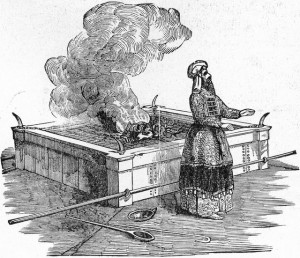
High Priest Offering Sacrifice of a Goat“. . . the duties of the priests to the people . . . ”

Canon 9 of Title III of the Constitution and Canons of the Episcopal Church is entitled “Of the Life and Work of Priests.” It is ten and a half pages long; several of its paragraphs begin with the words, “It shall be the duty . . . .”

The Catechism in The Book of Common Prayer teaches:

The ministry of a priest is to represent Christ and his Church, particularly as pastor to the people; to share with the bishop in the overseeing of the Church; to proclaim the Gospel; to administer the sacraments; and to bless and declare pardon in the name of God.

In the service of ordination of a priest, the candidate for ordination is asked early in the liturgy:

Will you be loyal to the doctrine, discipline, and worship of Christ as this Church has received them? And will you, in accordance with the canons of this Church, obey your bishop and other ministers who may have authority over you and your work?

Later in the service, the bishop addresses the ordinand with these words:

As a priest, it will be your task to proclaim by word and deed the Gospel of Jesus Christ, and to fashion your life in accordance with its precepts. You are to love and serve the people among whom you work, caring alike for young and old, strong and weak, rich and poor. You are to preach, to declare God’s forgiveness to penitent sinners, to pronounce God’s blessing, to share in the administration of Holy Baptism and in the celebration of the mysteries of Christ’s Body and Blood, and to perform the other ministrations entrusted to you.

In all that you do, you are to nourish Christ’s people from the riches of his grace, and strengthen them to glorify God in this life and in the life to come.

The ordinand is then asked eight more questions requiring him or her to promise to faithfully carry out specific ministries or to order his or her life in a particular way.

When the bishop and other presbyters lay hands upon the ordinand, the bishop prays:

Father, through Jesus Christ your Son, give your Holy Spirit to N.; fill him with grace and power, and make him a priest in your Church. May he exalt you, O Lord, in the midst of your people; offer spiritual sacrifices acceptable to you; boldly proclaim the gospel of salvation; and rightly administer the sacraments of the New Covenant. Make him a faithful pastor, a patient teacher, and a wise councilor. Grant that in all things he may serve without reproach, so that your people may be strengthened and your Name glorified in all the world. All this we ask through Jesus Christ our Lord, who with you and the Holy Spirit lives and reigns, one God, for ever and ever. [The pronouns are changed when the ordinand is a woman.]

When a priest accepts the call to be rector of a parish, he or she kneels in the center of the church’s worship space in the midst of the people and prays:

O Lord my God, I am not worthy to have you come under my roof; yet you have called your servant to stand in your house, and to serve at your altar. To you and to your service I devote myself, body, soul, and spirit. Fill my memory with the record of your mighty works; enlighten my understanding with the light of your Holy Spirit; and may all the desires of my heart and will center in what you would have me do. Make me an instrument of your salvation for the people entrusted to my care, and grant that I may faithfully administer your holy Sacraments, and by my life and teaching set forth your true and living Word. Be always with me in carrying out the duties of my ministry. In prayer, quicken my devotion; in praises, heighten my love and gratitude; in preaching, give me readiness of thought and expression; and grant that, by the clearness and brightness of your holy Word, all the world may be drawn into your blessed kingdom. All this I ask for the sake of your Son our Savior Jesus Christ. Amen.

“. . . the duties of the priests to the people . . . ”

I was a law office administrator and later a lawyer. I was an active member of the church. I served on the diocesan council, the commission on ministry, the camp and conference center board, and several other committees, commissions, and task forces. I even became the diocesan chancellor (the chief legal office of a diocese). From time to time my bishop (first Wes Frensdorff and then Stewart Zabriskie, both now departed) would say something like, “Why don’t we get you ordained?” or “When are you going to go to seminary?” or some other encouragement to take on the life and work of a priest, to bear the burden of “the duties of the priests to the people.” I would answer in protest, “I’m happy being a layman.”

Until one day, I couldn’t protest any longer. A friend who wanted to be a priest (he was a gas company engineer) but couldn’t afford the cost of changing careers died. He was only 45. At his funeral, I said to my wife, “I can’t do this anymore.” I started into the ordination process.

“. . . the duties of the priests to the people . . . ”

I didn’t want them. They can be onerous and burdensome. I don’t know how many of the duties of an Episcopal priest were also the duties of the priests of God at Shiloh. I know they had some duties that I’m very thankful we don’t have, like sacrificing animals. But I’ll bet the sons of Eli didn’t want them. The Law and the traditional inheritance of their tribe required that they do them, but I’ll bet they really didn’t want to, and that’s why they became “scoundrels.”

No one who does not feel that he or she cannot do anything else should take on “the duties of the priests to the people.” Maybe we ask the wrong questions at ordination. The really important question is “Can you do anything else?” because if you can, we shouldn’t be ordaining you. Our ordination screening process, the “discernment process” is (I guess) supposed to answer that question, although I’m not sure it does. But that is the most important question. Unless you simply cannot not be a priest, don’t be one.

“. . . the duties of the priests to the people . . . ”

They are often onerous and burdensome. I didn’t want them. In many ways, I still don’t want them. But I cannot not be a priest.

====================

A request to my readers: I’m trying to build the readership of this blog and I’d very much appreciate your help in doing so. If you find something here that is of value, please share it with others. If you are on Facebook, “like” the posts on your page so others can see them. If you are following me on Twitter, please “retweet” the notices of these meditations. If you have a blog of your own, please include mine in your links (a favor I will gladly reciprocate). Many thanks!

====================

Father Funston is the rector of St. Paul’s Episcopal Church, Medina, Ohio.

Nominate, Pray, Take Your Chances – From the Daily Office – June 18, 2013

From the Book of Acts:

So they proposed two, Joseph called Barsabbas, who was also known as Justus, and Matthias. Then they prayed and said, “Lord, you know everyone’s heart. Show us which one of these two you have chosen to take the place in this ministry and apostleship from which Judas turned aside to go to his own place.” And they cast lots for them, and the lot fell on Matthias; and he was added to the eleven apostles.

(From the Daily Office Lectionary – Acts 1:23-26 (NRSV) – June 18, 2013.)

Note: This blog has been “silent” the past few days for a variety of reasons. It was John Lennon, I believe, who observed that “life is what happens to you while you’re busy making other plans.” The past half-week or so has certainly been an example of that!

Drawing StrawsToday’s reading from Luke’s history of the early church details the method by which the eleven remaining apostles chose someone to replace Judas. It was a simple method: (a) identify the candidates; (b) pray; (c) take your chances. They drew lots, but they might have thrown dice, cut a deck of cards, flipped a coin, or done any number of other things that would have randomized the outcome.

There is something instructive in this lesson for Episcopalians who are now preparing for the 2015 meeting of the General Convention of the Episcopal Church at which a new Presiding Bishop will be chosen.

The Presiding Bishop is the Episcopal Church’s chief pastor (“head cook and bottle-washer” my late stepfather would have said). He or she (our current PB is a woman) is the Primate and Metropolitan of the church, equal in rank to the Archbishop of Canterbury and the other head pastors of the several autocephalic (independent and self-governing, though related and interdependent) provinces of the Anglican Communion.

How the Presiding Bishop is selected has changed three times in the 200-plus years of the American church’s existence. Under the original 1789 constitution of the church, the Presiding Bishop was simply the senior bishop in order of consecration. He (back then it was always “he”) served until death or retirement, when the next senior bishop took over; the Presiding Bishop retained his diocesan position (and in those days a bishop was also a parish rector). His only real duties were to be chief consecrator of new bishops and to preside at meetings of the House of Bishops; there was no national church administration and, to be honest, no Anglican Communion with which to interact. Eventually, the office was made elective in 1919. The archives of the Episcopal Church tell us:

The first election of a Presiding Bishop by General Convention took place in 1925. Since 1943 the Presiding Bishop has been required to resign diocesan jurisdiction upon election. In 1967 the duties of the office were significantly enhanced. As “Chief Pastor,” the Presiding Bishop is charged with initiating and developing church policy and strategy, speaking God’s Word to the church and the world, and visiting every diocese of the church. The title “Primate” was added in 1982. The Cathedral of Saint Peter and Saint Paul in Washington, D.C., is the official seat of the Presiding Bishop. The office of the Presiding Bishop is located at the Episcopal Church Center in New York City. The present term of office for the Presiding Bishop is nine years.

A term limitation was first imposed in 1976 when the canons were amended to provide for a twelve-year term (four triennia); this was amended in 1994 when the term was shortened to nine years. Our current Presiding Bishop was elected in 2006 and her term will end at the General Convention of 2015 when her successor will be elected.

In the past, the election has been by the House of Bishops with the House of Deputies concurring. Nominees were selected by the Bishops and the method of nomination and the balloting kept secret. At the last General Convention, it was decided that the whole church should be involved in the nomination process and a “joint commission” was created to select nominees consisting laity, clergy, and bishops. In the current budget of the church the princely sum of $226,000 is set aside for the expenses of this nominating committee. At the 2015 convention, because there has been no change in the Constitution or canons governing the process, the House of Bishops will elect and the election will be reported to the House of Deputies for its concurrence. Laity and clergy will not actually vote for the Presiding Bishop; they will “rubber stamp” the House of Bishops choice — the House of Deputies has never failed to concur in a Presiding Bishop election.

There are calls now to democratize the process further by amending the canons to provide that the PB be elected by both Houses of the General Convention, the House of Deputies voting “by orders” (which means the lay deputies and clergy deputies vote separately); to be selected, a nominee would need a majority of the votes of the bishops, a majority of clergy votes, and a majority of lay votes. (A “vote by orders” in the House of Deputies is a complicated and structurally conservative process actually requiring more than a simple majority, but that’s too much to think about this morning.)

I read about the drawing of lots by the Apostles in the first chapter of Acts and I begin to question the complication and expense of the processes we have devised . . . . Do they really work any better?

Praying and “taking your chances” has worked for the People of God throughout history, and random chance has been used to discern the divine will in many religions. For example, the I Ching (The Book of Changes) of China seeks guidance using the random tossing of yarrow stocks or the flipping of three coins to produce “hexagrams,” the meanings of which are recorded in the book. In the ancient Jewish religion, the High Priest carried two stones (or possible wooden or bone plates) in his breastplate, the Urim and Thummim, which were used to divine God’s Will; exactly what they were and how they were used is lost to history, but one speculation is that they were a sort of “holy dice” which would be cast and a message or meaning derived therefrom.

I have been told that in the tradition of some Eastern or Oriental Orthodox churches (particularly the Ethiopian church) bishops are selected by chance: the names of the eligible candidates are written on slips of paper which are put into a chalice and then one is randomly pulled out by a child. I’ve also been told that a similar method is (or was) used by the Moravians to select bishops with the interesting addition of a blank paper which, if drawn, would indicate that God was not satisfied with any of the named candidates and that the church should consider additional nominees.

It seems to me that these methods are equally as “democratic” as the expensive and complicated processes now underway in (or proposed for the future of) the Episcopal Church. We all share in such a random chance process!

Why not simply put the names of all eligible diocesan bishops (every bishop who has been in office at least five years and who will not reach mandatory retirement age before the end of the nine-year term) into a large chalice, pray, and let the youngest deputy present draw out a name? Presiding Bishop selected, complicated process and exorbitant expense avoided, and (by the way) the example of Scripture honored and followed.

Nominate, pray, take your chances! It worked for the Apostles. Surely it could work for us.

====================

A request to my readers: I’m trying to build the readership of this blog and I’d very much appreciate your help in doing so. If you find something here that is of value, please share it with others. If you are on Facebook, “like” the posts on your page so others can see them. If you are following me on Twitter, please “retweet” the notices of these meditations. If you have a blog of your own, please include mine in your links (a favor I will gladly reciprocate). Many thanks!

====================

Father Funston is the rector of St. Paul’s Episcopal Church, Medina, Ohio.

Honoring Women on Fathers’ Day – Sermon for the 4th Sunday after Pentecost (Proper 6C) – June 16, 2013

====================

This sermon was preached on the Fourth Sunday after Pentecost, June 16, 2013, at St. Paul’s Episcopal Church, Medina, Ohio, where Fr. Funston is rector.

(Revised Common Lectionary, Pentecost 4 (Proper 6, Year C): 1 Kings 21:1-21a; Psalm 5:1-8; Galatians 2:15-21; Luke 7:36-8:3. These lessons can be read at The Lectionary Page.)

====================
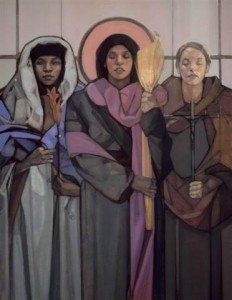
Mary Magdalene Susanna and Joanna by Janet McKenzieToday, I would like to talk about women. I know it’s Fathers’ Day but as my friend and colleague (someone known to many of you) the Rev. Jennifer Leider recently remarked, “The lectionary is no respecter of secular holidays.” On this 4th Sunday after Pentecost, looking at the lessons for Proper 6 in Lectionary Year C, we have some readings from Scripture which draw our attention to women: women as active agents in the world of men, as subjects who act rather than as objects which are acted upon. Given the cultures, the political realities, and the social mores of the times and places in which these stories happened and were recorded, that’s really quite amazing! So, it may be Fathers’ Day, but let’s take a look at these biblical women.

The first woman to consider is the wife of King Ahab of Israel, Queen Jezebel. Jezebel was the daughter of Ethbaal, king of Tyre, the Phoenician empire. She was a powerful woman who commanded her own army and had considerable control over the religious establishment of her homeland. According to the Scriptures, she converted her husband to the worship of Ba’al and convinced him to have many Jewish prophets killed. As we heard a couple of weeks ago, she brought 450 prophets of Ba’al into Israel and the Jewish prophet Elijah challenged them to a competition, which he and Yahweh won, and he then had the prophets of Ba’al slaughtered. This made Jezebel his enemy and, out of fear for her, he fled the country. In today’s lesson from the First Book of Kings we see her wielding this power and manipulating her husband’s acquisition of a vineyard by getting the legitimate owner, Naboth, falsely accused of and executed for blasphemy. This was not a woman to be messed with; she had political, military, and religious power.

This was not so with the second woman we meet in Scripture today, a woman described in Luke’s Gospel as a “notorious sinner” who interrupts a dinner party to wash Jesus’ feet with her tears, dry them with her hair, and anoint them with costly oil poured from an alabaster jar.

In all four of the gospels there is a story like this. Matthew, Mark, Luke, and John all relate a tale of a woman who, at a dinner party, comes and anoints Jesus with a jar of balm described as extravagantly expensive. In each story someone objects to the waste of the valuable ointment (or the money spent on it). In each story someone questions Jesus’ credentials as a religious person. In each story Jesus defends the woman’s action.

In Matthew’s Gospel the event happens “while Jesus was at Bethany in the house of Simon the leper,” just a few days before the Crucifixion; “a woman came to him with an alabaster jar of very costly ointment, and she poured it on his head as he sat at the table.” When the action is challenged by the disciples, Jesus defends it as an anointing for his burial. (Matt. 26:6-13) Mark’s version is essentially the same as Matthew’s.

John says that it was Jesus’ feet that were anointed, rather than his head, but agrees with Matthew and Mark this event took place just a few days before Jesus’ execution. Like Luke, John describes the woman as washing Jesus’ feet with her tears and drying them with her hair. But John identifies the woman as Mary of Bethany, the sister of Martha and Lazarus.

Luke is the only one who doesn’t put relate this story as part of the narrative Jesus’ passion and death. In this version, Luke takes the story of anointing, places it in the house of a Pharisee, adds the parable of excused mortgages, and gives us a story forgiveness, not a story of preparation for death.

In each of the other stories, especially John’s telling, there is some suggestion that the woman has a legitimate right to be at the dinner, or at least in the house. This is not the case here. As I said a moment ago, this woman is described by Luke as “a notorious sinner.” She is clearly not an invited guest; she is not a member of Simon the Pharisee’s household. She just comes in off the street and does this remarkable, surprising thing. We might wonder how this could have happened; how could she have gotten all the way into the dining room to do this? To answer that question, we need to imagine ourselves in First Century Palestine.

Imagine that world for a moment. There are no telephones, neither cell phones nor land lines. There is no air conditioning. There is no refrigeration. Nothing electric at all. Furthermore, there is no credit; lending or credit are forbidden in the Law of Moses. Whatever was needed for daily life, especially food, had to be purchased with cash everyday. Whatever communication there was need of had to be done in person or through a messenger, usually a servant or slave employed specifically to run messages around town. Whatever business was done was usually done from the home, not from an office somewhere else. There were no schools; whatever education a child may have gotten was done at home by parents or, if the family was wealthy, by servants or hired tutors.

So people were constantly coming and going; members of the household going out to shop everyday and returning with their purchases. Messengers from others delivering family or business communications; the households own messengers taking messages to others. Servants coming and going.

Houses of the sort a prominent man like Simon the Pharisee would have had had a central courtyard with a number of rooms opening off it. The courtyard would have been separated from the public street by a wall and a gate, the gate usually open to all that coming and going.

The other three sides of the courtyard was surrounded by rooms, which would have been open to the courtyard to provide ventilation and cooling. Their inner walls would have been finished with a smooth coat of clay or plaster, decorated with elaborate frescoes. Wide benches of stone for sitting and sleeping, and shelves for storage would have been built into the walls. Stairs or a ladder would have led up onto the roof, which was used as an outdoor room most likely for bathing and laundry during the day and for sleeping at night during summer heat.

These rooms tended to be small and dark, so the courtyard and the roof were the important parts of the house; here those activities needing good light, spinning and weaving, food preparation, and dining would have taken place. In the courtyard of a First Century house you might find:

  • the mikveh, a pool of clean rainwater used for ritual cleansing
  • a kitchen area where food, purchased day by day, was prepared
  • a covered area where people worked and socialized, where they ate

This was the center of activity and socializing; it was here that all that coming and going took place. It was here that a woman might enter the gate right off the public street and interrupt a dinner in progress.

And that is what this woman did. A “notorious sinner,” an outcast, one of the lowest of the low, took matters into her own hands. Knowing that Jesus was there and knowing that he might be able to help her do something to end her abject abnegation, she felt herself empowered. She had heard, no doubt, about the several times he had healed and forgiven others even when others thought it violated the Law in some way (Luke, Chapters 5 and 6). She might have heard about (or even been present at) his Sermon on the Plain. When he said:

Blessed are you who are poor, for yours is the kingdom of God. Blessed are you who are hungry now, for you will be filled. Blessed are you who weep now, for you will laugh. Blessed are you when people hate you, and when they exclude you, revile you, and defame you on account of the Son of Man. Rejoice in that day and leap for joy, for surely your reward is great in heaven; for that is what their ancestors did to the prophets. (Luke 6:20-23)

she might have understood that he was speaking to her. And when she heard him say:

Do not judge, and you will not be judged; do not condemn, and you will not be condemned. Forgive, and you will be forgiven; give, and it will be given to you. A good measure, pressed down, shaken together, running over, will be put into your lap; for the measure you give will be the measure you get back. (Luke 6:37-38)

she may have made her plan to give everything she had, to spend whatever she had on that costly jar of oil, to give him her best in thanksgiving for the forgiveness she felt had been given her. So she took matters into her own hands, bought that ointment, and walked through that gate and into that dinner party. Jesus rewarded her boldness and confirmed her forgiveness in the parable he told the Pharisee and in the words with which he thanked her and sent her on her way, “Your faith has saved you; go in peace.”

The last image of women we have in today’s lessons is not a single woman, but a group of women. Luke tells us that, shortly after this extraordinary dinner party, Jesus went on through cities and villages, proclaiming the good news, and that with him where the twelve and “some women who had been cured of evil spirits and infirmities: Mary, called Magdalene, from whom seven demons had gone out, and Joanna, the wife of Herod’s steward Chuza, and Susanna, and many others, who provided for them out of their resources.” (Luke 8:1-3) Here we have a picture of women of who in one sense are like Jezebel: they are independent women of means, some married, some unmarried, who own their own property and resources, women who have the authority to do as they wish. But in another sense they are like the woman with the alabaster jar; they give from their resources to provide for Jesus in his ministry.

So these are the three pictures of women in today’s scriptures: a woman of wealth and power who used who wealth and power to corrupt and manipulate; a woman of absolutely no status whatsoever who felt empowered to give probably everything she had in gratitude for the forgiveness brought to her by Jesus; and women of independent means who made their own decisions to work for the betterment of the world, who (in this particular instance) supported Jesus in his ministry of forgiveness. It is certainly not like Jezebel, but like the others that the Episcopal Church and the Anglican Communion encourages and hopes to help women to become through our adoption of the Third Millennium Goal: to promote gender equality and empower women.

Not only in this Gospel story, but again and again in the Gospels we see Jesus meeting and interacting with women in ways that honor them, raise them up, and empower them. There is the woman who argued that “even the dogs get to eat the crumbs under the table” as she begged for healing for her daughter, whose faith Jesus applauded. There is the widow he observed who gave all she had to the temple treasury, whom Jesus praised for putting the wealthy to shame. There was Mary Magdalene, who became the first witness to the resurrection, the first evangelist of the Good News of the Risen Christ.

These are women whom Jesus empowered to be something other than the role their society would have put them in, to act with confidence that they, like the men around them, were created in the image of God.

Many women around the world today live in circumstances that make it difficult, if not impossible, to act with similar confidence. News reports daily document the level of violence against women: rape as a weapon of war (or as a possible danger of military service), so-called honor killings, sex trafficking, and other horrors suffered by women simply because they are women. In the United States today, homicide is the third leading cause of death for girls aged 1 to 4 and also for young women, 15 to 24, and most are killed by someone they know.

We are called by Jesus and by the church to emulate his ministry of forgiveness and empowerment, to offer women throughout the world the opportunity to choose life in a world ravaged by war, hunger, disease, and death; to promote gender equality so that women and men have equal opportunities and equal roles in decision-making throughout society. To promote equality between the sexes is to promote the healing of our world and to further the church’s ministry of reconciliation.

Yes, it’s Fathers’ Day, and as Jennifer Leider said, “The lectionary is no respecter of secular holidays.” But as it happens, Time Magazine decided to celebrate Fathers’ Day this week by asking some famous fathers to write open letters to their daughters, and those letters echo remarkably the message of today’s lectionary readings. Senator Marco Rubio wrote to his daughters Amanda and Daniella: “My hope for my daughters is that they will grow up to be strong, confident women who understand that they can be whatever that want to be in life.” Chicago mayor Rahm Immanuel wrote to his daughters Ilana and Leah his hope that they would be “smart, fearless, independent . . . strong, trailblazing women.” And producer Aaron Sorkin wrote this advice to his daughter Roxanne: “Be brave and know that the bravest thing you can do is be willing to not fit in. Never take pleasure in someone else failing. Dare to fail yourself. Be the one who doesn’t care as much about clothes as the person wearing them. Be kind, be compassionate and be humble.”

Our call as Christians, the message of today’s lessons, is that we are to help build a world where that is possible, where no woman need be as conniving and manipulative as Jezebel, where no woman should be as put down and subjected as the woman who interrupted the dinner party, where every woman can be as independent and resourceful as those who followed Jesus and supported his ministry of forgiveness.

Today’s Gospel teaches us that the best way to honor fathers is empower their daughters.

====================

A request to my readers: I’m trying to build the readership of this blog and I’d very much appreciate your help in doing so. If you find something here that is of value, please share it with others. If you are on Facebook, “like” the posts on your page so others can see them. If you are following me on Twitter, please “retweet” the notices of these meditations. If you have a blog of your own, please include mine in your links (a favor I will gladly reciprocate). Many thanks!

====================

Father Funston is the rector of St. Paul’s Episcopal Church, Medina, Ohio.
Removing the Distraction of Personality – From the Daily Office – June 14, 2013

From the Book of Jesus Ben Sirach:

He exalted Aaron, a holy man like Moses
who was his brother, of the tribe of Levi.
He made an everlasting covenant with him,
and gave him the priesthood of the people.
He blessed him with stateliness,
and put a glorious robe on him.
He clothed him in perfect splendour,
and strengthened him with the symbols of authority,
the linen undergarments, the long robe, and the ephod.
And he encircled him with pomegranates,
with many golden bells all round,
to send forth a sound as he walked,
to make their ringing heard in the temple
as a reminder to his people;
with the sacred vestment, of gold and violet
and purple, the work of an embroiderer;
with the oracle of judgement, Urim and Thummim;
with twisted crimson, the work of an artisan;
with precious stones engraved like seals,
in a setting of gold, the work of a jeweller,
to commemorate in engraved letters
each of the tribes of Israel;
with a gold crown upon his turban,
inscribed like a seal with ‘Holiness’,
a distinction to be prized, the work of an expert,
a delight to the eyes, richly adorned.
Before him such beautiful things did not exist.
No outsider ever put them on,
but only his sons
and his descendants in perpetuity.

(From the Daily Office Lectionary – Ecclesiasticus 45:6-13 (NRSV) – June 14, 2013.)

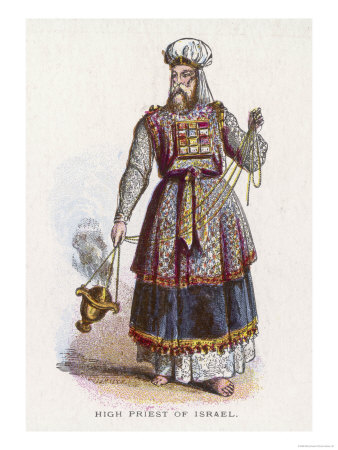
Jewish High Priest in His Ceremonial VestmentsWow!

And some people think an alb, stole, and chasuble are “fancy!”

There are a lot of essays out there on the history, origin, function, and purposes of vestments. Every writer has a slightly different take on the matter.

Here’s what I think: vestments obscure the minister. In a sense, vestments “democratize” the priesthood. Vestments symbolize the office of the priest, minister, or elder. No matter what the denominational tradition – whether they are the richly decorated, colorful vestments of the Orthodox or Catholic traditions, or the simple black Geneva gown of the Reformed tradition – the ceremonial garb obscures the personality of the individual wearing them. Personal differences among and between clergy can be a distraction, and there should be no distractions in worship. The focus should be God, not the presider.

Suppose we didn’t wear vestments (and there are traditions in which the preachers and worship leaders do not). And suppose one worship leader is dressed in a very stylish, well-tailored, custom-made, $3,000 Brooks Brothers suit. Suppose another is dressed in a $150 off-the-rack, polyester suit. Another, in t-shirt and jeans. Each participant in worship will react differently to these three clergy, based solely on their appearance. This difference in reaction may rational or non-rational; it may be volitional or non-volitional. But it will be there.

Now, suppose we have these same three leaders. But over their street clothes all are wearing an alb, a stole, and a chasuble. One cannot see any difference in their attire. That distinction between the clergy is erased.

Whatever the other reasons may be that we wear vestments, I think this obscuring of differences amongst the clergy is the most important. Vestments, fancy or plain, remove the distraction of personality.

====================

A request to my readers: I’m trying to build the readership of this blog and I’d very much appreciate your help in doing so. If you find something here that is of value, please share it with others. If you are on Facebook, “like” the posts on your page so others can see them. If you are following me on Twitter, please “retweet” the notices of these meditations. If you have a blog of your own, please include mine in your links (a favor I will gladly reciprocate). Many thanks!

====================

Father Funston is the rector of St. Paul’s Episcopal Church, Medina, Ohio.

Sitting Under, or Climbing, the Fig Tree – From the Daily Office – June 11, 2013

From the Gospel according to Luke:

Jesus entered Jericho and was passing through it. A man was there named Zacchaeus; he was a chief tax collector and was rich. He was trying to see who Jesus was, but on account of the crowd he could not, because he was short in stature. So he ran ahead and climbed a sycamore tree to see him, because he was going to pass that way.

(From the Daily Office Lectionary – Luke 19:1-4 (NRSV) – June 11, 2013.)

Sycamore Fig in AshkelonThe sycamore which Zacchaeus climbed is not the tree known to Americans as a sycamore. The American sycamore (Platanus Occidentalis) is also known as the “Buttonwood.” It was under a buttonwood tree at 68 Wall Street, New York City, that the New York Stock Exchange was form in 1793; the founding terms are known as the Buttonwood Agreement. A very large buttonwood sycamore stood in the church yard of St. Paul’s Chapel in New York City until September 11, 2001. It is said that that tree shielded St. Paul’s Chapel from the destructive storm of debris from the fall of the World Trade Center towers, allowing the chapel to survive and become a center of recovery ministry during the clean-up in the weeks that followed.

The biblical tree, however, is a fruit-bearing fig tree (Ficus Sycomorus). (In the “anglicized” version of the New Revised Standard translation of the bible, the spelling of “sycamore” in this passage is changed to “sycomore” to conform with the scientific name and to distinguish the tree from other “sycamores.”) There are several references to the sycamore fig in the Old Testament, one of my favorites being Amos’s protestation when Amaziah addresses him as a prophet: “I am no prophet, nor a prophet’s son; but I am a herdsman, and a dresser of sycamore trees.” (Amos 7:14) Knowing that the biblical sycamore is a fig tree makes being a “dresser of sycamore trees” much more understandable!

In the first chapter of John’s Gospel, Nathanael becomes a disciple when Jesus tells him he knew who he was when he saw him “sitting under the fig tree.” (John 1:47-50) It was probably a sycamore fig. “Sitting under the fig tree” was a colloquial expression referring to studying the Law. In later rabbinic commentary on the Book of Numbers, the Midrash Bamidbar Rabbah, the question, “Why is the Torah compared to a fig tree?” is answered:

Because most trees — olive, grape, date, have their fruit harvested all at one time, but the fig’s fruit is picked gradually. And so it is with the Torah: You learn a little today and more tomorrow, for you cannot learn it in one or two years. (Midrash Bamidbar Rabbah 12:9)

It was probably a sycamore fig that the Midrash writer had in mind.

I’m amused by the coincidence of this lesson with this date. In 1980, when I started law school, my wife and I bought a small two-bedroom bungalow in San Diego, California, on a street called “Sycamore Lane.” We lived there for three years. It was there (though not actually in that house) that our son was born on June 11, 1983. The next day, we brought him home to his first home on Sycamore Lane, and for the next six weeks he helped me study for the Nevada Bar Exam which I took that summer. We “sat under the sycamore fig” together, especially late at night, studying the law.

Thirty years later, I am no longer practicing law, and my son and I are both priests. In these thirty years, I’ve learned a lot and think he has, too. What the Midrash had to say about the study of Torah is true of all of life: you learn a little today and more tomorrow, for you cannot learn it in one or two . . . or thirty . . . years. Every day is a day to sit under, or to climb, the fig tree.

====================

A request to my readers: I’m trying to build the readership of this blog and I’d very much appreciate your help in doing so. If you find something here that is of value, please share it with others. If you are on Facebook, “like” the posts on your page so others can see them. If you are following me on Twitter, please “retweet” the notices of these meditations. If you have a blog of your own, please include mine in your links (a favor I will gladly reciprocate). Many thanks!

====================

Father Funston is the rector of St. Paul’s Episcopal Church, Medina, Ohio.

What a Long, Strange Trip – From the Daily Office – June 10, 2013

From the Second Letter to the Corinthians:

Look at what is before your eyes.

(From the Daily Office Lectionary – 2 Corinthians 10:7a (NRSV) – June 10, 2013.)

Road to the Desert HorizonDo we ever really know what is “before our eyes”?
I’ve been saying the Daily Office and reading the associated lessons of the two-year-cycle lectionary for the better part of 40 years and never before has this short sentence jumped out at me like it does today!

30 years ago tonight, my wife and I made the short trip from our small bungalow in East San Diego, where we had lived while I attended law school, to Sharp Hospital in Kearney Mesa where she would, early the next morning, give birth to our son, Aidan Patrick. If anyone had said to us, “Look at what is before your eyes,” we would have described a life of law practice and stability in our home state of Nevada. We had it pretty definitely planned out. We were very definitely wrong!

As I thought about the last three decades, a line from a song kept popping into my head. I’d like to be all religious and spiritual and pretend it is a line from a hymn . . . but it’s not. The words are, “What a long, strange trip it’s been.” From Truckin’ by the Grateful Dead. Now that song is an ear-worm which probably will eat away at me all day. What it’s definitely done is taken over this meditation.

So rather than write some other words, I give you the lyrics to Truckin’:

Truckin’ got my chips cashed in.
Keep truckin’, like the do-dah man
Together, more or less in line, just keep truckin’ on.

Arrows of neon and flashing marquees out on Main Street.
Chicago, New York, Detroit and it’s all on the same street.
Your typical city involved in a typical daydream
Hang it up and see what tomorrow brings.

Dallas, got a soft machine; Houston, too close to New Orleans;
New York’s got the ways and means; but just won’t let you be.

Most of the cats that you meet on the streets speak of true love,
Most of the time they’re sittin’ and cryin’ at home.
One of these days they know they gotta get goin’
Out of the door and down on the streets all alone.

Truckin’, like the do-dah man.
Once told me “You got to play your hand,”
Sometimes your cards ain’t worth a damn, if you don’t lay ’em down,

Sometimes the light’s all shinin’ on me;
Other times I can barely see.
Lately it occurs to me
What a long, strange trip it’s been.

What in the world ever became of sweet Jane?
She lost her sparkle, you know she isn’t the same
Livin’ on reds, vitamin C, and cocaine,
All a friend can say is “Ain’t it a shame?”

Truckin’, up to Buffalo. Been thinkin’, you got to mellow slow
Takes time, you pick a place to go, and just keep truckin’ on.

Sittin’ and starin’ out of the hotel window.
Got a tip they’re gonna kick the door in again
I’d like to get some sleep before I travel,
But if you got a warrant, I guess you’re gonna come in.

Busted, down on Bourbon Street, Set up, like a bowling pin.
Knocked down, it get’s to wearin’ thin. They just won’t let you be.

You’re sick of hanging around and you’d like to travel;
Get tired of traveling and you want to settle down.
I guess they can’t revoke your soul for tryin’,
Get out of the door and light out and look all around.

Sometimes the light’s all shinin’ on me;
Other times I can barely see.
Lately it occurs to me, What a long strange trip it’s been.

Truckin’, I’m a goin’ home,
Whoa whoa baby, back where I belong,
Back home, sit down and patch my bones, and get back truckin’ home.

Now that I sing it through, I realize this is a song that’s all spiritual and religious. It occurs to me that life is a trip and, despite Paul’s admonition, no matter how careful we scope it out, we really can’t see what is before our eyes. We always end up looking back and saying, “What a long, strange trip it’s been!”

Strange and wonderful. Thanks be to God!

====================

A request to my readers: I’m trying to build the readership of this blog and I’d very much appreciate your help in doing so. If you find something here that is of value, please share it with others. If you are on Facebook, “like” the posts on your page so others can see them. If you are following me on Twitter, please “retweet” the notices of these meditations. If you have a blog of your own, please include mine in your links (a favor I will gladly reciprocate). Many thanks!

====================

Father Funston is the rector of St. Paul’s Episcopal Church, Medina, Ohio.

Offal Theology Beats Awful Theology – Sermon for the 3rd Sunday after Pentecost (Proper 5C) – June 9, 2013

====================

This sermon was preached on the Third Sunday after Pentecost, June 9, 2013, at St. Paul’s Episcopal Church, Medina, Ohio, where Fr. Funston is rector.

(Revised Common Lectionary, Pentecost 3 (Proper 5, Year C): 1 Kings 17:8-24; Psalm 146; Galatians 1:11-24; and Luke 7:11-17. These lessons can be read at The Lectionary Page.)

====================

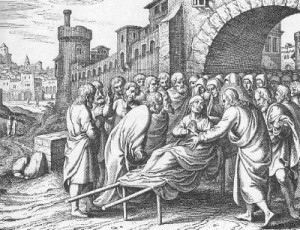
Jesus Raises the Son of the Widow of NainYou may remember that last week, as we were looking at the story of Elijah competing with the prophets of Ba’al, I said that Elijah was an unpleasant person. Well, this week we have another story of Elijah and another example of his unpleasantness. The Rev. Lia Scholl, a Mennonite pastor who writes sermon helps on a blog called The Hardest Question, said, “Every time I read this passage, my first reaction is, ‘Elijah is a jerk!'”
She points out that doesn’t ask for a drink of water or a morsel of bread, he demands them. Listen again to what the First Book of Kings says, “When [Elijah] came to the gate of [Zarephath], a widow was there gathering sticks; he called to her and said, ‘Bring me a little water in a vessel, so that I may drink.’ As she was going to bring it, he called to her and said, ‘Bring me a morsel of bread in your hand.'” He doesn’t introduce himself; he doesn’t explain himself; he just insists that the widow take care of his needs. “It’s just jerk behavior,” says the Rev. Scholl.

For the moment, though, let’s forgive Elijah his jerkiness, his unpleasant personality, and take a close look at this story. If it is an historical event (and about that there is some considerable doubt), and if the Books of Kings are intended to be a chronological record, then our lectionary has had us read about events in Elijah’s life out of sequence; this story is told one chapter before the sacrifice competition we heard about last week. The reason for us reading the stories out of order is pretty clear; our lectionary editors want us to hear and consider this story in connection with Jesus’ raising of the son of the widow of Nain.

This story about Elijah would have been very familiar to Jesus and those who witnessed what he did in Nain, and it’s possible that this Elijah story was known to Luke. They may have believed it to be an historical fact, but modern scholarship considers it unlikely that this is a factual story. It has the appearance of being a legend or folk tale intended by the author of First Kings to enhance Elijah’s standing as a prophet. First, there is the matter of the magic flask of oil and the magic container of flour, these vessels that never run out during the course of the three-year drought that is said to be affecting the land. (By the way, Elijah is credited with both causing and ending the drought with just a word, but other than this story in First Kings, there’s no evidence in any other historical or archeological record of there being a drought around his time.) Second, there is the manner in which Elijah brings the widow’s son back from the dead. Here’s the way it is described: “He [meaning Elijah] stretched himself upon the child three times.” This is what folklorists and anthropologists would call “sympathetic magic;” Elijah mimics the death of the boy, then acts out his desired resurrection, then utters some sort of magical formula, in this case a prayer to his god, Yahweh.

Now I said that those who witnessed Jesus raise the son of the widow of Nain probably knew this story and probably thought of it as factual. It is this prayer that Elijah speaks, and in fact the whole theology of the story, that makes me glad that we can look back at it and say it probably isn’t!

Listen to what the widow of Zarephath said to Elijah when her son died: “What have you against me, O man of God? You have come to me to bring my sin to remembrance, and to cause the death of my son!” This is awful theology! The widow blames herself for her child’s death. She believes that something she has done has caused her son to die. We still hear this kind of thinking today; we’ve all heard people in fits of grief cry out, “What have I done to deserve this?” Worse, she blames God because God’s prophet, Elijah, has come to her and this (she believes) has caused her sin to be recalled by God; in turn, because of that recollection, God has caused this terrible judgment (the death of her son) to happen. Now the poor woman in her grief, I suppose, can be forgiven this awful theology.

But Elijah in his prayer, his magic incantation after stretching out on the body of the deceased and enacting the boy’s resurrection, says exactly the same thing to God: “O Lord my God, have you brought calamity even upon the widow with whom I am staying, by killing her son?” According to the theology of this story, God punishes the sinful behavior (what ever it may have been) of parents by murdering their children!

I am often called upon to engage in conversation with atheists who want to tell me why they don’t believe in God. I don’t go looking for these conversations, but wearing a clerical collar in an airport or a restaurant or wherever they just seem to happen. And when they tell me why they don’t believe in God, in addition to all the allegedly scientific reasons about there being no credible experimentally verifiable evidence, there is always some variation on, “I can’t believe in a god that would allow (or cause) children to die.”

“Well, guess what?” I tell them. “I don’t either!” I don’t believe in the god that this story of Elijah portrays. I do not believe the theology of this story is correct! And that’s why I’m glad that I can say, “Modern biblical scholarship strongly suggests that this story never happened.” It was and is merely folklore preserved to enhance the reputation of this jerk Elijah as a powerful, miracle-working prophet of God.

But as I suggested, the people who witnessed Jesus’ action in raising the son of the widow of Nain revered Elijah’s memory and probably did believe it to be factual, and that’s why what Jesus did was so important. Let’s set Elijah and his awful theology aside for a moment and just focus on the gospel story.

First of all, let’s make note of the fact that this story is one of only three in which Jesus raises someone from the dead. One is the raising of the synagogue leader Jairus’s daughter told in all of the Synoptic Gospels. The second is the raising of Lazarus told only in John’s Gospel. And then there is this story told only by Luke.

In the first two, Jesus is asked by the grieving father, or by Lazarus’ grieving sisters, to come and heal their sick relative, but before he comes the patient dies. In this story, there is no request at all, and Jesus’ first knowledge of the death is when he happens upon the funeral procession. Luke writes, “As [Jesus] approached the gate of the town, a man who had died was being carried out. He was his mother’s only son, and she was a widow; and with her was a large crowd from the town. When the Lord saw her, he had compassion for her.” That’s it, that’s the key to this story. Jesus had compassion for the widow.

What does that word mean to you? When someone is said to be “compassionate,” what do you understand them to be saying? I asked some high-schoolers what it meant to them and one of them volunteered, “Well, it means you feel sorry for someone.” The rest all agreed with that. I suppose to most modern American folk that is what it means. We feel sorry for someone, so maybe we lend a hand if we have the time, or give a few dollars to charity, or if it’s someone we know we bake a casserole. The root of our word “compassion” is Latin for “feeling with” and feeling someone else’s sorrow, feeling “sorry for them” is part of that.

But that doesn’t hold a candle to the word Luke uses to describe Jesus! The Greek text here is the verb splanchnizomai. You know how some words just stick with you? When I was learning Greek that was one that did – splanchnizomai – I just loved the sound of it. It derives from the noun splanchna, which refers to offal, to inner organs – intestines, spleen, liver, kidneys – we would say “guts” today. Jesus didn’t just “feel sorry” for the widow of Nain; he felt this woman’s pain and grief down here, down deep, down in his offal, down in his guts . . . and he was determined to do something for her.

So Jesus does the unthinkable; he interrupts a funeral procession and takes hold of the corpse! In any culture that would be a violation of, at the very least, good taste, but amongst First Century Palestinian Jews this was an act of unspeakable uncleanness; it was a sacrilege! One simply did not touch, let alone grab hold of a dead body!

I was present at both my father’s and my paternal grandfather’s funerals. They were open-casket funerals because of their Lodge affiliations – my father was member of the BPOE; my grandfather, a Mason. Both groups have special funeral services that require an open casket. I remember that the morticians had arrange their hands so that they were laid across their chests, and I remember that both my mother and my grandmother at the conclusion of the services went up to the coffin, reached out, and grabbed hold of their husband’s hands. I’m certain that both of them, if they could have, would have pulled them out of those boxes and made them live again. They couldn’t, of course, but Jesus could do that for the widow of Nain. He could do it and did do it because he had compassion; he felt her pain and her grief right down there in his gut, and he gave her back her son.

And that is what makes this story so different from our Old Testament story!

The theology of the story of Elijah with widow of Zarephath tells of a god who punishes parents’ wrong doing by murdering their children. Jesus showed that theology to be not merely wrong, but awful, monstrously awful! God is a god of life, not of death. God is a god who not only does not murder children to punish their parents, God gives dead children back to their parents.

God moves powerfully beyond our theologies, especially our monstrous theologies, to give new life, to perform a new creation. God is a god of compassion, a god who feels our pain and our suffering and our grief down deep in God’s guts. (One might say that the offal theology of Jesus is beats the awful theology of Elijah.)

The Lord sets the prisoners free;
because the Lord feels their captivity in his guts.

the Lord opens the eyes of the blind; *
because the Lord feels their blindness in his guts.

the Lord lifts up those who are bowed down;
because the Lord feels their degradation in his guts.

the Lord sustains the orphan and widow.
because the Lord feels their pain and grief and loneliness in his guts.

The offal theology of Jesus beats the awful theology Elijah! Hallelujah!

====================

A request to my readers: I’m trying to build the readership of this blog and I’d very much appreciate your help in doing so. If you find something here that is of value, please share it with others. If you are on Facebook, “like” the posts on your page so others can see them. If you are following me on Twitter, please “retweet” the notices of these meditations. If you have a blog of your own, please include mine in your links (a favor I will gladly reciprocate). Many thanks!

====================

Father Funston is the rector of St. Paul’s Episcopal Church, Medina, Ohio.

Writing Sermons – From the Daily Office – June 8, 2013

From the Psalter:

Lord, you have searched me out and known me.

(From the Daily Office Lectionary – Psalm 139:1 (BCP Version) – June 8, 2013.)

to consider something deeply and thoroughlyToday, it is the evening psalm that I ponder.

The NRSV translation of the first verse of Psalm 139 is similar to that in The Book of Common Prayer: “O Lord, you have searched me and known me.” One renders the Hebrew verb chaqar as “search out;” the other as “search.” And both have always caused me to stop short and wonder, “What? The omniscient, omnipresent God has to look for me?”

Good thing chaqar has some other understandings:

  • In the First Book of Samuel, David is afraid that Saul has decided to kill him and so his friend, Saul’s son Jonathan, tells David that he will “sound out” his father. Chaqar is the verb translated as “sound out.” (1 Samuel 20:12 NRSV)
  • In the First Book of Kings, chaqar is rendered as “determined” when it is used in the story of Solomon making the bronze vessels for the Temple. They could not be weighed “because there were so many of them; the weight of the bronze was not determined.” (1 Kings 7:47 NRSV) – The New American Standard version of this verse uses “ascertained” to translate the Hebrew.
  • In the story of Job, the New American Standard translation uses “ponder” to translate chaqar when Elihu says to Job: “I waited for your words, I listened to your reasonings, while you pondered what to say.” (Job 32:11 NAS)

So “searching” or “searching out” as used in the Psalm doesn’t mean “looking for.” It means giving careful consideration, as in the weighing of precious metal vessels in the First Book of Kings. Even more, it means the give-and-take between two persons, the “sounding out” of ideas, the coming to mutual understanding as two people share their thoughts. And it means to contemplate and meditate upon what the other has revealed, to ponder what he or she has communicated.

Ponder is not a word we use much anymore in modern American English. Say the word to most people and probably the first thing that will come to their minds is the opening stanza of a famous American poem:

“Once upon a midnight dreary, while I pondered, weak and weary,
Over many a quaint and curious volume of forgotten lore,
While I nodded, nearly napping, suddenly there came a tapping,
As of some one gently rapping, rapping at my chamber door.
“Tis some visitor,” I muttered, “tapping at my chamber door —
Only this, and nothing more.”
(Edgar Allen Poe, The Raven)

Ponder, the dictionary tells us, means “to consider something deeply and thoroughly.” That is an image of God that resonates with me. I know full well that God is not an entity, not a being in the sense that God sits in heaven’s library late at night pondering over ancient tomes, leafing through the Book of Life or the Book of the Dead or the whichever book it is in which our “names are written in heaven.” (Luke 10:20) Nonetheless, I am intrigued and even comforted by that image.

Because that is precisely what I do! Especially on a Saturday when I do the final polishing of my sermon for the next day (and, if truth be told, more often than not “final polishing” actually means “start from scratch!”) Surrounded by bibles and books, my computer humming away, a cup of coffee (or other libation) nearby, I ponder God. That God might be simultaneously pondering me delights me. Together we ponder one another, we sound each other out, we ascertain our thoughts; perhaps (one hopes) we become “united in the same mind and the same purpose,” and perhaps within my mind forms “the same mind . . . that was in Christ Jesus.” (1 Cor. 1:10; Philip. 2:5) Hopefully, that gets onto the paper and into the sermon. That is, after all, the goal of writing and preaching homilies!

Lord, you have pondered me and known me; I ponder you and seek to know you . . . . and to preach your truth.

====================

A request to my readers: I’m trying to build the readership of this blog and I’d very much appreciate your help in doing so. If you find something here that is of value, please share it with others. If you are on Facebook, “like” the posts on your page so others can see them. If you are following me on Twitter, please “retweet” the notices of these meditations. If you have a blog of your own, please include mine in your links (a favor I will gladly reciprocate). Many thanks!

====================

Father Funston is the rector of St. Paul’s Episcopal Church, Medina, Ohio.

Justice Begins At Home – From the Daily Office – June 6, 2013

From the Book of Deuteronomy:

You shall appoint judges and officials throughout your tribes, in all your towns that the Lord your God is giving you, and they shall render just decisions for the people. You must not distort justice; you must not show partiality; and you must not accept bribes, for a bribe blinds the eyes of the wise and subverts the cause of those who are in the right. Justice, and only justice, you shall pursue, so that you may live and occupy the land that the Lord your God is giving you.

(From the Daily Office Lectionary – Deuteronomy 16:18-20 (NRSV) – June 6, 2013.)

Hands Through Prison BarsJustice. When I was initiated into the “free and accepted” fraternity of Masons, I was taught that justice is “that standard or boundary of right which enables us to render to every man [sic] his just due without distinction.” Justice, I was told, “is not only consistent with divine and human laws, but is the very cement and support of civil society.” Furthermore, my instructor continued, justice in large measure “constitutes the really good man, so should it be the invariable practice of every Mason never to deviate from the minutest principal thereof.”

As a child in Sunday School, I learned that justice is a quality of the kingdom of Heaven made real in the church’s practice of acceptance and equality. But that really wasn’t true in the church of the early 1950s – not everyone was accepted and not everyone was equal. In fact, I don’t think I would be too far off the mark to say that the Christian church then and now has done a pretty lousy job of teaching, by word and example, what justice, on an individual and personal basis, is. The Masons’ initiatory instruction probably does a better job of personalizing the idea of justice than does any teaching of the church.

We’re pretty good at teaching about “social justice” and addressing justice as a global goal. There are several books and websites where one can read something similar to this (copied from a popular church website):

It is central to the Christian faith that God desires a world in which justice is done. However, the past hundred years have revealed the scale of injustice in the world to be greater than anyone had previously imagined. Global forces that are deeply unfair determine the destiny of the world’s poorest people and cause damage to the planet’s environment. War and suffering follow. This has led to a planet on which, every eight seconds, a child in the developing world dies from diarrhea because his or her community has dirty water. When seen through God’s eyes, this and many similar issues are an outrage.

Striving for justice and working for peace, particularly for the world’s poorest people, are at the heart of what it means to be a follower of Jesus. The good news he came to announce was that suffering and oppression could be brought to an end. Christians believe that their faith should lead them to be the people who help bring that about.

The challenge Christians face is to have a personal way of life that does not add to the world’s problems. This means adopting a simple lifestyle in which the world’s resources are not wasted, buying goods that have been fairly traded, and changing habits that damage the environment. In the richer parts of the world many of them support and give money to organizations that are seeking to improve the conditions of the world’s poorest people, to end conflicts, and to preserve the planet.

I have no real quibble with what this says about justice on a global scale. My concern is, “What do we do about justice in our personal lives and in our most intimate local communities, our parish churches?”

This became an issue in my parish when a church member was arrested, and the fact of the arrest and the nature of the charges were splashed across the front page of the local newspaper’s Friday morning edition. The details are unimportant; what is important is how the rest of the church will deal with this parishioner and other members of the family.

On reading the newspaper, I contacted the family; on Saturday, I visited the arrestee at the county jail. I assured them all of my prayers. But then, in the privacy of my study, I began to wonder, “Should I say anything about the situation in church? Should I rework my sermon for Sunday?” At our early service, I said nothing; but just before our principal service, because of something I was asked by another member, I knew I had to address the issue. Our practice is to make announcements before beginning our worship, so when those were concluded, I said something along these lines:

You may have read Friday’s paper or have learned otherwise that a member of this congregation has been arrested and jailed. None of us know the details, so none of us really has anything to say. What I would ask is that we not speculate, not gossip, not spread rumors, and not judge. Instead, let us keep our fellow member and the family in our prayers, and allow the justice system to do its job. Let’s remember that as Americans we are bidden to treat everyone as innocent until proven guilty, and as Christians we are bidden to forgive even the guilty.

Was that enough? I asked some colleagues; I asked friends on Facebook: “Do you know of resources to help a pastor lead a congregation through dealing with the rather public and embarrassing arrest of a parish member?”

Pretty much deafening silence followed . . . .

I searched the internet.

Pretty much nothing there . . . .

I did learn that there is something called Prison Ministry Awareness Sunday among North American Orthodox Christians. This year, an encyclical from the Assembly of Canonical Orthodox Bishops sets the observation on June 9 and calls on members of Orthodox faith communities to participate in the church’s ministry to those who are in prison, and to support and encourage “those who bring the Gospel of hope and salvation to the incarcerated.” Their letter begins with these words:

We greet you in the surpassing joy of the Risen Christ. By the grace of God, we are blessed to observe the Sixth Sunday of Pascha, which this year falls on June 9, as Prison Ministry Awareness Sunday. We embrace the diakonia of prison ministry in keeping with the example of our Risen Lord Jesus Christ, the Great Physician of our souls, who did not come to call the righteous, but sinners to repentance; who ate in the houses of thieves and forgave the sins of harlots; and who said that, when we visit those in prison, we are in truth visiting Him, the Lord of Glory. (Orthodox Christian Prison Ministry, emphasis in original.)

I believe the Orthodox bishops are on to something. How we handle the arrest and incarceration of a parishioner should be informed by Jesus’ description of the Last Judgment in the 25th chapter of Matthew. When he says, “I was in prison and you visited me” by visiting “one of the least of these who are members of my family,” we should hear his words as addressing the full experience of arrest, arraignment, trial, and sentence. As anyone goes through that process, we should see that person as bearing Jesus’ identity, and however we relate to that person and his or her family will reveal how we relate to Christ. This is especially true of those who are our brothers or sisters in the local Christian community.

Concern for global social justice is well and good, and it certainly has and deserves a place in the teachings and practice of the church. But in light of our parish experience, I believe that, like charity, justice begins at home. How we treat one another in these difficult circumstances in the intimate setting of our parish communities is foundational of our efforts to promote justice in the wider sense.

I’m troubled that there seem to be so few resources available to clergy and church members providing guidance in these circumstances. The Sentencing Project reports that “the United States is the world’s leader in incarceration with 2.2 million people currently in the nation’s prisons or jails — a 500% increase over the past thirty years.” Surely this is something that will increasingly occur in our parishes. We need to address it.

====================

A request to my readers: I’m trying to build the readership of this blog and I’d very much appreciate your help in doing so. If you find something here that is of value, please share it with others. If you are on Facebook, “like” the posts on your page so others can see them. If you are following me on Twitter, please “retweet” the notices of these meditations. If you have a blog of your own, please include mine in your links (a favor I will gladly reciprocate). Many thanks!

====================

Father Funston is the rector of St. Paul’s Episcopal Church, Medina, Ohio.

Humility and Interfaith Dialogue – From the Daily Office – June 4, 2013

From the Book of Deuteronomy:

You must demolish completely all the places where the nations whom you are about to dispossess served their gods, on the mountain heights, on the hills, and under every leafy tree. Break down their altars, smash their pillars, burn their sacred poles with fire, and hew down the idols of their gods, and thus blot out their name from their places.

(From the Daily Office Lectionary – Deuteronomy 12:2-3 (NRSV) – June 4, 2013.)

A Smashed AltarOK. I’ll acknowledge and admit that there may have been good reason for Moses to lay down this law for his people as they were preparing to enter the Promised Land. He was concerned that they maintain their identity as the Hebrews, the People of the God of Sinai, and if they had taken on the gods or worship of the people they were conquering that might have been difficult. That he put these words into the mouth of God, however, is very problematic. It was a disservice to later generations and it has played havoc with ecumenical and interfaith relations in the modern era.

“Wait,” someone will say, “these are God’s words, not Moses’s.” So it says. So it says. Moses claims his words are God’s and we have no reason say otherwise. Except . . . . we have the later revelation of God incarnate in the person of Jesus Christ. We should read the text of the Hebrew Scriptures using our understanding of the Gospel and our relationship with Jesus as a lens or filter; Jesus should be our starting point for reading the text.

Brian McLaren suggests that we use a “a Christo-focal reading,” in which “Jesus becomes . . . the catalytic agent in a chemical reaction or the central variable in a mathematical equation. When Jesus is the focal point of the story, he is the climax, the hero, the summit, the surprise, the shock, the revelation that gives all that precedes and all that follows profound and ultimate meaning.” As one of my seminary professors used to say, “The gospel trumps the bible.”

When we apply such a lens, such a “Christo-focal” reading, when we allow the gospel to trump the bible, does the utter and complete destruction of another people’s religious tradition seem like a godly admonition? Is this what we expect of the God who, incarnate in Jesus, healed the daughter of the Syro-Phoenician woman and the servant of a Roman Centurion, who praised that same Centurion for faith greater than any he had seen in Israel, and who preached his gospel and worked his wonders among the Greek-speaking Gentile population of the Decapolis? Is this what we expect of the God who commissioned and empowered his apostle Paul to walk the streets of Athens viewing the temples of its citizens whom he would later praise as “extremely religious?”

I think not. I’m willing to give God the benefit of the doubt and conclude that these are Moses’s words, and to give Moses the benefit of the doubt that there was good reason for this strategy at the time of the Hebrews’ conquest of the Promised Land.

But today we must have a different attitude toward other faiths! In a paper presented to a symposium on pluralism sponsored by the National Council of Churches, Professor Damayanthi M.A. Niles calls upon Christians to develop a theology “that values and takes plurality seriously.” Such a theology, he argues, would “allow Christians to celebrate and participate in the diversity around us and to add our own particular stories, enriching the story of God’s work in the world.” It would also help Christians to hear “the weaker and marginalized voices often silenced in the name of an artificial unity.” He suggests that as Christians enter into interfaith dialogue we will discover that other religious traditions have appropriated Christ and the Christian story in their own terms. Responding to the ways other faiths may interpret Christian ideas will give us unique opportunities to restate our own understanding of who Christ is. This could not happen if the altars, pillars, sacred poles, the icons, and the images of other faiths are destroyed.

On the first anniversary of 9/11, my friend and colleague Pierre Whalon, bishop of the Convocation of American Churches in Europe, wrote that “the present global situation requires interfaith dialogue.” In an essay entitled The Question of Other Faiths he concluded:

Engaging people of other faiths is therefore not to be done as an exercise in the superiority of Christianity. Not only does our chequered history give the lie to any such claims—they are also fundamentally incompatible with being Christian. It is not in our strength but our weakness that we may speak of Christ to others. He demands not pride, not an imparting of our imagined riches, but an admission of our own poverty before God and others.

No one can go to war who is coming from this position of servanthood. On the contrary. In the strange reversal that characterizes the action of the Spirit, those who seek to be warrior-conquerors are weak, and the ones who cling to the powerless Jesus are the truly strong. This provides us with a coherent position from which to address others that avoids the hollow claims of Christian superiority, the unselfconscious arrogance of universalism, or the belittling of the grounds of Christian faith.

There is a single word that describes this attitude, which was attributed to Jesus himself: humility. It does not come naturally to us anymore than to other people. But without it, we are no followers of Christ, and we therefore have nothing to say to, and learn from, people of other faiths.

More than a decade later there is no less urgency, no less a need for humility and interfaith dialogue. And absolutely no need to “break down their altars, smash their pillars, burn their sacred poles with fire, and hew down the idols of their gods, and thus blot out their name from their places!” Even if that admonition is in the Bible!

====================

A request to my readers: I’m trying to build the readership of this blog and I’d very much appreciate your help in doing so. If you find something here that is of value, please share it with others. If you are on Facebook, “like” the posts on your page so others can see them. If you are following me on Twitter, please “retweet” the notices of these meditations. If you have a blog of your own, please include mine in your links (a favor I will gladly reciprocate). Many thanks!

====================

Father Funston is the rector of St. Paul’s Episcopal Church, Medina, Ohio.

« Older posts Newer posts »