Occasional thoughts of an Anglican Episcopal priest

Category: Ministry (Page 52 of 59)

The Audience of One – From the Daily Office – December 4, 2012

From First Thessalonians:

We have been approved by God to be entrusted with the message of the gospel, even so we speak, not to please mortals, but to please God who tests our hearts. As you know and as God is our witness, we never came with words of flattery or with a pretext for greed; nor did we seek praise from mortals, whether from you or from others.

(From the Daily Office Lectionary – 1 Thess. 2:4-6 (NRSV) – December 4, 2012.)

Audience of OneI would like to have a word with the clergy, music directors, musicians, choir directors, altar guild mistresses, sacristans, choristers, Sunday School superintendents, lay readers, acolytes, and a score of others about all the things many of us are doing to get ready for Christmas.

I’m sure that you, like my colleagues and me, are planning liturgies, choosing music, decorating sanctuaries, casting church school pageants, rehearsing anthems, laundering vestments, practicing readings, learning how to swing thuribles, and doing dozens of other preparatory tasks as the special events of the holiday loom every closer. Your looking forward to your Sunday School Pageant, to the Christmas Cantata, the Christmas Eve Family Service, the Midnight Mass, or whatever the “big event” may be in your congregation. You’re hoping, expecting that there will be a large turnout of appreciative people, probably many who only show up at Christmas (or maybe also at Easter), but you’re really hoping that a big crowd of parishioners will be there.

Last Sunday evening my parish’s choir did a wonderful job of offering a service of Lessons and Carols. It was the shorter version of that model of worship: six lessons each followed by a hymn or choral offering. Other music included a prelude, a couple of additional hymns at the beginning and end, an offertory anthem, and a postlude. A chanted vesper responsory and a few chanted collects were thrown in for good measure. The music was beautifully performed. The six readers of the lessons had obviously practiced and all read very well. Members of the choir had provided, and some non-choir volunteers had laid out, finger food and snacks for a reception in the parish hall following the service.

Barely 40 people attended. Not even a quarter of the Nave was filled. Those who attended all praised the choir’s, the officiant’s, and the readers’ efforts; they said it was a lovely experience. A couple of people said something to this effect, “It’s too bad more people weren’t here.” The spouse of a chorister was rather more critical and wondered why everyone had even bothered with all the planning, all the rehearsals, or the offering of the service when so few parishioners turned out.

Why? Paul directly answers that question in this bit from his first letter to the church in Thessalonika: “We [do it], not to please mortals, but to please God.” We do it for an audience of One.

A service of worship has many of the elements of a dramatic presentation or a musical concert, and much of the preparation we do for worship is the same as is done for those sorts of events. In many ways, worship is a drama . . . but in one important way it is very different. There is no difference between performer and audience; there is, in fact, no human audience. Every man, woman, and child who participates is an actor, not an observer.

For generations the church has acted as if these were roles of worship: The worship leaders (clergy and liturgical assistants, choir, liturgical musicians) are the performers of worship; the congregation is the audience; and God is the prompter of worship, i.e., God tells the worship leaders what to do. My favorite theologian-philosopher Soren Kierkegaard in the 19th Century wrote that that was all wrong. In corporate worship, he suggested, the people should be the performers, the worship leaders are to be the prompters, and God is the audience.

It doesn’t matter that only a few people turned out for the service of lessons and carols, or for any service. If we do all these things we are doing, all the liturgical design, all the musical rehearsal, all the polishing of silver and decorating of the church, and no one shows up on Christmas Eve but ourselves, it will not be for nothing. We do what we do, not to please mortals, but to please God.

So clergy, music directors, musicians, choir directors, altar guild mistresses, sacristans, choristers, Sunday School superintendents, lay readers, acolytes, and the scores of others doing all the things we are all doing to get ready for Christmas . . . do them to the best of your ability. We are doing them for the audience of One.
====================

A request to my readers: I’m trying to build the readership of this blog and I’d very much appreciate your help in doing so. If you find something here that is of value, please share it with others. If you are on Facebook, “like” the posts on your page so others can see them. If you are following me on Twitter, please “retweet” the notices of these meditations. If you have a blog of your own, please include mine in your links (a favor I will gladly reciprocate). Many thanks!

====================

Father Funston is the rector of St. Paul’s Episcopal Church, Medina, Ohio.

Advent Cleansing – From the Daily Office – December 3, 2012

From the Prophet Isaiah:

Wash yourselves; make yourselves clean;
remove the evil of your doings
from before my eyes;
cease to do evil,
learn to do good;
seek justice,
rescue the oppressed,
defend the orphan,
plead for the widow.

(From the Daily Office Lectionary – Isaiah 1:16-17 (NRSV) – December 3, 2012.)
 
Washing Behind th EarsAdvent is a time of preparation. We are getting ready for the annual feast of remembrance of the birth of Christ; we are getting ready for that unknown time that will come like a thief in the night when the Lord returns in glory to judge the living and the dead.

When I was a kid one of the rituals associated with going to visit someone, or when someone was going to come visit us, was the cleaning up. Taking a bath or shower, scrubbing behind one’s ears, brushing one’s teeth. The latter I could understand; bad breath was to be avoided. But the cleaning behind the ears . . . was somebody going to look at the backs of my ears? Were the people we were going to visit, or the person coming to visit us, really going to inspecting my ears?

Those childhood pre-visit baths come to mind when I read Isaiah’s admonition to “wash yourselves” and “make yourselves clean.” Of course, ears are not the issue here; personal spirits, individual consciences, and social injustices are. What can I do this Advent to seek justice? How can I rescue the oppressed? What measures can I take to defend and plead for the orphan and the widow? Each of us must answer these questions for ourselves, and then act on them. In the midst of shopping, baking, partying, gift-wrapping, decorating, and all the rest, we need to find time to do more than throw a few coins in a red bucket. That may be a start, but earlier in this reading today, the Lord says clearly that “bringing offerings is futile.” (v. 13)

When the king returns, he will be looking at our lives, not our offerings (as important as those may be to us). It is not enough to pay someone else, even a church or a well-deserving charity, to take care of the poor. When the king like a shepherd separates the sheep from the goats, to those on his right hand he will say, “You gave me something to eat or drink or to wear. You visited me.” He will not say, “You paid for someone else to do these things.” That won’t have been enough; it has to be personal. Each of us must undertake personal actions of justice and kindness; this is how we make ourselves clean.

====================

A request to my readers: I’m trying to build the readership of this blog and I’d very much appreciate your help in doing so. If you find something here that is of value, please share it with others. If you are on Facebook, “like” the posts on your page so others can see them. If you are following me on Twitter, please “retweet” the notices of these meditations. If you have a blog of your own, please include mine in your links (a favor I will gladly reciprocate). Many thanks!

====================

Father Funston is the rector of St. Paul’s Episcopal Church, Medina, Ohio.

The Wounds on my Chest – From the Daily Office – November 29, 2012

From the Prophet Zechariah:

On that day, says the Lord of hosts, I will cut off the names of the idols from the land, so that they shall be remembered no more; and also I will remove from the land the prophets and the unclean spirit. And if any prophets appear again, their fathers and mothers who bore them will say to them, “You shall not live, for you speak lies in the name of the Lord”; and their fathers and their mothers who bore them shall pierce them through when they prophesy. On that day the prophets will be ashamed, every one, of their visions when they prophesy; they will not put on a hairy mantle in order to deceive, but each of them will say, “I am no prophet, I am a tiller of the soil; for the land has been my possession since my youth.” And if anyone asks them, “What are these wounds on your chest?” the answer will be “The wounds I received in the house of my friends.”

(From the Daily Office Lectionary – Zechariah 13:2-6 (NRSV) – November 29, 2012)
 
Chest WoundI know I’ve read this bit of Zechariah before, but I don’t think I’ve ever paid any attention to it. This morning, the image of parents “piercing” their own children who happen to be prophets and that of “the wounds I received in the house of my friends” really hit home! Strife within families and between friends is here the recompense paid by God to false prophets, but it seems to be the lot of the prophet, the priest, or the ardent advocate in any age. I am reminded of Jesus’ quoting Micah to the effect that “your enemies are members of your own household.” (Micah 7:6; cf Matt. 10:35-36 and Luke 12:52-53) Speaking on behalf of God or any god or any cause is never easy; it leads to misunderstanding and conflict – just look at what happened in many families during the recently passed political campaigns.
That strife and that wounding seem to happen most severely when someone is focused on a particular issue of great importance to them to the exclusion of all others. We referred to them as “single-issue voters” during the election. In recent years that single-issue in politics has been abortion, but the phenomenon is not limited to that particular matter.

I have a friend who is particularly dedicated to the cause of marriage equality. He is a faithful member of an Episcopal parish where he regularly worships, but because of the failure of the 2012 General Convention to adopt a rite for marriage of same-sex couples for use across the church without restriction he has vowed to give nothing of his time, talent, or treasure to the Episcopal Church. The issue came up in our conversation because of a church appeal for donations to assist those affected by Hurricane Sandy. He refused, “Not one red cent.”

That refusal felt like a stab in the gut, like a wound on the chest! We, the church, do so many things that are worthwhile and yet, because of his principled stand on that single issue, they are treated as nothing, as worthless, as unworthy of his consideration. He is unwilling to contribute to the support of what I dedicate my life to everyday. I understand why he is doing so; I even share his position on the marriage equality question. And yet I feel wounded by his refusal.

I would have to have a lot more fingers and toes to count all the times this sort of thing has happened in the church through the years over much less serious matters and much less principled positions. People, myself included, get bent out of shape over silly things – the kind music chosen for a service, the type or color of flowers on the altar, you name it – and the next thing you know parishioners are withholding contributions, or not attending worship, or even transferring their membership. Piercings! Gut stabs! Chest wounds!

I do not claim the mantle of prophecy by any stretch of the imagination, but I can surely relate to Zechariah’s oracle! Years ago, when I would bring up these sorts of things with my spiritual director (who was a parish priest of many years experience), he would just look at me with gentle eyes and ask, “And how did they treat Jesus?” In comparison, although they hurt, I guess I can live with the wounds on my chest.

====================

A request to my readers: I’m trying to build the readership of this blog and I’d very much appreciate your help in doing so. If you find something here that is of value, please share it with others. If you are on Facebook, “like” the posts on your page so others can see them. If you are following me on Twitter, please “retweet” the notices of these meditations. If you have a blog of your own, please include mine in your links (a favor I will gladly reciprocate). Many thanks!

====================

Father Funston is the rector of St. Paul’s Episcopal Church, Medina, Ohio.

Giving It All Up, Getting Back Very Much More – From the Daily Office Lectionary – November 26, 2012

From Luke’s Gospel:

Jesus said, “It is easier for a camel to go through the eye of a needle than for someone who is rich to enter the kingdom of God. Those who heard it said, “Then who can be saved?” He replied, “What is impossible for mortals is possible for God.” Then Peter said, “Look, we have left our homes and followed you.” And he said to them, “Truly I tell you, there is no one who has left house or wife or brothers or parents or children, for the sake of the kingdom of God, who will not get back very much more in this age, and in the age to come eternal life.”

(From the Daily Office Lectionary – Luke 18:25-30 (NRSV) – November 26, 2012)
 
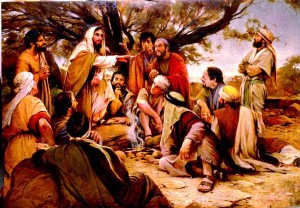
Jesus Talking to the DisciplesDo you ever wish someone whom you respect and admire hadn’t said what they said, because what they said is so hard to explain to someone who doesn’t respect and admire them, and what they said just sounds wrong, even to you? Then you know how I feel about the last response of Jesus in this conversation with Peter!

Jesus has just answered the question of someone Luke calls “a certain ruler” (in Mark’s Gospel he is described as a “rich young man”) about how to inherit eternal life with the famous reply, “Sell everything you own and give the money to the poor.” The disciples (more people than the Twelve, I think) are as unhappy with this hyperbolic response as the original questioner, and Peter seems downright outraged. “What are you saying?” I can almost hear him shouting at Jesus. “We have given up everything for you!” Is Jesus simply placating him with the promise of pie-in-the-sky-by-and-by? That’s what it sounds like. “Don’t worry! You’ll get it all back and get to live forever, too!”

Of course, I’m pretty certain that’s not what Jesus meant, but it’s so hard to explain that to someone who is skeptical of this whole God-Incarnate thing to begin with.

The reason I’m pretty certain that that’s not what Jesus meant is that here, unlike in the Markan version of this story, he doesn’t say, “You’ll get back a lot more of the things you gave up.” In Mark he does say pretty much that: “Truly I tell you, there is no one who has left house or brothers or sisters or mother or father or children or fields, for my sake and for the sake of the good news, who will not receive a hundredfold now in this age – houses, brothers and sisters, mothers and children, and fields, with persecutions – and in the age to come eternal life.” (Mark 10:29-30) Gave something up? Get a hundred more back. That’s what Mark’s Jesus says. But in Luke’s version of the story all that Jesus promises is “very much more.” I think that here there is a qualitative rather than quantitative difference in the promised return. In Mark, Jesus promises his follower will get a lot of the same stuff but at a price, i.e., persecutions; here, something better is promised . . . maybe peace, contentment, love, blessing, the Presence of God, the gifts of Holy Spirit . . . one doesn’t know, but it will be “very much more” than what was sacrificed. Are Mark and Luke trying to say the same thing? Are the things they report Jesus promising as rewards to the faithful follower equivalent? I don’t know; I hope they are, but the texts don’t make it easy to tell. And neither text makes it easy to explain to the skeptical unbeliever.

And the icing on the cake in both versions is the promise of “eternal life” in “the age to come”! It looks like a promise of immortality in the future, but (again) I’m not so sure. Both of these are coded phrases. The second one is found in lots of rabbinic literature, some contemporary with Jesus, some from later periods. It doesn’t necessarily mean the future; it means the time when God’s rule directs human affairs. That can be at any time when a person or persons give up their falsely perceived autonomy and live in accordance with God’s will. “The age to come” can (and does) exist concurrently with “this age”. It’s like that both-and, here-and-not-here, within-you-but-also-only-nearby thing that Jesus announced, the Kingdom of God. “Eternal life” is also not a future thing. For Jesus “eternal life” doesn’t mean immortality; it means life in eternity, where eternity is God’s Presence. “Eternal life” means living in God’s Presence with full awareness.

So the promised reward (whether it includes a hundred houses or not) is a qualitatively different life. Whatever we are called to give up in order to live a faithful life, possibly the hyperbolic “everything” that Jesus and Peter mention in this text, the reward of such a life is “very much more.” Which brings me back to how to explain it to the unbeliever . . . and the truth is that I don’t think it can be explained. It can only be lived and when it is lived, it becomes very apparent to someone not living it. An old friend of mine used to say this was the very best form of evangelism, to live the Christian life so well that one fairly glows with peace, contentment, love, blessing, the Presence of God, and the gifts of Holy Spirit. Others will see that and think, “I want that.” Then we don’t have to explain it, just offer it. Give it all up; get back so very much more.

====================

A request to my readers: I’m trying to build the readership of this blog and I’d very much appreciate your help in doing so. If you find something here that is of value, please share it with others. If you are on Facebook, “like” the posts on your page so others can see them. If you are following me on Twitter, please “retweet” the notices of these meditations. If you have a blog of your own, please include mine in your links (a favor I will gladly reciprocate). Many thanks!

====================

Father Funston is the rector of St. Paul’s Episcopal Church, Medina, Ohio.

Is go dtí tú mo mhuirnin slán

Christ the King Among the Amish – From the Daily Office – November 25, 2012

From Peter’s First Letter:

In your hearts sanctify Christ as Lord. Always be ready to make your defence to anyone who demands from you an account of the hope that is in you; yet do it with gentleness and respect.

(From the Daily Office Lectionary – 1 Peter 3:15-16 (NRSV) – November 25, 2012)
 
Amish Buggy and Cart in OhioToday is the last Sunday after Pentecost called “the Feast of Christ the King.” A relatively new feast on the calendar of the church, it was instituted by a 20th Century pope and originally set in late October as a response to the Protestant celebration of “Reformation Sunday” on the Sunday closest to October 31, the anniversary of Luther’s posting on the Wittenburg chapel door. The latter, I would suppose, started with the Lutherans but has spread throughout American Protestantism; I know of Presbyterian, Reformed, UCC, and Methodist churches that mark it. I know of no Episcopal congregations that do so. Episcopalians did take to Christ the King, however, and since Paul VI moved it to the last Sunday of the Christian year, every congregation I’ve been a part of has celebrated it. With the adoption of the Revised Common Lectionary, it is now an official part of our tradition.


Today, my congregation will be celebrating it without me. My spouse and I have taken a break and, since Friday, have been staying in a retreat facility not that far away from our home geographically, but mentally, emotionally, and spiritually a very, very long distance separate this place from that. We spent yesterday indulging our hobby of “antiquing” – wandering aimlessly through several of the amazing collections of junk one finds in the abandoned supermarkets, retired barns, and former garages now called “antique malls.” There are several in the Amish Country of Ohio, where we are.

The Amish are an interesting people. They quietly and steadfastly maintain a traditional way life hundreds of years old, one dating back to their formation as a Protestant sect in German-speaking Switzerland. Eschewing automobiles, they drive boxy black buggies down the state highways and country roads. Claiming not to use electricity, they have gas lights or kerosene lanterns in their homes and businesses, except when they don’t – I admit to being befuddled by this; I can’t figure out when it is OK to use electricity and when it isn’t. And then there is the use of batteries by those who “have no electricity” (as one shopkeeper put it); batteries power buggy lights and sometimes business lighting (but “we have no electricity”). I don’t get it it, but that’s OK – that’s not what this meditation is about.

What makes the Amish most interesting is that they go about this odd, set-apart way of life “with gentleness and respect.” I nearly wrote above that they maintain their traditions “unobtrusively,” but that really wouldn’t have been accurate. They are obtrusive! Come upon a horse-drawn farm cart plodding along a 55-mph-speed-limit highway or a buggy on a 35-mph country lane, roads which are winding and hilly and have limited visibility, and (believe me) it’s an obtrusion! Often a deadly one for the Amish if the automobile driver doing so is not paying attention or has poor reactions.

In stores, the Amish men with their broad-brimmed hats, long beards, and plain rugged clothing, and the Amish ladies with their long skirts, dark sweaters, and hair done up in buns under starched linen caps, are very noticeable, whether they are service personnel or are themselves customers. In restaurants, which they rarely but occasionally patronize, their large families pausing to say grace in antiquated German before eating are a reminder that while they are sanctifying the Lord, we are not. That’s obtrusive . . . but oh so gentle and respectful.

That is the nature of the King whom we sanctify today on this special day of remembering his lordship. He gave vent to flashes of anger, of course, and there are plenty of hints throughout the Gospels that he was, rather often, frustrated and unhappy with this followers, but we mostly remember him as gentle and reverent. “Gentle Jesus, meek and mild” is a phrase I remember from a hymn we learned in my Methodist Sunday School days of long ago.

The Gospel lesson for today’s celebrations of the Holy Eucharist is from John: Pilate questioning Jesus before his crucifixion. Jesus, the epitome of gentleness and respect, answers Pilate calmly, or stands silently, when he could have taken complete control of the situation, called down the wrath of God, and established an earthly kingdom right then and there. Instead, he takes complete control of the situation in another way, the way of gentleness and peace.

I think that’s what I find most compelling and oddly attractive about the Amish. They are in complete control of their lives, as narrow and confined as they may seem to a modern outsider like myself. They go about their traditional ways in the midst of the madness around them, the speeding cars, the frantic shoppers, the hurried diners too busy to say grace; they don’t give in to modern pressures. They just keep plodding along like the horses pulling their carts and buggies, doing faithfully what they know they are called to do. They are a Protestant’s Protestants, children of the Reformation started when Martin Luther nailed those theses to the Wittenburg door, but more than any Solemnity declared by pope or any dictate of the lectionary, they stand testimony to the power of gentleness and respect, a potent reminder of Christ the King.

====================

A request to my readers: I’m trying to build the readership of this blog and I’d very much appreciate your help in doing so. If you find something here that is of value, please share it with others. If you are on Facebook, “like” the posts on your page so others can see them. If you are following me on Twitter, please “retweet” the notices of these meditations. If you have a blog of your own, please include mine in your links (a favor I will gladly reciprocate). Many thanks!

====================

Father Funston is the rector of St. Paul’s Episcopal Church, Medina, Ohio.

Putting God to the Test – From the Daily Office – November 23, 2012

From the Prophet Malachi:

Will anyone rob God? Yet you are robbing me! But you say, “How are we robbing you?” In your tithes and offerings! You are cursed with a curse, for you are robbing me – the whole nation of you! Bring the full tithe into the storehouse, so that there may be food in my house, and thus put me to the test, says the Lord of hosts; see if I will not open the windows of heaven for you and pour down for you an overflowing blessing.

(From the Daily Office Lectionary – Malachi 3:8-10 (NRSV) – November 23, 2012)
 
Dear God Black Friday memeThis “test me and see” verse is a favorite of preachers of the so-called “prosperity gospel” (of course, it’s not from a gospel, but that doesn’t seem to bother them). To have it turn up in the Daily Office readings the day after the United States celebrated Thanksgiving Day is a real eye-opener! On Face Book this morning, a humorous “meme”* showed up picturing a young woman at prayer holding a credit card with this caption: “Dear God, we are so thankful for all we have . . . now, if you excuse us, we’ve got to go get more stuff. There’s a great Black Friday sale at Best Buy!” Could there have been a better juxtaposition?

Malachi says pretty bluntly that we are robbing God. Stealing from God is not something to be taken lightly. Many preachers cite this text about robbing God in the context of stewardship sermons. We rob God, they say, when we deny God what is rightfully God’s. We rob God, they say, when we fail to tithe, to make an offering of 1/10, or 10%, of our income. But it seems to me Malachi is more concerned about attitude than with particular actions like paying or not paying the biblical tithe.

Essentially, it comes down to our attitude about who owns what. If we believe (as most Americans seem to) that we have earned all we have, that we are entirely responsible for our prosperity, then we will have an ungenerous attitude toward everyone, including God. If we take a step back and realize that God is responsible for our well-being, we are more likely to be generous. The question is, “Who owns my possessions, bank account, and even my life?” To whom are we truly thankful for what we have?

Jesus told a story about a rich man who had a lot of stuff, so much stuff that he had to build a bigger barn for it all. When he had built the barn and stored the stuff, he sat back content. But just then God said to him, “You fool! This very night your life is being demanded of you. And the things you have prepared, whose will they be?” (Luke 12:20) Jesus’ point (and Malachi’s) is that we have no control over our possessions, our money, or our life. Anything and everything may be lost at any time. The truth is that we don’t own anything, not even ourselves. God owns it all.

When we fail to use it to benefit others around us, when we fail to hold it in trust for God with the proper attitude of generosity, we rob God. If, on the other hand, we use what we have to do what good we can, if we have an attitude of gratitude (the one we claimed we had yesterday), we will benefit as much as if not more than those around us. “Put me to the test and see,” says God.

So, today, what’s it to be? Rush off to the Black Friday sales putting Thanksgiving behind us, or rather making thanksgiving a way of life, not just a day on the calendar? Either way, we put God to the test . . . .

*An internet meme is a concept that spreads via the internet often taking the form of a captioned image.

====================

A request to my readers: I’m trying to build the readership of this blog and I’d very much appreciate your help in doing so. If you find something here that is of value, please share it with others. If you are on Facebook, “like” the posts on your page so others can see them. If you are following me on Twitter, please “retweet” the notices of these meditations. If you have a blog of your own, please include mine in your links (a favor I will gladly reciprocate). Many thanks!

====================

Father Funston is the rector of St. Paul’s Episcopal Church, Medina, Ohio.

Vision and Salt – From the Daily Office – November 19, 2012

From the Prophet Habakkuk:

The Lord answered me and said:
Write the vision;
make it plain on tablets,
so that a runner may read it.
For there is still a vision for the appointed time;
it speaks of the end, and does not lie.

(From the Daily Office Lectionary – Habakkuk 2:2-3a (NRSV) – November 19, 2012)
 
Vision Road SignThere are two passages of Scripture that I always think of when vestries or other church governing boards begin to discuss a vision for the church’s mission and ministry. One is the King James version of Proverbs 29:18a – “Where there is no vision, the people perish.” – the other is this passage from Habakkuk. I really like the image of the vision being written so large that someone running by can read it and make sense of it; the church’s vision needs to be as big, expansive, and attention-getting as a billboard.
To catch a fish, one must cast one’s line into the water in a manner that will attract the fish. To lead and perform an effective ministry, the church and its leadership must cast a vision of the future far and wide – write it large – in such a way as to attract and retain members and co-ministers who will see that vision through, buy into it, act upon it, make it a reality. Vision casting in the church means discerning God’s purpose for the church or program and then making it known. Vision, as Habakkuk makes clear, must be presented in a way that motivates, inspires, and encourages; the people rushing by, running to and fro attending to the demands of daily life, need to catch the vision and really believe in it.

The process is not easy, but it is necessary. In the absence of vision, as the verse from Proverbs says, the people perish. The parish perishes. I’m reading a book about church administration in which the author makes the point that a congregation needs direction, a vibrant energetic center of action and service to give the congregation its particular and peculiar identity. Without that God’s people are, as God’s Son said, like salt that has lost its savor.

Write God’s vision as big as a billboard! Without it, the church will founder and die; without it, the church is good for nothing but trampling under foot like unusable salt.

====================

A request to my readers: I’m trying to build the readership of this blog and I’d very much appreciate your help in doing so. If you find something here that is of value, please share it with others. If you are on Facebook, “like” the posts on your page so others can see them. If you are following me on Twitter, please “retweet” the notices of these meditations. If you have a blog of your own, please include mine in your links (a favor I will gladly reciprocate). Many thanks!

====================

Father Funston is the rector of St. Paul’s Episcopal Church, Medina, Ohio.

The Future of Sheep & Coins – From the Daily Office – November 14, 2012

From the Gospel of Luke:

Jesus told a parable: “What woman having ten silver coins, if she loses one of them, does not light a lamp, sweep the house, and search carefully until she finds it? When she has found it, she calls together her friends and neighbours, saying, ‘Rejoice with me, for I have found the coin that I had lost.’ Just so, I tell you, there is joy in the presence of the angels of God over one sinner who repents.”

(From the Daily Office Lectionary – Luke 15:8-10 – November 14, 2012)
 
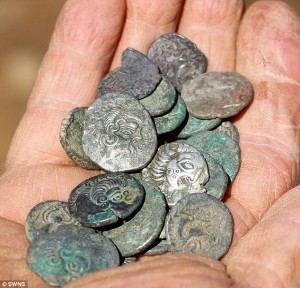
A Handful of Ancient CoinsThis story of the woman seeking her lost coin follows on the heels of the parable of the lost sheep in which the shepherd leaves the ninety-nine to seek the lost one. That story is much more familiar and, I suppose, is more popular because of romantic notions of some emotional bond between sheep and shepherd, supported no doubt by those lovely Sunday School images of Jesus carrying a lamb on his shoulders. As we modern (and now post-modern) 21st Century urban Christians have moved further and further from agrarian reality, those romantic misconceptions deepen and the less-palatable aspects of the parable’s metaphor are forgotten.

Sheep are not the shepherd’s beloved pets! He is not going to take the animal into his home (unless, perhaps, it is sick and needs to be nursed back to health). He is going to use the animal for his (or his employer’s) economic gain. At best, the sheep will be fleeced and/or milked on a regular basis. It will be bred and its lambs will be taken from it to be slaughtered for food, sold in the markets for profit. At the worst, it will find itself slaughtered, its meat sold as mutton, its hide used for leather. Surely these aspects of the sheep-shepherd relationship are outside the scope of Jesus’ metaphor; he did not mean us to see in them an analogy to the human-God relationship! And yet, there they are, background to the parable, limiting its scope and possibly confusing our understanding.

The parable of the woman seeking the lost coin is much more open ended, much richer in possibilities. Where the shepherd’s sheep have their limited future, the woman’s coins have a future that is wide open. What might she do with them? Anything! Taken to the marketplace, they could be spent with any vendor, purchase any product, follow any path of commerce. And the vendor then can similarly pass the coin on to any of a variety of other vendors, and so on into the future. Stretching before the coin I see a future filled with the branches of an unlimited decision tree, filled with unlimited possibilities, not unlike the myriad futures and alternative realities of quantum mechanics and superstring theory!

For the sheep . . . the future is fleecing and possibly slaughter. For the coin . . .the future is the multiverse! Of course, neither sheep nor coin has any say in what their future may be. As human co-creators with God, we do. Neither the sheep nor the coin has any choice in whether to cooperate with the shepherd or the woman. As human co-creators with God, we do. But like the sheep, we are not as knowledgeable as the shepherd; like the coin, we are not as wise as the woman. So like both, we must trust in the wiser, more knowledgeable Lord who saves us. A prayer in The Book of Common Prayer speaks of this; when I think of the future faced by either sheep or coin, I think of this prayer:

Almighty and eternal God, so draw our hearts to thee, so guide our minds, so fill our imaginations, so control our wills, that we may be wholly thine, utterly dedicated unto thee; and then use us, we pray thee, as thou wilt, and always to thy glory and the welfare of thy people; through our Lord and Savior Jesus Christ. Amen. (BCP 1979, Prayer 61, “Of Self-Dedication,” page 832)

====================

A request to my readers: I’m trying to build the readership of this blog and I’d very much appreciate your help in doing so. If you find something here that is of value, please share it with others. If you are on Facebook, “like” the posts on your page so others can see them. If you are following me on Twitter, please “retweet” the notices of these meditations. If you have a blog of your own, please include mine in your links (a favor I will gladly reciprocate). Many thanks!

====================

Father Funston is the rector of St. Paul’s Episcopal Church, Medina, Ohio.

Cooperating with Angels – From the Daily Office – November 13, 2012

From the Book of Revelation:

The angel said to me, “Write this: Blessed are those who are invited to the marriage supper of the Lamb.” And he said to me, “These are true words of God.” Then I fell down at his feet to worship him, but he said to me, “You must not do that! I am a fellow-servant with you and your comrades who hold the testimony of Jesus. Worship God! For the testimony of Jesus is the spirit of prophecy.”

(From the Daily Office Lectionary – Revelation 19:9-10 – November 13, 2012)
 
The Annunciation, fresco by Fra AngelicoPerhaps among the most familiar words from St. John’s apocalypse, “Blessed are they who are invited to the marriage feast of the Lamb.” They are used as a fraction anthem or invitation to communion in many churches. But in this brief passage from Revelation, the most powerful image for me today is the angel saying, “I am a fellow-servant with you and your brothers and sisters.”
All too often, I think, we go through our daily lives with no an awareness of, nor gratitude for the work of the holy angels in our midst and on our behalf. Modern Christians, especially Protestants and Anglicans, seem to be a reluctant to acknowledge the angelic ministry or to call upon the angels (or the saints) for help. But angels are God’s first creatures; created to sing God’s praise and glory, they are God’s ministering spirits, sent as messengers to God’s people (as Scripture witnesses again and again) and to assistance us as heirs of salvation. The effectiveness of the angels’ work in our lives depends upon our cooperation; the more we cooperate, the better.

So, how do we do that? How do we cooperate with the angels? At the very foundation of angelic cooperation is regular prayer and contemplation of God and God’s messengers. Openness of spirit and readiness of will are the proper attitudes of our prayer.

In Carmina Gadelica, a large collection of hymns, prayers, charms, poetry and rituals gathered from the people of the Highlands and islands of Scotland in the late 19th century by Alexander Carmichael, one finds this charming blessing, which we have used as a dismissal at church services:

The love and affection of the angels be to you.
The love and affection of the saints be to you.
The love and affection of heaven be to you,
To guard you and to cherish you.

We cooperate best with the angels when we accept their love and affection in the spirit of the Blessed Virgin: “Here am I, the servant of the Lord; let it be with me according to your word.” (Luke 1:38)

====================

A request to my readers: I’m trying to build the readership of this blog and I’d very much appreciate your help in doing so. If you find something here that is of value, please share it with others. If you are on Facebook, “like” the posts on your page so others can see them. If you are following me on Twitter, please “retweet” the notices of these meditations. If you have a blog of your own, please include mine in your links (a favor I will gladly reciprocate). Many thanks!

====================

Father Funston is the rector of St. Paul’s Episcopal Church, Medina, Ohio.

‘Til Earth and Heaven Ring – From the Daily Office – November 9, 2012

From the Book of Sirach:

Then the singers praised [God] with their voices
in sweet and full-toned melody.
And the people of the Lord Most High offered
their prayers before the Merciful One,
until the order of worship of the Lord was ended,
and they completed his ritual.

(From the Daily Office Lectionary – Sirach 50:18-19 – November 9, 2012)
 
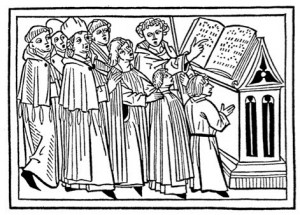
Engraving of a Latin ScholaChapter 50 of Ben Sira’s book is a description of a temple liturgy led by “the high priest, Simon son of Onias.” (v. 1) It is filled with poured-out wine, sumptuous vestments, the shouting of priests, the blowing of trumpets, the people falling on their faces. Not the sort of ho-hum run-of-the-mill worship service one finds in most Christian churches these days.

A committee in my parish is studying the whys and wherefores of worship, what we do, how and why we do it, how we might do it better. Music, to which these verses briefly refer, has been an on-going topic of discussion. Tastes in music vary, emotions around music are passionate, commitments to one style or another are rock-solid.

“Open the gates of hell,” a clergy colleague once quipped, “and out will march an army of music directors!” I’ve never had any conflict with the music directors with whom I’ve served, but I know clergy who have. I’ve heard tales of such conflicts from both sides, from musician friends and from clergy colleagues. Battles between clergy and musicians are not uncommon. Battles between worship leaders and congregations about music are also not uncommon. Changing, or even supplementing, a congregation’s musical repertoire is something to be approached with fear and trembling.

The purpose of music in worship is to bring glory to God; therefore, the hymns the congregation sings, and the anthems the choirs prepare, should be centered on God, aesthetically pleasing, and thoughtful. The musicians and choristers should be technically competent and well-rehearsed. The chief instrument in the worship of God should be the human voice. It is the one instrument we have in common and it is capable of great beauty and resonance. But the use of musical instruments should not be shunned; the Scriptures are filled with references to trumpets and horns, stringed instruments, drums, and other instruments. These add beauty and diversity to our songs. The style of music or the type of instrumentation does not matter; vibrancy, depth, and quality of performance do (at least for the anthems or other “performance pieces” that may be offered). For songs with words, whether performed by the choir or sung by the congregation, the theological content of the lyrics should also be of concern.

Some congregations are great at singing hymns; in other churches, only a few people dare to open their mouths. This is a great sadness. Everyone has a voice that was given them by God and God expects that voice to be used. In a former parish, we hung a sign in our entryway – “If you can’t sing good, sing loud!” – we invited everyone to sing. Whatever flaws our individual voices may have, when they are raised together in song those flaws disappear. When the Body of Christ sings, when every voice is lifted, the effect is wonderful and, I’m sure, pleasing to God. St. Augustine of Hippo is often quoted as having said “He who sings, prays twice.” Singing is much to be encouraged.

So, as that great and wonderful hymn by James Weldon Johnson says, “lift every voice and sing ’til earth and heaven ring!”

====================

A request to my readers: I’m trying to build the readership of this blog and I’d very much appreciate your help in doing so. If you find something here that is of value, please share it with others. If you are on Facebook, “like” the posts on your page so others can see them. If you are following me on Twitter, please “retweet” the notices of these meditations. If you have a blog of your own, please include mine in your links (a favor I will gladly reciprocate). Many thanks!

====================

Father Funston is the rector of St. Paul’s Episcopal Church, Medina, Ohio.

« Older posts Newer posts »