Occasional thoughts of an Anglican Episcopal priest

Category: Ministry (Page 56 of 59)

Shout! Good Liturgy! – From the Daily Office – September 11, 2012

From the Psalms:

Clap your hands, all you peoples;
shout to God with a cry of joy.
* * *
God has gone up with a shout,
the Lord with the sound of the ram’s-horn.
Sing praises to God, sing praises;
sing praises to our King, sing praises.

(From the Daily Office Lectionary – Psalm 47:1,5-6 – September 11, 2012)
 
ShoutI love this Psalm – it’s about liturgy and worship, something dear to my heart!

There’s a children’s song based on this song that we used to sing in the Cursillo movement (maybe they still do – I haven’t been to a Cursillo event in years). Our church school children learned to sing it at Vacation Bible School this year and had a great time doing so. I went surfing through YouTube and found this recording of Pat Boone teaching it to some kids:

The song, like the Psalm, has great energy. I have no idea how the Psalm was performed in the Temple, but how could a Psalm that calls for clapping, shouting, playing trumpets, and singing praises not be vibrant and energetic. That’s how liturgy should be.

It doesn’t have to be all kids’ songs, however. This same Psalm was sat as a choral anthem by Ralph Vaughn Williams. Here’s a YouTube of Williams’ O, Clap Your Hands performed by the Louisville Collegiate Choir.

It, too, is vibrant and energetic, but totally unlike Pat Boone’s children’s tune. Vibrancy and energy is not a matter of “style”; it is an issue of authenticity, of life, in the liturgy.

I love good liturgy! Good liturgy involves clapping, singing, praising, and even shouting done with authenticity and feeling! I love good liturgy!

====================

Father Funston is the rector of St. Paul’s Episcopal Church, Medina, Ohio.

“Average Sunday Attendance” – From the Daily Office – September 10, 2012

From the Acts of the Apostles:

The next sabbath almost the whole city gathered to hear the word of the Lord. But when the Jews saw the crowds, they were filled with jealousy; and blaspheming, they contradicted what was spoken by Paul.

(From the Daily Office Lectionary – Acts 13:44-45 – September 10, 2012)
 
Forest“Average Sunday Attendance” – also known as “ASA” – has become a hot topic in church circles. It’s how we gauge the health of congregations, not that it’s a very good measure of that, but what other easily accessed metric to governing boards and denominational judicatories have? If the parish priest, pastor, senior minister, whatever he/she may be called is doing a good job, the assumption is, the pews are going to be full. So if we count the number of seats in the seats, voila! we know if things are good.

Well, maybe. I’m not convinced that attendance figures are that good a metric of clergy performance; I’m not even sure there is a metric that measures the effectiveness of pastoral ministry. But here’s an interesting observation. Go to Google. Put in “Average Sunday Attendance” as your search term. In the first several pages of search results, the majority of websites will be Episcopal Church related! We are obsessed with this measurement!

So, it’s a hot topic and one way it pops up is when folks compare attendance in traditional, so-called mainstream churches with the numbers who throng to revival-type events offered by popular evangelists. It’s one thing to compare our mainline, denominational parish ASA to the weekly attendance of a non-denominational evangelical congregation; there may even be some validity to such a comparison (though probably not as a measure of clergy competence). But comparing our weekly numbers to the crowds at a one-off rally-type event strikes me as less than legitimate.

That is what the Jewish synagogue leaders are doing in today’s lesson from the Book of Acts! Here in Chapter 13, Paul and Barnabas have come to the city of Antioch in Pisidia on what is basically a preaching mission. They are offering something new, something out of the ordinary, something which diverts from everyday run-of-the-mill existence, so they get big crowds. (Yes, I know that Luke ascribes the big numbers to the work of the Holy Spirit, but let’s just look at the story as secularists for a moment; the new thing gets a lot of attention.) The synagogue leaders, comparing their weekly sabbath attendance to the crowds coming to see the missionaries, are jealous. In their envy, the Jewish leaders impugn Paul’s and Barnabas’s message and are condemned here by Luke as blasphemers.

But Luke is making the same mistake the synagogue leaders are making, the same mistake we make when look to ASA as a metric of performance. Attendance figures don’t measure message; attendance figures don’t estimate effectiveness; attendance figures don’t rank repentance; attendance figures don’t calculate commitment. Attendance figures measure . . . attendance, that’s all! High attendance is good, but it doesn’t necessarily mean that people’s lives are being impacted. Personal lives are at least as important as the size of the crowds, if not more so! When we see only the aggregate numbers, the individuals get lost.

The focus on ASA blinds us to other measures, other metrics. It raises blood-pressure; it raises blinders; it raises barriers. Have you ever noticed something like this? – When I am angry or upset about something and my blood pressure goes up, my sense of hearing is affected. I don’t know what it is, but I hear something like a rushing wind inside my ears (maybe that’s the blood pressure) and it interferes with my hearing. That’s maybe what happened with the Jewish leaders. The synagogue leaders couldn’t hear the message preached by Paul and Barnabas because their of anger over the attendance figures; it interfered with their perception. To switch to visual metaphor, they couldn’t see the trees for the forest. Seems it’s the same today.

====================

Father Funston is the rector of St. Paul’s Episcopal Church, Medina, Ohio.

An Instant of Transforming Grace – Sermon for Pentecost 15, Proper 18B – September 9, 2012

====================

This sermon was preached on Sunday, September 9, 2012, at St. Paul’s Episcopal Church, Medina, Ohio, where Fr. Funston is rector.

(Revised Common Lectionary, Proper 18B: Isaiah 35:4-7a; Psalm 146; James 2:1-17; and Mark 7:24-37.)

====================

Yellow and Purple WildflowersIf you are a political junkie like me, you’ve been following the campaigns, watching the conventions, reading the editorials, and generally getting angry with one side or the other or both and the whole process. You may have noticed, as I have, that candidates are never alone. They are surrounded by a whole corps, an entire gaggle of handlers, some of whom have the responsibility to make sure the candidate stays “on message”, that he or she makes no “gaffs”. Jesus was surrounded by a gaggle, as well, but these were not handlers and there was no one to keep him “on message” except himself. In fact, the gospel witness is pretty clear that even right up to the end the gaggle that followed him around really didn’t understand the message!

To be honest, it’s not clear in today’s lesson whether the gaggle is even around. Mark doesn’t say anything about them and the way he writes this story it sounds like Jesus may have gone without them to the city of Tyre, a gentile town north of the sea of Galilee and on the Mediterranean coast in what is now Lebanon. But whether they were with him or not, he doesn’t have anyone there who can stop him making a really awful racist gaff, from calling this foreign woman “a dog”! O.M.G.! Can you imagine what Fox News or MSNBC would have done with this?

Gentle Jesus, meek-and-mild Jesus, love-everyone Jesus, welcome-the-sinner Jesus has just said about the worst, most insulting, most awful thing he could say to a woman who wanted nothing more than to get medical help for her daughter! And make no mistake about it, that is what he has done. He has uttered a racial slur!
Immediately we want to say, “That can’t be! Jesus couldn’t possibly have been racist!” But Mark’s story of Jesus’ encounter with this Syrophoenician woman says otherwise. Jesus has called this woman, who simply wants a cure for her child, a dog, a dehumanizing ethnic slur common at the time. We can do some theological dancing, some interpretive two-step to avoid this uncomfortable reality, but eventually we have to face the truth. Jesus, with no handlers nearby to stop him making a “gaff”, has uttered a racial insult.

The difficulty of this passage is that we, as 21st Century Christians, want Jesus to be the simple, easy answer to all of our problems and to all of society’s problems. When faced with the problem of racism, whether personal or institutional, we would prefer to think of Jesus as always loving all people regardless of skin color or ethnicity. But Jesus the First Century Palestinian Jew doesn’t give us those easy 21st Century answers. He had a real life and real feelings. He was born and reared in a real culture with all of its trappings.

As a good Jewish man, Jesus would have given thanks daily that he was born a Jew not a Gentile, a man not a woman. He would have said the siddur prayer every day, one version of which praises God “. . . who has created me a human and not beast, a man and not a woman, an Israelite and not a gentile, circumcised and not uncircumcised, free and not slave.” (From the Cairo Genizah.) Even the best of humanity, the Incarnation himself, could get entangled in the sexist and racist snare of this tradition, could get caught up in its inherent system of oppression, its culture of supremacy.

The great lesson of his encounter with the Syrophoenician woman is that it teaches us how the cultural dynamics of racism, of prejudice of any kind, can be overcome in a real moment of conversion. Jesus’ understanding of what he was called to do was changed and expanded because of this gentile woman’s challenge. From that moment, he moved forward, and went about his work with an expanded awareness of who the Good News was for, healing the woman’s daughter and then going deeper into gentile territory.
Mark masterfully combines this story with the tale of healing the man with the speech impediment which seems also to have taken place in gentile territory. Mark writes that Jesus returned to the Sea of Galilee by way of Sidon; if you look at a map, that makes no sense. The Galilean Lake is south of Tyre and inland; Sidon is a considerable distance north of Tyre and on the coast. Like Tyre, it was and is a gentile settlement. The way Mark tells the story it may have been here that Jesus restored the hearing of the man with impeded speech. Mark combines the stories because because the second story explains the first. Jesus metaphorical ears, his ethnic or socio-political ears (if you will) were opened by the woman in the same manner that the deaf man’s physical ears were opened by Jesus. That Jesus went deeper into gentile territory and there healed the deaf man, probably himself a gentile, shows the impact of the woman’s words on Jesus. The man’s ears were opened by Jesus, his tongue was loosened, and he no longer spoke his slurred speech; Jesus’ “ears” were opened by the woman, his traditional upbringing was loosened, and he no longer uttered ethnic slurs.

What is noticeable about both “healings” is their surprising quickness. The Syrophoenician woman challenges Jesus and in a single instant of profound grace his heart is changed; Jesus speaks a single word and in an instant of profound grace the man’s ears are unstopped and his speech restored. These gospel stories of sudden and immediate transformation are combined for us today with a short lesson from the prophet Isaiah who likens the coming of God’s power, the time when the ears of the deaf will be opened and the eyes of the blind will be given sight, to one of the briefest moments in the desert, that time when the spring rains come and the desert quickly blooms.

There’s nothing quite like springtime in the desert! One is never sure when it will happen but one spring day a storm moves in and for a few hours the dry burning sands are covered with pools, the thirsty ground runs with streams that rush through the desert often to the point of dangerous flooding. In just a few more hours, the wilderness blooms with an intensity that truly has to be seen to be appreciated. Around my hometown of Las Vegas, the spring rains produce an incredible variety of blossoms. There are all sorts of different yellows: bear poppy, bristly fiddleneck, buttercups, and desert dandelion, to name a few. There are vivid pinks: beardtongue and arrowweed and the mojave thistle. There’s a red-spotted purple flower called “desert five spot”. There’s a flower called “desert bell” that is the most vivid blue you’ve ever seen and, of course, there are the red-orange California poppies all over the place. It’s just incredible! And it happens almost instantaneously and then, in just a few hours, the desert goes dry again . . . and the brilliant rainbow of desert color is gone, but for that brief moment the desert has been transformed and, truly, it will never be the same again.

Isaiah tells us that that is precisely the way the power of God comes, with that same sort of startling swiftness, in a moment of magnificent immediacy. That’s the way new hearing and new understanding came to the deaf man and, surprisingly, to Jesus, as well. And that’s the way it comes to us. We may study Scripture for years; that’s a good thing to do and we gain knowledge and understanding that way. But it is not through that study that we are transformed. We may attend worship services weekly or even daily; that’s a good thing to do and we show our love of God in that way. But it is not through liturgy that we are transformed. We may regularly give of our time and talent in ministry to the poor; that’s a good thing to do and we serve Christ in others in that way. But it is not through that service that we are transformed. It is, rather, through the swift and surprising in-breaking of God’s power and Spirit that we are transformed! And it is through that transformation that we are empowered to serve with new vigor, to worship with new thanksgiving, to read Scripture with new understanding.

Isaiah assures us that when the waters of God’s power break forth in the wilderness of our lives, when the streams of God’s Spirit flow through the deserts of our existence, then the burning sands of our souls become pools, the thirsty ground of our hearts become springs of living water. Through the words of the Syrophoenician woman it happened to Jesus; through the ministry of Jesus it happened to the man with the speech impediment; and through the power of the Holy Spirit it happens to us. The writer of the letter to the Hebrews declares that God in Jesus became like us “his brothers and sisters in every respect” that he might be “the pioneer and perfecter of our faith” (Heb. 2:17, 12:2) so that, as John says, “we will be like him!” (1 John 3:2) It happens in an instant, like the transformation of the desert in the spring rains or, as Paul said, “in the twinkling of an eye.” (1 Cor. 15:42)

Let us pray:

Almighty and merciful God, how wonderfully you created us and still more wonderfully transform us. In moments of surprising grace, you send your Holy Spirit into our hearts to reform our lives; you constantly renew us through your redeeming love, refreshing us as rain refreshes the wilderness. We thank you for the wondrous streams of your mercy, for the pools of your love, for the water of life which restores our parched spirits and transforms us ever more closely into the likeness of your Son, through whom in the power of the Holy Spirit, we join with the whole Church to give you praise, now and for ever. Amen.

There Are Those Times – From the Daily Office – September 8, 2012

From the Book of Job:

Eliphaz the Temanite answered: “Can a mortal be of use to God? Can even the wisest be of service to him?”

(From the Daily Office Lectionary – Job 22:1-2 – September 8, 2012)
 
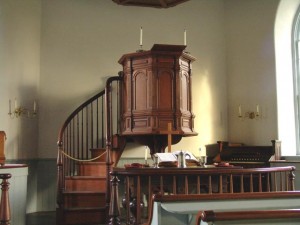
PulpitFrom time to time, people tell me that they have appreciated something I’ve said or done and I try to remember to say, “Thank you.” But inside, I really don’t think about compliments very much. It’s not that I don’t appreciated them, but I don’t do what I do to be complimented, and I really don’t think that I have much to do with it when whatever I do has gone well or had a positive impact on someone. I sort of take Paul’s attitude from the Letters to the Romans and the Galatians: “It is no longer I who live, but it is Christ who lives in me” (Gal. 20:2) and “I will not venture to speak of anything except what Christ has accomplished through me” (Rom. 15:18). So I do think, generally, that the answer to Eliphaz’s question is, “Yes.” Mortals can be of use to God. But there are times I would answer otherwise.

I’ve been a clergy person for not quite 21-1/2 years. I was ordained to the Sacred Order of Deacons on May 8, 1990, the Feast of Julian of Norwich; I was priested on June 21, 1991, the eve of the celebration of St Alban, first martyr of Britain. Before ordination, I was a lay preacher, a communion minister, a catechist, a seminarian. At the age of 21 (nearly 40 years ago) I was the youth minister in a major Southern California parish, and since then I have served the church in a variety of ways – vestry member, treasurer, diocesan chancellor (chief legal officer), diocesan trustee, standing committee member, various commissions and committees. Throughout those not-yet-ordained years I taught Sunday School, teen and adult education classes, and courses of ministry preparation for locally licensed ministers, and preached more than few sermons. Since ordination, I’ve done more of the same and preached a sermon nearly every week.

The message of those 22+ years of sermons can probably be boiled down to this: “In Christ Jesus, God loves and forgives you. Love and forgive one another.” I truly feel, all the flowery rhetoric aside, all the exigesis aside, all the sermon illustrations aside, that that simple message is what I’ve been trying to say every Sunday for more than two decades.

I don’t pay much attention to compliments or to critiques, frankly, but I do pay attention to behavior. When someone tells me they won’t do something for reasons having to do with a refusal to forgive, when someone fails to respond to a need, when someone treats another in ways that betray a lack of respect . . . and when those someones are people who’ve been listening to my sermons for a long time . . . that’s when I begin to feel that the answer to Eliphaz’s question is “No!” That’s when I begin to feel like maybe mortals, even wise mortals, just get in God’s way. That’s when I begin to feel like maybe that’s all I’ve done.

Of course, I know that’s not true, and I know when I feel that way that not too much time will pass before (in the words of today’s morning psalm) that God will turn my mourning into dancing, that God wil take off my sackcloth and clothe me with joy. (Psalm 30:11) Still . . . there are those times . . . .

====================

Father Funston is the rector of St. Paul’s Episcopal Church, Medina, Ohio.

Crooked Lines – From the Daily Office – September 6, 2012

From the Book of Acts:

The magician Elymas (for that is the translation of his name) opposed them and tried to turn the proconsul away from the faith. But Saul, also known as Paul, filled with the Holy Spirit, looked intently at him and said, “You son of the devil, you enemy of all righteousness, full of all deceit and villainy, will you not stop making crooked the straight paths of the Lord?”

(From the Daily Office Lectionary – Acts 13:8-10 – September 6, 2012)
 
Tangled wiresAs I look at life, crooked lines abound. It’s what human beings do. Bar-Jesus (as the magician Elymas is also named in the Book of Acts) may have been making the straight crooked with evil intent, but I suspect that most human beings just do it out of habit, out of an inability to do anything else, out of (maybe) some sort of primate instinct to make a mess. My mother used to admonish me, in a lot of circumstances, “Don’t get bent out of shape!” At sixty years of age, I have come to suspect that there is no way to avoid life getting bent out of shape! Crooked lines abound.

Way back when I was in college I had a good friend whose job was taking care of the animals used in our psychology department’s experimental work. He took care of pigeons and rats and cats and all sorts of critters, including some kind of monkeys (don’t ask me what kind . . . I don’t think I ever knew). I remember once visiting him at work and watching the monkeys play. Someone had given them a length of copper house wire (that thick 12-gauge stuff) and they were happily bending it into a mass of crookedness, then trying (unsuccessfully) to straighten it out.

That, it seems, is what happens in life. We get our monkey hands on things, even things that are straight, and we bend them up. And then we can’t unbend them on our own. Have you ever tried to straighten a bent-up mess of wire by yourself? Can’t be done. But there is an old rabbinic proverb, “God writes straight with crooked lines.” With God’s help, things can get straightened out. Wire, lives, relationships, paths to salvation. I don’t think Paul really had to worry about Elymas; God can take care of God’s paths. It’s our crooked lines that we need to worry about; with God’s help, we need to get them worked out, straightened out, or at least a little bit untangled.

One of my favorite prayer resources is the book Celtic Daily Prayer from the Northumbria Community in England. In it there is this lovely prayer picking up on the rabbinic proverb, acknowledging the bent-out-of-shapeness of our lives, and seeking God’s help with straightening things out:

O God,
I cannot undo the past,
or make it never have happened!
– neither can You. There are some things
that are not possible even for You
– but not many!
I ask you,
humbly,
and from the bottom of my heart:
Please, God
would You write straight
with my crooked lines?
Out of the serious mistakes of my life
will You make something beautiful for You?
Teach me to live at peace with You,
to make peace with others
and even myself.
Give me fresh vision. Let me
experience Your love so deeply
that I am free to
face the future with a steady eye,
forgiven,
and strong in hope.
Amen.

====================

Father Funston is the rector of St. Paul’s Episcopal Church, Medina, Ohio.

Pray Naked – From the Daily Office – September 4, 2012

From the Book of Psalms:

Prove me, O Lord, and try me; test my heart and mind.

From the Book of Job:

Job answered: “But I would speak to the Almighty, and I desire to argue my case with God.”

(From the Daily Office Lectionary – Job 12:3; Psalm 26:2 – September 4, 2012)
 
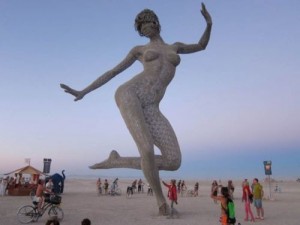
Bliss Dance, Statue at Burning Man Festival 2010 (Northern Nevada)This morning I was struck by the absolutely opposite attitudes displayed in these two readings. The morning psalm invites God to try the worshipper; the first reading of the day demands the right to try God. I think these poles really do represent the spiritual pendulum on which most humans swing; they circumscribe our ambivalent and ambiguous relationship with the Almighty.

At least they describe MY relationship with God! Some days my prayer life, my ministry, my personal life, my bodily feeling, all of it just seems great. “Bring it on, God! Whatever you want my to do today, I can handle it!” The next day I can feel just like Job: “Why me, God? I have been truly put-upon; I have been emotionally mistreated.” I come before God with the words of Moses:

Moses said to the Lord, “Why have you treated your servant so badly? Why have I not found favor in your sight, that you lay the burden of all this people on me? Did I conceive all this people? * * * I am not able to carry all this people alone, for they are too heavy for me. If this is the way you are going to treat me, put me to death at once – if I have found favor in your sight – and do not let me see my misery.” (Numbers 11:11-12,14-15)

I’m just like Job; I want to “speak [with God] and let come on me what may.” (Job 12:13) And so I do; I talk to God!

It’s called praying. Prayer comes in many forms. Whether I am telling God to “bring it on,” to test me, or whining about how hard it all seems and pleading my case, what I am doing is praying. Praying isn’t all praise and hallelujah; praying isn’t all supplication and intercession; praying isn’t all thanksgiving and gratitude. Praying runs the gamut of human emotion. Praying, at its best and most honest, is a conversation with God, baring the soul and the psyche in whatever condition they may be, trusting that God will handle them with love, gentleness, and care, sometimes tough love, sometimes a rough gentleness, but always with care.

This means that prayer is often difficult. It isn’t easy to bare the soul, to open the psyche, because there are things I’d rather not face. When I was in seminary, one of our classes in church history included a discussion of the ancient practice of nude baptism. Following that class, a group of us had some t-shirts made with the words “Pray Naked” emblazoned across the chest; they were certainly conversation starters when we wore them in public! They were a joke, but like most humor there is a kernel of seriousness buried therein. In genuine prayer we strip ourselves of all those things in our souls, our psyches our hearts which keep us from true openness before God, from true fellowship with Jesus.

Whether we are challenging God to try us, challenging God to be tried by us, pleading with God, praising God, thanking God, crying before God, or laughing with God, our souls, our hearts, the whole of our being should naked before God. Wherever you may be in the pendulum swing of your ambivalent and ambiguous relationship with God, pray naked!

====================

Father Funston is the rector of St. Paul’s Episcopal Church, Medina, Ohio.

Arise, My Love, My Fair One, and Come Away: A Baptismal Sermon – Pentecost 14, Proper 17B – September 2, 2012

====================

This sermon was preached on Sunday, September 2, 2012, at St. Paul’s Episcopal Church, Medina, Ohio, where Fr. Funston is rector.

(Revised Common Lectionary, Proper 17B: Song of Solomon 2:8-13; Psalm 45:1-2,7-10; James 1:17-27; and Mark 7:1-8,14-15,21-23.)

====================
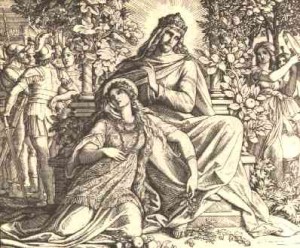
I want you for just a minute to close your eyes. Just sit back and relax, and imagine that you are hearing not my voice, but the voice of your beloved, the voice of the one person in this world who loves you more than any other . . . .

“Arise, my love, my fair one, and come away.”

Those words, of course, are from Scripture, from the Song of Songs or Song of Solomon, one of the oddest books in the Holy Bible, for it is nothing more nor less than a love song, a sensual and even erotic love song.

Our psalm this morning is also a love song. It is a marriage song which the Bible tells us was written by the Korahites or “Sons of Korah” for the wedding of a king. In fact, the Bible tells us a lot about this psalm, information that we don’t find in the Book of Common Prayer Psalter. First, it has an instruction: “To the leader: according to the Lilies.” Apparently this tells the choral director the tune or melody to which the psalm was to be sung. Second, it tells us that it was a song “of the Korahites” who were a musical guild (probably hereditary) in the Temple. Third, the psalm is described as a Maskil – this word is derived from a Hebrew word meaning “understanding” or “insight” and, thus, it is believed that Psalms so described are “insight-giving” or especially instructive. And, finally, it is described as a love song.

The insight comes, perhaps, in what is the third verse of our abbreviated recitation this morning:

Your throne, O God, endures for ever and ever,
a scepter of righteousness is the scepter of your kingdom;
you love righteousness and hate iniquity.
(Verse 7 in the BCP; vv. 6-7a in the NRSV)

In this verse, which has puzzled scholars for generations, though the singer seems still to be singing of the King, he names him “God”! The psalm appears to ascribe divinity to an earthly king which is something quite foreign to ancient Judaism. This is underscored by the last verse of the Psalm:

I will make your name to be remembered
from one generation to another;
therefore nations will praise you for ever and ever.
(Verse 18 in the BCP; v. 17 in the NRSV)

Here, this remarkable psalm lavishes on the human king the type of praise generally given to God! Christians, therefore, read this psalm as referring to Jesus, as we also read the Song of Solomon. The usual interpretation of both is that the Bridegroom or King is Jesus and the Bride or Queen is the church. However, in the middle ages the monastic mystics St. Teresa of Avila and St. Bernard of Clairvaux suggested a much more personal interpretation. In their commentaries Bernard and Teresa envisioned the love between Christ the Bridegroom and his bride, the individual soul, and they noted the way in which that love overflows to others.

For Bernard, the Song is about the manner in which the “thirsting soul” can rediscover the power of God’s love. “What a great thing is love, provided always that it returns back to its origin,” he writes; “flowing back again into its source, it acquires fresh strength to pour itself forth once again.” (On the Songs of Songs 83:4) Our journey to God’s love does not consist in our finding the path, but rather in being found on the path by Christ the Bridegroom who passionately seeks us. “Arise, my love, my fair one, and come away,” are words spoken by Christ to each one of us as he invites us to follow him. But the divine love is never intended to be, and is not complete if it is, purely individual and personal.

Bernard writes that the human soul aflame with the love of God “strives to win [other] souls with its habitual fire and renewed courage.” (58:1) “Love reveals itself,” he writes, “not by words or phrases, but by action and experience.” (70:1) Thus, says St. Bernard, love of God is not merely a personal experience; it is never complete unless it leads us to love our neighbors.

For Teresa of Avila, similarly, the Bridegroom’s call leads the soul back from a lack of love to love most fully realized:

Along how many paths, in how many ways, by how many methods You show us love! …[Not] only with deeds do You show this love, but with words so capable of wounding the soul in love with You that You say them in this Song of Songs and teach the soul what to say to You. (Meditations on the Song of Songs 3:14)

Using the sisters Martha and Mary of Bethany, as examples, Teresa, like Bernard, writes that the Song propels us to an exterior expression of love of neighbor. Only disciples who both pray with fervent desire and care for their neighbors, she writes, “imitate the laborious life that Christ lived.” (7:8)

So with the background of these songs of a divine love that compels us to share the love of God with those around us, we turn to today’s Gospel story of Jesus being confronted by and answering the Pharisees. The confrontation is over an issue of ritual cleansing, the failure of Jesus’ disciples to wash their hands before eating. Jesus, however, quickly turns that objection aside quoting from the 29th chapter of Isaiah, “‘This people honors me with their lips, but their hearts are far from me . . . . ” For Jesus the question is not one of ritual, not one of purity, not one of custom, not one of tradition. For Jesus the issue is love. “Their hearts are far from me.”

“Look,” he says, “the issue is not what’s on the outside. What’s on the outside cannot defile you. The issue is what’s on the inside. If the human heart is not filled with love, all sorts of filth results. If the human heart is not turned toward God with love, the result is disastrous.”

“Arise, my love, my fair one, and come away.”

Understand, the Pharisees weren’t bad people. They were trying to be good Jews. As the People of God, the Jews believed that God wanted them to be separate from other nations and peoples, that God wanted them to be pure and spotless. The word Pharisee means literally “separate ones.” They believed that the better and more stringently you observe the ritual practices, the more you were separate from, different from, and therefore more holy than others. Jesus was just telling them they were wrong, so he quoted from Isaiah about the heart and about love. This was the same prophet he quoted when he began his public ministry in his hometown synagogue in Nazareth. There, he read a passage from the 61st chapter of Isaiah. As Luke reports,

the scroll of the prophet Isaiah was given to him. He unrolled the scroll and found the place where it was written: “The Spirit of the Lord is upon me, because he has anointed me to bring good news to the poor. He has sent me to proclaim release to the captives and recovery of sight to the blind, to let the oppressed go free, to proclaim the year of the Lord’s favor.” (Luke 4:17-19)

Where the Pharisees sought to be separated from the unclean around them, Jesus preached the love of God which compels us to serve those around us, especially the ones who are considered unclean. Where the Pharisees were concerned about cleaning cups and washing hands, Jesus was concerned about cleaning lepers and washing their wounds. “Love reveals itself,” St. Bernard writes, “not by words or phrases, but by action and experience.” Only disciples who both pray with fervent desire and care for their neighbors, writes St. Teresa, “imitate the laborious life that Christ lived.”

This is the theme James takes up in today’s reading from his epistle: “Be doers of the word, and not merely hearers who deceive themselves.” “Religion that is pure and undefiled before God, the Father,” writes James, “is this: to care for orphans and widows in their distress, and to keep oneself unstained by the world.”

And this is what the Baptismal Covenant is all about. In a few minutes, we will baptize an infant, Finn, and an adult, John. Together with them and their sponsors, we will all reaffirm our own Baptismal Covenant as they make theirs. We will be asked, “Do you believe in God the Father? Do you believe in Jesus Christ, the Son of God? Do you believe in the Holy Spirit?” Answering these questions, we will prove ourselves to be hearers of the word. But that is not the end of the Baptismal Covenant.

We will then be asked these five questions:

  • Will you continue in the apostles’ teaching and fellowship, in the breaking of bread, and in the prayers?
  • Will you persevere in resisting evil, and, whenever you fall into sin, repent and return to the Lord?
  • Will you proclaim by word and example the Good News of God in Christ?
  • Will you seek and serve Christ in all persons, loving your neighbor as yourself?
  • Will you strive for justice and peace among all people, and respect the dignity of every human being?

In other words, we will be asked, “Will you be doers of the word, and not merely hearers?” Our response will be, “I will, with God’s help.”

In Baptism, the Christ the Bridegroom embraces us as his own. “Arise,” he says as we come up out of the Baptismal waters, “Arise, my love, my fair one, and come away.” Come away not to be separated from others, but come away to share God’s overflowing love with them. Come away to strive to win other souls with habitual fire and renewed courage. Come away to imitate the laborious life that Christ the Bridegroom lived. “Arise, my love, my fair one, and come away.”
Amen.

We’ve Never Done It This Way Before! – From the Daily Office – September 1, 2012

From the Acts of the Apostles:

[Peter said to the circumcised:] “I remembered the word of the Lord, how he had said, ‘John baptized with water, but you will be baptized with the Holy Spirit.’ If then God gave them the same gift that he gave us when we believed in the Lord Jesus Christ, who was I that I could hinder God?” When they heard this, they were silenced.

(From the Daily Office Lectionary – Acts 11:16-18 – September 1, 2012)
 
Changing a Light BulbA couple of days ago I talked about Cornelius’s conversion from pagan to Christian through some time spent as a pious not-quite-proselyte Gentile. In today’s reading Peter defends his decision to baptize the Gentiles (Cornelius and his entire household) with this great question, “Who was I that I could hinder God?” It certainly shut down his critics!
How often do we stand in God’s way? Well, how often have you heard these words: “We’ve never done it this way before”? Or it’s more affirmatively stated equivalent, “We’ve always done it this way before”? Both usually said in that dismissive, fatally negative tone of voice.

“How many Episcopalians does it take to change a light bulb?”

“Change??!?!?!??!”

It happens again and again in our churches. Nearly everyone will acknowledge that we need new carpet for the Nave or the Parish Hall, but then someone will ask, “What’s wrong with our old carpet? I like the old carpet.” I once served a church where there was universal agreement on the need to replace the carpet in the worship space, and everyone agreed that it should be red (the color of the previous carpet), but the Vestry debated for six months about the shade of red! (Finally, a member of the board just went out and ordered the carpet and put all out of our misery!)

I read recently about a church where a recently deceased parishioner had left a bequest of $15,000 for a new prayer garden. The memorial committee met for months, but eventually disbanded because they couldn’t decide where to put it or what it would look like. “We’ve never done it this way before!”

Wouldn’t be great if that were a cry of delight and adventure instead of the fatally negative dismissal of change it usually is?

A few years ago my wife and I made our first trip overseas together to Ireland, a country neither of us had ever visited. Everything we did on that trip was something we had never done before. We had never before driven on the narrow back-country lanes of Ireland, the single-track roads where one might meet a flock of sheep or a herd of cows and have to back up a hundred yards or more to wide spot and let them pass before you could go on. We had never before climbed the cliffs of County Antrim and seen the Giants’ Causeway. We had never before eaten “the full Irish breakfast” with black pudding, baked beans, sauteed mushrooms, and grilled tomatoes added to our usual fare of bacon and eggs. For eighteen days we lived an almost hourly experience of never having done nearly everything this way before, and we loved it.

Wouldn’t it be great if folks in the church, instead of fearing change and difference, would greet new things with “We’ve never done it this way before!” as a cry of delight and adventure?

We always need to remember Jesus’ words, “You did not choose me but I chose you.” (John 15:16) We have been invited by God to a surprising adventure. Just like Peter we need to ask (some of us constantly), “Who am I to hinder God?” Ours is not to hinder God, but to follow God; not to stand in God’s way, but to journey in God’s way; not to say dismissively, “We’ve never done it this way before,” but to cry with delight and excitement, “We’ve never done it this way before!”

====================

Father Funston is the rector of St. Paul’s Episcopal Church, Medina, Ohio.

Occasional Missionaries – From the Daily Office – August 30, 2012

From the Book of Acts:

[Peter asked Cornelius,] “Now may I ask why you sent for me?’ Cornelius replied, “Four days ago at this very hour, at three o’clock, I was praying in my house when suddenly a man in dazzling clothes stood before me. He said, ‘Cornelius, your prayer has been heard and your alms have been remembered before God. Send therefore to Joppa and ask for Simon, who is called Peter; he is staying in the home of Simon, a tanner, by the sea.’ Therefore I sent for you immediately, and you have been kind enough to come. So now all of us are here in the presence of God to listen to all that the Lord has commanded you to say.”

(From the Daily Office Lectionary – Acts 10:29-33 – August 30, 2012)
 
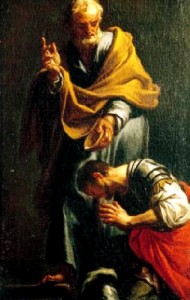
Peter Baptizing the Centurion Cornelius by Francesco Trevisani (1709)Judaism is not a missionary religion. It is, however, a proselytic religion. This means that Jews don’t go looking for converts, but those who come to them interested in becoming Jews are instructed and initiated; these initiates are called proselytes. Cornelius might have become a proselyte, but we know that he was not because if he had been, Peter would have had no issues with seeing him, meeting him, eating with him. Peter did have those issues initially, but then was shown the vision of unclean animals which he was told to eat. Peter interpreted that vision to mean that he should not treat non-Jews as unclean; it was the beginning of the Jewish Christian church welcoming non-Jews (“Gentiles”) as members.
Christianity is a missionary religion. Christians go looking for converts – or at least we’re supposed to and in the beginning we did. Someone may have told Cornelius about Jesus and about the followers of Jesus or, more likely, someone simply lived a Christian life. Cornelius had already been attracted to the Jewish religion and was following some of its practices, but the only way he could have become interested in hearing “all that the Lord had commanded Peter to say” was if someone had primed the pump, so to speak.

Once in a long while someone who is not a Christian will call me or will stop in the office and inquire about baptism (in fact, it happened quite recently, but that was the first time in several years). It always turns out that they have witnessed something in the life of a friend or family member that they find attractive – a way of handling misfortune, of dealing with the death of a loved one, of helping someone less fortunate than themselves. Having seen this, the inquirer has talked to the person and somehow in conversation they have learned that their friend or family member is a church member. Further conversation leads to further inquiry which leads eventually to me, to a conversation not unlike this conversation between Peter and Cornelius. When I’ve asked my version of “Why have you sent for me?” I’ve never been told about a vision of an angel in dazzling clothes, but I have been told about Christians testifying to their faith.

Christianity is a missionary religion, and occasionally Christians act like missionaries. When they do, Corneliuses show up.

====================

Father Funston is the rector of St. Paul’s Episcopal Church, Medina, Ohio.

Bread? Body? Questions Without Easy Answers – From the Daily Office – August 27, 2012

Jesus said:
 

Those who eat my flesh and drink my blood have eternal life, and I will raise them up on the last day; for my flesh is true food and my blood is true drink. Those who eat my flesh and drink my blood abide in me, and I in them.

(From the Daily Office Lectionary – John 6:54-56 – August 27, 2012)
 
The Jews, John tells us, disputed among themselves as Jesus was delivering the lengthy dissertation on bread from which these statements come. Earlier he had introduced this idea that his flesh was bread to be eaten by his followers: “I am the living bread that came down from heaven. Whoever eats of this bread will live for ever; and the bread that I will give for the life of the world is my flesh.” (v. 51) The very idea of consuming human flesh is off-putting, even disgusting, and would have been extremely objectionable to the Jews; no wonder they grumbled and mumbled, complained and disputed. Even as a metaphor, the statement demands a lot from Jesus’ followers!

Church-going Episcopalians (and others who participate weekly in Holy Communion) are perhaps overly familiar with the metaphor. It’s not that we have somehow explained it away, I don’t think we have. Rather we have made it routine. Weekly (or more frequent) communion, with sweet wine and tasteless little cracker we laughingly call “bread” seems to have weakened the impact of this shocking metaphor. I mean, really, to someone who does not hear these words through 2,000 years of eucharistic practice, eating flesh and drinking blood sound a whole lot like cannibalism and vampirism.

How can we recapture the power of this metaphor? How can we make it make sense both to ourselves and to the non-church world in the 21st Century? As a ministry colleague has put it, “How would we explain this to a person who has watched Buffy the Vampire Slayer and read every word of the Twilight Series, but never stepped foot in a church or even know what the Bible is?”

I wish I had the answer to these questions, but the answers are less important than the questions themselves. Simply knowing that there are questions, acknowledging that they are real, that they are troubling, that they are important, and that there are no easy answers is the first step in our calling to show that Christ is real, and troubling, and important to the world, that Christ is relevant in the 21st Century.

Questions are much more important than answers, especially the hard ones.

====================

Father Funston is the rector of St. Paul’s Episcopal Church, Medina, Ohio.

« Older posts Newer posts »