From the Book of Job:
One day the heavenly beings came to present themselves before the Lord, and Satan also came among them. The Lord said to Satan, “Where have you come from?” Satan answered the Lord, “From going to and fro on the earth, and from walking up and down on it.” The Lord said to Satan, “Have you considered my servant Job? There is no one like him on the earth, a blameless and upright man who fears God and turns away from evil.” Then Satan answered the Lord, “Does Job fear God for nothing? Have you not put a fence around him and his house and all that he has, on every side? You have blessed the work of his hands, and his possessions have increased in the land. But stretch out your hand now, and touch all that he has, and he will curse you to your face.” The Lord said to Satan, “Very well, all that he has is in your power; only do not stretch out your hand against him!” So Satan went out from the presence of the Lord.
(From the Daily Office Lectionary – Job 1:6-12 – August 23, 2012)
 A later selection from the Book of Job was called up by the Sunday Eucharistic Lectionary several weeks ago. In my sermon I said to the congregation that the Book of Job is fiction (which it is). You should have seen the look on one of my parishioners’ face! There’s a fellow in the congregation who is, shall we say, conservative with regard to the Bible. While I don’t believe he actually considers the Bible to be the inerrant word of God per se, he’s pretty sure that it is to be taken with the highest degree of certainty and words like “myth” or “fiction” applied to Scripture are not to his liking. I swear I thought he might have an apoplectic fit right there in his pew! But let’s be honest: do we really think that God and Satan are engaged (or have ever been engaged) in a game of chance involving the lives of human beings?
Because, when you get right down to it, that is the set up of the Book of Job – a bet between God and the Devil as to whether this good man, Job, will curse God if his life turns to garbage. If someone in the church does think that that’s the way God runs the universe, perhaps that person is following the wrong religion because that surely is not the way the Christian faith sees the world! In this, Christianity is not at odds with science. Albert Einstein once famously remarked, “God does not play dice with the universe.” And while quantum mechanics, chaos theory, superstring theory, and a whole host of new scientific and mathematical suppositions rely on the concept of probability rather than certainty, they still don’t posit a game of chance as determining the structure of reality.
If a game of chance is not the way the universe runs, then what are we to make of these verses from today’s Old Testament reading? If they are not factually accurate, then we have only two choices: they are a lie, or they are fiction.
If they are a lie, then they undermine the whole concept of Holy Scripture as an embodiment of Truth. If they are fiction, however, there is no problem. The Bible is not, as everyone ought to acknowledge, so much a book as it is a library. It is a collection of books, as we readily admit whenever we refer to the works found in this collection. We don’t refer to the “chapter of Genesis” or the “section of Isaiah”; we refer to them as “books”, books within a library. Just like a library, the Bible includes many kinds of literature. There are histories (the Books of Kings, Chronicles, and the Acts of the Apostles, for example). There are works of poetry (Psalms). There are books of etiquette and advice on good living (Proverbs and Ecclesiastes). There are memoirs (the Gospels). There are collections of letters (the Pauline and other Epistles). There are law books (Leviticus and Deuteronomy). And among various other forms of writing, there is fiction (Job is both an example of fiction and of poetry).
The question for the student of Biblical literature is “Does fiction embody truth?” Do any of these non-historical, non-scientific forms of literature embody truth? What is the truth of a poem, for instance? Well, as an early 20th Century writer on the subject of poetry put it, poetry expresses the truth that
behind our daily occupation, beyond the business of the market and the pleasure of the circus, there lies an unexplored world of beauty – a world of complete satisfaction for the highest human capacity, a world from which we may derive courage, and hope, and faith, to help us in this world we live in. (Laurie Magnus, Introduction to Poetry, London:1902, pg. 68)
Fiction does the same thing. Ralph Waldo Emerson once said, “Fiction reveals truth that reality obscures.” Among the reasons fiction is worth writing, reading, and studying is not that it’s entertaining (although good fiction truly is), but rather that it teaches us important lessons about the world, about human beings, and (the religious person says) about God. It does so even if we’re not actively studying, not trying to learn these things; they get into us and into our thinking in unconscious ways. That’s what Scripture is supposed to do, too. And that’s why Scripture includes fiction and poetry along with history, memoir, and correspondence. And that’s why it’s perfectly OK to say, “Job is fiction.” It may be fiction, but it’s nonetheless true!
====================
Father Funston is the rector of St. Paul’s Episcopal Church, Medina, Ohio.
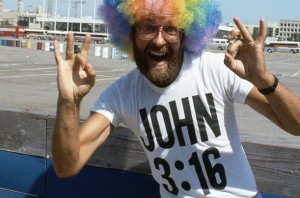 A very familiar quotation from Scripture that second verse: anyone who has ever attended a sporting event in the United States (or watched one on television) as seen someone holding up a sign with “John 3:16” emblazoned on it. Often that person is wearing a rainbow-colored “Afro” wig. Anytime I have witnessed that spectical I’ve wondered, “Has anyone ever become a follower of Jesus because of that sign?” I’m pretty certain the answer is “No.”
 This short passage from the Book of Acts describes the sort of world Jesus intended. Not just the sort of church . . . . the sort of world, the sort of human society, a complete community in which no one claims private ownership (it’s all God’s remember) and where there are no needy persons because what is needed is distributed equitably.
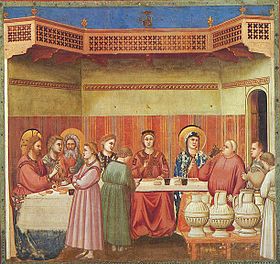 A year ago I was in Ireland, camped out in a cottage outside of the village of Banagher, County Offaly, on sabbatical. As my study project, I was translating old Irish hymns into metrical, rhyming English such that they could be sung to the music of the original. The hymns were published in the early 20th Century in a collection titled Dánta Dé Idir Sean agus Nuadh compiled by Uná ní Ógáin. Dánta Dé includes a communion hymn which elaborates on John’s story of the wedding feast; it is entitled The Blessed Wedding at Cana and is attributed to Maighréad ní Annagáin. I found I could not directly translate the hymn, so instead I wrote a poem of my own. Reading this story today, I recall working on that piece and offer it again.
 Just a few days ago the Public Religion Research Institute issued a new report entitled A Generation in Transition: Religion, Values, and Politics among College-Age Millennials. A “millennial” is somone currently 18 to 24 years of age, the youngest cohort of adults. (From my point of view at nearly 60 years of age these are children; my son and daughter are both older than this group!) According to the report, these young adults are more likely then the general population to be religiously unaffiliated; one-quarter of them so identify themselves. Interestingly, most of those who do so were reared in religiously affiliated households. The greatest movement away from religious affiliation was seen among those raised in Catholic and white mainline Protestant families. It would appear that we have not been doing a very good job of teaching our children “that they in their turn might tell it to their children”!
 Reading these oh-so-familiar words in the introduction to John’s Gospel, I remember other words I read on another blog yesterday:
 It is intriguing how often in stories of Holy Scripture food plays a role. From the “apple” in the Garden, to Abraham offering a meal of cakes and meat to the three men (who turn out to God) at the Oaks of Mamre, to this story of Gideon, to David and his men eating the Bread of the Presence, to all the food items listed as items of sacrifice in Leviticus, the Old Testament (indeed, the whole Bible) is food focused. The People of God define themselves through the annual reenactment of a ritual meal celebrating the Passover; the new People of God define themselves (in my tradition and others) by the weekly reenactment of a ritual meal celebrating the death and Resurrection of Christ and anticipating his return. It’s intriguing but not surprising. The Jewish and Christian faiths are not, in the long run, about following rules of ritual or moral conduct; they are about being in an intimate relationship with that which is the source of being, that which we call “God” and address as “Father” or brother or redeemer. And, other than sex, there is probably no more intimate activity two or more people can share than eating together.
 These are the words spoken by the great crowd of Jews and others who thronged the streets of Jerusalem for the Festival of Shavu’ot when the Twelve, empowered by the Holy Spirit, begin to tell the story of Jesus in languages they had never before spoken. Shavu’ot is a celebration with both agricultural and historical significance in Judaism. It is known as the “festival of the first fruits,” a harvest feast when the first fruits were brought as offerings to the Temple; it is also known as the “festival of the giving of the Law,” a celebration of the handing down of Torah on Mt. Sinai. It was called Pentecost, a Greek word meaning “fiftieth”, because it always falls on the fiftieth day after the Passover. That year it fell on the fiftieth day after the Resurrection and, thus, the Christian feast of the Holy Spirit carries that name, as well.
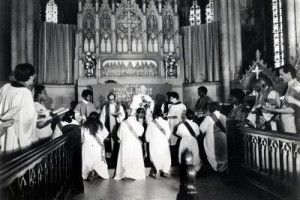 This past Sunday, the Episcopal Church marked the 28th anniversary of the women known as “the Philadelphia Eleven” who were ordained on July 29, 1974. Four retired bishops (Daniel Corrigan, Robert DeWitt, Edward Welles and George Barrett) chose to defy the General Convention of the Episcopal Church which, at its regular triennial meeting in 1973, had voted against opening the priesthood to women; women were already eligible for ordination as deacons. Joined by male presbyters who supported them and the candidates, they ordained eleven women deacons to the priesthood: Merrill Bittner, Alla Bozarth-Campbell, Alison Cheek, Emily Hewitt, Carter Heyward, Suzanne Hiatt, Marie Moorefield Fleisher, Jeannette Piccard, Betty Bone Schiess, Katrina Martha Swanson, and Nancy Hatch Wittig. Shortly thereafter, four additional women were also “irregularly” ordained: Eleanor Lee McGee, Alison Palmer, Betty Powell, and Diane Tickell. A firestorm of controversy erupted in the church: charges were filed against these dissident bishops (Daniel Corrigan, Robert DeWitt, Edward Welles and George Barrett) and an emergency meeting of the Episcopal House of Bishops was convened on August 15, 1974.
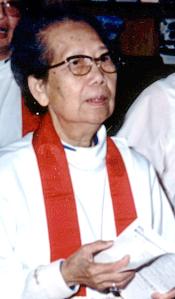 These women were not the first to be ordained to the Anglican priesthood, however. During the Second World War, Florence Li Tim-Oi was ordained to the presbyterate on January 25, 1944, by the Rt. Rev. Ronald Hall, Bishop of Hong Kong, in response to the crisis among Anglican Christians in China caused by the Japanese invasion. No male clergy could be found who were willing to take on the onerous ministry, but Ms. Li was, so she was ordained and served with distinction. After the war, the Archbishop of Canterbury sought to make the bishop and the priest rescind the ordination, but neither did. Ms. Li voluntarily ceased serving as a priest until more than 30 years later when she immigrated to Canada where the Anglican Church, following the Episcopal Church’s lead, had begun to ordain women. Her priesthood was recognized and she served as an honorary canon in Toronto, ministering among the immigrant Chinese population.

