From the Acts of the Apostles:
Paul stood in front of the Areopagus and said, “Athenians, I see how extremely religious you are in every way. For as I went through the city and looked carefully at the objects of your worship, I found among them an altar with the inscription, ‘To an unknown god.’ What therefore you worship as unknown, this I proclaim to you. The God who made the world and everything in it, he who is Lord of heaven and earth, does not live in shrines made by human hands, nor is he served by human hands, as though he needed anything, since he himself gives to all mortals life and breath and all things. From one ancestor he made all nations to inhabit the whole earth, and he allotted the times of their existence and the boundaries of the places where they would live, so that they would search for God and perhaps grope for him and find him — though indeed he is not far from each one of us. For ‘In him we live and move and have our being;’ as even some of your own poets have said, ‘For we too are his offspring.’ “
(From the Daily Office Lectionary – Acts 17:22-28 (NRSV) – June 29, 2014)
Always one of my favorite stories of the Apostle Paul, this incident is depicted in the stained glass altar window of my church (St. Paul’s Episcopal Church in Medina, Ohio). I chose to use it as my focus scripture to introduce a summary of our Holy Land Pilgrimage activities today because Paul’s message of unity – that in God we all live and move and have our being, and that we are all God’s offspring – is one that needs badly to be heard in Israel and Palestine and, if the statistics we are hearing about Christian population in these countries are correct, it is one that won’t be heard very loudly or at all. Down from as high at 35% at the time of the British Mandate and the establishment of the state of Israel in 1948, the Christian population of Israel and Palestine today is less than 2%.
We began our day early with breakfast at 5:30 a.m. — to the usual assortment of olives, pickled eggplant, humus, labneh, yogurt, cheeses, and so forth was added a flaky, cheese-stuffed pastry, a sort of savory popover. Washed down with several cups of instant coffee (instant is all they serve here), this got us fortified for a morning of cultural fascination and disappointment.
First, we rode our bus to the Dung Gate of the old city, a pretty awful but ancient name for the southern gate in the city wall which derives from the refuse dumped here in ancient times; presumably, the prevailing winds would carry odors away. (“I went out by night by the Valley Gate past the Dragon’s Spring and to the Dung Gate, and I inspected the walls of Jerusalem that had been broken down and its gates that had been destroyed by fire.” Neh 2:13) This gate leads directly to the Western Wall and an archaeological park located at the south end of the Temple Mount.
We stood on line for nearly an hour waiting for Israeli security to open the gate that leads to the only access non-Muslims have to the top of the Temple Mount (which Muslims call “the Noble Sanctuary), the Al-Aqsah Mosque, and the Dome of the Rock. Above this gate is a sign reading, “According to Torah Law, entering the Temple Mount area is strictly forbidden due to the holiness of the site. [signed] The Chief Rabbinate of Israel” Both the Ashkenazi and Sephardi Chief Rabbis have signed this statement which was first issued by the Ashkenazi rabbi in 1935; both reiterated this prohibition in 2013.
Ignoring the Chief Rabbinate, a group of Israeli “settlers” stood in the line in front of us waiting to gain access to the Temple Mount.
Finally, security opened the gate and we were ushered through. The settlers were given a thorough search, however. From the covered wooden walkway from the security point to the actual gate of the Mount, we were able to take some good photographs of the crowd of Jews at the Wailing Wall. Directly under us, a large group of Jewish women were singing a hymn at the Wall. Directly in front of us, at the end of the covered walkway, Israeli security stored their heavy plexiglass riot shields, a visible sign to anyone entering that the police were prepared.
We entered the Noble Sanctuary and found a spot in the shade where Iyad could tell us about its history, ancient and modern. While he was talking some young adult tourists (American or Canadian college kids?) came onto the Mount and an old Muslim man began to berate them for being immodestly dressed. (We’d been told ahead of time that should wear long pants and long- or short-sleeve shirts, no tank tops; women should be in dresses or pants to the ankle, long-sleeved blouses, and scarves or veils. Why their guide hadn’t done the same, I have no idea.) An argument erupted between the old man and the Israeli police guards about who had authority to tell tourists whether they could enter and what the should wear. Eventually the college kids got themselves properly attired (using towels and large scarves) and walked on, but I know they took away an image of Muslim intractability.
Shortly after that, the settlers we’d seen at the security gate entered, to boos, hoots, catcalls, and other shouts of protest (or of “Allah hu akbar” – God is great) from the Muslims. They either offered a prayer or held a short conversation just inside the gate, then made a bee-line for an exit (passing us and wishing us “Shalom” as they did so). They had no reason to be there, other than to be provocative.
We spent some time walking through the area and seeing its sights. Unfortunately, since September 2000 when Israeli prime minister Ariel Sharon “visited” the Temple Mount, an act scene by many as provoking the second Intifada, no non-Muslim has been permitted to enter the Al Aq-sah Mosque or the Dome of the Rock, so we could not see in the insides of the buildings.
After that we left the Noble Sanctuary by another gate (one can leave by any of the twelve gates, but non-Muslims can enter by only the one). We made our way to St. Anne’s Church at the Pools of Bethesda. A short visit to the pools and archeological site was followed by our entering the church and, as a group, singing Seek Ye First before the altar. The church, which is a crusader construction of limestone, has marvelous accoustics and we really sounded good. (The church is well preserved because it was turned into a Muslim school at one point. This is why it has no windows; those were replaced by the Muslims with plaster filigree. It also has a verse from the Qur’an carved in the stone over the front door.) After that, we made our way back to the bus which took us back to St. George’s Cathedral.
We gathered in a rather full church for the Eucharist, celebrated in both English and Arabic — and interesting experience reciting the creed and other parts of the canon in English while others were doing so in Arabic. Bishop Suheil Dawani presided; Canon Naim Atik preached. The canon focused on Jesus’ reference to rewards in the reading from Matthew’s Gospel and tied it to the recent vote by the Presbyterian Church USA to divest itself of stock in companies doing business in occupied Palestine, which he praised. I really didn’t follow the connection, however.
A short coffee hour (the coffee was “Turkish” or Arabic coffee – strong and sweet in tiny cups) and then a conversation with the bishop. He told us about his diocese’s ministries (education and health care) carried on by 30 diocesan institutions in five countries; the diocese covers Israel, Palestine, Lebanon, Syria, and Jordan! He also told us about the shrinking of the Christian community in the Holy Land: the cathedral had been full, but that fullness was made up of two pilgrimage groups – ours and a larger group from Canada – and one group of scholars at St. George’s College. The indigenous members of the congregation this morning numbered only about twelve! He pleaded with us to support the work of the church in Jerusalem and beyond.
Lunch followed, after which we went to the Israel Museum to see a scale model of what Second Temple (First Century) Jerusalem is believed to have been, and an exhibit of the Dead Sea Scrolls. Both were very impressive. More impressive was the unfortunate and unnecessary way in which Iyad was hastled by the guards at the museum’s entrance. He was clearly made to feel unwelcome.
On our return to the Guest House we had some free time and then had a conversation with a Jewish scholar who described himself as a “Jewish Zionist Leftist who sympathizes with the Palestinians and believes they have a right to self-determination.” He laid out for us in very a honest and nuanced way the differing Jewish perceptions of the difficulties in Israel and Palestine. He personalized the struggle in this land by telling us stories of the ways in which he, his wife, and his children had been accosted by Muslims, among whom they live! He teared up telling us of an incident involving his 9-year-old son, and yet he still urged us to not take sides and he still takes the view that the Palestinian Arabs have an equal right to a homeland.
He advised us to “not take the conflict home with you” and to support Christians in this country. Noting that they are (as stated above) down to less than 2% of the population, he opined that their absence would be tragic for the country. They are a force for peace, he said, and without them the possibility of armed conflict increases. Asked what we could do, his answer was the same as the bishops – support the Christians.
A tasty dinner of spiced beef and then Compline finished the day.
Take away from this day – Paul is correct; we are all the children of one God and those of us of the Abrahamic faiths ought to be able to demonstrate that to the rest of the world. But, for whatever reasons, we seem unable to do that. Everywhere we go in this country we find Israeli Jews provoking Palestinian Muslims; clearly it is a minority doing so blatantly, but the government seems to do so as well in more subtle ways. We find Palestinians, both Muslims and Christians, angry at the Israelis. We find Christians unable to work together (even though their bishops, Bishop Dawani told us, meet together frequently for mutual support and consultation). We hear Arabs talk of “peace and justice” and Jews talk of “peace with security,” but there is very little talk of reconciliation. There are some beginnings of grass-roots efforts at reconciliation, but it is not happening in the secular political world nor in the religious hierarchies. “Pray for the peace of Jerusalem: ‘May they prosper who love you. Peace be within your walls and quietness within your towers.’ ” (Ps 122:6-7)
====================
A request to my readers: I’m trying to build the readership of this blog and I’d very much appreciate your help in doing so. If you find something here that is of value, please share it with others. If you are on Facebook, “like” the posts on your page so others can see them. If you are following me on Twitter, please “retweet” the notices of these meditations. If you have a blog of your own, please include mine in your links (a favor I will gladly reciprocate). Many thanks!
====================
Father Funston is the rector of St. Paul’s Episcopal Church, Medina, Ohio.
 We got up this morning to the startling news that a major political figure had been defeated in his party’s primary by a candidate supported by what I would call an extremist fringe element of the party, a group which has gained more say and more influence in the party than it should have. I didn’t write a lectionary reflection until late in the day because, political news junkie that I am, I spent the morning listening to the radio pundits and perusing the on-line publications. Over and over I found the commentators using hyperbolic metaphors — earthquake, tornado, disaster, calamity — and asserting that the defeat was entirely unforeseen. “Wow!” I thought, “They sound like Qoheleth in today’s reading from Ecclesiastes!”
 “What is truth?” asked Pilate. (Jn 18:38)
 Here is another piece of Paul’s writing that the Episcopal Church has lifted out of the bible and plugged into The Book of Common Prayer. It is used as the opening dialog of the church’ baptismal service. After a seasonally appropriate greeting, the presider and people converse:
 “The Lord is a God of knowledge” may be the most important assertion in Hannah’s song. Many bible scholars believe her song to be the model of Mary’s song, The Magnificat. Both are sung by pregnant women; both extol the might and power of God; both confirm God’s preference for the poor and lowly over the rich and powerful. Only Hannah’s song, however, includes this description and her accompanying admonition to her hearers to not speak arrogantly. The translation in The Complete Jewish Bible renders her words in this way: “Stop your proud boasting! Don’t let arrogance come from your mouth! For ADONAI is a God of knowledge, and he appraises actions.”
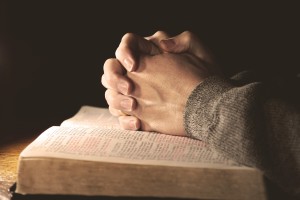
 Two years ago I wrote a meditation on First Timothy on this blog about our need to pray for our political leadership, especially those with whom we disagree; yesterday, I repeated that same reflection. Really, our need is to pray for everyone, including those we really don’t want to pray for: “Love your enemies and pray for those who persecute you.” (Mt 5:44) I believe that, I really do.
  There was a meme circulating the conservative blogosphere and email circuit several months ago in which folks of a certain political persuasion asserted that they were “praying” for President Obama by reciting a verse from Psalm 109: “Let his days be few, and let another take his office.” The psalm continues in the next verse: “Let his children be fatherless, and his wife become a widow.” And the petition get even worse after that. This is not what Paul is admonishing the faithful to do in his letter to the young bishop Timothy. In fact, it is clearly the very opposite.
  I’m going to do something I have never done before! I’m going to read someone else’s sermon. While I was pondering these lessons, doing the usual research, and thinking about what to say, I came upon a superb sermon preached on Memorial Day weekend three years ago when, as today, the lesson from Acts was the story of St. Paul preaching at the Areopagus. The preacher was the Rev. Kurt Wiesner who is the rector of All Saints Episcopal Church in Littleton, New Hampshire, and whom many of us remember from his tenure as curate at our own Trinity Cathedral. This is what Kurt had to say and I earnestly commend his thoughts to you:
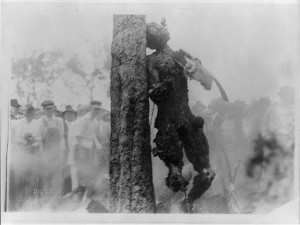 Does the name “Jesse Washington” mean anything to you? It’s unlikely that it does. If I tell you that Jesse Washington died in 1916 in Waco, Texas, would that spark any memory? Have you ever been taught about the incident in which Washington was killed? Have you ever heard of what came to be called “The Waco Horror?”
 It has been almost 40 years since presidential candidate Jimmy Carter admitted to Playboy magazine, “I’ve looked on many women with lust. I’ve committed adultery in my heart many times. God knows I will do this and forgives me.” Caused quite a stir and, some say, marked the beginning of the erosion of presidential privacy, the start of an era of leadership toxicity in American politics when partisan reporters feel free to reveal any fact or rumor, no matter how irrelevant, if it will hurt a politician of the opposite party or position. I’m not sure that that’s the case; a good argument can be made that the current polarized, hyper-partisan atmosphere started building during the Nixon, or even Johnson, years. That, however, is not what I’m thinking about this morning.

