Occasional thoughts of an Anglican Episcopal priest

Category: Politics (Page 18 of 23)

The Lesson of Bombings – From the Daily Office – April 19, 2013

From the Second Letter of John:

Everyone who does not abide in the teaching of Christ, but goes beyond it, does not have God; whoever abides in the teaching has both the Father and the Son. Do not receive into the house or welcome anyone who comes to you and does not bring this teaching; for to welcome is to participate in the evil deeds of such a person.

(From the Daily Office Lectionary – 2 John 9-11 (NRSV) – April 19, 2013.)

No Man Is an IslandReading this on a morning when parts of Watertown and Cambridge, Massachusetts, are “locked down,” when the entire city of Boston and its environs are under a “shelter in place” order as police engage in a massive manhunt for one of the two suspected perpetrators of the Boston Marathon bombing (the other having been killed already) is a bit strange.

“Do not receive into the house or welcome anyone who comes to you” is exactly what the authorities are telling people. Of course, they are doing so for safety’s sake not because of some religious or philosophical concern for approving or participating in evil.

Nonetheless, this is precisely the problem that the incidents of this week present to each of us. How do we, by our “welcome” or by our silence, participate in the evil deeds that pollute our world? John Stuart Mill in the late 1880s said, “Bad men need nothing more to compass their ends, than that good men should look on and do nothing.” Similarly, “All that is necessary for the triumph of evil is that good men do nothing,” runs a saying often attributed to Edmund Burke. Although it’s unlikely Burke ever said that, it is true.

Mosaic law, to which the elder may be referring in this letter, provides, “When any of you sin in that you have heard a public adjuration to testify and — though able to testify as one who has seen or learned of the matter — do not speak up, you are subject to punishment.” (Lev. 5:1) By one’s silence, one participates in the sin and is subject to the law.

Are there any who might have prevented the Boston bombings simply by speaking up? If so, how many? We may never know. What we do know is that each of us has an obligation to do what we can to improve the world, to do something when confronted with evil. A verse in the Mishnah reads:

Humans were created singly, to teach you that whoever destroys a single soul [of Israel], Scripture accounts it as if he had destroyed a full world; and whoever saves one soul of Israel, Scripture accounts it as if she had saved a full world. (Sanhedrin 4:5)

The Unitarian clergyman Edward Everett Hale, in the same spirit, is often quoted as saying, “I am only one; but still I am one. I cannot do everything; but still I can do something; and because I cannot do everything, I will not refuse to do the something that I can do.” (This is often misattributed to Helen Keller.)

Most artistically, perhaps, is the expression of this sentiment of connection in the famous poem by Anglican priest John Donne:

No man is an island,
Entire of itself.
Each is a piece of the continent,
A part of the main.
If a clod be washed away by the sea,
Europe is the less.
As well as if a promontory were.
As well as if a manor of thine own
Or of thine friend’s were.
Each man’s death diminishes me,
For I am involved in mankind.
Therefore, send not to know
For whom the bell tolls,
It tolls for thee.

There are many big lessons to be learned from the events of this week, but this lesson of individual responsibility may be the most important: we are not alone, we are not disconnected, we not without responsibility — to welcome the perpetrator of evil, even to remain silent in the face of evil, is to participate in it.

====================

A request to my readers: I’m trying to build the readership of this blog and I’d very much appreciate your help in doing so. If you find something here that is of value, please share it with others. If you are on Facebook, “like” the posts on your page so others can see them. If you are following me on Twitter, please “retweet” the notices of these meditations. If you have a blog of your own, please include mine in your links (a favor I will gladly reciprocate). Many thanks!

====================

Father Funston is the rector of St. Paul’s Episcopal Church, Medina, Ohio.

Mene, Mene, Tekel, Upharsin – From the Daily Office – April 18, 2013

From the Book of Daniel:

Daniel answered in the presence of the king, “You have exalted yourself against the Lord of heaven! The vessels of his temple have been brought in before you, and you and your lords, your wives and your concubines have been drinking wine from them. You have praised the gods of silver and gold, of bronze, iron, wood, and stone, which do not see or hear or know; but the God in whose power is your very breath, and to whom belong all your ways, you have not honored. So from his presence the hand was sent and this writing was inscribed. And this is the writing that was inscribed: mene, mene, tekel, and parsin. This is the interpretation of the matter: mene, God has numbered the days of your kingdom and brought it to an end; tekel, you have been weighed on the scales and found wanting; peres, your kingdom is divided and given to the Medes and Persians.”

(From the Daily Office Lectionary – Daniel 5:17,23-28 (NRSV) – April 18, 2013.)

Brass ScalesMene, mene, tekel, upharsin. (KJV)

“Your days are numbered. You have been judged and found wanting. Your possessions will be divided among others.” The writing on the wall is a harsh judgment and a decree of the sentence. As it turns out, the judgment is swiftly executed: “That very night Belshazzar, the Chaldean king, was killed. And Darius the Mede received the kingdom, being about sixty-two years old.” (vv. 30-31)

I read these lessons a few days ahead of time so that they can rumble around my head and I can figure out what I want to write about them. I had thought I would be writing something else – indeed, I thought I would be writing about a different lesson . . . . but yesterday the United States Senate voted 54-46 in favor of a bill that would have expand the federal background check system on gun purchases to include sales made at gun shows or over the internet. A majority of senators voted in favor of this legislation, and yet it will not become law. An overwhelming majority of American citizens favor this legislation (by some reports 90%), and yet it will not become law. It would not impose any burden on gun sellers or gun purchasers that is not now required in most gun transactions, and yet it will not become law.

“You have been weighed on the sales and found wanting.” I keep imagining a set of scales like those carried by Lady Justice. On one side of the scales stand 54 senators; on the other, 46. And yet the scales tip toward the 46, toward what should be the lighter side. On one side of the scales stand 90% of the American people; on the other, 10%. And yet the scales tip toward the 10%, toward what should be the light side.

On one side of the scales are the lives of 21 children and six adults killed at Newtown, twelve killed at Aurora, seven killed at Oak Creek, six killed in Tucson, nearly 3,500 people killed by guns since the Newtown massacre; on the other . . . . the interests of the N.R.A. and the gun industry. We know to which side the scales have been tipped.

We have been weighed on the scales. Have we been found wanting? I, for one, believe we have. We have to do something to change this unbalance. We have to do it soon.

Mene, mene, tekel, upharsin.

====================

A request to my readers: I’m trying to build the readership of this blog and I’d very much appreciate your help in doing so. If you find something here that is of value, please share it with others. If you are on Facebook, “like” the posts on your page so others can see them. If you are following me on Twitter, please “retweet” the notices of these meditations. If you have a blog of your own, please include mine in your links (a favor I will gladly reciprocate). Many thanks!

====================

Father Funston is the rector of St. Paul’s Episcopal Church, Medina, Ohio.

The Sin of Belshazzar – From the Daily Office – April 17, 2013

From the Book of Daniel:

Immediately the fingers of a human hand appeared and began writing on the plaster of the wall of the royal palace, next to the lampstand. The king was watching the hand as it wrote. Then the king’s face turned pale, and his thoughts terrified him. His limbs gave way, and his knees knocked together. The king cried aloud to bring in the enchanters, the Chaldeans, and the diviners; and the king said to the wise men of Babylon, “Whoever can read this writing and tell me its interpretation shall be clothed in purple, have a chain of gold around his neck, and rank third in the kingdom.” Then all the king’s wise men came in, but they could not read the writing or tell the king the interpretation. Then King Belshazzar became greatly terrified and his face turned pale, and his lords were perplexed.

(From the Daily Office Lectionary – Daniel 5:5-9 (NRSV) – April 17, 2013.)

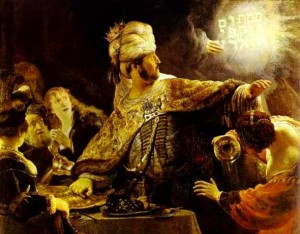
King BelshazzarMany are familiar with the phrase “the writing on the wall,” but few know that it has a biblical origin. Here, today, is the beginning of the story from which it comes. Belshazaar, son of Nebuchadnezzar, has thrown a party. He orders booty from the Jerusalem Temple, sacred vessels of silver and gold, used as drinking vessels. While he and his friends are partying, the hand appears as related above and writes on the wall.

The Boston Marathon was run this week. On Monday, 23,000 people ran the marathon. When about 75% of them had passed the finish line, two bombs went off in the midst of the observing crowds. As of this writing, three people (including one child) are dead; over 170 people are suffering injuries, some of them severally disabling and possibly still fatal. No person or group has yet claimed responsibility.

On the same day a bomb went off in Baghdad, Iraq. In fact, several bombs went off across that country and more than 75 people are dead and many others wounded. A colleague of mine commented that Baghdad “doesn’t seem so far away now.”

The writing on the wall provides some perspective. What was Belshazzar’s sin that prompted this display of divine displeasure? Using the Temple vessels in revelry, the abuse of a conquered people’s culture and values, imperial oppression of faith and identity. Could this not help explain of the acts of violence and terror perpetrated against our country from 9/11 to the present bloody mess in Boston? It could, if they are the acts of Muslim extremists. I am not suggesting that they are, but there are many who doing so.

Commentators left and right are trying to put spin on the Boston bombings, but everyone is speaking in ignorance right now because (as noted above) no one has claimed responsibility; law enforcement has identified no suspects. Nonetheless, plenty of people seem ready to point the finger at Muslims, but none of these finger-pointers appreciates that if that is the case, there is background to be dealt with . . . we may need to face the sin of Belshazzar committed anew by our own country. One of the more insightful comments, I think, came from an Arab editorial: “Whatever the truth about this latest bombing, the continued refusal to acknowledge the widespread grievances against the US and its allies caused by the wars and US policies in the Middle East will lead to turmoil until political solutions are found.” (Al Bawaba News Group)

The writer of Daniel tells us that Belshazzar’s “face turned pale, and his thoughts terrified him.” I think that pretty much describes the United States today . . . . The king could not understand the writing on the wall. At this point, we seem unable to understand what is written in blood on the sidewalks of Boston.

But if it turns out that this the act of Middle Easterners, we need to ask ourselves, “Are we guilty of the sin of Bleshazzar?” Many would answer that question, “Yes,” and call upon us to repent. We need to find not just political solutions, but spiritual solutions, as well.

====================

A request to my readers: I’m trying to build the readership of this blog and I’d very much appreciate your help in doing so. If you find something here that is of value, please share it with others. If you are on Facebook, “like” the posts on your page so others can see them. If you are following me on Twitter, please “retweet” the notices of these meditations. If you have a blog of your own, please include mine in your links (a favor I will gladly reciprocate). Many thanks!

====================

Father Funston is the rector of St. Paul’s Episcopal Church, Medina, Ohio.

The Leaflet in the Lou – From the Daily Office – March 19, 2013

From the Letter to the Romans:

But what does it say? “The word is near you, on your lips and in your heart” (that is, the word of faith that we proclaim); because if you confess with your lips that Jesus is Lord and believe in your heart that God raised him from the dead, you will be saved. For one believes with the heart and so is justified, and one confesses with the mouth and so is saved. The scripture says, “No one who believes in him will be put to shame.” For there is no distinction between Jew and Greek; the same Lord is Lord of all and is generous to all who call on him. For, “Everyone who calls on the name of the Lord shall be saved.”

(From the Daily Office Lectionary – Romans 10:8-13 (NRSV) – March 19, 2013.)

Public Restroom SinksIn my opinion there is probably no more misused piece of writing in all of Holy Scripture, unless perhaps it is Paul’s other toss-off line (in this same epistle): “For we hold that a person is justified by faith apart from works prescribed by the law.” (Rom. 3:28 NRSV) Both of them have led people to a religion that is all talk and no walk, which I am quite sure was not Paul’s intention at all!

I went to high school pretty much in the absolute middle of the United States. The geographic center of the U.S. is just outside the small town of Lebanon, Kansas. I went to high school in Salina, Kansas, about 100 miles away. At the time, and probably to this day, it is pretty much conservative, evangelical Christian territory. There are a few nutty Episcopalians, but not many; a few more good German Lutherans and just about as many good German Catholics. But the conservative, evangelical traditions rule the roost.

One of the things I most remember about my high school years in the center of the country are the evangelical Christian pamphlets that one would find distributed in, of all places, the public restrooms of filling stations and coffee shops. I know that sounds weird, and frankly it is weird! But almost without fail, anytime I would make use of such public facilities in the late 1960s I would find a small pamphlet on the wash basin counter, on the back of the toilet, or on top of the urinal telling me that all I needed to do to be saved and escaped the fires of Hell was “confess with your lips that Jesus is Lord and believe in your heart that God raised him from the dead.” That’s all. Nothing more.

That always struck me as nonsense. Even to a 14-year-old high school freshman, it just seemed like there ought to be more to it than the five-step outline for salvation set out in the public restroom pamphlet (and which I’ve subsequently seen enumerated elsewhere):

  1. Hear the Gospel (Romans 10:17)
  2. Believe the Gospel (Mark 16:16)
  3. Repent of sins (Luke 13:3)
  4. Confess Christ. (Matthew 10:32)
  5. Be Baptized for the remission of sins (Acts 2:38).

It seemed like poppycock because pretty regularly the priest in my church would recite other passages of Scripture: “Not every one that saith unto me, Lord, Lord, shall enter into the kingdom of heaven; but he that doeth the will of my Father which is in heaven.” (Matt. 7:21 KJV) was his favorite offertory sentence. And I recall more than one sermon in which he made reference to the Letter of James with its (to me, at least) cogent reasoning:

What good is it, my brothers and sisters, if you say you have faith but do not have works? Can faith save you? If a brother or sister is naked and lacks daily food, and one of you says to them, “Go in peace; keep warm and eat your fill,” and yet you do not supply their bodily needs, what is the good of that? So faith by itself, if it has no works, is dead. But someone will say, “You have faith and I have works.” Show me your faith apart from your works, and I by my works will show you my faith.

The leaflet in the lou seemed not even to require faith. I know it says that one step is to “Believe the Gospel” and another to “Confess Christ,” but those only require intellectual ascent, not faith. Just because one accepts the factuality of the Jesus story, and possibly even tells others about it, doesn’t mean that one trusts in Jesus as Lord and Savior. So even though it might have been parroting Paul in the 10th chapter of Romans, it seemed to have overlooked the 3rd chapter. And it’s authors had clearly dismissed James’s conclusion that “faith by itself, if it has no works, is dead.”

It’s not that the five steps in the bathroom broadside are wrong. It’s that they are incomplete. There are so many more steps – feeding the hungry, clothing the naked, caring for the ill, visiting the prisoners, housing the homeless, selling everything you own and giving the money to the poor, not being a stumbling block to others, loving your neighbor, and many many more. One can’t just talk the talk; one must walk the walk; one must take the journey.

Salvation is a journey of many steps through many places doing many things. Salvation is not achieved with five simple steps communicated through a community water closet!

====================

A request to my readers: I’m trying to build the readership of this blog and I’d very much appreciate your help in doing so. If you find something here that is of value, please share it with others. If you are on Facebook, “like” the posts on your page so others can see them. If you are following me on Twitter, please “retweet” the notices of these meditations. If you have a blog of your own, please include mine in your links (a favor I will gladly reciprocate). Many thanks!

====================

Father Funston is the rector of St. Paul’s Episcopal Church, Medina, Ohio.

A Politics of Truth – From the Daily Office – March 7, 2013

From the Gospel according to John:

Jesus said to the Jews who had believed in him, “If you continue in my word, you are truly my disciples; and you will know the truth, and the truth will make you free.”

(From the Daily Office Lectionary – John 8:31-32 (NRSV) – March 7, 2013.)

Crossed Fingers Behind the Back“We hold these truths to be self-evident, that all men are created equal, that they are endowed by their Creator with certain unalienable Rights, that among these are Life, Liberty and the pursuit of Happiness.” There is an undeniable link between truth and autonomy, between authenticity and independence. Those who seek to take away liberty do so by use of falsehood, and most effective untruths are those which are the biggest. Adolph Hitler described the phenomenon:

In the big lie there is always a certain force of credibility; because the broad masses of a nation are always more easily corrupted in the deeper strata of their emotional nature than consciously or voluntarily; and thus in the primitive simplicity of their minds they more readily fall victims to the big lie than the small lie, since they themselves often tell small lies in little matters but would be ashamed to resort to large-scale falsehoods. It would never come into their heads to fabricate colossal untruths, and they would not believe that others could have the impudence to distort the truth so infamously. Even though the facts which prove this to be so may be brought clearly to their minds, they will still doubt and waver and will continue to think that there may be some other explanation. (A. Hitler, Mein Kampf)

Hitler was not here advocating the big lie, though he and his propagandist made very effective use of it. Rather, he was accusing the Jews of founding their existence on “one great lie, namely, that they are a religious community, where as in reality they are a race.” Hitler made effective use of the big lie in his project to eradicate the Jews, but eventually the truth came out and he did not succeed.

Unfortunately, the lie as a political tool continues to rear its ugly head. We can all think of plenty of examples:

“Sadam Hussein was involved in 9/11. Sadam Hussein has weapons of mass destruction. Sadam Hussein is purchasing equipment to refine uranium for weapons.” None of that was true. Thousands of Americans and millions of Iraquis are dead, wounded, or displaced as a result.

“Barack Hussein Obama was not born in the United States.” What a huge waste of time and attention that lie caused.

“Health care reform will include the use of death panels . . . . ” Um, no.

“The government will collapse into chaos if the sequestration is allowed to happen.” We’ve seen some curtailment of programs, some furloughs of government employees, but it all seems rather orderly.

Falsehood is not a very good tool for politics or governance. In fact, it’s an obstacle to both. Falsehood makes it impossible to discuss or debate anything because the productive discourse demands truthfulness. Only if our decision-making processes are based on established facts can we make effective decisions. Actions taken on the basis of falsehood and fantasy are inevitably disastrous.

Truth, on the other hand, as Jesus promised, sets us and our politics free. Free to deal with problems in the real world. Free to find solutions to which all can agree, or which (at least) all can accept. Free to look at the real world in a realistic manner. Free to face facts.

We who are followers of the One who is the Truth, the Way, and the Life, need to rise up and demand of our politicians that they deal in fact, that they live in the real world, that they speak truth to us and to one another. As the now-popular meme puts it, everyone is entitled to their own opinions, but they are not entitled to their own facts. There is one set of facts in the real world in which we all live. Only a politics of truth that faces those facts can solve the problems we have and protect our liberty.

But no politics, not even the most fact-based politics, can truly set us free. Only the Truth can do that.

====================

A request to my readers: I’m trying to build the readership of this blog and I’d very much appreciate your help in doing so. If you find something here that is of value, please share it with others. If you are on Facebook, “like” the posts on your page so others can see them. If you are following me on Twitter, please “retweet” the notices of these meditations. If you have a blog of your own, please include mine in your links (a favor I will gladly reciprocate). Many thanks!

====================

Father Funston is the rector of St. Paul’s Episcopal Church, Medina, Ohio.

Deceptive Words – From the Daily Office – March 4, 2013

From the Prophet Jeremiah:

Here you are, trusting in deceptive words to no avail.

(From the Daily Office Lectionary – Jeremiah 7:8 (NRSV) – March 4, 2013.)

Trust Me I'm LyingI’ve been thinking about this all day and there is so much to say . . . but this cuts so deeply into so many areas of life that I cannot bring myself to say any of them.

I can only ask every person a question: If you are truly honest with yourself, can you identify the deceptive words – in church, in politics, in the economy, in your work, in your family, in your personal life – that you trust to no avail?

The most important ones, the deceptive words to be most honest about, are the ones we say to ourselves. They are also the most deceptive.

Be honest . . . you know there are many.

====================

A request to my readers: I’m trying to build the readership of this blog and I’d very much appreciate your help in doing so. If you find something here that is of value, please share it with others. If you are on Facebook, “like” the posts on your page so others can see them. If you are following me on Twitter, please “retweet” the notices of these meditations. If you have a blog of your own, please include mine in your links (a favor I will gladly reciprocate). Many thanks!

====================

Father Funston is the rector of St. Paul’s Episcopal Church, Medina, Ohio.

Reason and Consensus: Biblical Political Values – From the Daily Office – February 26, 2013

From the Psalms:

How long will you assail a person,
will you batter your victim, all of you,
as you would a leaning wall, a tottering fence?
Their only plan is to bring down a person of prominence.
They take pleasure in falsehood;
they bless with their mouths,
but inwardly they curse.

(From the Daily Office Lectionary – Psalm 62:3-4 (NRSV) – February 26, 2013.)

U.S. CapitolAs I read the lessons and Psalms of the Daily Office lectionary for today, this was the passage that spoke loudest to me, but I did not want to write about it. I tried to reflect upon and author a meditation about some other bits of the Scriptures appointed for today, but my thoughts kept returning to this one.

I’m fairly confident that my comments about it will not be readily accepted by, will indeed by rejected by some of my readers, including not a few of my parishioners. But I have to be honest in my understanding and exegesis of the Bible, and its application to our modern world.

I usually use the version of the Psalms from The Book of Common Prayer in these meditations, but today I’ve chosen to use the New Revised Standard Version because the translation is more accurate. The Prayer Book puts these words in the first person, “How long will you assail me . . . ?” The NRSV is closer to the Hebrew which is in the third person, “How long will you assail a man . . . ? The Hebrew is ‘iysh which can mean a male human being, but can also be translated as gender neutral, so the NRSV is not wrong to do so.

The theologian Karl Barth, in an interview with Time Magazine in 1963 advised theologians “to take your Bible and take your newspaper, and read both. But interpret newspapers from your Bible.” Three years later, in another interview, he said, “The Pastor and the Faithful should not deceive themselves into thinking that they are a religious society, which has to do with certain themes; they live in the world. We still need – according to my old formulation – the Bible and the Newspaper.”

When I read these words from the Bible, I cannot help but remember these words from the news: “I hope he fails. . . . . I hope Obama fails.” (Radio commentator Rush Limbaugh, The Rush Limbaugh Show, January 16, 2009)

I cannot help but remember these words from the news: “The single most important thing we want to achieve is for President Obama to be a one-term president.” (Senate Minority Leader Mitch McConnell, R-Ky, National Journal interview, October 23, 2010)

I cannot help but remember these words from the news: “We’re going to do everything — and I mean everything we can do — to kill it, stop it, slow it down, whatever we can.” (Speaker of the House John Boehner, R-Oh, Politico, concerning President Obama’s first-term agenda, October 28, 2010)

I cannot do anything but what Professor Barth admonished and interpret these newspaper reports from my Bible, especially when my Bible decries and condemns those whose “only plan is to bring down a person of prominence.”

I make no bones of that fact that I am politically a progressive. I’ve never hidden that from anyone and in today’s current American political climate, especially since I live in a “swing state”, that means that I voted for President Obama, twice. My congregation knows that. In the first election, I put no political bumper stickers on my car, but my wife had an Obama/Biden sticker on hers. In the second election, we both did. If I’d had my druthers, I’d rather have voted for the Green Party but, as I said, I live in a swing state and a vote for the Greens would have been, effectively, a vote for the Republican candidates. I voted for President Obama.

So there they are; my political cards are on the table. In politics, economics, and social values, I’m on the “left” of the spectrum. No secrets.

But this isn’t about left or right, Democrat or Republican. It isn’t really about politics, at all. It’s about consensus building and governing with with reason; it’s about values that are not only political but Biblical.

I take the Bible seriously; I’m fairly conservative when it comes to exegeting Holy Scripture. When a Psalm negatively portrays the sorts of politics we see in modern America, I take it seriously.

I can remember a time, not so long ago, when this wasn’t the way our leaders conducted the country’s business. For example, although I was not (and never will be) a member of his party, I remember with affection and respect Senator Everett Dirksen, R-Ill. His was a voice of reason and compromise; his skillful working with Senators Hubert Humphrey (D-Mn) and Mike Mansfield (D-Mt) led to the end of a Republican filibuster and passage of the Civil Rights Act 1964.

It was a Republican who spoke of “the need to maintain balance in and among national programs – balance between the private and the public economy, balance between cost and hoped for advantage – balance between the clearly necessary and the comfortably desirable; balance between our essential requirements as a nation and the duties imposed by the nation upon the individual; balance between actions of the moment and the national welfare of the future. Good judgment seeks balance and progress; lack of it eventually finds imbalance and frustration.” That Republican was President Dwight D. Eisenhower giving his farewell address to the nation on January 17, 1961.

President Eisenhower worked well with a Democratic Senate leader, Lyndon B. Johnson, D-Tx. They both had a fondness for government by consensus and reached across party lines to form a close working relationship. One of Johnson’s favorite sayings was “Come, let us reason together;” he spoke it often after he became president himself. It is a quotation from Scripture:

“Come now, and let us reason together,” says the Lord, “Though your sins are as scarlet, they will be as white as snow; though they are red like crimson, they will be like wool. If you consent and obey, you will eat the best of the land; but if you refuse and rebel, you will be devoured by the sword.” Truly, the mouth of the Lord has spoken. (Isaiah 1:18-20, NAS)

Our political parties do not have to play the sort of political games currently being played. They have worked together in the past; they can do so again. Planning only to bring down one’s opponent, refusing to work toward consensus, failing to reason together . . . these are not only bad politics, they are unfaithful.

Scripture is filled with admonitions to work together:

Oh, how good and pleasant it is, when brethren live together in unity! (Ps 133:1, BCP version)

Now I appeal to you, brothers and sisters, by the name of our Lord Jesus Christ, that all of you be in agreement and that there be no divisions among you, but that you be united in the same mind and the same purpose. (1 Cor. 1:10, NRSV)

Lead a life worthy of the calling to which you have been called, with all humility and gentleness, with patience, bearing with one another in love, making every effort to maintain the unity of the Spirit in the bond of peace. (Eph. 4:1-3, NRSV)

Make my joy complete: be of the same mind, having the same love, being in full accord and of one mind. (Philip. 2:2, NRSV)

Our political leaders who claim the Christian faith should not be governing (in truth, failing to govern) on the basis of “bringing down a person of prominence.” Any who do should be taken to task, but not on the basis of their politics, because on politics people of faith can disagree. No, they should be taken to task because such behavior is unfaithful; it betrays the Biblical witness and the admonitions of Scripture to reason together. Reason and consensus are not only political values; they are Biblical values.

====================

A request to my readers: I’m trying to build the readership of this blog and I’d very much appreciate your help in doing so. If you find something here that is of value, please share it with others. If you are on Facebook, “like” the posts on your page so others can see them. If you are following me on Twitter, please “retweet” the notices of these meditations. If you have a blog of your own, please include mine in your links (a favor I will gladly reciprocate). Many thanks!

====================

Father Funston is the rector of St. Paul’s Episcopal Church, Medina, Ohio.

Holy Wit: Humor in the Bible – From the Daily Office – February 25, 2013

From the Prophet Jeremiah:

The word of the Lord came to me, saying, “Jeremiah, what do you see?” And I said, “I see a branch of an almond tree.” Then the Lord said to me, “You have seen well, for I am watching over my word to perform it.”

(From the Daily Office Lectionary – Jeremiah 1:11-12 (NRSV) – February 25, 2013.)

Buddy Jesus, from the movie DogmaThese two verses have probably caused any number of people to scratch their heads in bewilderment over the centuries. Those who read them in English without looking behind the translation to the original language wonder, “What on earth does this mean?” Those who read them in Hebrew wonder, “How can God have such a terrible sense of humor?”

This is a pun. The Hebrew word for “almond” or “almond tree” is shaqed, while that for “watching” is shaqad. God is playing with words and images in order to impress upon Jeremiah’s mind the seriousness of God’s watchfulness. It worked; Jeremiah remembered (and wrote about) it.

The Irish satirist (and Anglican clergyman) Jonathan Swift said of punning that it “is an art of harmonious jingling upon words, which, passing in at the ears, excites a titillary motion in those parts; and this, being conveyed by the animal spirits into the muscles of the face, raises the cockles of the heart.” Essayist Charles Lamb considered the pun “a noble thing per se. It fills the mind, it is as perfect as a sonnet; better.”

Such praise, however, is far from universal. Often quoted is English poet John Dryden’s aphorism that the pun is the “lowest and most groveling kind of wit,” or Ambrose Bierce’s derision of it as a “form of wit to which wise men stoop and fools aspire.” In all of her work, Jane Austen includes puns in only one, Mansfield Park, and there only to demonstrate the low moral character of the offender, the shallow and evil Mary Crawford.

Holy Scripture, on the other hand, is full of puns and other word play, such as double-entendres. The Law and the Prophets are full of them; Jesus uses them in the Gospels. The problem for modern American readers, however, is that they are in Hebrew and Greek, and simply don’t translate into English. In addition, Scripture is chock full of other forms of humor, including sarcasm and irony, humorous imagery and exaggerations, and plays on the names of people and places. Again, these do not translate well from one language to another.

Although there are no jokes per se in the Bible, the Scriptures are replete with humor; there is an abundance of wit in Holy Writ. Perhaps not all, but most of this humor can only be appreciated if read in the original Hebrew or Greek. To the believer, the conservative believer especially, the Bible is a moral document, not a storybook, so the presence of humor in it comes as a shock to many; in fact, some would deny that there is anything funny about the Holy Book. The philosopher Alfred North Whitehead, for example, claimed that “the total absence of humour from the Bible is one of the most singular things in all of literature.” Many Christians seem to think the Bible is only a solemn and serious book, full of timeless wisdom but definitely containing nothing even remotely funny. I recently read a sermon by a preacher from the “Christian Right” which derided the use of humor in preaching; among his assertions was this:

There is no amusement in Jesus, nor is there in any of the 66 books of the Bible. God expects his saints to be quite content with straight forward fellowship and sound teaching. Any time the saints seem to get overloaded with good things, the solution is to sing Psalms and spiritual songs. Anything else is mongrel Christianity.

I remember reading a report a couple of years ago of a study by two psychologists which suggested that political conservatives have much less of a sense of humor than do liberals, and another which, disturbingly, showed that conservative evangelical Christians are more likely than not to support torture of suspected terrorists. And I wonder if there is some connection between failure to appreciate the humor in Holy Scripture and Christian conservatism.

As a Christian who generally leans towards political liberalism, I enjoy the word play, the sarcasm, the irony, and all the other humor in the Bible. I believe that humor brings us closer to God and that the holy wit in Holy Writ brings God closer to humankind. The Protestant theologian Karl Barth is reported to have said, “Laughter is the closest thing to the grace of God.” And the Catholic theologian and writer G.K. Chesterton wrote, “It is the test of a good religion whether you can joke about it.” I believe they are right, because “he whose throne is in heaven is laughing.” (Psalm 2:4a, BCP translation)

Maybe God’s doing so because of all those awful puns one finds in God’s book.

====================

A request to my readers: I’m trying to build the readership of this blog and I’d very much appreciate your help in doing so. If you find something here that is of value, please share it with others. If you are on Facebook, “like” the posts on your page so others can see them. If you are following me on Twitter, please “retweet” the notices of these meditations. If you have a blog of your own, please include mine in your links (a favor I will gladly reciprocate). Many thanks!

====================

Father Funston is the rector of St. Paul’s Episcopal Church, Medina, Ohio.

“Do Not Say To Yourselves…” – From the Daily Office – February 19, 2013

From the Book of Deuteronomy:

When the Lord your God thrusts them out before you, do not say to yourself, “It is because of my righteousness that the Lord has brought me in to occupy this land”; it is rather because of the wickedness of these nations that the Lord is dispossessing them before you. It is not because of your righteousness or the uprightness of your heart that you are going in to occupy their land; but because of the wickedness of those nations that the Lord your God is dispossessing them before you, in order to fulfill the promise that the Lord made on oath to your ancestors, to Abraham, to Isaac, and to Jacob. Know, then, that the Lord your God is not giving you this good land to occupy because of your righteousness; for you are a stubborn people.

(From the Daily Office Lectionary – Deuteronomy 9:4-6 (NRSV) – February 19, 2013.)

The S.S. Admiral NakhimovWe human beings are so proud, so prone to taking credit we really have no right or basis to claim and, apparently, we’ve been doing it for a long time. Moses’ caution to the Hebrews not to do so, not to think that it is through their own merit that the Promised Land is being given them, is a caution to all of us, for we are all “a stubborn people.” Self-importance and obstinacy are the human condition.

Aristotle once wrote, “Obstinate people can be divided into the opinionated, the ignorant, and the boorish.” (Nichomachean Ethics, Bk. VII) Michel de Montaigne is quoted as saying, “Is there anything so stubborn, obstinate, disdainful, contemplative, grave, or serious, as an ass?” Lent is a time of self-examination and perhaps this Daily Office lesson is a reminder to take a long, hard look out one’s own arrogant tendency to claim credit where none is due, at one’s one obstinacy. There is a link between the two, between pride and stubbornness.

Consider the case of two Russian ships, the Admiral Nakhimov, an aging passenger liner, and the Pyotr Vasev, a large bulk freight carrier. On the night of August 31, 1986, the two collided in the Black Sea near the port of Novorossiysk. The cause of collision was human stubbornness. Both captains were aware of the other ship’s presence nearby. Either could have prevented it, but neither wanted to give way to the other. Arrogance and stubbornness resulted in the deaths of 64 crew and 359 passengers.

As on the seaways, so on the paths of life. In business, in politics, in our personal lives, pride and obstinacy lead to problems, sometimes to disasters. During these days of Lent, remember Moses’ words, “Do not say to yourself, ‘It is because of my . . . whatever.'”

====================

A request to my readers: I’m trying to build the readership of this blog and I’d very much appreciate your help in doing so. If you find something here that is of value, please share it with others. If you are on Facebook, “like” the posts on your page so others can see them. If you are following me on Twitter, please “retweet” the notices of these meditations. If you have a blog of your own, please include mine in your links (a favor I will gladly reciprocate). Many thanks!

====================

Father Funston is the rector of St. Paul’s Episcopal Church, Medina, Ohio.

Employers and Employees – From the Daily Office – January 25, 2013

From the Letter to the Ephesians:

Slaves, obey your earthly masters with fear and trembling, in singleness of heart, as you obey Christ; not only while being watched, and in order to please them, but as slaves of Christ, doing the will of God from the heart. Render service with enthusiasm, as to the Lord and not to men and women, knowing that whatever good we do, we will receive the same again from the Lord, whether we are slaves or free. And, masters, do the same to them. Stop threatening them, for you know that both of you have the same Master in heaven, and with him there is no partiality.

(From the Daily Office Lectionary – Ephesians 6:5-9 (NRSV) – January 25, 2013.)

Victorian Child Labor PhotographSo let’s admit right off the bat that we have a problem here. Where the progressives and liberals among us would much prefer to read Paul condemning the institution of slavery, he does not. Instead, he simply admonishes slaves to be good slaves and masters to be good masters, and even goes so far as to analogize a Christian’s relationship with God (or Jesus) to slavery. This just doesn’t sit well in the modern mind and provides plenty of ammunition for those whom Friedrich Schleiermacher addressed as religion’s “cultured despisers.” We would much rather Paul hadn’t said this.

But he did. So what to think of it . . . .

First off, the Greek here is doulos which is most often translated as “slave” as it is here, but it can also refer to a bond-servant, a servant for hire, or to someone who is devoted to another without regard of his or her own interests (the last often metaphorically). It’s unlikely that Paul intended this as either a comment on non-slavery employment relationships or as a metaphorical statement, but we can certainly read it in those ways in our modern context.

Secondly, and this encourages us to read this text as applicable to modern employee-employer relations, the institution of slavery in the First Century Roman empire was an economic, not a racial, reality. We modern Americans, influenced by our own history, hear racial overtones in these verses, but they are not really there. In ancient Rome slaves might be prisoners of war, sailors captured and sold by pirates, slaves bought outside Roman territory, or even the children of desperately poor Roman citizens sold into bond-servanthood by their parents. Further, slaves were commonly and even rather frequently freed; a slave could buy his or her own freedom.

So if we read this text as referring not only to the First Century practice of slavery, but applying also to any economic institution wherein one person works at the behest of and for the benefit of another, it provides guidance for theological critique of contemporary employment practices and related laws. It requires the church to question any employment situation in which workers are inadequately paid, where worker safety is at risk, or which threatens to damage the family life or welfare of the worker and his or her dependents.

In fact, the long struggle to recognize and protect workers’ rights finds its genesis in this and similar biblical texts. In Great Britain and in our own country during the 18th and 19th Centuries (and even into the early 20th Century), children worked in mines and factories; all laborers worked six-day weeks and often 16- to 18-hour days; working conditions were often dangerous; and on-the-job death was a common occurrence. Fans of the series Downton Abbey (or earlier dramas such as Upstairs, Downstairs) need only think of the way in which the servants’ life is portrayed to see a small (and very toned-down) illustration of what a worker’s life was like, always at the beck-and-call of the employer.

The anti-slavery movement in Britain became the movement to bring about just and equitable labor laws, to prevent children from working, to reduce the work day to ten hours per day, and to make employers responsible for working conditions. That movement spread to the United States. In both Britain and America, it was driven by Christians, many of them Christian socialist Anglo-Catholics in the Church of England and the Episcopal Church, who read these texts as demanding the ends they sought.

So we need not apologize to our “cultured despisers” for Paul’s words about slavery. Instead, we are called like our forebears in the faith to see in them our call to champion workers’ rights and just labor laws.

====================

A request to my readers: I’m trying to build the readership of this blog and I’d very much appreciate your help in doing so. If you find something here that is of value, please share it with others. If you are on Facebook, “like” the posts on your page so others can see them. If you are following me on Twitter, please “retweet” the notices of these meditations. If you have a blog of your own, please include mine in your links (a favor I will gladly reciprocate). Many thanks!

====================

Father Funston is the rector of St. Paul’s Episcopal Church, Medina, Ohio.

« Older posts Newer posts »