Occasional thoughts of an Anglican Episcopal priest

Category: Politics (Page 19 of 23)

One Today – From the Daily Office – January 21, 2013

From the Letter to the Ephesians:

There is one body and one Spirit, just as you were called to the one hope of your calling, one Lord, one faith, one baptism, one God and Father of all, who is above all and through all and in all.

(From the Daily Office Lectionary – Ephesians 4:4-6 (NRSV) – January 21, 2013.)

One SunI held off offering a meditation on this Inauguration Day, the Martin Luther King, Jr., holiday, for a variety of reasons. Throughout the day, however, this particular bit of St. Paul’s Letter to the Church at Ephesus kept returning to my mind. The Episcopal Church uses this in dialogue form in our baptismal liturgy, so it is familiar to us. The idea that we are all in some way united is a part of our Anglican ethos.

In the celebration of President Barack Obama’s second inauguration, poet Richard Blanco focused also on our unity. I think his poem bears repeating here in celebration of unity.

One Today by Richard Blanco

One sun rose on us today, kindled over our shores,
peeking over the Smokies, greeting the faces
of the Great Lakes, spreading a simple truth
across the Great Plains, then charging across the Rockies.
One light, waking up rooftops, under each one, a story
told by our silent gestures moving behind windows.

My face, your face, millions of faces in morning’s mirrors,
each one yawning to life, crescendoing into our day:
pencil-yellow school buses, the rhythm of traffic lights,
fruit stands: apples, limes, and oranges arrayed like rainbows
begging our praise. Silver trucks heavy with oil or paper —
bricks or milk, teeming over highways alongside us,
on our way to clean tables, read ledgers, or save lives —
to teach geometry, or ring-up groceries as my mother did
for twenty years, so I could write this poem.

All of us as vital as the one light we move through,
the same light on blackboards with lessons for the day:
equations to solve, history to question, or atoms imagined,
the “I have a dream” we keep dreaming,
or the impossible vocabulary of sorrow that won’t explain
the empty desks of twenty children marked absent
today, and forever. Many prayers, but one light
breathing color into stained glass windows,
life into the faces of bronze statues, warmth
onto the steps of our museums and park benches 2
as mothers watch children slide into the day.

One ground. Our ground, rooting us to every stalk
of corn, every head of wheat sown by sweat
and hands, hands gleaning coal or planting windmills
in deserts and hilltops that keep us warm, hands
digging trenches, routing pipes and cables, hands
as worn as my father’s cutting sugarcane
so my brother and I could have books and shoes.

The dust of farms and deserts, cities and plains
mingled by one wind — our breath. Breathe. Hear it
through the day’s gorgeous din of honking cabs,
buses launching down avenues, the symphony
of footsteps, guitars, and screeching subways,
the unexpected song bird on your clothes line.

Hear: squeaky playground swings, trains whistling,
or whispers across café tables, Hear: the doors we open
for each other all day, saying: hello / shalom,
buon giorno / howdy / namaste / or buenos días
in the language my mother taught me — in every language
spoken into one wind carrying our lives
without prejudice, as these words break from my lips.

One sky: since the Appalachians and Sierras claimed
their majesty, and the Mississippi and Colorado worked
their way to the sea. Thank the work of our hands:
weaving steel into bridges, finishing one more report
for the boss on time, stitching another wound
or uniform, the first brush stroke on a portrait,
or the last floor on the Freedom Tower
jutting into a sky that yields to our resilience.

One sky, toward which we sometimes lift our eyes
tired from work: some days guessing at the weather
of our lives, some days giving thanks for a love
that loves you back, sometimes praising a mother
who knew how to give, or forgiving a father
who couldn’t give what you wanted.

We head home: through the gloss of rain or weight
of snow, or the plum blush of dusk, but always — home,
always under one sky, our sky. And always one moon
like a silent drum tapping on every rooftop
and every window, of one country — all of us —
facing the stars
hope — a new constellation
waiting for us to map it,
waiting for us to name it — together.

We are one today.

====================

A request to my readers: I’m trying to build the readership of this blog and I’d very much appreciate your help in doing so. If you find something here that is of value, please share it with others. If you are on Facebook, “like” the posts on your page so others can see them. If you are following me on Twitter, please “retweet” the notices of these meditations. If you have a blog of your own, please include mine in your links (a favor I will gladly reciprocate). Many thanks!

====================

Father Funston is the rector of St. Paul’s Episcopal Church, Medina, Ohio.

Understanding the Citizenship Metaphor – From the Daily Office – January 17, 2013

From the Letter to the Ephesians:

So [Christ] came and proclaimed peace to you who were far off and peace to those who were near; for through him both of us have access in one Spirit to the Father. So then you are no longer strangers and aliens, but you are citizens with the saints and also members of the household of God, built upon the foundation of the apostles and prophets, with Christ Jesus himself as the cornerstone. In him the whole structure is joined together and grows into a holy temple in the Lord; in whom you also are built together spiritually into a dwelling-place for God.

(From the Daily Office Lectionary – Ephesians 2:17-22 (NRSV) – January 17, 2013.)

Ant HillFor many years, I have rather liked Paul’s citizenship metaphor for our participation in the household of God. It made sense . . . but I’m not sure it makes sense any longer because I’m not sure we understand any longer what citizenship is!
A historical review of the understanding of citizenship going back to the earliest Greek city-states suggests that there are two basic classical theories: the humanist and the individualist.

The humanist conception of citizenship emphasizes our political nature viewing citizenship as an active process of involvement in the affairs of the state. Under this theory, being a citizen means being active in government affairs; citizens and the government are mutually interrelated. An ideal citizen is one who exhibits good civic behavior and acts out of a commitment to civic duty and virtue. The individualist view, on the other hand, assumes that human beings act not out of civic morality, but out of enlightened self-interest. Citizens are seen as essentially passive politically, as sovereign, morally autonomous beings primarily focused on their own economic betterment. Nonetheless, between citizen and state there is a mutuality of obligation. The citizen is expected to pay taxes, obey the law, engage in business, and defend the nation if it comes under attack; the state has the duty to respect and protect the civil and political rights of the citizen.

The Enlightenment vision of citizenship, which gave rise to modern democratic republics like the United States, incorporates both of these classical models.

At the recent Emergence Christianity conversation, Phyllis Tickle used the examples of a beehive and an anthill to contrast traditional and emerging notions of leadership. Beehives are hierarchies with a controlling matriarch, the “queen”, and all workers exist to serve her needs and follow her direction. Anthills have “queens” but they are non-directive. The ant queen serves her function in the community (producing young) but does not control what others do. Instead, anthills exhibit a collective intelligence which does not depend upon the decision-making or direction of any one individual or even small group of individuals; in fact, there are no individuals, only the collective. Ms. Tickle suggested that because of the increase in knowledge and communication, which the internet and social media perhaps exemplify best, human society is moving away from the beehive and toward the anthill. One might say we are becoming “ant-i-fied”.

She may be right . . . and that’s the problem with the “citizenship” metaphor now. Neither the beehive nor the anthill understands the concept of “citizen” and if modern human society has been or is becoming patterned on either, Paul’s use of the term to describe our relationship with one another and with God in the context of the church becomes meaningless. Furthermore, if we human beings are becoming nothing more than “ants” in a collective intelligence, there is push back against that, and that push back is also counter to the classical notions of citizenship. The reaction to the “ant-i-fying” of human society is equally destructive of the citizenship metaphor because it has emphasized the individual over against society rather than the individual within and mutually related to society.

We are, Paul wrote, citizens with the saints and members of the household of God. If we do not understand what it is to be citizens of a human society, if we are all simply workers in a beehive hierarchy, or faceless units in an anthill collective, or individuals over against a society, can we make sense of this metaphor? Let us hope we can so that our understanding of Paul’s citizenship model will shape not only the church, but our society as well.

====================

A request to my readers: I’m trying to build the readership of this blog and I’d very much appreciate your help in doing so. If you find something here that is of value, please share it with others. If you are on Facebook, “like” the posts on your page so others can see them. If you are following me on Twitter, please “retweet” the notices of these meditations. If you have a blog of your own, please include mine in your links (a favor I will gladly reciprocate). Many thanks!

====================

Father Funston is the rector of St. Paul’s Episcopal Church, Medina, Ohio.

We Are Better Than This – From the Daily Office – December 28, 2012

From the Prophet Isaiah:

Surely your waste and your desolate places
and your devastated land—
surely now you will be too crowded for your inhabitants,
and those who swallowed you up will be far away.
The children born in the time of your bereavement
will yet say in your hearing:
“The place is too crowded for me;
make room for me to settle.”
Then you will say in your heart,
“Who has borne me these?
I was bereaved and barren,
exiled and put away—
so who has reared these?
I was left all alone—
where then have these come from?”

(From the Daily Office Lectionary – Isaiah 49:19-21 (NRSV) – December 28, 2012.)
 
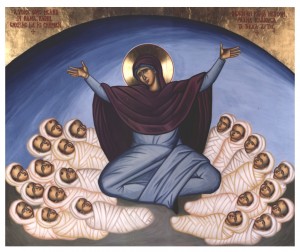
Holy Innocents IconToday is the Feast of the Holy Innocents and the Daily Office Lectionary again chooses lessons that underscore the day’s commemoration. In the midst of Christmas joy, we are reminded of the little children killed by Herod’s soldiers in the king’s attempt to do away with a perceived rival. I am not the first nor the only preacher or pastor to have thought of this story when, two weeks ago, gunman Adam Lanza opened fire at Sandy Hook Elementary School in Newtown, Connecticut. The wanton murder of children at any time makes the country where it occurs desolate and devastated. So today, again, we pray for the repose of the souls of those who died:

Charlotte Bacon, 6;
Daniel Barden, 7;
Olivia Engel, 6;
Josephine Gay, 7;
Ana M. Marquez-Greene, 6;
Dylan Hockley, 6;
Madeline F. Hsu, 6;
Catherine V Hubbard, 6;
Chase Kowalski, 7;
Jesse Lewis, 6;
James Mattioli, 6;
Grace McDonnell, 7;
Emile Parker, 6;
Jack Pinto, 6;
Noah Pozner, 6;
Caroline Previdi, 6;
Jessica Rekos, 6;
Avielle Richman, 6;
Benjamin Wheeler, 6;
Allison N. Wyatt, 6

Rachel Davino, 29;
Dawn Hocksprung, 47;
Anne Marie Murphy, 52
Lauren Russeau, 30;
Mary Sherlach, 56;
Victoria Soto, 27;

And, of course, also Nancy Lanza and Adam Lanza.

We pray for their souls, for comfort for their survivors, and for sanity in our land.

I just watched a public service announcement about our need for rational and reasonable regulation of gun and ammunition sales, gun ownership, and gun use. It includes the tag line, “We are better than this.” I pray God that the makers of the PSA are right, that we are better than this. We have to be. There are too many innocents dead.

====================

A request to my readers: I’m trying to build the readership of this blog and I’d very much appreciate your help in doing so. If you find something here that is of value, please share it with others. If you are on Facebook, “like” the posts on your page so others can see them. If you are following me on Twitter, please “retweet” the notices of these meditations. If you have a blog of your own, please include mine in your links (a favor I will gladly reciprocate). Many thanks!

====================

Father Funston is the rector of St. Paul’s Episcopal Church, Medina, Ohio.

False Teachings and Guns – From the Daily Office – December 22, 2012

From the Letter of Jude:

You, beloved, must remember the predictions of the apostles of our Lord Jesus Christ; for they said to you, “In the last time there will be scoffers, indulging their own ungodly lusts.” It is these worldly people, devoid of the Spirit, who are causing divisions. But you, beloved, build yourselves up on your most holy faith; pray in the Holy Spirit; keep yourselves in the love of God; look forward to the mercy of our Lord Jesus Christ that leads to eternal life. And have mercy on some who are wavering; save others by snatching them out of the fire; and have mercy on still others with fear, hating even the tunic defiled by their bodies

(From the Daily Office Lectionary – Jude 1:17-23 (NRSV) – December 22, 2012.)

Glory in the SkySort of buried in Jude’s moralizing about false teachers and those who follow them is an Advent message: “Look forward to the mercy of our Lord Jesus Christ that leads to eternal life.” As I’ve been saying pretty consistently throughout the season, here and in my sermons, Advent is not so much about celebrating the birth of Jesus, wherever it was and whenever it was about 2,000 years ago, as it is about getting ready for his return, the parousia as seminary-educated folks like to say.

It’s kind of humorous that Jude’s letter with its warning about “worldly people, devoid of the Spirit, who are causing divisions” and others for whom we are to have mercy mixed with fear “hating even the tunic defiled by their bodies” should come up today. Yesterday, a lot of those very people were running around convinced the world was going to end because of the Mayan long calendar. It didn’t, we and they are still here . . . and don’t they have egg on their faces (or defilement on their tunics, as Jude might have said).

It is humorous, but it’s also a warning to us that Jude was right. We can be led astray by false and outlandish teachings. In the days since the tragedy in Newtown, Connecticut, there have been a lot of people saying a lot of things, some of which I agree with and some of which I don’t. And some who should know better have been saying things about the use of violence to curb violence. Even before the NRA’s spokesman yesterday suggested putting armed guards in every school (an idea I find repugnant), I heard Christian clergy suggest the same thing, or some variation on it (such as arming our school teachers).

I don’t want to get into the politics of gun control or the history and meaning of the U.S. Constitution’s Second Amendment. (Well . . . I do, but not here.) What I do want to suggest is that those clergy are not building themselves or other church members up on our most holy faith; I suggest that their teaching is false. As I understand the Christian faith, it is not about meeting violence with violence. The One whom we name “Prince of Peace” gave these instructions to his followers: “Love your enemies, do good to those who hate you, bless those who curse you, pray for those who abuse you. If anyone strikes you on the cheek, offer the other also; and from anyone who takes away your coat do not withhold even your shirt. Give to everyone who begs from you; and if anyone takes away your goods, do not ask for them again. Do to others as you would have them do to you.” (Luke 6:27-31) No matter how much I try, I cannot make those admonitions into any sort of support for taking up guns, for arming teachers, for adding to the surfeit of firearms already present in our culture.

Every Sunday, I end the Mass with these words from my parish’s patron saint: “Rejoice in hope, be patient in suffering, persevere in prayer. Bless those who persecute you; bless and do not curse them. Rejoice with those who rejoice, weep with those who weep. Live in harmony with one another; do not be haughty, but associate with the lowly; do not claim to be wiser than you are. Do not repay anyone evil for evil, but take thought for what is noble in the sight of all. If it is possible, so far as it depends on you, live peaceably with all. Do not be overcome by evil, but overcome evil with good.” (Romans 12:12,14-18,21)

So far as it depends on me to live peaceably with all, the one thing I cannot do is arm myself nor recommend that others be armed nor countenance those recommendations from others. The words I leave out of Paul’s encouragements to the Christians in Rome include these: “Beloved, never avenge yourselves, but leave room for the wrath of God; for it is written, ‘Vengeance is mine, I will repay, says the Lord.’ No, ‘if your enemies are hungry, feed them; if they are thirsty, give them something to drink; for by doing this you will heap burning coals on their heads.’” (Rom. 12:19-20) I cannot guarantee that I will never avenge myself, but I can take a step in that direction by not preparing in advance to do so.

I know that I have friends and parishioners who disagree with me and with our church’s official teaching on this point (which is in favor of strict gun regulation). I believe they are wrong, but I know they hold their views for what they believe to be good reasons. I can only hope they know the same of me and that we can come to some consensus in our country that honors all points of view and that, at the end of it all, at the parousia we will all “stand without blemish in the presence of God’s glory with rejoicing.” (Jude 1:24)

====================

A request to my readers: I’m trying to build the readership of this blog and I’d very much appreciate your help in doing so. If you find something here that is of value, please share it with others. If you are on Facebook, “like” the posts on your page so others can see them. If you are following me on Twitter, please “retweet” the notices of these meditations. If you have a blog of your own, please include mine in your links (a favor I will gladly reciprocate). Many thanks!

====================

Father Funston is the rector of St. Paul’s Episcopal Church, Medina, Ohio.

The World Didn’t End Today – From the Daily Office – December 21, 2012

From the Prophet Isaiah:

Therefore the Sovereign, the Lord of hosts,
will send wasting sickness among his stout warriors,
and under his glory a burning will be kindled,
like the burning of fire.
The light of Israel will become a fire,
and his Holy One a flame;
and it will burn and devour
his thorns and briers in one day.
The glory of his forest and his fruitful land
the Lord will destroy, both soul and body,
and it will be as when an invalid wastes away.
The remnant of the trees of his forest will be so few
that a child can write them down.

(From the Daily Office Lectionary – Isaiah 10:16-19 (NRSV) – December 21, 2012.)
 
The End of the World ImaginedThe world was supposed to end today. I slept in in hopes it would be gone before I got out of bed . . . but alas, it is still here and there are still laundry to be done and a dog who needs a bath and Christmas meals to be shopped for and sermons to be written.

I jest, of course. I didn’t really think the world would end. I had no faith in doomsday predictions based on a misunderstanding of the Mayan long calendar, any more than I believe the world will be destroyed by a collision with the invisible planet Nibiru. But having said that, I’m left open to this big, gaping question: Why, then, do I believe Isaiah? It’s a legitimate question – why believe one prophecy and not another?

The answer really boils down to what we mean by “prophecy”. The Mayan “prophecy” really wasn’t a prophecy at all, just the end of a calendar. The Mayans divided time into eras called “baktuns”. Based solely on mathematics and observation of the movement of celestial bodies, the so-called “long calendar” laid out the calculations for the length of the 13th Baktun, which ended today. The long calendar doesn’t say, in any way, that creation would also end; the rational implication of the long calendar is that the 14th Baktun would begin, but that’s not the way the nuttier folk among us took it.

The Nibiru “prophecy” is based on even less observable reality than the Mayan long calendar. It comes from the tortured and demonstrably inaccurate translations of ancient Babylonian and Sumerian texts by one Zecharia Sitchin, a proponent of the idea of “ancient astronauts”. The idea is that there is an invisible planet called “Nibiru” which circles through our solar system every 3,600 years and will eventually collide with Earth. The date of the collision has been recalculated and changed on several occasions.

This is what differentiates the Hebrew prophecies like Isaiah’s from the Mayan, Nibiru, and similar prophecies. The former are not based on mathematical calculations; the latter are. The former give voice to a moral sense of history; the latter give voice to a mechanistic model of the universe.

Isaiah and the other Hebrew prophets were not simply, nor even primarily, predicters of the future; they were historians, moralists, social critics, spokesmen for God. In general, one can outline a Hebrew prophet’s pronouncement sort of like this:

(a) In the past the People of God or their leaders or their enemies behaved in this manner.

(b) God responded to this behavior in this way. From this we know that . . .

(c) if the People of God or their leaders or their enemies continue to act as they currently are . . .

(d) then God will respond to this behavior in a similar way. On the other hand . . .

(e) if the People of God or their leaders or their enemies change their behavior . . .

(f) then God will change God’s mind and respond differently.

In other words, the prophecies of the Hebrew seers are conditional upon the moral behavior of human beings and a belief that the Creator of the universe also behaves in a moral way. I’ve heard it said that the role of a Hebrew prophet is not “foretelling” (predicting the future) but “forth telling” (speaking the word of God to God’s People in their time and place).

The Mayan calendar and the Nibiru prophecy are amoral; they simply assert that heavenly bodies (real or imagined) behave in certain ways and will continue to do so without regard to human or divine behavior. If they predict disaster (and it is by no means clear that they do – obviously the Mayan calendar did not), there is nothing anybody can do about it. And knowing about it offers us no moral guidance.The prophecies of Isaiah and other Hebrew prophets, on the other hand, are of a different sort. They provide us the same guidance they provided their original audiences: “God has dealt thusly with God’s People in the past; we can expect God to deal similarly with us; how, then, should we act?” Our specific reading today, a part of a pronouncement against the king of Assyria and in consolation to the People of Israel, is a reminder of the corrupting influence of political power and the dangers of political arrogance, a lesson we and our own leaders should often remember.

From the Mayan long calender we learn nothing of moral guidance; from the Nibiru prophecy we learn nothing except that poor scholarship produces ridiculous nonsense; from the prophecy of Isaiah, however, we learn that human political authority has its limits. This is why I trust in the prophecies of the Hebrew prophets, but not predictions of “the Mayan apocalypse.”

On the First Sunday of Advent this year, the Gospel lesson at the Holy Eucharist (Luke 21:25-36) included Jesus’ warning that before the end of time there would be “distress among nations” and that “people will faint from fear and foreboding.” These are much more important than “signs in the sun, the moon, and the stars,” though there may be those, as well. As Advent ends, let us pray for less distress, less fear, less foreboding, less political arrogance, less corruption . . . and let us give thanks that the world didn’t end today, even though we didn’t really think it would.

====================

A request to my readers: I’m trying to build the readership of this blog and I’d very much appreciate your help in doing so. If you find something here that is of value, please share it with others. If you are on Facebook, “like” the posts on your page so others can see them. If you are following me on Twitter, please “retweet” the notices of these meditations. If you have a blog of your own, please include mine in your links (a favor I will gladly reciprocate). Many thanks!

====================

Father Funston is the rector of St. Paul’s Episcopal Church, Medina, Ohio.

Advent Exclamations of Disappointment – From the Daily Office – December 20, 2012

From the Prophet Isaiah:

Ah, you who make iniquitous decrees,
who write oppressive statutes,
to turn aside the needy from justice
and to rob the poor of my people of their right,
that widows may be your spoil,
and that you may make the orphans your prey!
What will you do on the day of punishment,
in the calamity that will come from far away?

(From the Daily Office Lectionary – Isaiah 10:1-3a (NRSV) – December 20, 2012.)
 
Lonely Old WomanThe first word of this bit of Isaiah in Hebrew is often translated “Woe” but here in the New Revised Standard Version, it has been rendered “Ah”. The Hebrew is hôy ; it is a negative exclamation pronounced “oy!” Perhaps the “woe” translation is better. However, the construction “woe to you . . . . ” has taken on an oracular connotation to modern ears and that is not what the prophet is saying here. He will later make prediction about these oppressors, but for now he is simply making an indictment.
It is an indictment against the leaders of his own community. This is not a part of the prophet’s writings in which international politics play any part whatsoever; this is a complaint against his own people.

Whenever I read the prophets’ writings and they begin a statement with this Hebrew word hôy, I often wonder what tone of voice to use. I got a clue recently while talking to a Jewish friend.

My friend is a 75-year-old woman. She may be the only Jew in my small town; she claims to be but I don’t think she is. A couple of weeks ago, my friend and I were together with some other people at a luncheon. We were talking about the current “fiscal cliff” nonsense and the issue of whether Social Security and Medicare would be cut or otherwise changed. “Oy vey!” she said, “They’re going to rob us of our pensions!” She said it in that Jewish grandmother caricaturish voice that Jon Stewart sometimes mimics on his Daily Show television program.

I don’t know if the Hebrew word hôy is the origin of the Yiddish expression, “Oy vey!” But when I read this passage today, my friend’s comment and her tone of voice came immediately to mind. Think of Jon Stewart’s caricature, think of the cartoon character Zoidberg on Futurama, think of the character Howard Wolowitz’s never-seen mother on The Big Bang Theory, think of Judd Hirsch’s portrayal of Jeff Goldblum’s father in the movie Independence Day. Read Isaiah’s words in that tone of voice . . . a tone of exasperated disappointment, of deeply negative resignation, of an anger that can only be uttered in sorrow.

Last Friday the terrible tragedy at Sandy Hook Elementary School took place and in my sermon on Sunday (posted elsewhere on this blog) I said that I’d had a vision of unwrapped Christmas presents sitting under unlighted Christmas trees in darkened rooms. Today, similarly, I have a vision of the lonely elderly, the widowed sitting alone beside ancient menorahs or in rooms with a few tattered Christmas decorations. I know they are out there; I’ve visited them, as I know my colleagues in ordained ministry have all done. As Advent comes to a close this week and we put up our Christmas decorations (if they are not already up) and make our final preparations for Christmas, Isaiah’s prophecy reminds us of the plight of the elderly poor. They have been around a long long time . . . and so, apparently, have the political leaders “who make iniquitous decrees [and] write oppressive statutes.”

This Advent, this Christmas, and in the coming year . . . perhaps we should do more than simply utter exclamations of exasperated disappointment.

====================

A request to my readers: I’m trying to build the readership of this blog and I’d very much appreciate your help in doing so. If you find something here that is of value, please share it with others. If you are on Facebook, “like” the posts on your page so others can see them. If you are following me on Twitter, please “retweet” the notices of these meditations. If you have a blog of your own, please include mine in your links (a favor I will gladly reciprocate). Many thanks!

====================

Father Funston is the rector of St. Paul’s Episcopal Church, Medina, Ohio.

Defining God, or Not . . . . – From the Daily Office – December 19, 2012

From the Psalter:

The fool has said in his heart, “There is no God.”
All are corrupt and commit abominable acts;
there is none who does any good.
God looks down from heaven upon us all,
to see if there is any who is wise,
if there is one who seeks after God.
Every one has proved faithless;
all alike have turned bad;
there is none who does good; no, not one.

(From the Daily Office Lectionary – Psalm 53:1-3 (BCP 1979 Version) – December 19, 2012.)
 
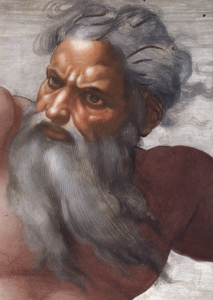
God as envisioned by MichelangeloRecently, following the tragedy in Newtown, Connecticut, a bunch of Christian “leaders” (Mike Huckabee, James Dobson, Bryan Fisher, to name a few) have basically said, “God has been taken out of the schools,” or “God has been taken out of our society,” or some variation on this theme. This, they say is, the reason the shooting at Sandy Hook Elementary School took place. Because of God’s supposed absence (voluntary on God’s part, it would seem) the horror took place. They seek to blame those who have “put God out,” but the way they make this argument really places the responsibility on God who apparently made the decision to stay away; either that or they are describing a God who is powerless in the face of some alleged official refusal to “allow God in” because our Constitution prohibits state-prescribed sectarian prayer in the schools.

Their alternative theory seems to be that because America now condones some sort of behavior to which these so-called “ministers” object (marriage equality, for example), or disallows some behavior they would champion (that state-sponsored school prayer, for example) God is punishing us. They seem to believe that God shares their judgement and is acting upon it . . . by killing children.

If any of this is true about God then I am in the class of fools who have said in their hearts, “There is no God” because I sure don’t believe in a God of the sort they seem to be describing.

But then, to be honest, I’m finding myself not believing in a lot of the Gods various people have described over the years. I read the atheist arguments of folks like scientist Richard Dawkins or the late journalist Christopher Hitchens; when I read their descriptions of God, I think “I don’t believe in that God, either.”

Recently, I’ve been thumbing through an old theology book, one that I think got me through my General Ordination Exam almost single-handedly (if that description can be applied to a book). It is Theological Outlines by Francis J. Hall (Morehouse-Barlow:1933). I found this description of God in the section on Divine Perfection:

By virtue of His infinite perfection, God is self-sufficient. Nothing is wanting to His essence which is needed for His blessedness. Neither His knowledge, nor His will, nor His love, depend upon the existence of the creature, but have sufficient scope for their activity in the eternal relations subsisting between the Persons of the Trinity. Creation is an act of the Divine will, not the result of necessity.

I read that and (guess what?) thought, “I don’t believe in that God!” I don’t believe in a God that has no need of God’s creation. I don’t believe in a God whose love has “sufficient scope for [its] activity” in God alone. The God I believe in wants to be in relationship with God’s creation! The God I believe in not only “looks down from heaven upon us all;” the God I believe in became one of us! The God I believe in was and is incarnate in Jesus Christ, lived in First Century Palestine, was crucified, died, was buried, and ascended to heaven, and yet is with us always, even to the end of the age. (Matt. 28:20) That is not a God in whom “nothing is wanting;” that is a God who wants to be with his creatures, with us!

That, I believe, is a God who wants to know, who lovingly hopes to know “if there is one who seeks after God.” That, I believe, is a God who, finding instead “ministers” like Huckabee who portray him as powerless or Dobson who make God into some kind of child-killing monster, finding atheists who make God into a caricature that no one actually accepts, finding theologians who describe God as some sort of theoretical philosophical construct with no needs, probably does conclude that “every one has proved faithless.”

Maybe as Christmas gets closer and Advent draws to an end, as we celebrate the birth of the God incarnate in Jesus, as we anticipate his return . . . maybe we could stop trying to define God and start trying to relate to God? Maybe we could turn our attention from describing God and instead simply try to do good? Let’s leave defining God up to God.

====================

A request to my readers: I’m trying to build the readership of this blog and I’d very much appreciate your help in doing so. If you find something here that is of value, please share it with others. If you are on Facebook, “like” the posts on your page so others can see them. If you are following me on Twitter, please “retweet” the notices of these meditations. If you have a blog of your own, please include mine in your links (a favor I will gladly reciprocate). Many thanks!

====================

Father Funston is the rector of St. Paul’s Episcopal Church, Medina, Ohio.

Advent Music, Advent Politics – From the Daily Office – December 18, 2012

From the Prophet Isaiah:

For a child has been born for us,
a son given to us;
authority rests upon his shoulders;
and he is named
Wonderful Counsellor, Mighty God,
Everlasting Father, Prince of Peace.
His authority shall grow continually,
and there shall be endless peace
for the throne of David and his kingdom.
He will establish and uphold it
with justice and with righteousness
from this time onwards and for evermore.
The zeal of the Lord of hosts will do this.

(From the Daily Office Lectionary – Isaiah 9:6-7 (NRSV) – December 18, 2012.)

Roman Imperial CoinsI absolutely adore Handel’s Messiah. As a child in a non-church-going family (except during the summers when I lived with my Methodist grandparents), my introduction to these words from the Prophet Isaiah was through Handel’s music. My step-father, who had sung in high school choirs, would take me with him to community sing-alongs of the oratorio which churches in our area would offer during the Christmas holidays. Even now as I read these lines from Isaiah, I read them to music of Handel!

That’s a mistake. The beautiful notes of the oratorio mask the highly charged political nature of this prophecy and the titles by which the church has named Jesus of Nazareth. Two weeks ago on Sunday morning we read the evangelist Luke’s report of the ministry of John the Baptizer crying out in the wilderness. Luke tells us very specifically that it happened “in the fifteenth year of the reign of Emperor Tiberius, when Pontius Pilate was governor of Judea, and Herod was ruler of Galilee, and his brother Philip ruler of the region of Ituraea and Trachonitis, and Lysanias ruler of Abilene, during the high priesthood of Annas and Caiaphas . . . .” This grounds John in a specific place and time, a political place and time. The Nicene Creed does the same thing when it bids us to affirm as an article of faith that Jesus was “crucified under Pontius Pilate,” that his death took place within a specific political context, the hard and gritty reality of the Roman Empire.

When the first Christians used Isaiah’s prophetic titles as references to Jesus they were not making so much a religious or theological point as a political one. They were making a bold and provocative political declaration about the Roman emperors. The emperors claimed religious titles and expected to be worshiped. Coinage and documents from the reigns of both Augustus, Caesar at the time of Jesus’ birth, and Tiberius, Caesar when he was crucified, proclaim the emperors divine and give them such titles as Prince of Peace, Lord of Lords, King of Kings, Savior, and Son of God. The church’s transfer of these titles to Christ declared that the emperors’ claim was false, as false as the Roman Peace, the Pax Romana for which the emperors claimed credit.

The Pax Romana was, in fact, no peace at all! It was the conquering and occupation of non-Roman territories, as in Judea and Galilee. It was a state of constant warfare on the empire’s borders, as in Gaul and Britain. It was a sham. Giving Isaiah’s prophetic titles to Jesus was the early church’s way of making that clear. Declaring that Jesus would reign “from this time onwards and for evermore” was the church’s way of saying that the emperor would not!

As we prepare for Christmas, Advent’s call to calm reflection is as much a call to examine our politics as to examine our faith. As we prepare to welcome the Prince of Peace, the Lord of lords, the King of kings, Advent calls us to question the princes, the lords, the kings, the political leaders of our own time and place, at all points on the political spectrum, from Right to Left, Republican or Democrat, conservative or liberal. Do we have the courage of the early Christians to stand up to them, to declare that their “peace” is no peace and that their reign will not last?

Handel’s beautiful music can mask the political impact of Isaiah’s words, and all the music of the holiday season can lull us into complacency. But the message of Advent, even of the music of Advent, should remind us that our faith is not a fairy tale. Our faith is grounded in the hard and gritty reality of human politics.

====================

A request to my readers: I’m trying to build the readership of this blog and I’d very much appreciate your help in doing so. If you find something here that is of value, please share it with others. If you are on Facebook, “like” the posts on your page so others can see them. If you are following me on Twitter, please “retweet” the notices of these meditations. If you have a blog of your own, please include mine in your links (a favor I will gladly reciprocate). Many thanks!

====================

Father Funston is the rector of St. Paul’s Episcopal Church, Medina, Ohio.

A Holy and a Broken Hallelujah – Sermon for Advent 3, Year C – December 16, 2012

====================

This sermon was preached on Sunday, December 16, 2012, at St. Paul’s Episcopal Church, Medina, Ohio, where Fr. Funston is rector.

(Revised Common Lectionary, Advent 3, Year C: Zephaniah 3:14-20; Canticle 9 (The First Song of Isaiah, Ecce Deus, Isaiah 12:2-6); Philippians 4:4-7; and Luke 3:7-18. These lessons can be read at The Lectionary Page.)

====================

Broken Hallelujah LyricDid you pay attention to the words of the song we just sang as our sequence hymn? Listen to them again:

Comfort, comfort ye my people,
Speak ye peace, thus saith our God;
Comfort those who sit in darkness,
Mourning ‘neath their sorrows’ load . . . .

(Hymn 67, The Hymnal 1982)

These are God’s words to the prophet Isaiah; we find them in the 40th chapter of Isaiah. They are God’s instructions to Isaiah, but I think every priest hears them personally when we are called on to minister to someone in times of trouble and loss. “Comfort, comfort my people; comfort those who are in sorrow.”

Since Friday morning when I, like many others, sat in stunned silence struggling to understand the horror of what had just happened at Sandy Hook Elementary School in Newtown, Connecticut, I have had a recurring vision of Christmas presents under Christmas trees in darkened homes, presents that will never be unwrapped. I see mothers and fathers sitting in that darkness mourning beneath a load of sorrow I don’t think I could ever comprehend, and I wonder if I as a priest or as a friend could speak any word of comfort to them. I have known the pain and brokenness of losing loved ones; I have known the sadness that comes with the death of parents and siblings. But I can only imagine (and I’m sure completely inadequately) the grief and agony a parent must feel when his or her child has been murdered; I can only imagine how broken those parents’ hearts must be, how broken they must feel. I don’t know if I could offer any comfort to them.

I have spent the past 48 hours following the news reports, weeping, screaming at the television, reading the statements of bishops and other clergy, enraged at the injustice of it, angry because as a society we seem unwilling (not incapable, unwilling) to do anything about the epidemic of gun violence that seems to sweep unchecked across our country.

This is not the way we are supposed to be on this, the Third, Sunday of Advent! In the tradition of the church, today is known as Gaudete Sunday or “Rejoicing Sunday” because in the medieval church the introit, the first words of the Mass, was Gaudete in Domino semper: iterum dico, gaudete, the first words of our epistle lesson this morning: “Rejoice in the Lord always; again, I say, rejoice.” The same theme is struck in the Old Testament reading from the Prophet Zephaniah and in the Gradual taken from the Prophet Isaiah; these readings are meant to emphasize our joyous anticipation of the Lord’s coming. “Rejoice and exult with all your heart,” Zephaniah cries out, but when our hearts are broken how are we to do that? Here in the depths of dealing with a senseless act of brutality, there is damned little rejoicing in our broken hearts, there is damned little comfort. We are in the midst of a murderous gun violence epidemic and I find it hard to rejoice.

Consider what has gone on in just the past week: last Sunday a man fatally shot his security-officer wife, tried to kill another person, and then killed himself in an employee parking lot at Cleveland-Hopkins Airport; on Tuesday a masked gunman killed two people and seriously injured another in a Portland, Oregon, shopping mall; on Friday, the Sandy Hook Elementary School killings, the second worst mass shooting at a school in U.S. history; and yesterday, a gunman shot three people in a hospital in Birmingham, Alabama. Earlier this year we saw fatal mass shootings in Minneapolis, in Tulsa, in a Sikh temple in Wisconsin, in a theater in Colorado, in a coffee bar in Seattle, and in a college in California. It is painfully clear that this is an epidemic of violence, that all is not well in our country. Like our hearts, our society is broken.

According to the Centers for Disease Control, there are about 31,000 deaths from firearms annually in our country. Of those, 500 are accidental; another 300 or so are considered “legal” as the result of law enforcement actions; and the nature of about 200 cannot be determined. That means that about 30,000 intentional, illegal, fatal shootings occur in the United States in a year’s time; 62% of those are suicides; 38% are murders.

Speak ye to Jerusalem
of the peace that waits for them;
tell her that her sins I cover,
and her warfare now is over.

As someone who, everyday, tries to speak the word of God to people who need to hear it, I don’t know that I can do that! I don’t know if I could comfort those parents mourning beneath their dark load of sorrow, and I don’t know how I could tell you that our warfare, our plague of gun violence is over! Our warfare is not over; the slaughter goes on . . . one or two people here, thirteen theater-goers there, twenty children in Connecticut . . . the massacre continues more than 11,000 times a year. Yes, it is painfully clear that this is an epidemic of violence, that all is not well in our country. Like our hearts, our society is broken.

John the Baptizer warned the people who came to him that all was not well in their society, that it was broken. “Do not,” he told them, “begin to say to yourselves, ‘We have Abraham as our ancestor.'” Don’t think that because you are who you are that all is well and that all will be well; it is not and it will not be. Our society is broken! “And the crowds asked him, ‘What then should we do?'” John’s answer was simplicity itself – do what you know to be right. If you have two coats, if you have extra food, and your neighbor has none, share. If you have taken on the job of tax collector, or if you are a soldier entitled to ask citizens for support, collect no more than you should, ask no more than is proper. Just do what you know to be right, do what you know ought to be done.

Every time one of these mass shootings occurs there is an outpouring of public grief, and there are expressions of sorrow and sympathy. Every time this has happened, however, we have been told that it is not the appropriate time to talk about strengthening our nation’s gun control laws; we are told that it is too soon to talk about doing something about gun violence; we are told that we have to give the families of the victims time to heal. But as John the Baptizer said to those who came to him at the Jordan, the time is now – “Even now,” he said, “the ax is lying at the root of the trees . . . .” There is no time like the present to do what we know to be right, to do what we know ought to be done.

I believe that that talk about time to heal is a sham. I don’t think anyone ever “heals” from the death of a loved one; one remains broken. I know that I have never “healed” from the deaths of my parents or of my brother or of any other person I loved; forever, after each death, there is a part of me that is and will always be broken. As a parent, I am very sure I would never “heal” from the murder of my child; I would be forever broken. But I know that life goes on and, through the grace of God, we are given the strength to live it, even as wounded, as broken, as broken-hearted as we may be. As Isaiah said, “Surely, it is God who saves me; I will trust in him and not be afraid. For the Lord is my stronghold and my sure defense, and he will be my Savior.” The one who was broken on Calvary’s tree was broken that I, in my brokenness, might be made whole. Through his brokenness, in our brokenness, we are given the peace of God which passes all understanding.

Life goes on, and by the grace of our Savior we are given the strength to live it, and in it to do what we know to be right, to do what we know ought to be done. The only question is whether we have the will to do it.

Make ye straight what long was crooked,
make the rougher places plain;
let your hearts be true and humble,
as befits his holy reign.

Have we the will to do what we know to be right, to make what is crooked straight, to make what is rough plain? Are our hearts, broken though they may be, true and humble as befits our Savior’s holy reign?

Many of you know that I’m a great fan of the singer-songwriter Leonard Cohen and many of you are familiar with his song Hallelujah. In it there is this great line:

Love is not a victory march
It’s a cold and it’s a broken Hallelujah

And again, later in the song, the singer says of love,

It’s not a cry you can hear at night
It’s not somebody who has seen the light
It’s a cold and it’s a broken Hallelujah

In the funeral liturgy of our church, near the end of the service, the priest stands at the body of the deceased and says, “All of us go down to the dust; yet even at the grave we make our song: Alleluia, alleluia, alleluia.” When each of those twenty children, each of those seven adults are buried, their families will hear those as cold and broken Hallelujahs! But as our Advent hymn reminds us in its conclusion,

For the glory of the Lord
now o’er the earth is shed abroad,
and all flesh shall see the token
that the word is never broken.

Our hearts may be broken; our lives may be broken; our society may be broken, but God’s word, God’s promise is never broken. The Word made flesh, Jesus Christ, he was broken . . . broken on the Cross that we might be made whole. Risen unbroken though still bearing the scars of our brokenness, he will return again so that we might sing not a broken, but a whole Hallelujah, a holy Hallelujah, so that we might “rejoice in the Lord always.”

I still don’t know if I could comfort those grieving parents, but I do know that I believe in God, that I believe God’s promise, and that I believe in Jesus Christ, the One who was broken that we might be made whole. It is his birth and its promise of wholeness that we prepare to celebrate in this Advent season. And because I believe, I know that I could, at least, be with those families in this time of grief, that I could sit with them, and that I could assure them in words just slightly changed from the end of Mr. Cohen’s song . . . .

There’s a blaze of light in every word
It doesn’t matter which you heard
The holy or the broken Hallelujah.
* * * *
And even though it all went wrong
We’ll stand before the Lord in song
With nothing on our tongue but Hallelujah!

The Wounds on my Chest – From the Daily Office – November 29, 2012

From the Prophet Zechariah:

On that day, says the Lord of hosts, I will cut off the names of the idols from the land, so that they shall be remembered no more; and also I will remove from the land the prophets and the unclean spirit. And if any prophets appear again, their fathers and mothers who bore them will say to them, “You shall not live, for you speak lies in the name of the Lord”; and their fathers and their mothers who bore them shall pierce them through when they prophesy. On that day the prophets will be ashamed, every one, of their visions when they prophesy; they will not put on a hairy mantle in order to deceive, but each of them will say, “I am no prophet, I am a tiller of the soil; for the land has been my possession since my youth.” And if anyone asks them, “What are these wounds on your chest?” the answer will be “The wounds I received in the house of my friends.”

(From the Daily Office Lectionary – Zechariah 13:2-6 (NRSV) – November 29, 2012)
 
Chest WoundI know I’ve read this bit of Zechariah before, but I don’t think I’ve ever paid any attention to it. This morning, the image of parents “piercing” their own children who happen to be prophets and that of “the wounds I received in the house of my friends” really hit home! Strife within families and between friends is here the recompense paid by God to false prophets, but it seems to be the lot of the prophet, the priest, or the ardent advocate in any age. I am reminded of Jesus’ quoting Micah to the effect that “your enemies are members of your own household.” (Micah 7:6; cf Matt. 10:35-36 and Luke 12:52-53) Speaking on behalf of God or any god or any cause is never easy; it leads to misunderstanding and conflict – just look at what happened in many families during the recently passed political campaigns.

That strife and that wounding seem to happen most severely when someone is focused on a particular issue of great importance to them to the exclusion of all others. We referred to them as “single-issue voters” during the election. In recent years that single-issue in politics has been abortion, but the phenomenon is not limited to that particular matter.

I have a friend who is particularly dedicated to the cause of marriage equality. He is a faithful member of an Episcopal parish where he regularly worships, but because of the failure of the 2012 General Convention to adopt a rite for marriage of same-sex couples for use across the church without restriction he has vowed to give nothing of his time, talent, or treasure to the Episcopal Church. The issue came up in our conversation because of a church appeal for donations to assist those affected by Hurricane Sandy. He refused, “Not one red cent.”

That refusal felt like a stab in the gut, like a wound on the chest! We, the church, do so many things that are worthwhile and yet, because of his principled stand on that single issue, they are treated as nothing, as worthless, as unworthy of his consideration. He is unwilling to contribute to the support of what I dedicate my life to everyday. I understand why he is doing so; I even share his position on the marriage equality question. And yet I feel wounded by his refusal.

I would have to have a lot more fingers and toes to count all the times this sort of thing has happened in the church through the years over much less serious matters and much less principled positions. People, myself included, get bent out of shape over silly things – the kind music chosen for a service, the type or color of flowers on the altar, you name it – and the next thing you know parishioners are withholding contributions, or not attending worship, or even transferring their membership. Piercings! Gut stabs! Chest wounds!

I do not claim the mantle of prophecy by any stretch of the imagination, but I can surely relate to Zechariah’s oracle! Years ago, when I would bring up these sorts of things with my spiritual director (who was a parish priest of many years experience), he would just look at me with gentle eyes and ask, “And how did they treat Jesus?” In comparison, although they hurt, I guess I can live with the wounds on my chest.

====================

A request to my readers: I’m trying to build the readership of this blog and I’d very much appreciate your help in doing so. If you find something here that is of value, please share it with others. If you are on Facebook, “like” the posts on your page so others can see them. If you are following me on Twitter, please “retweet” the notices of these meditations. If you have a blog of your own, please include mine in your links (a favor I will gladly reciprocate). Many thanks!

====================

Father Funston is the rector of St. Paul’s Episcopal Church, Medina, Ohio.

« Older posts Newer posts »