Occasional thoughts of an Anglican Episcopal priest

Category: Prayer (Page 11 of 48)

Act Three (Pt 1): Fully Human – Easter Vigil 2017

====================

A homily offered by the Rev. Dr. C. Eric Funston at the Great Vigil of Easter, Saturday, April 15, 2017, to the people of St. Paul’s Episcopal Church, Medina, Ohio, where Fr. Funston is rector.

(The lessons for the service are from the Revised Common Lectionary: Genesis 1:1-2:4a; Exodus 14:10-31,15:20-21; Proverbs 8:1-8,19-21,9:4b-6; Zephaniah 3:14-20; Psalm 114; Romans 6:3-11; and St. Matthew 28:1-10. These lessons can be read at The Lectionary Page.)

====================
Two weeks ago, the Sunday lectionary treated us to the entire long Gospel lesson of the story of Jesus’ raising of Lazarus and then last week the Daily Office lectionary repeated it in smaller bits over the course of several days. Last Sunday I suggested that Holy Week and Easter can be conceived as a three-act drama to which the Triumphal Entry of Palm Sunday is an overture.

The Lazarus story, like last Sunday’s Gospel, is part of that overture, the introduction to the three-act drama of celebration in which we have participated this week and in which we have come, this evening, to the third and final act. Lazarus has been much on my mind as we have prepared for this Easter celebration and for the baptisms we have just performed. I believe the story of Lazarus’ raising has much to teach us about what we have done here tonight in this third act, this Baptismal Vigil, this liturgy of welcoming and inclusion.

Lazarus was the brother of Mary and Martha of Bethany; they are a family which figures prominently in the Gospels as friends of Jesus. They are clearly people who believe in Jesus and in his mission, but their belief is much, much more than simply signing on to his program, a new approach to religion. This family really seems to know Jesus; he apparently stayed with them on several occasions. He lodged with them, ate with them, taught in their home. When word is sent to Jesus that Lazarus is ill, Lazarus is described to him as “he whom you love.” (John 11:3) Lazarus and his sisters are close to Jesus; they are practically family, may even be family.

As the story of Lazarus raising is told, the family is described as accompanied by “Jews.” That has always struck me as a bit odd. After all, aren’t they all Jews? Mary, Martha, Lazarus, Jesus, the whole lot of them? Of course they are! So many scholars suggest that we should better understand John’s term Ioudaiou to mean “Judeans,” that is people native to the Jerusalem area; these scholars suggest that Mary, Martha, and Lazarus, like Jesus, were Galileans who had moved to Judea and been accepted into this southern community. This strengthens the suggestion that they may have been members of Jesus’ extended family.

Next, when both of the sisters greet Jesus (Martha’s greeting is earlier in the story), the very first thing each says is, “If you had been here, he wouldn’t have died.” (John 11:21 & 32) Not “Hi, how are you?” Not “Welcome back.” Not “I’m so sorry we have to tell you.” What the sisters say is not really a greeting; it’s an angry, accusative confrontation. “You could have prevented this!”

We’re told that Jesus’ response to this is that he is “greatly disturbed in spirit and deeply moved.” That’s a fine translation, but it’s also a bit misleading. The Greek word rendered “disturbed” very literally means he “snorted with anger”; and the word translated “deeply moved” means “stirred up” and implies a certain physicality, not simply an emotion. Jesus response to the sisters’ confrontations, to Lazarus’ death, to the whole situation is to become indignant and sick to his stomach.

The Lazarus story contains the shortest verse in the New Testament, famously rendered in the King James Version with only two words, “Jesus wept.” Some of the Judeans, John tells us, interpreted this as a sign of Jesus’ love for Lazarus; “See how he loved him!” they said. While I’ve no doubt that that is true, I suggest that, since John describes Jesus as angry and physically sick, we might consider another way to understand what is happening in this story.

We have just baptized four children and, together with them, we have affirmed the Baptismal Covenant beginning with a recitation of the Apostle’s Creed in which we will claim that Jesus, the Son of God, was “conceived by the power of the Holy Spirit and born of the Virgin Mary” (BCP 1979, p 304). In the Nicene Creed, which we recite most Sundays during the Holy Eucharist, we go further and declare that he “became incarnate . . . and was made man,” that is, that he became a flesh-and-blood human being. (BCP 1979, p 358). In the Definition of Chalcedon, which you can find on page 864 of the Prayer Book, the church goes even beyond that and asserts its conviction that Jesus is “truly [human] . . . like us in all respects, apart from sin.”

I believe that standing before that tomb where his beloved friend Lazarus had been buried four days earlier, feeling the anger and frustration of his close friends Mary and Martha, surrounded by Judeans muttering “couldn’t he have prevented this,” and perhaps physically exhausted from traveling from the other side of the Jordan valley where he was when he got the news, Jesus’ humanity hit him like a ton of bricks. In that moment, everything that it meant to be human came crashing in on him: the way human beings settle for easy answers, half-truths, and superficial relationships; the injustice, oppression, and exploitation we impose on one another; the pain, rejection, hunger, and war we endure . . . but, also, the love, friendship, community, family, support, and every other good thing about being a human being; it all come together in that moment standing at that grave.

Why do I think that? Because that’s what I feel every time I stand at a grave. The first time I did that, I was 5-1/2 years old. I remember standing between my mother and my paternal grandmother watching two members of the US Army fold the flag that had draped my father’s coffin, feeling loss, grief, anger, confusion, and emotions I couldn’t even name. But there was also the love of family, pride in my father’s military service, a sense of community with extended family and friends, all the comfort that comes from our common humanity. And every time I have stood beside a grave, I have felt that again, and I can surely imagine that our Lord experienced something very like that. No wonder Jesus – the sorrowful-but-also-angry and stirred-up Jesus, the knowing-he-too-might-soon-be-dead Jesus, the fully-human, like-us-in-all-respects Jesus – wept.

We should feel that same way when we welcome a new member into the household of God through the Sacrament of Baptism. Symbolically, baptism is burial; in the oldest tradition of the church, full immersion baptism, we go down under the water in the same way a body is buried in the earth, then we come up out of the water as Lazarus came from his tomb, as Jesus came from his grave. Baptism is death, burial, and restoration to life all encapsulated in one short liturgical act. As St. Paul asks in his letter to the Romans which was read just a few minutes ago, “Do you not know that all of us who have been baptized into Christ Jesus were baptized into his death?” The Prayer Book says in the blessing of the baptismal water, “In it we are buried with Christ in his death.”

St. Paul’s assurance that “if we have been united with him in a death like his, we will certainly be united with him in a resurrection like his,” is echoed by the Prayer Books bold promise that by baptism we share in Jesus’ resurrection, and that “through it we are reborn by the Holy Spirit.” (BCP 1979, p 306) As Jesus called for Lazarus to be unbound from his funeral wrappings, as Jesus himself rose and set aside his shroud, through Holy Baptism our Lord calls us “from the bondage of sin into everlasting life” (ibid), into a new life of full humanity joined with those whom the Psalmist describes as having “clean clean hands and a pure heart, [those] who have not pledged themselves to falsehood nor sworn by what is a fraud, [those who] shall receive a blessing from the Lord and a just reward from the God.” (Ps 24:4-5)

The Creation story in Genesis tells us that “God created humankind in his image, in the image of God he created them; male and female he created them.” (Gn 1:27) The story of the Fall reminds us that somehow that divine likeness has been marred, that on our own we fail to live up to that image; we fail to fully live up to the potential God created in humankind. Through baptism, the divine image is restore; through our baptism into the life, death, and resurrection of Jesus Christ, a process of transformation begins and God restores us to who and what we were meant to be – fully human.

When we baptized these children, we asked them and their baptismal sponsors (and we asked ourselves) some questions which are taken directly from the Apostle’s Creed, to which I referred earlier. These questions began with the words, “Do you believe . . . .”

A few years ago a colleague of mine said that he had once asked his congregation, when reciting the Nicene Creed, to say “We trust in” instead of “We believe in” since the original Greek could have been translated either way. He said he wondered if the church would be less fragmented if we had used “trust.” He suggested that there might have been far less of, “You don’t believe exactly what I believe, so I’m out of here,” or, “You don’t believe exactly what I believe, so you are out of here.” When we ask those questions of baptismal candidates and their Godparents, when we say the creeds ourselves, are expressing a deep affirmation of community whether we say, “We believe in . . .” or “We trust in . . .” Maybe we don’t “believe” exactly the same things that others here believe, but we all trust in the same God.

In that same conversation, another priest objected to what he called the distinction between “faith as trust and faith with content.” “It’s always struck me as a strange distinction,” he said. “If, for example, faith as trust is about relationship [and not about content], it is like someone saying to a prospective marriage partner, ‘I love you and I want to marry you, but I’m not certain who you are.’” I suggested to him, however, and I suggest to you now that this distinction really doesn’t exist, that faith as trust or as relationship necessarily implies and includes “faith with content.” One cannot place trust in another person, such as the Father, the Son, and the Holy Spirit named in the Creed, without assenting to that person’s existence and properties; to say, “I trust you” or “I love you” and not also agree that you exist makes very little sense.

This is why we ask those questions of baptismal candidates. When we say, “Do you believe in” the three Persons of the Holy Trinity, we are not merely asking if the candidates (and the congregation who join them in answering) are assenting to certain doctrines about them; we are asking if they claim to be in a relationship of trust and love with God the Holy Trinity, and through God with the full community of human beings whom God loves and whom God has redeemed in all that long salvation history that we have heard read from the Hebrew Scriptures this evening. When we baptized these children, when we baptize any new member of the Christian community, we recognize them as part of that fully human community whom God invites to “lay aside immaturity, and live, and walk in the way of insight” (Prov 9:6), whom God promises to save, and gather, and bring home, and restore. (Zeph 3:19-20)

That full human community relationship, I believe, is why Jesus wept. To be sure, he grieved the death of his friend Lazarus, but he knew he was about to do something to change that; there was no reason to cry about that. But that in-rushing crash of realization of what it is to be a human being, of what it is to be fully human, that is enough to make anyone cry. The story of the raising of Lazarus is a story about Jesus’ full humanity, the full humanity he shares with and promises to us, the full humanity which gathered with friends and family at the Last Supper in the first act of this drama of redemption, the full humanity which was arrested and brutalized and crucified in the second act, the full humanity whose Resurrection we celebrate in this, the third act, the feast of Easter. It is into that Easter promise that we have baptized Kadence, Bryce, Hadley, and Joseph this evening. And that is why the Lazarus story figures so prominently in the church’s preparations for Holy Week and Easter, part of the overture of this three-part drama of redemption!

In the words of a popular Franciscan blessing, let us pray that, as these children grow into the full humanity into which they are initiated today, God will bless them with discomfort at easy answers, half-truths, and superficial relationships, so that they may live deep within their hearts; that God will bless them with anger at injustice, oppression, and exploitation of people, so that they may work for justice, freedom, and peace; that God will bless them with tears to shed for those who suffer from pain, rejection, hunger, and war, so that they may reach out their hands to comfort others and turn their pain into joy; and that God bless them with enough foolishness to believe that they can make a difference in this world, so that they can do what others claim cannot be done, to bring justice, kindness, and love to all.

As they have been buried with Christ, they have begun to share in his Resurrection; may God bless them with the gift and the commission to be, like Christ, fully human. Amen.

====================

Father Funston is the rector of St. Paul’s Episcopal Church, Medina, Ohio.

Intermission: We Cannot Know – Holy Saturday 2017

====================

A meditation offered by the Rev. Dr. C. Eric Funston on Holy Saturday, April 15, 2017, to the people of St. Paul’s Episcopal Church, Medina, Ohio, where Fr. Funston is rector.

(The lessons for the day are from the Revised Common Lectionary: Lamentations 3:1-9, 19-24; Psalm 31:1-4,15-16; 1 Peter 4:1-8; and St. Matthew 27:57-66. These lessons can be read at The Lectionary Page.)

====================

Today is Holy Saturday, perhaps the least thought upon, least looked upon day in the Easter Triduum. A moment when the pomp and majesty of events ceases; no betrayals, no protestations of loyalty, no meaningful dinner, no demonstrations of servanthood, no admonitions to love, no agony, no dying, and, as yet, no rising — merely dormancy on all fronts. It is the Intermission of the three-act drama of Redemption.

A time, as poet Emily Polis Gibson quoting T.S. Eliot says is a time to Be Still and Wait:

I said to my mind, be still, and wait without hope

For hope would be hope for the wrong thing; wait without love
For love would be love of the wrong thing; yet there is faith
But the faith and the hope and the love are all in the waiting.
Wait without thought, for you are not ready for thought:
So the darkness shall be light, and the stillness the dancing.
~T. S. Eliot, from “East Coker,” The Four Quartets

This in-between day
after all had gone so wrong
before all will go so right,
puts us between the rock
and the hard place:
all hope, love and faith is squeezed from us.
Today we are flattened,
dried like chaff,
ground to pulp,
our destiny with death sealed.

We lie still
like sprinkled spices
trying to delay
inevitable decay,
wrapped up tight
stone cold
and futile.
The rock is rolled into place
so we lie underneath,
crushed and broken.
We are inside,
our bodies like His.
We are outside,
cut off and left behind.
We cannot know about tomorrow,
we do not fathom what is soon to come:
the stone lifted and rolled away,
the separation bridged,
the darkness giving way to light,
the crushed and broken rising to dance,
and the waiting stillness stirring, inexplicably,
to celebrate new life.

“We cannot know about tomorrow . . . . ” Poet and essayist Aaron Brown says that Holy Saturday “dwells in [the] place where words fail, between the bookends of suffering and resurrection. When the defiance of loss gives way to numbness, we are left in a space where time seems to slow, indeed seems to stop altogether.” (Brown) It is truly an intermission.

And yet it is not a time of inactivity. While we, the actors and cast of the yearly remembrance of the drama seem to languish, our faith teaches that the one who has died is active. We confess in each recitation of the Creed that “he descended to the dead.” It is the time called “the harrowing of hell” when the souls of the righteous dead are freed. An ancient anthem of the day sings

Our shepherd, the source of the water of life, has died.
The sun was darkened when he passed away.
But now man’s captor is made captive.

This is the day when our Savior broke through the gates of death.
He has destroyed the barricades of hell,
overthrown the sovereignty of the devil.
This is the day when our Savior broke through the gates of death.
(Responsory, Roman Rite Morning Prayer, Saturday of the Three Days)

The protagonist died, but the drama is not ended. This is merely Intermission, time to gather strength and prepare for the third act. Let us pray:

All-powerful and ever-living God, your only Son went down among the dead and rose again in glory. In your goodness raise up your faithful people, buried with him in baptism, to be one with him in the eternal life of your kingdom, where he lives and reigns with you and the Holy Spirit, one God, forever and ever. Amen.

====================

Father Funston is the rector of St. Paul’s Episcopal Church, Medina, Ohio.

Act Two: Do You Love Me? – Good Friday 2017

====================

A homily offered by the Rev. Dr. C. Eric Funston on Good Friday, April 14, 2017, to the people of St. Paul’s Episcopal Church, Medina, Ohio, where Fr. Funston is rector.

(The lessons for the day are from the Revised Common Lectionary: Isaiah 52:13-53:12; Hebrews 10:16-25; Psalm 22; and St. John 18:1-19:42. These lessons can be read at The Lectionary Page.)

====================

On Palm Sunday, I suggested that we think of Holy Week and Easter as a three-act drama beginning with an Overture on Palm Sunday. Last night, we took part in the first act. The analogy of the Three Holy Days (or “Triduum”) to a play breaks down if we think of ourselves as the “audience.” We are not the audience.

The audience of worship is God. The one, holy, blessed, and glorious Trinity, Father, Son, and Holy Spirit, God is the audience. We, all of us, are the actors. We, all of us, are the cast.

So, here we are . . . . the second act . . . .

In the first act of the drama of redemption, Love tried to teach his lesson through bread and wine, through water and basin, through garden prayer, and through willing surrender to corrupt authority. The Body and Blood symbolically broken, the Body washing other bodies, the Blood sweated out in agonized prayer, these did not suffice and so, betrayed and exhausted, he surrendered. Whether or not he knew what would ultimately happen is irrelevant. He could do nothing else – if he were to remain faithful to his God, faithful to his values, faithful to his principles, faithful to his mission, he could do nothing else. And so now, in the second act, the incarnate Creator is prisoner to Destruction, now Life is condemned to death by Death.

In the beginning he had been tempted by riches, by power, by idolization; all these had been offered in the desert. Now how great the temptation must have been to simply give up! Poet Denise Levertov ponders this allure in her poem Salvator Mundi: Via Crucis

Maybe He looked indeed
much as Rembrandt envisioned Him
in those small heads that seem in fact
portraits of more than a model.
A dark, still young, very intelligent face,
A soul-mirror gaze of deep understanding, unjudging.
That face, in extremis, would have clenched its teeth
In a grimace not shown in even the great crucifixions.
The burden of humanness (I begin to see) exacted from Him
That He taste also the humiliation of dread,
cold sweat of wanting to let the whole thing go,
like any mortal hero out of his depth,
like anyone who has taken herself back.
The painters, even the greatest, don’t show how,
in the midnight Garden,
or staggering uphill under the weight of the Cross,
He went through with even the human longing
to simply cease, to not be.
Not torture of body,
not the hideous betrayals humans commit
nor the faithless weakness of friends, and surely
not the anticipation of death (not then, in agony’s grip)
was Incarnation’s heaviest weight,
but this sickened desire to renege,
to step back from what He, Who was God,
had promised Himself, and had entered
time and flesh to enact.
Sublime acceptance, to be absolute, had to have welled
up from those depths where purpose
drifted for mortal moments.
(In The Stream & the Sapphire: Selected poems on religious themes [New Directions Books: 1997])

In this second act of the drama of redemption, it is faith and will which prevail, the faith and will of Jesus who did not step back, who did not give in to the human longing to simply cease.

In this second act of the drama all that has gone before is recapitulated; all that we saw in yesterday’s first act, the supper in the upper room, the act of servanthood taught there, the agonized prayer in the garden, the willing surrender to unjust authority, and more. Not just yesterday’s first act, but all that has gone before from our first act of defiance in the first garden. Poet Ross Miller reminds us of that bond in his brief verse entitled Tau

That dreadful beam
that Jesu bore
knot made from pine
but ancient tree
that bore a bitter fruit

That pole on which it hung
he hung
knot made from pine
undying tree of life
that bears forever fruit

Take and eat – the Serpent cried
You shall not die
You shall be
like God
We bit
The Servant took those twisted words
held them on the knotted wood
Take and eat – the Servant cries
You shall not die
You shall be
like me
(Found in 2012 at Stations of the Cross (www.stations.org.nz) a no-longer-working site)

We shall be like him! It is here on the cross in this second act that the promise of the Incarnation, the guarantee of the Nativity is made good. Then we sang

Great little One! whose all-embracing birth
Lifts Earth to Heaven, stoops Heaven to Earth.
(In The Holy Nativity of Our Lord God: A Hymn Sung as by Shepherds, Richard Crashaw [1613-49])

Here on the cross, indeed, God “gathers up all things in Christ, things in heaven and things on earth.” (Eph. 1:10) And here on the cross, in an act of faithfulness and will, he died. Here on the cross, in this final fact of human existence, truly “God became man so that man might become a god.” (St. Athanasius, De Incarnatione)

But his death, we know, cannot be the end of the story. This is only the second act of a three-act drama. So his body must be taken down; it must be dealt with in the appropriate way.
Composer Jimmy Owens paints the picture in his cantata No Other Lamb:

They took Him down,
His poor dead body,
and prepared Him for His burial.

They took Him down,
His poor pale body
drained of life, ashen, and stained
with its own life-blood.

His healing hands, now pierced and still;
Serving hands, that broke five loaves
to feed five thousand;
Holy hands, often folded in fervent prayer;
Poor gentle hands, now pierced and still.

His poor torn feet, now bloodied and cold;
Feet that walked weary miles
to bring good news to broken hearts
Feet once washed in penitent’s tears;
Poor torn feet, now bloodied and cold.

His kingly head, made for a crown,
now crowned – with thorns.
His poor kingly head, crowned with thorns.

His gentle breast, now pierced by
spear-thrust, quiet and still;
His poor loving breast.

His piercing eyes, now dark and blind;
Eyes of compassion, warming the soul;
Fiery eyes, burning at sin;
Tender eyes, beckoning sinners;
His piercing eyes, now dark and blind.

His matchless voice, fountain of the Father’s
thoughts, stopped –
and stilled – to speak no more.
Silence now, where once had flowed
Wisdom and comfort, Spirit and life;
His matchless voice; stilled, to speak no more.

They took Him down,
His poor dead body,
and prepared Him for his burial.
(They Took Him Down in No Other Lamb [Lillenas Publishing Co.])

And so the second act comes to a close, the body is laid in a tomb and as the rock is rolled to seal it, the now-torn curtain descends. We are left in the darkness of our hearts to contemplate our place in this drama. With poet Luci Shaw we realize that we just may be Judas or Peter….

because we are all
betrayers, taking
silver and eating
body and blood and asking
(guilty) is it I and hearing
him say yes
it would be simple for us all
to rush out
and hang ourselves
but if we find grace
to cry and wait
after the voice of morning
has crowed in our ears
clearly enough
to break our hearts
he will be there
to ask each again
do you love me?
(Judas, Peter in A Widening Light: Poems of the Incarnation [Regent College Publishing, 1997])

====================

Father Funston is the rector of St. Paul’s Episcopal Church, Medina, Ohio.

Act One: Use Your Towel – Maundy Thursday 2017

====================

A homily offered by the Rev. Dr. C. Eric Funston on Maundy Thursday, April 13, 2017, to the people of St. Paul’s Episcopal Church, Medina, Ohio, where Fr. Funston is rector.

(The lessons for the day are from the Revised Common Lectionary: Exodus 12:1-14; Psalm 116:1,10-17; 1 Corinthians 11:23-26; and St. John 13:1-17,31b-35. These lessons can be read at The Lectionary Page.)

====================

On Palm Sunday, I suggested that we think of Holy Week and Easter as a three-act drama beginning with an Overture on Palm Sunday. Today, we take part in the first act. The analogy of the Three Holy Days (or “Triduum”) to a play breaks down if we think of ourselves as the “audience.” We are not the audience.

The audience of worship is God. The one, holy, blessed, and glorious Trinity, Father, Son, and Holy Spirit, God is the audience. We, all of us, are the actors. We, all of us, are the cast.

So, here we are….

Act One, Scene One: The curtain rises. We see a group of people gathered in an upper room somewhere in Jerusalem.

A meal is in progress… we wonder if it might be a seder, the ritual meal of remembrance of the Passover. We don’t really know; the playwrights have not made this clear and the theater critics, the scholars, debate the issue.

Three of the story-tellers suggest that it is. Luke and Matthew based their stories on Mark’s, so to be honest there aren’t three stories, there’s only one that would make us think that this supper is a seder.

However, the fourth, John, tells the tale very differently. John doesn’t even seem to care about the dinner – he spends no time at all describing the meal; for him, it’s not important. What’s important is what happened afterward.

So as we continue this three-act drama of redemption let’s just assume that that Matthew, Mark, and Luke are correct and what we see in this first scene of the first act is, indeed, a seder.

Those present are prepared to do all that is laid out in the instructions in the book of Exodus; they have worn their sandals; they carry their staffs; they expect to eat of roasted lamb and unleavened bread and bitter herbs. They anticipate spending the night in remembrance of that which happened generations before in Egypt. If we can imagine that they celebrate as modern Jews celebrate, they are gathered in that upper room, those serving the meal coming and going, and a breeze blowing through the open windows. They are following along in their prayer books, the Haggadah; they expect the youngest among them to ask the questions, beginning with “Why is this night different from all other nights?” They know that the head of the household, their rabbi Jesus, will answer those questions in the prescribed way and tell the story of the Passover.

So, when the youngest asks “Why do we eat the broken matzah?” they expect Jesus to answer “This is the bread of our affliction; the unleavened bread of poverty, baked and eaten in haste,” but instead he takes the bread, brakes it and says, “This bread is my body, given for you.”

They look up startled, glancing at one another, murmuring to each other, “What is he talking about? That’s not here! That’s not the right answer. Where is he? What page is he on?” But the moment passes, the meal moves on.

At the end he takes up the fourth and final cup of wine, the kiddush cup, which recalls God’s promise, “I will acquire you as a nation; you will be my people and I will be your God.” As before, they expect Jesus to say the prescribed prayer, “Blessed are you, O Lord our God, sovereign of the universe, creator of the fruit of the vine,” but instead they hear, “This cup is my blood!” “What?!” They look at one another in disbelief. “What is he saying???”

It is for Jesus and his disciples one of those fleeting opportunities when, because of the pupils’ confusion or frustration or grasping for understanding, the teacher can pass on to the students new information, new values, new moral understanding, a new behavior, a new skill, a new way of seeing and coping with reality; it is what we have come to call “the teachable moment” and so he teaches, yet again, “Remember! Remember,” he says, “Love one another as I have loved you.”

The curtain falls as Jesus continues to teach; the disciples look mystified.

Act One, Scene Two: The curtain rises again. We see the same group of people gathered in the same upper room somewhere in Jerusalem.

The meal is over, the dishes have been cleared. The disciples are arguing among themselves about who is the greater among them. Jesus looks frustrated and troubled; the teachable moment has passed and the disciples clearly have not understood! They just haven’t gotten it.

“Look,” he says, “the greatest among you must become like the youngest, and the leader like one who serves. For who is greater, the one who is at the table or the one who serves? Is it not the one at the table? But I am among you as one who serves. Here, let me show you what I mean.” Getting up from the table, he takes off his robe, picks up a basin of water and a towel, and begins to wash and dry their feet.

As many of you know, I am a fan of science fiction, so when I hear about towels, one of the first things I think of is the late Douglas Adams’ hilariously funny novel, The Hitchhiker’s Guide to the Galaxy. The book begins seconds before Earth is demolished to make way for a galactic freeway, when the protagonist Arthur Dent is plucked off the planet by his friend Ford Prefect, a researcher for a revised edition of The Hitchhiker’s Guide to the Galaxy who has been posing for the last 15 years as an out-of-work actor. The one thing Prefect makes sure that Dent brings with him is a towel. Quoting from the guidebook, he explains that a towel is the one, crucial, indispensable necessity that the intergalactic traveler must bring along on any journey:

A towel (says The Hitchhiker’s Guide) is about the most massively useful thing an interstellar hitchhiker can have . . . . you can wrap it around you for warmth . . . . you can lie on it on . . . brilliant marble-sanded beaches . . . . you can sleep under it beneath the stars . . . . use it to sail a mini-raft down a slow river . . . . wet it for use in hand-to-hand combat; wrap it round your head to ward off noxious fumes . . . . you can wave your towel in emergencies as a distress signal, and of course dry yourself off with it if it sill seems to be clean enough.

Any man who can hitch the length and breadth of the galaxy, rough it, slum it, struggle against terrible odds, win through, and still know where his towel is is clearly a man to be reckoned with.

John tells us that Jesus made use of the towel to dry the disciples’ feet and then said, “I have set you an example, that you also should do as I have done to you.” It has occurred to me that The Hitchhiker’s Guide suggests many other ways in which we might use a towel in following Jesus’ lead.

When we baptize someone here at St. Paul’s Parish, the altar guild supplies towels for them to be dried with; I often joke about getting those towels back. But now it seems to me that we might better give them to the newly baptized with an admonition to follow Jesus’ example of loving service. The towel of service just might be the one, crucial, indispensible necessity that the Christian traveler should bring along on his or her journey through life. It just may be the most massively useful thing we can have as we serve others. We can wash and dry their feet; we can wrap them in warmth; we can provide a comfortable place to sleep; we can help them on a journey; we can protect them; we can signal to them and for them in emergencies; we can clothe the naked, swaddle a baby, comfort the sick. I’m sure you can come up with many more uses, small and large, for a towel and, by extension, for your heart, for your life, and for your willing hands.

That Jesus made use of the towel in the context of the Lords’ Supper is a really important point. There used to be what some thought of as a silly and useless bit of priestly vesture worn at Communion called a “maniple.” It looked sort of like a short stole and was made of the same material as the stole and chasuble. It was worn over the left forearm and looked like, and in fact was meant to symbolize, the sort of towel or table napkin often worn by the wait-staff in fancy restaurants, a symbol of service. Anglican clergy stopped wearing maniples long ago and Roman Catholic priests were allowed to discontinue them in 1967, one of the minor reforms of the Second Vatican Council.

In abandoning that symbolic vestment, however, we may have lost a reminder that, in addition to being called to follow Jesus along the way of the cross, we are also called to follow him in his use of the towel! Just as Jesus said, “Take up your cross and follow me,” he might also have said, “Take up your towel and follow me.” In fact, he did when he said, “I have set you an example, that you should also do as I have done to you.”

Perhaps we no longer use the maniple as a priestly vestment because the ministry of Christian servanthood which it represents is not limited to clergy; it is the ministry of all baptized people. “Will you seek and serve Christ in all persons, loving your neighbor as yourself?” we are asked in the liturgy of baptism, and every person present answers, “I will, with God’s help.” This servant ministry is one which we all share, just as this meal of Bread and Wine, of Christ’s Body and Blood, is one which we all share.

The disciples, however, don’t get the opportunity to serve one another, for this second scene ends with Jesus, visibly agitated, declaring, “One of you will betray me.” As the curtain goes down, the disciples are looking puzzled and Judas Iscariot is leaving.

Act One, Scene Three: The curtain rises again. We see a garden and an olive grove just outside of Jerusalem. Jesus is there, accompanied by Peter, James, and John. “Stay here,” he tells them, “Stay awake while I go over there to pray.” As they settle themselves, he moves away from them, and collapses in a heap, sobbing: “O God … Father, let this pass!”

Three times he returns to find them asleep; three times they rise looking sheepish and embarrassed; twice he tells them again to try to stay awake as he goes away still pleading with God for a way out. “Enough,” he says the third time, “Enough! We’re leaving.”

When they look back on that night, how must they feel? When we look back, how should we feel? Poet Mary Oliver offers a glimpse in her poem Gethsemane:

The grass never sleeps.
Or the roses.
Nor does the lily have a secret eye that shuts until morning.
Jesus said, wait with me. But the disciples slept.

The cricket has such splendid fringe on its feet,
and it sings, have you noticed, with its whole body,
and heaven knows if it ever sleeps.

Jesus said, wait with me. And maybe the stars did,
maybe the wind wound itself into a silver tree,
and didn’t move, maybe the lake far away,
where once he walked as on a blue pavement,
lay still and waited, wild awake.

Oh the dear bodies, slumped and eye-shut, that could not
keep that vigil, how they must have wept,
so utterly human, knowing this too
must be part of the story.

Yes, this too, our utterly human inability to fully keep company with our Lord, this too must be part of the story when it is told, part of the third scene of the first act of this drama that is retold again and again. This minor, little betrayal is as much a part of the story as Judas’ treachery which now plays out.

Scene Three ends as Jesus is arrested and taken away off-stage. In the wings, a trivial side-story plays out as Judas dies, either by hanging himself (as Matthew asserts) or by falling and suffering some sort of rupture (as Luke portrays in the Book of Acts). In any event, Judas dies and, in the church’s eyes, is condemned.

The Scottish poet Robert Williams Buchanan, in a very long elegy entitled The Ballad of Judas Iscariot, tells the tale of the soul of Judas carrying his body in search of a burial place, only to have it rejected by even the worst of places in all creation. Eventually, he comes to a banquet hall where a wedding feast is waiting to get started. The guests (that is, the church), recognizing Judas, demand that he be “scourged away,” but the Bridegroom has a different idea:

The Bridegroom stood in the open door,
And he waved hands still and slow,
And the third time that he waved his hands
The air was thick with snow.

And of every flake of falling snow,
Before it touched the ground,
There came a dove, and a thousand doves
Made sweet sound.

‘Twas the body of Judas Iscariot
Floated away full fleet,
And the wings of the doves that bare it off
Were like its winding-sheet.

‘Twas the Bridegroom stood at the open door,
And beckon’d, smiling sweet;
‘Twas the soul of Judas Iscariot
Stole in, and fell at his feet.

“The Holy Supper is spread within,
And the many candles shine,
And I have waited long for thee
Before I poured the wine!”

The supper wine is poured at last,
The lights burn bright and fair,
Iscariot washes the Bridegroom’s feet,
And dries them with his hair.

We sometimes use a Scottish invitation to Communion which comes from the ecumenical monastic community on the island of Iona:

The table of bread and wine is now to be made ready.
It is the table of company with Jesus,
And all who love him.
It is the table of sharing with the poor of the world,
With whom Jesus identified himself.
It is the table of communion with the earth,
In which Christ became incarnate.
So come to this table,
You who have much faith
And you who would like to have more;
You who have been here often
And you who have not been for a long time;
You who have tried to follow Jesus,
And you who have failed;
Come. It is Christ who invites us to meet him here.

All who have faith; all who would like to have more; all who have been to Communion often; all who have not been for a long time; all who have tried to follow Jesus (in the way of the cross or the way of the towel); all who have failed to do so. In other words, as John of Patmos witnessed in his vision recorded in the Book of Revelation, everyone is called to the Supper of the Lamb; everyone is invited to the Wedding Feast! Even the disciples who fell asleep in the garden; even Judas Iscariot!

In this, the first act of the drama of redemption, Jesus has gathered his disciples. He has gathered us at the table that in the upper room. He has shared Bread and Wine. He washed and dried feet. He has given us the New Commandment: “Love one another.” He has said, “I have set you an example.” He might well have said, “Take up your towel and use it.”

The Hitchhiker’s Guide says your towel can be used as a signal. So take up your towel; wave it so that all may see, and when you have their attention, invite them into this drama of redemption in which, tonight, we witness and take part in the first of three acts. Say to them, with Jesus, “Come! Come to this table! . . . . We have waited long for thee!”

====================

Father Funston is the rector of St. Paul’s Episcopal Church, Medina, Ohio.

Redemption: Drama in Three Acts (Sermon for Palm Sunday, 9 April 2017)

====================

A homily offered by the Rev. Dr. C. Eric Funston on Palm Sunday, April 9, 2017, to the people of St. Paul’s Episcopal Church, Medina, Ohio, where Fr. Funston is rector.

(The lessons for the day are from the Revised Common Lectionary, Year A, with the addition of a reading from the prophet Zechariah: at the Liturgy of the Palms: Zechariah 9:9-12; at the Liturgy of the Word: Isaiah 50:4-9a, Psalm 31:9-16, Philippians 2:5-11, and St. Matthew 21:1-11; following the distribution of Communion, St. Matthew 26:14-27:66. Most of these lessons can be read at The Lectionary Page.)

====================

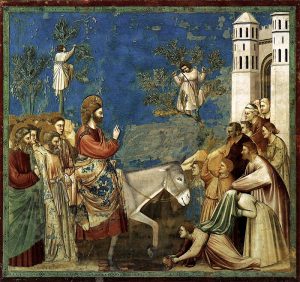
Redemption is a drama in three acts – three acts and a brief intermission – today the prelude, the overture, an introduction encapsulating the story to be fleshed out as the action proceeds. Jesus and his companions enter the city of Jerusalem from the east while the Roman governor, Pilate, makes his annual procession into the city in pomp and circumstance from the west.
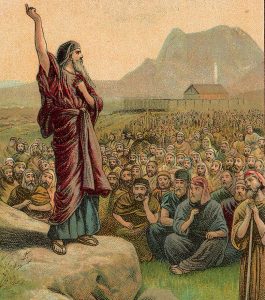
The crowds welcome Jesus, singing “Hosannas” (a Jewish word meaning “Save us, we pray!”). We can perhaps hear a chorus, as in the Greek theater, singing sentiments later put into writing by the English philosopher journalist G.K. Chesterton:

O God of earth and altar,
bow down and hear our cry,
our earthly rulers falter,
our people drift and die;
the walls of gold entomb us,
the swords of scorn divide,
take not thy thunder from us,
but take away our pride.

Jesus, eschewing pride and showing a different way, enters the city on a donkey.

Later in the week, Act One, Scene One – An upper room somewhere in Jerusalem.

In the first act, Jesus shares a Passover meal with his friends. He knows, although they seem not to, that this will be their last formal meal together. At supper he tries to explain to them what he believes is going to happen and how he hopes they’ll remember him. He uses bread and wine to make his point, but they don’t seem to understand. In fact, as the scene ends, they are arguing about their relative ranks! Who among them will be the greatest? The curtain falls on a frustrated rabbi.

Act One, Scene Two – the same upper room somewhere in Jerusalem.

Dinner is over, so Jesus tries something else. Taking on the role of a servant, he kneels down and washes their feet, but they still don’t get it. Later they would begin to understand; later they would re-enact Jesus’ actions and ponder them again and again, trying to more fully understand him. We, too, are pondering; we, too, grope for understanding.

Act One, Scene Three – a garden outside the city walls at Gethsemane.

Depressed and agonizing, feeling he has failed, knowing his actions of the past three years are leading inexorably to a final “showdown” with the political authorities, Jesus prays to be delivered from the inevitable. He asks his closest friends to stay awake with him, but they cannot. Falling asleep as he prays, they abandon him emotionally just as they will abandon him physically. Soldiers enter the scene led by one of Jesus’ own friends, Judas from the village of Kerioth. After a brief struggle in which a servant is injured, Jesus surrenders. His friends scatter and even deny knowing him. We hear the chorus sing more of Chesterton’s words:

From all that terror teaches,
from lies of tongue and pen,
from all the easy speeches
that comfort cruel men,
from sale and profanation
of honour and the sword,
from sleep and from damnation,
deliver us, good Lord!

Act Two – another place outside the city, a hill called “the place of a skull.”

Jesus, struggling under the weight of a cross, staggers up the hill from the city to the summit. Once there, he is nailed to the cross he has dragged along the way. The crowd jeers, the soldiers mock, his friends (so few of them now) weep. Speaking from the cross as he dies, “Forgive them…. It is finished.” His friends take his body and seal it in a borrowed tomb. What more is there to do? It certainly seems to be the end. What more could possibly come after the death of the drama’s protagonist?

Intermission – another garden occupied by a sealed tomb.

The characters have all left. The stage is as bare and as silent as a grave. Is this intermission or has the drama concluded? The principal’s death certainly seems to have ended things! The silence of Holy Saturday is profound; it is palpable; it is pregnant with uncertainty. What does all that has come before mean? How can there possibly be anything more after this?

Act Three – the same garden, the tombstone rolled away.

What seemed to be a tragedy at the end of the second act turns out to be a comedy. The tomb is empty! There are angels where there should be mourners! There are only folded linens where there should be a body! Confusion mixes with relief, disbelief encounters faith, death is overcome by life. The joke is on the powers of evil, but what does it all mean? Many who have missed the first two acts of this drama arrive to see the end of the story, but can one truly appreciate the momentous conclusion without having lived through it all? Can one really get the punchline without hearing the whole story?

As the drama ends, Jesus’ friends and others who now believe are moving into the world, a world they will change, a world to which they will bring a message of love and a vision of peace. The chorus sings the last of Chesterton’s verses, a triumphant supplication to the conqueror of death:

Tie in a living tether
the prince and priest and thrall,
bind all our lives together,
smite us and save us all;
in ire and exultation
aflame with faith, and free,
lift up a living nation,
a single sword to thee.

The story of our Lord’s Resurrection, the story of redemption is a drama in three acts. Today, only the overture . . . don’t miss the whole story!

====================

Father Funston is the rector of St. Paul’s Episcopal Church, Medina, Ohio.

Life or Death; Lawfulness or Sinfulness: Sermon for 6 Epiphany, 12 February 2017

====================

A homily offered by the Rev. Dr. C. Eric Funston on the 6th Sunday after the Epiphany, February 12, 2017, to the people of St. Paul’s Episcopal Church, Medina, Ohio, where Fr. Funston is rector.

(The lessons for the day are from the Revised Common Lectionary, Year A: Sirach 15:15-20 (or, alternatively, Deuteronomy 30:15-20); Psalm 119:1-8; 1 Corinthians 3:1-9; and St. Matthew 5:21-37. These lessons can be read at The Lectionary Page.)

====================

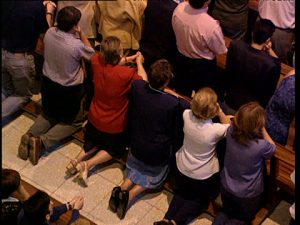
Moses_Pleading_with_IsraelThe Book of Deuteronomy tells us that when the long Exodus journey of the People of the Hebrews ended, just before they were to cross over into the Promised Land, Moses delivered a farewell address. He was not going to be going into the new land with them.
You may remember that God had been angered by the first generation of wandering Hebrews, what Jesus might have called an “adulterous and sinful generation” (Mk 8:38), who had grumbled against God, had wanted to turn back, and who had eventually been so disobedient that they had fashioned an idol (the Golden Calf) and worshiped it instead of Yahweh, their deliverer.

Furthermore, even when they worshiped and followed God, they didn’t trust God. Not believing God’s promise of the land into which they were to come, they sent spies ahead of them. This angered God, so that God had decreed that none of those who had left Egypt would enter the Holy Land (Numbers, Ch. 14). The Psalmist quotes God:

They put me to the test,
though they had seen my works.
Forty years long I detested that generation and said,
“This people are wayward in their hearts;
they do not know my ways.”
So I swore in my wrath,
“They shall not enter into my rest.” (Ps 95:9-11)

So Moses was the last of these and, in addition, he himself had been told by God that he would not enter the Promised Land because he and his brother Aaron had doubted God at Kadesh in the wilderness of Zin. God had said to him and to Aaron, “Because you did not trust in me, to show my holiness before the eyes of the Israelites, therefore you shall not bring this assembly into the land that I have given them.” (Num 20:12)

So at the brink of their entry, probably near Moab in the valley of Beth-Peor where he would be buried in an unmarked tomb, Moses gathered the children and grandchildren of the original Hebrews and summarized all that God had done for them and all that God required of them saying, “See, I have set before you today life and prosperity, death and adversity”(Deut 30:15). Follow the laws of God, have life and prosperity; disobey the commandments, death and adversity.

Throughout the discourse, Moses does an interesting thing that we can’t follow in the English translation; he intermixes the use of the plural “you” and the singular “you.” By doing so, he seems to be saying that the obligation to do good, to follow the commandments is both a communal and an individual responsibility. As a whole, the People of God must do these things, but it isn’t sufficient that they do it only as a community. The individual member can’t rely on his or her neighbor to do it for them; he or she can’t rely on the community’s leadership to do it for them. Each member of the community must do it for themselves; the individual needs the support of the community to undertake and accomplish this individual responsibility, but the individual can’t let it slide and just rely on the community to take up his or her slack, so to speak.

Also throughout the course of his speech, Moses makes it clear that though God places this choice of good or bad, life or death, prosperity or adversity, obedience or waywardness before God’s people, God does not underwrite or endorse both equally. In fact, God endorses only one. So, at the end of his address, Moses offers his own advice: “Choose life so that you and your descendants may live, loving the Lord your God, obeying him, and holding fast to him” (Dt 30:19-20).

Choose life! I can imagine Moses raising a glass and giving this counsel in the form of the great Jewish toast “l’Chaim!” – “To life!” And given what was at stake, Moses adds, “Hold fast to God,” basically saying, “And don’t mess it up!”)

Several generations later, around 200-175 BC, Shimon ben Yeshua ben Eliezer ben Sira of Jerusalem, a Jewish scribe, echoed Moses’ admonition as he wrote a text which is in the canon of writings called “the wisdom literature.” This body of literature constitutes basically a course of education for young men training for what we might call “the civil service.” The sons of the class equivalent to the “minor aristocracy” of England would be trained to function in the courts of kings throughout the ancient middle east using these writings. We heard this author’s advice to these young men in today’s reading from the Book of Sirach.

The author’s name is Simon, and he is identified as the son of Yeshua, who was the son of Eliezer, who was the son of Sirach, but some for reason we call the book by his grandfather’s, or rather his great-grandfather’s name. I suppose we do that because we think grandfathers are wiser than their sons or grandsons, although I don’t think I’ve convinced my son of that. This book is part of the Christian scriptures we call “the Apocrypha.” It is recognized as canonical by the Roman Catholic Church and the Eastern Orthodox churches, but not by Protestants. The Jews don’t recognize it as scripture because it is known only in a Greek translation discovered in Egypt; if there was a Hebrew language original (which one would assume since a scribe from Jerusalem wrote it), it has been lost to history. And since the Jews don’t accept it, the Protestants won’t recognize it, either.

Of course, we Anglicans take our usual middle way . . . we won’t based doctrine on it, but we will use it for the teaching of ethics and morality, which is pretty much the way this book has been used by the church through the ages. Another name for the text is “Liber Ecclesiasticus” or “Book of the Church” because it was used throughout the middle ages to teach clergy.

In any event, Simon the son of Yeshua, the son of Eliezer, the son of Sirach, offers advice to the trainee courtiers not at all dissimilar to that offered by Moses to the Hebrews: “If you choose, you can keep the commandments, and to act faithfully is a matter of your own choice. He has placed before you fire and water; stretch out your hand for whichever you choose. Before each person are life and death, and whichever one chooses will be given” (Sirach 15:15-17).

Simon the Scribe is a very canny fellow. He uses a metaphor for the choice of life or death, lawfulness or sinfulness; God, he says, “has placed before you fire and water.” At first glance that seems a pretty solid and clear metaphor, destructive fire versus life-giving water; but the metaphor is not all that clear. It’s really rather ambiguous. In some circumstances, yes, fire is destructive and death-dealing, but if you’re freezing to death in a winter storm, fire can be life-preserving; in some circumstances, yes, water is sustaining of life, but if you’re drowning in the sea the last thing you want is more water. Which, then, represents death and which life? One’s choices, Simon the Scribe seems to be saying, are not always clear cut and unambiguous.

And, like Moses, Simon reminds his readers that although the choices may be set before one by God, God does not underwrite or endorse both alternatives. God, he says, has a clear preference: “He has not commanded anyone to be wicked, and he has not given anyone permission to sin. ” (v. 20)

So Moses and Simon the Scribe offer their audiences, both their original audiences and us, this counsel that we have some big, important choices to made: life or death, prosperity or adversity, ethical conduct or sinful behavior. The choice may sometimes be ambiguous, but these are really big matters. And along comes Jesus in the Sermon on the Mount and complicates things by telling us that our choices aren’t just about the big stuff. “You’ve heard the commandment,” he says, “‘Thou shalt not murder.’ Well, you’re just as guilty if you think badly of another, if you insult a brother or sister, if you argue with another member of the community. You’ve heard it said, ‘Thou shalt not commit adultery.’ Well, even if you just think about about it, you’re guilty!” Remember when Jimmy Carter got into public hot water by confessing in that quaint King James language that despite his long and faithful marriage to Rosalyn he had “lusted in his heart” after other women? (Oh, for the day’s when just that was sufficient to get a candidate or politician into trouble…. )

Jesus extended Moses’ admonition and Simon the Scribe’s advice even further. Yes, there are important choices to be made. Yes, they are sometimes ambiguous. And, guess what? They come at us every day, every hour, in everything we do. Not just in the big things, but in the little everyday minutiae of human existence.

I don’t know about you, but it’s not very often I have to decide not to kill someone (only about once a week), but every day I have to decide whether let a zinger of an insult fly or bite my tongue and hold it back, whether to vent my anger over some upset or just shrug it off and let go of it. It’s not very often that I have to decide whether or not to commit adultery; in fact, never (no one seems to think I’m that attractive). But all through the day I have to make . . . we all have to make . . . these ethical and moral decisions. We have to make our choices, daily, and then stick to them as best we can. As Jesus admonishes us, let our decisions to be “Yes, yes” or “no, no.”

Interestingly, in the koine Greek in which the author of our Gospel lesson wrote, he recorded Jesus doing what the Hebrews scripture recorded Moses doing: mixing plural “yous” with singular “yous” in his discourse. Like Moses, Jesus underscores what we all know to be the truth – that none of us can do this on our own, that we have to have the support of our parents, our spouses, our brothers and sisters, our neighbors, our fellow church members.

There is a story in the Book of Deuteronomy (Chapters 27 & 28) about something that happened after the children of the Hebrews entered the Promised Land. Joshua the son of Nun, who was Moses’ assistant and took over leadership when Moses died, was directed to Moses to lead them into the valley of Shechem, the place where Jacob’s well is. Somehow I seem to recall that there were about 40,000 of them at the time, and Joshua divided them by tribes, sending half of them to the summit of Mount Gerizim and half of them to the summit of Mount Ebal on the other side of the valley. And those on Mt. Gerizim recited the blessings of keeping the Law, while those on Mt. Ebal recited the curses that came with disobedience.

I have this vision of Joshua reading the commandments, not just the “big ten” that Moses brought down from Mt. Sinai on the stone tablets, but the other 603 mitzvoth (or “statutes”) that got added to them and as he would read each one, the folks on Mt. Gerizim would shout “Obey this law and you will be blessed” and those on Mt. Ebal would shout “Disobey and you will be cursed.” Can you imagine how 20,000 voices shouting on one side of valley and another 20,000 voices shouting in response on the other side would have echoed throughout the land? Those voices also would have echoed down through time as a reminder that obedience is a communal thing, but also a personal thing, an individual obligation in which one is support by the community.

But even that is not enough. We humans individually are unable to stay in the narrow way and we are also unable to do so as communities, as churches, as nations. As our opening collect says, “in our weakness we can do nothing good without you” (BCP 1979, pg 216) and as St. Paul reminded the Corinthians it is “only God who gives the growth” (1 Cor 3:7). If we choose, we can keep the commandments, and to act faithfully is a matter of our own choice; but we can only stay the course if we are aided by our community and upheld by God.

Today and every day, the choice is before us, good or evil, obedience or sinfulness, life or death. Choose life! – l’Chaim – and rely on God (don’t mess it up)!

Amen!

(Illustration: Moses Pleading with Israel, an illustration from a Bible card published 1907 by the Providence Lithograph Company.)

====================

Father Funston is the rector of St. Paul’s Episcopal Church, Medina, Ohio.

Praying for Presidents: Sermon for Epiphany 2, Year A – 15 January 2017

====================

A homily offered by the Rev. Dr. C. Eric Funston on the 2nd Sunday after the Epiphany, January 15, 2017, to the people of St. Paul’s Episcopal Church, Medina, Ohio, where Fr. Funston is rector.

(The lessons for the day are from the Revised Common Lectionary, Year A: Isaiah 49:1-7; Psalm 40:1-12; 1 Corinthians 1:1-9; and St. John 1:29-42. These lessons can be read at The Lectionary Page.)

====================

prayer-in-church“The Lord called me before I was born, while I was in my mother’s womb he named me.” (Isa. 49:1b) What a powerful statement that is that the prophet makes in today’s reading. We name this prophet Isaiah; scholars name him Deutero-Isaiah or Second Isaiah. We don’t really know his name . . . but God did! God named him before he was born. Gave him personhood and human identity.

In many ancient and pre-scientific cultures names hold a very special significance; this was so in the near-Eastern cultures from which our Bible comes at the time of Second Isaiah and right down to and after the time of Jesus. Far from merely identifying a person, names in ancient Jewish culture revealed a person’s essential character and, it was believed, their destiny. So it is that this same Second Isaiah prophesies the name of the messiah, Immanuel – “God with us” (Isa 7:14), and the angel of the Annunciation instructs Joseph to name Mary’s child Jesus – “God saves” (Matt 1:21). Jesus does this with Simon in today’s Gospel lesson when he tells him: “You are to be called Cephas (which is translated Peter).” (Jn 1:42) This name, Cephas or Peter, means “rock” and Simon Peter did, indeed, become a rock anchoring the fledgling Christian church after Jesus’ death, resurrection, and ascension.

Furthermore, it was believed that to know a person’s name was to have a certain power over that person. This is why the name of God is never spoken by devout Jews; indeed, it is never read even when written in Scripture. We Anglicans have continued that tradition even into our Prayer Book and our service bulletins; if you look at today’s Gradual, Psalm 67, in the Book of Common Prayer, and as we have reprinted it in today’s bulletin, you will see that the word “LORD” is printed in all upper-case letters.

The reason for this is that Jews developed the idea that God’s name was so holy that it could not be uttered. When Jews read from the Hebrew Scriptures and get to the name of God, written only with four consonants and no vowels, “YHWH,” they will not try to pronounce it as “Yahweh;” instead, they will say “Adonai,” which means “Lord.” The Psalter in the Book of Common Prayer continues this tradition.

When the Old Testament was translated into English, the translators continued to signify the holiness of God’s name: when they came to “YHWH” in the Hebrew text, they wrote “LORD” instead. If you look through the Authorized Version of the Old Testament you will see this done many times – over 6000 times in fact. In every case, the original Hebrew says “YHWH,” but it is translated “LORD.”

In the Gospel lesson today, John the Baptizer names Jesus, “the Lamb of God who takes away the sin of the world.” (Jn 1:29) If ever there was a naming which revealed a destiny, that was it. Names have power. To know and to use someone’s name, or to refuse to use someone’s name, is always an act of power: sometimes an act of domination; sometimes an act of submission; sometimes an act of collaboration; and sometimes an act of dismissal.

Rabbi Andrew Davids, head of the Beit Rabban Jewish School in New York, commenting on the first few chapters of the Book of Genesis, writes:

God gave human beings the ability and power to name. Just as God separates light from darkness and dry land from water, [the biblical creation story] affirms that humans – created in the image of God – may seek to bring order to our chaotic and dynamic world through the process of naming. The power to name can be experienced in our everyday lives; for example, nothing grabs the attention of a misbehaving child more effectively than a parent – the bestower of the child’s names – calling him [or her] by . . . first, middle, and last names.

The rabbis caution us, however, to use the power of our voices and our words wisely. We must make certain that we use the divine gift of naming in a moral, appropriate, and thoughtful manner. (The Power Of A Name: The Power Of Naming)

In a commentary on that event recorded in Genesis when Jacob wrestles with the Angel of God and gets his named changed to Israel (“one who wrestles with God and prevails”), David Lose, President of Lutheran Theological Seminary in Philadelphia, challenged preachers to challenge their congregations about names. He wrote:

The task before us . . . Working Preacher, is to invite our people to confess their names. Whether silently or by writing them down on a paper, ask them first to answer this one question: Who are you? Really. What is your name? What is it that others call you? More importantly, what is it that you call yourself? What is that name you can scarce speak for fear or shame? Scoundrel, cheat, or phony like Jacob? Unworthy, irresponsible, unfaithful? Discouraged or burnt-out? Divorced, deserted, or widowed? Coward or bully? Unloved or unloving? Disappointed or disappointing? Abused or abuser? Ugly or abnormal? (Working Preacher Commentary, October 14, 2013)

And he continues, “Names, as we know, can limit us, hurt us, even kill. But so also can they heal and make alive. And so a part of what [the church does each week], is to invite people to come and be reminded once again of our true name and new identity so that we may go out into the world as new persons, as God’s own beloved child.”

One of the things that happens when human beings are angry with one another is that we stop using names; by doing so, we deprive the other of personhood. One of the greatest offenses you can give a person is to not use their name. It’s dehumanizing. It takes away that precious gift that God gave to Second Isaiah even before he was born! So, in my pastoral counseling with persons dealing with anger issues, one of the first things I suggest to them is to pray for the person with whom they are angry by name. Nothing elaborate, just a simple prayer; something as simple as, “Lord, I pray for [fill in the blank].” Doing so does not endorse the person’s behavior or validate what it is about them that has angered you, but it does create an intimacy which can defuse the anger. Praying for the person by name, naming the person, brings them into your sphere of being.

One of the saints of our church, Dr. James DeKoven, a priest who taught Church history at Nashotah House seminary in Wisconsin in the 19th Century, wrote that prayer brings the one for whom we pray present to us “in the deep, hidden bonds” that link persons together. (From a letter written just before his death, March 1879.) Although he was writing of prayer for deceased loved ones, I believe his observation is true of prayers for the living, as well.

I bring this up because an event is about to happen which has caused some consternation and debate in our denomination and in others. It is something that we have already addressed in this congregation and which we will not change so long as I am the rector and the one charged by tradition and canon with making liturgical decisions.

When I came to St. Paul’s Parish in the summer of 2003, although the President of the United States was being prayed for in the generic manner set out in the standard forms of the Prayer Book, George W. Bush (who was then the president) was not being named. I began to name him and to instruct prayer leaders to do so. Some people not of Mr. Bush’s political persuasion objected. When he left office and Barack Obama was elected, we began praying for him by name. Some people not of Mr. Obama’s political persuasion objected. When we started distributing the sheets with the additional petitions to be read by members of the congregation, some people refused to read the petition including Mr. Obama’s name. Now that Donald Trump has been elected and we have added his name as president-elect, some people have refused to read that petition.

On Friday, Mr. Trump will be sworn in as the 45th President of the United States. Some of us are pleased as punch about that. Some of us are appalled. Most of us are somewhere in between. And many are debating about whether or not to pray for him by name. What an incredibly silly thing to argue about! And what a terrible thing to do, to refuse to pray for someone by name.

In St. Paul’s First Letter to Timothy, he writes:

First of all, then, I urge that supplications, prayers, intercessions, and thanksgivings be made for everyone, for kings and all who are in high positions, so that we may lead a quiet and peaceable life in all godliness and dignity. This is right and is acceptable in the sight of God our Savior, who desires everyone to be saved and to come to the knowledge of the truth. For there is one God; there is also one mediator between God and humankind, Christ Jesus . . . . (1 Tim. 2:1-5)

In this parish on Sunday morning, as a congregation, will pray for the president and “all who are in high positions” by name. To do otherwise is to deprive them personhood, to dehumanize them, and in doing that we dehumanize ourselves.

In our Gospel lesson today, when the Baptizer named Jesus the Lamb of God, two of John’s disciples took off following Jesus. They asked him what to us sounds like an impertinent, but really quite inessential, question, “Rabbi, where are you staying?” (Jn 1:38)

[T]he English obscures the significance of the phrase. The Greek verb is meno: abide, remain, endure, continue, dwell, in the sense of permanence or stability. John the Baptist recognizes Jesus when the Holy Spirit remains (meno) upon him (John 1:32). After Jesus provides bread enough to satisfy a crowd, with plenty left over, he cautions the people to work not for the food that perishes, but for the food that endures (meno) for eternal life (John 6:27). He promises that he will abide (meno) in those who abide (meno) in him (John 15:4-10). Wherever Jesus stays (meno), people have the opportunity to believe (John 4:40; 10:40). (Audrey West, Working Preacher Commentary, January 15, 2017)

The Lord abides; the Lord endures: earthly rulers do not. The Psalms remind us:

It is better to rely on the LORD *
than to put any trust in flesh.
It is better to rely on the LORD *
than to put any trust in rulers. (Ps 118:8-9)

and again

Put not your trust in rulers, nor in any child of earth, *
for there is no help in them. (Ps 146:2)

Presidents come and presidents go; Jesus Christ, “the Lamb of God who takes away the sin of the world,” endures. (The dude abides!) “He will . . . strengthen [us] to the end.” (1 Cor 1:8) So we rely on the Lord . . . and we pray for presidents.

By name.

Amen.

====================

Father Funston is the rector of St. Paul’s Episcopal Church, Medina, Ohio.

A Bicentennial Epiphany: Sermon at Evensong – 6 January 2017

====================

A homily offered by the Rev. Dr. C. Eric Funston on the Feast of the Epiphany, January 6, 2017, to the people of St. Paul’s Episcopal Church, Medina, Ohio, where Fr. Funston is rector and which inaugurated at the service its Year of Celebration marking the parish’s bicentennial.

(The lessons for the day are the Episcopal Church’s Daily Office Lectionary, Year 1: Psalms 96 & 100;
Isaiah 52:7-10; and St. Matthew 12:14-21.)

====================

St Paul's Church -- December 2013We are here tonight for two reasons. First, because this is the Feast of the Epiphany, one of the major feasts of the Christian Church and one we too often ignore, and second, because this is the inaugural event of our Year of Celebration during which we will mark the 200th anniversary of the founding of this parish.
Epiphany is one of those weird Greek-based words that is so weakly translated into English that we misunderstand its power. Generally, the word is translated as “manifestation” and by it we refer to the manifestation of God in Christ Jesus. In the western church, this Feast of the Epiphany has come to focus on the visitation of the Magi – in some places it is even called “Three Kings Day” or just “Kings Day” – and it is followed by a season of Ordinary Time during which other “manifestations” of Christ are the focus of the weekly gospel lessons: his baptism by John with the descent of the Spirit and the voice of the Father, his first miracle of changing water to wine at the wedding in Cana, the calling of the Twelve, and so forth. In the eastern church, it is called the Theophany, usually translated as “manifestation of God,” and it is the principal feast of the Incarnation in the eastern tradition where the focus is primarily on either Jesus’ birth or his baptism.

These words epiphany or theophany, however, mean so much more than what is suggested by the translation “manifestation.” They are compound words made up of, in the first case, the preposition epi– meaning “on” or “onto,” and in the second case, theo meaning “god,” combined with phanos,

… a word familiar to [us] from the English ‘fantasy’ and ‘fantastic’ and all that is suggested by the ‘light shows’ with which modern electronics have made [us] familiar – the word epiphany speaks to [us] of showing forth, breaking through, letting light shine forth. * * * This is a time to look up and out, to shine forth, to witness to something quite literally spectacular and that, of course, is the presence in our midst of the Light of the World. [1]

So that is one reason we gather to celebrate this evening, to celebrate the fantastic, spectacular manifestation of God in Christ, the Epiphany of our Lord!

You may wonder why, if this is Three Kings Day, none of our lessons mentioned the visitation of the Magi: we heard neither Psalm 72, which speaks of the kings of Tarshish, of the isles, of Arabia, and of Saba paying tribute and offering gifts, nor Matthew’s story of the wise men from the East bearing myrrh, frankincense, and gold. Instead, we have Isaiah’s prophecy praising the beauty of messengers’ feet and another story from Matthew’s gospel in which Jesus heals a crowd of people but then “order[s] them not to make him known.”

The simplest answer, of course, is that those lessons about kings and wise men are reserved for the celebration of the Eucharist, while the lessons we have heard are part of the daily rotation of Scripture for use at the Daily Offices of Morning and Evening Prayer, the latter of which being the service we are offering tonight.

The more complicated, or perhaps deeper, answer is that tonight’s lessons remind us of the ministry of God’s People, a ministry of epiphany described in our Catechism as “represent[ing] Christ and his Church” and “bear[ing] witness to him wherever [we] may be.”[2] For that is what those beautiful footed messengers of Isaiah’s did with their proclamation of God’s reign and his comfort for a people in ruins, and it is what those people in Matthew’s gospel story did despite Jesus’ pleading with them not to do so; they manifested God, proclaimed God to those around them.

Which brings us to the second reason we gather this evening, to remember the founding of this parish and begin our year of celebration during which we will, in a number of ways, commemorate the first 200 years of the life of St. Paul’s Episcopal Church of Medina, Ohio, and look forward to our third century of proclaiming the Gospel of Jesus Christ in this community.

So let us look back for moment some 200 years ago . . . rather let’s look back 241 years ago for the story of our congregation really has its beginnings in the origins of our republic. Had the Revolution of 1776 not happened, we very likely would not be here today. You know the story, of course, how some American colonists came to the reluctant conclusion that their government, the King, his ministers, and the parliament in London, England, were acting in tyrannical ways and that they were unlikely to change their behavior; how those American colonists decided that the only remedy was to rebel, over throw that government’s dominion in the thirteen colonies, and establish a new sort of local government; and how, against the odds and nearly everyone’s expectations, they succeeded.

You know all of that, but did you know that 32 of the 56 men who signed the Declaration of Independence where members of the Church of England? That’s nearly 60% of the Founders who were Anglicans like you and me! And did you know that their chaplain, the chaplain of the Continental Congress which adopted that Declaration was the rector of a parish in Philadelphia, a man named William White?

Those men, those Anglicans, were reared in a religious tradition of public service, schooled in a theology of society, a peculiar worldview which teaches that the point of one’s life is not to locate oneself in some particular position of privilege, but rather to contribute to the transformation of the social order. Because of their Anglican ethos, they believed that the nation, whether it be the old Mother Country or the new nation they were conceiving, should reflect the merciful purposes of God: the comfort among the ruins of which Isaiah’s beautiful-footed messengers spoke, the healing of the sick which Matthew describes in this evening’s gospel, God’s everlasting mercy about which our Psalm sings today.

When they acted to sever their civil and political society from England, which they believed had fallen away from that tradition and that theology, they also severed their religious lives from the Church which had taught them that worldview. This was a serious matter for these men who were, many of them, vestrymen and leaders in their parishes. They belonged to a church which had preserved the ancient three-fold model of Holy Orders – bishops, priests, and deacons – which had preserved the traditional seven Sacraments – which believed with the ancient theologian Ignatius of Antioch in the centrality of the Eucharist and the unique role of the bishop in preserving the unity of the church. It was a serious matter because there were no Anglican bishops in North America, neither in what would become the United States nor in the still-loyal-to-Britain colonies of Canada.

After the Revolutionary War was ended and the new country was established, many of these men therefore turned their attention to the organization of Anglican Christianity in the new nation. In 1782, William White wrote a pamphlet entitled The Case of the Episcopal Churches in the United States Considered, in which he proposed a structure very similar to that which eventually came to be.

It is said that William White was the chief architect of our new kind of Anglican polity, a uniquely American, democratic way of being church. “Hierarchical rule [would be replaced] with egalitarian, democratic government,”[3] and bishops would be elected by majority vote of the laity and the clergy to be “servants of the Church and not its lords.”[4]

In 1784, the churches in Connecticut elected Samuel Seabury who sailed off for the United Kingdom and was eventually ordained a bishop by the Scottish Episcopal Church; he returned to Connecticut in August of 1785. In September 1785, the first General Convention of the Episcopal Church was held in Philadelphia, but it was a meeting only of the House of Deputies made up of lay and presbyteral representatives, Bishop Seabury not being in attendance; Mr. White presided.

In 1786, the churches in New York elected Samuel Provoost, who had fought in the Revolution and had succeeded William White as Chaplain of Congress, and the churches in Pennsylvania elected Mr. White. A year later, first Provoost and then White were ordained bishops at Lambeth Palace with the Archbishop of Canterbury presiding. In 1789, what is considered to be the third General Convention was held; it was the first in which a House of Bishops would meet. Bishop White presided, making him both the first President of the House of Deputies and the first Presiding Bishop. He later surrendered the chair to Bishop Seabury who served until his death about two-and-a-half years later; Seabury was succeeded by Provoost who also served for about two and a half years. He was then succeeded in 1795 by Bishop White, who thereby became not only the first Presiding Bishop but also the fourth. He served in that office for almost 41 years until his death in 1836!

During Presiding Bishop White’s tenure, some important things happened. Ohio was admitted to the Union in 1803 as the 17th State. Medina County was created in 1812.

In 1814, at the XIth General Convention of the Episcopal Church, the Rector of St. Peter’s Church in Plymouth, Connecticut, made an impassioned plea for the funding of mission activity and church planting in Ohio. His name was Roger Searle. Thereafter, with the blessing and support of the Bishop of New York, the Rt. Rev. John Henry Hobart, and of Presiding Bishop White, Searle left Connecticut and began planting churches in northeastern Ohio. In March of 1817, he met with a group of people living in the village of Weymouth who decided to organize themselves as the congregation of St. Paul’s Episcopal Church of Medina County; some of them may have been old enough to have been members of the Church of England before the Revolution. A month later, they built a small log cabin to serve as their church on Sundays and as a schoolhouse for the children of Weymouth during the week. That was the beginning of our parish!

On January 5, 1818, representatives of St. Paul’s, Medina would join with other Ohio congregations to adopt the constitution of the Episcopal Church and formally organized the Diocese of Ohio, the first diocese formed outside the borders of the thirteen original states. Although some hoped that Mr. Searle might be the first bishop of the new diocese, he supported the Rev. Philander Chase, who was elected as Ohio’s first bishop and consecrated to that office in 1819.

What they started here was a congregation and a diocese of the Episcopal Church, a manifestation (if you will) of that unique form of American Anglicanism championed by Bishop White, a way of being Christian that former Presiding Bishop Katharine Jefferts Schori has described as “holding together in tension polarities that some [might be] eager to resolve,” a sort of “both/and” thinking and living “that keeps our hearts pumping and mission thriving. [T]he kind of tension that drives some of us crazy – what’s more important? – justice or mercy? inclusion or orthodoxy? ministry grounded in bishops or in baptism?” Our American Anglican way of following Christ takes “the long view [that] says that if we insist on resolving the tension we’ll miss a gift of the Spirit, for truth is always larger than one end of the polarity. Tension is where the Spirit speaks. Truth has something to do with that ongoing work of the Spirit, and it can only breathe in living beings capable of change and growth.”[5]

We are indebted to Presiding Bishop White, to Bishop Hobart, to the Rev. Mr. Searle, and to the men and women who formed that first congregation of St. Paul’s Church in Weymouth 200 years ago. They bequeathed to us that sometimes tense, but living and breathing, changing and growing, Anglican sort of Christian faith which emphasizes reason in religion; which advocates an alliance of religion and science supporting scientific developments and believing that true philosophy can never hurt sound divinity; which seeks to make the church as inclusive as possible by providing toleration for dissent; and which teaches that constraining inquiry and the freedom of the believer is neither necessary nor salutary. It is a Christian witness which insists on a practical, public morality which comforts those whose lives are in ruins, heals those who are sick, feeds those who are hungry, shelters those who are homeless, and embraces the Gospel with the innocence of the children it educates. This is the legacy bequeathed to us by White and Searle and those Weymouth Episcopalians two centuries ago.

For 200 years this parish, St. Paul’s Episcopal Church of Medina, Ohio, has been an epiphany, shining forth in our peculiar American Anglican way, and witnessing to that fantastic, spectacular truth that present in our midst is the Light of the World.

As we celebrate the Epiphany of our Lord Jesus Christ tonight, we look forward to continuing that ministry, “represent[ing] Christ and his Church” and “bear[ing] witness to him” into the next century. May God continue to bless us abundantly as we do. Amen.

====================

Father Funston is the rector of St. Paul’s Episcopal Church, Medina, Ohio.

Notes:

[1] Byron, William J., SJ, Epiphany, The Word Proclaimed: A Homily for Every Sunday of the Year – Year A (Paulist Press: Mahwah, NJ, 2013).

[2] American BCP 1979, Page 855.

[3] Podmore, Colin, A Tale of Two Churches, International Journal for the Study of the Christian Church, Vol. 8:2, pp 124-54, 2008.

[4] Gundrum, James R., The General Convention: Understood Authority or Ecclesiastical Chaos, Arrington Lectures, University of the South, 1982.

[5] Closing Sermon, General Convention 2009.

Daily Habits: Sermon for Holy Name Day, 1 January 2017

====================

A homily offered by the Rev. Dr. C. Eric Funston on the Feast of the Holy Name of Jesus, January 1, 2017, to the people of St. Paul’s Episcopal Church, Medina, Ohio, where Fr. Funston is rector.

(The lessons for the day are the second set of readings from the Revised Common Lectionary for Holy Name Day in Year A: Numbers 6:22-27; Psalm 8; Philippians 2:5-11; and St. Luke 2:15-21. These lessons can be read at The Lectionary Page.)

====================

holy_name_picToday on the secular calendar is New Year’s Day, but that’s not true in the church. We celebrated a new church year several weeks ago on the First Sunday of Advent. In the church, January 1, being eight days after the Feast of the Incarnation, is the day on which we celebrate Jesus’ Jewishness. We call it, these days, the Feast of the Holy Name of Jesus; it was formerly called the Feast of the Circumcision of Christ because that is what Luke’s Gospel tells us was done. It was a very Jewish thing to do.
We sometimes forget (and there are people who would like to completely ignore) that Jesus was a Jew, a very devout and observant Jew. Apparently his parents were, as well. They had him circumcised on his eighth day of life in accordance with Leviticus 12:3. The ceremony is called a “bris milah” (which means “Covenant of Circumcision”):

While the circumcision is performed, the child is held by a person called a sandek. In English, this is often referred to as a godfather. It is an honor to be a sandek for a bris. The sandek is usually a grandparent or the family rabbi. Traditionally, a chair (often an ornate one) is set aside for Elijah, who is said to preside over all circumcisions. Various blessings are recited, including one over wine, and a drop of wine is placed in the child’s mouth. The child is then given a formal Hebrew name.

It is not necessary to have a minyan for a bris, but it is desirable if feasible. (Judaism 101)

It’s kind of disappointing that Luke doesn’t tell us who the sendak was or whether there was a minyan or (if there was) who the ten men were.

Luke does tell us that later, thirty-three days to be exact, Mary and Joseph took the child to the Jerusalem Temple where they made the mandatory sacrifice of two pigeons, since they were too poor to afford a lamb. We celebrate this event on February 2 in a feast called by some churches the Presentation of Christ in the Temple and by others the Purification of the Blessed Virgin. Luke tells us also that every year Mary and Joseph would go to Jerusalem for the feast of Passover; it was on one of these trips when Jesus was 12 years old that he was inadvertently left behind and was later found in learned conversation with the doctors of the Law. Luke tells us all of these things in the second chapter of his gospel.

What Luke, and to a lesser extent the other gospels, demonstrate is that Jesus came from a very devoted and observant Jewish family and that he himself continued that pattern throughout his life. He regularly attended synagogue services on the Sabbath. He prayed frequently. He commended observance of the Law and declared that “not one letter, not one stroke of a letter, [would] pass from the law until all is accomplished.” (Mt 5:18; cf Lk 16:17) In his devotion to his Jewish faith, what Jesus modeled and taught was the regular practice of religion, the cultivation of a habit of religious observance, a life of spiritual discipline.

But, we might think, Jesus was and is God! One would think that if anyone could take a pass on spiritual discipline, it would be God. However, as Paul writes in our selection from the letter to the Philippians this morning, he “emptied himself, taking the form of a slave, being born in human likeness. And being found in human form, he humbled himself.” (Philip 2:7-8) Part of his human humility was this habit of regular religious and spiritual practice.

Our gradual this morning speaks of human existence in terms that seem somewhat at odds with a sense of human humility:

What is man that you should be mindful of him? *
the son of man that you should seek him out?
You have made him but little lower than the angels; *
you adorn him with glory and honor;
You give him mastery over the works of your hands; *
you put all things under his feet . . . . (Ps 8:5-7, BCP Version)

Whenever I read this psalm, my mind immediately skips to lines from William Shakespeare, to words spoken by the character Hamlet in Act II, Scene 2, of that play:

What a piece of work is a man! How noble in reason, how infinite in faculty! In form and moving how express and admirable! In action how like an Angel! In apprehension how like a god! The beauty of the world! The paragon of animals!

I have always been certain that Shakespeare was glossing on Psalm 8.

The psalm, in our Prayer Book version, speaks of human mastery over creation; the New Revised Standard Version of the Bible translates this as “dominion.” The Hebrew word is mashal, which is sometimes translated as “authority.”

Presbyterian pastor and theologian Matthew Stith argues that our dominion or authority over the creation should “look like the loving stewardship,” though it seldom has (Stith). Episcopal theologian Elizabeth Webb makes the same point when she writes:

To be human is to be responsible for our fellow creatures, and we must take that responsibility with the utmost seriousness. * * * [A]t the same time that Psalm 8 recognizes our dominion, it also reminds us of our humility. We are each still that awestruck person gazing in wonderment at the stars. We bear the image of God; we are not God. Our finitude and fallibility must be kept in mind as we exercise our responsibility. We are also reminded that we are a part of the creation over which God has granted us dominion. We do not stand apart from our fellow creatures, but we stand with them. (Webb)

Perhaps this is why Shakespeare’s Hamlet does not stop where I ended quoting the character. Instead, he tells Guildenstern and Rosencrantz that “Man delights not me; no, nor Woman neither” declaring humankind to be nothing more than the “quintessence of dust.”

And, yet, this is dust which God blesses. God instructed Moses to teach his brother Aaron the priest a particular blessing, one we heard in our reading from the Book of Numbers, one which I’m sure is familiar to all of us:

The LORD bless you and keep you;
the LORD make his face to shine upon you, and be gracious to you;
the LORD lift up his countenance upon you, and give you peace. (Num 6:24-26)

This blessing is taught as part of the instructions for the Hebrews’ preparations for leaving Mt. Sinai where they have been camped for almost a year. This blessing is designated for their journey from Sinai to the land of promise; it was to be said daily throughout their journey.

Terence E. Fretheim, Professor Emeritus of Old Testament at Luther Seminary in Saint Paul, Minnesota, tells us that the climactic word of the benediction, shalom, has wide-ranging connotations. Citing Professor Dennis Olson’s commentary on the Book of Numbers, Fretheim says the richness of the word includes “prosperity (Psalm 37:11; Proverbs 3:2), longevity, happiness in a family (Psalm 128:6), safety, security (Psalm 4:9; 122:6-8), good health (Psalm 38:4), friendship (Jeremiah 38:22), and general well-being.” (Fretheim, quoting Olson, Numbers, [Louisville: John Knox, 1996] 42-43)

That the Aaronic blessing was to be said over the Jewish people daily brings us back to the teaching and model of Jesus put before us by Luke the Evangelist: a devout and observant Jew who cultivated the daily habit of spiritual and religious practice. Today, in this Feast of the Holy Name of Jesus, this Feast of the Circumcision of Christ, we celebrate his Jewishness, his daily devotion to his faith. Today, as we celebrate our secular New Year, let us resolve to follow his example and renew in the coming year our own daily devotion to God. As you do so, everyday

The LORD bless you and keep you;
the LORD make his face to shine upon you, and be gracious to you;
the LORD lift up his countenance upon you, and give you peace.

Amen!

====================

Father Funston is the rector of St. Paul’s Episcopal Church, Medina, Ohio.

A Christmas Lamb Chop: Sermon for Christmas Eve 2016

====================

A homily offered by the Rev. Dr. C. Eric Funston on Christmas Eve, December 24, 2016, to the people of St. Paul’s Episcopal Church, Medina, Ohio, where Fr. Funston is rector.

(The lessons for the day are the second set of readings from the Revised Common Lectionary for Christmas in Year A: Isaiah 62:6-12; Psalm 97; Titus 3:4-7; and St. Luke 2:1-20. These lessons can be read at The Lectionary Page.)

====================

lambchop1I was in the pet supply aisle at Giant Eagle several days ago getting food for the Archbishop (that’s our black cocker spaniel, Lord Dudley of Ballycraic, the Archbishop Canine of Montville) when I found, right in front of the Beneful which is his favorite meal, a bin filled with these: dog toys in the likeness of a lamb dressed for Christmas. And not just any lamb! This is Lamb Chop, the somewhat snarky puppet introduced to the world by the late Shari Lewis in 1957.
As many of you know, this is something I do every year for this Christmas Eve sermon . . . find something to be a sort of “focus object” or trigger for our Christmas Eve meditations. Lamb Chop just seemed perfectly suited. This Christmas toy suggested four poetic associations to me: one is the title given Jesus by John the Baptizer, “the Lamb of God;” a second was a familiar nursery rhyme; the third was a romantic English poem; and the fourth, a song that Lamb Chop sang on the Shari Lewis television show, all of which can help us explore and understand the Incarnation of God in Christ Jesus.

So, the first thing that comes immediately to mind when we look at a lamb, whether Lamb Chop the puppet dressed up for Christmas or an actual lamb in the fields is the statement made by John the Baptizer in the Gospel of John: “[John] saw Jesus coming toward him and declared, ‘Here is the Lamb of God who takes away the sin of the world!’” (Jn 1:29) That seems an odd way to refer to a grown man, which Jesus was at the time.

The 20th-century bible scholar Joachim Jeremias suggested that a way to understand John’s statement is that he probably used the Aramaic word talya. Jeremias says that “lamb” (amnos in the Greek in which the gospel is written) is a translation of this Aramaic word, which can also be translated “boy,” “child” or “servant.” When Jesus was described as the talya of God, Aramaic speakers of the earliest church would have heard “child” of God, or “son” of God, or “servant” of God, or “lamb” of God. When that gospel story was written after Jesus’ Crucifixion and Resurrection, the image of the sacrificial lamb of the Hebrew tradition resonated with the author. (See America)

According to some widely accepted Christian theologies, the sacrifice of the cross is the very reason for which Jesus was born. I’m not entirely sure that’s the case; I suspect that God the Father would much rather have had Jesus followed than killed, but certainly God made use of Jesus’ Crucifixion and through it opened for us the way of salvation. In any event, some people think that the nursery rhyme Mary Had a Little Lamb, the second thing called to mind by our Christmas Lamb Chop, is about Jesus’ birth as the sacrificial lamb of God. You know the one:

Mary had a little lamb,
a little lamb, a little lamb
Mary had a little lamb,
Its fleece was white as snow.

It’s not really about the Virgin Mary and the birth of Jesus, however. It was written by Sarah Josepha Hale of Sterling, Massachusetts, in 1830, and is said to describe an actual event of a pet lamb visiting the local schoolhouse. (See Wikipedia) Nonetheless, we can learn something about our Christian faith by considering the lamb of that story.

The rhyme continues that the lamb followed Mary and “everywhere that Mary went the lamb was sure to go.” Although I don’t believe that the Son of God was born necessarily or primarily to be a sacrifice, I am sure he was born to be followed; I’m certain Christ came into Creation to teach us how to live life God’s Way. He is the Word given to us to lead us to salvation. The little lamb in the nursery rhyme trusted Mary and followed her, and that is what God wants us to do, to trust and follow the Son so that, with the Son, we may live the abundant life of the Kingdom of Heaven that God constantly offers us. This is what makes his birth so important to us and why we celebrate the Incarnation in our many special ways.

So, anyway, I picked up this Christmas Lamb Chop dog toy and the first thing I did was check to see where it was made. I’m very careful not to give the Archbishop, Lord Dudley, anything made overseas. (I’m sure you’ve heard about the toxins found in dog toys and treats made, for example, in China.) Doing so, I thought of another bit of lamb-inspired poetry, one by the English Romantic poet William Blake. You may know it; it is entitled simply The Lamb. It is, in essence, a question asked of a lamb by a child:

Little Lamb who made thee
Dost thou know who made thee
Gave thee life & bid thee feed.
By the stream & o’er the mead;
Gave thee clothing of delight,
Softest clothing wooly bright;
Gave thee such a tender voice,
Making all the vales rejoice!
Little Lamb who made thee
Dost thou know who made thee

Little Lamb I’ll tell thee,
Little Lamb I’ll tell thee!
He is called by thy name,
For he calls himself a Lamb:
He is meek & he is mild,
He became a little child:
I a child & thou a lamb,
We are called by his name.
Little Lamb God bless thee.

Blake’s poem is a deceptively naive child’s song. Beginning with a descriptive, pastoral stanza, it moves quickly to focus on the abstract spiritual matter of Creation. The child’s guileless but profound question – “Who made thee?” – echoes the deep and timeless question that all human beings have about our origin. It reminds us of the opening lines of John’s Gospel with its abstract account of the Incarnation:

In the beginning was the Word,
and the Word was with God,
and the Word was God.
He was in the beginning with God.
All things came into being through him,
and without him not one thing came into being.
And the Word became flesh and lived among us,
and we have seen his glory,
the glory as of a father’s only son,
full of grace and truth
(Jn 1:1-3,14)

In Blake’s poem, this profound truth is presented with the naiveté of a child’s puzzle revealing the child’s confidence in a simple and innocent Christian faith. Our Christmas Lamb Chop reminds us that “whoever does not receive the kingdom of God as a little child will never enter it.” (Mk 10:15) Christmas is a time for us all to experience once again our childlike wonder at the simple beauty that is the Incarnation.

But our Christmas dog toy can trick us! We have to beware of oversimplifying the Incarnation. I read recently about “a Christmas display . . . at [a shopping] mall: giant plush bears robed as Mary and Joseph, beaming at a swaddled Baby Jesus bear in the manger.” Theologian Fredrica Mathewes-Green, who described this display, said of it,

If there was once grand mystery around the Incarnation, it has long since dispersed. Three jolly bears now convey everything we know or expect to know. It is a scene plump with stupidity. Jesus as a cookie. God as a pet. (Patheos)

This, she says, “is very bad news,” because “a circle of cuddly bears is useless at helping us deal with pain. It cannot help us grasp searing heartbreak.” Neither can a puppet, even a nice Christmas Lamb Chop puppet, but it can serve as a warning and a reminder!

Tracy Dugger, an Episcopal priest in Florida, has written about what she calls “meat puppet theology,”

. . . the idea that our bodies are machines simply being utilized and driven around by our minds. The mind/soul is the control, and the body is subservient. This way of thinking about the mind/body connection is wrong, and leads us into some pretty wrongheaded [ideas]. (The Young Anglican)

“The ultimate example of why bodies are important,” she says, is the simple fact that “JESUS HAD ONE! Jesus was Incarnate. Not only was Jesus, Son of God, begotten by the Holy Spirit, He was knit together in Mary’s womb. Jesus was a man of flesh and blood, as well as God from God, light from light.”

Mathewes-Green puts it this way:

God came down in a suit of skin and bones, and walked and talked and offended people, and finally they tortured him to death. And by that death he destroyed death; he rescued us and gave life everlasting and every other good thing. Into this universe crammed with pain we say that God came down, because he loves us with the kind of love that we can only understand by thinking of how a parent loves. (Patheos)

In an Advent meditation offered earlier this week, Brother Mark Brown of the Society of St. John the Evangelist reminded us that parental love and every act of kindness is an action of the body. He wrote: “The Spirit of God animates us, but it all happens in the flesh: every deed of kindness, every act of generosity, every word of encouragement happens in the flesh. Every embodiment of Christ’s grace or truth or love happens in the flesh – or it doesn’t happen.”

Tonight, tomorrow, as we celebrate the Word becoming flesh, we celebrate that bodily parental love . . . the love of mother and father tending their newborn child; the eternal love of the Father sending the Son to redeem us. As we celebrate the birth of Jesus to Mary, we celebrate also the truth we recite every Sunday (and this evening) in the Nicene Creed:

We believe in one Lord, Jesus Christ,
the only Son of God,
eternally begotten of the Father . . .
(BCP 1979, Pg 358)

Jesus was born in Bethlehem once for all time; the Son of God is eternally begotten of the Father and both, as we say in the Creed, for our salvation.

lambchop2Which brings me to the fourth and last bit of poetry our Christmas Lamb Chop brought to mind, which is a song Lamb Chop and Shari Lewis taught their viewers during the 1992 season of the PBS show Lamb Chop’s Play-Along. Some of you may know the song and can sing along:

This is the song that doesn’t end
Yes, it goes on and on my friends
Some people started singing it
Not knowing what it was
And they’ll continue singing it
Forever just because . . .
(Repeat)

There is a contemporary Christmas carol by Canadian folksinger Bruce Cockburn entitled The Cry of a Tiny Babe which expresses the timelessness and eternality of Jesus’ birth in its refrain:

Like a stone on the surface of a still river
Driving the ripples on forever
Redemption rips through the surface of time
In the cry of a tiny babe
(Cry of a Tiny Baby YouTube)

In the last book of the bible, St. John of Patmos recorded his many visions, the last of which was of the Lamb:

I saw no temple in the city, for its temple is the Lord God the Almighty and the Lamb. And the city has no need of sun or moon to shine on it, for the glory of God is its light, and its lamp is the Lamb. The nations will walk by its light, and the kings of the earth will bring their glory into it. Its gates will never be shut by day – and there will be no night there. People will bring into it the glory and the honor of the nations. * * * Nothing accursed will be found there any more. But the throne of God and of the Lamb will be in it, and his servants will worship him; they will see his face, and his name will be on their foreheads. And there will be no more night; they need no light of lamp or sun, for the Lord God will be their light, and they will reign for ever and ever. (Rev 21:22-26,22:3-5)

Our Christmas Lamb Chop reminds us that salvation is a song that doesn’t end, that “redemption rips through the surface of time,” and that our Christmas carols are but a faint echo of the multitude’s song of worship before the throne of the Lamb for ever and ever. Mary had a little lamb, the Lamb of God, the Word made flesh through Whom all things were made, Who came down for our salvation, and Whose song of redemption doesn’t end. Yes, it goes on and on, my friends.

Merry Christmas!

====================

Father Funston is the rector of St. Paul’s Episcopal Church, Medina, Ohio.

« Older posts Newer posts »