Occasional thoughts of an Anglican Episcopal priest

Category: Prayer (Page 12 of 47)

Superbloom: Sermon for Advent 3 – 11 December 2016

====================

A homily offered by the Rev. Dr. C. Eric Funston on the Third Sunday of Advent, December 11, 2016, to the people of St. Paul’s Episcopal Church, Medina, Ohio, where Fr. Funston is rector.

(The lessons for the day are from the Revised Common Lectionary for Advent 3 in Year A: Isaiah 35:1-10; Psalm 146:4-9; James 5:7-10; and St. Matthew 11:2-11. These lessons can be read at The Lectionary Page.)

====================

01-death-valley-super-bloomMost of the time when we hear this story of John’s disciples coming to Jesus we focus on John’s question – “Are you the one who is to come, or are we to wait for another?” (Mt 11:3) – and on Jesus’ answer to it which is neither a “yes” nor a “no” but a pointing to the evidence – “the blind receive their sight, the lame walk, the lepers are cleansed, the deaf hear, the dead are raised, and the poor have good news brought to them” (Mt 11:5).

But the lesson adds a second conversation, one that happens after John’s followers leave. Jesus turns to the crowd and asks them a question, “What did you go out into the wilderness to look at?” (Mt 11:7)

Whenever I read this gospel and encounter that question (especially when I read it in one of the translations that renders it as “What did you go out into the desert to see?”) I remember my childhood and early adult life in southern Nevada, where we would often “go out into the desert to see” something. Today’s prophecy from the Book of Isaiah – “The wilderness and the dry land shall be glad, the desert shall rejoice and blossom; like the crocus it shall blossom abundantly, and rejoice with joy and singing” (Isa 35:1-2) – reminds of those times when we would go out to see the wild flowers in bloom.

There is a phenomenon that occurs only rarely in the desert when there is sufficient rain, a blossoming of the wild flowers called a “superbloom.” You may have seen the news of a superbloom in Death Valley last year, in the fall of 2015. It’s an amazing sight to see! The desert bursts with color as thousands of plants come to life; coaxed to blossom by the rains, the flowers create intricate tapestries, the blues and purples of desert lavender, sand verbena, and Arizona lupine, the red of the California poppies, the brilliant orange of the Mariposa lily, and the yellow explosion of a stand of Palo Verde trees in full bloom. It is truly a vision worthy of Isaiah’s prophecy, “The desert shall rejoice and blossom!” It is what we would go out into the wilderness to see.

Most of the time, though, we go out into the desert and we see . . . wilderness, a “reed shaken in the wind,” as Jesus says (Mat 11:7). We go out into the wilderness with our expectations of wild flowers in blossom, of superblooms carpeting the desert with color, and we are disappointed. We miss the truly remarkable splendor of the “fields and floods, rocks, hills and plains” that “repeat the sounding joy” of God’s creation. (I. Watts, Joy to the World) We dismiss the gray-greens of cactus and sage, failing to see that there’s “not a plant or flower below but makes [God’s] glories known.” (I. Watts, I Sing the Mighty Power) We fail to see the stark native beauty of the wilderness for what it is because it doesn’t meet our superbloom expectations.

That was the problem for John, and it was the problem for the religious authorities whom John opposed. They looked at Jesus but did not see; this Galilean peasant messiah was not what they expected and so John sent his disciples to ask, “Are you the one who is to come, or are we to wait for another?” If we are honest – and the point of the season of Advent is to call us to that sort of honesty – there are times we have seen and heard the work of God but called it something else, not recognizing it for what is. Like the Romans, like the religious authorities, like John the Baptize sitting weary in prison, we mistake what we see. Somehow, it just doesn’t match what we had in mind.

There is a danger during Advent – while we are preparing for the annual celebration of the winter solstice that we call “Christmas”, while we are hosting teas and attending office parties and going to school Christmas plays – there is a danger that we will create the Jesus we want, and miss the Jesus who really is. As Methodist campus minister Deborah Lewis at the University of Virginia notes, we can be confused by and miss “God’s willful, wily, wonderful ways of showing up in the world.” She advises us:

Don’t get carried away in your waiting, in your anticipation. Keep alert and keep paying attention. We’re called not to create and conjure the Prince of Peace but to recognize and welcome him when he arrives, when we see and hear what he’s doing. In the remaining weeks of Advent and when you go home to family and friends and a Christmas you’ve been expecting for a while now, remember what it was you came to see. Remember that wilderness vision and pay attention to how it might look and sound as it is revealed in new places and people. (Deborah Lewis)

Advent, as I said, calls us to be honest. It calls us, as Jesus called his first followers, to “keep awake, for [we] do not know on what day [our] Lord is coming.” (Mat 24:42) It calls us to “beware [and] keep alert, for [we] do not know when the time will come.” (Mk 13:33) We must be alert to the many cultural messages which obscure the Truth of Jesus Christ, cultural messages which lead us to expect something other than the Truth that Jesus offers. “Advent calls us to be honest about the values and beliefs that we hold because of cultural convenience, rather than the values and beliefs [of] our faith.” (Roman Catholic Bishop Paul D. Etienne)

So for the next couple of weeks, keep awake, be alert, be honest. Look to the wilderness beyond the teas, the office parties, and the Christmas plays. Look to the wilderness beyond the decorated trees, the colorful lights, and the blow-up displays in the neighbors’ yards. Look to the wilderness.

Look for God in works of mercy, healing, hope . . . .
Look for God in those who strive for justice and peace . . . .
Look for God in those who mourn and suffer . . . .
Look for God in your own heart. Go there. Into the wilderness. Follow the leading star of your longing for a closer relationship with God, a closer walk with Christ. There is where you hear the still small voice of the Holy Spirit. There you begin to see.
Three times Jesus asks the gathered crown: What then did you go out to see? Ask yourself the same question this week, and not only at church, but at any time or place: what did I come here to see?
Ask yourself the same question . . . .
(The Rev. Dr. Matthew Calkins)

Answer honestly and you will see the superbloom of God’s Presence!

Note: The illustration is from the article Marveling at the Super Bloom in the March 2016 issue of Vogue Magazine.

====================

Father Funston is the rector of St. Paul’s Episcopal Church, Medina, Ohio.

Two Poems for Thanksgiving: November 24, 2016

====================

In place of a homily, the Rev. Dr. C. Eric Funston offered the congregation two poems by contemporary poets on Thanksgiving Day, November 24, 2016, at St. Paul’s Episcopal Church, Medina, Ohio, where Fr. Funston is rector.

(The lessons for the day are from the Revised Common Lectionary for Thanksgiving Day in Year C: Deuteronomy 26:1-11; Psalm 100; Philippians 4:4-9; and St. John 6:25-35 These lessons can be read at The Lectionary Page.)

====================

the_first_thanksgiving_cph-3g04961

My Work is Loving the World
by Mary Oliver

My work is loving the world
Here the sunflowers, there the hummingbird..
Equal seekers of sweetness,
Here the quickening yeast; there the blue plums,
Here the clam deep in the speckled sand.

Are my boots old? Is my coat torn?
Am I no longer young, and still not half-perfect?
Let me keep my mind on what matters,
Which is my work

Which is mostly standing still and learning to be astonished.
The phoebe, the delphinium,
The sheep in the pasture, and the pasture.
Which is mostly rejoicing, since all the ingredients are here,

Which is gratitude, to be given a mind and a heart and these body-clothes
A mouth with which to give shouts of joy to the moth and the wren, to the sleepy dug-up clam
Telling them all, over and over, how it is that we live forever.

* * * * * * * *

Thanksgiving
by Malcolm Guite

Thanksgiving starts with thanks for mere survival,
Just to have made it through another year
With everyone still breathing. But we share
So much beyond the outer roads we travel;
Our interweavings on a deeper level,
The modes of life embodied souls can share,
The unguessed blessings of our being here,
The warp and weft that no one can unravel.

So I give thanks for our deep coinherence
Inwoven in the web of God’s own grace,
Pulling us through the grave and gate of death.
I thank him for the truth behind appearance,
I thank him for his light in every face,
I thank him for you all, with every breath.

====================

Image: The First Thanksgiving 1621, oil on canvas by Jean Leon Gerome Ferris (1899). It’s a painting filled with misconceptions and misinformation about the first Thanksgiving, but it’s lovely and romantic and fills our imaginations on this day.

====================

Father Funston is the rector of St. Paul’s Episcopal Church, Medina, Ohio.

God Reigns: Sermon for the Feast of Christ the King, 20 November 2016

====================

A homily offered by the Rev. Dr. C. Eric Funston on Christ the King Sunday, November 20, 2016, to the people of St. Paul’s Episcopal Church, Medina, Ohio, where Fr. Funston is rector.

(The lessons for the day are from the Revised Common Lectionary for Proper 29 in Year C: Jeremiah 23:1-6; Psalm 46 or Canticle 16 (Luke 1: 68-79); Colossians 1:11-20; and St. Luke 23:33-43 These lessons can be read at The Lectionary Page.)

====================

Christ the KingIt’s the last Sunday of the Christian year, sort of a New Year’s Eve for the church. We call it “the Feast of Christ the King” and we celebrate it by remembering his enthronement. As Pope Francis reminded the faithful in his Palm Sunday homily a few years ago, “It is precisely here that his kingship shines forth in godly fashion: his royal throne is the wood of the Cross!” (Francis)

My friend Malcolm Guite, a priest of the Church of England and a remarkable poet, has written a lovely sonnet for this feast:

Our King is calling from the hungry furrows
Whilst we are cruising through the aisles of plenty,
Our hoardings screen us from the man of sorrows,
Our soundtracks drown his murmur: ‘I am thirsty’.
He stands in line to sign in as a stranger
And seek a welcome from the world he made,
We see him only as a threat, a danger,
He asks for clothes, we strip-search him instead.
And if he should fall sick then we take care
That he does not infect our private health,
We lock him in the prisons of our fear
Lest he unlock the prison of our wealth.
But still on Sunday we shall stand and sing
The praises of our hidden Lord and King.

Each year on Christ the King Sunday we read some part of the crucifixion story. As we do so, I wish I could think in the terms of Malcolm’s beautiful poem, but I seldom do. This year, for example, we get the story of Jesus’ surprisingly calm conversation with the thief crucified next to him; these three men hanging in agony on crosses carry on a remarkably clear and lucid discussion. It’s probably my own sinful nature or my warped sense of humor or my attention deficit disorder or something, but I cannot read this gospel lesson with flashing to the crucifixion scene at the end of Monty Python’s “The Life of Brian” in which a chorus of two or three dozen crucified men, led by Eric Idle, address the lead character (who is also crucified) in song:

Cheer up, Brian. You know what they say.
Some things in life are bad.
They can really make you mad.
Other things just make you swear and curse.
When you’re chewing on life’s gristle,
Don’t grumble. Give a whistle.
And this’ll help things turn out for the best.
And…
Always look on the bright side of life.

If life seems jolly rotten,
There’s something you’ve forgotten,
And that’s to laugh and smile and dance and sing.
When you’re feeling in the dumps,
Don’t be silly chumps.
Just purse your lips and whistle. That’s the thing.
And…
Always look on the bright side of life.

A few stanzas later, the chorus sneaks in the line “Always look on the bright side of death.”

That scene, indeed the whole movie, is disrespectful, sacrilegious, and very funny . . . and in that particular scene it is theologically profound. Because that is precisely the meaning of Jesus’ words to the thief, “Today you will be with me in paradise.” That is precisely the meaning the Christian faith, that beyond the darkness of death, beyond the darkness of the tomb, there is a brighter side, there is paradise and resurrection. On the other side of human decisions that sometimes produce bad consequences or unacceptable results, whether intended or not, there is the reign of God.

Growing up, as most of us have, in a constitutional democracy without a monarch, our basic idea of kingship today is probably somewhere between Disney and Queen Elizabeth of England, somewhere between fairytale and figurehead. Today, we probably conceive of kingship as a life of luxury were everything goes well and people write books (or tabloid headlines) about you.

Well, Jesus, Christ the King, is not that sort of monarch (or ruler or president or whatever). Instead, he is something utterly different, a king who ushers in an entirely new order – a world characterized by new life, hope, grace, and above all love – the kind of love that never wearies pointing to and inviting beyond the darkness to the brighter side, to paradise and resurrection.

That seems to be a message a lot of people need to hear today; it’s the message that we as the church need to speak to our society loudly and clearly because many people are frightened by the outcome of our presidential election. And many other people are taking its result as permission to do some very unpleasant things.

On the day after the general election, a Presbyterian clergyman in Iowa, a married gay man, found a computer-printed note tucked under his car’s windshield wiper addressed to “Father Homo.” The text of the note began with the question “How does it feel to have Trump as your president?” and was both belittling and threatening. The same day a softball dugout in Island Park in Wellsville, New York, was defaced with graffiti reading “Make America White Again,” accompanied by a large swastika. The next day, students at nearby Canisius College, a Jesuit institution, found a black baby doll with a noose tied around its neck in the freshman dormitory elevator, and students at Wellesley College in Massachusetts witnessed two young white men drive a truck through their campus flying a Trump campaign banner, yelling “Make American Great Again,” and spitting on African-American young women.

Last Sunday, St. David’s Episcopal Church in Bean Blossom, Indiana, was vandalized by someone who painted a swastika, an anti-gay slur, and the words “Heil Trump,” on its walls, and in Silver Spring, Maryland, a sign for the Episcopal Church of Our Saviour’s Spanish-language service was marked with the words “Trump nation. Whites only.”

Disruptive responses are not limited to those on the so-called “alt-right” side of things, however. Thousands of people have taken to the streets in New York City, Los Angeles, San Francisco, Chicago, Portland, Atlanta, Miami, and even Akron, Ohio, brandishing signs reading “Not My President” and “Dump Trump.” And there have been reports of violence and destruction of property associated with some of these marches.

We, as the church of Christ the King, need to say to both sides, “Enough!” We need to remind everyone that, regardless of what side they may have been on in the election or what side they believe they are on now, on the other side of every human decision, every human decision, including elections, there is the bright side, the reign of God, paradise and resurrection. In 1930, Archbishop William Temple preached at the opening of the seventh Lambeth Conference, assuring his colleagues:

While we deliberate, God reigns;
When we decide wisely, God reigns;
When we decide foolishly, God reigns;
When we serve God in humble loyalty, God reigns;
When we serve God self-assertively, God reigns;
When we rebel and seek to withhold our service, God reigns –
the Alpha and the Omega, which is, and which was,
and which is to come, the Almighty.
We decide however we decide . . .
but Almighty God will always reign!

That is the meaning of this day and that must always be the message of the church: “Our God, the God who said, ‘Love your neighbor as yourself,’ reigns!” Amen.

====================

Father Funston is the rector of St. Paul’s Episcopal Church, Medina, Ohio.

Unity, Love, Prayer: Homily for a Celebration of New Ministry – November 18, 2016

====================

A homily offered by the Rev. Dr. C. Eric Funston on Friday, November 18, 2016, to the people of St. Timothy’s Episcopal Church, Massillon, Ohio, at the Celebration of New Ministry (Installation) of the Rev. George Baum as their rector.

(The lessons for the service were Joshua 1:7-9; Psalm 134; Ephesians 4:7,11-16; and St. John 15:9-16)

====================

prayercircleGood evening! For those who don’t know me, I am Eric Funston, a priest of the Episcopal Church and rector of St. Paul’s Parish in Medina, Ohio. For those of you who don’t know why I’m preaching here tonight . . . I wish I could tell you! Usually these ordination or installation homily gigs go to someone with whom the new clergy person has had a, shall we say, formative relationship: a former pastor, a seminary professor or a ministry supervisor, an elder minister under whom the new pastor served a curacy, someone responsible for the priestly formation of the new rector. But that doesn’t describe me . . . I am not responsible for George Baum ~ and that is very probably a good thing!

Seriously, I’m here simply because George and I are friends and colleagues, and he asked me to preach, which I am honored and pleased to do.

An ecumenical friend of mine was asked to do the same, to preach at the installation of a new pastor of his denomination with whom he had not had a mentor relationship, so he sent the soon-to-be-plugged-in clergyman an email asking what sort of church he hoped he’d be joining. The answer was, “I would love to come into a church that was unified, where everyone loved each other, and they all prayed for the pastor.” When my friend shared that reply with our ministerial alliance, we all started laughing. Not because it’s funny, but because it’s so universally true. Every pastor would love to have a parish characterized by unity, love, and prayer.

I didn’t ask George what he might be looking for in a new pastoral call, nor what he might be hoping for from this installation sermon; frankly, I was sort of afraid to do so! Besides, when I even hinted at what I might say tonight he started to (and I quote from his Facebook page) “make a few phone calls for backup preachers.” Nonetheless, I suspect that if I had asked him, he might have said pretty much the same thing, that he would love to have St. Timothy’s Parish be a church that is unified, where everyone loves one another, and where the members pray for the rector.

So, about that first item, unity:

George selected a well-known passage from St. Paul’s letter to the church in Ephesus as our Epistle Lesson tonight. In the three verses which come before the opening sentence of our reading, St. Paul wrote these words which, I think, will also be very familiar to all of you:

There is one body and one Spirit, just as you were called to the one hope of your calling, one Lord, one faith, one baptism, one God and Father of all, who is above all and through all and in all. (Eph 4:4-6)

These verses summarize the primary focus of the letter to the Ephesians, which is the church’s call to unity. The letter stresses that members of the church are to make “every effort to maintain the unity of the Spirit in the bond of peace.” (4:3) After making this appeal, Paul launches, as we heard, into a celebration of the church’s diversity: some members are apostles, some are prophets, some are evangelists, some are pastors, some are teachers, and so on. He has done this before, as when he reminded the Corinthians that

there are varieties of gifts, but the same Spirit; and there are varieties of services, but the same Lord; and there are varieties of activities, but it is the same God who activates all of them in everyone. (1 Cor 12:4-6)

Or when he wrote to the Galatians that though they might have been Jew or Greek, slave or free, male or female, those differences no longer mattered “for all of you are one in Christ Jesus.” (Gal 3:28) Whatever and whoever we are, we are all given gifts to equip the saints for ministry “until all of us come to the unity of the faith and of the knowledge of the Son of God, to maturity, to the measure of the full stature of Christ.” (Eph 4:13). Paul’s call in this letter is for unity not uniformity, for a unity which embraces and celebrates diversity so that, in the words of our Lord’s prayer to his Father:

. . . [all] may be one, as we are one, I in them and you in me, that they may become completely one, so that the world may know that you have sent me and have loved them even as you have loved me. (Jn 17:22-23)

More than a half-century ago, when I was in junior high school, I saw a made-for-television movie which portrayed the most outrageous future you could imagine, a future in which every home had in it a computer terminal on which the family could talk to their friends and co-workers, could order their groceries, and could even cast their votes. In this impossible-to-imagine future, every citizen would enjoy instant coverage of world news, direct contact with political leaders, immediate access to all sorts of data, and be well-informed. This, of course, would lead to political unity and world peace. Oh … and everyone would have flying cars.

I’m still waiting for that future. We have the computers in our homes but not much else. Perhaps all the rest will come along when the flying cars get here. In the meantime, what our 24/7 instantaneous news cycle and our direct access to data (both true and false) have done is exacerbate our differences. Instead of drawing us closer together, the internet seems to have pushed us apart into competing “bubbles” and “echo chambers.” If the recently concluded election cycle, its outcome, and reactions to that result teach us anything, it is that the church’s witness to unity in diversity is needed now more than ever. And it is within this wider context of division and conflict that this community, St. Timothy’s Episcopal Church of Massillon, Ohio, has called the Rev. George Baum to be its rector.

Now, let’s be honest, the church has not always been a paragon of unity, despite Jesus’ prayer and St. Paul’s admonitions. There have always been divisions and differences of opinion within the church; there have always been black and white and several shades of grey and many colors in between; there have always been yesses and there have always been noes; there have always been those who want to push forward and those who want to hold back. But on a recent episode of the NPR show On Being Muslim American social scholar Eboo Patel argued that religious communities must stand together and witness to what he called “diversities of justice.” In this, he echoes the call of Anglican theologian David F. Ford, who has called upon our churches, within themselves and in outreach to others, to form what he labels “improved partnerships of disagreement.” Only if we ourselves are in unity of faith measuring up to the full stature of Christ can we make that witness to the world.

You have called George to be your rector which means that, among other things, you have called him to be a prophet, to be your parish’s and the wider church’s and God’s spokesman to the community around you. In a few minutes, your wardens will present him a set of keys and encourage him to open the doors of this place to all people; shortly after that, George will kneel in the center of the nave and pray for God’s blessing that through his ministry and yours “all the world may be drawn into [God’s] blessed kingdom.” Regardless of where a rector may personally stand on any of the economic, political, demographic, or social spectra of difference and disagreement which encourage us to division and conflict, he or she is called to represent your unity in and to the wider world.

Don’t get me wrong, disagreements are fine and leaders in the church should welcome lively discussion of issues because no one person has a monopoly on all wisdom. Disagreement and debate help church leaders to hear all sides of the issues and force them to think matters through. But when all is said and done, when all the disagreements have been aired, and all the points debated, the church community will still be here and it must be united in faith and growing into the full stature of Christ.

The only way we can do that is with the second element of the new pastor’s request, love:

“This is my commandment,” said Jesus, “that you love one another as I have loved you.” (Jn 15:12)

We all know that no matter what may be happening in the larger world, no matter what disagreements or conflicts we may get into in business, or politics, or the church, babies still get born, children still grow up, teens and young adults still go through the changes and passages of life, young men and women still get married . . . and older people do too! People still get sick and people still die . . . and, George, these fine people here have invited you to be their pastor, guide, companion, and counselor to share all of that with them. No matter where they or you may stand on those many spectra of opinion, demographics, politics, or economics, they are going to invite you into some of the most intimate and sacred moments of their lives.

And it is in those intimate and sacred moments that the reality of our unity in Christ is made most clear. Connections, sacramental connections are made between people at different points on those various spectra; a web of relationship comes into being and fosters and upholds the work to which we all are called. That web is elastic but tough; it is flexible and enduring; it is stronger than any of those one-dimensional spectra could ever be. We give that web the name of “love.”

Good people of St. Timothy’s Parish, please remember that George does not do this ministry alone! Tending to this web of relationship we call “love” is everyone’s job. As St. Paul continues in his letter to the church in Ephesus, while some are given the charism of being pastors and teachers, to “each [and every one] of us [grace is given] according to the measure of Christ’s gift . . . to equip the saints for the work of ministry, for building up the body of Christ.”

Love is the glue that bonds the church in unity. Love for Christ and love for each other. In St. Paul’s letter to the Colossians, he writes that he hopes his readers’ hearts will “be encouraged and united in love.” (Col 2:2) The Greek word translated as “united” is sumbibazo. It’s the same verb Paul uses in our Ephesians text this evening, translated here as “joined together,” the way the ligaments and tendons hold the joints of the body together and promote its growth, “building itself up in love.” (Eph 4:16) Remember that love is never an emotion; it is always an action. Love is not something we feel; love is something we do.

Love is patient; love is kind; love is not envious or boastful or arrogant or rude. It does not insist on its own way; it is not irritable or resentful; it does not rejoice in wrongdoing, but rejoices in the truth. It bears all things, believes all things, hopes all things, endures all things. Love never ends. (1 Cor 13:4-8a)

So love each other and love your new rector. As our bishop is fond of saying, “Love God. Love your neighbor. Change the world.”

One of my favorite hymns includes the repeated refrain, “God is love and where true love is, God himself is there.” So, George, remember those words of God to Joshua, “Be strong and courageous; do not be frightened or dismayed, for the Lord your God is with you wherever you go.” Or, as St. Paul wrote to the young bishop Timothy for whom this parish is named, “God [does] not give us a spirit of cowardice, but rather a spirit of power and of love and of self-discipline.” (2 Tim 1:7)

Which brings us, finally, to the third request of the new pastor, to the discipline of prayer.

“You that stand by night in the house of the Lord, lift up your hands and bless the Lord.” (Cf. Ps 134) The Psalmist’s fancy way to say, “Pray!” What more can be said? What more needs to be said? Not much, really . . . but I’m a preacher so it’s my job say what shouldn’t need to be said. Tonight, let’s say it. “Pray!”

Prayer is the putting into action of the love that binds our unity. Let me say that again: Prayer is the putting into action of the love that binds our unity.

It’s easy, I’m sure you’ll all agree, to pray for those we like, for those with whom we agree. It’s also pretty easy to pray for people we don’t know; our formal in-church prayer often include prayers for foreign provinces of the Anglican Communion – this Sunday, for example, we are asked to pray for church members in the Falkland Islands and for their bishop William Nigel Stock. I don’t know Bishop Stock or anyone else in the Falklands so I’m perfectly happy to pray for them until the cows come home!

It should be easy to pray for members of our family and of our church, and for our friends, although sometimes we may not like them very much and often we may not agree with them, and that makes it a little harder. And then there are those other people, the ones we really don’t like or with whom on a scale of 1-to-10 we disagree at level 12; for me, I confess, it’s practically impossible to pray for them. But Someone once said, “Love your enemies, do good to those who hate you, bless those who curse you, [and] pray for those who abuse you.” (Lk 6:27-28)

In my counseling with people who are dealing with anger issues, I often suggest to them that they should pray by name for the one with whom they are angry. In every parish I have served, I have insisted that we pray for the president, by name, at every Sunday service: I have had parishioners who refused to pray for Bill Clinton; I have had parishioners who refused to pray for George Bush; I have had parishioners who refused to pray for Barack Obama; and I know I will have parishioners who will refuse to pray for Donald Trump. Nonetheless, I will insist that we do so because, as Paul wrote to Timothy, “I urge that supplications, prayers, intercessions, and thanksgivings be made for everyone, for kings and all who are in high positions, so that we may lead a quiet and peaceable life in all godliness and dignity.” (1 Tim 2:1-2)

Note what Paul says there. He urges prayer for our leaders not so that they, the ones being prayed for, will be successful, but rather so that we, the ones who are praying, may have the blessings of quiet, peace, godliness, and dignity. Prayer works on the heart of the one who prays. One of the chief purposes of prayer is to transform the heart of the person praying so that it more closely resembles the heart of God. Prayer nourishes us and aligns our wills with God’s will. In this way, prayer heals and strengthens our relationships with the ones for whom we pray.

To be sure, we also believe that prayer benefits the subject of our prayers, as well. Prayer, as an offering of humble dependence, strengthens all within the community which finds its source and harmony in God. Prayer is the putting into action of the love that binds our unity.

In every epistle, Paul begs his churches to pray for him. It is the constant need of every pastor, to feel supported by the prayers of his or her people. So, please, pray for George (even when he disappoints – which he will, occasionally; even when you disagree with him – which you will, occasionally); pray for his family; pray for one another; and pray for the community and the world within which together you begin this new ministry.

So there you have it. The three things every priest wishes to find in his or her parish: unity, love, and prayer. With these as foundation, together with your new rector, you can faithfully respond to Jesus, who says to you, just as surely as he said to his first disciples, “You did not choose me but I chose you. …. Go and bear fruit that will last.”

It is common at the end of these sorts of homilies to give a specific charge to the person whose new ministry is being celebrated so, George, I invite you to stand . . . and every member of St. Timothy’s Parish, I invite you to stand, also . . . I can offer all of you no better charge than that given by the Patron Saint of my parish to the Patron Saint of your parish:

Pursue righteousness, godliness, faith, love, endurance, [and] gentleness. Fight the good fight of the faith; take hold of eternal life . . . keep the commandment without spot or blame . . . [and] guard what has been entrusted to you. (1 Tim 6:11-12,14,20)

Do so in unity, with love, holding each other in prayer. Because despite what I said in the jest at the beginning of this sermon, I am responsible for George Baum. We are all responsible to and for one another. So, again, live and minister in unity and with love, and pray for one another.

Amen.

====================

Father Funston is the rector of St. Paul’s Episcopal Church, Medina, Ohio.

A Saintly Obligation: Sermon for All Saints Sunday – November 6, 2016 (RCL Year A)

====================

A homily offered by the Rev. Dr. C. Eric Funston on All Saints Sunday, November 6, 2016, to the people of St. Paul’s Episcopal Church, Medina, Ohio, where Fr. Funston is rector.

(The lessons for the day are from the Revised Common Lectionary for All Saints Day in Year C: Daniel 7:1-3,15-18; Psalm 149; Ephesians 1:11-23; and St. Luke 6:20-31. These lessons can be read at The Lectionary Page.)

====================

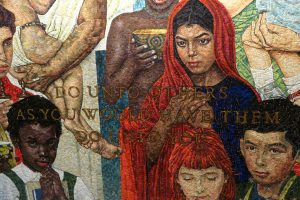
un-rockwell-mos-largeTuesday was the Feast of All Saints (which we are commemorating today, as is permitted by tradition, by translating the feast to the following Sunday). Traditionally, All Saints Day (or All Saints Sunday) commemorates the departed members of the Christian church who are believed to have attained heaven (it is not limited to those officially canonized by a church hierarchy).
It recognizes the reality that:

Our ancestors are sacred and their resting place is hallowed ground. *** Our religion is the traditions of our ancestors – the dreams of our old men, given them in solemn hours of the night . . . and the visions of our [sages], and is written in the hearts of our people. (Chief Seattle, Native American)

It looks to and gives thanks for the example of those who knew that “it is easy enough to be friendly to one’s friends but to befriend one who regards himself as your enemy is the quintessence of true religion.” (M.K. Gandhi, Hindu) And it is underscored by the Christian community’s certainty “that in the religion of Love there are no believers and unbelievers. Love embraces all.” (Rumi, Sufi Muslim)

It is a Christian holy day, but I have just described it in three quotes from notable sages none of whom were Christians. The description of our ancestors as sacred and of religion as written on the hearts of the people is from Chief Seattle, the 19th Century leader of Suquamish and Duwamish nations of the northwest, a man who followed the religion of his ancestors. The observation about befriending one’s enemies is from Mohandas K. “Mahatma” Gandhi, a Hindu from India. And the statement about the religion of love is from Jal?l ad-D?n Muhammad R?m?, a 13th Century Muslim Sufi mystic and poet.

I quote from these three men because I’ve come to believe that in our commemoration of all the saints, we should include those who are recognized as “holy” or “saintly” in other religious traditions, as well. There is, I believe, nothing in what these saintly men said that could be disagreed with by anyone of any differing religious or philosophical background. Nonetheless, I am sure that there are some (perhaps many) who would reject their words entirely, with little or no thought, as a sort of knee-jerk reaction simply because they were not Christian, despite the wisdom, morality, and generosity of spirit which they displayed.

Such is the world and the nation in which we celebrate All Saints Day this year, two days before the voters of the United States will select a new chief executive for our country. We are a society divided, polarized, and given to knee-jerk reactions. It is in this context that our Lectionary today asks us to read and consider a portion of the Book of Daniel, the only piece of apocalyptic literature in the Hebrew Scriptures, a book which focuses the reader’s attention on “the relationship between earthly and heavenly rule, emphasizing that the sovereign authority of earthly [rulers] depends upon the will of God.” (Portier-Young)

In the vision shown to Daniel, God gave sovereignty to “one like a Son of Man,” one like a human being in response to the suffering of God’s people under the domination of the Persian, Median, Macedonian, Seleucid, and Ptolemaic empires. Professor Anathea Portier-Young of Duke Divinity School argues that in so doing, God sought to free the oppressed from political domination, state terror, and persecution, to empower them to exercise authority and participate willingly in the political systems in which they live, and to inaugurate just rule on earth as in heaven. (Ibid.)

The culmination of Daniel’s vision is the handing of the earthly over to “the holy ones of the Most High.” Historically, these “holy ones” may have been understood as divine beings, but from the perspective of the Christian Gospel, the “holy ones of God” are those good people who were deeply engagement in the power struggles of their day and time, those divided, polarized, and knee-jerk reactive struggles that threatened to change to course of history. (Davidson) The “holy ones of the Most High” are those who, in the midst of a highly troubled and dangerous world, know that God is present and that God is more powerful than all the unjust empires and political systems human beings can devise. The saints, of whatever religious tradition, know that God loves and nourishes us, and gives us hope and meaning, life and salvation, gives us “the kingdom [to] possess . . . for ever – for ever and ever.” (Gaiser)

In our context, we have been given not a kingdom, but a participative democracy in which we have the same obligation as the saints of old to be deeply engaged in the struggle for justice to which Jesus calls us in today’s reading from the Gospel according to Luke, the blessings and woes from the Sermon on the Plain. We are to remember the poor and the hungry, those who weep, and those who are hated, reviled, and excluded. We are to love our enemies, do good to those who hate us, bless those who curse us, and pray for those who abuse us. We are to follow what has come to be called “the Golden Rule:” “Do to others as you would have them do to you.” These are not merely good ideas to be followed sometimes; they are moral imperatives which are to inform every activity of our lives, including our participation – wisely, morally, and with generosity of spirit – in the democracy we have been given.

As I wrote in our parish newsletter this month, I believe that voting is more than a privilege, more than a right; it is, I believe, an ethical, moral obligation. It is, for me as a Christian, an exercise in stewardship. We have been given this country and its governance by our forebears – and even, if Daniel’s vision is true (and I believe it is), by God – and we have the obligation to participate in its democratic processes, preserve it, and pass it on to our children, grandchildren, and more distant descendants.

We have heard too much cynicism in this election season. We have been told again and again how the candidates nominated by our two major parties are both deeply disliked and deeply distrusted by the electorate. On November 1, All Saints Day itself, the United Kingdom’s Independent newspaper reported that 60 per cent of likely voters view Mrs. Clinton negatively and a similar percentage dislike Mr. Trump. In a pastoral letter to his flock last weekend, the Most Rev. Paul S. Coakley, Roman Catholic Archbishop of Oklahoma, wrote, “Our major party candidates are both deeply flawed.” (Patheos)

Well, I have some news for the Archbishop: that is just the way people, all people, are. He might just as well have written, “Our major party candidates are both human beings.” When the Roman Catholic Church began the process to canonize Pope John Paul II as a Capital-S Saint, the popular Jesuit author James Martin wrote an article responding to those who objected because they felt the late pope was insufficiently perfect to warrant it. Martin wrote of the saints:

[E]ven after their decisions to amend their lives, the saints remained stubbornly imperfect. In other words: human. And the history of sinful saints begins right at the start of Christianity. St. Peter, traditionally described as the “first pope,” denied knowing Jesus three times before the Crucifixion.

After cataloguing the indiscretions of several well-known saints, Martin commented:

All these men and women were holy, striving to devote their lives to God. They were also human. And they knew it, too. Of all people, the saints were the most cognizant of their flawed humanity, which served as a reminder of their reliance on God. (Slate)

Yes, our candidates are deeply flawed human beings. But to slightly misquote Jesus, “Let the one who is without sin cast the first ballot.” (See John 8:7)

I believe Archbishop Coakley was correct in writing that “what we most need is a renewed commitment to the pursuit of virtue, to seek the good and adhere to the truth as inscribed in our hearts by our Creator” and that “[v]oting is a moral act. It ought to be guided by prayer and an evaluation not only of the political, but also the moral implications of our decisions.” (Patheos)

In today’s reading from Paul’s letter to the church in Ephesus, the Apostle writes of the church and the Christian faith being “an inheritance” for which the saints are to praise God. As I have said, I believe this nation and our participative democracy are likewise an inheritance. As Paul prayed for the Ephesians, so I pray for all of us, especially this week, that God may give us a spirit of wisdom and revelation, that the eyes of our hearts may be enlightened, and that we may know what is the hope to which God has called us. None of us, not our candidates, not our neighbors, not our fellow voters, and especially not ourselves . . . none of us is perfect; we are all deeply flawed human beings. But we are also saints like the saints of old whom we commemorate today and like them we have been given the kingdom, on earth as in heaven, to possess and to participate in for ever – for ever and ever.

It is a saintly obligation. May we exercise it wisely, morally, and will generosity of spirit.

Let us pray:

Almighty God, to whom we must account for all our powers and privileges: Guide the people of the United States in the election of officials and representatives; that, by faithful administration and wise laws, the rights of all may be protected and our nation be enabled to fulfill your purposes; through Jesus Christ our Lord. Amen. (BCP Page 822)

====================

Father Funston is the rector of St. Paul’s Episcopal Church, Medina, Ohio.

Thank God, I’m Not Like Him: Sermon for Pentecost 23, Proper 25C, Track 2 (23 October 2016)

====================

A homily offered by the Rev. Dr. C. Eric Funston on the 23rd Sunday after Pentecost, October 23, 2016, to the people of St. Paul’s Episcopal Church, Medina, Ohio, where Fr. Funston is rector.

(The lessons for the day are Proper 24C of the Revised Common Lectionary: Sirach 35:12-17; Psalm 84:1-6; 2 Timothy 4:6-8,16-18; and Luke 18:9-14. These lessons can be read at The Lectionary Page.)

====================

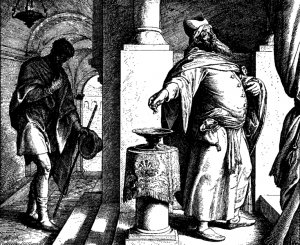
Woodcut for Die Bibel in Bildern, 1860For the past couple of weeks in the Daily Office lectionary and today in the Sunday lectionary we are reading from the Wisdom of Yeshua ben Sira, some times called Sirach, sometimes called Ecclesiasticus, one of the books of the Apocrypha, those books recognized by the Roman and Eastern Orthodox churches as canonical, but rejected by Protestants. Anglicans steer a middle course and accept them for moral teaching, but not as the basis for religious doctrine. The text is a late example of what is called “wisdom literature,” instruction in ethics and proper social behavior for young men, especially those likely to take a role in governance.
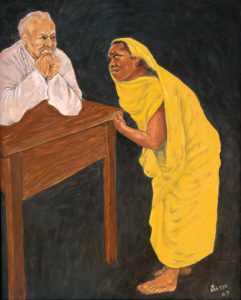
Ben Sira was written early in the 2nd Century before Christ by a Jewish scribe named Shimon ben Yeshua ben Eliezer ben Sira of Jerusalem. The Jewish nation was then under domination of the Seleucid Empire, a Greek-speaking kingdom centered in modern day Syria. Society in Jerusalem was very polarized: powerful vs. weak; rich vs. poor; Jew vs. Gentile. Ben Sira sought to guide his students through socially ambivalent times.

Among the topics he addresses is the proper forms and attitudes of worship. The Seleucid governors had involved themselves in the affairs of the Temple and, therefore, many people (especially the precursors of the Pharisees) believed that Temple worship was comprised and invalid. Furthermore, for many of the city’s wealthy participation in Temple rituals was a matter of show to advance themselves and their agenda; they offered mere lip service to God while oppressing the poor and helpless.

In this social milieu, Ben Sira offered instruction on the nature of worship, sacrifice, and prayer in Chapters 34 and 35 of the book. In Chapter 34 he describes worship that is not acceptable to God:

The Most High is not pleased with the offerings of the ungodly, nor for a multitude of sacrifices does he forgive sins. Like one who kills a son before his father’s eyes is the person who offers a sacrifice from the property of the poor. The bread of the needy is the life of the poor; whoever deprives them of it is a murderer. To take away a neighbor’s living is to commit murder; to deprive an employee of wages is to shed blood. When one builds and another tears down, what do they gain but hard work? When one prays and another curses, to whose voice will the Lord listen? If one washes after touching a corpse, and touches it again, what has been gained by washing? So if one fasts for his sins, and goes again and does the same things, who will listen to his prayer? And what has he gained by humbling himself? (Ben Sira 34:23-31)

He follows this up with the advice we heard in our reading today: “Be generous when you worship the Lord, and do not stint the first fruits of your hands. With every gift show a cheerful face, and dedicate your tithe with gladness. Give to the Most High as he has given to you, and as generously as you can afford.” (Ben Sira 35:10-12)

Ben Sira’s wisdom would have been well known to the people of Jesus’ time. Portions of the book were found among the Dead Sea Scrolls, and a nearly complete scroll was discovered at Masada, the Jewish fortress destroyed by the Romans in 73 AD. In addition, there are numerous quotations of the book in the Talmud, and the Anglican scholar Henry Chadwick (1920-2008) cogently argued that Jesus even quoted or paraphrased it on several occasions, including in the petitions of the Lord’s Prayer.

In our gospel lesson today, Jesus told the parable of two men praying: a Pharisee, who worships strictly in accordance with the law of Moses but whose life may not reflect that, and a tax collector, whose life is criticized by everyone around him but whose worship is as open and sincere as it can be. Jesus’ original audience would have been very familiar with Ben Sira’s advice about worship and would have thought of it as background for the story. They would have known that Jesus was referring back to a concern about hypocritical worship, about worship that is merely for show, about worship coming from a life that does not honor the commandments, a concern dating back many years. They would have known who Jesus was condemning, just like we do! They knew that Jesus was not talking about them, just like we know that Jesus is not talking about us! Thank God that we are not like the bad people who pray with self-righteousness and contempt for others . . . .

Oh . . . wait a minute! You see what Jesus has done? He’s trapped us! He’s tricked us into judging the Pharisee, to regarding him with contempt. And by judging the Pharisee we have become like the Pharisee; in order to get Jesus’ point we have to point to the Pharisee and his sin. By pointing to someone else, to “thieves, rogues, adulterers, or even . . . this tax collector,” and to their sins, the Pharisee condemns himself; by pointing to the Pharisee and his sin, we condemn ourselves.

Clever, sneaky preacher, that Jesus! How do we become more like the tax collector and less like the Pharisee? Ben Sira instructed his students to look worship with the eyes and understanding of God, with humility and without partiality.

So here’s an exercise . . . look at the other people all around you in church today. You know most of these people; some of them are in your family; some of them are your friends; you go to breakfast with some of them every Sunday. You may not know others; some are people you see here on Sunday but don’t otherwise socialize with; some may be people you don’t know at all. But about all of them, you do know two things. First, you know that God loves them; God loves every single person in this church today. God made them; God knows them; God loves them.

The second thing you know is that nobody in this church today is perfect. The religious way to say that is that every one of us is a sinner. Each one of us says and does things that hurt others; each one of us says and does things that hurt ourselves; each one of us says and does things that hurt God. Sometimes we do that intentionally; more often we do it negligently. But the simple truth is, whatever the reason for it may be, that we do it.

And here’s a third thing you know, and this you know about yourself . . . that the two things you know about all these people around you in church are also true of you. These are the two central truths of the Christian faith: that we are sinners and that God loves us anyway.

Now I’d like to ask you all to stand, as you may be able.

Raise your right hand, palm cupped up. Receive in that hand the truth that God loves you, that God loves all of us. Now raise your left hand, palm cupped up. Offer from that hand to God the truth that you are not perfect, that you are a sinner. See how your right hand is still holding the first truth; the second doesn’t change it at all. Not about you, not about anyone!

This, by the way, is called the orans position, the ancient position of prayer, standing with one’s hands up-raised, open to God; it has a rich tradition in Jewish and Christian practice, one’s body representing the spirit open to God’s grace.

The Pharisee in the parable failed to be fully open, fully honest with God or with himself. He was willing to raise the one hand to receive God’s blessing, but was unwilling to raise the other, unwilling to admit that he was imperfect, that he was like the thieves, rogues, adulterers, and tax collectors, that he was like us.

Jesus, clever, sneaky preacher that he is, tricks us into acknowledging that we are like the Pharisee. Like Ben Sira before him, he encourages us to place ourselves fully before God, fully open to God, praying with the tax collector, “God, be merciful to me, a sinner!”

You might say that Jesus is encouraging us to live generously. And that brings us to R____ S_________ who would like to say a few words about our Living Generously Annual Fund Campaign and his personal story of stewardship.

====================

Father Funston is the rector of St. Paul’s Episcopal Church, Medina, Ohio.

Persistent Stewardship: Sermon for Pentecost 22, Proper 24C, Track 2 (16 October 2016)

====================

A homily offered by the Rev. Dr. C. Eric Funston on the 22nd Sunday after Pentecost, October 16, 2016, to the people of St. Paul’s Episcopal Church, Medina, Ohio, where Fr. Funston is rector.

(The lessons for the day are Proper 24C of the Revised Common Lectionary: Genesis 32:22-31; Psalm 121; 2 Timothy 3:14-4:5; and St. Luke 18:1-8. These lessons may be found at The Lectionary Page.)

====================

unjustjudge2The story of the “unjust judge” has to be one of the most confusing of Jesus’ parables related in any of the Gospels. In every bible study group I have ever been a part of someone will want to know how the “unjust judge” could possibly represent God . . . .

So let me begin my sermon with this assertion: The “unjust judge” is not God! This not a parable about God! God is not in this parable! This is a parable about justice and persistence; this is not a parable about God. God is the addressee of prayers for justice; God is sometimes the object of such prayer; God is sometimes the subject of such prayer. But God is not in this parable about justice and persistence. The “unjust judge” is not God!

I hope I’ve made that clear.

This parable is about persistence and in our lectionary today we are given, in addition, two other readings and a psalm about persistence:

  • The story from Genesis of Jacob wrestling with the man, who may have been an angel, who may have been God, is one of persistence, of struggling through the night against unknown odds and not giving up.
  • The admonition of Paul to the young bishop Timothy is to “be persistent whether the time is favorable or unfavorable” and to “always be sober, endure suffering, do the work of an evangelist, carry out your ministry fully.”
  • The psalm portrays a persistent God who “keeps watch over Israel [and] shall neither slumber nor sleep,” who “shall watch over your going out and your coming in, from this time forth for evermore.”

That this persistent caring God of the Psalms, the Father of Jesus, is not the “unjust judge” is made clear by a question Jesus asks of his hearers: If the “unjust judge” eventually listened to the poor widow, “will not God grant justice to his chosen ones who cry to him day and night?” This is a prophetic question, which is why I did not say this is a parable about prayer.

The cry for justice is heard throughout the Old Testament in the cry, complaint, or appeal of the victims of injustice. It is heard in cry of Abel’s blood from ground in Genesis (4:10). It echoes in the cry of the poor and needy of Sodom and Gomorrah (Gen. 18:20; Ezek 16:49). It is the cry of the Israelites enslaved in Egypt (Ex 3:7,10), and the cry of Job against the Lord (Job 19:7). It is heard in the exasperated frustration of Solomon in the Book of Ecclesiastses (3:16-4:3). It is sung by David in many of the psalms, “I know that the Lord will maintain the cause of the poor and render justice to the needy.” (Ps 140:12)

The poor widow is not our representative; she is not a stand-in for us and our everyday personal petitions or intercessions. She represents the poverty and vulnerability of a people whose life has been shaped in the cruelty of exploitation and the arbitrary abuse of power. In telling this parable of persistence in this way, “Jesus is reading the signs in the wounds of the people. The contours of their devastation shape the structures of his thought, because this is where he belongs and these are the people whose cries he hears.” (William Loader)

So Jesus tells them and us a story which affirms that the God of persistence who watches over our going out and our coming in is a God who cares even though the solution does not come speedily. He tells them and us a story to encourage us to be a “people [who] can sustain the crying [for justice] day and night and not lose heart, [a people who] do not tune out, but live in hope and with a sense of trust that does not make us feel we have to carry the whole world on our shoulders.” (Loader)

This parable is a story in which we find “a glint of God in the gray of corruption [which affirms that] we do not have to be God; we are not alone; faith and hope are possible.” (Loader) And this is the gospel message from which Timothy is admonished to teach, reprove, correct, and train in righteousness “so that everyone who belongs to God may be proficient, equipped for every good work.”

We are, all of us who are members of the church, to be readied for “the performance of gospel-infused good works unto the glory and magnification of God in Jesus Christ,” because the “gospel is not merely about the salvation which we receive through faith in Christ; it is about the [justice and] salvation which we bring to the world through our [persistent] faithfulness to Christ.” (John Frederick)

Like Jacob, we must each of us struggle with the angel as we determine how it is that we will do that, as God encourages and aids us (even by wrestling with us) in making that determination. On that desert night, God challenged and reshaped Jacob so that he would be able to live into his promised destiny as Israel; God challenges and reshapes us in the same way, to be his people, to be persistent in the work of justice and salvation.

This is a work of stewardship. The question with which we must wrestle is not only how will we do this work, but with what resources will we do it? How will we use the riches with which God has blessed us? Prof. Richard Hayes, New Testament scholar at Duke University, in a sermon on this Genesis text reminded his congregation that Jacob is “one who first receives and then finally gives blessings” and that “that is not a bad description of [Christian] ministry.” (Richard Hayes) It’s not a bad description of Christian stewardship, either.

The work of persistently pursuing justice and practicing good stewardship is the core of a life transformed by a relationship with Jesus Christ; it is not peripheral to the gospel. Justice and stewardship are not mere evidences of the gospel. “Rather, gospel works are the necessary result of the gospel, the inseparable and authentic response to the gospel.” (John Frederick)

This week, you will receive your pledge card for 2017. As you consider your financial stewardship and support of St. Paul’s Parish, I encourage you to engage this work with the persistence of the woman confronting the “unjust judge.” I encourage you to wrestle with these questions with the persistence of Jacob who became Israel. I encourage you, as Paul encouraged Timothy, “to continue in what you have learned and firmly believed,” to persistently “carry out your ministry.” And I encourage you to do so without fear, remembering that the Lord “shall keep you safe” and “shall watch over your going out and your coming in, from this time forth for evermore.”

Today, parishioner D_______ F____ has offered to share some of his thoughts about financial stewardship with us.

====================

Father Funston is the rector of St. Paul’s Episcopal Church, Medina, Ohio.

(Note: The illustration is by the late Fr. Jim Hasse, SJ, of Claver Jesuit Ministry, Cincinnati, OH.)

Living Generously: Sermon for Pentecost 19 – Proper 21C, Track 2 (September 25, 2016)

====================

A homily offered by the Rev. Dr. C. Eric Funston on the Nineteenth Sunday after Pentecost, September 25, 2016, to the people of St. Paul’s Episcopal Church, Medina, Ohio, where Fr. Funston is rector.

(The lessons for the day are Proper 21C of the Revised Common Lectionary: Amos 6:1a,4-7; Psalm 146; 1 Timothy 6:6-19; and St. Luke 16:19-31. These lessons may be found at The Lectionary Page.)

====================

Dives and Lazarus. Psalter (Munich Golden Psalter). England [Gloucester?], 1st quarter of the 13th century.We could, I suppose, spiritualize the story of Lazarus and the rich man. We could, but if we did we would be twisting it out of shape. This is not a spiritual story. This is a bare-knuckled street-brawl of a story about wealth, about money and possessions, about someone who had plenty and about someone who had none. If we are going to honor the biblical text, we cannot spiritualize this tale; we have to deal with it as it is given us, as a story about money.

Did you know that the rich man has a name? Not in the Bible, I grant you that, but in the tradition of the church he is known as “Dives” – D-I-V-E-S pronounced “Dye-veez”. That name comes from the Latin “Vulgate” translation completed by St. Jerome in the late 4th Century in which he translated the Greek word for “rich,” plousios – which means “one who possesses wealth” – with the Latin word dives (pronounced “Dee-vase” in this context) – which comes from the same root as our word “divine” and means “one who is favored by the gods.”

In the Bible, of course, only the poor man is actually given a name, Lazarus. This is the Latinized version of the Greek transliteration of a Hebrew name, Eliezer. This name, it turns out, means “one who is aided by God.”

So, in the church’s tradition, both biblical and magisterial, these men have the same name! “Favored by God” . . . “Aided by God” . . . they are both named as beloved children of God, helped by God, bestowed by God with God’s grace and love. That is why we cannot spiritualize this story. Spiritually, there is no difference between these two men; they stand in the same relationship to God who, interestingly enough, isn’t even mentioned in the story. This not a story about God; it’s a story about money.

Which makes perfect sense when we consider where it comes in Luke’s gospel and in our lectionary sequence of readings. Let’s just go back a few chapters:

In chapter 12 Jesus told the story of Barn Guy, the rich man who had a great year with bumper crops and lots of lambs and calves, thought he could keep his earnings all to himself, and built bigger barns to keep it in . . . only to be told that he was going to die and learns, as Paul writes to Timothy in today’s epistle, “we brought nothing into the world, so that we can take nothing out of it,” so the best we can do is use our wealth to do good in this world.

In chapter 13, he talks about two trees both understood to be metaphors for God’s people and God’s kingdom: a barren fig tree which the owner decides to cut down and a mustard tree which starts from small beginnings but soon grows to provide shelter not only for the one who sowed it but for everyone.

In chapter 14, Jesus commands his followers to count the cost of following him and then tells them (that is to say, us) what that cost is: that until we sell all of our possessions and give the proceeds to the poor we are not worthy to follow him.

In chapter 15, we heard the parables of the shepherd who sought one lost sheep to complete his herd of 100 and of the woman who cleaned her whole house to find the one missing coin to complete her purse of 10, and then Jesus told us about the Prodigal who squandered all his wealth . . . but was nonetheless welcomed home with love and respect!

Now in chapter 16, we had last week’s weird story in which Jesus praised the dishonest steward who told his boss’s debtors to falsify the record of what they owed; Jesus’ punchline was that we should use our earthly wealth to win friends to welcome us “into the eternal homes.” Now he tells us this story about Dives who didn’t do that and wasn’t welcomed by Lazarus whom he might have helped or by Father Abraham, who (by the way) was quite a wealthy guy himself but clearly not sympathetic to Dives. (You know, it occurred to me that Dives could be Barn Guy. Jesus could have said, “Remember that guy who was really well off, had that great harvest, and built those new barns, but didn’t share his good fortune with anyone? Well, let me tell you about what happened after he died that night . . . .”)

Now, as I said, we could spiritualize all these stories and try to make them about God, but if we did that we’d have to wonder about Jesus, wouldn’t we? I mean the man has used stories about money so often that we would have to think that he must be unable to come up with another metaphor . . . or we would have to conclude that he doesn’t mean it to be a metaphor, at all. I think we have to reach the second conclusion and to understand, as Paul does, that Jesus believes “the love of money is a root of all kinds of evil,” and that those who have wealth are expected “to do good, to be rich in good works, generous, and ready to share, thus storing up for themselves the treasure of a good foundation for the future, so that they may take hold of the life that really is life.”

“What’s implied here is that places in the kingdom [‘the life that really is life’] are not given out according to what we have, but according to what we give away. What counts is solidarity; what counts is love. [Dives] who made a name for himself but didn’t care enough to share his wealth has no name any more. [Lazarus] who couldn’t achieve a thing all his life has been given a name of honor.” (Wendt, F., The Politics of a Name)

So let’s talk about money. Throughout his life, Jesus showed love, compassion, and care for those who didn’t have any, those who were at the bottom of society, namely the poor, the sick, the outcast, the foreigner, and those whom others considered to be sinners because of their poverty. However, he never condemned anyone for having money; what Jesus seems to have been most concerned about in regard to the wealthy was their reliance on money to provide security, a security which is ultimately temporary because wealth cannot provide that ultimate security found only in God. What is condemned is the love of money, the putting of wealth into that place in our lives where God ought to be.

Therefore, it would be “inappropriate to affirm in a wholesale fashion that [Jesus or the] early Christians criticized material wealth. Instead, of crucial importance is the attitude of the person owning it. Material wealth can get in the way of putting one’s trust in God, and it can be a hindrance to following Jesus. Yet [we must admit that all of our] church ministries and services depend on the financial resources of those who are willing [and able] to share them.” (Eberhart, C.A., Commentary on 1 Timothy 6:6-19)

I want to repeat here what I wrote in this week’s parish up-date email and what I will publish again in the October issue of our newsletter:

It is this sharing of resources that God wants of us. Clearly, God doesn’t want us to be self-reliant and, frankly, selfish rich people like Dives, but God also doesn’t want us all to be poor, sore-covered, gutter-dwelling beggars like Lazarus. What God does want us to do is to share with one another and with God in the ministries of the church.

When Bishop Hollingsworth visits here in a month (on October 30), we will, as we do at each service of baptism or confirmation, affirm our agreement to that partnership by reciting five vows from the Baptismal Covenant:

  • Will you continue in the apostle’s teaching and fellowship, in the breaking of bread, and in the prayers?
  • Will you persevere in resisting evil, and, whenever you fall into sin, repent and return to the Lord?
  • Will you proclaim by word and example the Good News of God in Christ?
  • Will you seek and serve Christ in all persons, loving your neighbor as yourself?
  • Will you strive for justice and peace among all people, and respect the dignity of every human being?

To each question, we respond: “I will, with God’s help.”

When we recite our baptismal vows, we are renewed in and reminded of God’s call in our lives and the life of St. Paul’s Parish. We are all God’s partners by virtue of our baptism, and we are all called by God to proclaim, in word and action, God’s justice, love and mercy for all creation, to do God’s work right here on earth.

Ministry, outreach, worship, baptisms, marriages, funerals, visiting the sick, praying for family and friends, offering spiritual and religious formation, helping those less fortunate than ourselves – doing these things in and through our church is part of our partnership with God. And each one of them costs money. God provides us with inspiration, skill, vision, and determination. But we have to provide the money.

Over the next six weeks, we will talking a lot about money. You will be asked to think about your support of St. Paul’s Parish for the next year. You will be asked to make your pledge of financial support for 2017. You will be asked to act on your promised partnership with God. Think of all your regular gift of money can do for our church, for our families, and (most importantly) for our neighbors. Think of all it can do for our partnership work with God here on earth. It is through our pledges, faithfully made and faithfully kept, that we partner with God to tell the good news, take care of children, visit the elderly, heal the sick, house the homeless, feed the hungry, and (yes) maintain our most important tool in doing all of that, this lovely building within which we worship today.

That’s what our pledged financial support does; that is what our sharing of our wealth does: God’s work in which we are partners. God expects us to live generously as God lives generously with us.

Like Dives, we are all favored by God. Like Lazarus, we are all aided by God. We stand in the same relationship to God as they did. In a sense, we are Dives’ siblings, those five brothers he asked that Father Abraham send Lazarus to warn. “We who are still alive have been warned about our urgent situation, the parable makes clear. We have Moses and the prophets; we have the scriptures; we have the manna lessons of God’s economy, about God’s care for the poor and hungry. We even have someone who has risen from the dead. The question is: Will we – [Dives’] sisters and brothers – see? Will we heed the warning, before it is too late?” (Rossing, B., Commentary on Luke 16:19-31) Will we who have the God of Jacob for our help, whose hope is in the Lord our God, whose God richly provides us with everything for our enjoyment . . . will we live generously and fulfill our promises of partnership with God?

I believe we will.

Let us pray:

Gracious and generous God,
your Son came that we might have life
and have it abundantly,
we pledge our trust in you and each other,
and we accept your invitation to be partners in ministry.
We acknowledge that your call requires us
to be stewards of your gifts,
shaping our lives in imitation of Jesus,
whom we have promised to follow.
As stewards, we receive your gifts gratefully,
cherish and tend them in a responsible manner,
share them by living generously with others,
and return them with increase to you, our Lord.
We pledge to attend to our ongoing formation as stewards
and our responsibility to call others to that same endeavor.
Almighty and ever-faithful God,
we are grateful
that you who have begun this good work in us
and will bring it to fulfillment
in Jesus Christ, our Lord. Amen.

[The illustration is “Dives and Lazarus” from the Munich Golden Psalter, dating from the 1st quarter of the 13th century.]

====================

A request to my readers: I’m trying to build the readership of this blog and I’d very much appreciate your help in doing so. If you find something here that is of value, please share it with others. If you are on Facebook, “like” the posts on your page so others can see them. If you are following me on Twitter, please “retweet” the notices of these meditations. If you have a blog of your own, please include mine in your links (a favor I will gladly reciprocate). Many thanks!

====================

Father Funston is the rector of St. Paul’s Episcopal Church, Medina, Ohio.

Restoring Wholeness: Sermon for Pentecost 17, RCP Proper 19C (11 September 2016)

====================

A homily offered by the Rev. Dr. C. Eric Funston on the Seventeenth Sunday after Pentecost, September 11, 2016, to the people of St. Paul’s Episcopal Church, Medina, Ohio, where Fr. Funston is rector.

(The lessons for the day are Proper 19C of the Revised Common Lectionary: Exodus 32:7-14; Psalm 51:1-11; 1 Timothy 1:12-17; and St. Luke 15:1-10. These lessons may be found at The Lectionary Page.)

====================

little-lost-lamb-59319I’d like you all to take your Prayer Books in hand and turn with me to page 855 which is way in the back of the book in the section called The Catechism or Outline of the Faith. At the top of the page are three questions about the mission of the church and the answers to those questions that we as Episcopalians teach. I’m going to read the questions; I’d like you to read the answers:

Q. What is the mission of the Church?
A. The mission of the Church is to restore all people to unity with God and each other in Christ.
Q. How does the Church pursue its mission?
A. The Church pursues its mission as it prays and worships, proclaims the Gospel, and promotes justice, peace, and love.
Q. Through whom does the Church carry out its mission?
A. The church carries out its mission through the ministry of all its members.

Following those questions are a few more about the specific ministry of the various orders (lay persons, bishops, priests, and deacons); I invite you to read those on your own.

For now, just keep in mind that the church’s mission is to restore people to unity with God and one another; we have a word for that – it’s called reconciliation. Remember that the church carries out that mission in prayer, worship, and proclamation, and by promoting justice, peace, and love. And, finally, remember that the church does so not as an institution, but through the individual ministries of its members, not as a collective like the Borg of Star Trek but as individuals with distinctive skills, talents, and interests (as Capt. Kathryn Janeway of the USS Voyager often instructed the former Borg drone Seven-of-Nine).

As you keep all that in mind, let me tell you a story about myself as a younger man, about thirty years younger. Back then I was not ordained; I was a practicing attorney living in Las Vegas, Nevada, with Evelyn and our children. Patrick was three years of age and Caitlin was one. One day I decided to take my son to the circus; more accurately, I took him to Circus Circus Casino. Now normally one does not take a 3-year-old to a casino, but Circus Circus is (or at least was) a special sort of casino. Housed in a building made to look like a “big top”, it had a mezzanine circling the gaming floor and on this mezzanine was an arcade filled with all the circus and carnival attractions you can name. Over the gaming floor was a trapeze rig on which gymnasts swung and flew with reckless abandon, while on the mezzanine midway barkers sought to attract patrons to shooting galleries, ring-toss games, and the like. My toddler was in awe of the whole thing.

We stopped for a few minutes to watch the trapeze artists and at some point I looked down and discovered that my son was no longer at my side. He was right there – and then he wasn’t! I know that most, if not all parents, have experienced something similar. That moment when your child has gone missing and you begin to experience every emotion known to humankind . . . in spades! Adrenaline courses through not only your body but your soul; you are in a physical and spiritual panic! “Where is my child!?!?” Fear and worry, hope and hopelessness, confusion and sadness . . . it’s all there, all jumbled together. It’s almost impossible to function and yet function you must; you have to find your child!

As it turned out, Patrick was only about eight feet away. The trapeze wasn’t nearly as exciting as the ring-toss game where, if his father had a good eye and a steady hand he might throw a plastic ring around a jelly jar and Patrick would get the gold fish living therein. When, after an eternity of maybe two or three minutes, I finally found him, a whole new rush of mixed emotions set in – relief, anger, joy, love – and I found myself kneeling on the floor holding him by the shoulders and yelling at him, adding to the circus noise of the crowded casino.

A security guard about my age, probably a father himself, had seen my panicked search and started to come over, arriving about the same time that I’d found Patrick. As I was shouting my lecture about not leaving Dad’s side, the guard put his hand on my shoulder . . . and that’s all it took. It calmed me down; the anger fled and the relief, joy, and love flooded in. I hugged my son tightly to me and vowed never to lose him again.

If you’re a parent, perhaps you’ve had a similar experience; as I said, I imagine most if not all parents have done so. Or perhaps you’ve been through that situation where you’ve worked for days on a project at work or school only to have a co-worker or a fellow student do something that renders all your effort of no worth at all. You’ve just lost all that time and work, and the feeling of futility that washes over you is just mind-numbing and drains you of all sense of worth and well-being. If you could, you’d drop-kick that colleague right out the front door. But then, perhaps another workmate, perhaps a supervisor or a teacher, makes a gesture or says a word and you realize that you really have no reason for anger. This is just the way things go sometimes and whatever the other worker or student may have done probably wasn’t done to hurt you; that’s just life. You pick up and you move on.

If you’ve had experiences like these, you know how the shepherd or the woman in Jesus’ parables this morning felt. You know how Yahweh felt at Sinai in our story from the Book of Exodus.

In the latter, Moses has left the Hebrews encamped at the base of Mt. Sinai while he has climbed the mountain to converse with Yahweh; he will eventually be bringing down the Law, the Commandments etched on stone by God’s own self. Moses is on the mountain for forty days and forty nights during which the Hebrews begin to feel themselves abandoned. They probably go through that whole gamut of emotions that a lost child, or a parent looking for a lost child, feels . . . but this story really isn’t about them . . . . Anyway, they feel abandoned because of Moses’ long absence and so they turn to his brother, Aaron the Priest, and say, “Make us a god!”

Aaron complies; Aaron seems like the type who is always easy going and willing to compromise and so he does as they ask, taking their jewelry and gold money and fashioning a god for them, the Golden Calf. This comforts them and so they begin to celebrate with revelry, the Bible tells us; that’s singing and dancing and some things we don’t generally talk about in church.

Meanwhile, Yahweh distracted by his conversation with Moses doesn’t notice his children wandering off. When he looks down, however, he finds them gone and, worse, when he finds them they aren’t just distracted by a ring-toss game and some goldfish. They are worshiping an idol!

Shauna Hannan, Associate Professor of Homiletics at Pacific Lutheran Theological Seminary in Berkeley, California, says that we should stop referring to this text as the “golden calf” incident and begin calling it the “God changes God’s mind at the request of Moses” incident. (Hannan) One of the things that strikes me about this incident is how very much Yahweh acts like an angry parent in this episode.

Something I found myself doing early in parenthood was referring to our kids as “my son” or “my daughter” when they were behaving well, but when they misbehaved I would turn to Evelyn and say, “Do something about your son (daughter)!” Back in Chapter 20, Yahweh said to the Hebrews, “I am the Lord your God, [I’m the one] who brought you out of the land of Egypt,” (v. 2) but now he says to Moses, “Your people, whom you brought up out of the land of Egypt, have acted perversely.” (32:7) I can really relate to Yahweh’s doing that!

And not only does God sort of disown these folks! Prof. Hannan points out that

God calls them names: stiff-necked people. And worse, God wants to be left alone to wallow in anger and to “consume” the idolaters. If that is not enough, God seems to bribe Moses to leave him alone (32:10). If Moses does so, God will make of him a great nation. Anger, tirade, blame, name-calling, destruction, bribery; this is not God at God’s best. (Hannan)

But Moses steps in like that security guard at Circus Circus, or like the supervisor at work or the teacher at school, and says a calming word. “Turn from your fierce anger,” he says, “Calm down. Remember your promises to Abrahan, Isaac, and Jacob.” Moses figuratively lays a hand on Yahweh’s shoulder. Callie Plunket-Brewton, who teaches at the University of North Alabama, says Moses here serves as a model for the Church, bearing witness to God’s faithful compassion and urging reconciliation between God and God’s people, although in this peculiar circumstance it is Yahweh himself to whom Moses is witnessing! (Plunket-Brewton)

Five years ago, on the Sunday closest to the anniversary of the September 11 tragedy at the World Trade Center, at the Pentagon, and near Shanksville, Pennsylvania, of which today is the 15th anniversary, I was invited to preach at St. Paul’s Church of Ireland Parish in the town of Banagher, County Offaly, Ireland. The lessons for that day were from the first chapter of the Book of Proverbs, in which Lady Wisdom cries out to passersby, “How long will you love being naive?” (Prov. 1:22) and from the eighth chapter of Mark’s Gospel in which Peter tries to stop Jesus from going to Jerusalem and Jesus responds, “Get behind me, Satan! For you are setting your mind not on divine things but on human things.” (Mk 8:33)

I suggested to my Irish audience that there is a parallel between the way the British authorities responded to Ireland’s Easter Uprising of 1916 and the way we in America responded to the actions of Al-Qaeda on September 11. They and we were naive, and when they and we experienced the tragic loss of life and the overwhelming loss of control that those events represented, we did, indeed, set our minds on human things, on revenge and retribution, rather than on divine things, on restoring all people to unity with God and each other, on promoting justice, peace, and love. So Ireland found itself in nearly a century of sectarian strife and eventually the deadly and devastating Troubles of Northern Ireland. And we have found ourselves 15 years later still battling terrorists, still fighting in the Gulf States, still engaged in Afghanistan and Iraq in the longest armed combat in our nation’s history, and trying not to get deeply involved in the directly consequent civil war in Syria.

If only someone had raised their voice, if only someone had laid their hands on our nations’ shoulders and said, “Turn from your fierce anger. Calm down. Remember your promises . . . .” Eventually the Irish and the British were able to end their bitter relationship and the Troubles which made Northern Ireland a hell-on-earth; we hope and pray that we will be able to do the same in and with the Gulf States and those who live there.

I said that the reading from Exodus is really not a story about the Hebrews. It is a story about God, about Yahweh, a god who understands those feelings of loss, who knows what it is to feel loss-engendered anger and to want retribution and revenge, and who turns away from those things to seek reconciliation instead.

The parables that Jesus tells in our selection from Luke’s Gospel are also stories about God, about God and loss, and not (as we often think) about us. Though they are often called the parables of the “lost sheep” and the “lost coin,” they ought to be called the parable of the shepherd who went in search of a sheep and of the woman who cleaned her house looking for a coin. That would take the focus off the thing that is loss and put it properly on the one who does the finding.

However, we do have to consider the things that are lost and what that means. Karoline Lewis, who writes a weekly internet column about the lectionary texts entitled Dear Working Preacher, noted this week that “the state of being lost is a rather ambiguous determination in life.” Being lost can mean being misplaced, or misdirected, or misguided, or wasted. “A definition of ‘lost’ seems as broad as its incidences: unable to be found; not knowing where you are or how to get to where you want to go; unable to find your way; no longer held, owned, or possessed.” (Lewis)

On Thursday afternoon I was driving to Brook Park and listening to Terry Gross’s NPR show Fresh Air as she interviewed an author named Steve Silberman about his book NeuroTribes: The Legacy of Autism and the Future of Neurodiversity. (Available online) As they talked about the autism spectrum, it occurred to me that there might be a similar continuum of “lostness” that could help us understand these bible lessons. It seems to me that at one end of such a lostness spectrum are the Hebrews at the foot of Mt. Sinai. They are lost by reason of their own decision; they are, as Yahweh said, stiff-necked people and their lostness is the consequence of their own actions, their own impatience, rejection, and alienation. In short, the Hebrews at the foot of Mt. Sinai are lost because of sin.

At the other end of the spectrum is the coin, about which we might ask, “How does a coin sin? How does a coin lose itself?” and the simple answer is that it can’t.

And somewhere in the middle of our lostness continuum is the sheep, who wandered away from the flock not out of rejection or alienation, but simply because sheep are rather dull-witted and naive. It has wandered off not through sinful intent, but through silly innocence.

The wonderful thing that these stories demonstrate is that the mechanism of lostness, the reason the Hebrews, the sheep, or the coin are lost, is irrelevant. What these stories show is that the one who feels their absence, the one who is concerned about their lostness, God, is going to find them. Influenced by the intervention of Moses, by his witness to God’s own ministry of reconciliation, “the Lord changed his mind about the disaster that he planned to bring on his people,” and instead restored Godself to unity with them. The shepherd sought and found the lost sheep and rejoiced. The woman sought and found the lost coin and rejoiced. The emphasis in all these stories is on the finding and the restoration of relationship, on the one committed to that end.

Jennifer Copeland, a Methodist minister, wrote several years ago in The Christian Century magazine:

The lost sheep and the lost coin are more than the prized possessions of their owners; they are also parts of a whole. The sheep belongs to the flock and the coin to the purse; without them the whole is not complete. The search, then, is a quest for restoration and wholeness. In this sense, all of us who are part of God’s creation should be just as anxious as God until the lost are restored and we are made whole again by their presence. (Clean Sweep, The Christian Century, September 7, 2004, p. 20)

Prof. Hannan suggests that this emphasis on wholeness is also the “shocking and profoundly hopeful news” of the Exodus passage, the news “that God sticks with us; God continues to claim us as God’s own despite” everything. (Hannan)

On this 15th anniversary of those terrible events that are summed up in the simple numbers “9-11,” in this 13th year of armed conflict that has flowed from them, let us remember that our mission as a church, our mission as individual members of the church, has that same emphasis of reconciliation and wholeness:

The mission of the Church is to restore all people to unity with God and each other in Christ. The Church pursues its mission as it prays and worships, proclaims the Gospel, and promotes justice, peace, and love. The church carries out its mission through the ministry of all its members.

In today’s Daily Office gospel reading from Matthew, Jesus admonishes his hearers, “Be reconciled to your brother or sister.” (Matt 5:24b) I can think of no better way to memorialize all who died September 11, 2001, and in the conflict and violence that has followed.

To close, I would like to offer a prayer for this anniversary co-authored by my friends Deacon Scott Elliott of the Diocese of Chicago and Fr. Bob Winter, a retired priest of this diocese.

Let us pray:

O God of mercy, justice, and love, you have taught us to love even those with whom we are at enmity: As we gather in the Name of your Son to celebrate your goodness and grace, we remember the great evil done in your Name on this day. In your mercy, relieve our hearts of the burden of shock and horror and help us to remember that we, your children, are likewise called to be merciful; help us, as children of the Just One, to respond to your call to be people of justice; help us, as the beneficiaries of your love, to remember your command to love the whole world in your Name. All this we ask in the Name of the Prince of Peace. Amen.

====================

A request to my readers: I’m trying to build the readership of this blog and I’d very much appreciate your help in doing so. If you find something here that is of value, please share it with others. If you are on Facebook, “like” the posts on your page so others can see them. If you are following me on Twitter, please “retweet” the notices of these meditations. If you have a blog of your own, please include mine in your links (a favor I will gladly reciprocate). Many thanks!

====================

Father Funston is the rector of St. Paul’s Episcopal Church, Medina, Ohio.

The Foolishness of Selfishness: Sermon for RCL Proper 13C (Pentecost 11, 31 July 2016)

====================

A homily offered by the Rev. Dr. C. Eric Funston on the Eleventh Sunday after Pentecost, July 31, 2016, to the people of St. Paul’s Episcopal Church, Medina, Ohio, where Fr. Funston is rector.

(The lessons for the day are Proper 13C of the Revised Common Lectionary: Ecclesiastes 1:2,12-14;2:18-23; Psalm 49:1-11; Colossians 3:1-11; and St. Luke 12:13-21. These lessons may be found at The Lectionary Page.)

====================

188347-barnSome translations of the Bible like to add to it. They insert explanatory headings and titles into the teachings of the authors of scripture or before the parables or important elements in Jesus’ life and teachings. The New International Version, for example, adds the title “The Parable of the Rich Fool” to our gospel text for today. It breaks up our reading from Ecclesiastes with three such headings: “Everything Is Meaningless,” “Wisdom Is Meaningless,” and “Toil Is Meaningless.” If you have a bible like that, take those titles and subheadings with a very large grain of salt because they are simply not accurate!

Even though Ecclesiastes is famous for its many repetitions of “Vanity of vanities! All is vanity!” and its apparent judgment that nearly all human activity is a “chasing after wind,” meaninglessness is not, in the end, the message of Qoheleth the Preacher, as the author of this book is sometimes called.

Elizabeth Webb, an Episcopal theologian who teaches at William Jewell College in Missouri, writes that to find meaninglessness and hopelessness to be the message of Ecclesiastes is to give in to a “profound lack of faith in the God who delights in our very being, and in whom we are to find our delight.” Such an understanding, she asserts, is far from the message this book has for us. Instead, she suggests, the message of the Preacher is that

The cure for despair and hopelessness, and the desire of God for human beings, is to find joy precisely in this wearying life. Several times (2:24-25; 3:12-13; 5:18) Qoheleth asserts that, when confronted with the apparent meaninglessness of life, the best we can do is enjoy ourselves – take joy in eating, drinking, even in our work. A particular joy is to be found in companionship with one another; two are better than one, he writes, “For if they fall, one will lift up the other” (4:9-10). We are to see such enjoyment in play, in work, and in relationships as gifts from God; indeed, enjoyment comes “from the hand of God” (2:24). (Webb)

It looks like that is exactly what the rich farmer in Jesus’ parable is trying to do! He has had the good fortune to enjoy a bumper crop and has great plenty, so he builds larger barns in which to store it and says to himself, “Soul, you have ample goods laid up for many years; relax, eat, drink, be merry.” That seems to be precisely the advise of Qoheleth, so why is this man called “a fool”? Indeed, it is God who so addresses him, so we ought to take this question seriously.

So let’s begin by acknowledging that this not a parable in which Jesus in anyway criticizes the accumulation of wealth. This parable does not, for example, have the moral overtones of lamenting the relative positions of rich and poor such as in the story of Lazarus and Dives (Lk 16:19–31), nor the outright spiritual condemnation of our Lord’s observation that “it is easier for a camel to go through the eye of a needle than for someone who is rich to enter the kingdom of God.” (Mt 19:24) No, the rich man is not foolish nor immoral simply because he is wealthy. Something very different is at play here.

This gospel lesson is a short one and the parable itself is only a couple of sentences long, so bear with me as I read it again and listen carefully to how Jesus tells the story:

“The land of a rich man produced abundantly. And he thought to himself, `What should I do, for I have no place to store my crops?’ Then he said, `I will do this: I will pull down my barns and build larger ones, and there I will store all my grain and my goods. And I will say to my soul, `Soul, you have ample goods laid up for many years; relax, eat, drink, be merry.'” (Lk 12:16-19)

It is at this point that God addresses the man as “You fool!” (v. 20)

So let’s have a short pop quiz. The man had a bumper crop and wondered what to do with it; with whom did he consult? Only himself. When he reached his decision to pull down his barns and build bigger ones, whose advice did he take? Only his own. And when he had stored his grain and his goods, with whom did he plan to enjoy them? Himself alone! “When the rich man talks in this parable, he talks only to himself, and the only person he refers to is himself.” (Johnson) He is, in the truest sense of the word, selfish. He has no thought of family or community; he has no thought of God. He’s all “I alone,” and it’s a fearful loneliness. Meda Stamper, a Presbyterian theologian in England, suggests that underlying this parable and many of Jesus’ other stories is a recognition that underlying excessive accumulation of goods and possessions is most often personal anxiety and fear.

It is said that the person who represents himself in court has a fool for a client; in the case of the man in this parable, the person who consults only himself on how to handle wealth has a fool for an advisee.

Elisabeth Johnson, a Lutheran who teaches theology in Cameroon, writes: “The rich farmer is a fool not because he is wealthy or because he saves for the future, but because he appears to live only for himself, and because he believes that he can secure his life with his abundant possessions.” Meda Stamper says the rich man, whom she calls “the barn guy,” is a fool because of his selfishness, because of his “earthbound, inward-looking way” of seeking happiness.

But “is ‘life’ to be equated with happiness?” Jesus’ First Century society exemplified by “the barn guy” certainly thought so, and so does our own. “Western society abounds with seductive invitations to happy lifestyle, usually promoting new products and promising that ‘good feeling’,” writes Australian theologian Bill Loader. “Markets manipulate the modes so that regular dissatisfactions can be exploited as people just must have the latest. For some the problem is blindly building bigger barns. For others it is building bigger wardrobes, possessing fancier gadgets, sporting flashier cars.” There is, says Loader, “a deep human anxiety about being worthwhile which reaches to the heart of the self.”

In his book Following Jesus in a Culture of Fear (Brazos Press: Grand Rapids, 2007), University of Scranton theologian Scott Bader-Saye, points out that the Christian faith has long understood this:

In this context [the 13th Century theologian Thomas] Aquinas uses the Greek term systole, from which we get our English term systolic (referring to the contracting of the heart muscle as it pumps blood into the arteries). Fear, for Aquinas, can cause a kind of contraction of the heart. By imagining some future evil, fear draws us in on ourselves so that we “extend” ourselves to “fewer things.” This, in turn, becomes a hindrance to Christian discipleship, which calls us not to contract but to expand, not to limit ourselves to a few things but to open ourselves charitably and generously to many things, not attack that which threatens us but to love even the enemy. (Page 28)

At the heart of the rich man’s foolishness is this selfish, “I alone” fear which asks the fearful question “Is my life worthwhile?”

The answer to that question, the courage which answers that fear, the wisdom which counters rich man’s foolishness is found in “a kind of Christian defiance which says: only in life towards God, a life participating in God’s life is peace. That will be a peace that weeps, knows anguish, sometimes does not know and does not have answers, but keeps believing in the worth God wants us to have and wants us to give and live towards others.” (Loader)

The rich man is foolish because, although he seems to follow Qoheleth’s advice in Ecclesiastes and prepares to “eat, drink, and be merry,” he stores up treasures for himself alone and not for his community or for God. The translators of scripture who insert titles and subheadings into scripture and suggest that Qoheleth’s message is one of meaninglessness are also foolish because nothing is further from the truth; yes, the Preacher decries wisdom, and toil, and accumulation of wealth as “vanities,” but in the end he says that the purpose of these things is to allow us, together in community, to eat, drink, and be merry, not as an act of selfishness, but as a communal act of faith toward God.

After telling them this parable, Jesus says to his listeners:

Consider the ravens: they neither sow nor reap, they have neither storehouse nor barn, and yet God feeds them. Of how much more value are you than the birds! And can any of you by worrying add a single hour to your span of life? If then you are not able to do so small a thing as that, why do you worry about the rest? Consider the lilies, how they grow: they neither toil nor spin; yet I tell you, even Solomon in all his glory was not clothed like one of these. But if God so clothes the grass of the field, which is alive today and tomorrow is thrown into the oven, how much more will he clothe you? (Lk 12:24-28)

It is the Father’s good pleasure to give the kingdom itself to us, his flock, in companionship with one another. So the way to collect treasure suitable for the kingdom isn’t, as Meda Stamper said, “the earthbound, inward-looking way of the barn guy but the soaring, beautiful way of the one who lives and loves generously, lavishly, and with joy.” Not foolishly, selfishly alone, but wisely, gratefully together. Amen.

====================

A request to my readers: I’m trying to build the readership of this blog and I’d very much appreciate your help in doing so. If you find something here that is of value, please share it with others. If you are on Facebook, “like” the posts on your page so others can see them. If you are following me on Twitter, please “retweet” the notices of these meditations. If you have a blog of your own, please include mine in your links (a favor I will gladly reciprocate). Many thanks!

====================

Father Funston is the rector of St. Paul’s Episcopal Church, Medina, Ohio.

« Older posts Newer posts »