Occasional thoughts of an Anglican Episcopal priest

Category: Prayer (Page 21 of 47)

Horizontal Faith – From the Daily Office – June 16, 2014

From the Letter to the Romans:

For I am longing to see you so that I may share with you some spiritual gift to strengthen you — or rather so that we may be mutually encouraged by each other’s faith, both yours and mine.

(From the Daily Office Lectionary – Romans 1:11-12 (NRSV) – June 16, 2014)

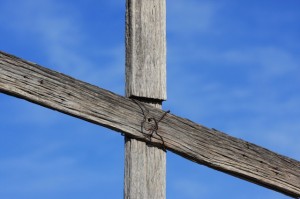
Wooden CrossConfession: For years I have found Paul’s writing tedious. I read it because the early church reached consensus that his letters would be considered divinely inspired and the contemporary church has mandated that we read his stuff in the Daily Office and Eucharistic lectionaries. But I read it carelessly, not paying much attention.

Only since taking on the discipline of writing these daily meditations on some part of the daily readings have I really read Paul. And I am impressed with his stated reason for wanting to visit the Romans! “That we may be mutually encouraged by each other’s faith.” That’s solid.

That is, in fact, what I think Christianity is all about. It’s about mutually encouraging and supporting one another. It’s about sustaining interpersonal relationships. It’s about community. It must be by design that these lessons show up the day after Trinity Sunday when we celebrate the paradigm complete and perfect community which is the Triune Godhead.

So much of modern Christianity seems to focus solely on the individual’s devotion to God in Christ to the exclusion of the faith’s social aspect. Many Christians seem to have forgotten that the cross has two members: a vertical, which represents that earth-to-heaven, human-to-God aspect; and a horizontal, which represents the relationships of human-to-human. Christianity is as much a horizontal faith as it is a vertical one. A prayer for mission in the Daily Office focuses on the horizontal:

Lord Jesus Christ, you stretched out your arms of love on the hard wood of the cross that everyone might come within the reach of your saving embrace: So clothe us in your Spirit that we, reaching forth our hands in love, may bring those who do not know you to the knowledge and love of you; for the honor of your Name. Amen.

I usually reserve this prayer for Fridays, but following Paul’s hope in the horizontality of faith, “that we may be mutually encouraged by each other’s faith,” I said it today.

====================

A request to my readers: I’m trying to build the readership of this blog and I’d very much appreciate your help in doing so. If you find something here that is of value, please share it with others. If you are on Facebook, “like” the posts on your page so others can see them. If you are following me on Twitter, please “retweet” the notices of these meditations. If you have a blog of your own, please include mine in your links (a favor I will gladly reciprocate). Many thanks!

====================

Father Funston is the rector of St. Paul’s Episcopal Church, Medina, Ohio.

Internal Polling – From the Daily Office – June 11, 2014

From Ecclesiastes:

Again I saw that under the sun the race is not to the swift, nor the battle to the strong, nor bread to the wise, nor riches to the intelligent, nor favor to the skillful; but time and chance happen to them all. For no one can anticipate the time of disaster. Like fish taken in a cruel net, and like birds caught in a snare, so mortals are snared at a time of calamity, when it suddenly falls upon them.

(From the Daily Office Lectionary – Ecclesiastes 9:11-12 (NRSV) – June 11, 2014)

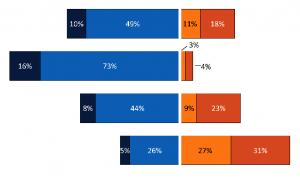
Meaningless Bar GraphWe got up this morning to the startling news that a major political figure had been defeated in his party’s primary by a candidate supported by what I would call an extremist fringe element of the party, a group which has gained more say and more influence in the party than it should have. I didn’t write a lectionary reflection until late in the day because, political news junkie that I am, I spent the morning listening to the radio pundits and perusing the on-line publications. Over and over I found the commentators using hyperbolic metaphors — earthquake, tornado, disaster, calamity — and asserting that the defeat was entirely unforeseen. “Wow!” I thought, “They sound like Qoheleth in today’s reading from Ecclesiastes!”

One of the reasons given for the failure of the losing politician and his handlers to have foreseen the potential (now actual) loss was that they relied (to quote one news source) “on their own internal polling.” When I heard those words I remembered the last presidential election. In that election, the losing candidate and his party also were supremely confident of victory based on their “own internal polling.” One of his operatives went so far as to argue with a supportive news organization when its analysts came to the (accurate) conclusion that the current president was the winner.

It occurs to me that reliance on one’s “own internal polling” is a dangerous thing. The words “own internal polling” might be code for “self-deluding fantasy.”

We have much better predictive abilities now than in the time of King Solomon of Israel (who is reputed to have been the preacher who authored Ecclesiastes). We have a reasonable ability to foretell the weather, although tornadoes still surprise us. Hurricanes and major weather fronts, storm surges of the sea, and dry hot winds that fan forest fires can all be tracked and prepared for. Earthquakes and volcanic eruptions are beyond our prophetic capabilities, though scientists seem to be closing in on ways to prognosticate seismic activity.

We have a better ability to prepare for calamities and disasters — better means of food preservation, faster ways to evacuate potentially affected areas, swifter communication. We can prevent plagues and epidemics through vaccination, and we can treat them with antibiotics and other medications.

What we seem no better at doing is avoiding self-delusion. We still (all of us, not just politicians) rely a too much on our “own internal polling.” And when we do, we get overtaken by surprise, by events that seem to be (or, at least, are described as) disastrous and calamitous. Perhaps we should be listening to more than those internal polls?

It seems to me that those losing politicians might have been better served by taking a look at the polling numbers of independent opinion surveys and not relying so heavily on their “own internal polling.” They may not have been able to change the outcome, but at least they would have been better prepared for it; it would not have been such a surprise, such a “disaster” or “calamity.”

A few days ago, I was in conversation with a bible study group considering the question “How do you know you are responding to God’s call?” Nearly everyone’s initial response was, “Well, when it feels right,” but after discussion we came to the realization that our internal feelings, our “own internal polling,” aren’t often accurate. A better barometer of God’s call to us, of God’s will for us, is the discernment of the community. Checking one’s feelings with others turned out to be our consensus as to how to know whether we are answering that call, checking some independent rather than internal polling.

Qoheleth concludes today’s reverie with a couple of proverbs, one of which is political: “The quiet words of the wise are more to be heeded than the shouting of a ruler among fools.” (v. 17) Given today’s political news, we might say that the quiet words of others are more to be heeded than one’s “own internal polling.”

====================

A request to my readers: I’m trying to build the readership of this blog and I’d very much appreciate your help in doing so. If you find something here that is of value, please share it with others. If you are on Facebook, “like” the posts on your page so others can see them. If you are following me on Twitter, please “retweet” the notices of these meditations. If you have a blog of your own, please include mine in your links (a favor I will gladly reciprocate). Many thanks!

====================

Father Funston is the rector of St. Paul’s Episcopal Church, Medina, Ohio.

We Always Have Choices – From the Daily Office – May 31, 2014

From the Gospel according to Matthew:

There was a leper who came to him and knelt before him, saying, “Lord, if you choose, you can make me clean.” He stretched out his hand and touched him, saying, “I do choose. Be made clean!” Immediately his leprosy was cleansed.

(From the Daily Office Lectionary – Matthew 8:2-3 (NRSV) – May 31, 2014)

ChoicesI admit that I’m never quite sure how to read this publicly, what tone of voice to use for Jesus. I suppose I could avoid that question by reading in that dull monotone some lectors chose, or in that “stained glass church voice” many clergy affect. However, the bible is mostly story, and the Gospels are entirely story, and I believe stories are to be read, especially in public, as stories — living, breathing, interesting, engaging stories.

So how to read Jesus in this narrative? Angry? Authoritative and decisive? Amused? I once heard a deacon read this tale in a way that made Jesus sound surprised that he had a choice, with a tone of voice that said, “Really? I don’t have to do this?”

Sometimes it seems to me that the Gospel is presented in such a way as to suggest that Jesus had little, if any, say in anything. “This was God’s design, the plan of salvation from the very beginning, ba-blah, ba-blah, ba-blah . . . .” as if Jesus were simply some preprogrammed automaton. But, of course, Jesus always had a choice; everyday Jesus had to make the decision whether to continue, whether to “set his face toward Jerusalem” even knowing the probable outcome of his choices.

And so it is with all of us. Life is a series of choices. We don’t always get our way; the choices we would like to make a sometimes refused us. Today in the church is the Feast of Visitation of the Blessed Virgin Mary, a day set aside to honor Mary’s visit with her cousin Elizabeth, mother of John the Baptist. It is the day on which she sang the Magnificat. It is the day I chose to be ordained. However, it was not the day my bishop chose to ordain me. Guess whose choice prevailed.

So, no, we don’t always get our choices, but we always have choices to make. I simply do not understand and cannot accept the sort of religion that denies that. Not to long ago, I read a devotional text in which the writer asserted that “God is strategic. He has laid out an exact plan for our lives right down to the smallest details. God has it all figured out. He is orchestrating your life right down to the very second.” That sort of spiritual belief has always seemed to me a cop out. It lays our bad choices, our poor decisions at God’s feet, denying our own responsibility.

And it is a belief which can’t be sustained. Within a few pages of that statement, the author then wrote that God can “turn any situation around” because “it doesn’t matter how you got there, whether it was by your own poor choices or maybe someone else treated you unfairly.”

Which is it? Either God has a plan for every second of everyone’s life and is orchestrating every detail or human beings have free will and are always making choices; it can’t be both ways. Or perhaps it can. As the great Jewish writer Isaac Bashevis Singer was fond of saying, “We must believe in free will — we have no choice.”

We always have choices.

====================

A request to my readers: I’m trying to build the readership of this blog and I’d very much appreciate your help in doing so. If you find something here that is of value, please share it with others. If you are on Facebook, “like” the posts on your page so others can see them. If you are following me on Twitter, please “retweet” the notices of these meditations. If you have a blog of your own, please include mine in your links (a favor I will gladly reciprocate). Many thanks!

====================

Father Funston is the rector of St. Paul’s Episcopal Church, Medina, Ohio.

Let the Psalms Do It – From the Daily Office – May 28, 2014

From the Book of Psalms:

Go away from me, you evildoers,
that I may keep the commandments of my God.
— Psalm 119:115 (NRSV)

O that my people would listen to me,
that Israel would walk in my ways!
— Psalm 81:13 (NRSV)

Give justice to the weak and the orphan;
maintain the right of the lowly and the destitute.
Rescue the weak and the needy;
deliver them from the hand of the wicked.
— Psalm 82:3-4 (NRSV)

(From the Daily Office Lectionary – Morning & Evening Psalms – May 28, 2014)

Empty Arched SpaceTwo years ago I wrote a meditation on First Timothy on this blog about our need to pray for our political leadership, especially those with whom we disagree; yesterday, I repeated that same reflection. Really, our need is to pray for everyone, including those we really don’t want to pray for: “Love your enemies and pray for those who persecute you.” (Mt 5:44) I believe that, I really do.

Since the first publication of that reflection in May, 2012, there have been nine mass shootings in this country, including the Sandy Hook tragedy in Newtown, Connecticut, and this week’s killings near UC Santa Barbara in Isla Vista, California:

“Seven people are dead, including a suspect, and seven people are wounded following a series of shootings in Isla Vista. The identities of those who were killed are not being released until next of kin notifications are made. Of the seven people in the hospital, all are being treated for gunshot wounds or traumatic injuries and at least one of the victims has undergone surgery.” — Santa Barbara, California, Sheriff’s Office press release, May 24, 2014

After the UCSB deaths, this father spoke out:

“Why did Chris die? Chris died because of craven, irresponsible politicians and the N.R.A. They talk about gun rights. What about Chris’s right to live? When will this insanity stop? When will enough people say, ‘Stop this madness; we don’t have to live like this?’ Too many have died. We should say to ourselves: not one more.” — Richard Martinez, father of Christopher Martinez, one of the Isla Vista decedents

And these gun-rights advocates responded:

“No idea how my son will die, but I know it won’t be cowering like a bitch at UC Santa Barbara. Any son of mine would have been shooting back.” — Todd Kincannon, North Carolina Tea Party activist, known for thoughtless tweets like this one

“[Y]our dead kids don’t trump my Constitutional rights.” — Samuel Wurzelbacher a/k/a “Joe the Plumber,” brought to national attention during the 2012 presidential campaign

And I wrote this on Facebook (after reading Wurzelbacher’s open letter):

“Between this (and that Kincannon person characterizing the Isla Vista victims as ‘cowering bitches’) we see the moral depravity, the ethical bankruptcy, and the just-plain vileness of those who have elevated the misconstrual of the Second Amendment’s provision of a right to bear arms above all other rights and laws.”

And The Onion published this biting satire:

“ISLA VISTA, CA—In the days following a violent rampage in southern California in which a lone attacker killed seven individuals, including himself, and seriously injured over a dozen others, citizens living in the only country where this kind of mass killing routinely occurs reportedly concluded Tuesday that there was no way to prevent the massacre from taking place. ‘This was a terrible tragedy, but sometimes these things just happen and there’s nothing anyone can do to stop them,’ said North Carolina resident Samuel Wipper, echoing sentiments expressed by tens of millions of individuals who reside in a nation where over half of the world’s deadliest mass shootings have occurred in the past 50 years and whose citizens are 20 times more likely to die of gun violence than those of other developed nations. ‘It’s a shame, but what can we do? There really wasn’t anything that was going to keep this guy from snapping and killing a lot of people if that’s what he really wanted.’ At press time, residents of the only economically advanced nation in the world where roughly two mass shootings have occurred every month for the past five years were referring to themselves and their situation as ‘helpless.’”

I really, really believe in the power of prayer. I really, really believe that we are to pray for those who do wrong. I really, really believe we should pray for those we don’t want to pray for. I really, really believe that we are to pray for our leaders, even when we disagree with them and even when they are failing to lead, failing to protect the people, failing to take action that is needed.

But today I’m finding really, really hard to do that. So I’ll let today’s psalms do it for me.

Let the psalms do it.

====================

A request to my readers: I’m trying to build the readership of this blog and I’d very much appreciate your help in doing so. If you find something here that is of value, please share it with others. If you are on Facebook, “like” the posts on your page so others can see them. If you are following me on Twitter, please “retweet” the notices of these meditations. If you have a blog of your own, please include mine in your links (a favor I will gladly reciprocate). Many thanks!

====================

Father Funston is the rector of St. Paul’s Episcopal Church, Medina, Ohio.

The Monday of a Three-Day Weekend – From the Daily Office – May 30, 2014

From the Book of Leviticus:

They shall compute with the purchaser the total from the year when they sold themselves to the alien until the jubilee year; the price of the sale shall be applied to the number of years: the time they were with the owner shall be rated as the time of a hired laborer.

(From the Daily Office Lectionary – Leviticus 25:50 (NRSV) – May 26, 2014)

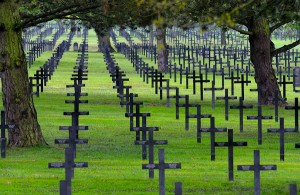
German war cemetery, Neuville-St-Vaast, Pas-de-Calais Copyright David CrosslandToday is Memorial Day according to the calendar: in my mind, it’s really not, it’s just the Monday “holiday” that replaced Memorial Day which ought to be on Friday of this week. Yes, in that regard, I’m a traditionalist; I don’t hold with the change made by Federal law back when I was in college, a change that moved Memorial Day and a couple of other significant civil holidays (Washington’s birthday, for example) from their real dates to a variable Monday, creating “three-day weekends”.

As a student, of course, I thought that creating three-day weekends was a great idea, but as I’ve grown older I think back to fond memories of May 30th Memorial Days with my mother tending my father’s grave, days that were a disruption in the normal flow of everyday life, days that jarred us into awareness, days that forced us to recollect his military service and the sacrifices he and his comrades had made. The Monday of a three-day weekend doesn’t do that.

We have lost something, and what I think it is is the dissonance of that interruption and awareness that it brings. When Memorial Day fell whenever it would, forcing us in the middle of the week to take time from work and school or on a Saturday disrupting our weekend gardening or sporting events, we took notice. The Monday of a three-day weekend doesn’t do that.

The Episcopal Church doesn’t have special lessons for the commemoration of Memorial Day; this is a secular holiday, not a religious one. So when we sit down to offer our prayers in formal worship on this day this year we have three choices: the Daily Office lessons for Monday in the sixth week of Easter; the daily Eucharistic lectionary; or the lessons for the commemoration of St. Augustine of Canterbury. (In another year on another date, these options would change.) None of these offer anything one could count as particularly appropriate to the day, but I am struck by how grossly inappropriate the Levitical discussion of slavery and the redemption of slaves is . . . grossly inappropriate and yet very instructive.

One cannot deny that the Bible approves of slavery, however that evil may be embodied in a culture. Although slavery as practiced by the Hebrews was different from that of the Roman Empire and both were very different from that practiced in the American South before the Civil War, Holy Scripture was easily used to justify an inhumane practice. What was ignored in American slavery was the Bible’s insistence that slaves be treated fairly, that they or their kin be able to redeem them, and that the price of redemption be just. That’s what today’s Old Testament reading is all about, setting a redemption price that would be just and equitable.

I suppose, if I were more of a historian, my meditations on the relationship between this text and Memorial Day might have focused on the fact that the holiday’s historical origins are found in the aftermath of the American Civil War and the abolition of slavery in this country. There might be some appropriate and instructive linkage between this discussion of a reasonable price to free a slave and the horribly unreasonable cost of thousands of soldiers’ lives to free the American slaves. But I’m not that much of a historian and my initial thoughts on reading the text were more personal: I remembered those Memorial Days with Mom at my father’s grave, those special disruptions in our day-to-day lives and I wondered about the cost of moving the holiday from a set date to a variable Monday.

It seems to me that, in one sense, the alteration in the holiday has exacted too high a price and in another has cheapened the remembrance. The high price paid is in our forgetfulness and its consequences. That the day has become just another Monday of a three-day weekend, a day for gardening and sporting events and picnics, helps us to forget — or more accurately, encourages us to not remember — the horrors of war and the sacrifices of those who fight, are wounded, and die. Forgetting — or not remembering — the unjust and inequitable price of past wars, we are more willing to send our young men and women into another one.

The change also cheapens our loved ones’ loss. My father was badly wounded in France in World War II: shrapnel nearly destroyed his right leg. Surgeons were able to save it and, after more than a year of rehabilitation and therapy, he was able to walk, but I never knew him not to walk without a painful and pronounced limp. I suspect that that pain was one reason he drank to excess, self-medicating himself into numbness, oblivion, and eventually an early death; another was probably what he witnessed around him on the battlefield. A day of remembrance barging into and making a mess of our daily lives is not a high price to pay to remember the sacrifice he made and the larger sacrifices made by those who died in battle. The Monday of a three-day weekend doesn’t do that. It’s too easy; it’s cheap. And to me, the son of veteran who paid much too high a price, it’s offensive.

The Law of Moses may have approved of slavery, but it didn’t cheapen human lives. It insisted that the price of a human being be justly and equitably determined. The Monday of a three-day weekend doesn’t do that.

====================

A request to my readers: I’m trying to build the readership of this blog and I’d very much appreciate your help in doing so. If you find something here that is of value, please share it with others. If you are on Facebook, “like” the posts on your page so others can see them. If you are following me on Twitter, please “retweet” the notices of these meditations. If you have a blog of your own, please include mine in your links (a favor I will gladly reciprocate). Many thanks!

====================

Father Funston is the rector of St. Paul’s Episcopal Church, Medina, Ohio.

Doing Something – From the Daily Office – May 24, 2014

From Matthew’s Gospel:

Jesus said, “Not everyone who says to me, ‘Lord, Lord’, will enter the kingdom of heaven, but only one who does the will of my Father in heaven.”

(From the Daily Office Lectionary – Matthew 7:21 (NRSV) – May 24, 2014)

Jesus Said What?I love this verse! I always think of it as Jesus’ version of “Don’t just stand there. Do something!”

If I could point to one bit of Holy Scripture that convinced me to become an Episcopalian, it would be this one. The King James Version’s rendition was the favorite offertory sentence of the Episcopal chaplain at the military academy where I went to high school and attended Evening Prayer or the Holy Eucharist everyday. I can still recite that version from memory: “Not every one that saith unto me, Lord, Lord, shall enter into the kingdom of heaven; but he that doeth the will of my Father which is in heaven.”

My childhood was largely an unchurched one. My earliest memories of going to church were in a Baptist congregation which eventually we ceased attending when the pastor declined to bury my non-church-member father (whose hard-drinking, Las-Vegas-Strip lifestyle he found objectionable); no more churchgoing after that. Summers were spent with my paternal grandparents who insisted that I go with them to an old-timey, very evangelical Methodist Church. The message at both those churches, so far as understood (and now remembered) by a grade school kid, was that all you needed to do to be “saved” was to claim Jesus as Lord and talk about him a lot. I never heard anything like this verse from Matthew and, by the time I was in junior high and no longer going to church with my grandparents, the talking-about-Jesus thing had worn a bit thin.

The liturgical worship of the Episcopal Church (back then, the 1928 Book of Common Prayer) resonated with me. I do have to admit that the first few weeks of attending daily chapel I was less aware of the words than of the rhythm of worship because I was getting used to the “Episcopal juggle” — when to use the prayer book, when to use the hymnal, when to use the service sheet or “bulletin” — and Episcopal calisthenics — when do I kneel? when do I stand? do I ever get to just sit still? But eventually the words started making an impact and the words of the chaplain’s favorite offertory sentence — “Not every one that saith unto me, Lord, Lord, shall enter into the kingdom of heaven; but he that doeth the will of my Father which is in heaven” — made a particular impact.

In addition to learning about the liturgy of the Episcopal Church, I was learning about the culture of the Episcopal Church. It was the 1960s. John Hines was Presiding Bishop; he was contributing to the Angela Davis Defense Fund! Episcopalians were marching with Martin Luther King, Jr. One of them, a seminarian named Jonathan Myrick Daniels, was shot and killed by a deputy sheriff in Alabama when Daniels moved to protect a 17-year-old black girl. (Daniels is now recognized as a martyr on the church’s sanctoral calendar.) Some Episcopalians were active in protesting the Vietnam War, while other Episcopalians served as chaplains in the military and were stationed in Vietnam — but both respected the other, worshipped together, and worked out their differences, whatever they may have been, through the church’s conciliar governance at diocesan and national (general) conventions.

I was captivated by the culture of the 1960s Episcopal Church. These weren’t people who simply claimed Jesus as Lord and talked about him a lot; these people did things! I joined, and as I got more active I found out Episcopalians did “smaller,” less noticed things — things like feeding the hungry, providing shelter for the homeless, opening their churches for free community concerts, tutoring kids struggling in school, teaching English to refugees from other countries — the list of things Episcopalians do, things I hadn’t seen in my parents’ and grandparents’ churches (although now I’m pretty sure they did at least a few of them; I hope they did), is long, almost endless.

It is my joy to be rector of a parish with an active food pantry ministry, a parish which opens its space each month for a free concert, a parish whose youth sleep outside in all sorts of whether to call attention to the plight of those without homes, a parish where youth and adults travel somewhere together every summer to build or repair the homes of those unable to do it themselves, a parish which doesn’t just call Jesus “Lord” but which actively does the things he told us were his Father’s will.

There are many, many reasons I became, and stay, an Episcopalian. An important one is that Episcopalians don’t just stand there — they do something!

====================

A request to my readers: I’m trying to build the readership of this blog and I’d very much appreciate your help in doing so. If you find something here that is of value, please share it with others. If you are on Facebook, “like” the posts on your page so others can see them. If you are following me on Twitter, please “retweet” the notices of these meditations. If you have a blog of your own, please include mine in your links (a favor I will gladly reciprocate). Many thanks!

====================

Father Funston is the rector of St. Paul’s Episcopal Church, Medina, Ohio.

What Is Joy? – From the Daily Office – May 19, 2014

From Book of Psalms:

The pastures of the wilderness overflow,
the hills gird themselves with joy,
the meadows clothe themselves with flocks,
the valleys deck themselves with grain,
they shout and sing together for joy.

(From the Daily Office Lectionary – Psalm 65:12-13 (NRSV) – May 19, 2014)

Joy Carved on StoneWhat is joy? A bible study group at church grappled with that question recently and I’m still thinking about the question, so these concluding verses of today’s evening psalm got my attention. It’s not just a matter of defining emotion. Joy is a religious attitude, a stance toward God mentioned numerous of times in the Holy Scriptures; according to St. Paul, it is one of the “fruits of the Spirit.” (Gal 5:22) It’s important to know what we mean when we name it.

In the bible study discussion, I found it amazing that, although “laughter” was mentioned as we tried to answer this question, the common synonyms “happiness,” “mirth,” “giddiness,” and the like (even “gladness”) were not. We wrestled with the issue by exploring such questions as: “When do you feel it?” “Who are you with?” “Where does it come from?” “Where are you when you know joy?” and a really tough one “How do you feel when you experience it?”

That question almost seems redundant, doesn’t it? But as we tried to answer that in some meaningful way another question was asked, “Did Jesus feel joy on the cross?”

Catholic philosopher Peter Kreeft says that joy “is more than happiness, just as happiness is more than pleasure. Pleasure is in the body. Happiness is in the mind and feelings. Joy is deep in the heart, the spirit, the center of the self.” If he’s right, and I think he is, then the answer to our question about Jesus must be “Yes.” Jesus felt joy on the cross!

Consider Christ’s “seven last words”:

“Father, forgive them; for they do not know what they are doing.” (Lk 23:34)
“Truly I tell you, today you will be with me in Paradise.” (Lk 23:43)
“Woman, here is your son” . . . “Here is your mother.” (Jn 19:26-27)
“My God, my God, why have you forsaken me?” (Mk 15:34; Mt 27:46)
“I am thirsty.” (Jn 19:28)
“It is finished.” (Jn 19:30)
“Father, into your hands I commend my spirit.” (Lk 23:46)

Read in this, the traditional order in which they are presented in Good Friday meditations, only one simply cannot be read or understood as containing any joy: Mark’s and Matthew’s report of his cry of despair, “Why have your forsaken me?”

Jesus had told his disciples that joy is the result of a relationship with God:

I am the true vine, and my Father is the vinegrower. He removes every branch in me that bears no fruit. Every branch that bears fruit he prunes to make it bear more fruit. You have already been cleansed by the word that I have spoken to you. Abide in me as I abide in you. Just as the branch cannot bear fruit by itself unless it abides in the vine, neither can you unless you abide in me. I am the vine, you are the branches. Those who abide in me and I in them bear much fruit, because apart from me you can do nothing. Whoever does not abide in me is thrown away like a branch and withers; such branches are gathered, thrown into the fire, and burned. If you abide in me, and my words abide in you, ask for whatever you wish, and it will be done for you. My Father is glorified by this, that you bear much fruit and become my disciples. As the Father has loved me, so I have loved you; abide in my love. If you keep my commandments, you will abide in my love, just as I have kept my Father’s commandments and abide in his love. (Jn 15:1-10)

He concluded this discourse saying to them, “I have said these things to you so that my joy may be in you, and that your joy may be complete.” (v. 11)

In the Psalms, the hills, the sheep, the trees, all of nature is described as experiencing and giving voice to joy. This makes sense only if joy is a relationship with God. On the cross, only once, only in that cry of “why have you forsaken me,” do we find Jesus unable to sense that connection. In fact, the “seven last words” in their traditional order evince the very human journey every person has experienced at one time or another during a time of trouble, a journey from trust in God (“Forgive them”) into the valley darkness where God seems absent and back out again with a renewed sense of kinship with God (“Into your hands, I commend my spirit”).

What is joy? A connection with God, a relationship in which we are fulfilled not by our own efforts, not by the circumstances in which we find ourselves, not by anything other than the Presence and grace of God. Even in the hardest and most troubling of situations, even hanging on a cross, we can know joy.

====================

A request to my readers: I’m trying to build the readership of this blog and I’d very much appreciate your help in doing so. If you find something here that is of value, please share it with others. If you are on Facebook, “like” the posts on your page so others can see them. If you are following me on Twitter, please “retweet” the notices of these meditations. If you have a blog of your own, please include mine in your links (a favor I will gladly reciprocate). Many thanks!

====================

Father Funston is the rector of St. Paul’s Episcopal Church, Medina, Ohio.

Psalms Are Not Science – From the Daily Office – May 17, 2014

From Book of Psalms:

For it was you who formed my inward parts;
you knit me together in my mother’s womb.
I praise you, for I am fearfully and wonderfully made.
Wonderful are your works; that I know very well.
My frame was not hidden from you,
when I was being made in secret,
intricately woven in the depths of the earth.
Your eyes beheld my unformed substance.
In your book were written
all the days that were formed for me,
when none of them as yet existed.

(From the Daily Office Lectionary – Psalm 139:13-16 (NRSV) – May 17, 2014)

Human FetusLet me make one thing clear: I do not want to get into the abortion debate! I never want to get into the abortion debate!

Whether and when to end a pregnancy is a personal and painful decision, one which I believe is ultimately to be made by one person, the pregnant one. Others may offer her advice and counsel, but when it comes right down to it no one other than her has any business making the decision. Abortion should not be a debate; it should be a private, medical decision by one person.

But I find myself rather frequently pummeled by those who do want to get into the abortion debate, beaten over the head by one side or the other with their particular arguments — most often, I must admit, by the so-called “Pro-Life” side. As a Christian pastor, I get mail, emails, and phone calls from (mostly) the anti-abortionists encouraging me to support their current efforts to restrict access to medically supervised termination of pregnancy.

And nearly every piece of literature they provide includes somewhere the assertion that “human life begins at conception.” And very often that statement is coupled with a citation to this part of Psalm 138.

So let’s make another thing clear: the psalms are not science. The Psalter is poetry and metaphor; the purpose of the psalms is primarily to praise God and secondarily to teach God’s people that the Almighty is to be praised because of the intimacy with which God loves us. These verses simply do not mean that God creates the inmost parts or the unformed substance of every fetus in every womb; nor do they address the issue of when human life begins! Even taken literally, all that this psalm is saying is that God made plans for David; it has nothing to do with when David’s, or any, life began or begins.

That is, basically, what the entire abortion controversy boils down to: when does human life begin? When does a fertilized ovum become a human person? That is a question with so many dimensions — theological, legal, moral, scientific, medical, spiritual, and more — that I’m not sure I can count them!

What I notice about these verses today is that all they name are the physical parts of the body: inmost parts, frame, substance. The spiritual aspect of human life is not mentioned; there is no thought given here to the soul, the spirit, the breath.

In Jewish and Christian theology a human person is only a human person when there is unity of the physical body with the spirit. In the Old Testament, the Hebrew noun nephesh is often translated as “soul,” but it is most often found in combination with adjective hayyah, meaning “living” or “alive.” In combination, the two are rendered “living being” or “soul alive,” but perhaps the best translation is “person.” There is human personhood only when there is both physical body and living spirit.

So when do they come together? The technical theological term is ensoulment. To ask “When does human life begin?” is to ask when ensoulment occurs.

In Jewish tradition, a baby is not considered to be a human person until its head emerges from the birth canal. According to the Talmud, “the fetus is the thigh of its mother,” which means that it is not considered an independent person until after birth. Indeed, some medieval Jewish sages held a child was not a bar kayyama or “lasting being,” i.e., a viable human being, until a month after being born. Obviously, traditional Jewish law and medieval Jewish wisdom did not give Psalm 138 the meaning our contemporary “Pro-Lifers” give it.

Christian tradition has been all over the board on the question.

Some sects (Mormons, for example — and another debate I don’t want to get into is whether members of the Latter-Day Saints are Christians) believe that the soul pre-exists the body, that God has parented or created numerous “spirit children” who await physical bodies in this world.

Some of the earliest theologians, e.g., Clement of Alexandria, Tertullian, and Gregory of Nyssa, taught that the egg and the sperm each carried a soul derived from the souls of the mother and the father, and that at conception these two proto-souls merged to form a new and distinct soul. This theory, called traducianism, is a direct and necessary development of the doctrine of Original Sin, which teaches that our sinful nature is passed from parent to child via concupiscence (sexual desire) and its (sinful?) satisfaction.

Interestingly, Augustine, who was responsible for much of the formulation of Original Sin, rejected traducianism; he favored what came to be known as Creationism, which is not the creationism which today does battle with evolutionary science.

Traducianism was rejected by the theologians of the Middle Ages — Thomas Aquinas, especially — and in favor of creationism. This view, based in part on Genesis 2:7 (“The Lord God formed man from the dust of the ground, and breathed into his nostrils the breath of life; and the man became a living being”) and Hebrews 12:9 (which distinguishes between our “human parents” and God who is the “Father of spirits”), holds that while the body is formed gradually the soul is directly created by God and enters the body when it is ready to receive it (a determination made by God).

Creationism was the accepted teaching of the church from the Fifth Century on . . . until recent times. In fact, from the late Middle Ages until the end of the 19th Century, the official teaching of the Roman Catholic Church (and the generally accepted position of most of Christianity) was that the soul enters the body of the fetus at the time of “quickening,” when the mother first feels movement.

So when does the soul enter the physical body? When does a fertilized ovum become a human person?

I don’t know.

Years ago I sat on a panel discussing abortion law and religion with an older colleague from the Eastern Orthodox tradition. He made this statement which I will never forget: “I would rather counsel a woman about legal abortion than bury a woman who’s resorted to an illegal one. And I’ve done both.” I have had to do the former, both before and after the procedure; that’s why I know so much (and so little) about this theology. Fortunately, unlike my colleague, I’ve not had to do the latter and I hope I never will.

I don’t know when “human life” begins, but I do know this: I do not want to get into the abortion debate, ever, even though I am often forced to. And I know this: abortion is a private, personal, and painful decision which is ultimately to be made by only one person, the pregnant one. And I know this: the psalms are not science.

====================

A request to my readers: I’m trying to build the readership of this blog and I’d very much appreciate your help in doing so. If you find something here that is of value, please share it with others. If you are on Facebook, “like” the posts on your page so others can see them. If you are following me on Twitter, please “retweet” the notices of these meditations. If you have a blog of your own, please include mine in your links (a favor I will gladly reciprocate). Many thanks!

====================

Father Funston is the rector of St. Paul’s Episcopal Church, Medina, Ohio.
Wrestling in Prayer – From the Daily Office – May 12, 2014

From the Letter to the Colossians:

Epaphras, who is one of you, a servant of Christ Jesus, greets you. He is always wrestling in his prayers on your behalf, so that you may stand mature and fully assured in everything that God wills.

(From the Daily Office Lectionary – Colossians 4:12 (NRSV) –May 12, 2014)

Hercules and Diomedes by Vincenzo de Rossi“Wrestling in his prayers” seems such an odd turn of phrase! Aren’t prayers supposed to be peaceful? The image of prayer as athletic competition (and vigorous, muscular, and very personal competition, at that) just seems contradictory. But the contradiction calls to mind two thoughts.

The first is that I remembered Jacob: “Jacob was left alone; and a man wrestled with him until daybreak. When the man saw that he did not prevail against Jacob, he struck him on the hip socket; and Jacob’s hip was put out of joint as he wrestled with him.” (Gen 32:24-25)

Doing early morning study of Koine Greek is probably a mistake . . . but I wondered, “Does Paul use the same word to describe Epaphras as the Septuagint uses to describe Jacob?” Short answer — no. Long answer — In Genesis, the wrestling contest is described using the word palaío; in Colossians, the word is agonizomai. The former is specific; the latter refers in general to athletic competition and may also mean “to struggle” or “to labor.”

Nonetheless, I wonder if Paul is calling Jacob’s late-night wrestling match with God to mind. If Jacob’s dream-time contest is a metaphor for prayer (and I think it is), then there is a striking contrast between first-party prayer (petition) which leaves the supplicant limping, and third-party prayer (intercession) which permits the subject to “stand mature and fully assured.” I don’t know what to make of this. Is there a suggestion that the prayers of others are more effective for our well-being than our own?

An Indian guru once said, “Prayer is not asking. It is a longing of the soul. It is daily admission of one’s weakness.” Was Jacob’s hip put out of joint by his encounter with God? Or was it always out of joint and the encounter merely led to a recognition or an admission of that fact? Prayer for oneself always does, in my experience, bring one up face-to-face with one’s own inadequacies. And, I have to say, I rely much more upon the prayers and prayerful support of others than upon my own. So perhaps there is something in the contrast Paul may be making.

The second, unrelated thought, is how often I struggle to find the “right words” with which to pray, both in private meditation and in public worship. As a priest, I am often asked to pray in public and, when that happens, I am grateful that, as an Episcopalian, I have been steeped in the language and cadences of The Book of Common Prayer. When I cannot think of anything original to say, I can rely on the prayerful words of generations of Anglicans and, from memory of the prayer book’s beautiful phrases, cobble something quickly together.

It is not always so in my private devotions. But that same Indian guru said of prayer, “It is better in prayer to have a heart without words than words without a heart.” So if my struggle to find the right words is unsuccessful, I just let it go and sit quietly, sure that God will understand me.

====================

A request to my readers: I’m trying to build the readership of this blog and I’d very much appreciate your help in doing so. If you find something here that is of value, please share it with others. If you are on Facebook, “like” the posts on your page so others can see them. If you are following me on Twitter, please “retweet” the notices of these meditations. If you have a blog of your own, please include mine in your links (a favor I will gladly reciprocate). Many thanks!

====================

Father Funston is the rector of St. Paul’s Episcopal Church, Medina, Ohio.

Ancestor Abraham – From the Daily Office – May 6, 2014

From the Gospel according to Matthew:

Do not presume to say to yourselves, “We have Abraham as our ancestor”; for I tell you, God is able from these stones to raise up children to Abraham.

(From the Daily Office Lectionary – Matthew 3:9 (NRSV) – May 6, 2014.)

StonesJohn the Baptizer is speaking to the Pharisees and the Sadducees, warning them against the very common human practice of relying upon the piety of our forebears instead of practicing our own faith. Relying on the religion of our ancestors is weakens and attenuates our own spirituality. One might as well be rocks lying by the roadside.

A few days ago, in what I consider a badly reasoned decision, Town of Greece v. Galloway, the U.S. Supreme Court upheld the practice of beginning secular legislative body meetings (in the particular case, a city council) with sectarian prayer. Justice Anthony M. Kennedy, writing for the majority, reasoned: “Legislative prayer has become part of our heritage and tradition, part of our expressive idiom, similar to the Pledge of Allegiance, inaugural prayer, or the recitation of ‘God save the United States and this honorable Court’ at the opening of this Court’s sessions.” He might as well have said, “We have Abraham as our ancestor.”

I’ve no problem with public prayer. I lead it on a pretty regular basis. I have a problem with prayer offered in a secular legislative body in a nation that is supposed to have a separation of church and state. The First Amendment to our Constitution includes two clauses which work that separation. One is known as “the establishment clause” and provides that government “shall make no law respecting an establishment of religion.” The other is called the “free exercise clause” and provides that government shall do nothing “prohibiting the free exercise” of religion.

A legislative body’s rule of procedure requiring prayer at the opening of its sessions violates at least the first of these clauses; it is a law establishing a religious practice. Arguably, it also violates the second clause although (as Kennedy and others have noted) no one is forced to participate in the prayer and, one supposes, could absent oneself from the session until the prayer was concluded.

My concern, in light of today’s reading from Matthew, is not with the Constitutional issue of public governmentally-sponsored prayer. Rather, it is with the notion that somehow the religiosity of our nation is dependent upon practices of government and the (mistaken) notion that our Founders (our equivalent of Abraham) intended this to be a “Christian nation.” This is the argument often made and now being repeated in innumerable online discussions of this ruling.

I can find no difference between “The Founders intended this to be a Christian nation” and “We have Abraham as our ancestor.” Both rely upon the supposed faith of long-dead forebears rather than the lively faith of living people. Any number of prayers may be recited at city council meetings or in state or national legislative chambers; unless and until the people of the nation begin actually living and practicing whatever religion they claim to hold — actually participating in religious events and, more importantly for Christians, feeding the hungry, clothing the naked, and housing the homeless — those prayers are no better than the protest of the Pharisees and Sadducees, “We have Abraham as our ancestor.”

This is especially true when Christian prayer opens a legislative session in which the legislators proceed to enact legislation which flies in the face of Jesus’ commands — when funds are stripped from feeding programs, when homelessness is made a crime, when public assets are diverted to the benefit of the rich at the expense of the poor. The prayer and the faith which it represents are rendered meaningless, with as little life as a pile of rocks.

There is a place for prayer, but it is not in the halls of government and it is not in the historic and attenuated traditions of long-dead forebears. It is in the hearts and lives of living persons acting out their faith. Relying on government-sponsored prayer is nothing more than claiming Abraham as our ancestor, nothing more than being dead stones.

====================

A request to my readers: I’m trying to build the readership of this blog and I’d very much appreciate your help in doing so. If you find something here that is of value, please share it with others. If you are on Facebook, “like” the posts on your page so others can see them. If you are following me on Twitter, please “retweet” the notices of these meditations. If you have a blog of your own, please include mine in your links (a favor I will gladly reciprocate). Many thanks!

====================

Father Funston is the rector of St. Paul’s Episcopal Church, Medina, Ohio.

« Older posts Newer posts »