Occasional thoughts of an Anglican Episcopal priest

Category: Prayer (Page 22 of 47)

“You Have Died (a Little)” – A Sermon for Easter Morning – April 20, 2014

====================

This sermon was preached on Easter Sunday, April 20, 2014, at St. Paul’s Episcopal Church, Medina, Ohio, where Fr. Funston is rector.

(The lessons for the day were: Jeremiah 31:1-6; Psalm 118:1-2,14-24; Colossians 3:1-4; and John 20:1-18. These lessons can be read at The Lectionary Page.)

====================

Shrouded CorpseSeveral days ago, as I was reading again the Easter story and the sections of the Holy Scriptures appointed for this year, I had the radio on and tuned to my favorite oldies station.

I was prayerfully considering and trying to figure out what Paul was saying to the Colossians when he wrote these words that we heard in the Epistle lesson for today: “You have died, and your life is hidden with Christ in God.” (Col. 3:3) I was trying to figure out what Paul meant by “hidden with Christ.” The Greek word is krypto and in addition to “hidden” it can also mean “secret” or “not noticed.” It is the origin of words like cryptogram and cryptography and also of crypt, a synonym for tomb. What does Paul mean? Is he saying our life is buried with Christ? Or that, somehow, the Christian life is a “secret” or that it goes “unnoticed”?

So I was pondering all of that and my oldies station played a very old and familiar song:

It hurts to be in love when the only one you love
Turns out to be someone who’s not in love with you
It hurts to love her so when deep down inside you know
She will never want you, no matter what you do

And so you cry a little bit
Oh, you die a little bit
Day and night, night and day
It hurts to be in love this way

Some of you are old enough to recognize the lyrics of It Hurts To Be In Love by Gene Pitney, a Top Ten hit from 1964.

And then, right after that song, the radio station played the one which has this as the refrain:

Strumming my pain with his fingers
Singing my life with his words
Killing me softly with his song
Telling my whole life with his words
Killing me softly with his song

That was a Number One hit for Roberta Flack in 1973.

Those songs played just as I was prayerfully considering and trying to figure out what Paul was saying to the Colossians when he wrote: “You have died, and your life is hidden with Christ in God.” (Col. 3:3) Now I don’t really think that God speaks to me through the radio or in the lyrics of popular songs, although it’s possible that God does. However, that coincidence of lyrics and Biblical text did take me down a path of revelation that I’d like to share with you this morning.

Those songs and songs like them – you can probably name several popular melodies going back to Cole Porter’s 1944 tune Every Time We Say Goodbye (“Every time we say goodbye, I die little”) or before – songs that mention this sense we have all had of “dying a little” because of a broken heart, because of the loss of a loved one, because of a disappointment in life. I think that’s why these songs become popular. We’ve all had that sense of “dying a little inside” for these and for many other reasons. And so Paul writes to the Colossians and to us:

“You have died, and your life is hidden with Christ in God.”

In his historical play Julius Caesar, William Shakespeare has his title character observe that “a coward dies a thousand times before his death, but the valiant taste of death but once.” (Act 2, Sc. 2) Ernest Hemingway took Shakespeare to task about that. In A Farewell to Arms he wrote:

‘The coward dies a thousand deaths, the brave but one’…. (The man who first said that) was probably a coward…. He knew a great deal about cowards but nothing about the brave. The brave dies perhaps two thousand deaths if he’s intelligent. He simply doesn’t mention them.

I think the truth is that everybody, valiant or cowardly, everybody dies many little deaths throughout our existence on this earth. Each and every one of us is “killed softly” in myriad ways by the circumstances of life. We have, as Paul wrote to the Colossians, died . . . many times over.

Sometimes those little deaths are the result of our own actions; sometimes they are the result of other’s actions; sometimes they happen because that’s just the way the world is. The world, though created by God to be good, is out of kilter; it is, we say theologically, fallen. The world and everything in it, including you and me, are not in the proper relationship with our Creator. We are not in proper relationship with one another. We call that “sin.” And sin, as the writer of the Letter to the Hebrews reminds us, has weight, a weight that clings to us like dirt, and each time we experience one of those little deaths a little more weight, a little more dirt is tossed on until, as Paul wrote in this simple verse in the letter to the Colossians, we are buried.

“You have died, and your life is hidden with Christ in God.”

Think about the weight of all that sin, all that dying, experienced in little ways every day by all the people who have ever lived . . . think of that weight crashing down
through the centuries,
through the millennia,
through all of time and all of space,
crashing down to a single hour,
a single moment,
a single instant,
on a hill outside of Jerusalem,
on a single man,
a man hanging on a cross
who cried out
“It is finished!”

“You have died, and your life is hidden with Christ in God.”

They took him down from the cross and laid him in a tomb and on the day after the Sabbath the women came and found the tomb empty. We know that story so well. It is the foundational story of our faith. We know it so well and yet we have to be reminded of it again and again because those little deaths seem to keep happening and hiding it from us. “Our life is hidden;” it gets buried under that weight; it goes unnoticed.
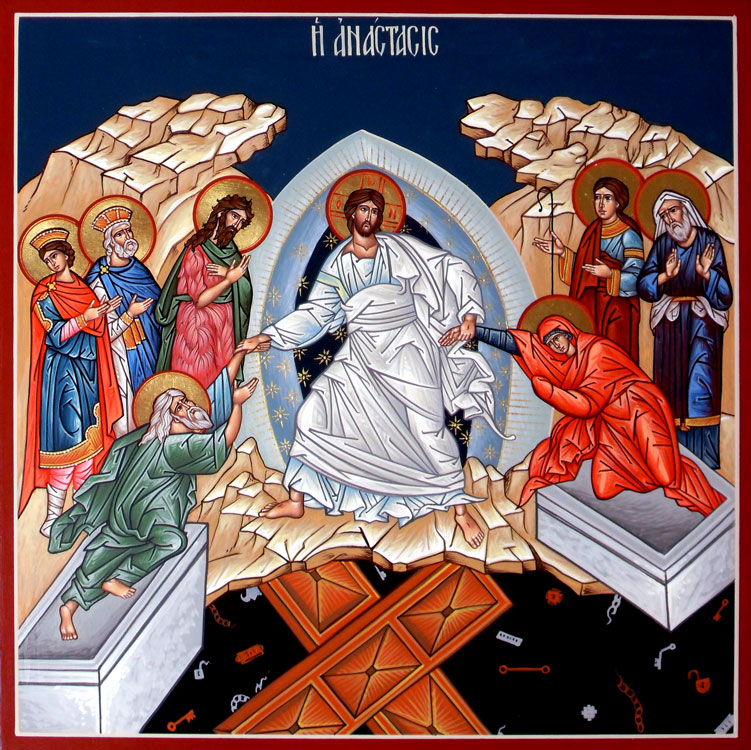
Anastasis IconIn the Eastern Orthodox tradition, icons of the Resurrection depict Christ rising from the tomb with a whole crowd of people. To one side of him crowned and haloed are King David and King Solomon; on the other, we see Abel the first martyr of creation carrying a shepherd’s crook and Moses the first prophet of the Old Covenant. Also present is John the Baptist, who is both the first prophet and the first martyr of the New Covenant. Beneath Christ’s feet, the gates of hell lie broken, often forming a cross. And from two tombs, Adam and Eve are rising, but not of their own accord; Jesus holds them by the wrists and is pulling them from their graves.

The mythological proto-parents of our race, the ancient kings, the prophets and martyrs . . . this little crowd represents all of humankind . . . you and me and all the people who have ever lived, all the people who have ever died any kind of death, whether physical death or the little daily kinds of dying we all have experienced . . .
we are all there,
all being pulled from death,
pulled from out of hiding,
pulled from where we are buried,
pulled from where the life God wants for us is unnoticed,
all rising with Christ to new life.

“In a moment, in the twinkling of an eye, . . . ‘Death has been swallowed up in victory.’ ‘Where, O death, is your victory? Where, O death, is your sting?’” (1 Cor. 52,54-55) “You have died, and your life is hidden with Christ in God.”

We celebrate Easter, the historical fact of the Resurrection of Christ, not because it is something that happened 2,000 or so years ago, although it is certainly that. We celebrate the Resurrection because it is something that happens every day. “You have died . . .” Every day in myriad little ways, as those popular songs and our own experience reminds us, we die a little. Every day our life is obscured and hidden; every day our life is made secret even from us and the life God wants for us goes unnoticed.

But . . .
“It is finished!”
That seemingly endless round of sinful little deaths is over;
it crashed down through time and space
to that one instant
on that one cross
and it was done with,
conquered!
“It is finished!”

Every day Jesus, rising from the tomb, grabs us by the wrist and pulls us from the grave. “I came,” said Jesus, “that they may have life, and have it abundantly.” (John 10:10) Every day, he pulls us up out of the little deaths of sin into the resurrection of that abundant life. “Death has been swallowed up in victory.” “It is finished!”

“When Christ who is your life is revealed, then you also will be revealed with him in glory,” wrote Paul. (Col. 3:4)
Christ has been revealed; we are revealed with him in glory.
Christ is risen.
We are risen!
Death is conquered!
“It is finished!”
We are free!
Alleluia!

====================

A request to my readers: I’m trying to build the readership of this blog and I’d very much appreciate your help in doing so. If you find something here that is of value, please share it with others. If you are on Facebook, “like” the posts on your page so others can see them. If you are following me on Twitter, please “retweet” the notices of these meditations. If you have a blog of your own, please include mine in your links (a favor I will gladly reciprocate). Many thanks!

====================

Father Funston is the rector of St. Paul’s Episcopal Church, Medina, Ohio.

Standing by Jesus – Sermon for Palm Sunday (Year A) – April 13, 2014

====================

This sermon was preached on Palm Sunday, April 13, 2014, at St. Paul’s Episcopal Church, Medina, Ohio, where Fr. Funston is rector.

(The lessons for the day were: Isaiah 50:4-9a; Psalm 31:9-16; Philippians 2:5-11; and Matthew 21:1-11. In addition, Zechariah 9:9-12 was read at the Liturgy of the Palms, and the Passion story, Matthew 26:14-27:66, was read at the conclusion of the Mass. Except for the Zechariah text, these lessons can be read at The Lectionary Page.)

====================

Donkey with Colt

When fishes flew and forests walked
And figs grew upon thorn,
Some moment when the moon was blood
Then surely I was born;

With monstrous head and sickening cry
And ears like errant wings,
The devil’s walking parody
On all four-footed things.

The tattered outlaw of the earth,
Of ancient crooked will;
Starve, scourge, deride me: I am dumb,
I keep my secret still.

Fools! For I also had my hour;
One far fierce hour and sweet:
There was a shout about my ears,
And palms before my feet.

That’s one of my favorite pieces of verse, The Donkey, by G.K. Chesterton, in which he captures Palm Sunday from the perspective of the donkey that Jesus rode.

Matthew’s version of Jesus’ entry into Jerusalem is somewhat confusing because he pluralizes the donkey. Did you notice that in the reading of the Gospel lesson? “The disciples went and did as Jesus had directed them; they brought the donkey and the colt, and put their cloaks on them, and he sat on them.” Why does Matthew do this (when none of the other Gospel writers do so)? Some have speculated that it is because Matthew wants to tell the story in a way that precisely mirrors the prophecy in Zechariah: as you can see in the Gospel reading, Matthew’s version of Zechariah is that the Messiah will come “mounted on a donkey, and on a colt, the foal of a donkey.”

That argument presupposes, however, that Matthew does not understand Jewish poetry which uses what is called “parallelism” to underscore or highlight a particular idea, saying the same thing in two or more ways, often connected with the conjunction “and”. But Matthew was an educated Jew, so that argument doesn’t float. Others have suggested that Matthew is the first Christian biblical literalist, but that doesn’t hold water either since Matthew’s Gospel is full of metaphor and allegory. No, the likely reason Matthew does this is to present Jesus as the least military, the least kingly, the least imperial of all possible messiahs. Bible scholar John Dominic Crossan points out that Jesus the Messiah (and Matthew the Gospel writer)

. . . want two animals, a donkey with her little colt beside her, and that Jesus rides “them” in the sense of having them both as part of his demonstration’s highly visible symbolism. In other words, Jesus does not ride a stallion or a mare, a mule or a male donkey, and not even a female donkey. He rides the most unmilitary mount imaginable: a female nursing donkey with her little colt trotting along beside her.

Matthew, Mark, and Luke also make point of telling us that Jesus approached Jerusalem from the east. They do this be situating us to landmarks: Matthew tells us in today’s lesson that it was “when they had come near Jerusalem and had reached Bethphage, at the Mount of Olives” that Jesus sent two of the disciples to get the donkey and the colt. This direction of approach is important.

At the time of the Passover, as pilgrims made their way into the city for the ritual observances, the population of Jerusalem would swell from around 50,000 (about twice the size of Medina) to well over 200,000 (more than the population of Akron). We know from secular histories that it was the custom for the Roman governor to make a militaristic triumphal entry to Jerusalem — with war horse, chariot, and weapons — each year in the days before Passover to remind the pilgrims that Rome was in charge. Because the Passover is a celebration of liberation from imperial Egypt, imperial Rome was very uneasy about so many people being in town. Pilate’s procession displayed not only imperial power, but also Roman imperial theology, according to which the emperor was not simply the ruler of Rome, but the Son of God.

The Roman garrison was on the coast at Caesarea Maritima, a city built by Herod the Great to honor Caesar Augustus, so their approach would have been from the west. So there were two processions into Jerusalem. One — the procession of the Roman army — coming from the west, demonstrating imperial might; the other — those with Jesus — coming from the east, making a clearly anti-imperial witness. Jesus’ subversive donkey ride reminded all those waving Palm branches that Rome was the new Egypt, and the Emperor was the new Pharaoh.

And, obviously, the crowd got it! People began to spread their cloaks on the road for Jesus to ride over like a red carpet; they remembered, perhaps, the story in the Second Book of Kings, which tells how the crowds spread their cloaks on the ground when Jehu was anointed King of Israel. They cut palm branches or other leafy plants as Jews did at other celebrations and festivals and strewed them in Jesus’ path; perhaps they remembered the admonition of Psalm 118: “The Lord is God, and he has given us light. Bind the festal procession with branches, up to the horns of the altar.” (v. 27) They must have, for they began chanting verses of that psalm:

Save us, we beseech you, O Lord!
O Lord, we beseech you, give us success!
Blessed is the one who comes in the name of the Lord.
We bless you from the house of the Lord. (Ps 118:25-26)

This is what Hosanna means. Hosanna is not a shout of exultation, though we have made it one; hosanna is a prayer for salvation. The Hebrew is h?shi `?h nn? and it means “Save now, we pray.”

Recognizing Jesus as the “Son of David,” the crowd chanted the words “Hosanna! Blessed is he who comes in the name of the Lord!” and others respond, “Blessed is the coming kingdom of our father David! Hosanna in the highest!”

The scene was set for a clash not only with the authorities of the Jewish nation, but with imperial Rome. The first Holy Week had begun. And ever since that first Holy Week, the followers of Jesus have been trying to figure out what to do with it. Sara Miles of St Gregory of Nyssa Episcopal Church in San Francisco says, “it’s kind of confusing: there’s a lot of different stuff going on in Holy Week. You could get whiplash” and she explains:

Think about it. During Holy Week, we wave palms in the air and hail Jesus as king, the long-awaited messiah who’s going to save us from our oppressors, then we change our minds and scream that the oppressors should crucify him; we share a loving last supper with Jesus and he washes our feet, then we sneak out after dinner and betray him. Jesus begs us to stay with him, we promise we will, then we don’t. We abandon him, he’s arrested and beaten; he forgives us, then we run away. Then Jesus is killed; we lay him in the tomb and weep; we go back for him, then he’s gone, then he’s back, and then — wait! — he’s not dead at all.

Spiritual whiplash, indeed!

But necessary whiplash, I’m afraid . . . . If we just skip from Palm Sunday to Resurrection Sunday, without stopping to ponder the days between, Jesus’ last supper with his friends, his night of tormented prayer in the garden, his scourging and crucifixion, the fear and anguish of his disciples, and their confusion on finding the empty tomb, then we will have misunderstood the whole thing. We’ll be lulled into believing that the Christian life is just one triumph after another. We will have failed to appreciate that triumph often comes with suffering and death. Palm Sunday is only the opening act of the drama of redemption; it takes courage and commitment to enter completely into the fullness of the story.

It is so much easier to come for the pomp of Palm Sunday and then go about our business for the week, ignoring Maundy Thursday and Good Friday, before coming back in for the trumpets, the lilies, the bells, and all the rest of the great show on Resurrection Sunday. But this year somebody needs to stand by Jesus. Somebody needs to hang in there with him. Somebody needs to stay at his side as he is humiliated, beaten, mocked, and killed. Holy Week is our annual confrontation with that choice.

The donkey had no choice facing her

One far fierce hour and sweet:
[When] There was a shout about [her] ears,
And palms before [her] feet.

She and her colt had not choice, but we do. If we don’t have the courage to stand by Jesus, who will?

====================

A request to my readers: I’m trying to build the readership of this blog and I’d very much appreciate your help in doing so. If you find something here that is of value, please share it with others. If you are on Facebook, “like” the posts on your page so others can see them. If you are following me on Twitter, please “retweet” the notices of these meditations. If you have a blog of your own, please include mine in your links (a favor I will gladly reciprocate). Many thanks!

====================

Father Funston is the rector of St. Paul’s Episcopal Church, Medina, Ohio.

Gathered – From the Daily Office – April 1, 2014

From the Genesis:

When Jacob ended his charge to his sons, he drew up his feet into the bed, breathed his last, and was gathered to his people.

(From the Daily Office Lectionary – Genesis 49:33 (NRSV) – April 1, 2014.)

Pine Box CoffinHe has kicked the bucket, cashed in his chips, shuffled off this mortal coil, gone the way of all flesh, croaked, gone home, passed away, turned up his toes, ridden the pale horse, fallen off his perch, taken his last bow, entered larger life, joined the choir invisible.

We have so many idioms and euphemisms for the simple reality of death. I suppose that is because death is frightening, although if we take our Christian faith seriously it should not be.

The epistle lesson for the Easter vigil is always a short reading from Paul’s letter to the Romans in which the Apostle reminds us that “we have died with Christ, [and] we believe that we will also live with him.” (Rom. 6:8) There really is nothing to fear. Still, we avoid even mentioning death by using all these idioms and euphemisms (and many more).

As these turns of phrase go, none is quite so lovely as this verse in Genesis describing the death of Israel (Jacob): “He was gathered to his people.” I find something about that very comforting; I’ve never been a big fan of the “going home” euphemism which it resembles (even though there is biblical warrant for it), but I find this image of joining earlier generations inviting. Perhaps that is because of the fond memories I have of childhood family reunions.

In a former parish, I had a congregant who frequently would turn the discussion in bible study or adult education classes to the question of life after death. “I just want to know what happens when I die,” she would say. “Martha,” I would answer, “I don’t know. I haven’t been there yet.”

I don’t know, but I do have faith that our Book of Common Prayer is accurate when it says (in the Preface to the Eucharist to be said at a requiem), “to your faithful people, O Lord, life is changed, not ended; and when our mortal body lies in death, there is prepared for us a dwelling place eternal in the heavens.” (BCP 1979, page 381) One of the collects in the Burial Office includes this petition: “Give us faith to see in death the gate of eternal life, so that in quiet confidence we may continue our course on earth, until, by your call, we are reunited with those who have gone before.” (page 493) Until, the writers of Genesis might have said, we are gathered to our people.

Lent begins with a reminder of our mortality: “You are dust and to dust you shall return.” Here in the middle of the season we find another, but rather more comforting, reminder: you are a part of a people and to your people you shall be gathered.

====================

A request to my readers: I’m trying to build the readership of this blog and I’d very much appreciate your help in doing so. If you find something here that is of value, please share it with others. If you are on Facebook, “like” the posts on your page so others can see them. If you are following me on Twitter, please “retweet” the notices of these meditations. If you have a blog of your own, please include mine in your links (a favor I will gladly reciprocate). Many thanks!

====================

Father Funston is the rector of St. Paul’s Episcopal Church, Medina, Ohio.

No Words – From the Daily Office – March 29, 2014

From the First Letter to the Corinthians:

No testing has overtaken you that is not common to everyone. God is faithful, and he will not let you be tested beyond your strength, but with the testing he will also provide the way out so that you may be able to endure it.

(From the Daily Office Lectionary – 1 Corinthians 10:13 (NRSV) – March 29, 2014.)

Tear on CheekA couple of months ago, a friend mine published a list of the ten things Christians can’t say while following Jesus. One of those things was “God never gives us more than we can handle.” My friend explained, “Ever tried saying this to a person contemplating suicide? No? Well, of course not. Why? Because it is just wrong. It’s wrong for the reason that #10 (Everything happens for a reason) is wrong and it’s wrong because factual circumstances of living prove that sometimes this life does bring with it more than we can handle.”

And here is Paul, in Paul’s own verbose inimitable way, saying exactly that, or is he? I’ll admit that I first read Paul as saying what my friend says Christians can’t say, but on reflection I think Paul is rather more nuanced than that. “God will not let you be tested beyond your strength” does not (as the thing we can’t say does) suggest that it is God doing the testing; further, Paul adds that God provides us additional strength (“the way out”) that should allow us to endure the testing.

The issue for us is whether we are able to recognize and take advantage of that “way out.”

I’ve known too many people who couldn’t, family members and friends who when faced with the trials and tribulations of life couldn’t handle them and simply cracked, became broken people. My father, who killed himself in a single-car motor vehicle accident while driving drunk, was probably one of them. My mother, who weathered that event and pulled herself and her children up out poverty into relative economic comfort, was not, although in retrospect I believe she waged a life-long battle with depression. How is one person able to contend with what life throws at us and one not?

Paul assures us that “no testing has overtaken you that is not common to everyone.” In other words, we all face the same trials; they are part of life, part of being human. They are not something “God gives us” to test us; God doesn’t give them to us at all. Some might not buy Paul’s assurances, but I think what he is saying is that the differences are of degree not kind, or perhaps that the differences have to do with our differing abilities and willingnesses to tap into “the way out” provided all of us by God.

Something I learned early in my ministry is that “the way out” has nothing to do with words, teaching, talking, writing, reading, or any of that. It has nothing to do with anyone hearing or anyone else saying “the right words.” Sometimes there are no right words. “The way out” has to do with human companionship, presence, and community.

When I was first ordained a deacon, a family in my congregation lost a teenage daughter to sudden and tragic death in a car accident. I couldn’t reach them by telephone when I first heard the news so I went to the family home thinking I could at least leave a note on the door. I found the parents just arriving home from the hospital. I had no idea what to say so I said virtually nothing; we simply sat together an wept. I felt like a complete pastoral failure; I had offered nothing that would “make it all make sense.” But several weeks later the girl’s mother sent me a short note thanking me for being there; specifically, she thanked me for not saying anything, for just being there to share their grief.

When Paul says that “no testing has overtaken you that is not common to everyone,” he is reminding us of the centrality of human community. When he says that God “will provide the way out,” that is what he is again referring to. God doesn’t send the test, the trial, or the tribulation. God, indeed, does not give us more than we can handle; he doesn’t give us these things at all! They are not from God. But the people around us, who weep with us when there are no words, who support us through the troubles, they are.

====================

Father Funston, a retired Episcopal priest, was last the rector of St. Paul’s Episcopal Church, Medina, Ohio.

Jesus’ Cellphone – From the Daily Office – March 27, 2014

From the Gospel of Mark:

Immediately he made his disciples get into the boat and go on ahead to the other side, to Bethsaida, while he dismissed the crowd. After saying farewell to them, he went up on the mountain to pray.

(From the Daily Office Lectionary – Mark 6:45-46 (NRSV) – March 27, 2014.)

Jesus with CellphoneJesus sure spends a lot of time on mountains! And I can understand why. They are generally inaccessible to all but the most determined making them the perfect place for someone who needs a little “down” time, a little bit of “I’m exhausted by all of this and need to recharge” time, a little “leave me be for a while” time.

It may be cynical of me, but my first thought reading these two verses was, “I hope he remembered to turn off his cellphone.” I have learned that lesson well, even though I sometimes fail to follow my own advice and answer the phone on my day away from church business and usually regret it when I do.

Why is it that we take little note of, and often ignore, these last two verses of the story of the feeding of the 5,000? When Matthew’s version of the tale is used in the Sunday readings (as Proper 13 in Year A of the Revised Common Lectionary), his similar statement is cut off from it:

Immediately he made the disciples get into the boat and go on ahead to the other side, while he dismissed the crowds. And after he had dismissed the crowds, he went up the mountain by himself to pray. (Matt 14:22-23)

Luke does not mention Jesus’ behavior after the miracle of the loaves and fishes, but neither Luke’s nor Mark’s versions are read in the Sunday rotation. John’s version ascribes a motive other than prayer to Jesus’ climbing the mountain: “When Jesus realized that they were about to come and take him by force to make him king, he withdrew again to the mountain by himself.” (John 6:15, RCL Year B, Proper 12)

I don’t give John’s political twist much credence. It may be that people wanted to “make him king,” after all the Jews were anticipating that sort of Messiah, but I suspect that exhaustion and the need for privacy were much bigger motives for Jesus at the moment.

When in public worship we end the story with the report that “those who ate were about five thousand men, besides women and children” (Matt. 14:21, cf. Mk. 6:44), we get an incomplete picture of Jesus. And John’s “I don’t want to be king” motivation for his departure just makes it worse! He becomes a superman who does incredible miraculous things with little or no effort and with no cost to himself, and then (like some super-spy) thwarts the political designs of the ignorant and ill-informed; as a model for life or ministry, he is an impossible paradigm. Being Christ-like becomes an impossible task beyond the ken of mortal human beings.

But what if we include these two verses, this post-script about depleted reserves, this acknowledgement of Jesus’ weariness and need to replenish? What a richer, more nuanced vision we are given! Jesus becomes a much more accessible savior! He truly is seen to be (as the writer of the Letter to Hebrews insisted) someone who is able “to sympathize with our weaknesses . . . in every respect . . . as we are.” (Heb. 4:15) He is seen as a model of healthy ministry, of self-care following service to others. We see him as someone who really would turn off his cellphone!

====================

A request to my readers: I’m trying to build the readership of this blog and I’d very much appreciate your help in doing so. If you find something here that is of value, please share it with others. If you are on Facebook, “like” the posts on your page so others can see them. If you are following me on Twitter, please “retweet” the notices of these meditations. If you have a blog of your own, please include mine in your links (a favor I will gladly reciprocate). Many thanks!

====================

Father Funston is the rector of St. Paul’s Episcopal Church, Medina, Ohio.

The Prisoner’s Groaning – From the Daily Office – March 24, 2014

From the Psalter:

Let the sorrowful sighing of the prisoners come before you,
and by your great might spare those who are condemned to die.

(From the Daily Office Lectionary – Psalm 79:11 (BCP Version) – March 24, 2014.)

Icon of Archbishop Oscar RomeroThis verse is from the optional additional evening psalm for today. I chose to focus on it because today is the commemoration (on the Episcopal Church’s sanctoral calendar) of the martyred Roman Catholic Archbishop of San Salvador, Oscar Romero. Today is the 34th anniversary of his assassination; he was shot to death while celebrating a private funeral mass for the mother of a friend.

Romero was a relatively conservative priest before being appointed a bishop in 1970. When he was made auxiliary bishop of San Salvador, he was not welcomed by the more radical progressives among the clergy; until his appointment as archbishop seven years later, he did not distinguish himself as any sort of social activist. He was made Bishop of the Diocese of Santiago de María in 1975 and then Archbishop of San Salvador in 1977. His appointment met with approval in Salvadoran government circles, who felt he would be a “safe” bishop, but was met with surprise and dismay by some clergy. They feared that with his conservative reputation he would put the brakes on liberation theology and their commitment to the poor.

However, a month after this elevation to archbishopric, a progressive Jesuit priest and personal friend, Rutilio Grande, was assassinated. Grande had been creating self-reliance groups (“base communities”) among the poor campesinos, a program seen as a threat to the right wing military supported government. His death had a profound impact on Romero who later stated “When I looked at Rutilio lying there dead I thought ‘if they have killed him for doing what he did, then I too have to walk the same path.” For the next three years, until his assassination, Romero’s theology became increasingly radicalized as he spoke out for the poor in his country.

Later that same year, on New Year’s Eve, Romero preached a sermon of which the today’s evening psalm, with its plea that God hear the groaning of suffering prisoners, reminded me:

For the church, the many abuses of human life, liberty, and dignity are a heartfelt suffering. The church, entrusted with the earth’s glory, believes that in each person is the Creator’s image and that everyone who tramples it offends God. As holy defender of God’s rights and of his images, the church must cry out. It takes as spittle in its face, as lashes on its back, as the cross in its passion, all that human beings suffer, even though they be unbelievers. They suffer as God’s images. There is no dichotomy between man and God’s image.

Whoever tortures a human being, whoever abuses a human being, whoever outrages a human being, abuses God’s image, and the church takes as its own that cross, that martyrdom. (Homily by O. Romero, December 31, 1977)

====================

A request to my readers: I’m trying to build the readership of this blog and I’d very much appreciate your help in doing so. If you find something here that is of value, please share it with others. If you are on Facebook, “like” the posts on your page so others can see them. If you are following me on Twitter, please “retweet” the notices of these meditations. If you have a blog of your own, please include mine in your links (a favor I will gladly reciprocate). Many thanks!

====================

Father Funston is the rector of St. Paul’s Episcopal Church, Medina, Ohio.

Stilling the Seas – From the Daily Office – March 21, 2014

From the Gospel of Mark:

On that day, when evening had come, he said to them, “Let us go across to the other side.” And leaving the crowd behind, they took him with them in the boat, just as he was. Other boats were with him. A great windstorm arose, and the waves beat into the boat, so that the boat was already being swamped. But he was in the stern, asleep on the cushion; and they woke him up and said to him, “Teacher, do you not care that we are perishing?” He woke up and rebuked the wind, and said to the sea, “Peace! Be still!” Then the wind ceased, and there was a dead calm. He said to them, “Why are you afraid? Have you still no faith?” And they were filled with great awe and said to one another, “Who then is this, that even the wind and the sea obey him?”

(From the Daily Office Lectionary – Mark 4:35-41 (NRSV) – March 21, 2014.)

Boat in Violent WavesMark, who is usually so taciturn and parsimonious with his descriptions, goes into rather great detail telling this story of Jesus calming the sea. A detail often overlooked is the second sentence of verse 36: “Other boats were with him.” (When Luke tells the same story in chapter 8 of his gospel, he leaves out this detail.)

One presumes that these other boats were being as tossed about, as beaten by the waves, as nearly swamped as that in which Jesus and disciples found themselves. One presumes that they also experienced the dead calm when Jesus rebuked the winds and commanded the say, “Peace! Be Still!” Unlike the passengers in Jesus boat, they would have had no idea what the cause of the sudden stillness might have been.

It’s interesting that this story is paired in the morning with Psalm 69, in which the rising waters of a swamp are used as a metaphor for an abundance of “lying foes” (v. 5) and “those who hate me” (v. 16), while in the evening the psalm appointed in Psalm 73, in which the source of one’s trouble is internal rather than external, arising from envy of “the wicked” who seem to have more than they deserve:

When my mind became embittered,
I was sorely wounded in my heart.
I was stupid and had no understanding;
I was like a brute beast in your presence.
(Ps. 73:21-22, BCP 1979, p. 688)

Are our lectionary editors suggesting that the raging storms in our life are as often caused by our own internal mechanisms as by the machinations of others? I think they are. Are they encouraging us to believe that Jesus can calm all chaos, both internal and external? I think they are.

And that little-noted half-verse in the gospel story reminds us that chaos and disruption, whether brought from outside or created from within, never affect only one person or one small group. Chaos and confusion are like the storm-tossed sea that disrupts everything around; the raging storm may have been centered on Jesus’ boat, but “other boats were with him” and just as certainly in danger of being swamped. And when it was stilled, the other boats also benefited. So it is when our lives (or those of others around us) are beset by chaos and trouble, external or internal, and when those troubles end and a calm settles unexpectedly on all about.

I’ve experienced those times when, all of a sudden, what had seemed a raging, chaotic mess simply resolved in a moment and settled into something manageable. It occurs to me now that it may have been because a storm, internal or external, in someone else’s life was calmed in ways and by means unknown to me. So this morning I give thanks for the stilling of the seas in others’ lives and for the undeserved calm it brings into mine.

====================

A request to my readers: I’m trying to build the readership of this blog and I’d very much appreciate your help in doing so. If you find something here that is of value, please share it with others. If you are on Facebook, “like” the posts on your page so others can see them. If you are following me on Twitter, please “retweet” the notices of these meditations. If you have a blog of your own, please include mine in your links (a favor I will gladly reciprocate). Many thanks!

====================

Father Funston is the rector of St. Paul’s Episcopal Church, Medina, Ohio.

Carrying Our Mat – From the Daily Office – March 14, 2014

From the Gospel of Mark:

Some people came, bringing to him a paralyzed man, carried by four of them. And when they could not bring him to Jesus because of the crowd, they removed the roof above him; and after having dug through it, they let down the mat on which the paralytic lay. When Jesus saw their faith, he said to the paralytic, “Son, your sins are forgiven.”

(From the Daily Office Lectionary – Mark 2:3-5 (NRSV) – March 13, 2014.)

Paralytic Lowered Through the RoofIt’s a familiar story. A paralyzed man on a pallet comes to Jesus carried by his friends. They can’t get by the crowd, so they cut a hole in the roof of the house where Jesus is staying. (The first verse of the chapter says “he was at home” in Capernaum. That’s an interesting thing to say of someone who “has nowhere to lay his head,” [Matt. 8:20] but I don’t want to be distracted by that this morning.) The man on his mat is lowered through the hole and Jesus heals him. A pretty straightforward story of a miracle healing.

Except for one thing. In every other story that I can think of it is the faith of the sick person that Jesus witnesses or credits with accomplishing (or at least setting up) their healing. In this story, it is “their faith,” the faith of the paralytic’s friends (perhaps his, as well, but the Greek taken in context is clearly plural).

We live in a world in which the besetting sin is individualism. Our (Episcopal Church) Presiding Bishop, Katharine Jefferts Schori, has commented that she believes the notion of a “personal relationship with Jesus” is “the great Western heresy—that we can be saved as individuals, that any of us alone can be in right relationship with God.” In her opening statement to the General Convention of 2009, she went on to say, “It’s caricatured in some quarters by insisting that salvation depends on reciting a specific verbal formula about Jesus. That individualist focus is a form of idolatry, for it puts me and my words in the place that only God can occupy, at the center of existence, as the ground of being.” Jesus attention to the faith of the paralytic’s community, not simply his personal faith underscores the communal nature of the Christian creed.

The writer of the letter to the Hebrews touched on this in the Daily Office epistle lesson for Ash Wednesday when he noted that we are surrounded by “so great a cloud of witnesses” and suggested by way of admonition that this allows us to “run with perserverance the race that is set before us.” (Heb. 12:1) Any of us alone cannot be in right relationship with God; we are surrounded and supported by the community of faith. The writer of Hebrews also emphasized the community in the next verse when he said of Jesus that he is the “pioneer and perfecter of our faith.” (12:2)

This is why the Nicene Creed was originally written as a “We believe . . . .” statement. Made personal as an “I believe . . . .” creed in Latin and then in English, it is now properly translated in the current Episcopal Church prayer book. It is a statement of the faith of the community, not that of any one individual. (The Apostle’s Creed, on the other hand, is a personal statement of faith made by the individual especially in connection with his or her baptism.)

When we recite the Nicene Creed together in worship, we are all standing on the roof of the house lowering the paralytic to the floor beneath where Jesus can heal him or her. We are also the paralytic on the pallet. Our voices united are the ropes and the Creed, “the sufficient statement of the Christian faith” as Anglicans call it, is our mat. Jesus bids us to stand up and carry our mat for all to see: “Let your light shine before others, so that they may see your good works and give glory to your Father in heaven.” (Matt. 5:16)

====================

A request to my readers: I’m trying to build the readership of this blog and I’d very much appreciate your help in doing so. If you find something here that is of value, please share it with others. If you are on Facebook, “like” the posts on your page so others can see them. If you are following me on Twitter, please “retweet” the notices of these meditations. If you have a blog of your own, please include mine in your links (a favor I will gladly reciprocate). Many thanks!

====================

Father Funston is the rector of St. Paul’s Episcopal Church, Medina, Ohio.

Lenten Rejoicing – From the Daily Office – March 6, 2014

From the Prophet Habakkuk:

Though the fig tree does not blossom,
and no fruit is on the vines;
though the produce of the olive fails
and the fields yield no food;
though the flock is cut off from the fold
and there is no herd in the stalls,
yet I will rejoice in the Lord;
I will exult in the God of my salvation..

(From the Daily Office Lectionary – Habakkuk 3:17-18 (NRSV) – March 6, 2014.)

Dry Farm FieldsLent began yesterday and I heard the question at least 50 times: What are you giving up for Lent? It’s a legitimate question given that the church through the centuries has (in the words of the American Book of Common Prayer) invited her members “to the observance of a holy Lent . . . by prayer, fasting, and self-denial.” (BCP 1979, pg 264) We humans just tend to look on the negative side of things and focus on the sense of deprivation this tradition inspires.

Every year for longer than I have been ordained, I have tried to encourage my fellow Christians to see in the “giving up” a making room for something else. Giving up your favorite television program? You now have that hour each week for some other activity, reading the Bible maybe, or taking a walk and enjoying God’s creation. Not eating chocolates? What are you doing with the money saved? If the giving up creates space for something healthier or more productive, is it really privation? Oughtn’t we to give thanks for the opportunities, rather than bemoan the lost pleasures?

So, I’m glad to see my favorite bit of Habakkuk this morning. In a time of forced, not voluntary, privation, he could nonetheless give thanks, rejoice in the Lord, exult in God. That’s the example we should be following during Lent. The proper question is not, “What are you giving up?” The proper question is, “What are you rejoicing about?”

====================

Father Funston is the rector of St. Paul’s Episcopal Church, Medina, Ohio.

Temporary Reminder – From the Daily Office – March 5, 2014

From the Letter to the Hebrews:

Therefore, since we are surrounded by so great a cloud of witnesses, let us also lay aside every weight and the sin that clings so closely, and let us run with perseverance the race that is set before us . . . .

(From the Daily Office Lectionary – Hebrews 12:1 (NRSV) – March 5, 2014.)

Ashes on a ForeheadMany years ago, when I was a child growing up in Las Vegas, Nevada, my dad and I went fishing on Lake Mead. I was five years old, but already a pretty good swimmer. After we’d caught a few bass, we decided to go swimming.

I think we must have been somewhere near one of the marinas, because some time during that swim I encountered a slick of oil or motor fuel and found myself coated with a smell film of petroleum distillate of some sort. I tried several times to rinse it off, but once it got on my skin, it wasn’t coming off. My dad and I ruined a couple of my mother’s towels wiping it off, but it didn’t really wipe off.

On the drive home (the seat in my dad’s Thunderbird protected by another of my mom’s towels), the stuff dried, my skin got sticky and kind of stiff feeling. At home, my mother scrubbed me until my skin burned, but that petroleum odor still seemed to stick around for days – other people couldn’t smell it, but I sure could.

When I read this verse of the letter to the Hebrews, I think of that oily stuff — “the sin that clings so closely” — no matter how much rinsing, how much wiping, how much scrubbing, it’s still there. Others may not see it, but we can feel it. Others may not see it, but we can smell it. We know it’s there! The author of the letter encourages us to “lay it aside,” but that is easier said than done. On our own, we can’t lay it aside; we can’t rinse, wipe, or scrub it off. It is permanent! . . . Or is it?

Today is the Day of Ashes, that Wednesday forty days before Easter when we symbolize that sin and our own mortality with a smudge of oily ash on our foreheads — in the same place where the priest at our baptism or the bishop at our confirmation places a cross of oil marking us a Christ’s own, we are marked again with a reminder that we are nonetheless soiled by sin and liable unto death . . . Or are we?

The chrism, the holy oil marking us as an adopted child of God, is there first. Like a shield or a protective skin, it guards us from being permanently stained. Because of that protective buffer (what St. Paul might have called “the armor of light” — Romans 13:12 — or even “the whole armor of God” — Ephesians 6:11) the sin which clings so closely is not permanent; we are not permanently soiled and liable to death! Through the power of Christ, that sin can be set aside.

The smudge is merely a temporary reminder, not a permanent stain.

====================

Father Funston is the rector of St. Paul’s Episcopal Church, Medina, Ohio.

« Older posts Newer posts »