Occasional thoughts of an Anglican Episcopal priest

Category: Prayer (Page 31 of 47)

Made and Fashioned . . . and Fat! – From the Daily Office – June 12, 2013

From the Psalter:

Your hands have made me and fashioned me . . . .

(From the Daily Office Lectionary – Psalm 119:73a (BCP Version) – June 12, 2013.)

Over Weight Man Waist MeasurementI started to write a meditation about St. Paul’s arrogance (today’s epistle lesson is one of his bits of baggadocio that always annoys me. So when I reviewed today’s lessons yesterday, that’s what caught my eye.

But then, last night, my wife and I went out to dinner. One of the local restaurants has added a “heart-smart” vegan menu to its line-up of extremely expensive steaks and seafood. Since our children are vegans we are always on the look out for places where we can take them out to dinner when they visit us. We decided to check it out. I had the vegan burger. It was very good and not unreasonably priced. (My gin martini up with a twist and my wife’s glass of merely passable old vine Zinfandel, those were unreasonably priced!)

After eating we walked back to our car parked about a block away, which meant that we had to work past several plate-glass-window fronted restaurants and other stores. I got a look at my reflection.

I’m fat. I hate to say that. I hate the words; I hate the condition. But I’m fat. I’m an old man with a large gut.

So this morning, I sat down to write that reflection about how Paul is a braggart . . . but when I read again all the selections of Scripture for today, the first half of the first verse of the evening psalm was what got my attention.

“Your hands have made me and fashioned me . . . .” Well great, God! Couldn’t you have done a better job? I’ve fought excess weight all my life! When I was preparing to enter the ordained ministry, going through the screening and “discernment” process, the psychologist I had to meet with put in his report to my bishop that I had “a tendency to build weight.” A tendency!!!???!!! Hell, yes! More than a tendency. No matter what I do . . . I get fat.

I’m what the weight loss industry calls a yo-yo dieter. I follow some weight loss program, lose a little bit (sometimes a lot), but I can’t maintain the loss and gain back the weight, and then some. And I’ve tried all the options – Weight Watchers (in several of its incarnations – exchanges, points, calories, whatever), physician-supervised fasts, protein-sparing fasts, Atkins, South Beach, Dr. Fuhrman, you name it. Lose weight, gain it back, get fatter.

And I do my best to stay reasonably active. I’m not a sportsman of any sort. I don’t run (bad feet and ankles make that impossible) and even walking is sometimes difficult. But I know I need to increase my activity level.

I have to do something about this. I hate being fat! Your hands have made me and fashioned me, God. Help me get to a healthy weight! Please!

====================

A request to my readers: I’m trying to build the readership of this blog and I’d very much appreciate your help in doing so. If you find something here that is of value, please share it with others. If you are on Facebook, “like” the posts on your page so others can see them. If you are following me on Twitter, please “retweet” the notices of these meditations. If you have a blog of your own, please include mine in your links (a favor I will gladly reciprocate). Many thanks!

====================

Father Funston is the rector of St. Paul’s Episcopal Church, Medina, Ohio.

What a Long, Strange Trip – From the Daily Office – June 10, 2013

From the Second Letter to the Corinthians:

Look at what is before your eyes.

(From the Daily Office Lectionary – 2 Corinthians 10:7a (NRSV) – June 10, 2013.)

Road to the Desert HorizonDo we ever really know what is “before our eyes”?

I’ve been saying the Daily Office and reading the associated lessons of the two-year-cycle lectionary for the better part of 40 years and never before has this short sentence jumped out at me like it does today!

30 years ago tonight, my wife and I made the short trip from our small bungalow in East San Diego, where we had lived while I attended law school, to Sharp Hospital in Kearney Mesa where she would, early the next morning, give birth to our son, Aidan Patrick. If anyone had said to us, “Look at what is before your eyes,” we would have described a life of law practice and stability in our home state of Nevada. We had it pretty definitely planned out. We were very definitely wrong!

As I thought about the last three decades, a line from a song kept popping into my head. I’d like to be all religious and spiritual and pretend it is a line from a hymn . . . but it’s not. The words are, “What a long, strange trip it’s been.” From Truckin’ by the Grateful Dead. Now that song is an ear-worm which probably will eat away at me all day. What it’s definitely done is taken over this meditation.

So rather than write some other words, I give you the lyrics to Truckin’:

Truckin’ got my chips cashed in.
Keep truckin’, like the do-dah man
Together, more or less in line, just keep truckin’ on.

Arrows of neon and flashing marquees out on Main Street.
Chicago, New York, Detroit and it’s all on the same street.
Your typical city involved in a typical daydream
Hang it up and see what tomorrow brings.

Dallas, got a soft machine; Houston, too close to New Orleans;
New York’s got the ways and means; but just won’t let you be.

Most of the cats that you meet on the streets speak of true love,
Most of the time they’re sittin’ and cryin’ at home.
One of these days they know they gotta get goin’
Out of the door and down on the streets all alone.

Truckin’, like the do-dah man.
Once told me “You got to play your hand,”
Sometimes your cards ain’t worth a damn, if you don’t lay ’em down,

Sometimes the light’s all shinin’ on me;
Other times I can barely see.
Lately it occurs to me
What a long, strange trip it’s been.

What in the world ever became of sweet Jane?
She lost her sparkle, you know she isn’t the same
Livin’ on reds, vitamin C, and cocaine,
All a friend can say is “Ain’t it a shame?”

Truckin’, up to Buffalo. Been thinkin’, you got to mellow slow
Takes time, you pick a place to go, and just keep truckin’ on.

Sittin’ and starin’ out of the hotel window.
Got a tip they’re gonna kick the door in again
I’d like to get some sleep before I travel,
But if you got a warrant, I guess you’re gonna come in.

Busted, down on Bourbon Street, Set up, like a bowling pin.
Knocked down, it get’s to wearin’ thin. They just won’t let you be.

You’re sick of hanging around and you’d like to travel;
Get tired of traveling and you want to settle down.
I guess they can’t revoke your soul for tryin’,
Get out of the door and light out and look all around.

Sometimes the light’s all shinin’ on me;
Other times I can barely see.
Lately it occurs to me, What a long strange trip it’s been.

Truckin’, I’m a goin’ home,
Whoa whoa baby, back where I belong,
Back home, sit down and patch my bones, and get back truckin’ home.

Now that I sing it through, I realize this is a song that’s all spiritual and religious. It occurs to me that life is a trip and, despite Paul’s admonition, no matter how careful we scope it out, we really can’t see what is before our eyes. We always end up looking back and saying, “What a long, strange trip it’s been!”

Strange and wonderful. Thanks be to God!

====================

A request to my readers: I’m trying to build the readership of this blog and I’d very much appreciate your help in doing so. If you find something here that is of value, please share it with others. If you are on Facebook, “like” the posts on your page so others can see them. If you are following me on Twitter, please “retweet” the notices of these meditations. If you have a blog of your own, please include mine in your links (a favor I will gladly reciprocate). Many thanks!

====================

Father Funston is the rector of St. Paul’s Episcopal Church, Medina, Ohio.

Offal Theology Beats Awful Theology – Sermon for the 3rd Sunday after Pentecost (Proper 5C) – June 9, 2013

====================

This sermon was preached on the Third Sunday after Pentecost, June 9, 2013, at St. Paul’s Episcopal Church, Medina, Ohio, where Fr. Funston is rector.

(Revised Common Lectionary, Pentecost 3 (Proper 5, Year C): 1 Kings 17:8-24; Psalm 146; Galatians 1:11-24; and Luke 7:11-17. These lessons can be read at The Lectionary Page.)

====================

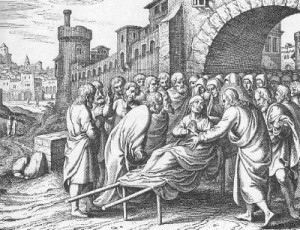
Jesus Raises the Son of the Widow of NainYou may remember that last week, as we were looking at the story of Elijah competing with the prophets of Ba’al, I said that Elijah was an unpleasant person. Well, this week we have another story of Elijah and another example of his unpleasantness. The Rev. Lia Scholl, a Mennonite pastor who writes sermon helps on a blog called The Hardest Question, said, “Every time I read this passage, my first reaction is, ‘Elijah is a jerk!'”

She points out that doesn’t ask for a drink of water or a morsel of bread, he demands them. Listen again to what the First Book of Kings says, “When [Elijah] came to the gate of [Zarephath], a widow was there gathering sticks; he called to her and said, ‘Bring me a little water in a vessel, so that I may drink.’ As she was going to bring it, he called to her and said, ‘Bring me a morsel of bread in your hand.'” He doesn’t introduce himself; he doesn’t explain himself; he just insists that the widow take care of his needs. “It’s just jerk behavior,” says the Rev. Scholl.

For the moment, though, let’s forgive Elijah his jerkiness, his unpleasant personality, and take a close look at this story. If it is an historical event (and about that there is some considerable doubt), and if the Books of Kings are intended to be a chronological record, then our lectionary has had us read about events in Elijah’s life out of sequence; this story is told one chapter before the sacrifice competition we heard about last week. The reason for us reading the stories out of order is pretty clear; our lectionary editors want us to hear and consider this story in connection with Jesus’ raising of the son of the widow of Nain.

This story about Elijah would have been very familiar to Jesus and those who witnessed what he did in Nain, and it’s possible that this Elijah story was known to Luke. They may have believed it to be an historical fact, but modern scholarship considers it unlikely that this is a factual story. It has the appearance of being a legend or folk tale intended by the author of First Kings to enhance Elijah’s standing as a prophet. First, there is the matter of the magic flask of oil and the magic container of flour, these vessels that never run out during the course of the three-year drought that is said to be affecting the land. (By the way, Elijah is credited with both causing and ending the drought with just a word, but other than this story in First Kings, there’s no evidence in any other historical or archeological record of there being a drought around his time.) Second, there is the manner in which Elijah brings the widow’s son back from the dead. Here’s the way it is described: “He [meaning Elijah] stretched himself upon the child three times.” This is what folklorists and anthropologists would call “sympathetic magic;” Elijah mimics the death of the boy, then acts out his desired resurrection, then utters some sort of magical formula, in this case a prayer to his god, Yahweh.

Now I said that those who witnessed Jesus raise the son of the widow of Nain probably knew this story and probably thought of it as factual. It is this prayer that Elijah speaks, and in fact the whole theology of the story, that makes me glad that we can look back at it and say it probably isn’t!

Listen to what the widow of Zarephath said to Elijah when her son died: “What have you against me, O man of God? You have come to me to bring my sin to remembrance, and to cause the death of my son!” This is awful theology! The widow blames herself for her child’s death. She believes that something she has done has caused her son to die. We still hear this kind of thinking today; we’ve all heard people in fits of grief cry out, “What have I done to deserve this?” Worse, she blames God because God’s prophet, Elijah, has come to her and this (she believes) has caused her sin to be recalled by God; in turn, because of that recollection, God has caused this terrible judgment (the death of her son) to happen. Now the poor woman in her grief, I suppose, can be forgiven this awful theology.

But Elijah in his prayer, his magic incantation after stretching out on the body of the deceased and enacting the boy’s resurrection, says exactly the same thing to God: “O Lord my God, have you brought calamity even upon the widow with whom I am staying, by killing her son?” According to the theology of this story, God punishes the sinful behavior (what ever it may have been) of parents by murdering their children!

I am often called upon to engage in conversation with atheists who want to tell me why they don’t believe in God. I don’t go looking for these conversations, but wearing a clerical collar in an airport or a restaurant or wherever they just seem to happen. And when they tell me why they don’t believe in God, in addition to all the allegedly scientific reasons about there being no credible experimentally verifiable evidence, there is always some variation on, “I can’t believe in a god that would allow (or cause) children to die.”

“Well, guess what?” I tell them. “I don’t either!” I don’t believe in the god that this story of Elijah portrays. I do not believe the theology of this story is correct! And that’s why I’m glad that I can say, “Modern biblical scholarship strongly suggests that this story never happened.” It was and is merely folklore preserved to enhance the reputation of this jerk Elijah as a powerful, miracle-working prophet of God.

But as I suggested, the people who witnessed Jesus’ action in raising the son of the widow of Nain revered Elijah’s memory and probably did believe it to be factual, and that’s why what Jesus did was so important. Let’s set Elijah and his awful theology aside for a moment and just focus on the gospel story.

First of all, let’s make note of the fact that this story is one of only three in which Jesus raises someone from the dead. One is the raising of the synagogue leader Jairus’s daughter told in all of the Synoptic Gospels. The second is the raising of Lazarus told only in John’s Gospel. And then there is this story told only by Luke.

In the first two, Jesus is asked by the grieving father, or by Lazarus’ grieving sisters, to come and heal their sick relative, but before he comes the patient dies. In this story, there is no request at all, and Jesus’ first knowledge of the death is when he happens upon the funeral procession. Luke writes, “As [Jesus] approached the gate of the town, a man who had died was being carried out. He was his mother’s only son, and she was a widow; and with her was a large crowd from the town. When the Lord saw her, he had compassion for her.” That’s it, that’s the key to this story. Jesus had compassion for the widow.

What does that word mean to you? When someone is said to be “compassionate,” what do you understand them to be saying? I asked some high-schoolers what it meant to them and one of them volunteered, “Well, it means you feel sorry for someone.” The rest all agreed with that. I suppose to most modern American folk that is what it means. We feel sorry for someone, so maybe we lend a hand if we have the time, or give a few dollars to charity, or if it’s someone we know we bake a casserole. The root of our word “compassion” is Latin for “feeling with” and feeling someone else’s sorrow, feeling “sorry for them” is part of that.

But that doesn’t hold a candle to the word Luke uses to describe Jesus! The Greek text here is the verb splanchnizomai. You know how some words just stick with you? When I was learning Greek that was one that did – splanchnizomai – I just loved the sound of it. It derives from the noun splanchna, which refers to offal, to inner organs – intestines, spleen, liver, kidneys – we would say “guts” today. Jesus didn’t just “feel sorry” for the widow of Nain; he felt this woman’s pain and grief down here, down deep, down in his offal, down in his guts . . . and he was determined to do something for her.

So Jesus does the unthinkable; he interrupts a funeral procession and takes hold of the corpse! In any culture that would be a violation of, at the very least, good taste, but amongst First Century Palestinian Jews this was an act of unspeakable uncleanness; it was a sacrilege! One simply did not touch, let alone grab hold of a dead body!

I was present at both my father’s and my paternal grandfather’s funerals. They were open-casket funerals because of their Lodge affiliations – my father was member of the BPOE; my grandfather, a Mason. Both groups have special funeral services that require an open casket. I remember that the morticians had arrange their hands so that they were laid across their chests, and I remember that both my mother and my grandmother at the conclusion of the services went up to the coffin, reached out, and grabbed hold of their husband’s hands. I’m certain that both of them, if they could have, would have pulled them out of those boxes and made them live again. They couldn’t, of course, but Jesus could do that for the widow of Nain. He could do it and did do it because he had compassion; he felt her pain and her grief right down there in his gut, and he gave her back her son.

And that is what makes this story so different from our Old Testament story!

The theology of the story of Elijah with widow of Zarephath tells of a god who punishes parents’ wrong doing by murdering their children. Jesus showed that theology to be not merely wrong, but awful, monstrously awful! God is a god of life, not of death. God is a god who not only does not murder children to punish their parents, God gives dead children back to their parents.

God moves powerfully beyond our theologies, especially our monstrous theologies, to give new life, to perform a new creation. God is a god of compassion, a god who feels our pain and our suffering and our grief down deep in God’s guts. (One might say that the offal theology of Jesus is beats the awful theology of Elijah.)

The Lord sets the prisoners free;
because the Lord feels their captivity in his guts.

the Lord opens the eyes of the blind; *
because the Lord feels their blindness in his guts.

the Lord lifts up those who are bowed down;
because the Lord feels their degradation in his guts.

the Lord sustains the orphan and widow.
because the Lord feels their pain and grief and loneliness in his guts.

The offal theology of Jesus beats the awful theology Elijah! Hallelujah!

====================

A request to my readers: I’m trying to build the readership of this blog and I’d very much appreciate your help in doing so. If you find something here that is of value, please share it with others. If you are on Facebook, “like” the posts on your page so others can see them. If you are following me on Twitter, please “retweet” the notices of these meditations. If you have a blog of your own, please include mine in your links (a favor I will gladly reciprocate). Many thanks!

====================

Father Funston is the rector of St. Paul’s Episcopal Church, Medina, Ohio.

Writing Sermons – From the Daily Office – June 8, 2013

From the Psalter:

Lord, you have searched me out and known me.

(From the Daily Office Lectionary – Psalm 139:1 (BCP Version) – June 8, 2013.)

to consider something deeply and thoroughlyToday, it is the evening psalm that I ponder.

The NRSV translation of the first verse of Psalm 139 is similar to that in The Book of Common Prayer: “O Lord, you have searched me and known me.” One renders the Hebrew verb chaqar as “search out;” the other as “search.” And both have always caused me to stop short and wonder, “What? The omniscient, omnipresent God has to look for me?”

Good thing chaqar has some other understandings:

  • In the First Book of Samuel, David is afraid that Saul has decided to kill him and so his friend, Saul’s son Jonathan, tells David that he will “sound out” his father. Chaqar is the verb translated as “sound out.” (1 Samuel 20:12 NRSV)
  • In the First Book of Kings, chaqar is rendered as “determined” when it is used in the story of Solomon making the bronze vessels for the Temple. They could not be weighed “because there were so many of them; the weight of the bronze was not determined.” (1 Kings 7:47 NRSV) – The New American Standard version of this verse uses “ascertained” to translate the Hebrew.
  • In the story of Job, the New American Standard translation uses “ponder” to translate chaqar when Elihu says to Job: “I waited for your words, I listened to your reasonings, while you pondered what to say.” (Job 32:11 NAS)

So “searching” or “searching out” as used in the Psalm doesn’t mean “looking for.” It means giving careful consideration, as in the weighing of precious metal vessels in the First Book of Kings. Even more, it means the give-and-take between two persons, the “sounding out” of ideas, the coming to mutual understanding as two people share their thoughts. And it means to contemplate and meditate upon what the other has revealed, to ponder what he or she has communicated.

Ponder is not a word we use much anymore in modern American English. Say the word to most people and probably the first thing that will come to their minds is the opening stanza of a famous American poem:

“Once upon a midnight dreary, while I pondered, weak and weary,
Over many a quaint and curious volume of forgotten lore,
While I nodded, nearly napping, suddenly there came a tapping,
As of some one gently rapping, rapping at my chamber door.
“Tis some visitor,” I muttered, “tapping at my chamber door —
Only this, and nothing more.”
(Edgar Allen Poe, The Raven)

Ponder, the dictionary tells us, means “to consider something deeply and thoroughly.” That is an image of God that resonates with me. I know full well that God is not an entity, not a being in the sense that God sits in heaven’s library late at night pondering over ancient tomes, leafing through the Book of Life or the Book of the Dead or the whichever book it is in which our “names are written in heaven.” (Luke 10:20) Nonetheless, I am intrigued and even comforted by that image.

Because that is precisely what I do! Especially on a Saturday when I do the final polishing of my sermon for the next day (and, if truth be told, more often than not “final polishing” actually means “start from scratch!”) Surrounded by bibles and books, my computer humming away, a cup of coffee (or other libation) nearby, I ponder God. That God might be simultaneously pondering me delights me. Together we ponder one another, we sound each other out, we ascertain our thoughts; perhaps (one hopes) we become “united in the same mind and the same purpose,” and perhaps within my mind forms “the same mind . . . that was in Christ Jesus.” (1 Cor. 1:10; Philip. 2:5) Hopefully, that gets onto the paper and into the sermon. That is, after all, the goal of writing and preaching homilies!

Lord, you have pondered me and known me; I ponder you and seek to know you . . . . and to preach your truth.

====================

A request to my readers: I’m trying to build the readership of this blog and I’d very much appreciate your help in doing so. If you find something here that is of value, please share it with others. If you are on Facebook, “like” the posts on your page so others can see them. If you are following me on Twitter, please “retweet” the notices of these meditations. If you have a blog of your own, please include mine in your links (a favor I will gladly reciprocate). Many thanks!

====================

Father Funston is the rector of St. Paul’s Episcopal Church, Medina, Ohio.

Justice Begins At Home – From the Daily Office – June 6, 2013

From the Book of Deuteronomy:

You shall appoint judges and officials throughout your tribes, in all your towns that the Lord your God is giving you, and they shall render just decisions for the people. You must not distort justice; you must not show partiality; and you must not accept bribes, for a bribe blinds the eyes of the wise and subverts the cause of those who are in the right. Justice, and only justice, you shall pursue, so that you may live and occupy the land that the Lord your God is giving you.

(From the Daily Office Lectionary – Deuteronomy 16:18-20 (NRSV) – June 6, 2013.)

Hands Through Prison BarsJustice. When I was initiated into the “free and accepted” fraternity of Masons, I was taught that justice is “that standard or boundary of right which enables us to render to every man [sic] his just due without distinction.” Justice, I was told, “is not only consistent with divine and human laws, but is the very cement and support of civil society.” Furthermore, my instructor continued, justice in large measure “constitutes the really good man, so should it be the invariable practice of every Mason never to deviate from the minutest principal thereof.”

As a child in Sunday School, I learned that justice is a quality of the kingdom of Heaven made real in the church’s practice of acceptance and equality. But that really wasn’t true in the church of the early 1950s – not everyone was accepted and not everyone was equal. In fact, I don’t think I would be too far off the mark to say that the Christian church then and now has done a pretty lousy job of teaching, by word and example, what justice, on an individual and personal basis, is. The Masons’ initiatory instruction probably does a better job of personalizing the idea of justice than does any teaching of the church.

We’re pretty good at teaching about “social justice” and addressing justice as a global goal. There are several books and websites where one can read something similar to this (copied from a popular church website):

It is central to the Christian faith that God desires a world in which justice is done. However, the past hundred years have revealed the scale of injustice in the world to be greater than anyone had previously imagined. Global forces that are deeply unfair determine the destiny of the world’s poorest people and cause damage to the planet’s environment. War and suffering follow. This has led to a planet on which, every eight seconds, a child in the developing world dies from diarrhea because his or her community has dirty water. When seen through God’s eyes, this and many similar issues are an outrage.

Striving for justice and working for peace, particularly for the world’s poorest people, are at the heart of what it means to be a follower of Jesus. The good news he came to announce was that suffering and oppression could be brought to an end. Christians believe that their faith should lead them to be the people who help bring that about.

The challenge Christians face is to have a personal way of life that does not add to the world’s problems. This means adopting a simple lifestyle in which the world’s resources are not wasted, buying goods that have been fairly traded, and changing habits that damage the environment. In the richer parts of the world many of them support and give money to organizations that are seeking to improve the conditions of the world’s poorest people, to end conflicts, and to preserve the planet.

I have no real quibble with what this says about justice on a global scale. My concern is, “What do we do about justice in our personal lives and in our most intimate local communities, our parish churches?”

This became an issue in my parish when a church member was arrested, and the fact of the arrest and the nature of the charges were splashed across the front page of the local newspaper’s Friday morning edition. The details are unimportant; what is important is how the rest of the church will deal with this parishioner and other members of the family.

On reading the newspaper, I contacted the family; on Saturday, I visited the arrestee at the county jail. I assured them all of my prayers. But then, in the privacy of my study, I began to wonder, “Should I say anything about the situation in church? Should I rework my sermon for Sunday?” At our early service, I said nothing; but just before our principal service, because of something I was asked by another member, I knew I had to address the issue. Our practice is to make announcements before beginning our worship, so when those were concluded, I said something along these lines:

You may have read Friday’s paper or have learned otherwise that a member of this congregation has been arrested and jailed. None of us know the details, so none of us really has anything to say. What I would ask is that we not speculate, not gossip, not spread rumors, and not judge. Instead, let us keep our fellow member and the family in our prayers, and allow the justice system to do its job. Let’s remember that as Americans we are bidden to treat everyone as innocent until proven guilty, and as Christians we are bidden to forgive even the guilty.

Was that enough? I asked some colleagues; I asked friends on Facebook: “Do you know of resources to help a pastor lead a congregation through dealing with the rather public and embarrassing arrest of a parish member?”

Pretty much deafening silence followed . . . .

I searched the internet.

Pretty much nothing there . . . .

I did learn that there is something called Prison Ministry Awareness Sunday among North American Orthodox Christians. This year, an encyclical from the Assembly of Canonical Orthodox Bishops sets the observation on June 9 and calls on members of Orthodox faith communities to participate in the church’s ministry to those who are in prison, and to support and encourage “those who bring the Gospel of hope and salvation to the incarcerated.” Their letter begins with these words:

We greet you in the surpassing joy of the Risen Christ. By the grace of God, we are blessed to observe the Sixth Sunday of Pascha, which this year falls on June 9, as Prison Ministry Awareness Sunday. We embrace the diakonia of prison ministry in keeping with the example of our Risen Lord Jesus Christ, the Great Physician of our souls, who did not come to call the righteous, but sinners to repentance; who ate in the houses of thieves and forgave the sins of harlots; and who said that, when we visit those in prison, we are in truth visiting Him, the Lord of Glory. (Orthodox Christian Prison Ministry, emphasis in original.)

I believe the Orthodox bishops are on to something. How we handle the arrest and incarceration of a parishioner should be informed by Jesus’ description of the Last Judgment in the 25th chapter of Matthew. When he says, “I was in prison and you visited me” by visiting “one of the least of these who are members of my family,” we should hear his words as addressing the full experience of arrest, arraignment, trial, and sentence. As anyone goes through that process, we should see that person as bearing Jesus’ identity, and however we relate to that person and his or her family will reveal how we relate to Christ. This is especially true of those who are our brothers or sisters in the local Christian community.

Concern for global social justice is well and good, and it certainly has and deserves a place in the teachings and practice of the church. But in light of our parish experience, I believe that, like charity, justice begins at home. How we treat one another in these difficult circumstances in the intimate setting of our parish communities is foundational of our efforts to promote justice in the wider sense.

I’m troubled that there seem to be so few resources available to clergy and church members providing guidance in these circumstances. The Sentencing Project reports that “the United States is the world’s leader in incarceration with 2.2 million people currently in the nation’s prisons or jails — a 500% increase over the past thirty years.” Surely this is something that will increasingly occur in our parishes. We need to address it.

====================

A request to my readers: I’m trying to build the readership of this blog and I’d very much appreciate your help in doing so. If you find something here that is of value, please share it with others. If you are on Facebook, “like” the posts on your page so others can see them. If you are following me on Twitter, please “retweet” the notices of these meditations. If you have a blog of your own, please include mine in your links (a favor I will gladly reciprocate). Many thanks!

====================

Father Funston is the rector of St. Paul’s Episcopal Church, Medina, Ohio.

An Olive Tree in the House of God – From the Daily Office – June 3, 2013

From the Psalms:

But I am like a green olive tree in the house of God;
I trust in the mercy of God for ever and ever.

(From the Daily Office Lectionary – Psalm 52:8 (BCP Version) – June 3, 2013.)

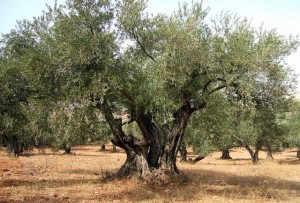
Olive Tree in IsraelThe writers of the psalms used trees a lot as a metaphor for the righteous. The very first psalm says, “They are like trees planted by streams of water, bearing fruit in due season, with leaves that do not wither; everything they do shall prosper.” (Ps. 1:3, BCP) Throughout the psalms we find references to specific types of trees, and today “a green olive tree.”

When we lived in Las Vegas we had two olive trees in our front yard, very large, well grown trees. We had a great arborist who trimmed and shaped them each year. They were beautiful trees with gnarled, twisting, yet graceful trunks. Their leaves were dark green on the top side, silver on the underside: when the wind blew they seemed to shimmer. Their grace and character set them apart from other trees. They provided wonderful shade in the hot desert summer, but they were messy. Olive trees are very productive; they dropped lots of fruit and lots of leaves!

Our olive trees were purely decorative. The fruit they produced was useless. In biblical Israel, however, the olive was a very important tree, a source of food, light, hygiene, and healing. For nearly 6,000 years, olives have been eaten in the Mediterranean as a staple food. Olive oil has been used for cooking, in lamps for light, for medicine, in bathing, and for religious anointing.

Olives are also extremely hardy, which is why we had them as shade trees in our desert landscape. They will live and produce fruit in any conditions: hot, dry, cold, wet, rocky, or sandy. It is said that you can’t kill an olive tree: when cut down or burned, new shoots will emerge from the root.

To be an olive tree, then, is to endure and to be productive. To endure and be productive in the house of God is the goal of every person of faith. As Paul reminded the Romans, endurance produces character, and character produces hope, and hope does not disappoint. (Rom. 5:5-4)

The Palestinian pastor of the Evangelical Lutheran Christmas Church in Bethlehem, the Rev. Mitri Raheb wrote in Bethlehem Besieged, “At times, when we feel as if the world must be coming to an end . . . our only hopeful vision is to go out . . . and plant olive trees. If we don’t plant any trees today, there will be nothing tomorrow. But if we plant a tree today, there will be shade for our children to play in. There will be oil to heal the wounds, and there will be olive branches to wave when peace arrives.”

This is what it is to be an olive tree in the house of God.

====================

A request to my readers: I’m trying to build the readership of this blog and I’d very much appreciate your help in doing so. If you find something here that is of value, please share it with others. If you are on Facebook, “like” the posts on your page so others can see them. If you are following me on Twitter, please “retweet” the notices of these meditations. If you have a blog of your own, please include mine in your links (a favor I will gladly reciprocate). Many thanks!

====================

Father Funston is the rector of St. Paul’s Episcopal Church, Medina, Ohio.

Ten Authentic Years – Sermon for Pentecost 2 (Proper 4C) – June 2, 2013

====================

This sermon was preached on the Second Sunday after Pentecost, June 2, 2013, at St. Paul’s Episcopal Church, Medina, Ohio, where Fr. Funston is rector.

(Revised Common Lectionary, Pentecost 2 (Proper 4, Year C): 1 Kings 18:20-39, Psalm 96, Galatians 1:1-12, and Luke 7:1-10. These lessons can be read at The Lectionary Page.)

====================

10th AnniversaryTen years ago yesterday, June 1, 2003, I became Rector of St. Paul’s Episcopal Church of Medina, Ohio, Inc. We didn’t celebrate that “new ministry” until sometime in October because of difficulties scheduling bishops and other dignitaries, but on Sunday, June 1, 2003, I presided at the Holy Eucharist for the first time in this space.

It was different then. One of the things we’ve done in the past ten years is remodel this space (thanks to a gift from Verna Bruckmann in memory of her late husband Jack whom many of us remember with affection). We’ve also upgraded the parish library, refurbished the dining room, and improved the parish hall (thanks to the good fund-raising efforts of the Episcopal Church Women). We’ve purchased additional real estate, torn down the derelict houses that were on it, incorporated those lots into our landscaping, and replanted nearly all of the decorative gardens, mostly with volunteer labor.

But more important than the building and the grounds are the ministries through which we have touched peoples’ lives. In these ten years, there have been more than 1,500 celebrations of the Holy Eucharist in this sanctuary! That means just here, in this space, there have been more than 250,000 administrations of Holy Communion; more than a quarter of a million times communicants have received the Blessed Sacrament, this sacrament which (as one of our prayers of thanksgiving says) is “the pledge of our redemption” through which the grace of God brings us “forgiveness of our sins, strength in our weakness, and everlasting salvation.”

During these ten years, since we started the Brown Bag Concerts in 2007, there have been more than seventy free concerts and recitals in this space, which means something on the order of 4,000 concert-goers have received the gift music which (the poet Berthold Auerbach said) “washes away from the soul the dust of everyday life.”

There have been more than seventy baptisms, more than forty-five weddings, and more funerals than I care to remember. Each summer up to fifty children have come into this worship space to sing songs, act in skits, and learn the stories of the faith at our annual Vacation Bible Schools.

And downstairs, twice month, 220 times in these ten years, the Free Farmers’ Market has opened its doors and provided sustenance to those unable to afford it in the stores. I suppose a statistician or an economist would invent some measure for what has been distributed like a “family-week of groceries” — we’ve distributed something like 16,000 or more “family-weeks” of food and other items to hundreds of needy households. All told, nearly a half-million pounds, 250 tons, of food have been given away by this parish.

And that’s just a small sample of the statistics we could boast. There have been home visits, picnics, hospital communions, confirmations, study groups, foyer groups, potluck suppers, and so much more.

It’s been a good ten years. So . . . Happy Anniversary!

I’ll come back to consideration of our decade together, but for now, let’s take a look at the lessons for today.

What we have in our three selections from Scripture this morning are stories of authority, but more than that, they are stories of authenticity. Let’s take a look at each one in turn.

First, we have the story of a competition between Elijah, a prophet of Yahweh, the God of Israel, and the priests and prophets of Ba’al, who was the god (or perhaps the pantheon of gods) of the Phoenicians. Elijah was a well-known prophet. We know that he was known in Syria and in Egypt and in other places because the Bible tells us this, that he was known as “the man of God.” Not simply as “a man of God” but as “the man of God.” He was well known as a prophet, but he was not well known as a pleasant fellow – I’ll get to that in a moment.

In our story today, “the man of God” is dealing with a competing religion. Ba’al worship had been brought to Israel when King Ahab married a woman whose name is familiar to all of us, Jezebel, the daughter of Ethbaal, King of Tyre. The marriage of their king to this Phoenician princess and his allowing her to set up temples and practices of her native religion in Shechem, the capital of the northern kingdom, caused a problem for the people of Israel. Should they continue in their old religion (represented by Elijah) or in this new religion followed by their queen and, eventually under her influence, their king? Being politically astute, they did the logical thing – a little bit of both. And this is where we enter the story in today’s reading from the First Book of Kings.

An assembly is called and Elijah says to everyone, “How long will you go limping with two different opinions? If the Lord is God, follow him; but if Ba’al, then follow him.” Nobody says a word . . . . So Elijah proposes a contest. “Let’s do this,” he says, “well set up two altars and put a bull carcass on each one. The priests of Ba’al will call on their god to consume his bull with fire and I’ll call on my god to consume his bull with fire, and the one that actually does it will be acknowledged as the god to be worshiped in this country.”

I love the way the New Revised Standard translation gives the people’s response: “Well spoken!” they say. It’s like he was just giving a speech – the Gettysburg Address or something. The actual Hebrew is “good utterance.” The American Standard translation renders it better as, “That is a good idea!” Everybody loves a sporting event; everybody loves a good contest! Good idea!

So they do it. The priests and prophets of Ba’al set up their altar and do their best. They chant and dance and even cut themselves in an attempt to get their god’s attention, but nothing. Then it’s Elijah’s turn. But before he prays, he tells those present to make it really hard to burn up the altar and the bull sacrifice – “Douse it with water,” he says, “douse it good.” Three times they flood it, until water is running everywhere and the whole place is a muddy mess.

That’s when he says, basically, “OK, God, do it!” And God does it – a lightning bolt or a pillar of fire or something – and all the wood, the water, the bull, the whole shebang is burnt up!

But this is where our lectionary gives us a false impression of the story. Our “official” reading cuts off a verse before the story actually ends. We are left hearing that all the people “fell on their faces and said, ‘The Lord indeed is God; the Lord indeed is God.'” It sounds like everybody, including the followers of Ba’al, agreed Yahweh was the real deal and lived happily ever after. Not so . . . .

The next verse:

Elijah said to them, “Seize the prophets of Baal; do not let one of them escape.” Then they seized them; and Elijah brought them down to the Wadi Kishon, and killed them there. (1 Kings 18:40)

You see, Elijah was not a particularly pleasant person. We know this from the story of Elijah cleansing the Syrian leper, the general Naaman; he wouldn’t even bother to talk to Naaman, just sent him a message to bathe in the Jordan. That really annoyed Naaman. And we see it in spades here. Elijah had won this battle. God was proven to be the true God and Ba’al was shown to be powerless. But Elijah can’t just leave it there; he has to drive the point home by slaughtering those who had served the false god. This really annoys Queen Jezebel who will send her army to find and kill Elijah. You all know the story of Elijah hiding in the cave and living through a storm, a mighty wind, and an earthquake, but finally hearing the voice of God in the silence. This little competition with and killing of the prophets of Ba’al is why he was hiding.

So this is a story of authority – the authority of Yahweh as the true god and the authority of Elijah as his prophet – but it is also a story of authenticity. Elijah made no bones about who and what he was; he was not a pleasant fellow. And everyone knew it. Nonetheless, they clearly respected him. Despite his unpleasantness, this defect in his character, they respected his role and office as a prophet of the living God. And God empowered him as and who he was.

So . . . second reading — the introduction to Paul’s Letter to the Galatians. Reading one of Paul’s letters it is always best to remember that almost all of them were written to solve problems.

Paul’s method of evangelism was to ride into town, spend time getting to know the people, gather a group of folks interested in the story of Jesus, share the gospel with them and instruct them, identify the leaders in the group, empower those leaders (ordain them, if you will) to carry on and minister within the community, and then move on to some new town and start the process all over again. What would happen then is that the community would have some problem and someone would contact Paul – “Dear Paul, you aren’t going to believe what is going on . . .” – and he would write a letter giving his advice on how to deal with it.

This is what has happened in Galatia. After Paul left, two other groups of Christian missionaries showed up and tried to convince the Galatians that Paul had been wrong. The first group were the Gnostics. The Gnostics had been around since before Jesus, but they’d sort of adopted Jesus as one of their own; some who were exposed to the Gnostic teachings found in Jesus the sort of teacher they’d had before. Gnosticism gets its name from the Greek word for “knowledge” and their approach to religion and spirituality was based on the idea that through special knowledge one could escape the evil of the material world. They thought that the material world was bad and that salvation was achieved by leaving it behind, and the only way to leave it behind was through initiation into this special or secret knowledge. Christian Gnostics taught that Jesus had given the secret knowledge to the Twelve and they had then passed it on to a few special leaders who passed it on to chosen initiates, and so forth. To them, Paul’s response was, “No way! The Gospel is open and transparent. It’s for everyone!”

The second set of folks who were causing the Galatians problems were Jewish Christians who taught that before you could be a Christian you had to be a Jew. We call them “the Judaizers.” They were teaching that a Gentile had to first convert to Jewish law and practice. Gentiles had to “keep kosher” (as we would currently say), then they could be baptized and be followers of Jesus’ Way. For example, they taught that adult males had to be circumcised. (I think it may have been one of those adult males who wrote to Paul – “You aren’t going to believe what these people are saying!”)

Paul’s response to the Judaizers was also a big “No way!” What he wrote to the Galatians was that Jesus and Jesus’ good news redeems them where and as they are. They do not need to become something else, something different. Rather, they need to be authentically themselves. It is as their authentic selves that Jesus redeems them and empowers them to be better Gentiles; they don’t have to become Jews.

Again, it is a story of authenticity and of God’s respect for people as and who they are.

Which brings us to the gospel lesson from Luke, a healing story told in both Matthew’s and Luke’s Gospels, but in Luke’s version it is unlike any other in all of the Gospels. In no other healing story does Jesus never talk to the person making the request, nor address the person being healed, nor even see (let alone touch) the person being healed, but that is exactly what happens here according to Luke. As Jesus arrives in Capernaum, some Jewish elders come to him and tell him about this Roman Centurion who has been very good to their community. Apparently there is someone in his household who is very important to him and this person is gravely ill. The Greek is unclear — the word used is pais which could mean “son” or “servant” or “slave” or, even possibly, “beloved” — but what is clear is that the Centurion would like this person healed.

Jesus is convinced by the elders to do so and sets off for the Centurion’s house. Before he gets there, however, the Roman sends messengers saying, “You don’t need to come. I’m unworthy to have you to enter my home. Just say the word and my son/servant/beloved will be healed.” Perhaps the Centurion knows of the Jewish custom forbidding an observant Jew from entering a Gentile home. In any event, his messengers convey his explanation: “Like you, Jesus, I am a man under authority. I answer to those above me, and I expect and get obedience from those below me.” He is saying that he recognizes that Jesus is under the authority of Heaven, and that as such he can expect and get the obedience of the powers of the world. Just say the word; it will be done.

In response to this message, Jesus praises the Roman’s faith: “Not even in Israel have I found such faith,” he tells the crowd. The word here translated as “faith” is pistis, the root of which is peitho which names the quality of having trust, or of being trusted, or trusthworthy, and confident. So while this, too, appears to be a story about authority it is, at its heart, a story about authenticity. This Roman was being true to who he was; not a Jew, he felt unable to appeal directly to Jesus or to have Jesus enter his home. Nonetheless, he had the confidence that Jesus would honor him and heal his son/slave/beloved. And Jesus does so. Jesus honors his honesty and authenticity.

Which brings me back to our 10th anniversary . . . .

Ten years and a few months ago we, this parish of St. Paul’s Episcopal Church of Medina, Ohio, and I began the courtship which is the way we Episcopalians pick and choose our clergy leadership. This parish, as any parish in search of a rector would do, did a self study and prepared a parish profile which was then entered in to our denominational dating computer in New York City. As a priest seeking a new call, I had done a personal profile and had it in entered into that same ecclesiastical “match-dot-com” system. The dating computer ran its algorithms and matched us up, and you all selected me as one of the priests to contact, so we started our conversations.

Now you all know that Evelyn and I are originally from Nevada, so while this was going on, she was praying that we would end up somewhere (as she put it) “western.” She didn’t disallow my consideration of a parish in Ohio, but she wasn’t really all that thrilled about it. One of the things that had attracted me to St. Paul’s Parish was your written profile, this booklet that parishes write and publish with pictures and financial reports and so forth, describing themselves, their town, the ministries they do, etc. etc. etc. Most of the time these profiles are not really very accurate; instead of being a description of the parish as it is, they describe what the congregation wants to be — they are “wish lists.” Sometimes, even worse, they are simply “what someone in the diocesan office told us we had to say if we wanted to get a priest.” St. Paul’s Parish Profile was different. It seemed to be honest and authentic. It told a story of a lot of good stuff, but it also admitted to some not very positive, not very inviting aspects of the church, as well. I remember one line, in particular, in the closing paragraphs of the booklet: “This is who we are . . . warts and all.” (I now have some suspicion about who probably wrote that line!)

At the same time, I tried to be honest and up-front with you, as well. While Evie was praying that I would get a call to someplace “western,” I kept telling her not to worry; each time I would answer one of your search committee’s requests for more information about me, or for a copy of a sermon, or for my position on some controversial issue, I would say to her, “Well, after they get this, they won’t be calling me.”

And then there was the face-to-face interview, the visit when we got to know one another. You told me what you were looking for in the future, what you hoped to be, what your problems as a church community were. I told you what my strengths and skills in ministry were and are; I told you what I didn’t (and still don’t) do well. Let’s face it — there are some things I’m pretty good at . . . and there are some things I’m really quite bad at! And after our last, extremely honest conversation, as we sat waiting to board the plane back to Kansas, I said to Evelyn one more time, “Well, after this, they won’t be calling me.” But you did.

I tell Evie that she got exactly what she prayed for! Where did we end up? In the “Western Reserve”! (I tell her now that she has to be more specific in her requests of God.)

Throughout our so-far-ten-year relationship we’ve stayed honest and up-front and authentic with one another. I think that’s how we’ve been able to accomplish the things we’ve done. And let’s be very honest about that — all of those statistics, the hundreds of worship services, the thousands of communions, the dozens of concerts, the tons of food distributed, I can’t take responsibility for those. I believe we have been able to do all of that because we have been authentic; I believe that God blesses those who are authentic, open, honest, and up-front with themselves, with one another, with the world around them, and with God. Just as Yahweh answered Elijah’s prayer, just as Jesus blessed the Centurion and healed his son/slave/beloved, God has answered our prayers and blessed our ministries.

I didn’t do those things. You did them. We did them together. About the only thing I can lay entirely at my own feet, the only statistic that I can take full responsibility for over the past ten years, is that I have gained about 70 pounds! I’m not happy about that, and I intend to change that.

But we together have done a lot, and I believe we have a lot more to do, and I believe that we will accomplish it together – openly, honestly, and authentically. It’s been a great ten years! Let’s have ten more! Amen.

====================

A request to my readers: I’m trying to build the readership of this blog and I’d very much appreciate your help in doing so. If you find something here that is of value, please share it with others. If you are on Facebook, “like” the posts on your page so others can see them. If you are following me on Twitter, please “retweet” the notices of these meditations. If you have a blog of your own, please include mine in your links (a favor I will gladly reciprocate). Many thanks!

====================

Father Funston is the rector of St. Paul’s Episcopal Church, Medina, Ohio.

The Hard Road to the Narrow Gate – From the Daily Office – June 1, 2013

From the Book of Deuteronomy:

You must follow exactly the path that the Lord your God has commanded you, so that you may live, and that it may go well with you, and that you may live long in the land that you are to possess.

(From the Daily Office Lectionary – Deuteronomy 5:33 (NRSV) – June 1, 2013.)

Forest PathsConfession: I have never followed any path exactly as it was laid out by anyone . . . even, I’m sure, God. Ever. Could that be why I’ve never lived long in any one place? The longest I ever lived in any place was in an exurban area of Kansas City on the Kansas side of the state line in a house I hated. (It was a split-level; I don’t like split-level homes.) Maybe not following the straight-and-narrow is why I’ve been something of a vagabond; the two do seem to go hand-in-hand.
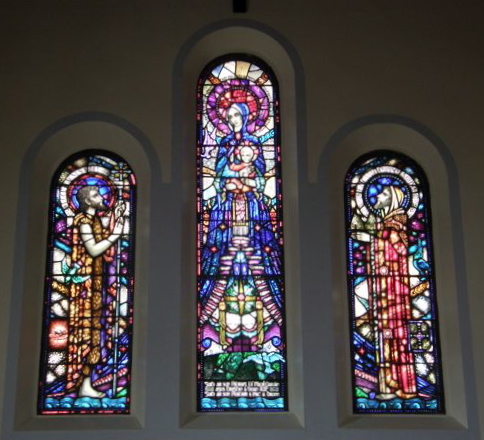
On the other hand, getting off “the beaten path” leads to wonderful discoveries and unique experiences. A few years ago when traveling Ireland, I decided to visit the Aran Islands. Most tourists head to Inis Mór, the largest of islands, where most ferries from County Galway dock and where Dún Aonghasa is to be found; many go to Inis Oírr, the smallest, where boats from County Clare dock. I chose to go to Inis Meáin, the middle island, the least touristy of the three. There I found An Seipéal Mhuire gan Smál agus Eoin Baiste — the Church of St. Mary Immaculate and St. John the Baptist.

The church is a newer church, built in 1939. I was entranced by stained glass windows which had a most remarkable jewel-like quality with brilliant colors. My poor skills at photography with my inexpensive digital camera couldn’t possible convey the beauty of those windows. I later learned that they were the work of Harry Clarke, considered Ireland’s greatest stained glass artist.

Altar Window - Church of St. Mary Immaculate & St. John the Baptist

Getting off the well-marked, well-travel road and taking a different path can be dangerous . . . but it can also be marvelous!

In any event, when I read Moses this morning I contrast his words with those of Jesus in Luke’s Gospel (not the gospel lesson for today):

Enter through the narrow gate; for the gate is wide and the road is easy that leads to destruction, and there are many who take it. For the gate is narrow and the road is hard that leads to life, and there are few who find it.

The easy road is the one well marked; the hard road to the narrow gate is difficult to find. It is the road less traveled about which Robert Frost wrote in The Road Not Taken

Two roads diverged in a yellow wood,
And sorry I could not travel both
And be one traveler, long I stood
And looked down one as far as I could
To where it bent in the undergrowth;

Then took the other, as just as fair,
And having perhaps the better claim,
Because it was grassy and wanted wear;
Though as for that the passing there
Had worn them really about the same,

And both that morning equally lay
In leaves no step had trodden black.
Oh, I kept the first for another day!
Yet knowing how way leads on to way,
I doubted if I should ever come back.

I shall be telling this with a sigh
Somewhere ages and ages hence:
Two roads diverged in a wood, and I —
I took the one less traveled by,
And that has made all the difference.

Get off the highways! Explore the by-ways . . . they may lead to wonderful discoveries . . . and they may lead to the hard road to the narrow gate, the one few find.

====================

A request to my readers: I’m trying to build the readership of this blog and I’d very much appreciate your help in doing so. If you find something here that is of value, please share it with others. If you are on Facebook, “like” the posts on your page so others can see them. If you are following me on Twitter, please “retweet” the notices of these meditations. If you have a blog of your own, please include mine in your links (a favor I will gladly reciprocate). Many thanks!

====================

Father Funston is the rector of St. Paul’s Episcopal Church, Medina, Ohio.

Entering the Kingdom by Force? – From the Daily Office – May 31, 2013

From the Gospel according to Luke:

[Jesus said,] “The law and the prophets were in effect until John came; since then the good news of the kingdom of God is proclaimed, and everyone tries to enter it by force.”

(From the Daily Office Lectionary – Luke 16:16 (NRSV) – May 31, 2013.)

Medieval Battering RamThe 16th chapter of Luke’s Gospel keeps pulling me up short with these weird little “What did Jesus mean by that” moments. There’s that “dishonest wealth” comment and now this one about entering the kingdom of God by force . . . .

There are alternative translations, but they aren’t much help in making sense of this. The Douay-Rheims translation, for example, is “The law and the prophets were until John. From that time the kingdom of God is preached: and every one useth violence towards it.” The notes to the New Revised Standard translation (quoted above) suggest this alternative which is truly different, “The law and the prophets were in effect until John came; since then the good news of the kingdom of God is proclaimed, and everyone is strongly urged to enter it.” That does make more sense, but it’s not a generally accepted rendering of the Greek, so we really do have to read this as “everyone tries to enter it by force.” What can we make of that?

Not quite a generation and a half or so ago (a “generation” is something like 30 years they tell me) I was a college drop-out working as an orderly in a small Southern California hospital. Nearby was one of the earliest start-up nondenominational conservative evangelical churches that eventually became a mega-church and is now the mother church of what might be called a “denomination.” A young member of that church was injured very seriously in an automobile accident and was brought to the hospital where I worked. Brain damaged and nearly dead he was put on life support. He was in our facility about three weeks before being transferred to a long-term care facility. During those 21 or so days, there was never a time during which members of the congregation were not present with him. 24 hours a day for three weeks at least a half-dozen church members were in his room praying. They told us they were “storming the gates of heaven” with intense, incessant prayer. (I have no idea if their intercession was effective. In general, I believe in the efficacy of intercessory prayer, but that is not to say that I expect God to work miracles in cases such as that boy’s horrendous injuries. I know that his condition had not changed when he was transported from that hospital to a long-term care facility, and I heard through the grapevine several months later that he was still there, so my suspicion is that his condition never improved.)

When I read of entering the kingdom of God “by force” I think of those folks “storming the gates of Heaven.” And I truly wonder, negatively, if that’s what Jesus ever had in mind in this or any other of his parables, proverbs, actions, or commandments — the two parables about incessant prayer come immediately to mind (the neighbor who gets out of bed to answer the door and the unjust judge who finally responds to the widow’s complaint) but even with those, I don’t believe Jesus ever meant that that is the proper attitude of intercessory prayer. Storming the gates of Heaven just seems some how wrong, as does entering the kingdom of God by force. I have this mental image of folks breaking down the Pearly Gates with a medieval battering ram — just not a great picture of prayer in my opinion.

Nonetheless, it seems to me that this is a prevailing attitude in some religious and political circles, and that it takes the form of “say something loud enough and often enough in enough venues and you’ll get your way” whether one is petitioning the Almighty or stating a partisan position.

Today is the Feast of the Visitation of the Blessed Virgin Mary, celebration on the church calendar since the mid-13th Century when the Franciscans began observing it. It commemorates the visit Mary made to her cousin Elizabeth, mother of John the Baptist, and if it celebrates anything, it celebrates their joy in being pregnant. As is my custom on feast days, I read various devotional texts dealing with the feast this morning, including some on the internet. After reading one of those, I skimmed the comments of other readers. I found in one the assertion that this ancient feast of the church is “the most important church holiday for pro-life forces.”

Now on this issue of abortion and its regulation, I am (I guess) in the politically liberal camp. I believe that abortion should be legal, regulated, and safe. I am also in the theologically conservative camp. If asked as a priest for my guidance and counsel on whether a woman should get an abortion, my advice is nearly always going to be “No.” But in the end it is not my decision. It is the woman’s and her physician’s and no one else’s. Years ago an older colleague and I took part in a discussion panel presentation about legal abortion. In answer to some participant’s question, he said words I’ve never forgotten: “I would rather counsel a woman who’s had a safe, legal abortion than bury one who’s had an illegal abortion. And I’ve done both.” Because of our current laws, I’ve not had to do the latter and I hope I never do!)

That said, I must admit that I am just tired of the way the so-called “pro life” advocates turn every (and I do mean every conversation into an abortion debate. They truly are “storming the gates” on this issue. Frankly, it is tedious and irritating; it does not further their cause; it is counterproductive. Like them, I would like to see the number of abortions reduced, but their way is not going to do that. Good sex education in the public schools, readily available contraception, parenthood training, and better moral education in churches and homes . . . those stand a much better chance than this constantly entering into the issue by force!

And their point is especially misplaced on this holy feast day! One of the most important theological aspects of Mary’s pregnancy, which this feast celebrates, is her choice! Nothing could have happened if she had not said, “Be it to me according to your word.” Her conception and pregnancy were not forced upon her; she chose them. One of my favorite paintings of the Annunciation is this one by Sando Botticelli in which Gabriel seems almost fearful that Mary will say “No” and Mary seems almost on the verge of doing so! If the feasts of the Blessed Virgin are about anything, they are about choice! This is not a “pro-life” holiday! And no amount of polemic, or prayer, will make it so. It really isn’t necessary to push the anti-abortion agenda, or any political or religious point of view, at every opportunity in every venue.

Annunciation of the Blessed Virgin Mary by Sandro Botticelli

So what are we to make of Jesus’ statement that “everyone tries to enter the kingdom of God by force?” I think it is a condemnation of the sort of prayer and the sort of politics that storms the gates of Heaven (or of public opinion) with incessant, tiresome, counterproductive petition or polemic. After uttering these words, he reminded his listeners that “it is easier for heaven and earth to pass away, than for one stroke of a letter in the law to be dropped.” Elsewhere he had summarized the law: “You shall love the Lord your God with all your heart, and with all your soul, and with all your strength, and with all your mind; and your neighbor as yourself.”

The law of love trumps force any day. Loving will accomplish more than storming!

====================

A request to my readers: I’m trying to build the readership of this blog and I’d very much appreciate your help in doing so. If you find something here that is of value, please share it with others. If you are on Facebook, “like” the posts on your page so others can see them. If you are following me on Twitter, please “retweet” the notices of these meditations. If you have a blog of your own, please include mine in your links (a favor I will gladly reciprocate). Many thanks!

====================

Father Funston is the rector of St. Paul’s Episcopal Church, Medina, Ohio.

The Little God Made By Human Hands – From the Daily Office – May 29, 2013

From the Book of Deuteronomy:

There you will serve other gods made by human hands, objects of wood and stone that neither see, nor hear, nor eat, nor smell.

(From the Daily Office Lectionary – Deuteronomy 4:28 (NRSV) – May 29, 2013.)

My Samsung Galaxy S2Seems to me that “gods made by human hands” these days can do some of these things. I have a smartphone that wakes me up by speaking out the time, the weather (current and predicted for the day), and a news headline (I have no idea what the algorithm for choosing the news item is, nor what news feed the alarm application uses). I think I can (if I knew how and did the set up) talk to my smartphone and get it to do things. My phone is not an iPhone, so it doesn’t have a name, but it can do a lot of seeing and hearing and speaking. I don’t think it’s gotten to the eating and smelling part . . . yet. But there are restaurant and wine review applications and who knows what upgrades may be coming . . . .

It would be an overstatement, I think, to say I “serve” my smartphone – after all, it’s supposed to serve me! But it’s all too true that I seem to be at it’s beck and call every minute of every day, or at least I can fall into the trap of thinking that way. The darned thing has a variety of “tones” by which it alerts me to, among things other than telephone calls, text messages, emails, Facebook postings, up-dates available for various applications, Amber alerts, severe weather alerts, voicemail messages, Words with Friends plays, and slew of other inputs. Telephone calls are neatly sounded with individual ringtones; my wife, my daughter, my son, my office, the bishop, and a few other people all have personalized sounds.

A few of those alerts I’ve learned to ignore. I often don’t even recognize the faint “buzz” of a Facebook notification. On the other hand, the raucous SS-siren of an Amber alert will waken me from a sound sleep several rooms away. And when the ringtones for my wife (something called Illuminator) or the bishop (Fanfare for the Common Man) sound, I know I’d better answer.

So, yeah, I guess it does feel like I serve this little “god made by human hands.”

Therefore, for a few minutes each day, and for several hours one day each week . . . I turn this little god off. I can do that. I make it a point to do that. And in the times it is turned off, I turn my attention to God, the real one, the “maker of heaven and earth, of all that is, seen and unseen.” I need to do this because when the phone is on, when it sounds one of its insistent tones, I can forget to turn to God. When my “little god made by human hands” is in control, I can (and frequently do) find myself relying on my own strength, or on human institutions, or on human technology, all of which are prone to fail. I need those moments when it is turned off to be reminded, as Moses reminded the Hebrews and the end of today’s reading, “The Lord your God is a merciful God, he will neither abandon you nor destroy you; he will not forget the covenant with your ancestors that he swore to them.”

====================

A request to my readers: I’m trying to build the readership of this blog and I’d very much appreciate your help in doing so. If you find something here that is of value, please share it with others. If you are on Facebook, “like” the posts on your page so others can see them. If you are following me on Twitter, please “retweet” the notices of these meditations. If you have a blog of your own, please include mine in your links (a favor I will gladly reciprocate). Many thanks!

====================

Father Funston is the rector of St. Paul’s Episcopal Church, Medina, Ohio.

« Older posts Newer posts »