Occasional thoughts of an Anglican Episcopal priest

Category: Prayer (Page 33 of 47)

Entering Silence – From the Daily Office – May 7, 2013

From the Letter of James:

If any think they are religious, and do not bridle their tongues but deceive their hearts, their religion is worthless.

(From the Daily Office Lectionary – James 1:26 (NRSV) – May 7, 2013.)

Silent CloisterThere are a lot of people today who claim to be religious but do not bridle their tongues. Just spend a few hours searching the internet. Limit yourself even to Facebook. Plenty of “religious” people saying lots of, shall we say, non-religious things. I won’t say their religion is worthless, but I do wonder how much they actually value their religion and what it teaches.

But what about those who do not think they are religious? You know, the ones who claim to be “spiritual but not religious” (SBNR). Sometimes they don’t do a very good job of bridling their tongues either. Would James condemn their spirituality as worthless? Would James even acknowledge a difference between religion and spirituality? Would he rather not focus on the unbridled tongue which seems to be a commonality between many so-called religious and many so-called SBNRs?

Some of the religious are so busy defending religion against the SBNRs. Some of the SBNRs are so busy denouncing religion as unnecessary. Wouldn’t it be wonderful if both would simply bridle their tongues for a while and enter into silence?

In the Ignatian spiritual tradition, silence is a mark of spiritual maturity. In the Hindu tradition, the sages teach that if we have something to say that is truthful, kind, or useful, we should say it; if what we have to say is not, we should not say it. In some Muslim teachings, it is said that the voice of the soul is in love with silence and will only speak when its beloved comes; conversation with this voice, which speaks for the inner spiritual world, is impossible in the absence of silence.

We may claim to be religious. We may claim to be spiritual. But if we do not bridle our tongues and spend time in silence, we are neither. If we do, if we enter into silence, we may find that there is no difference between them and that we are both.

====================

A request to my readers: I’m trying to build the readership of this blog and I’d very much appreciate your help in doing so. If you find something here that is of value, please share it with others. If you are on Facebook, “like” the posts on your page so others can see them. If you are following me on Twitter, please “retweet” the notices of these meditations. If you have a blog of your own, please include mine in your links (a favor I will gladly reciprocate). Many thanks!

====================

Father Funston is the rector of St. Paul’s Episcopal Church, Medina, Ohio.

One of Those Weeks (Salvation Belongs to Our God) – Sermon for the Fourth Sunday of Easter – April 21, 2013

====================

This sermon was preached on the Fourth Sunday of Easter, April 21, 2013, at St. Paul’s Episcopal Church, Medina, Ohio, where Fr. Funston is rector.

(Revised Common Lectionary, Fourth Sunday of Easter: Acts 9:36-43; Psalm 23; Revelation 7:9-17; and John 10:22-30. These lessons can be read at The Lectionary Page.)

====================

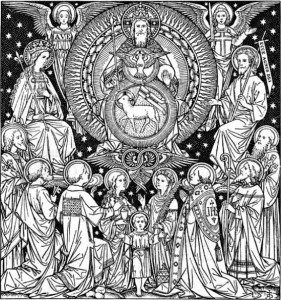
Etching of the Heavenly Throne RoomIt’s Good Shepherd Sunday . . . the Fourth Sunday of the Easter Season is always Good Shepherd Sunday. Every year, regardless of which of the three years of the Lectionary cycle we are in, we hear some lessons which mention shepherds or lambs, and we recite the 23rd Psalm as the Gradual, and we sing every “Shepherd hymn” in the hymnal. I’ve been preaching Good Shepherd sermons for 25 years, so I pretty much thought this was going to be one of those Sundays when I could just “wing it” and preach extemporaneously.

But it’s not. The events of the past week have made this a Good Shepherd Sunday unlike any that has come before. This Good Shepherd Sunday, as I read the words of the 23rd Psalm, “Though I walk through the valley of the shadow of death, I shall fear no evil,” (Ps. 23:4) I cannot help but be aware of all those who, unknowingly, were in that very place on Monday afternoon; I cannot help but think of Boylston Street, Boston, as “the valley of the shadow of death.”

Today’s Gospel lesson is John the Evangelist’s story of an event that happened before Jesus’ crucifixion, something that happened as he was teaching in the Jerusalem Temple. “The Jews,” which is John’s way of naming the temple authorities (the priests and scribes) gathered around Jesus and put him on the spot. “Are you the Messiah?” they ask, “Tell us plainly.”

Jesus’ answer is to say that he has said as much and that it is plain to those who are his sheep, because his sheep understand what he says: “My sheep hear my voice. I know them, and they follow me.” (John 10:27) They hear what I say; they understand my words; and they do what I tell them.

Well, maybe . . . .

Let’s be honest. Understanding Jesus and doing what he says aren’t always very easy. For example, St. Luke tells us that Jesus said, “Be merciful, just as your Father is merciful. Do not judge, and you will not be judged; do not condemn, and you will not be condemned. Forgive, and you will be forgiven.” (Luke 6:36-37) And St. Matthew tells us that he commanded, “Love your enemies and pray for those who persecute you.” (Matt. 5:44) I know what those words mean, but when it comes to the events of this week, they are not easy to obey.

But . . . OK . . . let’s give it a try. Our prayer book heritage gives us words to pray when we cannot think of the words ourselves, so let’s give this praying for those who hurt us a try using some of those prayers:

O God, the Father of all, whose Son commanded us to love our enemies: Lead them and us from prejudice to truth: deliver them and us from hatred, cruelty, and revenge; and in your good time enable us all to stand reconciled before you, through Jesus Christ our Lord. Amen. (Book of Common Prayer 1979, page 816)

Into your hands, O Lord, we commend Tamerlan Tsarnaev, as into the hands of a faithful Creator and most merciful Savior, praying that he may be redeemed in your sight. Wash him, we pray, in the blood of that immaculate Lamb who was slain to take away the sins of the world; that, whatever defilements he may have contracted in the midst of this earthly life being purged and done away, he may be presented before you pure and without spot; through the merits of Jesus Christ your only Son our Lord. Amen. (Adapted from the BCP 1979, page 488)

O God, whose mercy is everlasting and whose power is infinite; Look down with pity and compassion upon Dzhokhar Tsarnaev; and whether you visit him to test his fortitude or to punish his offences, enable him with your grace to submit himself willingly to your holy will and to your judgment. O Lord, go not far from him or any person whom you have laid in a place of darkness; and seeing that you have not cut him off suddenly, chasten him as a father and grant that he, duly considering your great mercies, may genuinely turn to you with true repentance and sincerity of heart; through Jesus Christ our Lord. Amen. (Adapted from the Book of Common Prayer of 1789, A Form of Prayer for the Visitation of Prisoners.)

This is what our Shepherd requires of us, that we pray for the repose of the soul of Tamerlan Tsarnaev and for the salvation Dzhokhar Tsarnaev, even though we find it very difficult to do.

When I was still practicing law, I had occasion to defend a dentist whose hobby was sculpting. One of the pieces he showed me was a very nicely done, and in most respects very traditional, Crucifix. What was nontraditional about it was the expression on Jesus’ face; it was contorted in obvious and quite extreme rage.

I asked him about that saying, “I don’t think I’ve ever seen Christ depicted in that way, and I can’t say that I’ve ever conceived of this reading any of the Gospels’ crucifixion stories.” He answered by asking me, “You know in the Gospel according to Luke when Jesus says, ‘Father, forgive them . . . . ?’ I’ve always heard that as angry, as Jesus saying to God the Father, ‘You forgive them because, right now, I can’t.'”

If you, like me, are having some difficulty in praying for those two boys, let these prayers be offered in that same spirit. We pray for God to take them, for God to forgive them, because right now, we can’t. We know exactly what Jesus meant but right now, we can’t do it. So we ask our Shepherd to do it for us. Because, as the multitude witnessed by St. John of Patmos cried so clearly, “Salvation belongs to our God who is seated on the throne, and to the Lamb!” (Rev. 7:10)

That’s one of the Good News lessons for today, for this week, I think. Jesus asks us to pray for and forgive those who do us wrong, but if we can’t, he can do it for us. We don’t need the fancy words of prayers out of the prayer book tradition. We just need Jesus’ own words, his words on the cross, “Father, forgive them.” That’s really all we need to say, “Father, forgive them.” Because even if we can’t, he can.

I think the other Good News lesson for this week is in something else Jesus says in today’s Gospel lesson: “I give them eternal life, and they will never perish. No one will snatch them out of my hand.”

Yesterday, I was at a diocesan leadership conference and, as you might expect, during the break times, our conversations centered around the events of the week.

A colleague commented at a diocesan meeting this morning, “It’s been one of those weeks.” My first thought was, “One of what weeks? There aren’t very many weeks like this!” The more I thought about it, however, I think maybe every week is like this. Every week people die. It’s an uncomfortable reality, but it’s true. Every week people die. It’s nothing to fear, however. I remember hearing a bishop (it may have been Desmond Tutu) say that being a Christian means (among other things) accepting the fact that you have already died. Certainly that is the witness of scripture: “Do you not know that all of us who have been baptized into Christ Jesus were baptized into his death? Therefore we have been buried with him by baptism into death, so that, just as Christ was raised from the dead by the glory of the Father, so we too might walk in newness of life.” (Rom. 6:3-4) And, again, “Set your minds on things that are above, not on things that are on earth, for you have died, and your life is hidden with Christ in God.” (Col. 3:2-3) And, again, “The saying is sure: If we have died with him, we will also live with him.” (2 Tim. 2:11) The very meaning of the Easter Season which we continue to celebrate is that death has been conquered, and that to God’s faithful people “life is changed, not ended; and when our mortal body lies in death, there is prepared for us a dwelling place eternal in the heavens.” (BCP 1979, page 382)

And every week people do awful things to other people. Sometimes those things are hugely catastrophic for many people, like the bombs at the marathon finish line. Sometimes those things go unseen by nearly everyone except the one injured, like the bullying that has led so many teens to commit suicide. Such things, awful things happen all the time. But . . . “Have you not known? Have you not heard? The Lord is the everlasting God, the Creator of the ends of the earth. He does not faint or grow weary; his understanding is unsearchable. He gives power to the faint, and strengthens the powerless.” (Isaiah 40:28-29) And, again, “The Lord upholds all who are falling, and raises up all who are bowed down.” (Psalm 145:14) And, again, “I can do all things through him who strengthens me.” (Philip. 4:13) The very meaning of the Easter Season which we continue to celebrate is that the power of God overcomes anything, any-awful-thing, the evildoers of this world can throw at us.

Not very long after the bombs exploded in Boston, comedian Patton Oswalt posted a reflection on his Facebook page in which he said:

I remember, when 9/11 went down, my reaction was, “Well, I’ve had it with humanity.”

But I was wrong. I don’t know what’s going to be revealed to be behind all of this mayhem — one human insect or a poisonous mass of broken sociopaths.

But here’s what I DO know. If it’s one person or a HUNDRED people, that number is not even a fraction of a fraction of a fraction of a percent of the population on this planet. You watch the videos of the carnage and there are people running TOWARDS the destruction to help out. (Thanks FAKE Gallery founder and owner Paul Kozlowski for pointing this out to me). This is a giant planet and we’re lucky to live on it but there are prices and penalties incurred for the daily miracle of existence. One of them is, every once in a while, the wiring of a tiny sliver of the species gets snarled and they’re pointed towards darkness.

But the vast majority stands against that darkness and, like white blood cells attacking a virus, they dilute and weaken and eventually wash away the evildoers and, more importantly, the damage they wreak. This is beyond religion or creed or nation. We would not be here if humanity were inherently evil. We’d have eaten ourselves alive long ago.

So when you spot violence, or bigotry, or intolerance or fear or just garden-variety misogyny, hatred or ignorance, just look it in the eye and think, “The good outnumber you, and we always will.”

I think that is the reality to which Scripture testifies; I think that is the triumph of Easter — that the good will always outnumber the evil. “I give them eternal life, and they will never perish. No one will snatch them out of my hand.”

So I guess my colleague was right. It’s been one of those weeks . . . a week when life was changed for some, a week in which the Presence of God helped people get through some really awful stuff, a week when the good outnumbered the bad. It’s been one of those weeks. Every week is. Thanks be to God!

====================

A request to my readers: I’m trying to build the readership of this blog and I’d very much appreciate your help in doing so. If you find something here that is of value, please share it with others. If you are on Facebook, “like” the posts on your page so others can see them. If you are following me on Twitter, please “retweet” the notices of these meditations. If you have a blog of your own, please include mine in your links (a favor I will gladly reciprocate). Many thanks!

====================

Father Funston is the rector of St. Paul’s Episcopal Church, Medina, Ohio.

The Sin of Belshazzar – From the Daily Office – April 17, 2013

From the Book of Daniel:

Immediately the fingers of a human hand appeared and began writing on the plaster of the wall of the royal palace, next to the lampstand. The king was watching the hand as it wrote. Then the king’s face turned pale, and his thoughts terrified him. His limbs gave way, and his knees knocked together. The king cried aloud to bring in the enchanters, the Chaldeans, and the diviners; and the king said to the wise men of Babylon, “Whoever can read this writing and tell me its interpretation shall be clothed in purple, have a chain of gold around his neck, and rank third in the kingdom.” Then all the king’s wise men came in, but they could not read the writing or tell the king the interpretation. Then King Belshazzar became greatly terrified and his face turned pale, and his lords were perplexed.

(From the Daily Office Lectionary – Daniel 5:5-9 (NRSV) – April 17, 2013.)

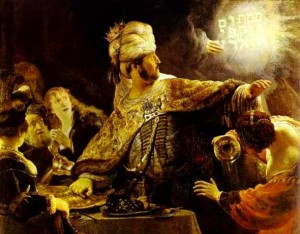
King BelshazzarMany are familiar with the phrase “the writing on the wall,” but few know that it has a biblical origin. Here, today, is the beginning of the story from which it comes. Belshazaar, son of Nebuchadnezzar, has thrown a party. He orders booty from the Jerusalem Temple, sacred vessels of silver and gold, used as drinking vessels. While he and his friends are partying, the hand appears as related above and writes on the wall.

The Boston Marathon was run this week. On Monday, 23,000 people ran the marathon. When about 75% of them had passed the finish line, two bombs went off in the midst of the observing crowds. As of this writing, three people (including one child) are dead; over 170 people are suffering injuries, some of them severally disabling and possibly still fatal. No person or group has yet claimed responsibility.

On the same day a bomb went off in Baghdad, Iraq. In fact, several bombs went off across that country and more than 75 people are dead and many others wounded. A colleague of mine commented that Baghdad “doesn’t seem so far away now.”

The writing on the wall provides some perspective. What was Belshazzar’s sin that prompted this display of divine displeasure? Using the Temple vessels in revelry, the abuse of a conquered people’s culture and values, imperial oppression of faith and identity. Could this not help explain of the acts of violence and terror perpetrated against our country from 9/11 to the present bloody mess in Boston? It could, if they are the acts of Muslim extremists. I am not suggesting that they are, but there are many who doing so.

Commentators left and right are trying to put spin on the Boston bombings, but everyone is speaking in ignorance right now because (as noted above) no one has claimed responsibility; law enforcement has identified no suspects. Nonetheless, plenty of people seem ready to point the finger at Muslims, but none of these finger-pointers appreciates that if that is the case, there is background to be dealt with . . . we may need to face the sin of Belshazzar committed anew by our own country. One of the more insightful comments, I think, came from an Arab editorial: “Whatever the truth about this latest bombing, the continued refusal to acknowledge the widespread grievances against the US and its allies caused by the wars and US policies in the Middle East will lead to turmoil until political solutions are found.” (Al Bawaba News Group)

The writer of Daniel tells us that Belshazzar’s “face turned pale, and his thoughts terrified him.” I think that pretty much describes the United States today . . . . The king could not understand the writing on the wall. At this point, we seem unable to understand what is written in blood on the sidewalks of Boston.

But if it turns out that this the act of Middle Easterners, we need to ask ourselves, “Are we guilty of the sin of Bleshazzar?” Many would answer that question, “Yes,” and call upon us to repent. We need to find not just political solutions, but spiritual solutions, as well.

====================

A request to my readers: I’m trying to build the readership of this blog and I’d very much appreciate your help in doing so. If you find something here that is of value, please share it with others. If you are on Facebook, “like” the posts on your page so others can see them. If you are following me on Twitter, please “retweet” the notices of these meditations. If you have a blog of your own, please include mine in your links (a favor I will gladly reciprocate). Many thanks!

====================

Father Funston is the rector of St. Paul’s Episcopal Church, Medina, Ohio.

Prayers for the Dead and Injured at the Boston Marathon – April 15, 2013

Votive Candles and Cross

O God, whose mercies cannot be numbered: Accept our prayers on behalf of your servants killed at the Boston Marathon, and grant them an entrance into the land of light and joy, in the fellowship of your saints; through Jesus Christ our Lord, who lives and reigns with you and the Holy Spirit, one God, now and for ever. Amen.

Heavenly Father, giver of life and health: Comfort and relieve your servants injured in the bombings at the Boston Marathon, and give your power of healing to those who minister to their needs, that they may be strengthened in their weakness, healed from their injuries, and have confidence in your loving care; through Jesus Christ our Lord. Amen.

Prayers adapted from The Book of Common Prayer (1979)

Going Fishing, Finding Grace – Sermon for the Third Sunday of Easter – April 14, 2013

====================

This sermon was preached on the Third Sunday of Easter, April 14, 2013, at St. Paul’s Episcopal Church, Medina, Ohio, where Fr. Funston is rector.

(Revised Common Lectionary, Third Sunday of Easter: Acts 9:1-20; Psalm 30; Revelation 5:11-14; and John 21:1-19. These lessons can be read at The Lectionary Page.)

====================

Palestinian Fishing Boat 1880Several years ago, shortly after my mother died, my step-dad’s business partner also passed away leaving my step-dad to run the business they had created together. Now it is no insult to my step-dad, Stan, who had never before been a business owner, to say that he knew little or nothing about running a business. He’d been a tool-and-die man most of his working life with a brief foray into sales, but he’d never been in the “front office” and he’d certainly never been a manager or executive of any sort. Stan didn’t know accounts receivable from fish, and inventory control was a foreign language to him.

So I took a leave of absence from the parish where I was then rector, left Evie and the kids on their own in Kansas, moved in with my step-dad in Costa Mesa, California, and became the de facto president and chief executive officer of Halogen Valve Systems. The company had been created to manufacture and market an emergency chlorine valve actuator for municipal water systems, a product my step-dad and his partner had invented and patented. I knew nothing about chlorine, water systems, or valves, but I did know computers, accounting, and business management, so I dove right in to the job, searching through computer files, finding blueprints and parts lists, learning supplier names and product numbers, customer contacts, and so forth; contacting suppliers and customers; charting supply and distribution patterns; organizing the warehouse, the manufacturing shop, and the front office. In the meantime, Stan taught me about chlorine gas and water purification and emergency valve actuators.

After a couple of months, I had the business pretty well systematized and was ready to turn it back to my step-dad and an office manager, so it came time to show my step-dad what I’d set up and teach him what he needed to know. We’d sit down in my office together and, at each session, we’d spend about an hour going over some aspect of the management plan. Our time was limited to an hour because each time, at just about the hour mark, Stan would stand up and say, “I’m going out to the shop.” And off he’d go, out to the manufacturing floor to work with the guys who were building the valve actuators. What he was doing is exactly what Peter does in today’s gospel lesson from John.

Stan could only take so much management talk, so much double-entry bookkeeping, so much inventory control . . . at some point, at that hour limit, he was filled up. He needed to do something with which he was familiar, to give his brain and his spirit time to process all the confusion of front office management. He was going back to the part of the business he could understand. Peter does the same thing in today’s gospel lesson. He’s taken as much confusion as he can stand. All the glory and wonder at the beginning of Holy Week, all the terror and sadness of Good Friday, all the bewilderment and relief and joy of Easter Sunday . . . it’s all been just about more than he can take and it’s time to do something he can understand. “I’m going fishing,” he says. “I’m going back to the part of this business I understand.” And the others know exactly how he feels and they chime in with, “We’ll join you.”

So off they go and as they are fishing, a figure appears on the beach and calls to them. It’s Jesus, who gives them some advice about fishing and then invites them to a grilled fish breakfast he is preparing. While they are eating, he and Peter engage in a conversation, but before we get into that, let’s take a look at the other major story of this morning.

Our Lectionary also gives us the story of St. Paul’s conversion in today’s reading from the Book of Acts. It’s a familiar enough story for us here at St. Paul’s Parish. We hear it at least twice a year, and now the Lectionary gives it to us a third time. Saul of Tarsus, a Jew among Jews, a Pharisee among Pharisees, a prosecutor of the heretics who proclaim this upstart rabbi Jesus to be the Messiah, is on his way to Damascus with letters of warrant from the chief priests to arrest and prosecute any Christians he finds there. Along the road, however, he is knocked on his butt, literally knocked off his horse by a blinding light and a crash of thunder and a voice which asks, “Saul, why are you persecuting me?” In surprise, he asks the voice who it is that is speaking and he is told, “I am Jesus!” And Saul and Jesus have a conversation.

Saul’s conversation with Jesus is rather abrupt. Jesus simply tells him to get up and go to a certain place in Damascus and there he will be instructed. Peter’s conversation is rather different. Three times Jesus asks him “Do you love me?” Three times Peter answers, “You know I do.” Three times Jesus tells Peter to take care of Jesus’ sheep.

When we read this in English, we miss a very important nuance in John’s use of language and we are apt to miss John’s point. The first two times Jesus asks Peter, “Do you love me?” John uses the word agape to render the question. This word is normally used in the Greek scriptures to describe perfect or “divine” love. When Peter answers Jesus in the affirmative, he uses another word, phileo, which means “brotherly love.” This suggests that he loved Jesus as a brother, not yet fully understanding his Risen Lord’s divinity. Jesus then calls Peter to feed the lambs. Jesus asks the second time, again using “agape.” Jesus at first had not gotten the answer from Peter that he wanted but, again, Jesus receives the same response from Peter. Jesus then repeats the feeding admonition, changing it so that Peter is responsible for feeding the not just the lambs, but the whole flock. The third time, Jesus changes the word and asks Peter the question in Peter’s own terms; Jesus uses the disciple’s “brotherly love” word, phileo.

What is happening in this conversation, indeed with this whole scene, is that Jesus is meeting Peter where Peter can meet Jesus. Peter had to get out of Jerusalem; he had to get to someplace, to doing something, that he could grasp. So Jesus met him there. Peter couldn’t quite yet understand Jesus’ godliness, using a term for human rather than divine love. So Jesus went along with him. Jesus met and interacted with Peter is a manner appropriate to Peter’s situation. Jesus does the same with Saul.

Saul was a fire-brand, a person who so aggressively and energetically promoted his own cause, his own understanding of religion that he encouraged unrest among Jews and kindled strife for the followers of Jesus. And Jesus did with him what he had done with Peter. He came to him in the place and in the manner in which Saul could be reached and led to understand. Saul clearly had heard the gospel message preached by the disciples; he’d heard it and rejected it. The soft and gentle approach hadn’t worked. So, in the alternative, Jesus came to him with flash of light and a clap of thunder, and knocked him on his butt!

The two stories from Scripture today teach us the same lesson. Jesus comes to us when and where and as we are able to understand and appreciate him, gently to some, more aggressively to others. But however he comes, he comes. We call this “grace.” Simply put, grace is the free and unmerited favor manifesting our salvation and bestowing blessings upon us. Both Peter and Paul received this grace in ways appropriate to them, as do we all.

Earlier this week an author named Brennan Manning passed away. Brennan was an American Roman Catholic, a friar, a priest (who had married!), a contemplative, and a frequent speaker at religious events. He lived a fascinating and turbulent life, and wrote many books, one of which was The Ragamuffin Gospel. In it, he wrote this about grace:

Because salvation is by grace through faith, I believe that among the countless number of people standing in front of the throne and in front of the Lamb, dressed in white robes and holding palms in their hands (see Revelation 7:9), I shall see the prostitute from the Kit-Kat Ranch in Carson City, Nevada, who tearfully told me that she could find no other employment to support her two-year-old son. I shall see the woman who had an abortion and is haunted by guilt and remorse but did the best she could faced with grueling alternatives; the businessman besieged with debt who sold his integrity in a series of desperate transactions; the insecure clergyman addicted to being liked, who never challenged his people from the pulpit and longed for unconditional love; the sexually abused teen molested by his father and now selling his body on the street, who, as he falls asleep each night after his last “trick,” whispers the name of the unknown God he learned about in Sunday school.

“But how?” we ask.

Then the voice says, “They have washed their robes and have made them white in the blood of the Lamb.”

There they are. There we are — the multitude who so wanted to be faithful, who at times got defeated, soiled by life, and bested by trials, wearing the bloodied garments of life’s tribulations, but through it all clung to faith.

My friends, if this is not good news to you, you have never understood the gospel of grace. (The Ragamuffin Gospel: Good News for the Bedraggled, Beat-Up, and Burnt Out)

The stories of Peter fishing on the Sea of Galilee and of Saul traveling to Damascus, and of their encounters with Jesus in those places, teach us that Jesus comes to us wherever and however we are, even defeated, soiled, and bloodied, to give us salvation and blessing, to give us the unmerited favor of God, to give us grace. We may have gone out to the manufacturing floor; we may have gone fishing; we may be on a trip pursuing our passion. Wherever we are, Jesus meets us, and there we find grace. Amen.

====================

A request to my readers: I’m trying to build the readership of this blog and I’d very much appreciate your help in doing so. If you find something here that is of value, please share it with others. If you are on Facebook, “like” the posts on your page so others can see them. If you are following me on Twitter, please “retweet” the notices of these meditations. If you have a blog of your own, please include mine in your links (a favor I will gladly reciprocate). Many thanks!

====================

Father Funston is the rector of St. Paul’s Episcopal Church, Medina, Ohio.

Fear & Trembling in Easter Season – From the Daily Office – April 13, 2012

From the Gospel of Luke:

Jesus, full of the Holy Spirit, returned from the Jordan and was led by the Spirit in the wilderness, where for forty days he was tempted by the devil. He ate nothing at all during those days, and when they were over, he was famished. The devil said to him, “If you are the Son of God, command this stone to become a loaf of bread.” Jesus answered him, “It is written, ‘One does not live by bread alone.'”

(From the Daily Office Lectionary – Luke 4:1- 4 (NRSV) – April 13, 2013.)

Climbing a LadderIt seems odd of the Lectionary to put us back to the beginning of Lent when we are not quite halfway through the season of Easter, but here we are, reading once again about Jesus’ temptations in the desert following his baptism.

Perhaps it’s not odd at all, however. Our spiritual life, like our emotional life, follows no particular schedule, no orderly progression. Elizabeth Kubler-Ross outlined the theoretical five stages of grief – denial, anger, bargaining, depression, and acceptance – but clinical experience has shown that a grieving person does not move neatly through them as if they were rungs on a ladder. One may move from denial to anger to bargaining and then return to denial; one may skip a stage only to return to it later; one may spend a good deal of time in one stage and only a short while in another. There is no orderly progression.

Perhaps that’s the message of today’s rehearsal of Jesus’ forty days of temptation in the desert. As one works through the process of enlightenment, of salvation, of spiritual growth, of whatever-one-calls-it, one does not follow a schedule. We may move back to an earlier stage, revisit issues we thought we’d dealt with.

St. Paul urged his friends in the church at Caesarea Philippi to “work out your own salvation with fear and trembling; for it is God who is at work in you, enabling you both to will and to work for his good pleasure.” (Philip. 2:12-13) Nowhere does Scripture promise that this work will be neat and tidy. If anything, the witness of Scripture is that spiritual and emotional growth is a messy affair.

Perhaps that is why Paul described salvation as something that comes with “fear and trembling,” and perhaps it is why, in the midst of Easter, we are taken back into the desert of temptation.

====================

A request to my readers: I’m trying to build the readership of this blog and I’d very much appreciate your help in doing so. If you find something here that is of value, please share it with others. If you are on Facebook, “like” the posts on your page so others can see them. If you are following me on Twitter, please “retweet” the notices of these meditations. If you have a blog of your own, please include mine in your links (a favor I will gladly reciprocate). Many thanks!

====================

Father Funston is the rector of St. Paul’s Episcopal Church, Medina, Ohio.

Lord, I Believe; Help Thou My Unbelief – Sermon for “Thomas Sunday” (Easter 2) – April 7, 2013

====================

This sermon was preached on the Second Sunday of Easter, “Thomas Sunday,” April 7, 2013, at St. Paul’s Episcopal Church, Medina, Ohio, where Fr. Funston is rector.

(Revised Common Lectionary, Second Sunday of Easter: Acts 5:27-32; Psalm 150; Revelation 1:4-8; and John 20:19-31. These lessons can be read at The Lectionary Page.)

====================

Doubting Thomas by GuercinoLeslie Dixon Weatherhead (1893-1976) was an English Methodist Minister who served at the City Temple, a Congregational Church in London. He served there from 1936 until his retirement in 1960. In one of his several book, The Christian Agnostic, he wrote, “When people said to me, ‘I should like to be a member of the City Temple, what must I believe?’ I used to say, ‘Only those things which appear to you to be true.’”

Last week at our Easter services, many of us reaffirmed our Baptismal Covenant doing exactly what we are about to ask Graham _____________, or those speaking on his behalf, to do . . . and we will all do it again with them. We will ask one another, “What do you believe?” and in good liturgical fashion we will all answer in the same way; we will answer the questions, “Do you believe in God the Father? Do you believe in Jesus Christ, the Son of God? Do you believe in God the Holy Spirit?” with responses which are nothing more and nothing less than the ancient Apostle’s Creed. Our Anglican tradition calls this creed “the Baptismal Symbol.”

Not a single one of us is likely to balk in the midst of our liturgy and say, “Unless I see the mark of the nails in his hands, and put my finger in the mark of the nails and my hand in his side, I will not believe.” And yet I’ll bet that some of us might be thinking something very much along those lines as we dutifully recite the answers set out for us in The Book of Common Prayer. Many people in our world today, both outside and inside the church, do.

And there is nothing wrong with thinking that. Nothing at all. Because, you see, there are varieties of belief. Writing to the church in Corinth, St. Paul said, “Now there are varieties of gifts, but the same Spirit; and there are varieties of services, but the same Lord; and there are varieties of activities, but it is the same God who activates all of them in everyone.” (1 Cor. 12:4-6) I suggest to you that there are varieties of belief, but the same Christian faith throughout the church.

For example, on a regular Sunday, a Sunday when we are not baptizing new member of God’s household, we would recite the Nicene Creed, which begins:

We believe in one God,
the Father, the Almighty,
maker of heaven and earth,
of all that is, seen and unseen.

Now let’s just take the last phrase of that bit, the part that says God is the “maker of all that is, seen and unseen.” Let’s just take the last word of the last phrase of that bit, “unseen.” What, in your understanding, does that mean?

Are you one of those who believes in a spiritual or supernatural realm? One who believes that, as the introduction to an old television anthology series used to put it, “there is, unseen by most, an underworld, a place that is just as real, but not as brightly lit.” Is that what you think of when you acknowledge your belief in God as maker all that is unseen?

Perhaps you think of the microscopic, atomic, and subatomic realms of Newtonian space or Einsteinian space-time. Maybe you think of the multiverse and the infinite number of alternate realities suggested by the probability equations of quantum mechanics. Possibly you give thought to the 13 tightly curled, hidden dimensions of superstring theory. Or perhaps you don’t think of any of that. Maybe you’ve never given it any thought; you just say the words that are put there in the Prayer Book.

Whatever, it’s all perfectly acceptable because, as the Rev. Mr. Weatherhead said, there is nothing in particular that you must believe about God as maker of all things unseen, “only those things which appear to you to be true.” And if we were to make our way through the rest of the creed, whether the Apostle’s Creed or the Nicene Creed, we would find ourselves facing a bewildering variety of beliefs as we paused at each phrase or word and teased out the various and sundry meanings we all might give it. One of us might say, “This is what that means,” and another would respond, “I don’t believe that at all!” And yet all of us would nonetheless still be comfortable in saying the creed together because, as Peter said to the Temple authorities, “We must obey God rather than any human authority.” (Acts 5:29) And the creeds, important as they are, are human authority, the words of bishops and church counsels and church tradition, not the word of God.

Early in our Anglican history, there were those who wanted to impose a single understanding, a single interpretation of the creeds, of our several prayers, of the Sacraments, and of Scripture. They wanted to enforce a single way of worshiping God and they prevailed upon Queen Elizabeth I to enforce that uniformity for them. She declined. She simply required that the English people worship together, but what each might make of that worship, of the words spoken, of the Sacraments administered, or of the Scriptures read she left to each: “I would not open windows into men’s souls,” she declared. Her preference, worked out in Parliament in a series of acts known as The Elizabethan Settlement, has been called the terminal point of the English Reformation and, in the long run, the foundation of Anglicanism and the “via media” (or “middle way”) we still, 550 years later, claim to be. We still do not open windows into each other’s souls; we still treat ascent to the historic creeds as a matter of individual conscience and interpretation.

Mr. Weatherhead, in his book The Christian Agnostic, also wrote this:

I believe passionately that Christianity is a way of life, not a theological system with which one must be in intellectual agreement. I feel that Christ would admit into discipleship anyone who sincerely desired to follow him, and allow that disciple to make his creed out of his experience; to listen, to consider, to pray, to follow, and ultimately to believe only those convictions about which the experience of fellowship made him sure.

Mr. Weatherhead may have been a Methodist, but these words would sum up the understanding of every Episcopalian or Anglican true to our heritage. Being an Anglican follower of Christ, to which manner of life today we welcome Graham _____________, is not a matter of theological system, even though we ask those questions with prescribed, systematic, creedal answers. Being an Anglican follower of Christ is about community and fellowship, a community and a fellowship in which it would be perfectly acceptable to say, “Unless I see the mark of the nails in his hands, and put my finger in the mark of the nails and my hand in his side, I will not believe.” Because more than mere intellectual assent to particular propositions is at stake. Because there are varieties of belief, but the same Christian faith throughout the church.

That is why the Baptismal Covenant does not end with those three questions and those three systematic, creedal responses. The Baptismal Covenant continues with questions about community and fellowship, questions about respect and dignity, questions about behavior and practice, questions about ministry and mission. Five questions:

Will you continue in the apostles’ teaching and fellowship, in the breaking of bread, and in the prayers?
Will you persevere in resisting evil, and, whenever you fall into sin, repent and return to the Lord?
Will you proclaim by word and example the Good News of God in Christ?
Will you seek and serve Christ in all persons, loving your neighbor as yourself?
Will you strive for justice and peace among all people, and respect the dignity of every human being?

Five questions to which the answer is the same: “I will, with God’s help.”

In the ninth chapter of the Gospel according to Mark there is a story of a man who comes to Jesus seeking healing for his son who is possessed by a demon. The mean tells Jesus that the demon “has often cast him into the fire and into the water, to destroy him; but if you are able to do anything, have pity on us and help us.” Jesus responds to man saying, “If you are able! – All things can be done for the one who believes.” In the wonderful poetic language of the King James version of the Bible we are told that, with tears, the father cries, ” Lord, I believe; help thou mine unbelief.” (Mark 9:17-24)

It is that same cry that we utter when we answer those behavioral questions of the Baptismal Covenant, “I will, with God’s help.” Lord, we believe (we have said that in answer to the first three questions; we believe in whatever manner each of us believes) . . . Lord, we believe; help thou our unbelief. Help us to carry through on the way of life which is implicit in those stated beliefs. We will; we’ll carry through “with God’s help.”

Belief is one of those ambiguous words that can mean so many things. In the creedal sense, it means to give intellectual assent to a stated proposition. “Do you believe in God?” in this sense means do you accept the proposition as true that there is a God. Suppose we change the object of question, however. “Do you believe in your wife/husband/child/parent?” It would be ridiculous, wouldn’t it, to interpret this as asking, “Do you accept as true the proposition that your wife/husband/child/parent exists?” We know that the question, that the word belief as used in the question, means something very different. It means, “Do you trust in your family member? Do you have faith in them? Do you expect them to behave in certain ways, to carry through on promises, to have your best interests at heart?” And if you believe in your family member, will you behave toward them and within the community of your family in equivalent and considerate ways?

And that is precisely what the word belief really means in the creeds and in the Baptismal Covenant. Do you trust in God? Do you have faith in Christ? Do you expect the Holy Spirit to act in certain ways in your life? Are you confident that God will carry through on God’s promises with your best interests at heart? Do you believe in God? And if you believe in God, will you behave toward God and within the community of God’s household the church and of God’s world, “all that is, seen and unseen,” in equivalent and considerate ways?

Thomas, known for all time as “Doubting Thomas,” wanted to believe! The words of that grieving father, “Lord, I believe; help thou mine unbelief,” could as easily have been his. And they are, most certainly, ours. “I will, with God’s help.” Help thou mine unbelief!

Jesus gave Thomas the help he needed; he showed him his hands and his feet; he invited him to put his hand into the wound in his side. “Thomas answered him, ‘My Lord and my God!’ Jesus said to him, ‘Have you believed because you have seen me? Blessed are those who have not seen and yet have come to believe.'” Jesus was talking about us, about you, about me, about all of us “who have not seen and yet have come to believe.” And he was talking about Graham _____________ who, if we do as we promise each time we reaffirm our Baptismal Covenant, if we continue “with God’s help,” if we persevere “with God’s help,” if proclaim “with God’s help,” if we seek and serve others “with God’s help,” if we strive for justice and peace “with God’s help” . . . if we do all that, with God’s help, Graham too will be blessed as one who has not seen and yet has come to believe, because he will, in fact, have seen. He will have seen Christ in us.

“Lord, we believe; help thou our unbelief.”

And now, “to him who loves us and freed us from our sins by his blood, and made us to be a kingdom, priests serving his God and Father, to him be glory and dominion forever and ever. Amen.” (Rev. 1:5b)

The candidate for Holy Baptism will now be presented . . . . .

====================

A request to my readers: I’m trying to build the readership of this blog and I’d very much appreciate your help in doing so. If you find something here that is of value, please share it with others. If you are on Facebook, “like” the posts on your page so others can see them. If you are following me on Twitter, please “retweet” the notices of these meditations. If you have a blog of your own, please include mine in your links (a favor I will gladly reciprocate). Many thanks!

====================

Father Funston is the rector of St. Paul’s Episcopal Church, Medina, Ohio.

Monstrous Relief – Sermon for Resurrection Sunday – March 31, 2013

====================

This sermon was preached on Resurrection Sunday, March 31, 2013, at St. Paul’s Episcopal Church, Medina, Ohio, where Fr. Funston is rector.

(Revised Common Lectionary, First Sunday of Easter: Isaiah 65:17-25; Psalm 118:1-2,14-24; 1 Corinthians 15:19-26; and John 20:1-18 . These lessons can be read at The Lectionary Page.)

====================
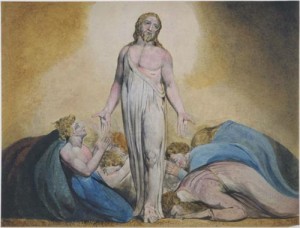
Christ Appearing to His Disciples after the Resurrection by Wm Blake

Make no mistake: if He rose at all
it was as His body;
if the cells’ dissolution did not reverse, the molecules
reknit, the amino acids rekindle,
the Church will fall.

So writes novelist and poet John Updike in the first of his Seven Stanzas at Easter from the collection Telephone Poles and Other Poems. Here is the rest of the poem:

It was not as the flowers,
each soft Spring recurrent;
it was not as His Spirit in the mouths and fuddled
eyes of the eleven apostles;
it was as His Flesh: ours.

The same hinged thumbs and toes,
the same valved heart
that – pierced – died, withered, paused, and then
regathered out of enduring Might
new strength to enclose.

Let us not mock God with metaphor,
analogy, sidestepping transcendence;
making of the event a parable, a sign painted in the
faded credulity of earlier ages:
let us walk through the door.

The stone is rolled back, not papier-mache,
not a stone in a story,
but the vast rock of materiality that in the slow
grinding of time will eclipse for each of us
the wide light of day.

And if we will have an angel at the tomb,
make it a real angel,
weighty with Max Planck’s quanta, vivid with hair,
opaque in the dawn light, robed in real linen
spun on a definite loom.

Let us not seek to make it less monstrous,
for our own convenience, our own sense of beauty,
lest, awakened in one unthinkable hour, we are
embarrassed by the miracle,
and crushed by remonstrance.

“Let us not seek to make it less monstrous!” I love that line!

Only a poet like John Updike could use the word monstrous to describe the Resurrection of Christ and, in spite of its shock value, or perhaps because of it, it is the perfect word, an ambiguous word that captures the essence of the entire Palm Sunday – Maundy Thursday – Good Friday – Resurrection Day event. Monstrous can, and usually does, mean something like “frightful or hideous; extremely ugly; shocking or revolting; awful or horrible,” and those are certainly good words to describe the way the people of Jerusalem turned on Jesus, the way his disciple Judas betrayed him, the way his other followers denied and abandoned him, the way the authorities both Jewish and Roman abused and killed him. It was all monstrous; there’s no doubt about that!

Monstrous, however, can also mean “extraordinarily great; huge; immense; outrageous; overwhelming.” And those are superlative ways to describe the fact of Christ’s Resurrection from the dead! It is a huge thing! It is immense, outrageous, overwhelming! Yes, the Resurrection is monstrous!

I have been thinking a lot recently about two people who are hardly ever thought of in all the drama and majesty of Holy Week and Easter: one of them is mentioned briefly only by John in his story of Jesus’ Crucifixion; the other isn’t named at all. I refer to Mary and Joseph, Jesus’ mother and foster father.

Of course, we know nothing of Joseph during Jesus’ adult ministry; after that event in the Jerusalem Temple when Jesus was about 13, Joseph is never again mentioned in the Gospels. Some suppose this is because he had passed away, but I like to think that he was just back home in Nazareth working the family carpentry business, making tables and chairs, supervising construction of homes, building hope chests, keeping the family provided for so that Jesus could go about his ministry and Mary could accompany him.

Mary is mentioned in John’s story of the Crucifixion as standing at the foot of the cross and being entrusted by Jesus to the disciple whom he loved. And the legend from which we get the 14th Station of the Stations of the Cross, and which Michelangelo’s exquisitely beautiful Pieta depicts, is that when his body was removed from the cross she held him, dead, in her arms. But there is no mention of her or of Joseph at Jesus’ burial, nor are they mentioned in any of the accounts of Christ’s post-resurrection appearances.

That omission, for I am sure that is what it is, an omission, disturbs me. Yesterday, was the 55th anniversary of my father’s accidental death at the age of 39. His mother and father, my grandparents, were in their sixties when he died. One of my clearest memories of childhood is his funeral. I remember how, as we were leaving the graveside, my grandparents hung back, how they could not step away from nor turn their backs on the grave that held their child’s lifeless body. When, at last, they accepted my Uncle Scott’s physical encouragement to do so, my grandmother said to my mother, “A mother should not outlive her child.” She would know that feeling again just a few years later when my Uncle Scott died of cancer.

And my mother would know it, as well, when in 1993 my only sibling, my older brother Rick, died of brain cancer. I vividly remember doing exactly what my uncle had done, physically moving my mother and stepfather away from the grave, the grave they could not leave on their own. Later that day, my mother said to me, “You’re grandmother was right. A parent should not outlive her child.”

Having seen my grandparents and my parents at the graves of their children, I cannot believe that Mary and Joseph were not there when the stone was rolled into place, when Jesus was buried in that borrowed tomb.

Updike’s description of the Resurrection and his admonition to us, “Let us not seek to make it less monstrous,” so aptly describes the entire event of Holy Week and Easter, because we cannot appreciate the overwhelming wonder of the Resurrection, without taking into account the horror and ugliness of the whole thing, Judas’ betrayal, the other disciples abandonment, Peter’s denial, the trial before Pilate, Christ’s scourging and humiliation, his bitter agony on the Cross, his final self-emptying in death, and his burial at which I cannot but believe his mother and foster father were present. It is all monstrous; painful and ugly and awful in the first sense of that wonderfully ambiguous adjective.

I thought that I had some sense of that because I had witnessed my grandparents’ and my parents’ anguish at the deaths of their children; I thought I understood what old Simeon had said to Mary when Jesus was dedicated in the Temple as an infant, his disturbing prophecy, “A sword will pierce your own soul, too.” (Luke 2:35) I thought that I had understood all that until a couple of weeks ago.

As some of you know, two weeks ago Good Friday, sixteen days ago, our daughter disappeared. She stopped posting things to Facebook, which she had been in the habit of doing almost hourly from her cell phone. She stopped answering her cell phone; calls would go directly to voicemail. Her friends checked her home and found her car gone and no one there. She wasn’t at her place of work; she wasn’t at her school; she wasn’t at any of her usual hangouts. My wife, our son, our daughter-in-law, and several of our daughter’s friends looked everywhere they could think of in the area of St. Louis, Missouri, where her apartment is. I played the role of information central, receiving their reports and letting everyone know what everyone knew, which was nothing. We went to bed that night knowing nothing.

Family systems therapists have discovered that patterns of events run in families. Not just habits or ways of handling things, not just customs or traditions, but actual life events repeat from generation to generation. I went to bed convinced that the pattern of a child predeceasing his or her parents was playing out again. I knew in the very depths of my being that my daughter was dead.

Let me tell you, old Simeon in that Temple proved himself a master of understatement. That sword of grief does not simply pierce a parent’s soul; it rips the soul to shreds. That, I now know, is why my grandparents and my parents could not leave those graves, and that is why I cannot believe that Mary and Joseph were not there in that garden when Joseph of Arimathea and Nicodemus buried their child.

Now, lest you believe that this is a funeral oration rather than an Easter homily, let me assure you that our daughter is not dead! As it turned out (Thanks be to God!), she had gone to Kansas City on a personal errand and, while there, had become acutely ill and been admitted to a local hospital on an emergency basis. She had lost her cell phone and because she hadn’t memorized our telephone numbers, she couldn’t call us. (One of the dangers of cell phones, it turns out, is relying on its memory of stored numbers instead of one’s own memory!) On Saturday morning, through a friend, she got word to her mother about where she was, and then her mother called me. Our daughter is now out of the hospital, is back in St. Louis, and is back to her usual occupations. But I cannot tell you how relieved her mother and I were on that Saturday morning! All of the anguish and fear and sorrow and grief of the night before drained away. I cannot say that we were joyful or happy, but we were profoundly, overwhelmingly, monstrously relieved.

Which brings me back to Mary and Joseph and the first Easter morning . . . . I have an entirely new understanding of the Resurrection story. Preachers and theologians toss around a funny word to describe the way we view and interpret Holy Scripture. The word is hermeneutic. It means, basically, the method or principle through which we understand the text; it is the filter through which we appreciate its meaning. There are shared, intellectual hermeneutics, but there are also highly personal hermeneutics. I share my grandparents’ and my parents’ and my family’s recent experiences with you so that I can also share with you, and you can enter into, my new personal hermeneutic for grasping the impact of the Day of Christ’s Resurrection.

Just as I am puzzled by the absence of almost any mention of Mary and Joseph in the narrative of Christ’s death and burial, and I am astounded that there is no allusion to them in the Gospel accounts of that first Easter morning or any time after his Resurrection! The only word about either of them is in the first chapter of the Book of Acts and, again, it’s only Mary who gets mentioned. Luke, the author of Acts, says that following Christ’s Ascension forty days after his Resurrection the apostles “were constantly devoting themselves to prayer, together with certain women, including Mary the mother of Jesus, as well as his brothers.” (Acts 1:14) That’s it, that one mention! I find that astonishing! Apparently so have many Christians throughout the ages, because there is an extra-biblical tradition that the Virgin Mary was the first person to witness our Lord’s Resurrection.

The Golden Legend, which is a medieval collection of stories about the saints, says that the first appearance of the resurrected Christ on Easter Day was to the Virgin Mary:

It is believed to have taken place before all the others, although the evangelists say nothing about it.. . . . [I]f this is not to be believed, on the ground that no evangelist testifies to it . . . perish the thought that such a son would fail to honor such a mother by being so negligent! . . . Christ must first of all have made his mother happy over his resurrection, since she certainly grieved over his death more than the others. He would not have neglected his mother while he hastened to console others.

St. Ignatius of Antioch (1st C.) claimed it was so, as did St. Ambrose of Milan (4th C.), St. Paulinus of Nola (4th C.), the poet Sedulius (5th C.), St. Anselm of Canterbury (11th C.), St. Albertus Magnus (13th C.), St. Bernardino da Siena (15th C.), and the bible scholar Juan Maldonado (16th C.)

Most recently, the late Bishop of Rome, his Holiness John Paul II, in a general audience in 1997 expressed this opinion:

The Gospels mention various appearances of the risen Christ, but not a meeting between Jesus and his Mother. This silence must not lead to the conclusion that after the Resurrection Christ did not appear to Mary . . . . Indeed, it is legitimate to think that [his] Mother was probably the first person to whom the risen Jesus appeared. Could not Mary’s absence from the group of women who went to the tomb at dawn indicate that she had already met Jesus? This inference would also be confirmed by the fact that the first witnesses of the Resurrection, by Jesus’ will, were the women who had remained faithful at the foot of the Cross and therefore were more steadfast in faith. (Gen. Aud., Wednesday, 21 May 1997)

I cannot but believe that the Risen Christ appeared to Mary and Joseph (if he was present as I prefer to think he was), and that they would have been at least as profoundly, overwhelmingly, monstrously relieved as my wife and I were two weeks ago yesterday, if not more so!

So here’s my new thought, my new hermeneutic of Easter Day. I think that the overwhelming initial response, especially of Mary and Joseph, but also of Mary Magdalene, of Peter, of the disciple whom Jesus loved, of all the others, to the fact of Jesus’ Resurrection was not, as we are usually told at Easter Services, joyfulness! I think it was relief. The dictionary defines relief as “alleviation of pain, as the easing of anxiety, as deliverance from distress.” This is the appropriate experience and emotion of Easter Day, profound relief, not immediate joy or gladness; I think that comes later in the Easter Season and that it comes later in life as we live out our Easter faith. But in the immediate aftermath of the monstrous-ness of Holy Week, in the wake of the horrible ugliness of death, Christ’s or anyone else’s, one is simply not ready to be jubilant and happy. In the face of our own sinfulness and spiritual dysfunction, we are not ready for joy and gladness. But the fact of Christ’s Resurrection relieves us of grief and sorrow; it relieves us of sin and death. The experience and impact of Easter Day is one of profound, overwhelming, (one might even say) monstrous relief.

Perhaps that is why Jesus stuck around for forty days, to continually reassure and sustain the disciples in their relief from fear and sorrow and grief, so that they could move into joy and gladness as time went on. Perhaps that is why Easter is not a single day, but a season of fifty days, so that as it progresses we can . . . like Mary and Joseph, like the Magdalen and Peter, like the disciple whom Jesus loved and all the apostles . . . move from relief into Resurrection joy, so that it provides a pattern with which we can handle the inevitable losses in our lives. As life goes on and as the victory of life over death sinks in, Easter relief grows into Easter joy, something that propels us toward action and compels us to invite others into the Resurrected life of our Risen Lord.

As Christians, we have access through the relief of Christ’s Resurrection into a joy that is unshakable. We must remember, however, that joy is really not an emotion — it is a virtue. Easter joy does not mean being happy all the time or being fine when times are difficult; Easter joy means being sustained by the power of the Resurrection. What Easter joy means is that in the depths of our being, despite the circumstances we may face, despite any fears we may have, despite whatever may be tearing up our souls, despite whatever sin or spiritual malaise we may be in, we are able to get through them, to let go of them, and to find relief and eternal life in the Resurrected Christ, a life into which we invite others.

John tells us that on that first Easter morning, when Jesus called the Magdalen by name, “she turned and said to him in Hebrew, ‘Rabbouni!’ (which means Teacher).” I do not hear joy and happiness in the voice of this woman who had just been weeping in grief and confusion at his grave; I do hear relief. She was so comforted that she grabbed on to him, but he said to her, “Do not hold on to me . . . . .” It has been said that joy comes from letting go — letting go of our attachments, letting go of any thoughts that the present moment should or even could be different than it is, letting go of our expectations. Joy is the virtue of celebrating present, of living in the moment, something to which we come through a process of detachment and release. Resurrection Day is not the end of the process; it is the beginning. “Do not hold on to me,” Jesus said to Mary Magdalen, “But go to my brothers . . . .” Go and invite them into the outrageous reality of which you are now a part.

Easter Day brings relief, overwhelming relief! Through that relief we are able to let go, to release our fears, our griefs, our worries, and our sorrows with absolute abandon, to be completely freed of our sinfulness! In letting go as the Easter Season and as our Easter faith progress, we ultimately find joy, unutterably ecstatic joy, huge, overwhelming, outrageous joy into which we are compelled to invite others!

“Let us not seek to make it less monstrous!”

Alleluia! Christ is risen!

====================

A request to my readers: I’m trying to build the readership of this blog and I’d very much appreciate your help in doing so. If you find something here that is of value, please share it with others. If you are on Facebook, “like” the posts on your page so others can see them. If you are following me on Twitter, please “retweet” the notices of these meditations. If you have a blog of your own, please include mine in your links (a favor I will gladly reciprocate). Many thanks!

====================

Father Funston is the rector of St. Paul’s Episcopal Church, Medina, Ohio.

When I Needed a Neighbor – From the Daily Office – March 21, 2013

From the Gospel according to John:

At that time the festival of the Dedication took place in Jerusalem. It was winter, and Jesus was walking in the temple, in the portico of Solomon. So the Jews gathered around him and said to him, “How long will you keep us in suspense? If you are the Messiah, tell us plainly.” Jesus answered, “I have told you, and you do not believe. The works that I do in my Father’s name testify to me; but you do not believe, because you do not belong to my sheep. My sheep hear my voice. I know them, and they follow me. I give them eternal life, and they will never perish. No one will snatch them out of my hand. What my Father has given me is greater than all else, and no one can snatch it out of the Father’s hand. The Father and I are one.”

(From the Daily Office Lectionary – John 10:22-30 (NRSV) – March 21, 2013.)

“I have told you, and you do not believe.”

Jesus Walks in the Portico of Solomon by James J TissotWhat does it mean to believe? That is really the crux of the matter and the stumbling block for 21st Century folks. In modern American English, the dictionary tells us, the the verb to believe means, “to accept a statement, supposition, or opinion as true.” Is this what Jesus is saying to the Jewish authorities in the Jerusalem Temple? “I have told you and you do not accept my statements, suppositions, and opinions as true.” Somehow, I don’t think so.

The Greek-English lexicon, in quite a contrast to the modern English dictionary, tells us that the Greek verb pisteuo, used in the original Greek of the New Testament and translated here and elsewhere into English as to believe, is “used in the [New Testament] of the conviction and trust to which a [person] is impelled by a certain inner and higher prerogative and law of soul to trust in Jesus or God as able to aid either in obtaining or in doing something: saving faith.” This is what Jesus is saying to the Temple authorities: “I have told you and you do not have that inner certainty which impels you to trust, with your soul, in God.”

In the same way, I was once told that the Latin verb credere, which is also translated to believe and from which we get our words credo, creed, and credibility, is related to the Latin word for “heart” (cardia) and can be understood as meaning “to put one’s heart upon.”

So religious belief, Christian belief is more than simply intellectual assent to a statement, supposition, or opinion. Religious belief is a matter of heart and soul, a matter of trust and conviction, not simply a matter of the head but of the whole person. This is what the Temple authorities lacked, this whole-person trust in and commitment to God. Jesus had told them, and they did not believe.

In recent days, I have had to put that kind of trust into people I have never before met. I have had to hand over to them and entrust them with one of the most precious things in my life. Not only have I had to accept their statements that they know what to do and have the skills and wherewithal to do it, I have had to steel my soul and my heart with the conviction, the inner certainty that they do. I have never doubted in God; in these days, I have had to not doubt these neighbors who, like the Samaritan, are ministering to my and my family’s needs. When they have told me what they know and understand, what they believe (in the modern English sense) needs to be done, I have had to believe it, too (in every sense of the word).

The experience of these days has reminded me of a lovely English hymn entitled When I needed a neighbour:

When I needed a neighbour were you there, were you there?
When I needed a neighbour were you there?
[Refrain:]
And the creed and the colour and the name won’t matter,
were you there?

I was hungry and thirsty, were you there, were you there?
I was hungry and thirsty, were you there? [Refrain]

I was cold, I was naked, were you there, were you there?
I was cold, I was naked, were you there? [Refrain]

When I needed a shelter were you there, were you there?
When I needed a shelter were you there? [Refrain]

When I needed a healer were you there, were you there?
When I needed a healer were you there? [Refrain]

Wherever you travel I’ll be there, I’ll be there,
Wherever you travel I’ll be there.
And the creed and the colour and the name won’t matter,
I’ll be there.

I do believe that what Jesus was really saying to the Temple authorities was, “I have told you to be neighbors to those around you, to those in need, and you have not done that; you have not committed yourself heart and soul to the love and care of others.” When I needed a neighbor, many were there. When I needed an answer to prayer, it came through these neighbors. Thanks be to God.

====================

A request to my readers: I’m trying to build the readership of this blog and I’d very much appreciate your help in doing so. If you find something here that is of value, please share it with others. If you are on Facebook, “like” the posts on your page so others can see them. If you are following me on Twitter, please “retweet” the notices of these meditations. If you have a blog of your own, please include mine in your links (a favor I will gladly reciprocate). Many thanks!

====================

Father Funston is the rector of St. Paul’s Episcopal Church, Medina, Ohio.

Be a Llama in the Lord’s Flock – From the Daily Office – March 20, 2013

From the Gospel according to John:

So again Jesus said to them, “Very truly, I tell you, I am the gate for the sheep. All who came before me are thieves and bandits; but the sheep did not listen to them. I am the gate. Whoever enters by me will be saved, and will come in and go out and find pasture. The thief comes only to steal and kill and destroy. I came that they may have life, and have it abundantly.”

(From the Daily Office Lectionary – John 10:7-10 (NRSV) – March 20, 2013.)

Llama with Sheep“The thief comes only to steal and kill and destroy.” This sentence really hit me today for a lot of very personal reasons I won’t get into. As I was doing my morning ablutions, I thought of the thieves who have stolen in and taken away loved ones, family members, and friends. I thought of how obvious those thieves were about it, and yet we passed those thieves off as simple eccentricities and odd behaviors.

The thieves of which I speak have names . . . names like Alzheimer’s, schizophrenia, glioblastoma, alcoholism, bipolar disorder, drug abuse, and the list goes on and on. When I think of these thieves and the havoc they wreak, I think of my cousin who served honorably in the U.S. Navy and then, after his discharge, slipped away from the family into the embrace of schizophrenia never to be seen again. I think of my father whose alcoholism led him away to death in a one-car motor vehicle accident. I think of my brother whose slightly strange behavior in speaking Italian to his spouse – who didn’t speak Italian – was the first sign of the glioblastoma (brain cancer) that took his life. I think of my mother-in-law whose occasional lapses of memory were the first steps of a slow downhill dance into the darkness of Alzheimer’s Disease. I think of the people I see in shabby clothing pushing supermarket trollies down the street muttering to themselves. They have all been stolen away by thieves, leaving behind families who grieve their loss and who may be in ignorance wondering where their loved ones are.

These thieves slip into the fold under the disguises of eccentricity, oddness, unconventionality, quirkiness, and peculiarity, none of which are the least bit objectionable in themselves. But in someone who isn’t or hasn’t been eccentric or quirky, they are the warning signs, the masks warn by the thieves.

In Nevada where I was born and raised, there was a thriving sheep industry at one time. (There may still be; I haven’t lived in Nevada for many years and really don’t know.) That is the reason there are so many people of Basque descent in Nevada and neighboring states; the Basque shepherds came to tend the flocks. I remember years ago reading that one of the things the shepherds had learned was the use of llamas as guard animals for their flocks. Llamas are accepted by the sheep as one of their own; the sheep are much more comfortable with the llamas than they are with sheepdogs. The llamas can mingle with the sheep and not upset them.

Llamas, however, are very different from sheep. Sheep, of course, are timid and easily frightened; sheep will run from something or someone strange. Llamas, on the other hand, are intensely curious animals and when something unknown approaches the flock, they will go toward it to see what’s up. If a coyote (the most common predator in the Nevada desert) approaches the flock, a llama will move toward it. Predators find this behavior disconcerting and even deadly! They will run away and not bother the sheep.

Llamas react to coyotes threatening the flock in a variety of ways. They begin with with an alert and attentive posture which alarms others in the herd or flock. The animal then makes a special alarm cry and often runs toward the threat. If the llama closes with the coyote, it will place itself between it and the flock, and even kick at the predator. Coyotes have been injured and even killed by llamas. Many shepherds who use llamas as guard animals have reported a 100 percent reduction in predator losses after employing the llamas.

We need to be like llamas. When we observe eccentricity, oddness, unconventional behavior, and peculiar conduct, deportment that is out of the ordinary in friends and loved ones, we need to move toward it, take a good look at it, figure it out. Is it just quirkiness? Or is it the mask of the thief of mental or physical illness.

Our Shepherd has come to give us life and give it abundantly, but there are thieves and predators prowling around – substance addictions, brain dysfunctions, emotional illnesses among them. They threaten to take us and those we love away from the abundant life our Shepherd promises. We can be the llamas in the flock, vigilant, curious, on guard, working with the Shepherd to prevent them from taking away his sheep. Be a llama for your loved ones! Be a llama in the Lord’s flock!

====================

A request to my readers: I’m trying to build the readership of this blog and I’d very much appreciate your help in doing so. If you find something here that is of value, please share it with others. If you are on Facebook, “like” the posts on your page so others can see them. If you are following me on Twitter, please “retweet” the notices of these meditations. If you have a blog of your own, please include mine in your links (a favor I will gladly reciprocate). Many thanks!

====================

Father Funston is the rector of St. Paul’s Episcopal Church, Medina, Ohio.

« Older posts Newer posts »