Occasional thoughts of an Anglican Episcopal priest

Category: Prayer (Page 35 of 47)

Take Your Best Shot, Don’t Blow It – From the Daily Office – February 22, 2013

From the Letter to the Hebrews:

Since, then, we have a great high priest who has passed through the heavens, Jesus, the Son of God, let us hold fast to our confession. For we do not have a high priest who is unable to sympathize with our weaknesses, but we have one who in every respect has been tested as we are, yet without sin. Let us therefore approach the throne of grace with boldness, so that we may receive mercy and find grace to help in time of need.

(From the Daily Office Lectionary – Hebrews 4:14-16 (NRSV) – February 22, 2013.)

“Let us approach the throne of grace with boldness”! These are among my favorite words in all of Scripture.

Boldly Approach the Throne of GraceSome years ago, my wife and I were members of a congregation in Southern California where the assistant priest was a military chaplain originally from Georgia. He was normally rather soft-spoken, but when he would introduce the traditional (Jacobean English) version of the Lord’s Prayer using the words from The Book of Common Prayer he would emphasize one word: “And now, as our Savior Christ has taught us, we are BO-WULD to say . . . .”

When I read these words from the Letter to the Hebrews, I find myself reading them with his voice and his inflection, “Let us approach . . . with BO-WULDness!” And I actually believe that the author of this letter would approve of that.

Over the years I’ve read a lot of commentaries on this letter and on this particular passage, and it seems to me that when most commentators read verse 16 they lose their focus. A lot of what I have read analyzes the term “throne of grace” and goes off on tangents about the relationship of this image to other depictions of God’s throne in the Hebrew and Christian scriptures. That’s all well and good, but the subject of this verse is “us”! It’s an admonition to “us” to come before God’s throne (whatever it may be called) with confidence, with self-assurance, maybe even with a little brashness, with some chutzpah!

About twenty years ago, when I was just starting in my first independent pastorate in a tiny country church (after a two-year curacy in a major metropolitan parish), I read a business management book entitled Built to Last: Successful Habits of Visionary Companies. The authors, James Collins and Jerry Porras, postulated that what made companies truly successful was their adoption of a long-term vision of their future, a vision that is “clear and compelling, serves as a unifying focal point of effort, and acts as a clear catalyst for team spirit.” They called this vision a “BHAG” (pronounced “BEE-hag”) or “Big Hairy Audacious Goal.” The book made sense to me and to the members of my vestry, and we engaged in a visioning process that established a BHAG for the congregation. It worked, for a while . . . we grew the church from an average attendance of 35 to nearly 150 on a Sunday; our Sunday School attendance increased five-fold; we added a larger parish hall, a couple of offices, and some classrooms to the church building. Sometimes, though, timidity can rear its head and advances can be lost.

In any event, when I read the Letter to the Hebrews telling us to approach God’s thrown with chutzpah I think of BHAGs; let us approach the Lord with big hairy audacious visions, with big hair audacious prayers. While I love the old hymn Before thy throne, O God, we kneel, I think its sentiment of pain and shame is exactly not what this epistle champions. This letter says, “Stand up on your feet! Hold your head high! Take your best shot with God!” In fact, when I read this letter, I think of a song by the rock group Styx:

You’re fooling yourself if you don’t believe it.
You’re kidding yourself if you don’t believe it.
Get up, get back on your feet;
You’re the one they can’t beat and you know it!
Come on, let’s see what you’ve got!
Just take your best shot and don’t blow it!

So then I ask myself, “Why is this epistle in the Lectionary for this time of year? Is this a Lenten sentiment?” Lent is a season in which we take time to rediscover just how much we are loved by God. Knowing that we are loved gives us confidence; it gives us courage for self-reflection and honest self-appraisal. We have the courage to change our minds, to change our hearts. This change, in Greek called metanoia, literally “change of mind” but theologically “repentance”, works an interior change in us to gain freedom from the things that bind us and the actions that diminish us. True repentance gives us the capacity and the confidence to boldly approach the throne of God where we receive what the Father wants to give us – grace and mercy to help in time of need. So, yes, this is a Lenten sentiment.

Approach the throne of grace, take your best shot, and don’t blow it!

====================

A request to my readers: I’m trying to build the readership of this blog and I’d very much appreciate your help in doing so. If you find something here that is of value, please share it with others. If you are on Facebook, “like” the posts on your page so others can see them. If you are following me on Twitter, please “retweet” the notices of these meditations. If you have a blog of your own, please include mine in your links (a favor I will gladly reciprocate). Many thanks!

====================

Father Funston is the rector of St. Paul’s Episcopal Church, Medina, Ohio.

Do I Indulge Some Unknown Sin? – From the Daily Office – February 21, 2013

From the Psalms:

The law of the Lord is perfect and revives the soul; *
the testimony of the Lord is sure and gives wisdom to the innocent.
The statutes of the Lord are just and rejoice the heart; *
the commandment of the Lord is clear and gives light to the eyes.
The fear of the Lord is clean and endures for ever; *
the judgments of the Lord are true and righteous altogether.
More to be desired are they than gold, more than much fine gold, *
sweeter far than honey, than honey in the comb.
By them also is your servant enlightened, *
and in keeping them there is great reward.
Who can tell how often he offends? *
cleanse me from my secret faults.

(From the Daily Office Lectionary – Psalm 19:7-12 (BCP Version) – February 21, 2013.)

"Original Sin" - Artist UnknownEvery time I recite Psalm 19 with its words of praise for the Law, I am caught up short by verse 12. In verses 7-11 we read that the Law is perfect and just, that it provides wisdom and rejoicing, that it is more desirable than gold or honey, and that in keeping it there is enlightenment and reward. Then comes the kicker, “Who can tell how often he offends? Cleanse me from my secret faults.” In other words, despite all the grandeur and wonder of the Law, no one can actually keep it!

The Prayer Book translation of the second part of verse 12 is rather poor. The Hebrew word translated here as “secret” is cathar. A better translation would be “hidden” because the subject is not my faults that I keep secret from others, but rather my offenses of which I am unmindful. The petition of this Psalm is to be cleansed from the sins I commit unawares.

Interestingly, the general confessions in the services of the Episcopal Church make no reference to unknown sins. We confess “things done” and “things left undone”; we confess sins of thought, word, and deed; but we do not confess that there may be (certainly, there are) sins of which we are guilty but of which we have no knowledge, that there are “secret faults.” Perhaps this is a “secret fault” in The Book of Common Prayer. If it is, it is one that can be remedied by recourse to other prayer books and devotionals.

In 1852, a Presbyterian pastor named Elisha Yale (no relation to Yale University), with the assistance of his colleague the Rev. Samuel Cozzens, compiled a devotional entitled, A Select Verse System: For the Use of Individuals, Families and Schools. Fifty-two chapters or “lessons”, one for each week of the year, provided Bible verses to be read each day, and one or more hymns, nearly all by Isaac Watts, to be learnt and sung. Lesson XIX is entitled Examining Ourselves and includes this verse from a two-verse hymn by Dr. Watts:

Lord, search my soul, try every thought;
Though my own heart accuse me not
Of walking in a false disguise,
I beg the trial of thine eyes.

The second verse of the hymn, found in the 1845 Canadian Congregationalist hymnal Church Psalmody: Hymns for Public Worship, is equally instructive.

Doth secret mischief lurk within?
Do I indulge some unknown sin?
O turn my feet whene’er I stray,
And lead me in thy perfect way.

We are encouraged by the Prayer Book to observe “a holy Lent, by self-examination and repentance,” but no amount of self-examination will disclose those “secret sins” which are hidden from ourselves. Our repentance must always include “begging the trial of God’s eyes” and asking, “Do I indulge some unknown sin?” Because the answer is undoubtedly, “Yes.”

====================

A request to my readers: I’m trying to build the readership of this blog and I’d very much appreciate your help in doing so. If you find something here that is of value, please share it with others. If you are on Facebook, “like” the posts on your page so others can see them. If you are following me on Twitter, please “retweet” the notices of these meditations. If you have a blog of your own, please include mine in your links (a favor I will gladly reciprocate). Many thanks!

====================

Father Funston is the rector of St. Paul’s Episcopal Church, Medina, Ohio.

Celebrating Brokenness – From the Daily Office – February 20, 2013

From the Book of Deuteronomy:

I turned and went down from the mountain, while the mountain was ablaze; the two tablets of the covenant were in my two hands. Then I saw that you had indeed sinned against the Lord your God, by casting for yourselves an image of a calf; you had been quick to turn from the way that the Lord had commanded you. So I took hold of the two tablets and flung them from my two hands, smashing them before your eyes.

(From the Daily Office Lectionary – Deuteronomy 9:15-17 (NRSV) – February 20, 2013.)

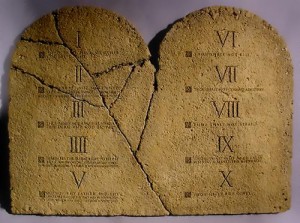
Broken Stone TabletsThe Bible tells us that the Tablets of the Law were kept in the Arc of the Covenant which traveled with the Hebrews throughout their forty years in the desert and that it was later housed in the Tabernacle and then in the Temple until lost at or about the time of the Babylonian Exile. According to Rabbinic lore, the Ark contained not only the second, whole Tablets, but the broken fragments of the first Tablets, to which Moses refers in this speech from the Book of Deuteronomy.

The Lubavitcher Rebbe (a very conservative Orthodox Jewish sage) once asserted that the keeping of the broken tablet fragments represented that truth can be crafted not only from the spiritually perfected life, but also from the pieces of a broken human life. This is good news since many, if not all, human lives are broken in some sense.

The Japanese have made art from of fixing broken pottery with a lacquer resin sprinkled with powdered gold. The technique, called kintsugi, renders the piece even more beautiful than it started out. The idea is not to hide the brokenness as ugly, but rather to beautify it using gold to make it shine, to expose and illuminate the damage. Kintsugi repaired vessels are particularly prized for use in the traditional tea ceremony.

Tea-ceremony aesthetics often focus on the beauty of imperfection; in the contemplative atmosphere of the ritual, host and guest appreciate the idiosyncrasies, the flaws, the differences in the glaze that differentiate one vessel from another. The context creates an awareness of transiency, of the way in which all things exist in a fleeting way and are decaying. As with tea vessels, so with human beings.

One of my favorite singer-songwriters is Leonard Cohen. His song Anthem celebrates brokenness:

The birds they sang at break of day
“Start again” I heard them say
Don’t dwell on what has passed away
Or what is yet to be
You can add up the parts
But you won’t have the sum
Strike up the march; there is no drum
Every heart to love will come
But like a refugee
Ring the bells that still can ring
Forget your perfect offering
There is a crack in everything
That’s how the light gets in.

There are no perfect offerings. There are no perfect lives. Everything, the tablets of the Law, tea ceremony vessels, human beings, are all prone to be broken; there is a crack in everything.

This Lent, as you evaluate your life, look for the brokenness that can be repair with the gold of truth, for the cracks where the light can get in.

====================

A request to my readers: I’m trying to build the readership of this blog and I’d very much appreciate your help in doing so. If you find something here that is of value, please share it with others. If you are on Facebook, “like” the posts on your page so others can see them. If you are following me on Twitter, please “retweet” the notices of these meditations. If you have a blog of your own, please include mine in your links (a favor I will gladly reciprocate). Many thanks!

====================

Father Funston is the rector of St. Paul’s Episcopal Church, Medina, Ohio.

The Ash Wednesday Exhortation – Sermon for the First Sunday in Lent – February 17, 2013

====================

This sermon was preached on Sunday, February 17, 2013, at St. Paul’s Episcopal Church, Medina, Ohio, where Fr. Funston is rector.

(Revised Common Lectionary, Lent 1, Year C: Deuteronomy 26:1-11; Psalm 91:1-2,9-16; Romans 10:8b-13; and Luke 4:1-13. These lessons can be read at The Lectionary Page.)

====================
LentIn The Book of Common Prayer on page 264 you’ll find the beginning of the liturgy for Ash Wednesday. If you were here on that day which marks the beginning of this season we call Lent, or in another church to be marked on your forehead with the cross of ashes, to be reminded of your mortality with the familiar words, “Remember you are dust, and to dust you will return,” you will also have heard the Lenten admonition which the presiding priest reads at each Ash Wednesday service. It begins at the bottom of that page and comes in the service after the reading of the lessons of the day and the preaching of the sermon.

It seems to me that many of us hear those words, perhaps even read along with them (as is our wont as Episcopalians), but I wonder to what extent we actually think about them, consider them, and internalize them. So this morning, as we enter into the Sundays which are in Lent but not of Lent, I’d like to return to Ash Wednesday and look more closely at, and perhaps offer a few cogent comments about, the Ash Wednesday admonition.

Dear People of God, . . . .

. . . . it starts and let’s just stop there and consider what that means. We hear those words, “the People of God,” often in Scripture, and when we do we usually understand it to mean those people long ago, those folks who lived way back then 2,000 or 3,000 or more years ago and way over there in the deserts of the Middle East in Palestine or Judea or Israel or Syria. “The People of God,” we think, are the Hebrews, those folks who Moses helped get their freedom from Pharaoh in Egypt, the ones to whom Moses is talking in the reading from Deuteronomy this morning. Or, perhaps, we believe “the People of God” are the descendants of Abraham, that “wandering Aramean” whom Moses’ audience was to claim as their ancestor. Or, again, maybe we think of the modern Jews as “the People of God,” the Chosen people with whom God has that special covenant.

But here we are addressed in the liturgy of Ash Wednesday as if we are the People of God! Do we think of ourselves that way? And more specifically, does each of us think of him- or herself individually as a “person of God”?

Did you know that that one of my titles, one of the names of the office of ministry in which I work, actually comes from that term? The word “parson,” which describes a parish priest or village clergyman comes from the old or middle English version of the word “person”. The medieval parish priest was the “person of God,” the “parson,” whose job it was to be in the church praying the liturgical hours, offering the sacrifice of the Mass, looking after the spiritual business of the community so the rest of the people wouldn’t have to! They could get on with the planting of crops, the tilling of fields, the harvesting of produce, the care and feeding of livestock. They could do all the other things of daily life and then go to the pub and have a beer because the “parson,” the “person of God” would have have taken care of the religious stuff, the spiritual stuff for them.

That is not, however, the way it’s supposed to be because no one person is the “person of God” — we are all “people of God;” we are all “persons of God.”

The first Christians observed with great devotion the days of our Lord’s passion and resurrection . . .

Now pay close attention to that! The focus of Lent is not Lent! The focus of Lent is “our Lord’s passion and resurrection.” The focus of Lent is Maundy Thursday and Jesus’ agonizing night of prayer in the garden at Gethsemane. The focus of Lent is Good Friday and his terrible, tortured death on the cross of Calvary. The focus of Lent is Holy Saturday and his burial in the borrowed tomb, his descent into hell, his freeing the souls of the dead. The focus of Lent is the empty tomb of Easter morning, his resurrection, his fifty days on earth appearing to, teaching, and sending forth his apostles. The focus of Lent is his Ascension into heaven to be always alive and always with us, our great high priest eternally pleading our case before the Father, elevating our humanity into divinity. Lent is never about Lent! Lent is always looking forward. Lent is always about Easter and beyond.

. . . . and it became the custom of the Church to prepare for them by a season of penitence and fasting. This season of Lent . . . .

As many of you know, I was not reared in the Episcopal Church . . . I wasn’t really brought up in any religious tradition. On one side, my mother’s, the family were part of the Campbellite tradition, out of which the Disciples of Christ is the largest current denominational body; they didn’t know from Adam about the church year, about Lent or any other season. On my father’s side they were Methodists in the old Methodist Episcopal (South) mold; no liturgical seasons for them! So we didn’t do this Lent thing. I had Catholic classmates in grade school, of course. I knew they were Catholic because they would show up at school on Ash Wednesday morning having come from Mass with a smudge of ash on their foreheads; they were doing Lent.

But the only thing I knew about “Lent” was that in the sort of English my grandmother spoke it was the past tense of the verb “to lend”. I thought the Roman Catholics were maybe paying back to God something they had borrowed from God. And, you know what? That’s not far from being a good description of what Lent is, in fact, all about. In our lesson from Deuteronomy today that is exactly what Moses instructs the people who are about to enter into the Promised Land, these Hebrews which he has led from captivity in Egypt. They are to remember that everything they have or ever will have has been given to them by God, through no merit of their own; they are to return to God at least some portion, the “first fruits”, of that which God has lent to them.

This season of Lent provided a time in which converts to the faith were prepared for Holy Baptism.

Did you know that back in the beginning, before the Emperor Constantine made Christianity first legal and then the official religion of the Roman Empire, it was a big deal to become a Christian? It was a dangerous thing because it was illegal, and Christians were often blamed for the Empire’s problems and made scapegoats, imprisoned, tortured, and killed. One could not simply walk into a congregation and ask to become a member. You had to be instructed and tested, and often it took as long as three years to complete all the catechesis needed to be accepted into the assembly, to be permitted to undergo the rite of Holy Baptism, which was commonly done only at Easter. And during these forty days of Lent modeled on the forty days of Christ’s tempting in the desert about which we heard in the Gospel lesson, the catechumens underwent their most rigorous training and testing, with mortification of the flesh, denial of even the simplest pleasures, a severely restricted diet (a “fast” in the dietary sense). Only then could they be baptized.

This was a big deal because baptism was considered a sort of death. St. Paul puts it this way in the Letter to Romans (not in the portion we heard today, but in the Sixth Chapter in a passage we read on Easter morning): “Do you not know that all of us who have been baptized into Christ Jesus were baptized into his death?” (Rom. 6:3) The symbolism of Holy Baptism, especially when done in the traditional way by full immersion, is that the water represents the soil of the grave; we are “buried” as we go under the surface and as we come up out of it, we are resurrected: “If we have been united with him in a death like his, we will certainly be united with him in a resurrection like his. . . . If we have died with Christ, we believe that we will also live with him.” (6:6,8)

So Lent was a time for this baptismal preparation, and it was a time that reminded every member of the church of their own baptismal promises, of their own “death” to the world and their new, resurrected life in Christ, of the seriousness of what it meant (and means) to be a Christian.

It was also a time when those who, because of notorious sins, had been separated from the body of the faithful were reconciled by penitence and forgiveness, and restored to the fellowship of the Church.

There was no rite of private confession in the early church; that was created by the Irish monks in the 6th Century and eventually spread to the whole church after the 9th Century. Nor was there a general confession in the early liturgies such as we now have in the Anglican form of worship that we enjoy. No, in the early church when a member was guilty of some grave sin they had to confess it before the whole assembly, after which they would be excluded from communion and they would be given some penance, some way to make amends before they would be permitted to return to worship with the congregation.

Thereby, the whole congregation was put in mind of the message of pardon and absolution set forth in the Gospel of our Savior, and of the need which all Christians continually have to renew their repentance and faith.

Of course, the congregation would, as the admonition suggests, realize that not only was the repentant sinner in need of forgiveness; they all were — and we all are. You’ll remember the story of Jesus encountering the rabbis and villagers planning to stone the woman taken in adultery. “Let anyone among you who is without sin be the first to throw a stone at her,” he said. (John 8:7) And not one of them did so because they realized, as Lent calls us to realize, that we are all sinners and all stand in need of forgiveness.

I invite you, therefore, in the name of the Church, to the observance of a holy Lent, by self-examination and repentance; by prayer, fasting, and self-denial; and by reading and meditating on God’s holy Word.

So this closing invitation to “a holy Lent” just asks us to do a lot of things we hear about every Lent, doesn’t it? Every year someone like me gets up in front of the congregation in every parish and prattles on about things we should do for the next six weeks, which are really things we ought to do year-round, but this time of year we sort of focus on them. We know we’re supposed to “fast” – that means give something up, right?

When people ask me what I’m going to give up for Lent, I always answer, “Chocolate.” It’s easy for me to give that up – I don’t eat chocolate. I should give up . . . I don’t know . . . my Irish whiskey? Good wines? I know! I’ll give up Downton Abbey right after tonight’s episode (the Season 3 finale).

But really, the point of fasting and self-denial is not the “mortification of the flesh.” It isn’t making oneself miserable because we think we ought to join Jesus in his desert misery, his famished hunger as described in today’s gospel lesson. The point of giving something up is to make room in our lives for something else, or to pay over or pay forward that which we give up to the benefit of someone else, or to concentrate on something of spiritual benefit to ourselves.

In the Book of the Prophet Isaiah, God questions God’s people about fasting. “Such fasting as you do today will not make your voice heard on high,” writes the Prophet. Delivering God’s word, Isaiah tells us that God asks, “Is such the fast that I choose, a day to humble oneself? Is it to bow down the head like a bulrush, and to lie in sackcloth and ashes? Will you call this a fast, a day acceptable to the Lord?” (58:4-5) The answer to these questions is clearly, “No.” The Prophet continues:

Is not this the fast that I choose: to loose the bonds of injustice, to undo the thongs of the yoke, to let the oppressed go free, and to break every yoke? Is it not to share your bread with the hungry, and bring the homeless poor into your house; when you see the naked, to cover them, and not to hide yourself from your own kin? (58:6-7)

If I give up whiskey for Lent, the money I save not buying it should be given to World Vision International or to Episcopal Relief and Development or to our own Free Farmers’ Market food pantry. If I do give up Downton Abbey, the time I save should be given to study of Scripture, another of the admonitions of this Ash Wednesday exhortation.

The forty days of Lent are, symbolically, our time with Jesus in the desert, our time to emulate our Lord in his preparation for ministry, our time to face our temptations as he faced his. Note how he did so. Each time the devil would set something wonderful before him – food, or world power, or spiritual superiority – Jesus responded by quoting Scripture. Jesus was sustained, strengthened, and empowered by the words of the Law and the Prophets. How many of us could do that?

The truth is that I couldn’t! I’ve never been able to memorize chapter and verse. If you ask me, “Doesn’t the Bible say something about . . . . ?” my response will be to shrug my shoulders and say, “I don’t know. I’ll look that up.” Don’t get me wrong! I read Scripture all the time, every day in fact. I just don’t have the head to remember it all. That’s what concordances and computer search programs are for! I know what’s in there, I just don’t always know where it is. But just because someone may not have the knack to remember chapter-and-verse is no excuse not to study God’s Word. So I do, and I commend the practice to you, so that, as Paul wrote to the Romans, “The word [will be] near you, on your lips and in your heart.” We are all, as the collect for today confesses, assaulted by many temptations; through study and contemplation of the Bible, we can each find God mighty to save; we can each, like Jesus, be sustained and strengthened and empowered by Scripture.

And, to make a right beginning of repentance, and as a mark of our mortal nature, let us now kneel before the Lord, our maker and redeemer.

And then there is a rubric, a word of instruction, saying, “Silence is then kept for a time.” The rubric is not part of the Ash Wednesday exhortation, but those may be the most important words on the page.

When the exhortation and our tradition ask us to “give something up for Lent,” the purpose is to turn our attention from the distractions of the world around us. At the vestry’s retreat the past couple of days, our facilitator asked us to consider the difference between “doing” and “being”, to consider whether the job of the vestry is to “do things” or rather to “be something”. As part of a clergy study group, I’m currently reading a book entitled Beyond Busyness: Time Wisdom in Ministry. The author’s premise is that being “busy” is a bad thing, that when we are “busy” we are allowing a lot of small distractions take us away from the bigger, more important things one which we should use our time. “Busyness” results from concentrating too much on “doing” and too little on “being”.

Keeping silence for a time helps us turn our attention away from busy doing and toward productive being.

There is a lovely verse from the Psalms. (Don’t ask me which verse in which psalm! Remember, I just can’t recall that stuff.) The verse reads, “Be still, and know that I am God!” (46:10) In those catalogs like National Public Radio and Public Broadcasting send out from time to time, I’ve seen a carved stone plaque of that verse which repeats the verse several times, but in each reiteration leaves off a word or two:

Be still and know that I am God.
Be still and know that I am.
Be still and know.
Be still.
Be.

So I leave you with the rubric as, perhaps, the most important admonition of Lent: “Silence is kept for a time.” Be still and know that God is God. . . . . Be still and know that God is. . . . . Be still and know. . . . . Be still. . . . . Be.

Amen.
Simple Invitations: Troubling Questions – From the Daily Office – February 15, 2013

From the Gospel according to John:

The next day John again was standing with two of his disciples, and as he watched Jesus walk by, he exclaimed, “Look, here is the Lamb of God!” The two disciples heard him say this, and they followed Jesus.

(From the Daily Office Lectionary – John 1:35-36 (NRSV) – February 15, 2013.)

InvitationCould it get any simpler? “Look, here is Jesus.” The proclamation of the Good News, the invitation into personal relationship with our Incarnate God, the revelation of what it is to be truly human . . . whatever you want to call it (we’ll steer clear for the moment from the word “evangelism”), it can’t get any simpler than this: “Look, here he is.”

That’s really all the Baptizer is doing. He’s inviting his friends to consider this Jesus whom he, John, has found to be a compelling figure. It’s a simple invitation.

Almost thirty years ago I read the book The Inviting Church by Roy Oswald and Speed Leas (Alban Institute 1987). In fact, I still have two or three copies of it on my office shelves. Right there on page 44 are these statistics about what attracts visitors to churches:

2% by Advertisement
6% by the Pastoral Invitation
6% by organized evangelism campaign
86% by friends or relatives

Guess what? Those statistics still hold true today. Over these three decades they have been confirmed again and again. The personal invitation, “Look, here he is,” is by far the most effective way the message of the Gospel spreads and the church grows.

The sadder statistic, also reported by Oswald and Leas and also still true today, is that half of church members have never invited anyone to church . . . ever. About a third have invited one person sometime during their lives. Fewer than 20% have made more than one invitation.

“What is the mission of the Church?” asks the Catechism in the Book of Common Prayer. The answer is simple: “The mission of the Church is to restore all people to unity with God and each other in Christ.” This mission, says the Catechism, is carried out “through the ministry of all its members.” (Emphasis mine.) The Catechism then teaches us that the ministers of the church are “lay persons, bishops, priests, and deacons.” That’s an awfully wordy way to say “all of us.”

The ministry of the laity, we are taught, is first and foremost “to represent Christ and his Church [and] to bear witness to him wherever they may be.” That’s really the ministry of all orders (lay or ordained), the ministry of every church member. There is no better example of bearing witness to Christ than the one given by the Baptizer in today’s lesson: “Look, here is the Lamb of God!” It’s really just that simple.

That so few do it speaks not of them as persons, but of the church corporately. Instead of asking (as so many clergy do) why people do not invite others, perhaps we should consider why people do invite friends to places or events. What encourages people to issue invitations? Basically, I think that we invite people we value to share with us in the things and communities we value, in the things and events that bring us joy. We invite people into that which is important to us.

And doesn’t that, especially for church leadership during this Lenten season, raise even more questions, more troubling questions, than it answers?

====================

A request to my readers: I’m trying to build the readership of this blog and I’d very much appreciate your help in doing so. If you find something here that is of value, please share it with others. If you are on Facebook, “like” the posts on your page so others can see them. If you are following me on Twitter, please “retweet” the notices of these meditations. If you have a blog of your own, please include mine in your links (a favor I will gladly reciprocate). Many thanks!

====================

Father Funston is the rector of St. Paul’s Episcopal Church, Medina, Ohio.

Enduring Enlightenment – From the Daily Office: Ash Wednesday – February 13, 2013

From the Letter to the Hebrews:

Lift your drooping hands and strengthen your weak knees, and make straight paths for your feet, so that what is lame may not be put out of joint, but rather be healed. Pursue peace with everyone, and the holiness without which no one will see the Lord.

(From the Daily Office Lectionary – Hebrews 12:12-4 (NRSV) – February 13, 2013.)

Running the RaceThe author of the Letter to the Hebrews is using an athletic metaphor, and borrowing from the Hebrew Scriptures, to make a point about endurance.

Taking up his own earlier metaphor of “running with perseverance the race that is set before us” (12:1), he echoes the Prophet Isaiah, “Strengthen the weak hands, and make firm the feeble knees. Say to those who are of a fearful heart, ‘Be strong, do not fear! Here is your God.'” (Isa. 35:3-4a) He draws from the Proverbs, “Keep straight the path of your feet . . . .” (Prov. 4:26)

Endurance, also known as “fortitude,” is one of Christianity’s four cardinal virtues. In Freemasonry (yes, I’m a Freemason), this Christian virtue is defined as “that noble and steady purpose of mind, whereby we are enabled to undergo any pain, peril, or danger, when prudentially deemed expedient.” As a subject of preaching, I’m afraid, this virtue gets rather short shrift in today’s church. I suppose that may be because the church reflects the popular culture which, with its emphasis on self-expression and instant gratification, emphasizes a sense of entitlement to ephemeral happiness and comfort.

As we begin Lent, it is well to reflect on this virtue. This period of forty days is meant to be our spiritual union with Jesus in his time of desert testing. If ever there was an example of endurance or fortitude, it has to be those days of temptation in the arid land beyond the Jordan. Endurance is a part of our Christian heritage, going back to Jesus and beyond him into the centuries-long story of the endurance of Israel, God’s chosen people.

Endurance is also one of the four Buddhist virtues, although in that religious tradition it is called “eternity”. It is regarded as a quality of inner being which allows the practitioner to remain unswayed by the ever-changing circumstances of life while confidently challenging him- or herself toward enlightenment. It leads, it is said, to another of the Buddhist virtues, happiness, a kind of contentment that can withstand the ups and downs of human existence including death. This is quite different from the vacuous “happiness” of the modern age, that insipid self-indulgence buoyed by unprecedented affluence and rampant consumerism.

This Lent let us eschew the world’s “happiness” and strive for that eternal happiness common to the Christian and Buddhist faith traditions, that noble and steady purpose of mind, that quality of inner being, that eternal endurance that leads to enlightenment, that leads to God.

====================

A request to my readers: I’m trying to build the readership of this blog and I’d very much appreciate your help in doing so. If you find something here that is of value, please share it with others. If you are on Facebook, “like” the posts on your page so others can see them. If you are following me on Twitter, please “retweet” the notices of these meditations. If you have a blog of your own, please include mine in your links (a favor I will gladly reciprocate). Many thanks!

====================

Father Funston is the rector of St. Paul’s Episcopal Church, Medina, Ohio.

Special Days, Sacred Time – From the Daily Office – February 4, 2013

From Paul’s Letter to the Galatians:

Formerly, when you did not know God, you were enslaved to beings that by nature are not gods. Now, however, that you have come to know God, or rather to be known by God, how can you turn back again to the weak and beggarly elemental spirits? How can you want to be enslaved to them again? You are observing special days, and months, and seasons, and years. I am afraid that my work for you may have been wasted.

(From the Daily Office Lectionary – Galatians 4:8-11 (NRSV) – February 4, 2013.)

Antique ClockWe are still reading through Paul’s correspondence with my Celtic friends of Anatolia. And, again, Paul is exasperated with them. They seem to be backsliding. I must admit, however, to some confusion here. Paul complains that they are “observing special days, and months, and seasons, and years.” What, I wonder, is wrong with that? Certainly the Jews, from whom Paul and Jesus came, observed special times, feasts, and seasons; and I’m pretty certain the earliest Christians observed Sunday as a “special day” – we still do.

Paul’s point, I know, is that the observance of “special days” in and of itself is not a meritorious work earning one salvation. But human beings need holidays — holy days — to mark the passage of time, to give it significance and meaning, to remember and perpetuate momentous events, to honor the cycles of life, not as meritorious acts but as memorials. The observance of “special days” creates a connectedness to other people and gives life events a spiritual meaning.

With some clergy colleagues I’m reading a book about being overly busy, especially as ordained ministers. In it the author includes this quotation (and I’m sorry I don’t know who it’s from): “Time is about God and the universe and all things human. Time is everywhere and it permeates everything: the cosmos, our solar system, the earth’s past, present and future, sociological existence. As such it has suffused knowledge since the dawn of humanity. It has occupied such a central place in the history of ideas and cultural practice because the temporality of being confronts us with the immemorial, existential issues of life and death, origin and destiny.”

While time itself is not sacred, times are redeemed and sanctified as human beings celebrate and participate in the eternal by “observing special days, and months, and seasons, and years.” These sacralized times join us as Christians in the Body of Christ across the generations, draw the worshiping community into a broader union with Christ, and connect us with the world. Sanctified and redeemed time focuses Christians on the great feasts celebrating the events of the life, death, and resurrection of Christ, events which we find echoed in the events of our own lives.

The observance of certain days in not in itself meritorious, but it can be redemptive. We human beings need our special days.

====================

A request to my readers: I’m trying to build the readership of this blog and I’d very much appreciate your help in doing so. If you find something here that is of value, please share it with others. If you are on Facebook, “like” the posts on your page so others can see them. If you are following me on Twitter, please “retweet” the notices of these meditations. If you have a blog of your own, please include mine in your links (a favor I will gladly reciprocate). Many thanks!

====================

Father Funston is the rector of St. Paul’s Episcopal Church, Medina, Ohio.

The Tongue of a Teacher – From the Daily Office – February 1, 2013

From the Prophet Isaiah:

The Lord God has given me
the tongue of a teacher,
that I may know how to sustain
the weary with a word.
Morning by morning he wakens —
wakens my ear
to listen as those who are taught.

(From the Daily Office Lectionary – Isaiah 50:4 (NRSV) – February 1, 2013.)

I Love My Teacher“The tongue of a teacher” is a such a ripe and fruitful image — it calls to mind all those wonderful people who are so formative in our lives. I remember particular teachers from throughout my life who have been and still are forces that formed and form who I am.

I’ve spent the past few days laid up by a case of viral enteritis with all of its unpleasant symptoms and so the first teacher to come to mind is my kindergarten teacher Mrs. Hancock. My most vivid memory of her is from a day when I was similarly ill and my father had to come to school to pick me up; I have other memories of Mrs. Hancock, but I especially remember how gentle and solicitous she was to a sick five-year-old.

In the Sixth Grade my teacher was Miss Upton. I was in love with Miss Upton, but she married during spring break and broke my heart! I think I fell in love with her because of how she dealt with the class the day President Kennedy was assassinated. I’m sure she appreciated the tragedy of the day much more than her group of 11- and 12-year-old students and was probably more upset than we were, yet she was a solid rock of calm and reassurance.

There were many others – Mrs. Weckle and Mr. Sallee in high school – Dr. Dykstra and Dr. Marcuse in college – professors in graduate school, law school, and seminary – and, of course, the many, many informal teachers we all encounter throughout life. All those people who have been given “the tongue of a teacher.” It is not the subjects they teach that makes them memorable; it is the way they taught, the way they lived their lives that infused their teaching.

Yes, teachers teach “subjects” – the nuts-and-bolts of mathematics or literature or property law or koine Greek. But more importantly a good teacher teaches how to learn and how to live. Good teachers foster critical thinking skills so that, given a concept, a student may go beyond the facts of the day and deal with any matter he or she may encounter. Great teachers foster critical living skills so that a student may go deeper than the mere facts and encounter the truth.

I thank God for Mrs. Hancock, Miss Upton, and all those to whom God has given “the tongue of a teacher” in my life.

====================

A request to my readers: I’m trying to build the readership of this blog and I’d very much appreciate your help in doing so. If you find something here that is of value, please share it with others. If you are on Facebook, “like” the posts on your page so others can see them. If you are following me on Twitter, please “retweet” the notices of these meditations. If you have a blog of your own, please include mine in your links (a favor I will gladly reciprocate). Many thanks!

====================

Father Funston is the rector of St. Paul’s Episcopal Church, Medina, Ohio.

A Gospel That Makes a Difference – From the Daily Office – January 28, 2013

From the Letter to the Galatians:

I am astonished that you are so quickly deserting the one who called you in the grace of Christ and are turning to a different gospel — not that there is another gospel, but there are some who are confusing you and want to pervert the gospel of Christ.

(From the Daily Office Lectionary – Galatians 1:6-7 (NRSV) – January 28, 2013.)

Diversity LogoI confess to a certain fondness for the Galatians. I’ve never been a really big fan of Paul the Apostle and I sometimes wistfully wonder how our Christian faith might have developed if he had not been its principal post-Ascension spokesperson. What if the Johanine community that produced the Gospel of John and the three letters that also bear his name had been more prominent? What if James and his insistence on works of mercy because “faith, if it has no works, is dead” (James 2:17) had been more influential than Paul’s assertion to the Romans that salvation is “by grace, it is no longer on the basis of works” (Romans 11:6)? Well, we’ll never know . . . but apparently the Galatians were listening to someone suggest an alternative to Paul’s understanding of the Christian gospel and, as a result, he wrote them this letter. Anybody that could so upset Paul that he would call them “you foolish Galatians” (Gal. 3:1) gets high marks in my book! That the Galatians were also Celts with whom I, as an Irish-American, share an ethnic heritage gives them additional credit.
But I have to admit that Paul does have a point about “a different gospel” and that “there is [not] another gospel.” What there are are differing interpretations of the gospel, different understandings of its import, different emphases on points of its message. What I really don’t like about what Paul is saying is the implication that his and his interpretation only is correct and that, therefore, anyone who disagrees with him “wants to pervert the gospel of Christ.” I believe it is entirely possible to have disagreement on this things, to have unity without uniformity. In fact, I would say it’s desirable, but here in his letter to the Celts of Asia Minor Paul doesn’t seem to think so.

Elsewhere Paul used the metaphor of the body when he tried to share with the church in Corinth the fundamental importance of unity. In the body metaphor in the 12th chapter of the First Letter to the Corinthians, Paul demonstrates how a body is made up of diverse members: “If all were a single member, where would the body be? As it is, there are many members, yet one body. The eye cannot say to the hand, ‘I have no need of you,’ nor again the head to the feet, ‘I have no need of you.'” (1 Cor. 12:19-21) Unity among diverse elements comes through inclusion of the various members of the body of Christ in deep sharing and mutual responsibility.

Of course, Paul was thinking of varying and diverse roles within the body of a congregation – apostle, evangelist, pastor, catechist, preacher, and so forth. He does not extend the body metaphor to those with differing opinions about the nature of faith, the person of Christ, the doctrine of atonement, the nature of salvation, and so forth. How much more lively might the church be if he had? How much more lively might the church be if we would?

If instead of thinking of the church as a community in which to find “the right answers,” we thought of it as a community in which to explore questions, how much more relevant and helpful to people’s lives might it be? So long as unity is seen as uniformity, we will be stuck trying to find (or convince others of) right answers. But if we can see unity in diversity, we will be able to hear a variety of responses; some responses will be useful for some seekers, and others will be useful for others. None will be “right” and none will be “wrong,” but all will be relevant.

This must be the church’s quest in the 21st Century, unity in diversity which makes the gospel relevant in the lives of all. No longer should we hear anyone address another as “you stupid Galatian!” No longer should we hear anyone condemned as “perverting the gospel.” We are not to preach “a different gospel,” but we are to offer a gospel that, with all its varied emphases and diverse applications, makes a difference.

====================

A request to my readers: I’m trying to build the readership of this blog and I’d very much appreciate your help in doing so. If you find something here that is of value, please share it with others. If you are on Facebook, “like” the posts on your page so others can see them. If you are following me on Twitter, please “retweet” the notices of these meditations. If you have a blog of your own, please include mine in your links (a favor I will gladly reciprocate). Many thanks!

====================

Father Funston is the rector of St. Paul’s Episcopal Church, Medina, Ohio.

Rector’s Address: “The Dream” by Wesley Frensdorff – Conversion of St. Paul (tr.) – January 27, 2013

====================

This address was given on Sunday, January 27, 2013, at St. Paul’s Episcopal Church, Medina, Ohio, where Fr. Funston is rector. The day was celebrated as the Patronal Feast of the parish by translating the Feast of the Conversion of St. Paul from January 25 to this, the closest following Sunday. Rather than preach on the propers of the day (Epiphany 3) or of the translated feast, Fr. Funston offered this assessment of the parish and how well it meets the vision of The Dream, a prophetic piece of prose written more than thirty years ago by the late Wesley Frensdorff, one-time bishop of the Episcopal Diocese of Nevada.

(Lessons for the Conversion of St. Paul according to the practice of the Episcopal Church: Acts 26:9-21; Psalm 67; Galatians 1:11-24; and Matthew 10:16-22. These lessons can be read at The Lectionary Page.)

====================

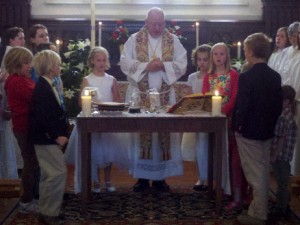
Fr. Funston assisted at the Communion Table by children of St. Paul's ParishMore than thirty years ago, a bishop named Wesley Frensdorff set out his vision for the church in a piece of writing he title simply The Dream. Wes Frensdorff was a good friend to Evelyn and to me. He was her parish priest when she was a child, and her boss when she was the director of the Diocese of Nevada’s summer camp. He officiated at our wedding, and is the person who spoke for God and hounded me into eventually becoming a clergyman. As my Rector’s Report, I’d like to share his dream with you, adding my own brief comments as to how I see this church meeting his vision.

Bishop Frensdorff begins . . .

Let us dream of a church . . .
in which all members know surely and simply God’s great love, and each is certain that in the divine heart we are all known by name.
in which Jesus is very Word, our window into the Father’s heart; the sign of God’s hope and his design for all humankind.
in which the Spirit is not a party symbol, but wind and fire in everyone; gracing the church with a kaleidoscope of gifts and constant renewal for all.

I think that is the sort of church we at St. Paul’s Parish are, a congregation which knows God and God’s Son and in which everyone’s gifts and ministries are welcomed, empowered, and celebrated. We have just received written and oral reports on the many and varied ways in which those gifts and ministries are embodied in our parish.

The bishop continues . . .

A church in which . . .
worship is lively and fun as well as reverent and holy; and we might be moved to dance and laugh; to be solemn, cry or beat the breast.
people know how to pray and enjoy it – frequently and regularly, privately and corporately, in silence and in word and song.
the Eucharist is the center of life and servanthood the center of mission: the servant Lord truly known in the breaking of the bread, with service flowing from worship, and everyone understanding why worship is called a service.

I believe we are such a congregation. We have affirmed often that we are a Eucharisticly-centered parish, a prayerful people, and a place of service. We have an active parish prayer chain; we have groups which meet weekly to read spiritual writings or study the Holy Scriptures (and I wish there were more of those); we have just instituted a new chapter of the Order of the Daughters of the King, whose ministry is one of intentional prayer. This is a parish with an active corporate and individual prayer life.

Let us dream of a church . . .
in which the sacraments, free from captivity by a professional elite, are available in every congregation regardless of size, culture, location, or budget.
in which every congregation is free to call forth from its midst priests and deacons, sure in the knowledge that training and support services are available to back them up.
in which the Word is sacrament too, as dynamically present as bread and wine; members, not dependent on professionals, know what’s what and who’s who in the Bible, and all sheep share in the shepherding.
in which discipline is a means not to self-justification but to discipleship, and law is known to be a good servant but a poor master.

I believe we are or are becoming such a congregation. We are a parish in which leadership of worship is shared, in which many study the Holy Scriptures (though I wish more would do so), and in which the discipline of the Christian life is a matter of trust and grace. This is a parish in which the “sheep share in the shepherding;” in addition to our Lay Eucharistic Visitors, we have many in our congregation who’s personal ministry is keeping in touch with those they may not see in church, those whom they know to be in need of a friendly visit, those who may not speak up when they are lonely. It is a delight to be the priest in a place where many share the pastoral service which is the ministry of the priesthood of all believers.

A church . . .
affirming life over death as much as life after death, unafraid of change, able to recognize God’s hand in the revolutions, affirming the beauty of diversity, abhorring the imprisonment of uniformity, as concerned about love in all relationships as it is about chastity, and affirming the personal in all expressions of sexuality;
denying the separation between secular and sacred, world and church, since it is the world Christ came to and died for.

I believe we are such a congregation. We are a parish which welcomes all regardless of race, origin, or sexuality; we are a parish in a tradition which boldly proclaims that creation is good and which seeks to husband and enhance that goodness.

A church . . .
without the answers, but asking the right questions; holding law and grace, freedom and authority, faith and works together in tension, by the Holy Spirit, pointing to the glorious mystery who is God.
so deeply rooted in gospel and tradition that, like a living tree, it can swing in the wind and continually surprise us with new blossoms.

I believe we are such a congregation. St. Paul’s Parish is a household which welcomes the seeker, the questioner, the curious, and the new, offering not easy, black-and-white answers, but responses and exploration in a community of questioners.

Let us dream of a church . . .
with a radically renewed concept and practice of ministry, and a primitive understanding of the ordained offices.
where there is no clerical status and no classes of Christians, but all together know themselves to be part of the laos – the holy people of God.
a ministering community rather than a community gathered around a minister.
where ordained people, professional or not, employed or not, are present for the sake of ordering and signing the church’s life and mission, not as signs of authority or dependency, nor of spiritual or intellectual superiority, but with Pauline patterns of “ministry supporting church” instead of the common pattern of “church supporting ministry.”
where bishops are signs and animators of the church’s unity, catholicity, and apostolic mission, priests are signs and animators of her Eucharistic life and the sacramental presence of her Great High Priest, and deacons are signs and animators – living reminders – of the church’s servanthood as the body of Christ who came as, and is, the servant slave of all God’s beloved children.

I hope we are becoming such a congregation in such a diocese. We have affirmed and celebrated today the ministry of many of God’s people through the activities and outreach of this parish. I look forward to a time when there may be one or more additional priests to animate (as Bishop Frensdorff put it) our Eucharistic life, when there may be one or more deacons to animate our life of service and servanthood, but whether we have those or not, we are now a community which, nourished on Christ’s Body and Blood, is corporately and individually reaching out in service to our community. The Free Farmers’ Market is our largest and most active corporate outreach ministry; but we have many members who are active in public service as hospital and hospice volunteers, as board members of charities, as tutors, and in a variety of other ways. Their public service is a testament to the Christian witness of this church to which they belong.

Let us dream of a church . . .
so salty and so yeasty that it really would be missed if no longer around; where there is wild sowing of seeds and much rejoicing when they take root, but little concern for success, comparative statistics, growth or even survival.
a church so evangelical that its worship, its quality of caring, its eagerness to reach out to those in need cannot be contained.

I believe we are becoming such a congregation. At a recent meeting of leadership in this parish, one of our people said, “I’m looking forward to failing!” What he meant was that he looks forward to us going out into the community around us with (as the bishop says) “little concern for success,” simply going out and getting something done, spreading the Gospel without worrying about the final outcome, which is always and ever in God’s hands.

A church . . .
in which every congregation is in a process of becoming free – autonomous – self-reliant – interdependent, none has special status: the distinction between parish and mission gone.
where each congregation is in mission and each Christian, gifted for ministry; a crew on a freighter, not passengers on a luxury liner.
of peacemakers and healers abhorring violence in all forms (maybe even football), as concerned with societal healing as with individual healing; with justice as with freedom, prophetically confronting the root causes of social, political, and economic ills.
which is a community: an open, caring, sharing household of faith where all find embrace, acceptance. and affirmation.
a community: under judgment, seeking to live with its own proclamation, therefore, truly loving what the Lord commands and desiring his promise.

I believe this is what we meant when we declared, as a congregation, that St. Paul’s Parish’s reason for being is “to set hearts on fire for Jesus” and that our mission is “to advance the Kingdom of God through liturgical worship, spiritual education, personal growth, and service to others.”

And finally, let us dream of a people
called to recognize all the absurdities in ourselves and in one another, including the absurdity that is Love,
serious about the call and the mission but not, very much, about ourselves,
who, in the company of our Clown Redeemer can dance and sing and laugh and cry in worship, in ministry, and even in conflict.
[Frensdorff was a great lover of clowns who often used the clown as a metaphor or illustration in his preaching about Jesus.]

I recently read an essay entitled Why Does God Need the Church? by Ragan Sutterfield, an Episcopalian who lives in Arkansas. Sutterfield’s answer is that God needs the church “to be God’s real presence in the world . . . a radical and amazing call for a group of people.” But, he wrote, “we need to realize . . . that the buildings, the ecclesial bodies, the liturgies, the hierarchies, the bishops, the priests, the laity, the budgets, etc, etc, etc, are only valuable as parts of the church in so far as they are fulfilling the mission of God. And . . . God’s mission is not nice services for nice people in nice buildings.” (Emphasis added.)

Sutterfield, I think, is echoing Bishop Frensdorff’s vision. In doing so, Sutterfield, proposed two new ways to think of our church congregations. First, as “icon” – an icon, he says, is an image that sparks the imagination to move beyond the image and see God. The question we must ask ourselves is “Are we such a community? Looking at us, visiting us, worshiping with us, being served by us, and serving with us, are others moved beyond us to see God?” I believe that we are such a community and I hope that others see through us in that way.

Sutterfield’s second new image of the church is as a “dojo.” A dojo, as you probably know, is “a practice community within martial arts – it is the place where adherents to a specific form come together to learn how to be better practitioners, both from each other and from recognized masters of the form.” It is, simply put, the place and community where people come to get better at what they do. In the church-as-dojo, the congregation becomes the place where we come together to work at becoming more Christ-like. The church becomes a place where we come not to sing some nice songs and hear an occasionally good sermon, but a community with which we gather to explore the faith with one another, recognizing that some among us are more practiced than we may be, challenging each other and learning from one another how better to practice the way of Jesus.

Sutterfield concludes with a vision not too much different from Bishop Frensdorff’s:

Imagine a church where, after a few months of regularly attending, you are able to recognize that you are less angry than you used to be. Imagine a church that shows you how to forgive the person who hurt you most profoundly. Imagine a church that measures your love of God as Dorothy Day did hers, by how much you love the person you love least. Imagine a church that loves you for who you are, away from all of the facades of the self, and teaches you how to love.

I believe that St. Paul’s Parish is and is constantly becoming such a place and such a community. The reports we have received today, the leadership our vestry and officers provide, the ministries of all of our members, all demonstrate that that is so, and for that I am grateful to each of you and to God.

Let us pray:

Almighty and everliving God,
ruler of all things in heaven and earth,
hear our prayers for this parish family.
Strengthen the faithful, arouse the careless, and restore the penitent.
Grant us all things necessary for our common life,
and bring us all to be of one heart and mind
within your holy Church;
through Jesus Christ our Lord. Amen.

Will you turn to the prayers page of the Annual Journal and join me in the “Disturb us, Lord” prayer attributed to Sir Francis Drake which our Inviting the Future Committee adopted as the guiding prayer for our capital project. After the prayer, we’ll sing I Have Decided to Follow Jesus (which is on the back cover of the Journal) and stand adjourned.

Disturb us, Lord, when we are too well pleased with ourselves, when our dreams have come true because we have dreamed too little, when we arrived safely because we have sailed too close to the shore.

Disturb us, Lord, when, with the abundance of things we possess, we have lost our thirst for the waters of life. Having fallen in love with life, we have ceased to dream of eternity and in our efforts to build a new earth, we have allowed our vision of the new Heaven to dim.

Disturb us, Lord, to dare more boldly, to venture on wider seas where storms will show your mastery; where losing sight of land, we shall find the stars.
We ask you to push back the horizons of our hopes; and to push us into the future in strength, courage, hope, and love. Amen.

« Older posts Newer posts »