From the Gospel of John:
When evening came, his disciples went down to the lake, got into a boat, and started across the lake to Capernaum. It was now dark, and Jesus had not yet come to them. The lake became rough because a strong wind was blowing. When they had rowed about three or four miles, they saw Jesus walking on the lake and coming near the boat, and they were terrified. But he said to them, “It is I; do not be afraid.” Then they wanted to take him into the boat, and immediately the boat reached the land towards which they were going.
(From the Daily Office Lectionary – John 6:16-21 (NRSV) – January 11, 2013.)
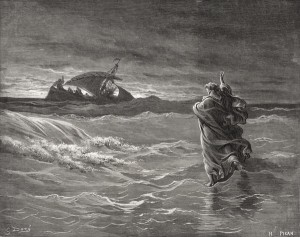 Jesus walking on the water has always struck me as a very funny story. “Funny” in the sense of “oddly out of place”, although it also has a certain Monty-Python-esque quality to it as well. The fact that it is reported in three of the Gospels – in the synoptic Gospels of Mark and Matthew and here in John – attests to its importance for the early church. John’s version of the story is the simplest, but it contains all the elements – a storm, rough seas, disciples’ fear. Like Mark, John leaves out Matthew’s addition of Peter trying to join Jesus on the surface of the lake.
I say the story seems out of place because it is (other than Jesus’ fit of pique at the poor fruitless fig tree, which has a parabolic quality to it, the fig being a rabbinic metaphor for the Torah; Mark 11:12-14, and Matthew 21:18-22) the single demonstration of divine power by Jesus which does not benefit another person or group of people. Other manifestations of power result in the provision of food (the wine at the wedding in Cana, the feeding of crowds of 5,000 and 4, 000) or in the healing of the supplicant or some other person. Jesus here seems to be simply about his own business. In fact, Mark makes it clear that “He intended to pass them by.” (Mark 6:48b) However, the disciples see him so he must respond.
It is Jesus’ response that underscores why this story is here, I think, and the NRSV translation does not do it justice. The Greek is “Ego eimi, me phobeithe.” The words “ego eimi” are the same words used in the Septuagint (the early Greek translation of the Hebrew Scriptures) when God’s identity is revealed as “I AM” (for this is what the Greek emphatically states). In Exodus, God speaks to Moses out of the burning bush and, when Moses asks God’s name, he is told, “I AM who I AM;” the Greek is “ego eimi”. (Exodus 3:14) In a similar way, Isaiah the prophet reports God saying several times, “I, even I AM He;” the Greek is “ego eimi.” Later in John’s Gospel, Jesus will use this same construction in his famous “I am” statements. Here as there, Jesus’ identity with God is what is stressed.
And this is also the import of the story of Jesus’ walking on the water, this miracle with no other purpose, no parabolic meaning as in the blasting of the fig tree, no benefit to another as in the feeding or healing miracles. This miracle simply demonstrates the power of Jesus over nature, and simply over nature, but over the forces of death and chaos represented by water and the storm. It is, purely and simply, a manifestation of divine power.
I try always to keep before my mind’s eye the Jesus who is human, to remember that he was “one who in every respect has been tested as we are” (Heb. 4:15) But every so often it is important to remember that Jesus is also divine, fully divine, God incarnate. It is necessary every so often simply to stand in awe of the One who walked on the water, the One WHO IS, and yet who humbled himself to become as we are.
====================
A request to my readers: I’m trying to build the readership of this blog and I’d very much appreciate your help in doing so. If you find something here that is of value, please share it with others. If you are on Facebook, “like” the posts on your page so others can see them. If you are following me on Twitter, please “retweet” the notices of these meditations. If you have a blog of your own, please include mine in your links (a favor I will gladly reciprocate). Many thanks!
====================
Father Funston is the rector of St. Paul’s Episcopal Church, Medina, Ohio.
 “I was ready to be sought . . . I said, ‘Here I am, here I am’.” Almost more than anything else in Scripture, these words speak to me of God as not just wanting but needing to be in relationship with creation. I have written elsewhere about my understanding of God as the God who communicates; here is the God who seems almost desperate to be in relationship with his people. God speaks and everything comes in to being; in the beginning was the Word. But what good is speaking, what good is a word, if no one hears it, no one answers it? “Here I am, here I am” seems like a plea to be heard, to be recognized, to be answered. But in our modern society, very few people seem to be answering. Many claim to be seeking, many claim to be “spiritual but not religious,” but few are finding God in the traditional faiths and faith communities.
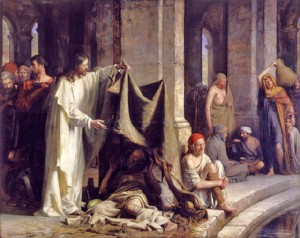 This is an old and familiar story, this tale of Christ healing the paralyzed man a the pool at Bethesda. We all know it well. The story continues with a confrontation between the man who has been and the Jewish religious authorities. This healing took place on the Sabbath. The confrontation is over whether it is proper for the man to carry his mat (i.e., perform work) on the Sabbath. The man’s defense is that the person who healed him told him to do so, although he doesn’t know (at the time) who the healer was. Later he learns it was Jesus and identifies him to the priests and scribes.
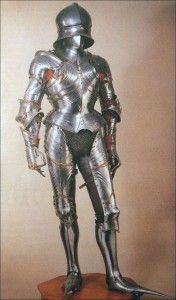 I am fascinated by this picture of God arming for battle, putting on his breastplate, his helmet, and his mantle, donning the “garments of vengeance.” It is, of course, injustice and evil against which God is arming. St. Paul picked up on the picture painted here by Isaiah when he admonished the Christians in Ephesus: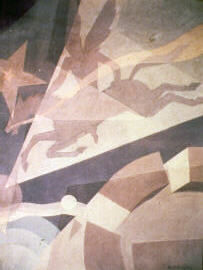
 How many places do we go where the Lord is and we do not know it? This story of Jacob reminds me of a song we sang in the Cursillo community where I meant my wife. It’s very pretty, very contemplative, and usually sung as an accompaniment to Holy Communion:
 Every so often something in Holy Scripture speaks to me of something other than the “purely” spiritual or “only” religious . . . and this little piece of the Letter to the Hebrews is one of those bits: “what is seen was made from things that are not visible.” Right!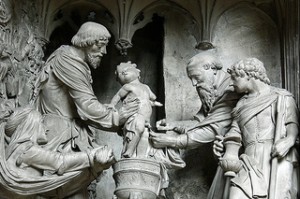
 New Year’s Eve and our epistle lesson in the Daily Office lectionary focuses on the old passing away and everything becoming new. It’s purely serendipitous, but what an opportunity to affirm our faith in God’s on-going and constant re-creation of the world.
 “No matter how big and bad you are . . . when a two-year-old hands you a toy telephone, you answer it.” That piece of wisdom showed up on my Facebook newsfeed recently and I will return to it in a moment, but first I want to share some more Christmas poetry with you.

