From the Prophet Habakkuk:
Though the fig tree does not blossom,
and no fruit is on the vines;
though the produce of the olive fails
and the fields yield no food;
though the flock is cut off from the fold
and there is no herd in the stalls,
yet I will rejoice in the Lord;
will exult in the God of my salvation.
(From the Daily Office Lectionary – Habakkuk 3:17-18 (NRSV) – November 20, 2012)
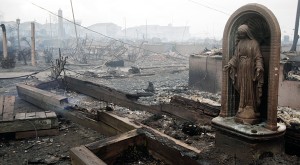
 Giving thanks at a time privation, that’s what these two verses from Habakkuk’s prophecy are about. Habakkuk describes a situation in which he (and all the people of Jerusalem) have lost everything. Just look at what he lists in verse 17: figs, grapes, and olives, the year-round fruit crops of the area; the fields, which is to say the annual crops, the grains and staple foods; flock and herd, which means sheep and cows. All their their produce is gone, all their livestock are dead.
This is a society utterly destroyed. Habakkuk’s situation is worse than anything we can imagine in our time and place. In Habakkuk’s time, there was no “safety net”, no social service agencies, no homeless shelters, no food stamps, no church food pantries, no well-off relatives (everyone is suffering the loss of the crops and livestock). For Habakkuk and his kindred, this all means starvation. It means death. None of us, I’m sure, has ever been in quite the situation Habakkuk experiences, though I do know that many have, for example, faced death their own possible in the form of cancer or of battlefield danger, and others have handled the death of loved ones.
Nonetheless, in face of the virtual certainty of destruction, Habakkuk can say, “I will rejoice in God; I will give thanks to my Lord.” It is easy to give thanks and rejoice when we have things; Habakkuk does so when he has nothing. I think we sometimes confuse thankfulness for the things we receive from God for faith in God God’s-self. Habakkuk has no things to be thankful for; it is in God’s self that Habakkuk rejoices. It is in God, not God’s gifts that Habakkuk trusts. This is more than gratitude for stuff. This is more than optimism and positive thinking. This is faith.
====================
A request to my readers: I’m trying to build the readership of this blog and I’d very much appreciate your help in doing so. If you find something here that is of value, please share it with others. If you are on Facebook, “like” the posts on your page so others can see them. If you are following me on Twitter, please “retweet” the notices of these meditations. If you have a blog of your own, please include mine in your links (a favor I will gladly reciprocate). Many thanks!
====================
Father Funston is the rector of St. Paul’s Episcopal Church, Medina, Ohio.
 There are two passages of Scripture that I always think of when vestries or other church governing boards begin to discuss a vision for the church’s mission and ministry. One is the King James version of Proverbs 29:18a – “Where there is no vision, the people perish.” – the other is this passage from Habakkuk. I really like the image of the vision being written so large that someone running by can read it and make sense of it; the church’s vision needs to be as big, expansive, and attention-getting as a billboard.
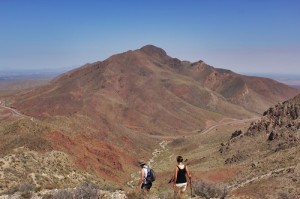 The “valley of decision” is probably another name for the Valley of Jehoshaphat referred to in an earlier verse of this chapter of the Prophet Joel. Jehoshaphat (a Hebrew name pronounced “yeh-hoh-shah-faht”) is a compound word of two other Hebrew terms, Yahweh (one of the names of God) and shaphat (meaning “to judge” or “to decide”). Jehoshaphat, therefore, means “God will judge” or “God will decide”. Geographically, the valley of Jehoshaphat, the valley of decision, lies between the city of Jerusalem and the Mount of Olives.
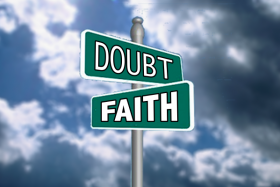 I suppose I take issue with Scripture more often than I should, but this is one of those bits that I just can’t agree with. I vehemently disagree with James’s equation of “doubt” with what he calls “double-mindedness”. The Greek word translated “double-minded” is dipsuchos , from dis , meaning “twice,” and psuche , meaning “mind.” James use of it to describe someone who has doubts suggests that such a person is divided in his or her interests or loyalties, wavering, two-faced, and half-hearted.
  Perhaps among the most familiar words from St. John’s apocalypse, “Blessed are they who are invited to the marriage feast of the Lamb.” They are used as a fraction anthem or invitation to communion in many churches. But in this brief passage from Revelation, the most powerful image for me today is the angel saying, “I am a fellow-servant with you and your brothers and sisters.”
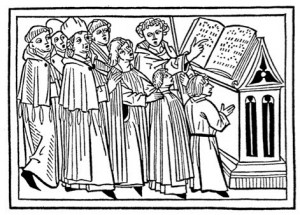 Chapter 50 of Ben Sira’s book is a description of a temple liturgy led by “the high priest, Simon son of Onias.” (v. 1) It is filled with poured-out wine, sumptuous vestments, the shouting of priests, the blowing of trumpets, the people falling on their faces. Not the sort of ho-hum run-of-the-mill worship service one finds in most Christian churches these days.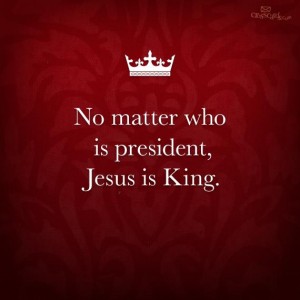
 It shouldn’t, but it always surprises me when I preside at a worship service and the offering of alms (cash money) is small. This is especially so at a small-attendance service when there are only a few people but even fewer dollars in the plate. It surprises me, I suppose, because of something I was taught by my grandfather. It shouldn’t surprise me, I suppose, because of the realities of which I am aware.
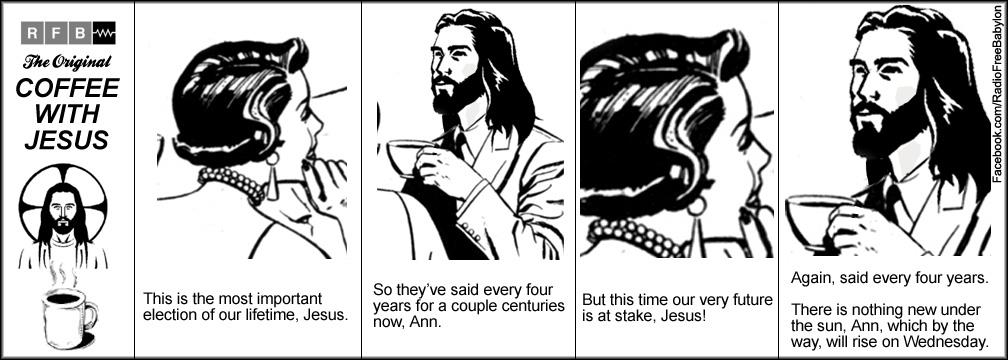
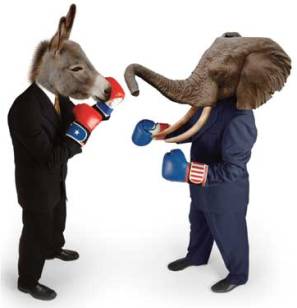 I am a political junkie (to use a term probably copyrighted by the NPR radio show Talk of the Nation). I love the democratic political process by which we in the United States choose our leadership. I don’t, however, love what it sometimes makes me become – a hyperpartisan. Once I have considered the issues and the candidates, once I have decided for which candidate or party or side of an issue I am going to vote, I am decidedly opinionated and not shy about sharing that opinion.