Occasional thoughts of an Anglican Episcopal priest

Category: Prayer (Page 42 of 47)

The Patients of Job: Part Four – “Can You Love What You Can’t Control?” – Sermon for Pentecost 22, Proper 25B – October 28, 2012

====================

This sermon was preached on Sunday, October 28, 2012, at St. Paul’s Episcopal Church, Medina, Ohio, where Fr. Funston is rector.

(Revised Common Lectionary, Proper 25B: Job 42:1-6,10-17; Psalm 34:1-8; Hebrews 7:23-28; and Mark 10:46-52. These lessons can be read at The Lectionary Page.)

====================
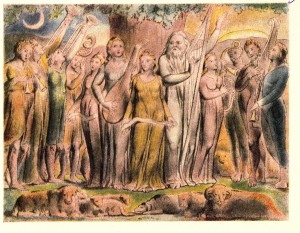
"So the Lord blessed the latter end of Job more than the beginning" by William BlakeSo here we are at the end of the Book of Job and the last of our sermons in this series entitled The Patients of Job. Let’s review the lessons we have learned, the spiritual remedies we have found in the medicine chest of this book.

First, in the introductory scenes in which the character God gave Satan leave to torment Job in ways he did not deserve, we learned that stuff sometimes happens in a person’s life, as it does in the story of Job, that he or she does not merit and for which he or she is not to blame! Stuff sometimes happens in your life that you do not deserve, and you are not to blame for it! The first bit of medicine we found in the Book of Job was the lesson to give up the “Why me? What have I done to deserve this?” ways of thinking, and stop beating ourselves up over things we can’t control! We also learned from the first part of Job’s story that life is a set of questions and that if there is truth to be found in this book, or in any of the books of the Bible, it is to be found in the process of struggling with those questions.

You’ll remember that, in the second reading we heard from this book, Job had decided to take God to court but had a problem: he didn’t know where to find God. In contemplating Job’s quandary, we recalled that our Christian faith assures us that in our times of pain and suffering, God comes to us in the loving acts of others. In illness, for example, God comes to us in the ministrations of the medical professionals who treat us. In emotional distress, God comes to us through those who offer us encouragement. In moments of deep need, God is there in a mysterious way through those who care for us. This gives us hope and courage. We need not cry out as Job did, “Oh, that I knew where I might find him;” (23:3) God knows where to find us. This is the balm for our souls, the spiritual medicine that we found in our second lesson from the Book of Job, that in our times of need, God knows were to find us and that, indeed, God does come to us.

In our third reading, last week, God spoke to Job but did not directly answer Job’s legal complaints. Instead, God’s response to Job was an invitation to us to participate in creation, to get creative. God let Job and us know that the answer to life’s problems is to get creative, to do something unexpected, to think outside the box. That is spiritual medicine for us because neither our problems, nor our world, nor our God will fit neatly into our preconceived boxes.

So those are the Book of Job’s spiritual medicines so far: stuff happens – don’t let it get you down; life is a bunch of questions, not a set of answers; God knows where to find us; and think outside the box.

Between last week’s lesson and this week’s reading, God continues to speak to Job about creation, describing its wildness, its beauty, and its uncontrollable nature; in Chapters 40 and 41, God specifically mentions the great bests Behemoth and Leviathan which cannot be captured and which overwhelm any who see them. The descriptions of nature in these ending chapters are suffused with the love that God has for God’s creation. This overwhelming and uncontrollable world which God created and which God loves is the answer God gives to Job’s self-pitying “Why me?” a question which clearly makes no sense in such a world.

Which brings us to the end and the epilogue but, frankly, these don’t make much sense. They seem to contradict everything we’ve learned so far. The whole book up to this point has seemed to be an argument against the old “wisdom religion” with its system of retributive justice, its idea that God rewards the righteous and punishes the wicked, that whatever happens to you, good or bad, is because you deserve it, so just accept it. But here at the end of the book that seems to be exactly what is happening: Job is rewarded for his righteousness by being reimbursed for his losses. “The Lord restored the fortunes of Job . . . the Lord gave Job twice as much as he had before.” Furthermore, God replaces Job’s ten dead children with ten new children, as if children are fungible commodities. Eliphaz, Bildad, and Zophar seem to have been right all along.

But if that’s what this Book of Job is all about, then it offers no spiritual medicines to us at all, for we know that the world simply doesn’t work that way! The righteous aren’t always rewarded; the wicked aren’t always punished; in fact, it’s all too often the other way around. If we read the end of the story in that way, we must be missing something. And indeed we are.

The lesson to be learned here requires that we compare the Job who is “restored” with the Job who existed before all of his losses. That earlier Job was a man who sought to control his world. We are told that that Job “would rise early in the morning and offer burnt offerings according to the number [of his children]; for Job said, ‘It may be that my children have sinned, and cursed God in their hearts.’ This is what Job always did.” (1:5) The restored Job, having been shown how uncontrollable the world is, turns loose of control; even before his death would require him to, he gives an inheritance to his children, his daughters as well as his sons. (42:15)

Ellen F. Davis, Professor of Bible and Practical Theology at Duke University Divinity School, in her book Getting Involved with God: Rediscovering the Old Testament (Cowley:Cambridge, MA, 2001), characterizes God’s speeches to Job, just the opening part of which we heard in last week’s reading, as posing for Job and us this question: “Can you love what you do not control?” (pg. 140)

You may be familiar with a popular saying that goes something like this: “If you love something, set it free. If it comes back, it’s yours. If it doesn’t, it never was yours.” God’s admonitions to Job and his restoration of Job’s fortunes affirm the first part of that, but call into the question the bits about return. The point here seems to be that even if it does return, it was never yours, at least it was never yours to control. In God’s descriptions of nature, of the unruliness of the weather, of the harshness of the wilderness, of the violence of the seas, of the wildness of the beasts, God made it clear that God made Creation wild and free, but God nonetheless loves Creation. This new, restored Job has learned to love his family in the same way, respecting their dignity and freedom, not seeking to control their world.

So the lesson for us to learn, the spiritual medicine for us at the end of the book, like the first lesson at its beginning, has to do with our lack of control. From the early scenes, we learned to accept that we cannot control the world; at the end, we learn to love it anyway. Love it even its most out-of-control, darkest times, because the lesson at the end of this Book of Job tells us that when the dark, uncontrollable night is over, the sun always rises. There is always the promise of hope. That is not only the balm at the end of Job’s story, it is the recurring message of the story of God and God’s People told again and again.

In the time of Noah, it rained for forty days and forty nights; water covered the earth for nearly a year. There was nothing Noah and his family could do about it; they were not in control. But, eventually, the dry land appeared again and God hung a rainbow in the sky.

For generations, the Hebrews were slaves in Egypt. There was nothing they could do about; they were not in control. But then God sent Moses and they were freed.

For forty years they wandered the desert because they were not in control, but eventually Moses led them to, and Joshua led them into, the Promised Land.

The Babylonians sacked Jerusalem and carried away the leaders and a goodly portion of God’s People to Babylon. They were exiled for seventy years; there was nothing they could do about it; they were not in control. But, eventually, God raised up Cyrus the Persian who defeated the Babylonians and set the Israelites free to return and rebuild.

Bartimaeus was blind. There was nothing he could do about it; he was not in control. But, eventually, the Son of God happened by and his sight was restored.

The Son of God himself was beaten, mocked, crucified and killed, laid in a tomb that was not his own. There was nothing he could do about it; he had given up control. But, eventually, there was Easter!

The last verse of the Book of Job as we have received it is, “And Job died, old and full of days.” But in some Greek-language texts there is one more verse added, “And it is written that he will rise again with those whom the Lord raises up.” The end of the Book of Job is a reminder to love what we cannot control, to love what is wild and free, because as bad as things may get, as dark and out-of-control as they may be, eventually there will be something very much like resurrection. And that is balm for our souls, that we like Job “will rise again with those whom the Lord raises up.” Amen.

====================

A request to my readers: I’m trying to build the readership of this blog and I’d very much appreciate your help in doing so. If you find something here that is of value, please share it with others. If you are on Facebook, “like” the posts on your page so others can see them. If you are following me on Twitter, please “retweet” the notices of these meditations. If you have a blog of your own, please include mine in your links (a favor I will gladly reciprocate). Many thanks!

====================

Father Funston is the rector of St. Paul’s Episcopal Church, Medina, Ohio.
How Not to Converse – From the Daily Office – October 26, 2012

From the Book of Ben Sira:

Do not find fault before you investigate;
examine first, and then criticize.
Do not answer before you listen,
and do not interrupt when another is speaking.

(From the Daily Office Lectionary – Sirach 11:7-8 – October 26, 2012)

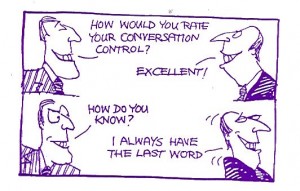
Conversation Skills CartoonJesus son of Sirach offered a lot of good advice in his little book sometimes called Liber Eccesiasticus, a book not included in the canon of inspired Scripture recognized by Protestants, but found in that selection of texts called the Apocrypha. Anglicans decline to use these texts to settle matters of doctrine, but read them ” for example of life and instruction of manners.” (Articles of Religion, Article VI, BCP 1979, page 868)

None of that advice, it seems to me, is better, nor more timely, than these verses from today’s Old Testament reading: investigate before speaking; listen before answering. The so-called “debates” (which were anything but) between the candidates for the presidency and vice-presidency of this country were exercises in how not to have a constructive and productive conversation. In whatever the format, none of which worked, these “debates” were showcases of people whose ears were hardly ever engaged, who weren’t examining things before criticizing and who weren’t listening before answering, and who definitely were interrupting when others were speaking.

I may use YouTube snippets of the debates in my pre-marital counseling of engaged couples! In that counseling, I talk with the couples about effective communication and problem solving and always, always encourage two things: active listening and assertiveness (which is very different from aggressiveness). Active listening means paying attention, not interrupting, and restating what you have heard so that you confirm your understanding; it means taking personal responsibility for getting what you hear from the other person right. Assertiveness means getting what the other hears from you right. It means taking responsibility for your feelings by using “I” statements; it means stating your position clearly and directly, not relying on the other to read your mind.

Obviously, the need for good interpersonal communications skills has been around as long as there have been people and the advice I give these couples is nothing new. Jesus Ben Sira was giving the same advice, how not to converse, a couple of millennia ago!

====================

A request to my readers: I’m trying to build the readership of this blog and I’d very much appreciate your help in doing so. If you find something here that is of value, please share it with others. If you are on Facebook, “like” the posts on your page so others can see them. If you are following me on Twitter, please “retweet” the notices of these meditations. If you have a blog of your own, please include mine in your links (a favor I will gladly reciprocate). Many thanks!

====================

Father Funston is the rector of St. Paul’s Episcopal Church, Medina, Ohio.

The Fire Inside – From the Daily Office – October 23, 2012

From the Psalms:

So I held my tongue and said nothing;
I refrained from rash words;
but my pain became unbearable.
My heart was hot within me;
while I pondered, the fire burst into flame;
I spoke out with my tongue.

(From the Daily Office Lectionary – Psalm 39:3-4 – October 23, 2012)

FlameThis is from one of today’s psalms for Evening Prayer. What got my attention and caught my imagination is the Psalmist image of unspoken thoughts being painful and bursting into flame demanding to be spoken. While it is intended to be a positive image of trying to not engage with the wicked until one can no longer refrain from doing so, until one’s righteousness is kindled against them, I could not help but be reminded of James’s words:

The tongue is a small member, yet it boasts of great exploits. How great a forest is set ablaze by a small fire! And the tongue is a fire. The tongue is placed among our members as a world of iniquity; it stains the whole body, sets on fire the cycle of nature, and is itself set on fire by hell. (James 3:5-6)

It’s a metaphor of mixed meaning, the unspoken word as a fire bursting from the tongue in burning speech. It can slay the wicked, but it can also destroy the world. The problem is that once those thoughts begin to smolder inside one’s being they can’t be controlled; they can’t be smothered out; they can’t be contained. Bob Seeger has a great song entitled The Fire Inside which includes these lines:

You’re out on the town, safe in the crowd
Ready to go for the ride
Searching the eyes, looking for clues
There’s nowhere you can hide
The fire inside

“There’s nowere you can hide the fire inside!” It’s going to get out; it’s going to known. Our goal should not be to contain the fire or keep it hidden; that’s when we lose control of it. Our goal should be to channel it and use it. Another word for the “the fire inside” is passion. Theologian Frederick Buechner has written that vocation is where our greatest passion meets the world’s greatest need: “The kind of work God usually calls you to do is work (a) that you need most to do and (b) that the world needs most to have done. The place God calls you to is the place where your deep gladness and the world’s deep hunger meet.” (Wishful Thinking: A Seeker’s ABC) Everyone has a vocation. The Psalmist’s was to speak God’s truth in the midst of the wicked. Each of us must discern our own.

What is the fire inside and where can it be used?

====================

A request to my readers: I’m trying to build the readership of this blog and I’d very much appreciate your help in doing so. If you find something here that is of value, please share it with others. If you are on Facebook, “like” the posts on your page so others can see them. If you are following me on Twitter, please “retweet” the notices of these meditations. If you have a blog of your own, please include mine in your links (a favor I will gladly reciprocate). Many thanks!

====================

Father Funston is the rector of St. Paul’s Episcopal Church, Medina, Ohio.

No Ifs, Ands, Or Buts – From the Daily Office – October 22, 2012

From Luke’s Gospel:

As they were going along the road, someone said to him, “I will follow you wherever you go.” And Jesus said to him, “Foxes have holes, and birds of the air have nests; but the Son of Man has nowhere to lay his head.” To another he said, “Follow me.” But he said, “Lord, first let me go and bury my father.” But Jesus said to him, “Let the dead bury their own dead; but as for you, go and proclaim the kingdom of God.” Another said, “I will follow you, Lord; but let me first say farewell to those at my home.” Jesus said to him, “No one who puts a hand to the plough and looks back is fit for the kingdom of God.?”

(From the Daily Office Lectionary – Luke 9:57-62 – October 22, 2012)

No ExcusesJesus is so demanding! Follow me and you won’t have a place rest; leave your dead; if you look back, you aren’t worthy!

My grandmother used to have a way of responding to excuses. She’d tell us to do something and my brother or my cousins or I would say, “But, Grammy . . . . ” And she would reply, “No ifs, ands, or buts!”

As I reflected on today’s gospel lesson I tried to find some humor in it, but the plain truth of the matter is that Jesus is demanding. To the rich young man he said, “Sell all you have, give the money to the poor, then follow me.” (Luke 18:22) To his followers he says, “If something in your life, even a part of your body, causes you to sin, get ride of it.” (Mark 9:43-47) Our allegiance to him and his gospel is to be so exclusive that it may even make enemies of our closest relatives: “I have come to set a man against his father, and a daughter against her mother, and a daughter-in-law against her mother-in-law; and one’s foes will be members of one’s own household.” (Matthew 10:35-36) No ifs, ands, or buts about it!

This is a man who brooks no compromise and if we are to be his followers, he demands that we adopt the same attitude: “A disciple is not above the teacher, nor a slave above the master; it is enough for the disciple to be like the teacher, and the slave like the master.” (Matthew 10:24-25)

No wonder many of those who thought they would be his disciples turned back and even those who continued with him found his teachings and example hard to follow. We still do; the church and her members still make the compromises he warned us not to make. But in the end we are left to ask with Peter, “Lord, to whom can we go? You have the words of eternal life.” (John 6:68)

It is a dilemma! To whom else can we go? But Jesus is so demanding! No ifs, ands, or buts about it!

====================

A request to my readers: I’m trying to build the readership of this blog and I’d very much appreciate your help in doing so. If you find something here that is of value, please share it with others. If you are on Facebook, “like” the posts on your page so others can see them. If you are following me on Twitter, please “retweet” the notices of these meditations. If you have a blog of your own, please include mine in your links (a favor I will gladly reciprocate). Many thanks!

====================

Father Funston is the rector of St. Paul’s Episcopal Church, Medina, Ohio.

The Patients of Job: Part Three – “What Is Half of 11?” – Sermon for Pentecost 21, Proper 24B – October 21, 2012

====================

This sermon was preached on Sunday, October 21, 2012, at St. Paul’s Episcopal Church, Medina, Ohio, where Fr. Funston is rector.

(Revised Common Lectionary, Proper 24B: Job 38:1-7,34-41; Psalm 104:1-9,25,37b; Hebrews 5:1-10; Mark 10:35-45. These lessons can be read at The Lectionary Page. At St. Paul’s Parish, the whole of Job 38 was read as the Old Testament lesson.)

The illustrations which follow in this sermon were presented as PowerPoint slides during the homily.

====================

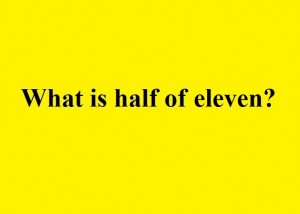
This is our third installment in the sermon series The Patients of Job and we begin with a diagnostic question: What is half of 11?

Job 38:1-7, (34-41) Psalm 104:1-9, 25, 37b  or  Isaiah 53:4-12 Psalm 91:9-16  Hebrews 5:1-10 Mark 10:35-45

Think about that for a while and we will return to this question in a moment. First, however, we need to catch ourselves up-to-date on the story of Job.

When we left Job last week, he and his friends Eliphaz, Bildad, and Zophar had had a long conversation about Job’s condition, his various misfortunes, and his own purity or blameworthiness; they then waxed philosophical about a hypothetical and stereotypical wicked man, being rather unclear whether that man was, in fact, Job. We were left with Job determined to take God to court where he would plead his innocence, but in something of a quandary because he was unsure where to find God.

Despite his confusion and bewilderment about the whereabouts of the Almighty, Job then spends the next nine chapters laying out his case. Bildad interrupts him briefly, but other than that the three friends do not speak further. There is a brief excursus in Chapter 28 about creation and wisdom, and scholars are unsure if Job is actually the speaker of that portion; it may be that this is one of the friends or even the narrator of the story speaking, but the text is unclear. When Job finishes, a newcomer begins to speak, Elihu the son of Barachel the Buzite. He comes on the scene unannounced, expresses his anger at Job and his friends because of their lack of understanding about God, and picks holes in some of their arguments. Most scholars think this a later addition to the book because Elihu’s speeches really add nothing and interrupt the flow between Job’s final speech and the appearance of the character God whose first speech in response to Job we heard today as our Old Testament reading. (I asked our lector to read the whole of Chapter 38, not simply the selected verses required by the Lectionary.)

My friend and colleague Steve _________, who is now the priest-in-charge of St. Bartholomew’s Episcopal Church in Mayfield Village, recently characterized the Book of Job, and this chapter of it in particular as “Job asking, ‘Why am I, a righteous man, suffering so?’ and God’s answer is ‘I am God and you are not.'” As Steve noted, that is not an entirely satisfying answer! I’ve often thought of the book and God’s answer in even less positive terms; it has frequently seemed to me that God’s response is (pardon the expression!), “Who the hell are you?”

But as I re-read the whole of the story in preparation for these sermons, and again as I have written each homily, I think that Steve and I have been wrong about this story. I don’t think God’s answer is either “I’m God and you’re not” or “Who the hell are you?” I think God’s answer is “What is half of 11?” And, again, I’ll come back to that.

I mentioned Chapter 28 earlier; that chapter really sets the background for God’s response to Job in this chapter. Chapter 28 has been called “one of the most exquisite poetic compositions of the entire Bible” (New Interpreters Bible, Vol. IV, Abingdon Press:1996, p. 528); I encourage you to read it! In Chapter 28, the speaker (whether Job or someone else) addresses the paradox of wisdom which cannot be found because it is everywhere. “Surely there is a mine for silver, and a place for gold to be refined,” it begins. (v. 1) “But where shall wisdom be found?” it asks, “And where is the place of understanding?” (v. 12) In what is really a hymn to wisdom and creation, the speaker sings of precious metals and prized gemstones, of the animals of nature, of the phenomena of weather, and of God who understands the way of wisdom because God “looks to the ends of the earth, and sees everything under the heavens.” (v. 24) Human beings, says the speaker, find wisdom through participation in creation in two particular ways. First, by what the speaker calls “the fear of the Lord,” a biblical term for piety or prayerful mindfulness; second, through “departure from evil,” which is to say moral action and uprightness. In these ways, human beings participate in the integrity of creation and understand the interrelatedness of all things; in a word, human beings find wisdom through creation and in creativity. This, then, is the background for what God says to Job in Chapter 38.

Job has laid out his legal case and made his arguments. God appears on the scene and rather than answer the lawsuit, he turns the tables on Job and starts asking him a lot of questions about nature. He asks about the seas, about wild animals, about storms and clouds and thunder, but says not a word about any of the points Job has laid out so carefully in his legal case . . . not a word. Instead, God’s address to Job is characterized by an “unrelenting use of rhetorical questions: ‘Who?’ ‘Where?’ ‘How?’ ‘What . . . can you . . . have you . . . do you know?'” (N.I.B., p. 598)

“What,” says God, “is half of 11?” Well, not actually. “What is half of 11?” is a question asked by my friend John O’Keefe. And, of course, we all know the answer, don’t we? Half of 11 is 5.5. You take 11; you divide it by 2; you get 5-and-a-half. Done.

5.5

But are we? In John’s book, The Church Creative (CreateSpace:2012), he suggests we ought to open ourselves to considering the question “What is half of 11?” from different and unexpected perspectives. (See also John’s website, The Church Creative.)

What if we visualize or understand this question not as “What is half of the number 11?” but “What is half of a character made up of two 1s, two vertical strokes?” Then half of 11 is . . .

1

. . . and the second half is . . .

1 & 1

Or what if we think not in Arabic numerals but in the Roman numerals?

What Is Half of XI?

Then the first half of XI is an X . . .

X

. . . and the second half is an I.

X & I

Or, we could just slice the figure horizontally so that there’s a top half . . .

Top of XI

. . . and a bottom half.

Top & Bottom of XI

Here’s another thought. Think in terms of words, not numbers. “What is half of e-l-e-v-e-n?”

What is half of eleven?

Obviously, the first half is “e-l-e” . . .

ele

. . . and the second, “v-e-n”.

ele & ven

Or, half of the word “eleven” is made up of the vowel “e” . . .

eee

. . . and the other half is made up of consonants.

eee & lvn

I suggest to you that God’s numerous rhetorical questions are meant to get Job to look at himself, his situation, his losses, and his current condition, from a different perspective, to understand God in a different way. God’s response to Job is like asking “What is half of 11?”

Just like us, when we read that question as being only and solely a math problem, Job has a particular way of seeing the world, a particular way of understanding reality, a particular way of understanding God. His frame of reference, if you will, was the social structure of his world, the village, clan, and family structure within which his life was lived. Job’s theological imagination was framed by that structure; the metaphors through which he sought to understand God came from that structure. Just as Job, acting as a person of honor, would hear and respond to a complaint from one of his employees or one of his children, so he believed God would hear and respond to his case. “Job’s image of God is developed out the highest and best values of his society, values that Job has always tried to embody.” (N.I.B., p. 556) This is fully in keeping with the Biblical tradition of “thinking about God by means of metaphors drawn largely from the realm of human relations.” (Ibid.) The problem, of course, is that such metaphors are limited and inadequate. God is not simply an ideal human person; God is “wholly other”, and God will not fit completely into the neat and tidy lines of our metaphors. Job is only partially correct about God. God will (and does) deal with Job as a loving Parent might deal with a child, but not in the way Job anticipates.

My daughter Caitlin recently shared with me an essay she wrote for one of her college courses. In it she related a story about my uncle, who was a very talented professional artist, teaching her to draw. This is her story:

My great uncle Richard was the first person to let me loose with a tool and tell me that I had the power to create “Art”. Sitting under an orange tree in my Grammy’s backyard, he handed me some colored pencils and told me to draw my favorite thing; at the time it was flowers. My geometric and organic patterns turned into a kid’s rendition of paisley. Once I got that flower thing down I wanted to move on to something more awesome. I couldn’t think of what to draw, so Uncle Richard decided to teach me a Surrealist technique to ease the imagination process. He told me to take a black pen, and without thinking about it too much, draw one continuous line all over the paper, “Just scribble it all up.”

After I scribbled the most extreme mess on the page, he told me to “make the ends meet.” I found the point at which I began my crazy doodle, connected the dots and then colored in the shapes between the lines with a myriad of color as he suggested. The great American painter Jasper Johns said the way to make art is to “Do something, then do something to that, then do something to that.”

My uncle had my daughter do something like this . . .

Squiggle

. . . and then do something like this to it.

Squiggle Colored-in

In this way, Uncle Richard taught Caitlin that she had (as she put it) “the power to create.” It must have worked; last year Caitlin painted this watercolor . . .

Red Snapper, copyright 2012, Caitlin Funston

and, with it, won a scholarship at the University of Missouri.

God’s response to Job, all those rhetorical questions – “Who?” “Where?” “How?” “What . . . can you . . . have you . . . do you know?” – were God’s way of getting Job to “just scribble it all up,” of getting Job to stop being confined within the lines and limits and inadequacies of his metaphors, of getting Job to think creatively, of helping Job to find wisdom by participating in the integrity of creation and through understanding of the interrelatedness of all things. God’s response was not asking Job “Who the hell are you?” and God wasn’t answering his complaint with “I’m God and you’re not.” God was, however, saying, “I’m God but not in anyway you’ve ever considered, understood, or even imagined.” God was saying, “Neither I nor the world I created will fit within the neat lines of your metaphorical box.”

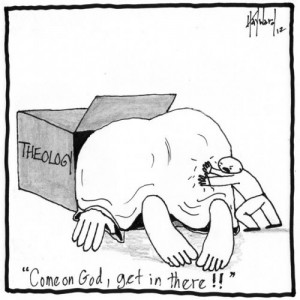
God’s response to Job is an invitation, and therein is the balm for us as “Patients of Job”, the prescription for whatever sickens our souls, for remedy for whatever ails our realities. God’s response is an invitation to Job and to us to participate in creation, to “scribble it all up,” to do something, then do something to that, then do something to that, to answer “What is half of 11?” in unexpected ways, to be creative in our problem solving. The answer to Job’s problem is not to sit on his pile of ashes moaning and complaining, disputing legalisms and “did I deserve it?”s with his friends; the answer to Job’s problem is not to sit on his pile of ashes framing legal arguments and preparing to sue God! The answer to Job’s problem is to get creative, to do something unexpected, to think outside the box. And that is spiritual medicine for us because, just like Job’s, neither our problems, nor our world, nor our God . . .

"Come on God, Get In There!!"

. . . will fit in our neat metaphorical boxes. Amen.

Warm Olive Oil – From the Daily Office – October 20, 2012

From Luke’s Gospel:

While everyone was amazed at all that he was doing, he said to his disciples, “Let these words sink into your ears: The Son of Man is going to be betrayed into human hands.” But they did not understand this saying; its meaning was concealed from them, so that they could not perceive it. And they were afraid to ask him about this saying.

(From the Daily Office Lectionary – Luke 9:43-45 – October 20, 2012)

Olive OilI’ve been thinking about this little bit of Scripture all day! It’s nearly 10:30 p.m. – time for Compline! – and I’m still thinking about seven words from the morning gospel: “Let these words sink into your ears” . . . .

What a great image for coming to wisdom, to understanding, to appreciation for the thoughts of another! I have this vision of Christ’s words as if they were an oily ointment soaking into his listeners’ ears and then oozing into their brains, their consciences, their very being.

When I was a kid I was prone to ear aches. The home remedy for them was warmed olive oil poured into your ear! I would lie down on my bed (or more often on the sofa in my grandmother’s living room, a towel under my head to protect the upholstery of her davenport), and she would put several drops of warmed olive oil into my ear. At first (especially if it was a bit over-warm) it was startling, but then it would sooth away the awful stabbing pain of the ear ache. I can still remember the sense of relief, the noticeable absence of pain.

When I was five years old, just a few month before my father died in an automobile accident, my tonsils and adenoids were removed to prevent further ear aches, so this must surely be a very early memory.

Jesus’ words soaking into his disciples’ ears should be like that. “Let these words sink into your ears . . . . ” Let these words soothe away the pains of this world. Of course, in this case, his words themselves were painful. His disciples were going to lose their master. Still, the image of wisdom oozing into their consciences, into our consciences, like that warm olive oil on my grandmother’s davenport remains. “Let these words sink into your ears.” Let my wisdom soak into your being like warm olive oil.

====================

A request to my readers: I’m trying to build the readership of this blog and I’d very much appreciate your help in doing so. If you find something here that is of value, please share it with others. If you are on Facebook, “like” the posts on your page so others can see them. If you are following me on Twitter, please “retweet” the notices of these meditations. If you have a blog of your own, please include mine in your links (a favor I will gladly reciprocate). Many thanks!

====================

Father Funston is the rector of St. Paul’s Episcopal Church, Medina, Ohio.

God At My Right Hand – From the Daily Office – October 19, 2012

From the Psalms:

I have set the Lord always before me; because he is at my right hand I shall not fall.
My heart, therefore, is glad, and my spirit rejoices; my body also shall rest in hope.

(From the Daily Office Lectionary – Psalm 16:8-9 (BCP Version) – October 19, 2012)

Vitruvian Man by Leonardo da VinciHeart, spirit, body. These two verses speak to me of the necessary investment of one’s whole self, the whole person, into the spiritual and religious life. One of the most influential lay theologians of the middle 20th Century, William Stringfellow wrote: “Spiritual maturity or spiritual fulfillment necessarily involves the whole person – body, mind and soul, place, relationships – in connection with the whole of creation throughout the era of time . . . . Spirituality encompasses the whole person in the totality of existence in the world, not some fragment or scrap or incident of a person.” (The Politics of Spirituality, Westminster John Knox: 1984, p. 22) If Stringfellow is right, and I think he is, then a plan for spiritual growth should follow the Psalmist example and “set the Lord always before” the person seeking to grow. Always . . . not just an hour or so on Sunday morning.
Consider all the areas of life in which a modern person lives, all the activities that fill our days, all the commitments to self and others that we juggle: marriage (or other significant relationship), family (nuclear and extended), friends and coworkers, employment, finances, health, entertainment, volunteer service . . . everyone who makes such a list creates different or additional categories, but the point is that life is (always has been) a bundle of stuff. However one subsections one’s life, there are going to be one or two areas that are just wonderful, and one or two areas that aren’t so good; there are parts of our lives that fill us spiritually and other parts that drain us. Good spiritual practice attends to both sorts of life activities.

Some questions I ask myself on a regular basis are: What has been going well? What hasn’t? What can I do to pour-over the strengthening aspects of the fulfilling areas of life into those that are draining? What are some achieveable goals for filling up those less-than-rewarding aspects? Who is speaking in these areas of my life? Is God? Who else needs to join the conversation?

That last one for me is a big one. The Psalmist said, “Because God is at my right hand I shall not fall.” I often wonder how he knew that. The only way I know that God is present with me is through the presence of other people. For me the presence of God is mediated through the community of faith. In his first catholic epistle, St. John wrote: “No one has ever seen God; if we love one another, God lives in us, and his love is perfected in us. By this we know that we abide in him and he in us, because he has given us of his Spirit.” (1 Jn 4:12-13) I only know that God is at my side when God is there in the presence of a brother or sister in Christ. So the question of who else should be engaged in my spiritual conversation is very important.

The gospel lesson for today is St. Luke’s story of the Transfiguration. Having seen Jesus transformed, Peter, James, and John are overshadowed by a cloud from which they hear a voice say, “This is my Son, my Chosen; listen to him.” (Lk 9:35) That doesn’t happen to most of us very often, if at all. But Christ does come to each of us through those around us; we should engage him in conversation and listen to him. Only in that way will we be assured, like the Psalmist, that God is at our right hand.

====================

A request to my readers: I’m trying to build the readership of this blog and I’d very much appreciate your help in doing so. If you find something here that is of value, please share it with others. If you are on Facebook, “like” the posts on your page so others can see them. If you are following me on Twitter, please “retweet” the notices of these meditations. If you have a blog of your own, please include mine in your links (a favor I will gladly reciprocate). Many thanks!

====================

Father Funston is the rector of St. Paul’s Episcopal Church, Medina, Ohio.

Jesus: God or Lunatic? – From the Daily Office – October 18, 2012

From Luke’s Gospel:

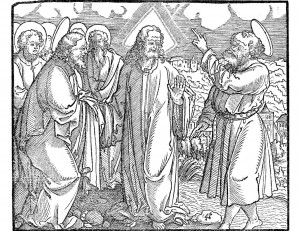
Once when Jesus was praying alone, with only the disciples near him, he asked them, “Who do the crowds say that I am?” They answered, “John the Baptist; but others, Elijah; and still others, that one of the ancient prophets has arisen.” He said to them, “But who do you say that I am?” Peter answered, “The Messiah of God.”

(From the Daily Office Lectionary – Luke 9:18-20 – October 18, 2012)

Confession of Peter, woodcut from Martin Luther, Kercken Postilla“Who do you say that I am?” Better writers and more erudite theologians than I have noted that this is the question at the heart of the gospel, the question that each person must answer for him- or herself. C.S. Lewis addresses it in one of my favorite of his writings, Mere Christianity:
I am trying here to prevent anyone saying the really foolish thing that people often say about Him. I’m ready to accept Jesus as a great moral teacher, but I don’t accept his claim to be God. That is the one thing we must not say. A man who said the sort of things Jesus said would not be a great moral teacher, he would either be a lunatic on the level with the man who says he is a poached egg – or else he would be the devil of hell. You must make your choice. Either this man was, and is, the Son of God, or else a madman or something worse. You can shut him up for a fool, you can spit at him and kill him as a demon or you can fall at his feet and call him Lord and God. But let us not come with any patronizing nonsense about his being a great human teacher. He has not left that open to us. He did not intend to. (Mere Christianity, Harper:2000, pp. 40-41)

I thought of this quote back in an earlier presidential campaign when former president George W. Bush was asked who his favorite philosopher was. His answer was, “Jesus Christ.” But as Lewis says, Jesus wasn’t a philosopher; he wasn’t a moral teacher. Jesus was (and is) either God incarnate or nothing at all of note, simply a madman.

Our answer to the question “Who do you say that I am?” is important not because it defines Jesus, but because it defines us. If Jesus is simply a philosopher (a nice way to say “lunatic”) then we can smile nicely at him, pick and choose which of his teachings we will follow, and go about life as master of our own existence. If Jesus is God, we must fall to the ground before him, pick up our cross and follow him, and go wherever he leads as master of our existence. Thus, the real question that we must answer (and we must answer it each day) is not “Who do you say that I am?” but “Whose do you acknowledge that you are?”

====================

A request to my readers: I’m trying to build the readership of this blog and I’d very much appreciate your help in doing so. If you find something here that is of value, please share it with others. If you are on Facebook, “like” the posts on your page so others can see them. If you are following me on Twitter, please “retweet” the notices of these meditations. If you have a blog of your own, please include mine in your links (a favor I will gladly reciprocate). Many thanks!

====================

Father Funston is the rector of St. Paul’s Episcopal Church, Medina, Ohio.

God Is A Nag! – From the Daily Office – October 16, 2012

From the Book of Jonah:

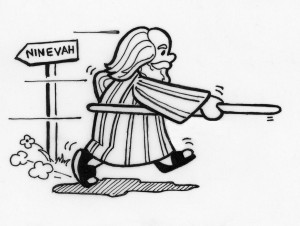
Now the word of the Lord came to Jonah son of Amittai, saying, “Go at once to Nineveh, that great city, and cry out against it; for their wickedness has come up before me.” But Jonah set out to flee to Tarshish from the presence of the Lord. He went down to Joppa and found a ship going to Tarshish; so he paid his fare and went on board, to go with them to Tarshish, away from the presence of the Lord.

(From the Daily Office Lectionary – Jonah 1:1-3 – October 16, 2012)

Jonah Going the Other WayJonah’s a fool! Trying to flee “from the presence of the Lord.” As if! This lesson today is an interesting contrast to Sunday’s Eucharistic Lectionary reading from Book of Job (Job 23:1-9,16-17) in which Job was bewildered and confused because he felt unable to find God: “Oh, that I knew where I might find him, that I might come even to his dwelling!” (Job 23:2) Jonah, on the other hand, would be perfectly happy never to find, or be found by, God.

If one is trying to avoid God, one might take C.S. Lewis’s advice:

Avoid silence, avoid solitude, avoid any train of thought that leads off the beaten track. Concentrate on money, sex, status, health and (above all) on your own grievances. Keep the radio on. Live in a crowd. Use plenty of sedation. If you must read books, select them very carefully. But you’d be safer to stick to the papers. You’ll find the advertisements helpful; especially those with a sexy or a snobbish appeal. (Christian Reflections, Eerdmans: 1967, pp. 167)

None of this will work, of course. As Job and Jonah both found out, God finds us. We don’t have to worry about where God is and we can’t avoid God; God knows where we are.

For a long time I avoided the call to ordained ministry: “No, I’m happy as an active lay man,” I would tell my bishop when he asked (yet again!) about entering the priesthood. But God, as the Book of Jonah makes perfectly clear, does not take “No” for an answer. I finally gave in. God pursues you! God wears you down! God won’t let you get away!

There are often times when I wonder why God was so insistent, when I think I’m really, really bad at this parish ministry stuff, when I am sure that God, the church, and I made a horrible mistake. But even at those times I know that I could not be doing anything else, that if I tried to leave the ministry and do something else God would chase after me again as God chased after Jonah.

I’m pretty sure that God chases after everyone. Everyone has a calling to some job, some task, some ministry in this life, and this Book of Jonah witnesses that God will pursue us until we do it. Jonah was a fool to think he could flee God! God simply won’t let go. I’ve always thought this book could be summarized in one short sentence: God is a nag!

====================

A request to my readers: I’m trying to build the readership of this blog and I’d very much appreciate your help in doing so. If you find something here that is of value, please share it with others. If you are on Facebook, “like” the posts on your page so others can see them. If you are following me on Twitter, please “retweet” the notices of these meditations. If you have a blog of your own, please include mine in your links (a favor I will gladly reciprocate). Many thanks!

====================

Father Funston is the rector of St. Paul’s Episcopal Church, Medina, Ohio.

In God We Trust – From the Daily Office – October 15, 2012

From the Prophet Micah:

Put no trust in a friend,
have no confidence in a loved one;
guard the doors of your mouth
from her who lies in your embrace;
for the son treats the father with contempt,
the daughter rises up against her mother,
the daughter-in-law against her mother-in-law;
your enemies are members of your own household.
But as for me, I will look to the Lord,
I will wait for the God of my salvation;
my God will hear me.

(From the Daily Office Lectionary – Micah 7:5-7 – October 15, 2012)

In God We Trust on Dollar BillSound familiar? Jesus sounded a lot like Micah at times:

Do not think that I have come to bring peace to the earth; I have not come to bring peace, but a sword. For I have come to set a man against his father, and a daughter against her mother, and a daughter-in-law against her mother-in-law; and one’s foes will be members of one’s own household. (Matt. 10:34-36; cf. Luke 12:51-53)

Micah is the same prophet who authored what may be my favorite verse in all of the Old Testament: “He has told you, O mortal, what is good; and what does the Lord require of you but to do justice, and to love kindness, and to walk humbly with your God?” (6:8) And Jesus is the same preacher who said “Love your neighbor as yourself” was one of the greatest commandments. (Mark 12:31) How does one reconcile these admonitions with advice to put no trust in friend or loved one and promises to bring enmity between family members?

The answer lies in the last part of the above quotation from Micah: Trust in God. In the 1950s the U.S. Congress decided to emblazon “In God We Trust” across American currency as a response to the rise of “Godless communism” in the Soviet Union and its sphere of influence. One may debate whether it was appropriate under the U.S. Constitution, or whether it has since had any salutary effect, but it is what Micah models here, and it is the message of Scripture and of Jesus. “Don’t trust human beings! Trust God!”

In the last weeks of the U.S. presidential campaign, as political debates lead to family arguments and people begin to see the members of their own households as political enemies, it is well to remember this. Human beings, even the best of us, are fallible and untrustworthy, especially the ones we put on pedestals and look to to solve the problems of our nation or our world. As the Psalmist (echoing Micah’s sentiment) reminded us, “Put not your trust in rulers, nor in any child of earth, for there is no help in them.” (Ps. 146:2, BCP version)

It may sound trite. It may be misplaced on our currency. But it is the only solution: “In God We Trust.” If we remember that, maybe we can all just get along . . . .

====================

A request to my readers: I’m trying to build the readership of this blog and I’d very much appreciate your help in doing so. If you find something here that is of value, please share it with others. If you are on Facebook, “like” the posts on your page so others can see them. If you are following me on Twitter, please “retweet” the notices of these meditations. If you have a blog of your own, please include mine in your links (a favor I will gladly reciprocate). Many thanks!

====================

Father Funston is the rector of St. Paul’s Episcopal Church, Medina, Ohio.

« Older posts Newer posts »