Occasional thoughts of an Anglican Episcopal priest

Category: Religion (Page 117 of 118)

Leaving the Fireflies

On June 30, 2011, I’ll load my rolling dufflebag filled with clothing and such, my backpack filled with computer and books, and my CPAP machine (its bag crammed with anything else I can fit into it) into the car, head for Cleveland-Hopkins Airport, and fly to Newark where I will wait for five hours and then take another plane to Edinburgh, Scotland, UK.

Last evening as I walked the dog after sunset, the sky still a fairly bright blue with plenty of light to see, I looked into the darkness of the woods behind our house and saw that the fireflies were beginning to flash their mating signals. I realized that I’m leaving Ohio at one of my favorite times of the year – firefly time! I love fireflies!

I was born and raised mostly in the little-known southern Nevada community of Las Vegas, but my summers from age 5 to age 13 were spent mostly in the southeastern Kansas town of Winfield. That area of Kansas has a lot of fireflies; my mother was born there and both of my parents were reared there. Those summers were spent living with my paternal grandparents and with my cousins, the children of my father’s only brother, who lived next door to them. A nearly daily activity during June and July was catching fireflies in the early evening so we could watch them flash on our dresser all night long.

I was delighted when we moved to Ohio to find fireflies here … not as many as there were in Kansas, but enough. An informational website maintained by Ohio State University has this to say about firefly habitat:

If you live in the United States, west of about the middle of Kansas, you are not apt to have the flashing type of fireflies in your area. Although some isolated sightings of luminous fireflies have been reported from time to time from regions of the western U.S., fireflies that glow are typically not found west of Kansas. The reason for this phenomenon is not known.

I can guarantee you that I never saw a firefly in Las Vegas! But those summers in Kansas there were plenty.

Fireflies are called different things in different parts of the country. I’m pretty certain that firefly was the most common term in Winfield, although occasionally someone might call them lightning-bugs. I know that some people also call them “glow worms” but the only time I ever heard them called that was when my mother would sing a song with that title popular back in those days. Whenever I would talk about catching fireflies, she start humming or singing that song. Here’s a YouTube video of the Mills Brothers singing it (it brings back a lot of memories!):

My cousins and I would catch the fireflies and keep them in mason jars. We’d grab a handful of the grass growing along the fence of our granddad’s garden (this was in the days long before “weed whackers” and no one ever seemed to feel like trimming that grass by hand, so it was always good and long, perfect for a mason-jar firefly habitat) and shove it in the jar, then run through the yard after the flashing bugs trying to trap them between jar and lid. The lid, of course, was a mayonnaise jar lid (Grammy wouldn’t let us use her good canning lids) that we had pounded a nail through several times to give the bugs air. We’d usually get five or six bugs in each jar and that would be enough for the night.

We’d put the jars on the dresser next to our beds in our grandparents’ basement or at my cousins’ house, wherever we were going to sleep that night, and then do something else for the rest of the evening. Eventually, though, bedtime would roll around and off we’d go, to lay awake as long as we could watching the fireflies flash. Come morning, Grammy would encourage us to set them free and we would dutifully dump out the contents of the jar, wilted grass, fireflies (dead or alive, who knew?), and all.

There are no fireflies in Ireland (though I’m told there’s a Klezmer band there called The Fireflies) so I am leaving one of my favorite sights of summer, the evening flashes of the lightning bugs. There are no fireflies in Ireland, but there is in the ancient verse and the Celtic spirituality of the Irish people a deep appreciation of nature and of nature’s God. In the early 20th Century, Dr. Douglas Hyde collected many bits of folk poetry reflecting that appreciation, including this one found in Dánta Dé. It is described as “ceol na ndaoine, as Albain, tré Lachlann MacBeathain” (“folk song from Scotland by Lachlann MacBeathain”); the notes in the hymnal indicate that Dr. Hyde collected it in 1924:

Áluinn fairrge spéir-ghlas
Áluinn uisgeacha ciúin,
Áluinn taithneamh na gréine
Ar na tonntaibh tá fúinn;
Faoileáin ‘g eiteal ‘s na spéarthaibh,
Teas le h-éirghe an lae;
Ó! nach áluinn, a Dhe!
Siúd uait amharc na sléibhte,
Bárra a bhfolach fá cheó,
Caoirigh ciúin ar a dtaobhaibh,
Síot a’s sonas a’s sógh.
Tógfad suas mo chroidhe-se
Tógfad suas mo ghlór,
Molfad Eisean a-choidhche
Fá gach iongantas mór;
Árdaigh feasta mo smaointe
Mar na sléibhte ‘san aéir,
Ciúnaigh feasta mo chroidhe-se
Mar an t-uisge soiléir;
Éist le m’athchuingh’, a Thigh’rna,
Tar a’s cómhnaigh im’ chléibh,
Réidhtigh m’anam: ‘s im’ inntinn
Déan-sa t’-árus, a Dhé.

The direct, non-metrical, prose interpretation:

Lovely is the sky-grey ocean,
Lovely the quiet waters,
Lovely the shining of the sun
On the waters below;
Seagulls flying in the skies,
Warmth with the rising of day, –
O how delightful is Thy world!
O how delightful, my God!
See in the distance the mountains,
Summits hidden in the mist;
Quiet sheep on their slopes,
Peace and pleasure and bliss.
I will lift up my own heart,
I will lift up my voice,
I will praise Him for ever
For each wonder great.
Lift Thou upwards my thoughts
Like to the mountains above,
Calm Thou henceforth my heart
Like the waters clear;
Hear, O Lord, my prayer,
Come, abide in my breast,
Quiet my soul, and within my mind
Make Thy dwelling, O God.

There are no fireflies in Ireland, but I’m sure if there ever had been they would have found there way into the religious songs of the Irish people. Fireflies spark our imaginations and light up our souls on summer nights. In a way, I’m sorry to be leaving the fireflies.

Sermon on the Sunday I Left for Sabbatical…. (June 26, 2011)

There is a lot happening at St. Paul’s Parish this morning – it would seem to be a lot more than one might expect to find going on in a church on a summer Sunday! If this is your first visit to our parish and you are not one of the members of Medina Lodge #58, Free & Accepted Masons of Ohio, who are our guests today, you may be wondering what sort of church this is, what is all this activity! Well, let me tell you ….

First – it is the last Sunday of the month and that means that, in addition to our regular weekly offerings, we take up a collection called “the 2-cent-a-meal offering” to fund hunger relief work in this parish and throughout the Episcopal Diocese of Ohio. Nick Magee, who oversees our Free Farmers Market food pantry ministry, sent me an email yesterday with the half-year statistics on that ministry. His spreadsheet showed that yesterday 221 people were provided with food by this parish, which just happens to be the average number of clients served each week the Free Farmers Market is open. In the first half of 2011, our food pantry has provided a week’s worth of groceries to 2,646 persons; nearly twenty thousand pounds of food have been distributed. A word of congratulations to Nick and the Free Farmers Market volunteers – the food pantry was recognized by the Akron Community Foundation last month which awarded it a grant of $4,000! It continues to be a vital and necessary ministry in our community and I encourage you to be as generous as the Akron foundation.

Second – also because it is the last Sunday of the month, this is the Sunday on which we offer prayers for healing and when we bless the work of our knitting circles. For those who are ill or injured, we offer unction and the laying on of hands here at the communion rail following the distribution of Holy Communion. You can also come forward to receive unction and prayer on behalf of someone else, someone unable to be here. The knitted items are, for the most part, prayer shawls made for the comfort of those recovering from illness or injury, warm garments (hats, scarves, and gloves) for merchant marine seamen served by the Episcopal Church’s Seamen’s Institute, and baby blankets for the newborn (many of which we now have or are soon expecting in this parish, by the way. Congratulations again to Nick Magee and to his wife Sian who this week welcomed Finn Griffiths Magee into the world and into their family.)

Third – this past week marked the 20th Anniversary of my ordination into the priesthood and my wife Evelyn and our Senior Warden Barbara Baird cooked up a scheme to have a reception acknowledging that milestone during our usual “coffee hour” after this service. Ladies, I’m very grateful to you for doing so. As I said in a post on Facebook on Tuesday, the actual anniversary, I am extremely grateful and humbled by the gift and privilege of priesthood which permits those of us in this office to share with each of you and all of you the milestones of your lives, to celebrate with you in times of joy and to grieve with you in times of misfortune and sorrow, to preside at our faith’s most significant acts of worship, and to participate in all the small but meaningful ways we form community. My wife secretly arranged for our children, Caitlin and Patrick, to be here for this reception, and Patrick (who was recently ordained a deacon and in a few months will himself be ordained a priest) is serving at the altar with me today – our first time to do so together.

Fourth – later this week … to be precise in four days, seven hours, and fifteen minutes (but who’s counting?) … I will be flying to Scotland to begin three months of sabbatical studying Celtic Christianity, learning more of the Irish Gaelic language, visiting ancient British, Scottish and Irish ruins, and translating and arranging some ancient Irish hymns. So the anniversary reception is also something of a going away party. Please join us in the Parish Hall after this service for the party!
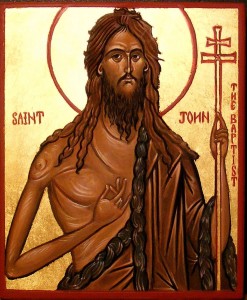
Finally – as we have done for the past few years, St. Paul’s Parish is hosting our friends from the local Masonic Lodge whom I mentioned earlier and whose custom it is to worship together on the Sunday closest to the feast of the Nativity of St. John the Baptist. Thus, we are using the lessons assigned to that feast not those of the usual Sunday lectionary, and singing songs which might seem to some more fitting for the season of Advent than for the middle of summer. The members of the Lodge do so because modern American Freemasonry regards both St. John the Evangelist and St. John the Baptist referring to them jointly as “the Holy Saints John of Jerusalem.”

Why, you may ask, would Masons, who insist that our fraternity is not a religious institution, thus venerate these saints? Why would Masons gather together in worship on this particular Sunday?

As every Mason knows, one of the symbols found in a lodge room is a certain point within a circle, bounded by two parallel lines, with the volume of sacred law displayed atop the circle. Christopher L. Hodapp, the author of the book Freemasons For Dummies, has suggested that this is one of the least understood Masonic emblems. On his internet blog, he writes:

The symbol is actually based on an old astrological and alchemical symbol. The point in the center represented the Earth, which was thought to be the center of the universe. The heavens were believed to spin around the Earth, represented by the circle. The two lines represented the summer and winter solstices, the longest and shortest days of the year. For thousands of years, these days were celebrated as pagan feast days all over the world, and they were especially important to farming societies, because they were the astronomical methods of determining planting seasons.

In about 300A.D., the [Christian] Church began to dedicate popular pagan feast days to the saints. June 24th, the longest day of the year, was declared St. John the Baptist day, while December 27th, the shortest day, was dedicated to St. John the Evangelist. Collectively, Masons refer to them as the Holy Saints John.

Operative Freemasonry was first developed when Roman Catholicism was the prevailing religion, and these feast days continued under the Church of England. It was common for guilds and other trade groups to adopt a patron saint or two. Some Masons picked both Saints John, and over the centuries Masons commonly celebrate their feast days with banquets. And curiously, even though Freemasonry today is non-denominational and non-sectarian, American Masons have retained these customs of old. ….

John the Baptist was zealous, while John the Evangelist was learned, and by picking both of them as patron saints, Masons symbolically united both passion and reason.

The symbol also shows the Volume of Sacred Law at the top. In Masonry, the point represents the individual, and the circle is the boundary of his actions. Taken as a whole, the symbol implies that a Mason should consult the sacred texts of his own religion to achieve the proper balance between passion and intensity on one side, and knowledge and education on the other. In other words, he should balance education, excitement and faith to effectively subdue his passions. In a way, it is a graphic representation of the conscience.

Zeal and learning, passion and reason, excitement and education … the effective blending of these supposed opposites into effective action and ministry … this is what is going on here at St. Paul’s Parish today.

It is all well and good to be zealous and passionate about the need to feed people, but to get it done people like Nick and the other Free Farmers’ Market leaders have to do the reasonable work, really the hard work of figuring out what’s needed, ordering it, stocking it, and organizing volunteers to actually get it done. The proper balance between passion and intensity on one side, and knowledge and education on the other, effectively accomplishes the mission of the church – people are fed.

It is all well and good to love to knit and want share what one makes with the excitement and intensity that our knitting circles display, but without someone to take on the job of learning where the shawls, the gloves and scarves, and the baby blankets are needed, and how to get them there, all that excitement and intensity goes nowhere. The proper balance between passion on one side, and knowledge and education on the other, effectively accomplishes the mission of the church – the ill are comforted and lonely seamen are kept warm.

Today, in commemorating St. John the Baptist, we honor the zealous, passionate, excited side of this equation; we honor the forerunners, the visionaries, the pioneers, the people who “dream dreams and see visions,” those who go to the mountain-top and cry out “Behold!”

It has been said of visionaries that what they do is make the untrue become true. Author Ken Zaretsky puts it this way:

If you say something you know isn’t true and just leave it at that, then you are a liar.

If you believe that untruth, then you are delusional.

On the other hand, if you say something you know isn’t true; then not only believe it but also make it true, you are a visionary! Visionaries are deserving of praise and accolades from friends, peers and the public.

There are fine lines between liars, delusional individuals and visionaries. After all, what is the difference between making something up and making something up?

The first difference is intent. A liar conjures an image. He or she might see it. He might get others to believe in it. But he doesn’t believe it himself. The liar has no intention to make anything happen.

Like the liar, the delusional person also has an image. He or she can see it and, unlike the liar, believe it. It’s possible that she can also get others to believe in it. But she doesn’t do anything beyond believing because, to the delusional person, the image already exists in reality.

A visionary has an image of the ideal. The visionary sees the image, believes it and gets other people to believe in it. Then the visionary works to make the image come to life.

Visionaries see and proclaim an inspired and inspiring positive picture of the future, with a clear sense of direction as to how to get there. They keep communicating the vision to create an energy that sometimes they, but more often others, use to bring their vision into physical reality. Nelson Mandela, for example, clearly held a positive vision of a racially harmonious South Africa during his 28 years in jail and helped bring it into reality peacefully – to the amazement of the world.

Visionaries inspire use to be better than we are and help us identify with what Lincoln called “the better angels of our nature.” This was the power of Martin Luther King’s “I have a dream” speech.

Visionaries often have the ability to see higher spiritual forces at work behind the scenes of events, and they align with the vision of these redemptive forces. Both George Washington and Winston Churchill spoke about the help they received from a “guiding hand.” Churchill said, “…we have a guardian because we serve a great cause, and we shall have that guardian as long as we serve that cause faithfully.”

Vision, it has been said, is an energy field that brings new realities into form. Visionaries tap into and transmit that energy to people, giving us a new sense of hope and confidence, helping us to believe in ourselves and work to create a better world.

More than twenty years ago I had a vision of the priesthood, a sense of call to the ministry of hope and confidence, to the work of creating a better world, to the gift of sharing with God’s people their times of joy and their times of misfortune and sorrow, to the privilege of presiding at our faith’s most significant acts of worship, and to the simple good fun of participating in all the small but meaningful ways the church forms community. I am very grateful for every minute of the twenty years that I have lived out that vision in this and other parishes, but let me be honest and tell you that after twenty years of managing tight budgets, chairing vestry meetings, rehearsing and solemnizing weddings, baptizing babies, leading bible studies, sitting beside hospital beds, and burying the dead … it’s time for a break. So I am also especially grateful for the opportunity to take these next several weeks of time away from the church.

I do so confident that this church will do just fine without me, that things will be (as I am wont to say) “Just peachy!” I know that they will be because our vestry, our lay leadership is a bunch of visionaries. They dream dreams and see visions and generate the energy make them come true. They are neither liars nor delusional, what they purpose they accomplish. They have dreamed a dream and seen a vision of a growing St. Paul’s Parish with and expanded and improved building, and they are going to see it accomplished. They have a clear sense of direction as to how to get there and over these coming weeks they will communicate that vision in way that I am sure will create the energy that they and you will use to bring that vision into reality.

Today, in commemorating St. John the Baptist, we honor the zealous, passionate, and excited leadership of the church; we honor the forerunners, the visionaries, the pioneers, the people who “dream dreams and see visions,” those who go to the mountain-top and cry out “Behold!”

The Vestry has begun closing its meetings with a prayer for vision attributed to Sir Francis Drake, the explorer who claimed North America on behalf of Queen Elizabeth the First and whose ship’s chaplain offered the first Christian worship on North American soil. I’m going to close my sermon today with that same prayer.

Let us pray:

Disturb us, Lord, when we are too well pleased with ourselves, when our dreams have come true because we have dreamed too little, when we arrived safely because we sailed too close to the shore. Disturb us, Lord, when with the abundance of things we possess we have lost our thirst for the waters of life; having fallen in love with life, we have ceased to dream of eternity and in our efforts to build a new earth, we have allowed our vision of the new Heaven to dim. Disturb us, Lord, to dare more boldly, to venture on wider seas where storms will show your mastery; where losing sight of land, we shall find the stars. We ask you to push back the horizons of our hopes, to push us into the future in strength, courage, hope, and love. Amen.

(This sermon is also posted at The Theology Diner)

Translating Hymns (Part 3)

Between the steps outlined in my last two posts, there is the matter of music. The metre, the accents, the stressed syllables … all that has to be considered. Hymn metres are often described numerically by the number of syllables in each line. For example, the great Lutheran hymn A Mighty Fortess Is Our God is metrically described “87 87 87 66 7” – this means that in each nine-phrase stanza, the first line has eight syllables, the second seven, the third eight, and so on.

I look over the music in Dánta Dé and determine, using this syllable-count scheme, what the metre of the translation should be, how the music fits the Irish lyrics and how best an English re-working might fit. And then, working from the literal translations of ní Ógáin and my own literal translation, I begin crafting a metrical paraphrase.

One of my favorite pieces in the hymnal is entitled The Heavenly Habitation, written by Donnchad Mór Ó Dálaigh in the 13th Century. Here it is in three versions – the original archaic Gaeilge, ní Ógáin’s translation, and my final metrical, rhyming paraphrase.

The original Irish Gaelic:

Áluinn Dún Mhic Mhuire,
An Dún is gluine blat;
Aoibhneas ann agus ceo,
Ní fhaicthear brón go brat.

Ní fhaicthear ann cean crom,
Tuirse trom ann nó cás,
Ní fhaicthear cúis no coir,
Ar aon neach ann go brat.

Do chídhtear ann do shíor,
Aoibhneas Ríogh na ngrás;
Do chídhtear sin san Dún
Soillse nach múcann smal.

An Spioraid Naomh go taithneamhac
Mar gaethibh siúbhlac’ gréine,
Is É ag scaoileadh go ceathannach
[Glé-] grása Ríogh na Féile.

San mbrúgh suaithneach solus-bhlát,
– Óir ‘s ionann lá is oidhche –
Ó chorraibh ‘n bhrógha bháin-ghil
Tig deallradh lán do’n aoibhneas.

Tá mile ógh is máirtireach
Fuair san tsaoghal gach dochar,
Lán dá n-aoibhneas taithniomhach
Ann go sámh glan socair.

Gorta is iota is ocras
‘S gach uile galar claoidhte,
Deoch as tobar na trócaire
D’fhóirfeadh iad sin choidhche.

Iompuighmíd ar ár n-ais arís,
Go bhfeicmid Ri na ngrása,
Is iarrmaoid ar ár nglúine
Ár leigean ‘san Dún is áilne.

Úna ní Ógáin’s direct translation:

Beauteous the Dún of the Son of Mary,
The Dún of purest bloom;
Delight is there and music,
And sorrow ne’er shall be seen there.

Ne’er shall be seen there a head bowed down,
Heavy weariness nor care;
Never sorrow nor crime
On anyone there for ever.

For ever is seen there
The loveliness of the King of the graces;
This is seen in that Dún,
Light that no cloud shall quench.

The Holy Spirit radiantly
Like moving beams of the sun,
And He shedding in showers
The graces of the King of generosity.

In the Fortress colour-full, light-blossoming,
– For there day and night are the same , –
From the pinnacles of the fair bright Fortress
Comes radiance full of delight.

A thousand virgins and martyrs
Who received in the world all hardships,
Filled with joyful delight
Are there, peaceful, pure, safe.

Famine and thirst and hunger,
And every wearing disease, –
A drink from the Well of Mercy
Would relieve them for ever.

We will return back again
That we may see the King of the graces,
And beseech him on our knees
To take us into the Dwelling most beauteous

My work based on this hymn:

How wondrous bright the glorious dún
of Jesus Christ our King;
Delight is there for ev’ryone,
and there the martyrs sing.

No head is bowed with sorrow there,
no heavy weariness known;
No crime, no cloud, no toilsome care,
bedims that heav’nly home.

The beauteous mansions of God’s Son
all sound with music bright;
The radiant Spirit, like the sun,
Fills them with glorious light.

The graces of the King are spread
and purest loveliness blooms
on all the holy, faithful dead
who now live in God’s rooms.

The many virgins, martyrs, saints
who hardship all endured
are filled with joy, delight, and grace;
blest, peaceful, and secure.

From famine, suff’ring, thirst, disease,
the Well of Mercy has giv’n
release and comfort to all these
who now dwell in God’s heav’n.

That heav’nly habitation we
all live in hope to share;
The King of all the graces we
beseech to take us there.

Upon our knees, the King we pray
will there make welcome our souls,
where ev’ry night is bright as day,
and ev’ry life made whole.

How wondrous bright, the glorious dún
of Jesus Christ our King;
Delight is there for ev’ryone,
and there we all shall sing.

There ev’ry soul is pure and bright,
and ev’ry loveliness known;
There joy, and peace, and pure delight
bless our eternal home.

There are about eighty ancient Gaelic hymns in the hymnal (there are also Gaelic translations of familiar hymns, especially Christmas carols, which I will be ignoring). My sabbatical project will be to work on these metrical, rhyming English paraphrases for as many as I can complete during my time on leave.

Translating Hymns (Part 2)

Continuing from my last post ….

Here’s an example of what I was describing in my last post. This is the first verse of the fourth hymn in Dánta Dé, in the section titled Maidin (“Morning”). The hymn is described as Cantain Tíre-Chonaill (“Chant [from] Tyrconnell”) and the ascription reads, Ó na daoinibh tré Antoine Ó Dochartaigh (“From the people by Anthony O’Doherty”).

A Íosa mhilis, a Mháighistir ‘s a Dhia,
A Fhuasglóir oirdheirc ainglidhe,
Féach d’ár laige ‘s ná leig ár gclaoidhe
Le tonnaibh buadhartha an pheacaidh.

Úna ní Ógáin translates this as follows:

O, Jesu sweet, O master and God!
Deliverer august, angelic,
Look on our weakness, and let us not be overcome
By the troublous waves of sin

Now, I’m quite certain that her translations are correct, but I want to understand this Irish Gaelic text as thoroughly as possible, so I go to work translating for myself. Many of the words are familiar to me – the name of Jesus, for example, Íosa, or the word meaning “sweet”, mhilis, or the verb “to see”, féach. Others look like words I know, but they seem to be older forms – for example, ainglidhe (which she has translated as “angelic”) does remind me of aingeal meaning “angel”, and tonnaibh (which she has translated as “waves”) is similar to the word I know for “wave”, tonn. Others are new to me.

So I spend a lot of time leafing through the dictionary learning new words and trying to understand the meaning of the almost-familiar words. However, many of these words are not found in my modern Irish-English dictionary (I’m primarily using Foclóir Gaeilge-Béarla by Níall Ó Dónaill, as well as various other sources) because of the changes made in modern standard Gaeilge. For example, ainglidhe has been simplified to aingli. The changes to other words are not so easily discovered: tonnaibh, for example. The plural of “waves” that I know is tonnta, so I think that perhaps this is a related word meaning a particular kind of wave? I know from dealing with other “modernized” words that the “bh” letter combination has been often replaced with either “ch” or “dh”, so I look in the dictionary for that variant spelling. Nothing. I also know that “ai” has frequently been simplified to “a”. Aha! The dictionaries have both tonnach (“quagmire”) and tonnadh (“surge” or “tide”). There’s no way to really know which of these the “folk of Tyrconnell” might have intended, so either could be used as a translation and both suggest imagery for the later step of putting this chant into metrical, rhyming English.

I move on to the next word, buadhartha, which ní Ógáin translated as “troublous” (which I’m not sure is even an English word!) This one is also unfamiliar to me, but it reminds of a word I do know, buaigh, the verb “to win”. The structure of buadhartha suggests to me that it is what the Irish call an aidiacht bhrathartha (“verbal adjective”), but the verbal adjective of buaigh is buach (“victorious” or “winning”). Further, “winning” and “troublous” hardly seem to fit one with the other, so this is obviously some other word. This requires the time-consuming process of simply reading the dictionary word by word until something comes close to ní Ógáin’s “troublous” rendering. The “r” in the word, by the way, is a lead, so I look particularly for words beginning with “bua” and including an “r”. The search ends when I find buair, a verb meaning “to grieve”, and its related word buartha (“grievous, worrying, or sorrowful”). (And a bit of learning for use later on … the letter combination “adha” here was simplified to “a”; this pattern may be repeated in other words.)

This is the process I work through which each word, each line, each stanza of the hymn. In the case of this first verse of Anthony O’Doherty’s chant from Tyrconnell, I render the verse as follows:

O Sweet Jesus, Master and God,
O exalted [and] angelic Redeemer,
See our infirmity and do not allow our conquering
By [With] the grievous tide [quagmire] [of our] sins

Not too dissimilar to ní Ógáin’s original translation, but by doing the work of translation myself, delving into deeper and alternative renderings of the text, I gain insights and ideas that will be of use in the next step, turning the translation into something in English that can fit the metre of the original music to which the Irish words were set. More on that in a later post.

Translating Hymns

In about a month I’ll be starting my sabbatical with two weeks walking hills and visiting important pre-historic, Celtic, Roman, and medieval sites in Great Britain, starting with Melrose Abbey in Scotland, St. Cuthbert’s Way, Lindisfarne in England, Hadrian’s wall, Jedburgh, etc. As I visit these sites, I’ll be blogging and sharing pictures, continuing my self-study of Irish Gaelic (refreshing my learnings from my summer 2008 time at NUI Galway and adding to them in preparation for more study there this summer), and working on translations of the poetry in Úna ní Ógáin’s hymnal Dánta Dé idir sean agus nuadh (Hymns to God: Old and New).

I’ve been working on this for a couple of years and, let me tell you, translating old Gaelic verse into rhyming and metrical English is not easy! I usually end up with more something of my own authorship that is inspired by the original than a translation of the original. The process requires four foundational steps before anything like a singable text can even be considered:

First – the hymns in Dánta Dé are printed in old Gaelic script and in the older form of Irish Gaelic in which there are a lot of letters which have been dropped from the modern standard Irish. So my first task is simply transliterating the Gaelic script into the Latin alphabet. My old eyes aren’t what they once were, so I make frequent mistakes confusing, for example, the letter combination “id” for “ro” and similar errors.

Second – once I’ve gotten the old Gaelic transliterated is to figure out what form the word has taken in modern Irish; spellings in many cases have changed and although the changes follow a pattern, there are sometimes difficult choices to make.

Third – review ní Ógáin’s translation. Her translations are more prose or free verse than rhyming/metrical lyrics. They are fairly direct, but they are also informed by a deep early 20th Century Irish Roman Catholic spirituality so that adds a “flavor” that a more direct translation might not have.

Fourth – my own direct translation. This involves a lot of dictionary work and a lot of grammar review!

Then comes the work of recasting the ideas, images, and spirituality of the piece into singable lyrics….

And we haven’t even considered what to do with the music…..

Forever Young

My son graduated from seminary last week …. he will be ordained in a few more weeks.

My daughter is working on her degree in art ….

This song by Bob Dylan, but sung best by Joan Baez is for both of them, from me, from the bottom of my heart.

May God bless and keep you always
May your wishes all come true
May you always do for others
And let others do for you
May you build a ladder to the stars
And climb on every rung
May you stay forever young
Forever young, forever young
May you stay forever young.

May you grow up to be righteous
May you grow up to be true
May you always know the truth
And see the lights surrounding you
May you always be courageous
Stand upright and be strong
May you stay forever young
Forever young, forever young
May you stay forever young.

May your hands always be busy
May your feet always be swift
May you have a firm foundation
When the winds of changes shift
May your heart always be joyful
And may your song always be sung
May you stay forever young
Forever young, forever young
May you stay forever young.

Night Cramps

The Mayo Clinic defines “night cramps” as follows:

Night leg cramps are sudden, painful, involuntary contractions of muscles in your leg. In most cases, night leg cramps involve your calf muscles, but muscles in your feet or thighs may cramp as well. The risk of having night leg cramps increases with age.

Last night shortly after 2 a.m. I woke up with cramps in both of my adductor muscle groups (interior thigh). Massage didn’t relieve it so I had to get up and walk up and down the hall for the better part of half an hour. This has happened before and it’s a great way to blow a good night’s sleep!

Mayo says of the cause:

Most of the time, true night leg cramps occur for no known reason, and they’re harmless. However, in rare situations, night leg cramps can be associated with an underlying disorder, such as peripheral artery disease or diabetes.

Great! I have none of those underlying disorders (TBTG!) so these are just harmless (but painful) events. (I tore the left adductor muscle about 25 years ago in a skate-boarding incident; maybe I can blame it on that. Or maybe I can blame it on being overweight now!)

In any event, while I was walking up and down the hall in the darkness of early morning, a snippet of scripture came to mind ….

O my God, I cry in the daytime, but you do not answer; by night as well, but I find no rest.

I couldn’t remember the source of this verse, so I looked it up this morning and it turns out to be from Psalm 22. It’s verse 2. The opening line of Psalm 22 is rather more familiar:

My God, my God, why have you forsaken me?

Here we are in the midst of Lent. In just three weeks we will read that Psalm on Good Friday. I wonder if God is trying to tell me something through my nighttime leg cramps. Something more to ponder….

Eventually “capitalism … will rank with feudalism as an evil memory of mankind.” (W. Rauschenbusch)

From A Theology for the Social Gospel by Walter Rauschenbusch…. I think this speaks to what we are seeing in the evil of Corporatism (Fascism) in the United States.

“Two principles are contending with each other for future control in the field of industrial and commercial organization, the capitalistic and the co-operative. The effectiveness of the capitalistic method in the production of wealth is not questioned; modern civilization is evidence of it. But we are also familiar with capitalistic methods in the production of human wreckage. Its one-sided control of economic power tempts to exploitation and oppression; it directs the productive process of society primarily toward the creation of private profit rather than the service of human needs; it demands autocratic management and strengthens the autocratic principle in all social affairs; it has impressed a materialistic spirit on our whole civilization.

Here, I think, we have the difference between saved and unsaved organizations. The one class is under the law of Christ, the other under the law of mammon. The one is democratic and the other autocratic. Whenever capitalism has invaded a new country or industry, there has been a speeding up in labor and in the production of wealth, but always with a trail of human misery, discontent, bitterness, and demoralization. When co-operation has invaded a country there has been increased thrift, education, and neighborly feeling, and there has been no trail of concomitant evil and no cries of protest. The men in capitalistic business may be the best of men, far superior in ability to the average committee member of a co-operative, but the latter type of organization is the higher, and when co-operation has had as long a time to try out its methods as capitalism (has), the latter will rank with feudalism as an evil memory of mankind.” (pp. 113-114)

I am truly beginning to wonder if it is possible to be a Christian and a capitalist….. Actually, I’ve wondered that for some time. What I’m trying to figure out is how to do something about it without actually joining a monastery. In other words, what might a group of people (families, actually) who live in their own homes, have their own expenses, have all the sorts of obligations that people have in a society such as ours, be able to do cooperatively that would promote “the law of Christ” in opposition to “the law of mammon.” I honestly don’t know! But I feel the need to find out.

Ideas?

Gnothach

“Gnothach” is the Irish Gaelic (Gaeilge) word for “busy” – “Táim gnothach” means “I’m busy.” This can be modified by prefixes such as “an-” meaning “very” and “ro-” which means “too”. “Táim an-gnothach” means “I’m very busy”; “Táim ro-gnothach” means “I’m too busy.”

The opposite of “gnothach” is “saor”. “Saor” can mean “free”, “cheap” or “off” (as in off from work, which is what I am today as I write this). The term for what Americans call “vacation” is “laethanta saoire”, which literally means “days free.”

Recently, I attended a conference for clergy anticipating sabbatical leave and our facilitator asked us to give up the use of the word “busy”. He suggested that it was a word which implied victimization! When one says, “I’m busy” there is an implication of negativity, as if one didn’t want to be doing the things that fill one’s day. (And, I must admit, that there are few of those sorts of things that fill my days … isn’t that true of all of us.) Most of what keeps us “busy” he argued are things we choose to be doing. And if we choose them, should we complain about them, should we be playing the victim because they are filling are day?

Rather, he suggested, we should abandon the word “busy” and instead describe our days as “rich and full.” I think he has a point … so even as I struggle to speak Irish (and it is a struggle!) I will abandon “busy” and “gnothach”.

Níl me gnothach; tá mo laethanta saibhir agus iomlán. (I am not busy; my days are rich and full.)

Preaching on Teen Suicide

The following is the text of an email I sent to some friends with whom I am part of an on-going internet community of some duration – an “email listserve” that has been in existence for several years.

This is long, but I have to write it down and share it with someone. And I apologize in advance for what I know to be offensive content below. It offended me – and I protested to the sender.

This morning I preached about the rash of recent gay teen suicides. I want to share the experience with you all. I preached ad lib with only a few notes.

I began reading John Donne’s Meditation XVII (“No man is an island, etc….”) and said that we had all been diminished recently by the suicides of Tyler Clementi (18 y.o. freshman at Rutgers), Asher Brown (13 y.o. middle school student in Houston), an unnamed 11 y.o. child in California, and Sladjana Vidovic (a Croatian immigrant student at a high school in Mentor, Ohio, age 16). Each of these children was driven to commit suicide because of bullying, teasing, oppression aimed at them because they were perceived as “different”, as outcasts. And the fault lies with each one of us because we have all participated in behaviour which has made such bullying permissible in our society. We have all sat by silently as jokes or political comments or gossip which was racist or sexist or heterosexist were uttered in our presence; we may even have told those jokes or made those remarks ourselves.

I then exegeted the lesson from Jeremiah and talked about how the Jews were the foreigners, the “other” in their exile in Babylon, and how although Jeremiah seems to be counseling assimilation, he is actually telling them to be proud of their heritage in a way that is respectful of those who are their oppressors, to pray and work for the welfare of the society in which they find themselves because in its welfare they will find their own wellbeing. And I noted how when they returned from exile, they hadn’t learned the lesson of what it is like to be “the other” in a strange society, how they had excluded the “Samaritans” from participating in the rebuilding of the Jerusalem temple and how the Jews continued, some of them even to this day, to practice religious intolerance and an exclusionary theology, noting particularly how it affected groups like women, gentiles, tax collectors, and the chronically ill (lepers) in Jesus’ day, and Palestinians today. I then moved on to the Gospel and focused on Jesus’s last words to Samaritan former leper – “your faith has made you well.”

I argued that it is our faith which can make our society well, if we will simply live up to it. Basically my message was “Stop it!” – do not in anyway participate in jokes, comments, conversations, that promote racism, heterosexism, sexism, or any other exclusionary ism. If you are with someone …who starts that kind of talk, tell them to stop it!

I made note of the fact that I had heard members of the congregation criticizing and making jokes about the President in the vilest and most racist of language, that I had heard men in the congregation make jokes about their wives or other women that were not fit to repeat, that I had heard women in the parish make jokes about gays and lesbians that were decidedly unladylike … and that I had said nothing when I had, but fair warning – no longer – if someone from now on says anything of that nature in my presence I will tell them “Stop it!”

I noted that in our Epistle Lesson, Paul warned Timothy of the power of words, of wrangling over words, and that’s basically what we have to deal with — the power of abusive, exclusionary words, of taunting and teasing and “making fun of” (a terrible euphemism if ever there was one). I made mention of James’s letter in which he notes that the tongue is a flame which can start a conflagration — and that is what we have – a conflagration of youthful suicides which result from words being spoken abusively, in a social climate which makes that acceptable behaviour. It is NOT acceptable and so we must stop it! So from now on, I will speak up and protest when I hear it. I will not do it myself … and I begged them not to do it and to speak up when they hear it.

Jesus told the outcast (the leper) that his faith had made him well – only our faith can make our society well – but that faith must be public and vocal – we must tell those who make an atmosphere of abuse acceptable through their racist, sexist, hetersexist jokes and snide remarks to STOP IT! And we must do it because that is the only way to be faithful to Jesus Christ!

That was my sermon, in a nutshell; it was longer, but that’s enough for here for now.

I expected a negative reaction from some, and I’m sure there was some. Mostly those who agreed with me told me as much, and those who didn’t avoided talking with me at all, even those very conservative members who usually do exchange pleasantries didn’t do so. Oh well….

Anyway, I came home … had lunch … checked my email.

So now I need to explain that we have a men’s group loosely affiliated with the church. It started as an attempt to create a men’s fellowship, but devolved into a poker and Scotch-sampling group and includes men whose families, for whatever reason, have left the Episcopal Church as well as members of the parish. This group meets on the 2nd Tuesday of the month and though I am usually unable to take part, I’m still on their email list. Tuesday is the next meeting and so several emails have been exchanged about where they are gathering, who’s hosting, the need to replenish the stock of various labels of Scotch, and so forth.

One of the men whose family are former members of the parish (now worshiping in a Southern Baptist church because of the couple’s very strong right-wing and Christian conservative feelings) … sent this email which I found in my in basket this afternoon:

Sorry guys, if any of you are offended by the attachment below, just couldn’t help it.

This will be my daily routine, through to 2012.

HOW TO START EACH DAY WITH A POSITIVE OUTLOOK

1. Open a new file in your computer.
2. Name it ‘Barack Obama’.
3. Send it to the Recycle Bin.
4. Empty the Recycle Bin.
5. Your PC will ask you: ‘Do you really want to get rid of ‘Barack Obama?’
6. Firmly Click ‘Yes.’
7. Feel better? GOOD! – Tomorrow we’ll do Nancy Pelosi.

Could there have been a more timely email, a better example of exactly what I was talking about? This offensive drivel was sent to about twenty men, mostly members of the parish, at least half of whom were in church this morning.

I sent this reply to the same recipients:

I am offended. This kind of nonsense is precisely what is wrong with this country. It comes from both sides of the political spectrum and it has to stop. This country and our society will only get worse if this kind of disrespect continues.

If anyone is tempted to send me anything of this nature, whether it be from the Left or the Right — Please don’t. And think about what you are doing and take my advice … don’t send it to anyone.

Stop this! Stop it now before this country sinks deeper into the abyss of incivility.

The sender very quickly sent a one-line email to the same list – “I apologize to everyone.” And I sent a quick one line, “Apology accepted. Thank you.”

It has to stop … it is this kind of incivility to those perceived as “other”, the demonizing of those that are different from ourselves, that has brought us to the point where 11 y.o. and 13 y.o. and 16 y.o. and 18 y.o. children are killing themselves because they are the targets of this sort of thing. It has to stop.

We have to stop it and we can only do that by standing up to it and demanding it stop.

« Older posts Newer posts »