From the Prophet Amos:
Thus says the Lord: As the shepherd rescues from the mouth of the lion two legs, or a piece of an ear, so shall the people of Israel who live in Samaria be rescued, with the corner of a couch and part of a bed.
(From the Daily Office Lectionary – Amos 3:12 (NRSV) – December 4, 2013.)
 I’m sitting here this morning knowing full well that I should be writing something about Advent and, truth be told, there are other parts of today’s daily readings that would lend themselves to an Advent reflection. But…. yesterday a federal court in Michigan decreed that the city of Detroit could carry on with a restructuring of its debt through bankruptcy and, more importantly and more destructively, that among the obligations that could be discharged are its pension responsibilities to former municipal employees. I was deeply troubled by that news when I heard it yesterday morning and I’ve been pondering it since.
It’s been more than thirty years since I graduated from law school (thirty years!) and at no time in those three decades have I practiced bankruptcy law, and I certainly haven’t kept up with the changes in statutory or judicial determination of what debts can and cannot be discharged. The only significant change that I know of personally is the legislative decision that student loans cannot be subjected to bankruptcy protection (about which I am keenly aware as the parent of a young adult with significant educational debt). Nonetheless, I recall from my law school studies that the basic concept of court-supervised bankruptcy is supposed to fairness and equity to both debtor and creditors. Sometimes fairness requires that an obligation cannot be set aside in bankruptcy; sometimes equity demands that the creditor be made whole to the greatest extent possible. There is something that seems to me grossly unfair about allowing an employer to simply walk away from a contractual promise to pay a pension, about putting pensioners into the same class of creditors with vendors and lenders.
So with that news of the day in my consciousness, I sat down to read the Daily Office and contemplate the Lectionary texts . . . and the image of the lion with two legs of a lamb or the ear of a goat hanging from its lips (which Amos has taken from the laws of Exodus) struck me as a visual metaphor for the plight of Detroit’s retirees (and possibly those of other employers, public and private, if this decision sets a precedent).
The law of Moses requires that someone entrusted with another’s livestock who has lost an animal to a predator, in order to prove that that is the case and that he has not taken it for his own use, salvage some part of the carcass (Exod. 22:13). Amos twists the legal requirement into a prophetic metaphor by using the verb “rescue” to refer to the salvage of the body parts and then uses the metaphor to describe the way in which God will “rescue” the Israelites of Samaria, driving the point home by saying that those few who will be “rescued” will also come away with only a fragment of their possessions, “the corner of a couch and part of a bed.”
I’m not really sure who’s the lion or who’s the rescuer in the Detroit bankruptcy, but I’m pretty certain who the sacrificial lambs are, who the people who are going to get to keep only a fragment (if that) of what ought to be legally theirs. At one point, Jesus warned his disciples about those whom he described as loving “to be greeted with respect in the marketplaces,” who want to have the “places of honor at banquets:” “They devour widows’ houses,” he said. (Luke 20:46-47) I can’t help but think of that warning, and see this image of the lion with legs dangling from its mouth, when I think of the pensioners who will be deprived of their retirement income by this court decision and the actions of the city managers of Detroit.
Perhaps the Advent message in the lesson from Amos today is found a few verses further on when the prophet addresses those “who oppress the poor, who crush the needy” and warns them, “The time is surely coming upon you, when they shall take you away with hooks . . . .” (Amos 4:1-2) That is the Advent theme, “The time is surely coming . . . the time is surely coming.”
The time is surely coming when the King will say to some, “I was hungry and you gave me no food, I was thirsty and you gave me nothing to drink, I was a stranger and you did not welcome me, naked and you did not give me clothing . . .” And he will assure them, “Truly I tell you, just as you did not do it to one of the least of these, you did not do it to me.” (Matt. 25:42-43,45)
I wonder if he will add, “I was a retiree and you did not pay me my pension.” I wonder if he will mention the bankruptcy of Detroit.
====================
A request to my readers: I’m trying to build the readership of this blog and I’d very much appreciate your help in doing so. If you find something here that is of value, please share it with others. If you are on Facebook, “like” the posts on your page so others can see them. If you are following me on Twitter, please “retweet” the notices of these meditations. If you have a blog of your own, please include mine in your links (a favor I will gladly reciprocate). Many thanks!
====================
Father Funston is the rector of St. Paul’s Episcopal Church, Medina, Ohio.
 This series of questions is asked by Amos just before he asks, “Does disaster befall a city unless the Lord has done it?” (v. 6b) He’s provoking his readers (originally, his listeners) to answer each preliminary question, “Of course not” so that their answer to his capper will also be “Of course not.”
 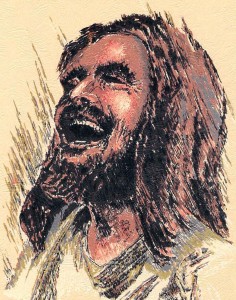 In the library of my parish church is a pen-and-ink drawing of Jesus laughing. It’s not a picture I particularly like, nor is it particularly well executed. In fact, if someone hadn’t told me that it is supposed to show Jesus laughing, I would have thought he was angry! Whenever I look at it, this verse from the Psalter comes to mind.
 Friday was a Holy Day in America! It was a day when all across the nation thousands, if not millions, of people breathed prayers of thanks. It was a day when all across the nation thousands, if not millions, improved the lives of many, many others. It was a day when news organizations from the smallest local radio station to international broadcast and cable conglomerates asked Americans across the nation, “How did you participate?” Yes, Friday was a Holy Day in America!
 Black Friday. The day after Thanksgiving Day in the United States. A day whose name comes from financial accounting and the ancient practice of recording profits in black ink, losses in red. Supposedly, at one time, this was the day when retail merchants who might have been running “in the red” the whole year would see themselves “in the black” at long last. I don’t know if that is still the case, but the name has stuck. Black Friday is the day after Thanksgiving Day.
 I had to read the first line of this familiar parable three or four times this morning before my eyes (it had to be my eyes; it couldn’t have been my brain) focused well enough to properly read the word landowner. On first reading, I read it as lawnmower.
  Obadiah’s words (on behalf of God) are directed to the Edomites; this short (one-chapter) book is a rather dire prediction of the complete destruction Edom for the way it had dealt with Israel. Apparently it was correct for there seem to be no Edomites, nor any descendants of Edomites identifiable in the modern world.
 I will go on record has being not an adherent of the ransom theory of the Atonement, which holds that the death of Christ was a ransom sacrifice in satisfaction for the bondage and debt on the souls of humanity as a result of inherited sin (another theory, “original sin,” with which I have some strong debate). It is unclear to me exactly who is the recipient of the ransom. Depending on who is setting out the argument, the ransom is usually said to have been paid either to Satan, which I think makes the ol’ devil rather bigger than he ought to be, or to God the Father, which makes the Almighty considerably less than we ought to think of God.
 Read it carefully, it’s not what you think it is. It’s not what you expect. It’s not a call to make agricultural implements out of the weapons of war . . . it is quite literally the opposite!
 This part of Isaiah was written shortly after the return of the Jewish exiles from Babylon, which Cyrus of Persia had allowed in the middle of the 6th Century BCE. Isaiah (on God’s behalf) was promising two things with these images of laborers enjoying the fruits of their own efforts: first, that the people would no longer be (if not slaves) subjugated workers of foreign (or domestic) overlords and, second, that there would be peace. Israel’s and Judah’s history had been one of regular (if not constant) upheaval with invaders coming in and taking control of the vineyards and seizing the people’s lands and homes: the simple planting of vineyards with an expectation of enjoying the crop was a metaphor of peace and security.

