Occasional thoughts of an Anglican Episcopal priest

Category: Sermons (Page 23 of 40)

Crossing Borders: A New Passport – Sermon for Christmas Eve, 24 December 2015

====================

A sermon offered on Christmas Eve, December 24, 2015, to the people of St. Paul’s Episcopal Church, Medina, Ohio, where Fr. Funston is rector.

(The lessons for the day are Isaiah 9:2-7; Psalm 96; Titus 2:11-14; and Luke 2:1-20. These lessons may be found at The Lectionary Page.)

====================
identitycards

Where refugees seek deliverance that never comes
And the heart consumes itself, if it would live,
Where little children age before their time,
And life wears down the edges of the mind,
Where the old man sits with mind grown cold
While bones and sinew, blood and cell,
go slowly down to death,
Where fear companions each day’s life,
And Perfect Love seems long delayed,
Christmas is waiting to be born
In you, in me, in all mankind.
(Howard Thurman, Christmas is Waiting to be Born in The Mood of Christmas, Friends United Press, Richmond, IN:1985, p 21)

As many of you know, I have a tradition of keeping my eye open, while doing my Christmas shopping, for something on a store shelf to use as a physical illustration for this annual event, this sermon on the Nativity of Our Lord and Savior Jesus Christ. Over the years, these illustrative objects have included a pair of Christmas stockings, a Christmas banner with the greeting misspelled, a stuffed frog wearing a Santa hat, and last year’s mechanical dancing dachshund. Finding and using the annual “focus object” has become a source of great fun for me and I hope for the congregations who’ve been subjected to my preaching. This year, however, nothing on the shelves spoke to me.

Maybe that’s because I really didn’t do much in the way of Christmas shopping; I did a lot of driving around but not much buying. And while I drove, I listened (as I usually do in my car) to what’s called “talk radio.” This year, the talk was all about refugees, with some commentators claiming it’s too easy to get into this country and some claiming it’s too hard, and all of them describing the process of “vetting” or doing background checks on immigrants. It made me think of my great-great-grandfather, who came to this country a refugee from the township lands of Donegal in the northern part of Ireland during “an Gorta Mor,” the Great Hunger, the so-called Irish potato famine. He came without a single document, with no proof of identity; he got off a ship in the port of New Orleans, made his way up the Mississippi River, settled in sourthern Indiana, married a German girl, and started the family from whence I came, but left no documentary evidence of any of that. He couldn’t have been “vetted” at all.

This is also the time of year, Christmas always is, when the religious press is filled with articles either claiming that the historical existence of Jesus can’t be proved, or answering claims that the historical existence of Jesus can’t be proved. And everyone agrees that there are very few mentions of Jesus outside of the bible; maybe one in a Roman criminal record and one that amounts to little more than a dismissive footnote in a work by the historian Flavius Josephus. Again, I was reminded of my great-great-grandfather. I know quite a bit about John Henry Funston, but I can’t document any of it. Believe me, I’ve tried! If I were asked to prove his existence from public records, I couldn’t do it. Nonetheless, I know he existed; I wouldn’t be here if he hadn’t. I know that Jesus existed; we wouldn’t be here if he hadn’t.

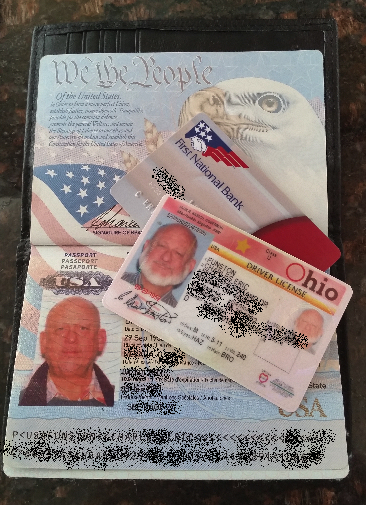
So as I was doing what little shopping I did, listening to talk about “vetting” refugees and contemplating the historical evidence of Jesus (or the lack of thereof), I did finally identify a focus object for tonight . . . or I should say a “focus category” . . . these – my identity papers. My driver’s license, my passport, my bank card, my membership cards for the Bar and various fraternal organizations. You, I’m sure, have a wallet (and perhaps a file or a strong box at home) full of similar papers. Vetting us, proving our existence, moving from place to place, gaining admission to special places, crossing borders from state to state or country to country . . . all these things are easy for us. We have these identity papers.

These papers, especially our driver’s licenses and passports, allow us to do what the refugees cannot, what my great-great-grandfather who had no papers could not do today, what Mary and Joseph could not do today . . . to cross borders and move freely from place to place. And these papers give us a lens through which to appreciate, in a new way, the meaning of Christmas which, once again in our time, “is waiting to be born in you, in me, in all [humankind].”

We heard this evening only a part of the Christmas story – we all know that there is a larger context, more to tell. This is a story that began nine months earlier when the Angel Gabriel surprised a young, teenage girl in the town of Nazareth with the invitation to be the bearer of God’s Child; this is a story that will not end, ever. The angel crossed the border between heaven and earth to make his announcement to Mary, and that set in motion a series of border crossings that is still going on:

  • between the divine and the human when Holy Spirit overshadowed Mary and she conceived
  • between law and grace when Joseph, who could have canceled their engagement and even had her killed, accepted her pregnancy and his fostering of the Child
  • between the tetrarchy of Samaria and Galilee and that of Judea as the Holy Couple made their way from Nazareth to Bethlehem
  • between the Holy Land and countries to the East (and possibly the North and South) when the Magi came to pay homage
  • between Judea and Egypt when the Holy Family became refugees escaping Herod’s slaughter of the Holy Innocents, and then back again when they returned
  • between Gentile and Jew when Jesus healed the Syrophoenician woman’s daughter in the region of Tyre, when he spoke with the Samaritan woman at Jacob’s well, and when he healed the Roman Centurion’s servant
  • between life and death when Christ was crucified and died, when he was buried, and when rose again
  • between earth and heaven again, between human and divine again when he ascended in the sight of his disciples
  • between the bondage of sin and the freedom of risen life in the Redeemer when you and I were baptized

Borders crossed, barriers removed, reconciliation accomplished.

A couple of years ago a rabbi named Irwin Kula wrote an essay entitled Crossing Borders: Jews and Christmas in America. In it he commented

The majority of Americans, including more than 80 percent of those less than 30 years of age, accept marriage across all types of boundaries, including ethnic and racial. We are creating identities and webs of relationships that do not fit our inherited boxes and labels. And so the fixed ways of dividing “us” and “them” are breaking down and not surprisingly people deeply committed to their own groups and creeds are worried.

***

At their best, our ancient religious traditions know this, which is why they all teach we are one global family . . . .

There are no roadmaps, which, paradoxically is the hallmark of a genuine spiritual journey. But the more people love each other, the more people with different inheritances and traditions form intimate relationships, and the more we learn the best of each others insights and wisdom, the more discerning we will be about what we need to bring along with us from our traditions to help create a better world in this next era. (The Wisdom Daily)

Rabbi Kula hits the nail squarely on the head when he speaks of “creating identities and webs of relationship that do not fit inherited boxes.” In the Birth of Jesus, in the life of Jesus, in the death and resurrection of Jesus, and in our baptism into his never-ending story, the Holy Spirit creates in us new identities and new webs of relationship. We are no longer defined by our driver’s licenses, our credit cards, our passports, and all the rest. Christmas gives us new papers, a new passport!

Christmas is, for those who wish to follow the way of Jesus, an invitation to accept a new identity. For us who live comfortable and safe lives, it is an invitation to become the inn-keeper in the story; to open the way for those who, like Mary and Joseph, come from far away, who seem ragged, marginal, or in transition. They may come from the desert wilderness of Syria or from the rain forests of Central America, but they may also come from the streets of Detroit or Cleveland, or from the wasteland of addiction, the outback of unemployment, the deep darkness of depression and mental illness. They may even be members of our own families:

This is how God finds us, at this very dark time of the year, the winter solstice, when the daylight hours have shrunk to their minimal light. He comes knocking at the door, looking for a haven, for a place to rest and recover. (CNN editorial by Jay Parini)

He comes again, as he comes every Christmas, as he comes every day, seeking to cross the borders, the boundaries, the barriers of our lives, asking us to “strive for justice and peace,” to respect the dignity of every human being,” to welcome again the Babe of Bethlehem who is born in all persons and all times. “Every year at Christmas, he comes to us as a child on the run with his impoverished and terrified parents. He knocks at the door of our house and our hearts. And we let him in – or we turn him away.” (Jay Parini)

Christmas is also an invitation to remember that, as St. Paul put it in his letter to the church in Ephesus, we were all once “aliens from the commonwealth of Israel, and strangers to the covenants of promise, having no hope and without God in the world.” But through the Incarnation of Christ, “in his flesh he has made both groups into one and has broken down the dividing wall” and “created in himself one new humanity,” so that none of us are any “longer strangers and aliens, but . . . citizens with the saints and . . . members of the household of God.” (Eph. 2: 12-19) In the birth of Jesus, in the life of Jesus, in the death and resurrection of Jesus, and in our baptism into his story, we have a new identity, a new passport.

The voice of the angels to shepherds on the first Christmas Eve proclaimed God’s promise of peace, of borders crossed and barriers breached, not only in First Century Judea, and not only in the future nor only in heaven, but right here on earth today, if we will but live into the Christmas invitation, into our new identity. Last week, the Most Rev. Justin Welby, Archbishop of Canterbury, offered a meditation in which he said that Christmas invites us to take the risk of reaching out to the other and “see[ing] what happens. As Christians we are called to be people who take that first step, who take the risk of kindness because we believe the other person is a gift to us from God, just as we can be a gift to them.” (Facebook Status, 4th Sunday of Advent)

Striking a similar note, the Quaker philosopher Parker Palmer just yesterday offered a reflection reminding us that we are

called to share in the risk of incarnation. Amid the world’s dangers, [we are] asked to embody [our] values and beliefs, [our] identity and integrity, asked to allow good words to take flesh in [us]. Constrained by fear, [we] often fall short. And yet [we] still aspire to walk [our] heart-and-soul talk, however imperfectly. – Christmas is a reminder that [we are] invited to be born time and again in the shape of [our] God-given self – which means embracing the vulnerability of the Christmas story. (On Being)

Christmas is a reminder and an invitation. Christmas is the passport we receive at our baptism empowering us to cross the borders.

I began this sermon with a meditation entitled Christmas Is Waiting to Be Born by the great African-American theologian Howard Thurman from his book The Mood of Christmas. I’d like to close with another from the same book:

When the song of the angels is stilled,
When the star in the sky is gone,
When the kings and princes are home,
When the shepherds are back with their flock,
The work of Christmas begins:
To find the lost,
To heal the broken,
To feed the hungry,
To release the prisoner,
To rebuild the nations,
To bring peace among others,
To make music in the heart.
(The Mood of Christmas, p 32)

May Christmas be born in us, and may the Birth of Jesus empower us to cross the borders, to breach the barriers, to overcome the boundaries, and to do the work of Christmas: to “see and serve Christ in all persons, loving [our] neighbors as [ourselves].” Amen.

====================

A request to my readers: I’m trying to build the readership of this blog and I’d very much appreciate your help in doing so. If you find something here that is of value, please share it with others. If you are on Facebook, “like” the posts on your page so others can see them. If you are following me on Twitter, please “retweet” the notices of these meditations. If you have a blog of your own, please include mine in your links (a favor I will gladly reciprocate). Many thanks!

====================

Father Funston is the rector of St. Paul’s Episcopal Church, Medina, Ohio.

Save and Deliver: Fourth of a Series – Sermon for Advent 4 (20 December 2015)

====================

A sermon offered on the Fourth Sunday of Advent, December 20, 2015, to the people of St. Paul’s Episcopal Church, Medina, Ohio, where Fr. Funston is rector.

(The lessons for the day are Micah 5:2-5a; Canticle 15 [Luke 1:46-55]; Hebrews 10:5-10; Luke 1:39-45. These lessons may be found at The Lectionary Page.)

====================

hen-with-chicksLanguages and the study of languages fascinate me – if you didn’t know that before this series on the Lord’s Prayer, you probably know it now – and I am therefore always keenly aware of the difficulty of fully appreciating the Holy Scripture if we only consider the meaning of the English translation.

In the 1950s the social scientist Noam Chomsky proposed the idea that the ability to communicate complex data with our fellows is one of the characteristics that distinguishes human beings. He went so far as to propose that all humans, unlike all other animals, are genetically programmed with a limited set of rules for organizing language; this became known as “the Universal Grammar.” Chomsky’s idea became received wisdom and pretty much the basis for all academic study of linguistics despite the fact that there was not a shred of objective, empirical data to support it.

In fact, there is now plenty data contrary to Chomsky’s notion. We now know that a variety of animal species are able to communicate among themselves and convey very complex information to one another. Furthermore, studies of human languages around the world have repeatedly demonstrated that there are no linguistic universals; instead, there is abundant variation at all levels of linguistic organization. For example, there is a language spoken by one small group of people on one of the South Pacific islands in which verbs have no tenses; we would, I suppose, say that the verbs are all in the present tense but that would be misleading because their verbs, in fact, carry no sense of time. That sense is expressed, instead, by adjectives, and specifically by color adjectives; the color variation ascribed to the subject and object of a verb conveys the idea of past, present, or future.

Can you imagine how difficult it is to translate from that language into English, or vice versa? A direct translation

I bring this up because, although the difficulties are not nearly so great in the translation from Greek to English (which we must do to read the New Testament in our own language), such difficulties are nonetheless there, and especially so as we consider the last of the petitions in the Lord’s Prayer: “lead us not into temptation, but deliver us from evil,” in the older liturgical form; “save us from the time of trial and deliver us from evil,” in the newer.

Some of the difficulties that confront us are (a) Greek words which can be translated in more than one way; (b) Greek word order which differs from, and is less important than, word order is in English; and (c) the fact that biblical Greek uses no punctuation, leaving us to guess about phrases and sentences. (I’ll only address the first today, but the others are also present here.) And, then, there is the overarching matter that Jesus, in teaching us to pray, is also teaching us something about God and such teaching is always contingent, partial, and problematic; no human language can encompass the reality of God. Any human attempt to describe God, even Jesus’, is incomplete and may be ultimately misleading.

In today’s Gospel, Mary pregnant with Jesus visits her kinswoman Elizabeth who is pregnant with John the Baptizer. Elizabeth greets her, commenting on how active her own baby becomes at the sound of Mary’s voice and then praising Mary as “blessed” because she “believed that there would be a fulfillment of what was spoken to her by the Lord.” Mary’s answer is the Magnificat, the song which we recited as our Gradual, in which she says of God that God casts down the powerful, scatters the proud, and sends the rich away hungry, but that God lifts up the downtrodden, feeds those in need, and remembers those with whom God has made covenants. This doesn’t mean that God has nothing to do with the rich, nor that God ministers only to the poor, nor that God is not active in the lives of those outside of God’s covenants. It gives us a picture of God’s commitment to justice, but only a partial picture.

The same is true of the Lord’s Prayer. This petition (like all of the petitions in this prayer) is loaded with more meaning than we are aware of. Methodist theologians William Willimon and Stanley Hauerwas in their book Lord, Teach Us, say this about this petition:

Words like “save” and “trial” and “deliver” are words of crisis. They remind us that to pray this prayer means to be thrust into the middle of a cosmic struggle. At this point the temperature rises within the Lord’s Prayer. Things are not right in the world. It is as if something, someone has organized things against God. You pray this prayer faithfully, attempting to align your life to it and the next thing you know, it’s like you are under assault.

How often is salvation presented as some sort of helpful solution to everything that ails us. “Lonely? Come to Jesus and get that fixed.” “Alcoholic? Come to Jesus and be delivered of your addiction.” “Confused? Join the church and find all the answers.” In such a presentation of the gospel, salvation is the resolution of all your problems, the way to fix whatever ails you.

But this petition, in which we ask for salvation, deliverance and help in time of trial reminds us that salvation in Christ is an adventure, a journey, a larger drama. Praying this prayer is the beginning of problems we would never have had had we not met Christ and enlisted with Christ’s people. The forces of evil do not relinquish their territory without a fight and, in being saved, God’s newly won territory is you. (Willimon, Wm. H., and Stanley Hauerwas, Lord, Teach Us, Abingdon, Nashville:1996, ch. 8)

“At this point the temperature rises . . . . ” What a great way to present the tensions of this petition and of the protection for which it asks!

So let’s take a look at some of these “words of crisis,” as Willimon and Hauerwas label them. The first are the words translated in the King James Bible and in the earlier liturgical prayer as “lead us not into,” in the NRSV as “do not bring us into;” this is the Greek phrase me eisenenkes hemas eis, and either translation may be correct. The root verb is eisphero which can mean “lead”, “bring”, “carry”, or even “sustain.”

A problem for many people is not so much in the translation as in the idea that God could or would lead someone into temptation. Walter Kaiser in his book Hard Sayings of the Bible (InterVarsity, Downers Grove, IL:1996, p 366) exclaims, “Why should we ask God not to lead us into this? As if God would do any such thing! ‘God cannot be tempted by evil, nor does he tempt anyone’ (Jas 1:13).” This is why the newer liturgical form paraphrases the Greek as a plea for protection – “Save us from.”

Save us from what? The Greek word is peirasmon. If that is translated as “temptation”, and that in turn is understood to mean an enticement to evil, then it does seems strange and perhaps even offensive to ask God not to do what God would never do. However, “temptation, when the word occurs in the older versions of the Bible, means more than temptation to sin; it has the wider sense of testing.” (Kaiser, 367) A 1st Century Greek physician and natural philosopher named Dioscorides used the word peirasmos to describe medical experimentation (Mat. Med. Praef. 5.12), and a Greek-speaking Indian philosopher of the century before named Syntipas used the word to denote the afflictions of life which tend to crush those who do not possess sufficient inner fortitude. It is in this way that Jesus or the evangelists seem to have used it when he went with the disciples to the Garden of Gethsemane after the Last Supper.

When they arrived at the garden, he went away by himself admonishing his friends, “Pray that you may not come into the time of trial.” (Lk 22:40) When he returned to them, he found them asleep and again he admonished them: “Get up and pray that you may not enter into the time of trial.” (Lk 22:46) In the Greek of the New Testament, the words of Jesus’ admonitions are nearly identical to this petition of the Lord’s Prayer. Thus, the full first half in the new liturgical form is, “Save us from the time of trial.”

The second half of the petition is rendered the same in both liturgical forms, “Deliver us from evil.” Sometimes the Biblical versions are personalized, “Deliver us from the Evil One” on the basis of some Greek variants, which would seem to limit it to being a request for protection from (perhaps) Satan. However, most translators and commentators support the more general understanding, many noting that Jesus seems to be using a Hebrew literary or poetic form known as parallelism. “‘Lead us not into temptation’ and ‘deliver us from evil’ mean just the same thing: Prevent us being brought into temptation too great for us to conquer.” (Palmer, Albert W., Humanity’s Greatest Prayer, in Prayer and Spiritual Living, Vol 2, Kregel, Grand Rapids:1995, p. 10) As Lutheran writer Lois Tverberg says, “[This petition] is an all-encompassing plea for God to protect us from what is outside us, but what is inside as well.”

The Brazilian theologian Leonardo Boff suggests that this petition “presupposes a bitter awareness that human beings are fragile, subject to temptation of betraying their hope, becoming unfaithful to God, actually succumbing to temptation, and consequently being lost.” (The Lord’s Prayer: The Prayer of Integral Liberation, Orbis Books, Maryknoll:1983, p 97) And Franciscan author Michael Crosby observes, “We cannot offer this petition without being aware of how we ourselves might be contributing to the very evil (for others) that we pray to be delivered from ourselves.” (The Prayer That Jesus Taught Us, Orbis Books, Maryknoll:2002, p 171)

With that “better awareness” we know, even as we utter this prayer, that there will be times of trial. I’m sure that even as Mary sang the praises of the God who “casts down the mighty from their thrones,” she knew that she would still have to deal with life in an occupied Israel under the control of Imperial Rome. Even as she thanked God for “lift[ing] up the lowly” and “fill[ing] the hungry with good things,” she knew that she and Joseph would have to work hard earning very little to support themselves and the baby she carried. She knew and we know that there will be times of trial.

This petition, then, is for us, the family of Jesus, who know that despite our best intentions every day we will be faced with and tempted by choices which may be bad and unhealthy for us or for others, who know that left on our own we will give in and make (some of) those choices. This is a petition that God will give us the protection and the resources we need to resist those choices. “Save us from the time of trial and deliver us from evil” is a prayer for God’s protective guidance and strength to endure, because on our own, we cannot resist temptation; we cannot do what is right and good. It is a prayer that what Paul wrote to the church in Rome will be true for us:

[S]ince we are justified by faith, we have peace with God through our Lord Jesus Christ, through whom we have obtained access to this grace in which we stand; and we boast in our hope of sharing the glory of God. And not only that, but we also boast in our sufferings, knowing that suffering produces endurance, and endurance produces character, and character produces hope, and hope does not disappoint us, because God’s love has been poured into our hearts through the Holy Spirit that has been given to us. (Rom 5:1-5)

Endurance, character, hope, and love: these are the protective gifts we ask for when we pray, “Save us from the time of trial and deliver us from evil.”

An oft-repeated alliterative aphorism sometimes attributed to former Archbishop of Canterbury Donald Coggan summarizes the Lord’s Prayer as one for provision, pardon, and protection. We pray for our basic needs; we pray for forgiveness; we pray for safety from evil, both that of others and our own.

Despite the difficulties of translation from Aramaic to Greek to English, despite cultural differences between 1st Century Palestine and 21st Century America, in our world with all of its complications, in our world which is (as Willimon and Hauerwas remind us) a battlefield where the battle may already be won but still must be fought, this prayer reminds us that these three things – provision, pardon, and protection – are ultimately all we need to live for God, whose was, and is, and will be “the kingdom, the power, and the glory . . . now and for ever. Amen.”

====================

A request to my readers: I’m trying to build the readership of this blog and I’d very much appreciate your help in doing so. If you find something here that is of value, please share it with others. If you are on Facebook, “like” the posts on your page so others can see them. If you are following me on Twitter, please “retweet” the notices of these meditations. If you have a blog of your own, please include mine in your links (a favor I will gladly reciprocate). Many thanks!

====================

Father Funston is the rector of St. Paul’s Episcopal Church, Medina, Ohio.

Remember and Rejoice: Sermon for the Funeral of Sheryl Ann King (14 December 2015)

====================

A sermon offered at the Funeral of Sheryl Ann King (12/14/1967-12/09/2015) on Monday, December 14, 2015, to the people of St. Paul’s Episcopal Church, Medina, Ohio, where Fr. Funston is rector.

(The lessons selected by the family were Isaiah 25:6-9 ; Psalm 121; Revelation 21:2-7; and John 14:23-30.)

====================

funeralsprayA Native American proverb instructs us, “When you were born, you cried and the world rejoiced; live your life in a manner that when you die, the world cries and you rejoice.” Today, on what would have been Sheryl Ann King’s 48th birthday, the world (you and me and everyone who knew and loved Sherry) is crying, but Sherry is rejoicing. “If you loved me,” Jesus told his followers, “you would rejoice that I am going to the Father” (Jn 14:28); we who love Sherry, let us rejoice (even through our tears) that she, too, has gone to the Father.
In the Jewish religion going back at least as far as the Babylonian exile it is a tradition that those mourning the death of a loved one recite a prayer called the Mourner’s Kaddish. The prayer begins with these words:

Exalted and hallowed be God’s great name in the world which God created, according to plan. May God’s majesty be revealed in the days of our lifetime and the life of all Israel – speedily, imminently, to which we say Amen. (ReformJudaism.org>

As the prayer continues to its conclusion, there is not a single mention of the loved one, no mention of the loved one’s passing, no mention of the mourner’s grief. The prayer is, in its entirety, a sanctification of God and a petition for peace. The rabbis tell us that this tradition arose to remind us, even in the midst of great sorrow, to rejoice and to give thanks.

Nonetheless, there is a very human need to acknowledge the loss of the one we love and in a prayer book of the Reform Jewish movement entitled New Prayers for the High Holy Days there is this lovely meditation:

At the rising sun and at its going down, we remember them.
At the blowing of the wind and in the chill of winter, we remember them.
At the opening of the buds and in the rebirth of spring, we remember them.
At the blueness of the skies and in the warmth of summer, we remember them.
At the rustling of the leaves and in the beauty of the autumn, we remember them.
At the beginning of the year and when it ends, we remember them.
As long as we live, they too will live,
for they are now a part of us.
As we remember them.
When we are weary and in need of strength, we remember them.
When we are lost and sick at heart, we remember them.
When we have decisions that are difficult to make, we remember them.
When we have joy we crave to share, we remember them.
When we have achievements that are based on theirs, we remember them.
For as long as we live, they too will live,
For they are now a part of us, as we remember them.
(Sylvan Kamens & Rabbi Jack Riemer, We Remember Them, New Prayers for the High Holy Days, Media Judaica, New York:1970, p. 36)

What memories do you have of Sherry? I will always remember three things about her. The first is her competence and her drive. When Sherry was doing volunteer work here at St. Paul’s Church, I knew that if she said she would do something it would get done and it would get done well. (Parish priests really appreciate that and remember with special blessings those members on whom they can rely as one could rely on Sherry.) The second is that she loved to have a good time: she was a great hostess and she enjoyed a good party. I’m sure that she is just as pleased as she can be to be joining the saints in light at God’s great party, the one Isaiah described, that “feast of rich food, . . . of well-aged wines, of rich food filled with marrow, of well-aged wines strained clear” (Is 25:6).

The third thing I will remember is the way she always looked when she came back from her annual trip to Cancun. Sherry was someone who clearly enjoyed the sun! I have to admit to being somewhat amused when I realized that the family had selected a psalm with the verse, “The sun shall not strike you by day” (Ps 121:6)! I’m not sure Sherry would have gone for that, but I am sure she is now enjoying what Malachi prophesied, “For you who revere my name the sun of righteousness shall rise, with healing in its wings. You shall go out leaping like calves from the stall.” (Mal 4:2) Sherry, we believe, is now in that place “where sorrow and pain are no more, neither sighing, but life everlasting.” (BCP 1979, p 499)

And this is where our Christian faith takes us beyond the meditation in the Reform Jewish prayer book. We are assured that more than our memories sustains the lives of our departed loved ones; it is not “as long as we live” that they shall live, but forever. We are assured, because of the birth of Christ which we will celebrate in just a few days, because of his life, his death, his resurrection, and his ascension, that the way to eternal life has been opened to Sherry, to all of our loved ones gone before, and to all of us.

Sometimes when we bury the dead, we also celebrate the Holy Communion. In the Episcopal Church as part of that service, in the introductory preface to the consecration of the bread and wine, the priest presiding at the altar says these words:

Jesus Christ our Lord . . . rose victorious from the dead, and comforts us with the blessed hope of everlasting life. For to your faithful people, O Lord, life is changed, not ended; and when our mortal body lies in death, there is prepared for us a dwelling place eternal in the heavens. (BCP 1979, p 382)

This is our Christian hope and our assurance, that in Christ Jesus God has (as Isaiah prophesied) “swallow[ed] up death forever” (Is 25:8), and as John of Patmos heard the voice in heaven saying, “Death will be no more; mourning and crying and pain will be no more, for the first things have passed away.” (Rev 21:4)

So, our memories are precious and we cherish them, but it is more than our memories which sustain Sherry or any of our departed loved ones: through the love of God and the salvation of Christ, rest eternal has been granted to them, and light perpetual shines upon them. And we honor them with more than our memories; we honor Sherry not by living in the past, not only by remembering her, but by living into the future. When Queen Mother Elizabeth passed away in 2002, this meditation entitled Remember Me by David Harkins was included in the order of service. It seems to me appropriate today as we remember and celebrate Sherry’s life:

Do not shed tears when I have gone
but smile instead because I have lived.
Do not shut your eyes and pray to God that I’ll come back,
but open your eyes and see all that I have left behind.
I know your heart will be empty because you cannot see me,
but still I want you to be full of the love we shared.
You can turn your back on tomorrow
and live only for yesterday,
or you can be happy for tomorrow
because of what happened between us yesterday.
You can remember me and grieve that I have gone
or you can cherish my memory and let it live on.
You can cry and lose yourself,
become distraught and turn your back on the world,
or you can do what I want –
smile, wipe away the tears,
learn to love again and go on.
(See Poetic Expressions.)

The French novelist Marcel Proust once wrote, “Let us be grateful to people who make us happy; they are the charming gardeners who make our souls blossom.” (Pleasures and Days, Hesperus Classics, London:2004, p 116) “Do not let your hearts be troubled,” said Jesus, “and do not let them be afraid.” (Jn 14:27c) Instead, let them blossom, and let us rejoice and be grateful for the life of Sheryl Ann King. Amen.

====================

A request to my readers: I’m trying to build the readership of this blog and I’d very much appreciate your help in doing so. If you find something here that is of value, please share it with others. If you are on Facebook, “like” the posts on your page so others can see them. If you are following me on Twitter, please “retweet” the notices of these meditations. If you have a blog of your own, please include mine in your links (a favor I will gladly reciprocate). Many thanks!

====================

Father Funston is the rector of St. Paul’s Episcopal Church, Medina, Ohio.

Forgive Us Our Sins: Third of a Series – Sermon for Advent 3 (13 December 2015)

====================

A sermon offered on the Third Sunday of Advent, December 13, 2015, to the people of St. Paul’s Episcopal Church, Medina, Ohio, where Fr. Funston is rector.

(The lessons for the day are Zephaniah 3:14-20; Canticle 9 [Isaiah 12:2-6]; Philippians 4:4-7; and Luke 3:7-18. These lessons may be found at The Lectionary Page.)

====================

derrystatueJohn the Baptizer came, Luke tells us, “proclaiming a baptism of repentance for the forgiveness of sins.” (Lk. 3:3) In today’s Gospel lesson, John tells the crowds who came to him, “Bear fruits worthy of repentance.” (v. 8) Our catechism teaches us that repentance is required of us to receive the Sacraments. With regard to baptism, the catechetical requirement is that we “renounce Satan, repent of our sins, and accept Jesus as our Lord and Savior;” with regard to the Holy Eucharist, that we “examine our lives, repent of our sins, and be in love and charity with all people.” (BCP 858, 860) But John’s admonition and the Catechism’s requirements leave us wondering, “What exactly is ‘repentance’?”
It is something more than mere acknowledgment of transgression or wrong-doing, more than saying I’m sorry. The biblical and theological word for repentance is metanoia, which means a “turning around” or a changing of direction. We get a hint of this meaning in the invitation to confession used in earlier Anglican prayer books and still found in Rite One in our current Book of Common Prayer:

Ye who do truly and earnestly repent you of your sins, and are in love and charity with your neighbors, and intend to lead a new life, following the commandments of God, and walking from henceforth in his holy ways: Draw near with faith . . . . (BCP 330)

To repent is to turn from our path onto God’s “holy ways” and “lead a new life.”

John’s audience clearly knew that some amendment of life was part of what he was calling them to, for “the crowds asked him, ‘What then should we do?'” (Lk 3:10) His answers probably seem to us pretty common-sensical: share what you have, don’t take more than you deserve, don’t extort money, don’t make false accusations, be satisfied with your wages. That’s pretty much what the old prayer book invitation to confession said, too: follow the commandments, follow God’s ways, be on good terms with your neighbors. It’s common sense; it’s hard to do!

That’s why Jesus taught us to seek forgiveness, to repent every time we pray: “Forgive us our sins as we forgive those who sin against us.” Which brings us to this, the next petition in our consideration of the Lord’s Prayer.

Now the truth is that hundreds if not thousands of books of several hundred pages each have been written about the Lord’s Prayer, and hundreds of those books are specifically about this petition, and only this petition. Perhaps that is because sin, the subject of this part of the prayer, is so fascinating. Perhaps it is because of the difference in terminology used by Luke and Matthew; Luke uses the Greek word hamartia, usually translated as “sin” although it actually means something else, while Matthew uses opheilemata, usually translated as “debt” which is pretty accurate, and neither uses the word which means “trespass,” which is paraptoma, a word found in Matthew’s follow-up commentary on the prayer, “If you forgive others their trespasses, your heavenly Father will also forgive you.” (Mt. 6:14) “Trespass” made its way into the older liturgical version of the prayer because of the early English translation work of John Wycliffe and William Tyndale in the 15th Century.

So what do these two words tell us about sin? By the way, the English word “sin” comes from an old Germanic word meaning a failure to obey a rule and carries an inference of moral guilt; neither of the Greek words derives from anything like that. Hamartia comes from the sport of archery and means “to miss the mark”; opheilemata comes from business accounting and means a monetary debt. (The word meaning “forgive,” aphes, also comes from accounting and means cancelation of a debt.)

Bible commentator William Barclay, in his book The Lord’s Prayer (Westminster John Knox, Louisville:1998) explains hamartia this way:

Harmartia was not originally an ethical word; originally it meant quite simply a missing of the mark, as when a javelin, or an arrow, or a blow misses its mark. In this sense, sin is a failure to hit the mark, a failure to realize the true aim of life, a failure to be and to do that which we ought to have done, and which we could have been and could have done. (p. 86)

And of opheilemata he writes that Matthew was directly translating an accounting metaphor used by Aramaic speaking rabbis of Jesus’ time, probably the very word that Jesus used in his original teaching:

Now in the time of Jesus in Palestine the rabbis thought of sin almost exclusively as a failure in obedience to God. To them goodness was obedience, sin was disobedience. This is to say that man’s first obligation is to give God obedience; not to give obedience to God is to be in debt to God; and therefore their commonest word for sins was choba’, which in fact means debt. (p. 86)

Neither of the Greek terms necessarily carries a connotation of moral culpability. Certainly there are times when a person commits an intentional act which misses the mark of moral or ethical behavior, but there are many more times when we miss the mark because, like a trained archer, we aim carefully to do the right thing and then miss. Certainly there are times when a person intentionally fails to pay a debt, an unethical and perhaps even criminal thing to do, but there are many more times when we incur indebtedness because we have blundered or slipped through inadvertence.

These Greek words remind us that sinfulness is not about breaking rules; sinfulness is about harming relationships. This is why the great existentialist theologian Paul Tillich insisted that “sin does not mean an immoral act;” he suggested “that ‘sin’ should never be used in the plural, and that not our sins, but rather our sin is the great, all-pervading problem of our life.” (Quoted in Killen, R. Allan, The Ontological Theology of Paul Tillich, J. H. Kok, Kampen:1956, p. 185) That problem, he said, is separation: “To be in the state of sin is to be in the state of separation.” (Tillich, Systematic Theology, 2:46)

Thus the state of our whole life is estrangement from others and ourselves, because we are estranged from the Ground of our being, because we are estranged from the origin and aim of our life. And we do not know where we have come from, or where we are going. We are separated from the mystery, the depth, and the greatness of our existence. We hear the voice of that depth; but our ears are closed. We feel that something radical, total, and unconditioned is demanded of us; but we rebel against it, try to escape its urgency, and will not accept its promise. (Tillich, The Shaking of the Foundations, Chapter 19: You Are Accepted.)

In trying to make that urgent escape, we stumble. We say the wrong thing, or perhaps the right thing in a wrong way, or we hear what another says differently than that other intended, and we both incur the debt of explanation. We do something we shouldn’t do or fail to do something we should; we miss the mark. We blunder off the path, transgress a boundary, and put things out of balance. We may not break any rule, but we hurt feelings and damage relationships. We exacerbate the sin of separation and increase our estrangement from ourselves, from others, and from God. Sin is not about breaking rules; sin is about harming relationships. Sin is separation.

God’s forgiveness, aphes, the cancellation of any debt, balances the books, moves the arrow from wherever it went astray and counts it a bull’s-eye. This is the promise of God set out by Zephaniah in today’s Old Testament lesson: “I will remove disaster from you, so that you will not bear reproach for it. . . . . I will change [your] shame into praise . . . .” (Zeph. 3:18-19) God’s forgiveness sets the pattern for our own; we are able to forgive others because we know that we are forgiven. So Jesus teaches us to pray, “Forgive us our sins as we forgive those who sin against us” in our liturgical version. “Forgive us our sins, for we ourselves forgive everyone indebted to us” (Lk 11:4) is how Luke renders it; “Forgive us our debts, as we also have forgiven our debtors” (Mt 6:12) is Matthew’s version.

Mark, of course, does not tell us about Jesus teaching the Lord’s Prayer, but he does tell us that on the day after his triumphal entry into Jerusalem, he instructed his disciples about the power of prayer and in that teaching said, “Whenever you stand praying, forgive, if you have anything against anyone; so that your Father in heaven may also forgive you your trespasses.” (Mk 11:25) In March of 2014, Pope Francis preached a homily on the feeding of the 5,000 in which he said this: “You pray for the hungry. Then you feed them. That’s how prayer works.” It’s an insight that applies to this petition of the Lord’s Prayer, as well: “You pray for forgiveness. Then you forgive. That’s how prayer works.”

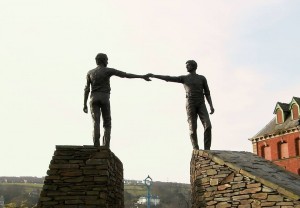
Last week, on the Archbishop of Canterbury’s Facebook page, he posted a picture of a statue erected in Derry, Northern Ireland, of two men reaching across a wide gap and reaching for each other’s hand. The Archbishop’s caption for the photograph said,

Reconciliation is about our relationship with God and with each other. It’s people, communities and nations learning to live together with deeply-held differences in a spirit of love and respect. It’s working for justice and seeking truth in the light of God’s mercy and peace. It’s the very heart of the gospel.

Forgiveness is the first step of reconciliation; together, forgiveness and reconciliation are chief among the fruits of repentance John the Baptizer admonished his hearers, and us, to bear.

There is so much more that could be said about this petition! Hundreds of books of hundreds of pages have been written about it. Please forgive me for only scratching the surface.

Forgive us our sins as we forgive those who sin against us. Amen.

====================

A request to my readers: I’m trying to build the readership of this blog and I’d very much appreciate your help in doing so. If you find something here that is of value, please share it with others. If you are on Facebook, “like” the posts on your page so others can see them. If you are following me on Twitter, please “retweet” the notices of these meditations. If you have a blog of your own, please include mine in your links (a favor I will gladly reciprocate). Many thanks!

====================

Father Funston is the rector of St. Paul’s Episcopal Church, Medina, Ohio.

Give Us Today Our Daily Bread: Second of a Series – Sermon for Advent 2 (6 December 2015)

====================

A sermon offered on the Second Sunday of Advent, December 6, 2015, to the people of St. Paul’s Episcopal Church, Medina, Ohio, where Fr. Funston is rector.

(The lessons for the day are Baruch 5:1-9; Canticle 16 [Luke 1: 68-79]; Philippians 1:3-11; and Luke 3:1-6. These lessons may be found at The Lectionary Page.)

====================

bread_1863824cIt’s the Second Sunday of Advent so according to our lectionary tradition, we hear the words of John the Baptizer, the voice of one crying in the desert, calling us to clean up the roadways and build a straight path for God’s coming. We are all familiar with the Baptizer. He’s some sort of cousin of Jesus. He’s a bit of a wild man; he lives in the wilderness wearing rough clothing and eating only what foods he can pick from desert plants and animals, “locusts and wild honey” is the way the evangelists put it. This year we hear Luke’s version of John’s story.

Later in his gospel story, Luke relates a tale of Jesus angrily denouncing the leadership in the towns of Galilee who refused to listen either to the Baptizer or to Jesus. Jesus says to them: “John the Baptist has come eating no bread and drinking no wine, and you say, ‘He has a demon’; the Son of Man has come eating and drinking, and you say, ‘Look, a glutton and a drunkard….’” (Lk 7:33-34) John refused to eat bread, but for Jesus bread is an important element of his ministry; he even taught us to pray for it. So, today, we continue our examination of the Lord’s Prayer with the next petition: “Give us today our daily bread.”

Why do you suppose John refused to eat this staple food that Jesus found so important? There are two related reasons. The first is that bread and wine are processed foods associated with settled communities; for John, as for many prophets, the settled communities were places of corruption. John would have nothing to do with corrupt society and bread, for him, was a symbol of that society.

Luke tells us very clearly in political terms when John appeared on the scene. He situates the advent of the Baptizer and his revelation in the temporal context of the native ruler Herod, the local but foreign governor Pilate, and the final authority who sits above all, Tiberius. Our translation says it was during the “reign” of Tiberius, the “governorship” of Pilate, and the “rule” of Herod. However, the word Luke uses for Herod’s dominion is “tetrarchy” and for both Pilate’s and Tiberius’s governance, his word is “hegemony” (hegemoneuo and hegemonia, respectively). “Tetrarchy” refers to the fact that imperial Rome had divided Palestine into four arbitrarily defined regions and imposed on them the rule of puppet kings. “Hegemony” denotes a kind of imperial governance in which political domination is maintained by military force. In other words, Luke describes the very sort of corrupt and unjust political society that John eschewed and symbolically rejected by his refusal to eat bread.

John’s prophetic message is a call to build a straight, level, and smooth road for God, but as the scribe Baruch points out that road will be a two-way street. As Baruch puts it, “God has ordered that every high mountain and the everlasting hills be made low and the valleys filled up, to make level ground, so that Israel may walk safely in the glory of God.” On that road, says Baruch, “God will lead Israel with joy, in the light of his glory, with the mercy and righteousness that come from him.” In other words, the justice which John found lacking in settled communities and in the hegemonic domination of imperial Rome will be found on the road prepared in the desert.

The second, related reason that John will not eat bread has to do with ritual impurity. The Jewish Virtual Library’s commentary on the Baptizer tells us, “The reference to John not eating bread or wine probably indicates that John preferred to eat foods that had not been processed by human hands and would not therefore be susceptible to impurity. For this same reason John was said to have eaten locusts and honey (Matt. 3:4), both of which were regarded by his fellow Jews as pure items of food.”

In many ways, John and Jesus were polar opposites. They seem to have had the same goal, the restoration of justice and righteousness in Israel, but their approaches were very different. If John was overly fastidious about ritual purity, Jesus doesn’t seem to have given a hoot about it! He regularly dined with tax collectors and outcasts, allowed prostitutes to touch him, touched dead bodies, conversed with gentile women, and allowed his disciples to eat without washing their hands (and presumably did the same himself). He just doesn’t seem to have cared much about the purity laws.

But Jesus did care about justice and for Jesus that is precisely what bread represents. If bread was John’s symbol for corrupt and unjust hegemony, for Jesus bread is the sign and symbol of divine righteousness and justice. He would even say of himself that he is “the bread of God . . . which comes down from heaven and gives life to the world;” “I am the bread of life.” (Jn 6:33,48)

I believe that a poem by the anti-Nazi poet and playwright Bertolt Brecht would have resonated for Jesus; it is entitled The Bread of the People:

Justice is the bread of the people
Sometimes is plentiful, sometimes it is scarce
Sometimes it tastes good, sometimes it tastes bad.
When the bread is scarce, there is hunger.
When the bread is bad, there is discontent.

Throw away the bad justice
Baked without love, kneaded without knowledge!
Justice without flavour, with a grey crust
The stale justice which comes too late!

If the bread is good and plentiful
The rest of the meal can be excused.
One cannot have plenty of everything all at once.
Nourished by the bread of justice
The work can be achieved
From which plenty comes.

As daily bread is necessary
So is daily justice.
It is even necessary several times a day.

From morning till night, at work, enjoying oneself.
At work which is an enjoyment.
In hard times and in happy times
The people requires the plentiful, wholesome
Daily bread of justice.

Since the bread of justice, then, is so important
Who, friends, shall bake it?

Who bakes the other bread?

Like the other bread
The bread of justice must be baked
By the people.

Plentiful, wholesome, daily.

“The bread of justice must be baked by the people” just as the road in the desert, the straight, level, smooth road of justice and righteousness must be cleared and built by God’s people.

Jesus taught us to pray for this bread, the bread of justice, daily in the Lord’s Prayer: “Give us today our daily bread.” This is a petition for more than food, for more than nourishment.

There is, hidden in this petition, one of the strangest words in the New Testament. It is the word which our English bibles translate as “daily” although it doesn’t actually mean that. It is translated that way because, in all honesty, no one is exactly sure what it means. The word, in Greek, is epiousion; it is a compound word made up of a root meaning “substance” or “being” (ousion) and a prefix meaning “over” or “above” (epi). It is what linguistics scholars call a hapax legomenon, “something said only once.” The word epiousion appears only in the New Testament Gospels, and only in this line of the Lord’s Prayer as recorded by both Luke and Matthew.

What is it meant to convey? No one knows. The Gospel writers were reporting in Greek something Jesus said probably in Aramaic, but no scholar has ever been able to suggest an Aramaic original. Translating the Greek backwards into Aramaic yields no intelligible clue. When the first translators of the Scriptures from Greek into Latin undertook their task, being ignorant of the word’s actual meaning (whatever it may be), they took a hint from the words just before it in the text – “this day” in Matthew, “each day” in Luke – and rendered it as quotidian, which means “daily”. And thus it entered the liturgical rendition of the prayer known to us.

St. Jerome, however, when he undertook his new translation into Latin, refused to guess. He simply rendered the Greek into equivalent Latin, creating the term supersubstantialem, “supersubstantial”. “Give us today our supersubstantial bread.” Whatever do you suppose that might be?

Even though he refused to translate it, St. Jerome had two suggestions for how to understand it. First he suggested “that it means ‘for tomorrow’ so that the meaning here is ‘give us this day our bread for tomorrow’ that is, for the future.” (Commentary on Matthew 1.6.11) In this sense, this petition could be understood as a prayer for God’s abundance. Jerome’s second suggestion is that it means that “bread which is above all substances and surpasses all creatures.” (Ibid.) He seems particularly to have had in mind the Holy Eucharist.

Now I would make no claim to greater scholarship than St. Jerome, but I do want to suggest another connection that may have been there for Jesus, and that is the bread of the Passover feast, the Seder. Among some Jews today, during the ritual of the unleavened bread or matzah, each person is invited to hold a piece of matzah. The leader of the ritual says: “This is the bread of affliction which our ancestors ate in the land of Egypt.” Then in silence all break their matzot in half and they listen to the sound of the bread of affliction cracking open. All then say together:

May our eyes be open to each other’s pain.
May our ears be open to each other’s cries.
May we live with greater awareness.
May we practice greater forgiveness.
And may we go forward as free people
able to respond to ourselves and to each other
with compassion, wonderment, appreciation, and love.

All of the broken matzah are put together on a single plate and the prayer continues:

Let all who are hungry come and eat.
Let all who are in need join us in this Festival of Liberation.
May each of us, may all of us, find our homes.
May each of us, may all of us, be free.

In this ritual of the Seder, the matzah is understood to be changed. It ceases to be the bread of affliction and is transformed into the bread of hope, courage, faith, and possibility. The bread of affliction becomes something greater than it was, something above its original being, something more than its original substance; it becomes the bread of justice.

This, I suggest, is what Jesus taught us to pray for on a daily basis, the bread of affliction transformed into more than its original substance, something greater than its original being, the supersubstantial bread of justice.

Just as the road in the desert, the straight, level, smooth road of justice and righteousness called for by the Baptizer must be cleared and built by God’s people, so “the bread of justice must be baked by the people.” That for which Jesus teaches us to pray each day, we must do the hard work of creating: hope and courage, faith and possibility, righteousness and justice.

Give us today our daily bread. Amen.

====================

A request to my readers: I’m trying to build the readership of this blog and I’d very much appreciate your help in doing so. If you find something here that is of value, please share it with others. If you are on Facebook, “like” the posts on your page so others can see them. If you are following me on Twitter, please “retweet” the notices of these meditations. If you have a blog of your own, please include mine in your links (a favor I will gladly reciprocate). Many thanks!

====================

Father Funston is the rector of St. Paul’s Episcopal Church, Medina, Ohio.

Your Kingdom Come: First of a Series – Sermon for Advent 1 (29 November 2015)

====================

A sermon offered on the First Sunday of Advent, November 29, 2015, to the people of St. Paul’s Episcopal Church, Medina, Ohio, where Fr. Funston is rector.

(The lessons for the day are Jeremiah 33:14-16; Psalm 25:1-9; 1 Thessalonians 3:9-13; and Luke 21:25-36. These lessons may be found at The Lectionary Page.)

====================

sunandmoonPerhaps you’ve heard about the recent advertisement that the Church of England wants to run in cinemas in the United Kingdom. It’s part of a campaign which includes the Church’s new website called justpray.uk (not to be confused with justpray.org) and which was conceived to encourage the British simply to offer prayer everyday. The website includes instructions and suggested short prayers. The advertisement is a video of a several people saying the Lord’s Prayer, each person or group shown says or sings a word or phrase of the prayer beginning with his Grace, the Most Rev. Justin Welby, Archbishop of Canterbury, and including people of different races and ages in a variety of settings.

It’s just 54 seconds of the Lord’s Prayer. The advertisement was to begin running this week. The trade organization for United Kingdom cinemas, however, has declared the Lord’s Prayer unsuitable for screening. They believe it carries the risk of upsetting or offending audiences. This, in a country which, unlike the United States, is officially Christian, a country which has an established church and whose head of state is also the temporal head of that established Christian church.

Now, let it be admitted that I’m a liberal when it comes to freedom of speech and freedom of commerce, and part of my liberal-ness means that I believe it’s entirely within a cinema owner’s rights to decline to screen anything he or she determines not to screen, including advertisements, including religious advertisements, including religious advertisements by the established church. On the other hand, as a churchman, I believe it is the church’s duty, not merely its right, to teach about prayer, to teach the Lord’s Prayer, in every place possible. In this instance, these two sets of rights and obligations come into direct conflict and, as much I applaud the CofE’s effort, I have to side with the cinema owners. The have the right to decline to show the advert and, furthermore, they are correct: the Lord’s Prayer is offensive!

As one British commentator put it, “The Lord’s Prayer is not mild, inoffensive, vanilla, listless, nominal, wishy-washy or wallpapery. If you don’t worship the God and Father of the Lord Jesus Christ, in fact, it is deeply subversive, upsetting and offensive, from the first phrase to the last.” (Wilson, Andrew, The Lord’s Prayer Advert Has Been Banned For Being Offensive – Which It Is)

I think it was Mae West who said, “There’s no such thing as bad publicity,” and Oscar Wilde once quipped, “The only thing worse than being talked about is not being talked about.” This kerfuffle over the justpray.uk advert is getting the Church of England and the Lord’s Prayer talked about in Britain, probably more so than if the ad had run without objection from the trade association! That can’t be anything other than a good thing.

Interestingly, I had decided, before the English advertising issue cropped up this week, to do a sermon series for this Advent season about the Lord’s Prayer, because I do believe we need to understand it better. It’s become, for many of us, such a matter of rote memory that we say the words without really engaging with them. So for Advent, we’ll be using the second translation of the prayer, the so-called “contemporary” version, which is actually truer to the text of the prayer as Matthew and Luke record it in their gospels. Using words that are other than . . . slightly different from . . . those our automatic brains and mouths are used to saying will call them to our attention.

So let’s begin with some history about the Lord’s Prayer. First, of all, it’s not really “the Lord’s Prayer.” It’s not a prayer that we have any record of Jesus saying; it is the prayer Jesus taught his followers to say – it might better be called “the Disciple’s Prayer.” In the oldest Anglican prayer books, the presiding priest introduced the prayer saying, “As our Saviour Christ hath commanded and taught us, we are bold to say . . . .” Bishop N.T. Wright points out that this introduction stresses that the prayer is “a command and its use [is] a daring, trembling, holy boldness,” but he notes that it is also “an invitation to share in the prayer-life of Jesus himself.” (The Lord’s Prayer as a Paradigm of Christian Prayer, in Longenecker, R.L., ed., Into God’s Presence: Prayer in the New Testament, Eerdmans, Grand Rapids:2001, p 132)

As I mentioned earlier, the Lord’s Prayer is found in two of the Gospels, Matthew and Luke. However, their two versions are not identical, nor is either the same as the liturgical form familiar to us, either the one we are more used to or the newer form added in the 1979 Prayer Book. Here is Matthew’s version (as translated in the NRSV):

Our Father in heaven, hallowed be your name.
Your kingdom come. Your will be done, on earth as it is in heaven.
Give us this day our daily bread.
And forgive us our debts, as we also have forgiven our debtors.
And do not bring us to the time of trial, but rescue us from the evil one.
(Matt 6:9b-13a)

And this is Luke’s (from the same translation):

Father, hallowed be your name. Your kingdom come.
Give us each day our daily bread.
And forgive us our sins, for we ourselves forgive everyone indebted to us. And do not bring us to the time of trial.
(Luke 11:2b-4)

As you can see, they are very different. Luke’s is shorter, having no mention of the doing of God’s will, nor any petition for rescue from “the evil one.” Matthew’s addresses God more familiarly as “our” Father, but distances God by specifically placing God “in heaven;” Matthew’s version thus witnesses to both the immanence and the transcendence of deity. There are differences in verb tenses and slight differences in emphases; for example, Matthew’s prayer petitions for bread “this day,” while Luke’s asks for bread “each day.” Most strikingly, perhaps, are the petitions for forgiveness: Matthew’s seeks forgiveness of “debts,” while Luke’s seeks absolution of “sins.” The differing English words reflect the use of two different Greek words for transgressions, which I will discuss in a later sermon. And, I suppose, most surprising to many Christians is that neither Matthew nor Luke include what is known as “the power-and-glory clause,” the concluding doxology that rolls so easily from our tongues; that doxology was added in a late First Century church text called The Didache, or “Teaching of the Twelve Apostles.”

We know from archaeological evidence that the Lord’s Prayer was being said regularly by Jewish Christians in their synagogues as early as 70AD and from The Didache that the Lord’s Prayer was part of Gentile Christian practice, as well. In fact, The Didache enjoins the recitation of the Lord’s Prayer (with the doxology which it adds) three times each day!

Two significant early church theologians, Origen and Tertullian, both taught “that the Lord’s prayer is a sketch or an outline for prayer. Origen, for example, says concerning this prayer: ‘And first of all we must note that Matthew and Luke might seem to most people to have recorded the same prayer, providing a pattern of how to pray.’ Origen summarizes what an outline on prayer should be: praise, thanksgiving, confession and petition. The prayer should be concluded with a doxology. Likewise, Tertullian indicates that the Lord’s prayer embraces ‘the characteristic functions of prayer, the honor of God and the petitions of man.’” (Kistemaker, S.J., The Lord’s Prayer in the First Century, in Journal of the Evangelical Theological Society, V. 21, No. 4, Dec. 1978, 327-28, citations omitted.)

So, now, let’s take a look at this prayer, its opening words of praise and its first petition: “Our Father in heaven, hallowed be your name.”

Right off the bat, Jesus invites (or, as the old Prayer Book said, commands) us to enter into the same “intimate, familial approach to the Creator” which characterized his own spirituality. (Wright) It gives us a sense of identity; it tells us who we are in relationship to God. As the bishop who ordained me like to say, “It tells us not only who we are, but whose we are.” We are not disconnect bits of matter existing in time and space separated from all other bits of matter; it asserts that humanity is not fragmented, but related one to another in that same intimate and familial way that Jesus and the Father are related. “We are created and loved and called into friendship with God who is our father and into community with our fellow human beings who are therefore our sisters and brothers,” wrote Dr. Steven Croft in an essay answering the cinema owners. “Only someone who has found this new identity can stand against the advertising culture which night and day seduces us to define who we are by what we spend.” (Seven Reasons to Ban the Lord’s Prayer)

But this isn’t any old father. This Father is “in heaven” and his name is “hallowed.” This is a typically Jewish affirmation of the holiness of God; in fact, to the most devout of Jews the Name of God is so holy that they will not even attempt to pronounce it. Whenever they encounter it in Scripture, they substitute the Hebrew word haShem, which means “the Name.” We Christians are not so reticent to name God, but in Jesus’ Jewish tradition we hallow God’s name. As the privilege to address God as “our Father” reminds us of God’s immanence, God’s intimate closeness with us, so the hallowing of God’s Name reminds us that God is transcendent: God is above, other than, and distinct from all that God has made.

The first petition of the prayer is “Your kingdom come.” This petition is the very heart of the season of Advent which we begin today; the longing desire and expectation for the final coming of the kingdom of God – “We await his coming in glory,” as we will affirm in our Eucharistic prayer this morning. In today’s Gospel, Jesus tells us that “there will be signs in the sun, the moon, and the stars, and on the earth distress among nations . . .” (Lk 21:25) These will, he says, be signs that the kingdom of God is near. In Mark’s Gospel a couple of weeks ago we heard Jesus’ warning, “When you hear of wars and rumors of wars, do not be alarmed; this must take place, but the end is still to come.” (Mk 13:7) These are signs that the kingdom is near, but they are not signs of its coming; they are, instead, the signs of endings – the ending of the kingdom of division, the ending of the kingdom of hatred, the ending of the kingdom where children go hungry, the ending of the kingdom where airliners are bombed out of the sky, the ending of the kingdom where restaurant patrons and concert goers are blown up, the ending of the kingdom where men with guns shoot up women’s health care clinics – “Nation will rise against nation, and kingdom against kingdom; there will be great earthquakes, and in various places famines and plagues; and there will be dreadful portents and great signs from heaven.” (Lk 21:10-11) But these are not the signs of the kingdom for whose coming we pray; we do not pray for the coming of a kingdom of distress, a kingdom of war, a kingdom of destruction or famine or plague.

The signs of the coming of the kingdom of God are those Jesus commended to messengers from John the Baptist who came asking “Are you the one who is to come, or are we to wait for another?” Jesus told them, “Go and tell John what you have seen and heard: the blind receive their sight, the lame walk, the lepers are cleansed, the deaf hear, the dead are raised, the poor have good news brought to them.” (Lk 7:19,22) These are the signs of the kingdom for whose coming we pray: light and healing and good news. The kingdom whose coming we await is characterized by the cardinal virtues: “Faith, hope, and love . . . these three; and the greatest of these is love.” (1 Cor. 13:13) We pray for the coming of a kingdom of faith, a kingdom of hope, a kingdom of love . . . most of all for a kingdom of love.

Which brings us to the next petition and last that we will consider today: “Your will be done on earth as it is in heaven.” “The will of God, to which the law gives expression,” wrote Dietrich Bonhoeffer, “is that men should defeat their enemies by loving them.” (The Cost of Discipleship, Touchstone, New York:1995, p 147) Love is the will of God. Jesus was asked what the greatest commandment might be. His answer was, “Love” – “‘You shall love the Lord your God with all your heart, and with all your soul, and with all your mind.’ This is the greatest and first commandment. And a second is like it: ‘You shall love your neighbor as yourself.’ On these two commandments hang all the law and the prophets.” (Mt 22:37-40)

Love is the will of God for which we pray; love is the will of God which we are commanded to do. “All the paths of the Lord are love and faithfulness,” declared the Psalmist. The will of God for which we pray in the Lord’s Prayer is that we be given the grace and power walk those paths.

Our Father in heaven, hallowed be your Name, your kingdom come, your will be done, on earth as in heaven. Amen.

====================

A request to my readers: I’m trying to build the readership of this blog and I’d very much appreciate your help in doing so. If you find something here that is of value, please share it with others. If you are on Facebook, “like” the posts on your page so others can see them. If you are following me on Twitter, please “retweet” the notices of these meditations. If you have a blog of your own, please include mine in your links (a favor I will gladly reciprocate). Many thanks!

====================

Father Funston is the rector of St. Paul’s Episcopal Church, Medina, Ohio.

Share Your Astonishment! – Sermon for Thanksgiving Day, 26 November 2015

====================

A sermon offered on Thanksgiving Day, November 26, 2015, to the people of St. Paul’s Episcopal Church, Medina, Ohio, where Fr. Funston is rector.

(The lessons for the day are Joel 2:21-27; Psalm 126; 1 Timothy 2:1-7; and Matthew 6:25-33. These lessons may be found at The Lectionary Page. The collect for the day, referenced in the sermon, is found at the same site.)

====================

This morning, after I took the dog for her walk and poured a cup of coffee, I turned on my computer and found a message from my friend Melania, who is from Naples but is currently working in Spain. We were students together in Ireland. This is her message:

“Thanksgiving” has always been my favorite American festival. If we remembered to be thankful for someone or something everyday, we would definitely live better! Don’t miss any opportunity to tell people how grateful you are for them! Happy Thanksgiving Day to all my dear American Friends and acquaintances out there!

Isn’t that lovely? That someone from another country would take the time to send greetings on what is a quintessentially American holiday?

There are a lot of myths surrounding Thanksgiving and we’re all familiar with them . . . the story of English pilgrims escaping religious persecution, their landing at Plymouth Rock, the help they received from the Native Americans, and so on and so forth. Do you know when Thanksgiving actually was made a holiday? 1863. By President Abraham Lincoln. It has more to do with the Civil War and the preservation of the Union than it does with our colonial origins. But it is, as I said, a quintessentially American holiday.

It is a day when we pause to give thanks for the abundance this nation enjoys, the abundances the prophet Joel describes and promises in the Old Testament lesson this morning. It is a day, too, when we reflect on our country’s beginnings, its original, aspirational ideals, and the social progress that has made here and that we have fostered in other places . . . but also a day on which we have to acknowledge our history and the on-going reality of brutal conflicts, of ethnic and racial oppression, of economic disparity here and abroad. It is a day when we must acknowledge that, despite Jesus’ assurance that we need not worry about food or drink or clothing or housing, there are many in this world who must worry about such things on a daily basis.

Another thing I did this morning was catch up on my daily news and blog reading. One of the websites I frequently visit is the On Being blog. On Being is a Sunday morning NPR show hosted by Krista Trippet, a religion journalist. She interviews someone each Sunday morning (at least that’s with our local station broadcasts the show) about their religious and spiritual life. She and several others keep a related blog and today I read a piece by Courtney E. Martin about being thankful. This is her conclusion:

[G]ratitude is not just about empty platitudes or forced dinner table exercises. It’s about marveling. It’s about witnessing people and telling them that you do. It’s about natural science and human anatomy. It requires, above all else, slowing down and noticing and letting yourself be astonished. (Courtney E. Martin, The Sensory Astonishment of Gratitude)

“It’s about witnessing people and telling them that you do.” It’s about sharing that astonishment. I think that may be what the biblical command for justice is all about: it’s about sharing astonishment. Only those who live in a just world, who are not suffering from hunger, fear, oppression, illness, warfare, or the myriad other brutalities of injustice can marvel at the grace and beauty of this world. If we are to share our astonishment with others, especially with those for whom worry about food, drink, clothing, or housing is daily a matter of survival, we must put an end to injustice. If Joel’s prophecy of threshing floors full of grain and vats overflowing with wine and oil so that all “shall eat in plenty and be satisfied” is to be a reality, it is up to us to make it so.

The stole I’m wearing this morning is the one you all gave me when I was installed as Rector here at St. Paul’s Parish. It was made by vestment creator Lynn Ronkainen of Houston, Texas, a long-time friend of mine and is embroidered with a verse from the prophet Amos: “Let justice roll down like waters, and righteousness like an ever-flowing stream.” (Am 5:24)

I think that may be my third favorite verse from the Old Testament prophets. The first is from Isaiah and is inscribed on a wall at the United Nations Plaza in New York City: “They shall beat their swords into plowshares, and their spears into pruninghooks: nation shall not lift up sword against nation, neither shall they learn war any more.” (Isa 2:4 KJV)

The second is from the end of book of the prophet Micah: “He has told you, O mortal, what is good; and what does the Lord require of you but to do justice, and to love kindness, and to walk humbly with your God?” (Mic 6:8)

When these prophets speak of peace and justice, I believe they are calling us to share our gratitude with others, to witness to that marvel and astonishment about which Ms. Martin wrote, and to what is necessary to make it possible for others to feel it as well.

This year that may seem more difficult that it usually is, and it’s often difficult enough. This year, with the killings in Paris and Beirut, the bombing of the Russian airliner, with the rise “ISIS” (or “Da’esh” as I am told we should call it) and its particular brand of Islamism of jihadism (whatever you want to call it – it’s not Islam but some terrible mutant creature that claims to be Muslim), with the Syrian civil war and the massive refugee crisis stemming from it, with rising sea levels and changing climate whatever its root cause may be, with economic disparity here at home even though unemployment has improved and many still struggling to meet their basic needs, with all of that . . . sharing gratitude and witnessing to astonishment just seems difficult.

Nonetheless, as we gather around our Thanksgiving Day tables, as we say our prayers of thanksgiving and enjoy our abundance, we need to ask ourselves: What can we do between this Thanksgiving Day and next to help those who are hungry, those who are homeless because of war, those who are oppressed and down-trodden by the brutalities of this world? What can we do to allow them to share our astonishment? What can we do so that they, too, can offer thanks?

That may seem to be a downer on this day of gratitude and celebration; it may seem an overwhelming task. But remember the words of a gloss on that verse from Micah. It is sometimes referenced to the Talmud, sometimes to the First Century sage Rabbi Tarfon; I don’t really know the source, but I think it filled with wisdom: “Do not be daunted by the enormity of the world’s grief. Do justly now. Love mercy now. Walk humbly now. You are not obligated to complete the work, but neither are you free to abandon it.” As my friend Melania said, “If we remembered to be thankful for someone or something everyday, we would definitely live better!” Share your astonishment! Work for justice! There is no better way to give thanks.

Amen.

====================

A request to my readers: I’m trying to build the readership of this blog and I’d very much appreciate your help in doing so. If you find something here that is of value, please share it with others. If you are on Facebook, “like” the posts on your page so others can see them. If you are following me on Twitter, please “retweet” the notices of these meditations. If you have a blog of your own, please include mine in your links (a favor I will gladly reciprocate). Many thanks!

====================

Father Funston is the rector of St. Paul’s Episcopal Church, Medina, Ohio.

The Three-Dimensional Kingdom: Sermon for Christ the King (Proper 29B), 22 November 2015

====================

A sermon offered on the Last Sunday after Pentecost, Christ the King, (Proper 29B, Track 1, RCL), November 22, 2015, to the people of St. Paul’s Episcopal Church, Medina, Ohio, where Fr. Funston is rector.

(The lessons for the day are 2 Samuel 23:1-7; Psalm 132:1-19; Revelation 1:4b-8; and John 18:33-37. These lessons may be found at The Lectionary Page. The collect for the day, referenced in the sermon, is found at the same site.)

====================

Christ the KingThe kingdom of God, of which today we celebrate Christ as king, is not a kingdom of security; it is a kingdom of peace, dangerous peace.

There is no way to peace along the way of safety. For peace must be dared, it is itself the great venture, and can never be safe. Peace is the opposite of security… To look for guarantees is to want to protect oneself. Peace means giving oneself completely to God’s commandment, wanting no security, but in faith and obedience laying down the destiny of the nations in the hand of Almighty God, not trying to direct it for selfish purposes. Battles are won, not with weapons, but with God. They are won when the way leads to the cross. (Dietrich Bonhoeffer, 1934, quoted in Bethge, Renate, Dietrich Bonhoeffer: A Brief Life)

In 1934 the young German pastor Dietrich Bonhoeffer watched in sadness as his democratic, educated, and Christian country discarded more and more of its core values. Fear-mongering politicians lured patriotic citizens to ignore their Bibles and the promise and hope of the Prince of Peace, and worship instead at the altar of safety and national security; he witnessed them behave terribly toward foreigners, minorities, the disabled and the mentally ill. Three weeks after Adolf Hitler was proclaimed Der Führer, Bonhoeffer preached the sermon I have just quoted.

Today, as the Christian year draws to a close, we celebrate the universal sovereignty of Christ. We call this last Sunday after Pentecost “Christ the King” and we underscore that Jesus is our Lord. My friend and colleague Kara Slade, who is completing her doctorate in systematic theology at Duke, posted as her Facebook status this morning:

Because Jesus is Lord, your fear is not.
Because Jesus is Lord, your bank account is not.
Because Jesus is Lord, your preferred political candidate is not.
Because Jesus is Lord, your theological platform (and mine) is not.
Because Jesus is Lord, every power and principality of this world is not.

Theologian Daniel Clendenin makes the same point when he writes, “The kingdom of God that Jesus announced and embodied is what life would be like on earth, here and now, if God were king and the rulers of this world were not. The political, economic, and social subversions would be almost endless — peace-making instead of war mongering, liberation not exploitation, sacrifice rather than subjugation, mercy not vengeance, care for the vulnerable instead of privileges for the powerful, generosity instead of greed, humility rather than hubris, embrace rather than exclusion.”

This morning we are joined by several young men and women, members of our own Episcopal Youth Community and of youth groups of other parishes, who erected cardboard shelters on our church’s front lawn, who spent the night as many homeless do in the cold and rain, and who walked the town square with volunteers from Operation H.O.M.E.S. to raise money for and call attention to the needs of the homeless in our community. Their witness extends beyond our community to the other cities where their other congregations are located, but also beyond our own diocese and state; they witness to plight of people of all ages made homeless by economics, made homeless by ill-health, made homeless by addictions, made homeless by war. They witness to hundreds of thousands in this country and beyond our borders who are refugees from their homes but who, like us, are “no longer strangers and aliens, but . . . citizens with the saints and also members of the household of God.” (Eph 2:19)

In worldly terms, Jesus’ kingship during his life was a pretty spectacular failure. He was born in a stable and soon (probably when he was about two years of age) became a refugee himself, living in a country not his own: “Get up,” said an angel to his father, “take the child and his mother, and flee to Egypt, and remain there until I tell you.” (Mt 2:13) He was rejected by most of his family and friends: “Prophets are not without honor except in their own country and in their own house,” he said. (Mt 13:57) He wandered as homeless person: “Foxes have holes, and birds of the air have nests; but the Son of Man has nowhere to lay his head,” he once remarked. (Mt 8:20) He died, as we heard in the Gospel account this morning, condemned as a political rebel. “Behold,” he says in the form of the Stations of the Cross we often use in this parish, “the poorest king who ever lived. Even my deathbed, this cross, is not my own.”

Yet within less than generation communities would form throughout the ancient Middle East dedicated to the idea that not only was he a king, but that he was and is the very Son of God. Within less than 60 years after his crucifixion, John of Patmos would declare that he is “the one who is and who was and who is to come.”

When we focus on Christ as our king, we celebrate and give thanks for this temporal three-dimensionality; when we give thanks for the universal sovereignty of Christ, who in the words of one of our Ascension hymns we name “the Lord of interstellar space and Conqueror of time,” we see these three tenses of Thanksgiving: the past, the present, and the future. The kingdom over which he is Lord and of which we are all a part always has been, is, and always will be. It is, preached Patrick of Ireland,

. . . greater than all report, better than all praise of it, more manifold than every conceivable glory. The Kingdom of God is so full of light, peace, charity, wisdom, glory, honesty, sweetness, loving-kindness and every unspeakable and unutterable good, that it can neither be described nor envisioned by the mind. . . . . In the eternal Kingdom there shall be life without death, truth without falsehood, and happiness without a shadow of unrest . . . (Sermon for Advent quoted in Ramshaw, Gail, Treasures Old and New: Images in the Lectionary)

On this Feast of Christ the King, in a few minutes, we will dedicate our financial commitments to our ministry in Christ’s church and our stewardship of Christ’s kingdom. The pledge cards we have completed and turned in are tokens of our gratitude, signs of our thanks for all “the unspeakable and unutterable good” that God has given us, sacramental of our commitment to care for it and use it to the benefit of others. Our thanksgiving is three-dimensional, evidencing our awareness of God’s abundance through the ages, our sense of his very presence in this moment, and our declaration of faith that God is also yet to come. When we live with that sense of expectation, today makes a difference; our pledges of gratitude and good stewardship make a difference.

When we celebrate Jesus as King, we reach back into the Jewish roots of our faith, into the Hebrew past. We hear King David, the shepherd son of Jesse the Bethlehemite, proclaim, “The God of Israel has spoken . . . to me, . . . he has made with me an everlasting covenant.” We hear the words of the prophets, such as Isaiah, proclaiming through the ages their expectation of the Messiah: “A shoot shall come out from the stump of Jesse, and a branch shall grow out of his roots. The spirit of the Lord shall rest on him, the spirit of wisdom and understanding, the spirit of counsel and might, the spirit of knowledge and the fear of the Lord.” (Isa 11:1-2)

Princeton philosopher Michael Walzer, however, reminds us that the prophetic expectation was not a political one. The prophets, indeed, “disdain” politics. In contrast to Greek philosophers, “the Biblical writers never attach great value to [human] politics as a way of life.” Politics is simply “not recognized by the Biblical writers as a centrally important or humanly fulfilling activity.” Their emphasis was on divine intention, not on human wisdom, The prophets exemplify the Hebrew Bible’s “radical denial of the doctrine of self-help,” of human safety and national security. (Walzer, Michael, In God’s Shadow; Politics in the Hebrew Bible, Yale:2012, pp 125, 186)

The prophetic emphasis is not one of political security; when Isaiah describes the Child upon whose shoulders authority will rest he names him “Wonderful Counselor, Mighty God, Everlasting Father, Prince of Peace” (Isa 9:6), and (as quoted above) asserts that he will possess a spirit of wisdom, understanding, counsel, and knowledge. St. Ambrose of Milan said:

When we speak about wisdom, we are speaking of Christ. When we speak about virtue, we are speaking of Christ. When we speak about justice, we are speaking of Christ. When we speak about peace, we are speaking of Christ. When we speak about truth and life and redemption, we are speaking of Christ.

Neither St. Ambrose, nor Isaiah, nor any Hebrew prophet ever spoke of national security or personal safety. As Bonhoeffer said, “Peace is the opposite of security… To look for guarantees is to want to protect oneself. [To give] oneself completely to God’s commandment, [means] wanting no security . . . .” “Those who want to save their life will lose it, and those who lose their life for my sake, and for the sake of the gospel, will save it,” said Jesus (Mk 8:35)

When Jesus says, “I am Alpha and the Omega,” he is reminding us all that our beginning and our ending is in him. No one is self-made. No one is safe apart from him. No one is secure apart from God. Nothing that God loves will ever be lost. No evil will endure. All that God has created he will redeem. The kingdom of God, proclaimed by Jesus the Son of David, is not a kingdom of security; it is a kingdom of peace, forever. And it’s for everyone.

Our annual fund campaign pledges represent our three-dimensional acknowledgement of the fact of Christ’s kingdom, our gratitude for the truth of Christ’s kingdom, and our commitment to be good stewards of that kingdom entrusted to us. Those pledge cards which have already been received are in this basket; I will ask our ushers now to take it and receive any additional cards which you have brought today. If you’ve not turned in a card and haven’t brought a completed card with you this morning, there is a form in your bulletins which you may use. We’ll take a few minutes of silent reflection upon the abundance of God’s kingdom while you do so. At the offertory, we will pray over and bless our pledge cards.

====================

A request to my readers: I’m trying to build the readership of this blog and I’d very much appreciate your help in doing so. If you find something here that is of value, please share it with others. If you are on Facebook, “like” the posts on your page so others can see them. If you are following me on Twitter, please “retweet” the notices of these meditations. If you have a blog of your own, please include mine in your links (a favor I will gladly reciprocate). Many thanks!

====================

Father Funston is the rector of St. Paul’s Episcopal Church, Medina, Ohio.

Baseball and a Father’s Death: A Funeral Homily, 18 November 2015

====================

A sermon offered at the requiem for James E. Freiberger, held November 18, 2015, at St. Paul’s Episcopal Church, Medina, Ohio, where Fr. Funston is rector.

(The lessons for the requiem were Lamentations 3:22-26,31-33; Psalm 27:1-7; Romans 8:14-19,34-35,37-39; and John 11:21-27. These lessons may be found at the Burials Lectionary Page The Lectionary Page. Mr. Freiberger’s obituary may be found here.)

====================

Baseball and GloveThe death of anyone important in our lives is a tragic and painful thing, even if the relationship was strained or even broken. This is especially so when a parent dies and, for some reason, more so when that parent is our father, perhaps because we use that metaphor of fatherhood to explain God’s relationship to us. Whenever someone’s father passes away, I cannot help but remember the poem by the Welsh poet Dylan Thomas, Do Not Go Gentle Into That Good Night:
Do not go gentle into that good night,
Old age should burn and rave at close of day;
Rage, rage against the dying of the light.
Though wise men at their end know dark is right,
Because their words had forked no lightning they
Do not go gentle into that good night.
Good men, the last wave by, crying how bright
Their frail deeds might have danced in a green bay,
Rage, rage against the dying of the light.
Wild men who caught and sang the sun in flight,
And learn, too late, they grieve it on its way,
Do not go gentle into that good night.
Grave men, near death, who see with blinding sight
Blind eyes could blaze like meteors and be gay,
Rage, rage against the dying of the light.
And you, my father, there on the sad height,
Curse, bless, me now with your fierce tears, I pray.
Do not go gentle into that good night.
Rage, rage against the dying of the light.

The death of a parent, especially a father (I think) no matter what our relationship with him may have been, fills us with rage, with conflicted emotion, with a frustration difficult to name. Let us commend all of that to God, as we commend the soul of James E. Freiberger to God’s eternal care.

I didn’t know Jim Freiberger; I do not know if he was (to use poet Thomas’s labels) a wise man, a good man, a wild man, or a grave man, so I cannot eulogize him. But I do know that he was a father and I know that he was in the Navy, that he had a career in data processing, and that he had three children, one of whom I know. I am told that he was a gifted athlete and almost had a chance to play professional baseball, a game about which he was passionate . . . a love I know he passed on to his daughter.

So I got to thinking about baseball and did some research and found an article about the lessons baseball can teach us, lessons that can be applied in business and management. I think what the author has to say suggests that baseball can also teach us something about our spiritual life, as well. It’s a cliché, I think, that baseball is a metaphor for life, but (in many ways) it actually is.

The author of that business article contrasts the timing of baseball with the timing of sports such as football or basketball, noting that in those sports there is a clock which limits the time of the game and ticks down inexorably and finally, and although there might be overtime in the event of a tie at the end of regulation play, even that is bounded by the clock. In contrast, he writes:

Baseball is a game that is pastoral in nature, a reminder of a time that our life was slower and most of us lived on farms and small towns. You have 27 outs and the game is not over until all outs are exhausted. There is no clock to pressure you. You simply go on your business until it is done. Time marches slowly in baseball and baseball allows us to simply relax for three hours while drinking a few adult beverages.

I think this is part of the message of the lesson from Lamentations: “[God’s] mercies never come to an end; they are new every morning.” God’s time marches slowly and it is always merciful and every morning is new. We can relax into God’s time; we can find comfort in God’s time; we can find all things renewed in God’s time; we can abandon our frustrations, our rages, and our fears in God’s time. “The Lord is the strength of my life,” says the Psalmist today, “of whom then shall I be afraid?”

In the article, then, the author talks about the way baseball deals with failure:

Baseball teaches about failure as the length of the season reflects the pace of our life. You have 162 games and there are days in which the batter can’t see the ball or the pitches look more like beach balloons as the opposing hitters feast on the big fat pitches coming their way. The beauty of baseball is that you can suck one day but the next you can redeem yourself. You don’t have to wait a week before getting a chance to get it right.

And you don’t have to dwell on getting it wrong. It occurred to me this morning that there’s a real contrast between football and baseball with regard to getting it wrong. In football, every mistake a player or a team can make has a name and is remembered by that name: the quarterback sack, the fumble, the incomplete pass, the missed block, and so forth. Fans and players relive, again and again, all the mistakes of past games. In baseball, on the other hand, there’s just one word for every sort of mistake: error. The scorekeeper and the statisticians keep track of “errors,” but the rest of us move on. There’s no point in dwelling on mistakes, because (after all) they are forgiven. They will be of no consequence in the end. As Paul said, “I am convinced that neither death, nor life, nor angels, nor rulers, nor things present, nor things to come, nor powers, nor height, nor depth, nor anything else in all creation, [and I would add that includes ourselves and any mistakes or errors or bad decisions we have made] will be able to separate us from the love of God in Christ Jesus our Lord.”

The author of our article on baseball and business then takes a look at the game’s attitude towards success, something that none us (especially in our families and interpersonal relationships) really have much of. He writes:

In baseball, if you hit .300, you are very good. In most sports, hitting .300 represent failures. Quarterbacks lose their jobs if their accuracy is 55% but in baseball, a manager who win 55% of the games is brilliant. In college football winning only 55% of your games will get you fired. Ask any good salesman and they will tell you if they get 30% of their prospects to buy their products, this will produce a successful year. There are days that you wonder why you got up and then there are days in which wow, you can’t do no wrong just like the baseball player who hits for the cycle.

In the Christian faith we believe in a cycle . . . a cycle of birth, life, death, and rebirth that we call “Resurrection,” not a rebirth into this world as taught by some other religions, but a rebirth into the Presence of God. This is the assurance Jesus gave to Martha, to Mary, to their brother Lazarus; it is the assurance that his own birth, life, death, resurrection, and ascension gives to us. “I go,” he told his disciples, “to prepare a place for you . . . and I will gather you to myself, that where I am you may also be.” Martha said to Jesus about her brother, “I know that he will rise again in the resurrection on the last day.” And we can say that now about Jim Freiberger and about all of us, no matter what our “batting average” or our “percentage of accuracy” may have been.

So, baseball (about which Jim was passionate) has something to teach us about our spirituality; it may be a cliché, but it is true that baseball can be a metaphor for life. If you “Google” that phrase – “baseball is a metaphor for life” – you will find, among many other less colorful explanations, this somewhat off-color monologue by the character Kenny Shea in the television program Rescue Me:

Anyway, baseball and life, one in the same. Everybody always says that life is too short. Bullshit. Life, unless you get cancer or hit by a bus or set on fire, takes forever. Just like baseball. It’s a series of long, mind-boggling boring stretches of time where absolutely nothing happens. So, you take a nap, and then, after a little while, when that crisp crack of the bat hittin’ the ball, so crisp you could almost smell that wood burning, jolts you awake and you open your eyes to see something so exciting and intricate, and possibly, very, very meaningful has just happened, but you missed it ’cause you were just so goddamn bored in the first place. Oh, you know, a couple of hot dogs, throw in some beers, . . . and that’s that.

So baseball is a metaphor for life with its long boring stretches and its moments of excitement and its disappointments. The author L.R. Knost didn’t mention baseball but she made the same point when she wrote:

Life is amazing. And then it’s awful. And then it’s amazing again. And in between the amazing and the awful, it’s ordinary and mundane and routine. Breathe in the amazing, hold on through the awful, and relax and exhale during the ordinary. That’s just living heartbreaking, soul-healing, amazing, awful ordinary life. And it’s breathtakingly beautiful.

Today, we commend to almighty God the soul of James E. Freiberger – Navy man, father, grandfather, data processing worker, lover of baseball – whose life was amazing and awful and ordinary and routine and, like everyone’s in its own way, breathtakingly beautiful. Remember that, remember the beautiful part, and remember that, whatever else may be true about Jim Freiberger, remember that “nothing in all of creation will be able to separate [him] from the love of God in Christ Jesus our Lord.” Amen.

====================

A request to my readers: I’m trying to build the readership of this blog and I’d very much appreciate your help in doing so. If you find something here that is of value, please share it with others. If you are on Facebook, “like” the posts on your page so others can see them. If you are following me on Twitter, please “retweet” the notices of these meditations. If you have a blog of your own, please include mine in your links (a favor I will gladly reciprocate). Many thanks!

====================

Father Funston is the rector of St. Paul’s Episcopal Church, Medina, Ohio.

Fully Human: A Baptismal Sermon for All Saints Day, November 1, 2015

====================

A sermon offered on All Saints Day, Sunday, November 1, 2015, to the people of St. Paul’s Episcopal Church, Medina, Ohio, where Fr. Funston is rector.

(The lessons for the day are Isaiah 25:6-9; Psalm 24; Revelation 21:1-6a; and John 11:32-44. These lessons may be found at The Lectionary Page.)

====================

The Raising of Lazarus, Basilica di Sant'Apollinare Nuovo, Ravenna, Italy, 6th centuryFor some reason, although I know that the Lectionary is a three-year cycle and thus that the lessons are not the same every year, when All Saints Sunday rolls around I’m surprised when the lessons do not include John the Divine’s vision of the multitude in white robes standing before the Lamb’s Throne in heaven (Rev 7:9-17) or Jesus preaching the Beatitudes in the Sermon on the Mount (Mt 5:1-12). Those were the lessons, the only lessons provided for this feast in prior editions of the Book of Common Prayer. I’ve preached the “new” Lectionary for thirty years, so you’d think I’d be used to it . . . but each time the raising of Lazarus pops up as the Gospel lesson I think, “Well, what’s up with that?” You may have had that thought this morning, as well: “It’s All Saints Day. We’re doing a baptism. What’s up with this Lazarus story?”

So I want to delve briefly into a couple details of the story.

First of all, let’s remember who this family is, Mary, Martha, and their deceased brother Lazarus. They are clearly people who believe in Jesus and in his mission, but their belief is much, much more than simply signing on to his program, a new approach to religion. These people seem to know Jesus; he apparently stayed with them on several occasions. He lodged with them, ate with them, taught in their home. Earlier in this story, Lazarus is described to Jesus as “he whom you love” when Jesus is told of his illness. (John 11:3) These people are close to Jesus; they are practically family, may even be family.

Secondly, we’re told that the family is accompanied by “Jews.” That seems a bit odd, doesn’t it? After all, aren’t they all Jews? Mary, Martha, Lazarus, Jesus, the whole lot of them? Of course they are! So many scholars suggest that we should better understand John’s term Ioudaiou to mean “Judeans,” that is people native to the Jerusalem area; these scholars suggest that Mary, Martha, and Lazarus, like Jesus, were Galileans who had moved to Judea and been accepted into this southern community. This strengthens the suggestion that they may have been members of Jesus’ extended family.

Next, when both of the sisters greet Jesus (Martha’s greeting is earlier in the story), the very first thing each says is, “If you had been here, he wouldn’t have died.” (vv. 21 & 32) Not “Hi, how are you?” Not “Welcome back.” Not “I’m so sorry we have to tell you.” What the sisters say is not really a greeting; it’s an angry, accusative confrontation. “You could have prevented this!”

In the portion we read, we’re told that Jesus’ response to this is that he is “greatly disturbed in spirit and deeply moved.” That’s a fine translation, but it’s also a bit misleading. The word rendered “disturbed” – embrimesato – very literally means he “snorted with anger”; and the word translated “deeply moved” – etaradzen – means “stirred up” and implies a certain physicality, not simply an emotionalism. Jesus response to the sisters’ confrontations, to Lazarus’ death, to the whole situation is to become indignant and sick to his stomach.

Angry and physically ill, Jesus wept. Some of the Judeans, John tells us, interpreted this as a sign of Jesus’ love for Lazarus; “See how he loved him!” they said. While I’ve no doubt that that is true, I suggest we consider another way to understand what is happening in this story.

In a few moments, we will baptize two young men, Aiden and his brother Carson, and together with them we will affirm the Baptismal Covenant beginning with a recitation of the Apostle’s Creed in which we will claim that Jesus, the Son of God, was “conceived by the power of the Holy Spirit and born of the Virgin Mary” (BCP 1979, p 304). In the Nicene Creed, which we recite most Sundays during the Holy Eucharist, we go further and declare that he “became incarnate . . . and was made man,” that is, that he became a flesh-and-blood human being. (BCP 1979, p 358). In the Definition of Chalcedon, which you can find on page 864 of the Prayer Book, the church goes even beyond that and asserts its conviction that Jesus is “truly [human] . . . like us in all respects, apart from sin.”

I believe that standing before that tomb where his beloved friend Lazarus had been buried four days earlier, feeling the anger and frustration of his close friends Mary and Martha, surrounded by Judeans muttering “couldn’t he have prevented this,” and perhaps physically exhausted from traveling from the other side of the Jordan valley where he was when he got the news, Jesus’ humanity hit him like a ton of bricks. In that moment, everything that it meant to be human came crashing in on him: the way human beings settle for easy answers, half-truths, and superficial relationships; the injustice, oppression, and exploitation we impose on one another; the pain, rejection, hunger, and war we endure . . . but, also, the love, friendship, community, family, support, and every other good thing about being a human being; it all come together in that moment standing at that grave.

Why do I think that? Because that’s what I feel every time I stand at a grave. The first time I did that, I was 5-1/2 years old. I remember standing between my mother and my paternal grandmother watching two members of the US Army fold the flag that had draped my father’s coffin, feeling loss, grief, anger, confusion, and emotions I couldn’t even name. But there was also the love of family, pride in my father’s military service, a sense of community with extended family and friends, all the comfort that comes from our common humanity. And every time I have stood beside a grave, I have felt that again, and I can surely imagine our Lord experience something very like that. No wonder Jesus – the fully-human, like-us-in-all-respects Jesus – wept.

We should feel that same way when we welcome a new member into the household of God through the Sacrament of Baptism. Symbolically, baptism is burial; in the oldest tradition of the church, full immersion baptism, we go down under the water in the same way a body is buried in the earth, then we come up out of the water as Lazarus came from his tomb, as Jesus came from his grave. Baptism is death, burial, and restoration to life all encapsulated in one short liturgical act. As the Prayer Book says in the blessing of the baptismal water, “In it we are buried with Christ in his death. By it we share in his resurrection. Through it we are reborn by the Holy Spirit” (BCP 1979, p 306). As he called Lazarus from to rise from his funeral wrappings, through Holy Baptism Jesus calls us “from the bondage of sin into everlasting life” (ibid), into a new life of full humanity joined with “those who have clean hands and a pure heart, [those] who have not pledged themselves to falsehood nor sworn by what is a fraud, [those who] shall receive a blessing from the Lord and a just reward from the God.” (Ps 24:4-5)

The Creation story in Genesis tells us that “God created humankind in his image, in the image of God he created them; male and female he created them.” (Gn 1:27) The story of the Fall reminds us that somehow that divine likeness has been marred, that on our own we fail to live up to that image; we fail to fully live up to the potential God created in humankind. Through baptism, the divine image is restore; through our baptism into the life, death, and resurrection of Jesus Christ, a process of transformation begins and God restores us to who and what we were meant to be – fully human.

When John the Divine witnessed his Revelation, he saw that multitude of human beings in white robes standing before the Lamb’s Throne in heaven. He was told who they were – those “who have come out of the great ordeal; they have washed their robes and made them white in the blood of the Lamb” (Rev. 7:14) – and why they were there, and nowhere in that description did the Elder who spoke to him say anything about the saints having agreed to a doctrine. When the voice spoke from the throne and said, “See, the home of God is among [human beings]. He will dwell with them as their God; they will be his peoples, and God himself will be with them” (Rev. 21:3), not a word was said about assent to a creedal formula. Nonetheless, when we baptized someone, we ask them (and ourselves) some questions that sound a lot like doctrine; we ask questions which are taken directly from the creedal formulation we call “the Apostle’s Creed,” to which I referred earlier.

Recently, a commission of Anglican theologians representing you and me and all Anglicans everywhere agreed with a similar group of theologians representing Orthodox Christians that three words could be removed from the Nicene Creed, three words that theologians and liturgists call “the filioque clause.” Filioque is a Latin word meaning “and the Son.” It refers to that place in the Creed where we say, “We believe in the Holy Spirit . . . who proceeds from the Father and the Son.” Those three words (or that single Latin word) were added to the Nicene Creed by the Third Council of Toledo in 589 CE, a council in which no Eastern bishops took part; that additional phrase, which the East rejected, was one of the causes of the schism between Eastern Orthodoxy and Western Catholicism. The theologians’ agreement is part of the on-going work to heal the rift between Eastern and Western Christianity.

As you might imagine, that agreement has excited no little amount of discussion amongst us clergy. In one of our conversations, another priest said this about the Creed which I think applies equally these doctrinal statements we require of baptismal candidates:

For the past couple of years, I have introduced the creed with, “Using the words of the Nicene Creed, we proclaim our faith and trust in the God . . . .” Last Sunday . . . I asked people to substitute “We trust in” for each “We believe in” as we said the Creed, since the original Greek word . . . could have been translated either way. I wonder if the Body of Christ would be far less chopped up, if we had used “trust”. There might have been far less of, “You don’t believe exactly what I believe, so I’m out of here,” or, “You don’t believe exactly what I believe, so you are out of here”, and another denomination is created. Also, there is that “in” . . . we are doing a whole lot more than expressing belief. We are expressing a deep community whether we say, “We believe in . . .” or “We trust in . . .” Maybe you don’t believe exactly the same things I believe, but we both believe/trust in the same God.

In that same discussion, another of our colleagues objected to what he called the distinction between “faith as trust and faith with content.” “It’s always struck me as a strange distinction,” he said. “If, for example, faith as trust is about relationship [and not about content], it is like someone saying to a prospective marriage partner, ‘I love you and I want to marry you, but I’m not certain who you are.'” I suggested to him, however, and I suggest to you now that this distinction really doesn’t exist, that faith as trust or as relationship necessarily implies and includes “faith with content.” One cannot place trust in another person, such as the Father, the Son, and the Holy Spirit named in the Creed, without assenting to that person’s existence and properties; to say, “I trust you” or “I love you” and not also agree that you exist makes very little sense.

This is why we ask those questions of baptismal candidates. When we say, “Do you believe in” the three Persons of the Holy Trinity, we are not merely asking if the candidates (and the congregation who join them in answering) are assenting to certain doctrines about them; we are asking if they claim to be in a relationship of trust and love with them, and through them with the full community of human beings whom God loves, with whom God will live, from whose eyes God will wipe every tear, and for whom God will spread that glorious and eternal feast described by the Prophet Isaiah.

That relationship, I believe, is why Jesus wept. To be sure, he grieved the death of his friend Lazarus, but he knew he was about to do something to change that; there was no reason to cry about that. But that in-rushing crash of realization of what it is to be a human being, of what it is to be fully human, that is enough to make anyone cry. The story of the raising of Lazarus is a story about Jesus’ full humanity, the full humanity he shares with and promises to us. It is into that promise that we baptize Carson and Aiden today. And that is what’s up with the Lazarus story!

In the words of a popular Franciscan blessing, let us pray that, as these boys grow into the full humanity into which they are initiated today, God will bless them with discomfort at easy answers, half-truths, and superficial relationships, so that they may live deep within their hearts; that God will bless them with anger at injustice, oppression, and exploitation of people, so that they may work for justice, freedom, and peace; that God will bless them with tears to shed for those who suffer from pain, rejection, hunger, and war, so that they may reach out their hands to comfort others and turn their pain into joy; and that God bless them with enough foolishness to believe that they can make a difference in this world, so that they can do what others claim cannot be done, to bring justice, kindness, and love to all.

May God bless them with the gift and the commission to be, like Christ, fully human. Amen.

====================

A request to my readers: I’m trying to build the readership of this blog and I’d very much appreciate your help in doing so. If you find something here that is of value, please share it with others. If you are on Facebook, “like” the posts on your page so others can see them. If you are following me on Twitter, please “retweet” the notices of these meditations. If you have a blog of your own, please include mine in your links (a favor I will gladly reciprocate). Many thanks!

====================

Father Funston is the rector of St. Paul’s Episcopal Church, Medina, Ohio.

« Older posts Newer posts »