Occasional thoughts of an Anglican Episcopal priest

Category: Sermons (Page 27 of 40)

We Do Not Have The Privilege – Sermon for Advent 1 – November 30, 2014

====================

On the First Sunday of Advent, Year B, November 30, 2014, this sermon was offered to the people of St. Paul’s Episcopal Church, Medina, Ohio, where Fr. Funston is rector.

(The lessons for the day, RCL Advent 1B, were Isaiah 64:1-9; Psalm 80:1-7, 16-18; 1 Corinthians 1:3-9; and Mark 13:24-37. These lessons can be read at The Lectionary Page.)

====================

Racism Is So YesterdayWhen Philip told Nathanael that he had found the Messiah and that he was the son of a carpenter from Nazareth, Nathanael’s immediate response was, “Can anything good come from Nazareth?” (Jn 1:46). Obviously Nazareth had a reputation, and not a good one. I often wonder if, as Jesus was making his way through the Holy Land, especially early in his ministry when he wasn’t well-known, people would ask him, “What was it like growing up in Nazareth?”

All of my life, whenever I tell my story to folks, they have asked, “What was it like growing up in Las Vegas?” And I have always answered, “Like growing up anywhere else. Las Vegas, when you get off the Strip, was just like anywhere else. It was hometown America.” Las Vegas at the time was smaller than Medina is today; the population of Las Vegas in the early 1950s was only about 25,000 people.

Although there was an airport by then, visitors to Las Vegas usually either drove across the desert or rode the Union Pacific Railroad. The line from Salt Lake City to Los Angeles went through Las Vegas; the railroad ran through town north-to-south and the business and hotel district now know as “the Las Vegas Strip” grew up parallel to, and east of, the tracks.

That’s the side of the tracks I grew up on; on the other side, “the Westside,” was where black people lived. Whites didn’t go there, and Negroes (as black Americans were then politely called) didn’t come to the east side of the tracks except to work, mostly in low paying service jobs as janitors, maids, cooks, porters, and doormen. Yes, indeed, the Las Vegas of my childhood was hometown America. Just like any other town in this country was, and just like many still are. Need I mention the St. Louis metropolitan area and its suburb of Ferguson? Need I mention the Cleveland metroplex and the westside neighborhood near the Cuddell Recreation Center? Need I mention, even, Medina itself?

Yes, I think I need to. A few years ago, our nation elected a black man to be president and many proclaimed that we now lived in a “post-racial” world, that racism is “so yesterday.” Throughout the whole of Barack Obama’s presidency, however, the rhetoric and behavior of many have demonstrated just how wrong that judgment was. We do not live in a “post-racial” society. The shooting deaths of black men and boys, Michael Brown in Ferguson, MO, John Crawford in Beavercreek, OH, and Tamir Rice in Cleveland, OH, all by white police officers, and the choke-hold death of Eric Garner, a black man in the custody of white officers of the New York Police Dept., together with the perceived failures of the justice system and the social unrest which have followed, have demonstrated just how wrong that judgment was. We do not live in a “post-racial” world.

“Keep awake!” said Jesus, “Keep alert!”

Elsewhere, ISIS in Iraq and the Taliban in Afghanistan murder those who differ from themselves, Jewish nationalists in Israel pass laws denying basic human rights to Palestinian Arabs, and Buddhist monks in Myanmar threaten to kill Muslim children, demonstrating just how wrong that judgment continues to be not only in our own country but throughout the world. We do not live in a “post-racial” world. Racism is not “yesterday;” it is today!

“Keep awake!” said Jesus, “Keep alert!”

Meanwhile, epidemics such as the ebola crisis in Africa have caused social upheaval, ethnic conflict, and calls for borders to be closed and walls to be raised between nations. Really quite silly notions about vaccines have led people to refuse them and diseases once thought nearly eradicated are being seen again, such as polio and bubonic plague.

“Keep awake!” said Jesus, “Keep alert!”

Weather extremes are being felt throughout the world and sea levels are rising threatening populations in low-lying areas in the South Pacific Islands, southeast Asia, various parts of Africa and South America, and even in our own country, and these things seem to be the result of our poor stewardship of the earth’s environment. At least, that’s what the great majority of the world’s climate scientists tell us.

“Keep awake!” said Jesus, “Keep alert!”

Jesus said, “Nation will rise against nation, and kingdom against kingdom; there will be earthquakes in various places; there will be famines . . . Brother will betray brother to death, and a father his child, and children will rise against parents and have them put to death . . . There will be suffering, such as has not been from the beginning of the creation . . . [and] after that suffering, the sun will be darkened, and the moon will not give its light, and the stars will be falling from heaven, and the powers in the heavens will be shaken.” (Mk 13:8,12,19,24-25)) Therefore, “Keep awake!” said Jesus, “Keep alert!”

Are we seeing the end-times? Are these things that are happening – the racial and ethnic conflicts, the wars, the epidemics, the weather crises, the floods – are these those fig-tree signs that “when [we] see these things taking place, [we] know that [the Son of Man] is near, at the very gates”? (Mk 8:29) I don’t think so, but who’s to say? As Jesus made quite clear, “about that day or hour no one knows, neither the angels in heaven, nor the Son, but only the Father.” (v. 32)

So I don’t know if these are the signs of the end, but I do know this, that these are the signs of things that displease God. And when God is displeased, watch out! When God is displeased, God “tear[s] open the heavens and . . . the mountains . . . quake at [God’s] presence.” (Is 64:1) It is when God is angry that stars fall from heaven and the powers of the heavens are shaken. We do not want to face an angry God!

And yet we cannot dismiss God’s indignation. We would like to. We would like to focus only on the loving God proclaimed by Jesus, not that angry God that Isaiah and the Psalmist remind us of. We would like to, but we can’t because when we blind ourselves to the potential of God’s anger, we blind ourselves to the things that provoke God’s anger. We fail to see (and thus to deal with) the racism which is endemic our society; we fail to see (and thus to deal with) our poor stewardship of creation; we fail to see (and thus to deal with) the illnesses and diseases which are pandemic among populations less fortunate than ourselves.

I’ll be honest with you. I don’t want to talk about the shooting of Michael Brown in Ferguson, MO, the shooting of John Crawford in Beavercreek, Ohio, the shooting of Tamir Rice in Cleveland, Ohio, or the chokehold death of Eric Garner in New York City. I don’t want to talk about the response of the justice system to those deaths and whether or not it functioned properly in not punishing, in some way, the police officers responsible for those deaths. I don’t want to.

In the same way, I don’t want to remember that when my father’s client and friend Sammy Davis, Jr., came to Las Vegas to perform in the Strip casino showrooms he was not allowed to enter those casinos through the front door but had to come in through the service entrance. I don’t want to remember that when Louis Armstrong and Duke Ellington played in Las Vegas they were not allowed to stay in the hotels that hired them but had to put up at boarding houses on the Westside. I don’t want to remember that when Cab Calloway played at a casino bar in Las Vegas in 1954 he was refused a drink at that same bar during a break in the performance.

I don’t want to talk about or remember these things and, I suspect, neither would most people in this church this morning. Frankly, a large fraction of the white society in which we live would, likewise, prefer that we not do so. We believe that we enjoy the privilege of not talking about, remembering, or doing anything about those things, that those things really don’t affect us, that they really aren’t any of our business. The families of Michael Brown, John Crawford, Tamir Rice, and Eric Garner, and the communities within which they lived, however, do not have that privilege. Black performers who succeeded Davis, Armstrong, Ellington, and Calloway, who now can enter the casino through the front door, stay in the hotel, and drink at the bar, who are the beneficiaries of the groundbreaking they did, do not have that privilege.

And, truth be told, neither do we. If we do not remember and talk about these things, we will have failed to see and deal with the racism, the conflict, the poor stewardship of humankind that is all around us; we will have failed to follow Jesus’ admonition in today’s Gospel to “keep alert” and to “keep awake.” We will have failed to follow the second great commandment to “love our neighbors as ourselves.” We will have failed to heed to word of God recorded in the law of Moses: “You shall not wrong a stranger or oppress him” (Ex 22:21); “The stranger who resides with you shall be to you as the native among you, and you shall love him as yourself” (Lev. 19:34); “You shall not pervert the justice due to [anyone]” (Deut. 24:17). We simply are not allowed to think of or to treat any human being differently from ourselves. We do not have the privilege not to talk about, not to remember, not to do something about the injustices done to others, whatever their race or color, whatever their religion, whatever their sex or sexual orientation.

Nathanael asked Philip, “Can anything good come out of Nazareth?” The world today is asking, “Can anything good come out of Ferguson? Out of Beavercreek? Out of Cleveland? Can anything good come of the shooting deaths of young black men by white police officers?” I pray that it can: we have had enough of the bread of tears; we have had enough of the derision of neighbors; we have had enough of the laughter of scorn. Some good must come from these things and it must start with our realization that we do not have the privilege to stand by and think these things have nothing to do with us.

We do not have the privilege to think of or to treat anyone differently from ourselves. We do not have the privilege not to talk about, not to remember, not to do something about the injustices done to others. If we do that, we fail to keep alert and to keep awake, and we risk the anger of the God who tears open the heavens and makes the mountains quake.

Are the things we are seeing signs of the end-times? No, I don’t think so. Are they signs to which we need to pay attention? Things we need to do something about? Oh, yes! Very much so!

“O Lord, you are our Father; we are the clay, and you are our potter; we are all the work of your hand. Do not be exceedingly angry, O Lord, and do not remember [our] iniquity forever.” (Is 64:8-9) “Restore us, O Lord God of hosts; show the light of your countenance, and we shall be saved.” (Ps. 80:18)

Amen.

====================

A request to my readers: I’m trying to build the readership of this blog and I’d very much appreciate your help in doing so. If you find something here that is of value, please share it with others. If you are on Facebook, “like” the posts on your page so others can see them. If you are following me on Twitter, please “retweet” the notices of these meditations. If you have a blog of your own, please include mine in your links (a favor I will gladly reciprocate). Many thanks!

====================

Father Funston is the rector of St. Paul’s Episcopal Church, Medina, Ohio.

Dreams of Samhain – From the Daily Office – October 31, 2014

From Ecclesiasticus:

The senseless have vain and false hopes,
and dreams give wings to fools.
As one who catches at a shadow and pursues the wind,
so is anyone who believes in dreams.

(From the Daily Office Lectionary – Sirach 34:1-2 (NRSV) – October 31, 2014)

Samhain IllustrationThe shadows tonight will be full of dreams moving from house to house, door to door, seeking handouts of candy or toys or whatever with a cry of “Trick or Treat!” We hope the wind will stay away, at least until America’s children’s annual celebration of the ancient Celtic feast of Samhain is completed.
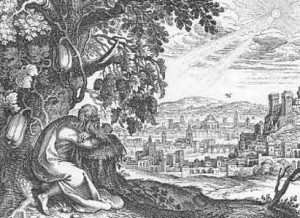
As much as I like Ben Sira, I think he is too dismissive of dreams in this passage. He’s right to sound a note of caution against self-delusion (or buying into the fantasies and fallacies of others), but dreams are also the stuff of hope and aspiration. Young Joseph, son of Israel, became overseer of Egypt because of his ability to correctly interpret dreams. Another Joseph received the message that he would be foster-father to the Son of God in a dream. Dreams can be substantial!

So, parting company with Ben Sira, I say, “Believe in your dreams! Chase them!” Yesterday I wrote about using our imaginations and playing with metaphors to better understand the words of Scripture. Following our dreams is a further exercise of imagination. Imagination, as I see it, is our only way forward; without dreams and imagination we have no way to envision the future.

Forty-five years ago, when I was in college, I read a newly published book by Scottish anthropologist Victor Turner entitled The Ritual Process in which the author explored the idea of liminality, the experience of standing on a threshold leaving behind a known, accepted reality and entering into an as-yet-unknown, new reality. (I was reminded of that book this week when I found it cited in the footnotes of another, a text on the use of imagination in biblical exegesis and preaching.) That threshold is the place of shadows and wind; it can be a frightening place. To stand at that threshold demands that we dream and imagine; otherwise, we will never move through it.

Ben Sira is right, dreams give wings, not just to fools, but to everyone. Have the imagination and the courage to take those wings and fly! Fly through the threshold of shadow and wind into the unknown future.

I hope that is what the costumed children, the living dreams wandering the shadows tonight will do.

====================

A request to my readers: I’m trying to build the readership of this blog and I’d very much appreciate your help in doing so. If you find something here that is of value, please share it with others. If you are on Facebook, “like” the posts on your page so others can see them. If you are following me on Twitter, please “retweet” the notices of these meditations. If you have a blog of your own, please include mine in your links (a favor I will gladly reciprocate). Many thanks!

====================

Father Funston is the rector of St. Paul’s Episcopal Church, Medina, Ohio.

Leaving Us with a Question: Sermon for the 15th Sunday after Pentecost, Proper 20A — September 21, 2014

====================

On the 15th Sunday after Pentecost, September 21, 2014, this sermon was offered to the people of St. Paul’s Episcopal Church, Medina, Ohio, where Fr. Funston is rector.

(The lessons for the day, RCL Proper 20A, Track 2, were Jonah 3:10-4:11, Psalm 145:1-8, Philippians 1:21-30, and Matthew 20:1-16. These lessons can be read at The Lectionary Page.)

====================

Jonah and the Gord VineLet’s talk about Jonah. When I say something like “Let’s talk about Jonah,” I have to be more specific. I have to tell you whether I mean “Let’s talk about the Book of Jonah” or “Let’s talk about the character of Jonah portrayed in the book” or “Let’s talk about the Prophet Jonah.” In this case, I mean all three: let’s talk about the book, character, and the prophet — although, to be honest, the prophet’s name really isn’t Jonah; we don’t know the prophet’s name — and that, I hope, will be clearer in a moment.

So, first, the book. The Book of Jonah tells a story from about the end of the 8th Century BCE, but it was written 300 or so years later in the late-5th or early-4th Century BCE. It is addressed to the people who have just returned from the Babylonian exile, who have come back to Jerusalem under the leadership of the priest Ezra and the governor Nehemia. Under Ezra’s and Nehemia’s oversight they are rebuilding the Temple, reestablishing Jewish worship, and (very likely) canonizing the Torah (the five books of Moses).

This is the social milieu within which the book is written. The story in the book, however, is set about 350 years before, around the year 700 BCE. Back then, Judea and its capital had been a vassal state under the Assyrian empire. It was under Assyrian rule that the “ten lost tribes of Israel” were lost. Under a particularly ruthless and brutal king named Sennacherib, the Assyrians became rather unhappy with the Judeans, and laid siege to and sacked Jerusalem in 701 BCE.

We know a lot about the Assyrians because they kept really good records. In the 1800s archeologists discovered the Royal Library of Ashurbanipal in the Assyrian capital city of Nineveh (that name should ring a bell!) consisting of more than 30,000 cuneiform tablets recording Assyrian history. In addition, the Assyrians were fond of illustrating their history, particularly their military victories, with sculpted and brightly painted bas relief murals. In one of the royal dining rooms of Sennacherib’s palace in Nineveh, for instance, there still exists such a sculpture depicting the siege of Lachish, another Judean city captured and destroyed at the same time as the siege of Jerusalem. We know from this mural and from other records that Lachish fared much worse than Jerusalem; its leaders were tortured to death and the town was leveled. That mural in Sennacherib’s dining room shows (in rather graphic detail) the Jewish leadership of Lachish being flayed alive by Assyrian soldiers.

So that is the setting of the story: it was written shortly after the end of the Babylonian exile and set at the time of the brutal Assyrian siege of Jerusalem and Lachish. However, the story of Jonah is not history. It is set in historically verifiable places — Israel, the Mediterranean Sea, and the city of Nineveh — at an historically verifiable time — about the high point of what is called the “Neo-Assyrian Empire,” but it is not itself history. It is, in fact, a work of fiction.

How do we know that? Well, there are several indicators, but let’s just look at a few glaring examples. First, not in the part we read today but in the first chapter, Jonah tries to escape his commission from God by fleeing to Tarshish (about which more in a moment). Instead of traveling northeast to Nineveh, he books passage on a ship heading west, and what happens? You know the story: a big storm kicks up, the sailors become frightened and convinced that some god is trying to kill them, they determine that it’s Jonah’s God, and they throw him overboard. The storm comes to an end and Jonah is swallowed by a “big fish” in whose belly he survives for three days. That ought to be the first clue that we are dealing with a fanciful tale: there are no fish (or other animals) native to the Mediterranean Sea big enough to swallow a human being and, if there were, it would be physically impossible to live three days inside one. (Certainly, I’m not suggesting that God could not have provided a miraculously big fish equipped as a mini-sub; I am suggesting that it’s unlikely.)

The second hint is the description of Nineveh. We read in Chapter 3 that “Nineveh was an exceedingly large city, a three days’ walk across.” (v. 3) But we know from archeology that that’s just not the case! The city of Nineveh was not quite 1900 acres, which is a little less than 3 square miles. It was, maybe, 1-3/4 miles across. You can walk that in under 40 minutes.

The third clue to the fictionality of this story is in the meat of the story itself. Just before the portion we heard today, the king of Nineveh, ruthless and brutal Sennacherib, in response to Jonah’s prophetic proclamation that the city would be destroyed in forty days, rises from his throne and issues this decree:

By the decree of the king and his nobles: No human being or animal, no herd or flock, shall taste anything. They shall not feed, nor shall they drink water. Human beings and animals shall be covered with sackcloth, and they shall cry mightily to God. All shall turn from their evil ways and from the violence that is in their hands. Who knows? God may relent and change his mind; he may turn from his fierce anger, so that we do not perish. (3:7-9)

If there had ever been such a decree or such a nationwide fast in Assyria, it would have been mentioned somewhere in those 30,000-plus tablets in the Royal Library of Ashurbanipal. But it’s not. There’s not the slightest bit of evidence that such a thing ever happened.

So, there you have it, a little bit of fiction, a short, satirical story (and it is short — only four brief chapters) plunked down in the middle of the Bible’s records of prophecy. But that’s OK; through the medium of this short satire a theological truth, a prophetic message is nonetheless conveyed. The prophetic import of the Book of Jonah, however, is not to be found in the words of its principal character, as is the case in most of the prophetic record. The prophetic message of the Book of Jonah is in its principal character himself, not in what he says, but in what he does and in what he represents. The Book of Jonah is prophecy the same way that Hosea’s marrying a prostitute was prophecy, the same way Micah’s wandering the streets of Jerusalem naked was prophecy, the same way Jeremiah’s failure to mourn his wife was prophecy. The people of Israel and Judea saw their one unfaithfulness reflected in Hosea’s spouse, their own shame in Micah’s nakedness, their own bereavement in Jeremiah’s loss. And the people of 4th Century Jerusalem recently returned from the Babylonian exile, would have recognized themselves in the character of Jonah.

In his book And God Created Laughter (Westminster John Knox: 1988), Presbyterian pastor and Professor of Religion Conrad Hyers, wrote this about this character:

Certain details of the comic caricature of Jonah, for instance, are more apparent in the Hebrew. No doubt these allusions were clearer to the people who first heard or read the story.

The opening words of the book of Jonah are a case in point. “Now the word of the Lord came to Jonah the son of Amittai.” Innocent as these words may seem, in Hebrew they contain two important allusions that are central to the comedy that is to follow. Jonah means “dove,” a metaphor sometimes used for the people of Israel, as in Psalm 74:19. Now the image of the dove brings with it a trail of associations that — as the story indicates — are the opposite of what Jonah (Israel) really is.

The dove is associated with hope, as in Noah’s sending out a dove to find land after the flood. Yet this dove (Jonah) behaves in a most contrary manner: sent out to warn of impending destruction, he refuses lest the judgment be averted. The dove is also associated with the theme of escape from troubles and evils, as in Psalm 55:6, “O that I had wings like a dove.” Yet this dove (Jonah) tries to escape from his mission in the hope that Nineveh cannot possibly escape from doom. The dove is further associated with love, as in the Song of Solomon, in which the beloved is dovelike: “My love, my fair one . . . my dove” (2:13,14). Yet this dove (Jonah) has not only no love for the Ninevites but not a penny’s worth of sympathy or pity. Jonah is no dove at all; he is a hawk. Perhaps the only Hebraic association that is directly applicable to Jonah is that he is “like a dove, silly and without sense” (Hos. 7:11). Certainly, flightiness and silliness aptly describe Jonah’s behavior throughout the story.

The other ironic allusion in the opening words is contained in the phrase “son of Amittai.” Amittai means “faithfulness.” A second contradiction with which the story is to deal is announced at the start. This “son of faithfulness” is completely disobedient. His response to the divine command is totally contrary to it. “Dove son of Faithfulness” flies off in the opposite direction lest he become the bearer of the least olive leaf of hope, love, and salvation. (pp. 99-100)

Prof. Hyers mentions Psalm 74 as one instance in which the dove is a symbol for Israel; others are found in the Prophets Hosea (7:11) and Jeremiah (48:28). Surely, this short story’s first readers would have recognized this.

They would also have recognized Israel in Jonah’s tendency to do the opposite of what God had commanded and would have seen allusions to their own worship and liturgy. Prof. Hyers mentions two examples from the sacred poetry of the Psalms and the Song of Solomon. Another is found in Psalm 139:

Where can I go then from your Spirit? *
where can I flee from your presence?
If I climb up to heaven, you are there; *
if I make the grave my bed, you are there also.
If I take the wings of the morning *
and dwell in the uttermost parts of the sea,
Even there your hand will lead me *
and your right hand hold me fast. (vv 6-9, BCP Translation)

In the story, as I mentioned earlier, Jonah is told to travel to the northeast to Nineveh. Nineveh still exists: today it is called Mosul, a city in Iraq with which we have all become familiar because of current events and recent news coverage. To get there from Jerusalem, Jonah should have traveled north to Damascus, then east to Baghdad, then north again to Nineveh, a journey of about 865 miles. Instead, Jonah tried to go west about 3,000 miles to Tarshish. Tarshish is the Hebrew variant of the Greek city name Tartessos, a city in Spain. Today, it is called Cadiz. Located on the Atlantic coast of Spain, to the west of the strait of Gibraltar, it was as far to the west as someone in the ancient Middle East could imagine going! Once one sailed past the Pillars of Hercules, there was nowhere to go, except to drop off the edge of the world. It was truly, in the words of the Psalm, “the uttermost parts of the sea.” And yet, even by going there Jonah could not flee from the presence of the Lord, even there God’s “right hand held him fast.”

So . . . we know now that the Book of Jonah is a short story, perhaps a satirical or humorous one, relaying through the medium of fiction a theological truth. We know that the people of post-Exile Jerusalem would have recognized themselves in its principal character, Jonah. Jonah is called a prophet but, in truth, he’s more like a missionary. Prophets were usually commissioned to speak to God’s own people, whereas Jonah was commissioned to convey the message of God’s justice to a foreign people. When prophets were commanded to speak to foreigners, it was usually to those living in the territory of Israel or Judeah; Jonah is commanded to travel almost 900 miles to the foreigners’ own country to convey God’s message. Try as he might not to do so, he ends up having no choice and eventually preaches to the Ninevites as God requires. And, unlike most prophets, he is actually listened to! The Ninevite king issues that decree that all the people and animals will fast, and they do so.

And what happens? God relents. Instead of destroying the city as the wicked and sinful Ninevites deserve, God pardons them and Jonah gets righteously angry, and this is where we entered the story in today’s lesson, at the very end. Jonah says to God, “See? I knew this would happen!” In the words of the text, “Is not this what I said while I was still in my own country? That is why I fled to Tarshish at the beginning; for I knew that you are a gracious God and merciful, slow to anger, and abounding in steadfast love, and ready to relent from punishing.”

Jonah is so angry that he just wants to die. “Lord, please take my life from me, for it is better for me to die than to live.” This is when God does the thing with the bush which grows up overnight, provides Jonah with shade the next day, then dies leaving Jonah on the following day to withstand the desert sun and heat. This just makes Jonah madder, so he repeats his death wish, “It is better for me to die than to live.” God, using the plant as a teaching tool, replies, “You are concerned about the bush . . . should I not be concerned about Nineveh . . . ?”

And, guess what? That’s the end of the story! God, in good rabbinic fashion using what we call “the Socratic method,” teaches Jonah — who is really the people of Israel — by leaving him — and them and us — with a question.

Jonah and the Israelites want God to be fair. These Ninevites, these Assyrians, are terrible, brutal, despicable people; they attacked and conquered God’s Chosen People; they flayed human beings alive; they decorated their dining rooms with color pictures of this being done. If God were fair, God would wipe them out; that’s what Jonah (and Israel) want. Instead God says, “Shouldn’t I rather be compassionate and merciful?” And leaves them — and us — to contemplate that question.

Whoever the nameless prophet who wrote this little story was, he was brilliant, because there is only one answer to that question just as there is only one answer to the question Jesus poses in gospel parable of the laborers in the vineyard. Hired at different times of the day, some at first light, others throughout the day, and the last just an hour before quitting time, they are all nonetheless paid the same wage. When those who worked all day complain, when they want the owner of the vineyard to be fair, the owner (God!) replies, “Shouldn’t I rather be generous?” And Jesus leaves his disciples — us — to contemplate the question.

Of course, we don’t want God to be fair! If God is going to be fair to “them” (the Assyrians, the later workers, whomever), God is going to be fair to us, too. Is that what we want? Wouldn’t we rather that God be compassionate and merciful and generous?

The good news is that that is what God is. Amen.

====================

A request to my readers: I’m trying to build the readership of this blog and I’d very much appreciate your help in doing so. If you find something here that is of value, please share it with others. If you are on Facebook, “like” the posts on your page so others can see them. If you are following me on Twitter, please “retweet” the notices of these meditations. If you have a blog of your own, please include mine in your links (a favor I will gladly reciprocate). Many thanks!

====================

Father Funston is the rector of St. Paul’s Episcopal Church, Medina, Ohio.

Uncounted, Unnamed Children – Sermon for August 3, 2014, Pentecost 8, Proper 13A

====================

On the Eighth Sunday after Pentecost, August 3, 2014, this sermon was offered to the people of St. Paul’s Episcopal Church, Medina, Ohio, where Fr. Funston is rector.

(The lessons for the day were: Isaiah 55:1-5; Psalm 145: 8-9,15-22; Romans 9:1-5; and Matthew 14:13-21. These lessons can be read at The Lectionary Page.)

====================

Tabgha Mosaic - Loaves and FishToday we are witnesses to one of the great and popular miracles of the gospel story, the feeding of the 5,000, which is actually the feeding of many more than that — notice the last few words of the gospel lesson text: “those who ate were about five thousand men, besides women and children.” (v. 21, emphasis added) Matthew gives little thought to the men’s wives or their uncounted, unnamed children.

I would like to put us in context, both in time and space, so we have a fuller picture of what we have just witnessed. Matthew tells this story in the middle of chapter 14 of his gospel. In chapter 13 he related all those parables told by Jesus sitting in a boat off the shore of the Galilean lake at Capernaum, but at the end of the chapter he doesn’t leave Jesus sitting in the boat. Instead, he tells us that “when Jesus had finished these parables, he left that place [and] came to his hometown,” which would be Nazareth. (Mt 13:53-54) (You may recall that that didn’t go well: Jesus was heard to say that ” prophets are not without honor except in their own country” – v. 57)

Then, at the beginning of chapter 14 Matthew leaves Jesus altogether and tells us about the beheading of John the Baptist, which took place Sebastia, about 36 miles south of Nazareth. Matthew then brings us back to Jesus saying at the beginning of our lesson today that upon hearing the news of John’s execution, Jesus “withdrew in a boat to a deserted place.” (14:13)

Since Nazareth is not on any river or lake, I’m not sure how he did that! Here’s my difficulty: Nazareth is about 20 miles due west of the southern tip of the Sea of Galilee. In order to “withdraw in a boat” he’d have had to walk for a day or two first. It’s possible though.

Near by Nazareth, about four miles away, is the city of Sepphoris, believed to be the Virgin Mary’s hometown. In Jesus’ time it was a Roman city and may have been where craftsmen from Nazareth, like Joseph, worked. There probably was regular commerce between Sepphoris and the Roman city of Tiberias on Galilee; today there is a highway between them. Jesus may have walked to Tiberias and then gotten in a boat to make his way back to Capernaum (about 10 miles north along the shore).

Tradition tells us that the feeding of the 5,000 (or more) took place about three miles south of Capernaum at a place called Tabgha, or al-Tabigha in Arabic, a name derived from the Greek name Heptapegon meaning “seven springs”. As early as the Fourth Century there was a shrine at the identified location. A pilgrim woman from Spain named Egeria chronicled her travels in the Holy Land around the year 384 and, about Tabgha, wrote: “In the same place (not far from Capernaum) facing the Sea of Galilee is a well watered land in which lush grasses grow, with numerous trees and palms. Nearby are seven springs which provide abundant water. In this fruitful garden Jesus fed five thousand people with five loaves of bread and two fish.” (Egeria, of course, has thought only of the men, not their wives or their uncounted, unnamed children.)

In the floor of that shrine was a mosaic of loaves and fishes which has become famous throughout the Christian world. It is reproduced on your bulletin cover and is now preserved in the floor before the altar of the Church of the Multiplication, a Benedictine monastery church built at the site. The place is about a mile inland from the shore of Lake Galilee.

One last detail must be attended to and that is the question, “Could there really have been that many people there?” Possibly. That’s the best answer one can give. There are many towns and cities close enough to Tabgha that, if word got around that a miracle worker were there, people could have gotten there within a day or less of good solid walking, more quickly if they could ride a donkey or camel. Sepphoris had a population 40,000 or more, and Tiberias may have been of similar size; both were within a day’s journey. Capernaum probably had a population of 2,000 or more. The city of Chorazin, which Jesus (by the way) had cursed, is nearby. Migdala Nunia, the hometown of Mary Magdalene, is nearby. A large, m ixed crowd of Jews, Romans, and other Gentiles could easily have gathered. Matthew may be exaggerating, but even if he has increased the number of men tenfold, we are still witnessing something wonderful. Jesus is able to feed a whole lot more people than he ought with two fish and a few loaves of bread.

So that’s when and where we are as we witness this scene of Jesus providing lunch for an unbelievably huge number of people. We are on a hillside a mile from the Sea of Galilee where Jesus has gone in an attempt to get away by himself. He has just recently had a negative experience in Nazareth; he has just heard about the execution of his cousin John; he has tried to get away from it all, but the people have followed him and now find themselves with nothing to eat. And so they have turned to Jesus’ disciples, to the Twelve (who seem also to have followed him) and asked them for food. And the Twelve are at loss about what to do. They have taken stock and they simply do not believe that they can feed all these men, to say nothing of the women and the uncounted, unnamed children.

So they have a very reasonable suggestion for Jesus: “Send them away. Tell them to go back where they came from, or if that is too far away then to one of the nearer towns, and buy themselves something to eat. We cannot feed all these men and their women and their unnamed, uncounted children.”

Send them away! We do not have enough to share with these children who are fleeing drug wars and violence in Central America and illegally crossing our border and . . . .

O, wait . . . I’m mixing up my stories, sorry. This isn’t the Mexican border. This is the Holy Land. Right . . . .

Send them away! We do not have enough to share with these Palestinian children with their demands for civil liberty and a country of their own and . . . .

O, darn. I’ve done it again, mixed up my stories. This isn’t Gaza; this is the Galilee. Right . . . .

But the stories are easy to mix up. Unnamed people in need, unnamed children in need, and the response at the Mexican border is the response in Gaza is the response on that hillside at Tabgha. Send them away! Get rid of them! And whatever you do don’t count the children, don’t name the children, don’t even think of them as children.

Think of them as “law breakers.” Think of them as “illegal immigrants.” Think of them as “migrant hispanics.” And send them away. Get rid of them.

A few days ago, a major news organization quoted a North Carolina politician as saying (and, as God is my witness, I am not making this up): “To me, they’re breaking the law when they come here. If we can’t turn them back, I think if we pop a couple of them off and leave the corpses laying on the border, maybe they’ll see that we’re serious about stopping immigration.” (Raw Story)

Send them away! Get rid of them! And whatever you do don’t count them, don’t name them, don’t even think of them as children.

A few days after the current fighting in and around Gaza started a U.N. school was bombed — Hamas claimed it was an Israeli shell; Israel claimed it was an errant Hamas rocket; but to the seventeen children who died that was really irrelevant. The numbers of Palestinian dead began to rise and a disproportionate number of the dead every day are kids. By July 23, over 600 Gazans had died, 150 of them children. On that day, international aid agencies were reporting that “a child had been killed in Gaza on average every hour for the preceding two days, and more than 70,000 children had been forced to flee their homes.” (The Guardian)

That week, the Israeli human rights organization B’Tselem offered for radio broadcast a public service advertisement listing the names of some of the children. The Israeli Broadcasting Authority banned the ad saying its content was “politically controversial.” B’Tselem appealed and in its appeal said: “Is it controversial that the children [aren’t] alive? That they’re children? That those are their names? These are facts that we wish to bring to the public’s knowledge.” Its appeal was denied and the names of the children have never been published in Israel.

Whatever you do don’t count the children, don’t name the children, don’t even think of them as children. Think of them as “collateral damage.” Think of them as “Hamas sympathizers.” Think of them as “dirty Palestinians.” But send them away. Get rid of them.

On learning that the advertisement had been banned, the respected British children’s author Michael Rosen wrote a poem. Rosen, for two years, was British Children’s Laureate and has written more than 140 books for children. He is, incidentally, an ethnic Jew. This is his poetic response to the Broadcasting Authority’s ban:

Don’t mention the children.
Don’t name the dead children.
The people must not know the names
of the dead children.
The names of the children must be hidden.
The children must be nameless.
The children must leave this world . . .
having no names.
No one must know the names of
the dead children.
No one must say the names of the
dead children.
No one must even think that the children
have names.
People must understand that it would be dangerous
to know the names of the children.
The people must be protected from
knowing the names of the children.
The names of the children could spread
like wildfire.
The people would not be safe if they knew
the names of the children.
Don’t name the dead children.
Don’t remember the dead children.
Don’t think of the dead children.
Don’t say: ‘dead children’.
(Don’t Name the Dead Children)

“Send them away,” said the Twelve, “Get rid of them.” Jesus answer took them by surprise: “You feed them,” he said. And he proceeded to show them how they could, to prove to them that with whatever resources they had, they could care for those 5,000 men and their wives and their uncounted, unnamed children.

LambsAbout a mile away from the spot where that happened, on the beach of the Sea of Galilee is another church. It is called by two names. One is the Church of the Primacy of Peter; the other is Mensa Domini, the Lord’s Table. It marks the place where, after his Resurrection, the Lord appeared to his disciples and cooked for them a breakfast of broiled fish. As they ate, Jesus asked Peter, “Simon, son of John, do you love me?” Peter


said to him, “Yes, Lord; you know that I love you.” Jesus said to him, “Feed my lambs.” A second time he said to him, “Simon son of John, do you love me?” He said to him, “Yes, Lord; you know that I love you.” Jesus said to him, “Tend my sheep.” He said to him the third time, “Simon son of John, do you love me?” Peter felt hurt because he said to him the third time, “Do you love me?” And he said to him, “Lord, you know everything; you know that I love you.” Jesus said to him, “Feed my sheep.” (Jn 21:15-17)

On the Mexican border, in the person of our brothers and sisters who work in Episcopal Border Ministry or Episcopal Migration Ministry, we meet those refugee children fleeing violence and death in Central America . . . In Gaza, in the person of our sisters and brothers of the Episcopal Diocese of Jerusalem who work in the hospitals and clinics our own Good Friday offerings support, we meet the Palestinian children facing bombs and rockets and death . . . And when we meet those uncounted and still in the media unnamed children, we are just like the Twelve standing on that hillside at Tabgha looking at those 5,000 men and their wives and their unnamed, uncounted children and wondering, “How are we going to deal with this?” Some of us will want to say “Send them away we can’t handle this,” but Jesus says to us as he said to the Twelve, “Feed them.”

Jesus asks us what he asked Simon, son of John, on that beach, “Do you love me?” And if our answer is “Yes” he will name those children: he will name them “my lambs,” and what he said to Peter he will say to us, “Feed my lambs.”

====================

A request to my readers: I’m trying to build the readership of this blog and I’d very much appreciate your help in doing so. If you find something here that is of value, please share it with others. If you are on Facebook, “like” the posts on your page so others can see them. If you are following me on Twitter, please “retweet” the notices of these meditations. If you have a blog of your own, please include mine in your links (a favor I will gladly reciprocate). Many thanks!

====================

Father Funston is the rector of St. Paul’s Episcopal Church, Medina, Ohio.

Parables and Women’s Ordination – Sermon for Pentecost 7, Proper 12A – July 27, 2014

====================

On the Seventh Sunday after Pentecost, July 27, 2014, this sermon was offered to the people of St. Paul’s Episcopal Church, Medina, Ohio, where Fr. Funston is rector.

(The lessons for the day were: 1 Kings 3:5-12, Psalm 119:129-136, Romans 8:26-39, and Matthew 13:31-33,44-52. These lessons can be read at The Lectionary Page.)

====================

Philadelphia 11 Ordination

Tell all the truth but tell it slant,
Success in circuit lies,
Too bright for our infirm delight
The truth’s superb surprise;
As lightning to the children eased
With explanation kind,
The truth must dazzle gradually
Or every man be blind.

That’s a wonderful poem, isn’t it? Tell All The Truth by Emily Dickinson: “Tell all the truth but tell it slant;” come at it obliquely, shaded as it were, because “the truth must dazzle gradually” otherwise everyone will be blinded. But for the fact that she wrote it 1868, I would suspect Jesus of having read it and following her advice in today’s gospel discourse. These several parables are very “slanted”!

Of course, it is very unlikely that Jesus related all of these parables at one time, the two we heard the last two Sundays and these five (or is it six) that are in today’s lesson, but that is the way Matthew presents them. Most probably, these seven or eight metaphors for God’s dominion were things Jesus said at different times, but as the oral tradition transmitted them to and through his followers in the years afterward the specific circumstances of each were forgotten. Just the “slanted” sort of weird imagery was remembered, so Matthew writing his gospel tale a few decades later was left to figure out how to fit them in and decided to just put them all together in one teaching session. So we have these five (or is it six) all lumped together on one Sunday, five ways to understand — I use that word advisedly — to understand God’s sovereignty played out “on earth as it is in Heaven.” The holy domain is

  • like a mustard seed (and the mighty big bush it grows into);
  • like yeast (leaven) in a lot of flour;
  • like a treasure buried in a field;
  • like a pearl of incredible value;
  • like a dragnet gathering in an abundance of fish; and
  • (maybe, I’m not sure of this one counts as a parable)
    like a scribe tossing out a bunch of stuff, old and new.

As one commentator has suggested, “That is probably four [or is it five] images too many for one sermon.” So let’s deal with the first one primarily, the mustard seed and the tree into which Jesus says it grows.

Tree imagery as a metaphor for empire was well-known in Jesus’ time. There are at least three very important instances of it in the Hebrew scriptures, so it was familiar to the scribes, the priests, the rabbis, the Pharisees, and the Sadducees, and those who preached in the synagogues had probably made it fairly well known to their congregations, to folk like those who heard Jesus tell this parable. Those three instances are found in Ezekiel, Daniel, and the Psalms.

In the 17th Chapter of Ezekiel we read:

Thus says the Lord God: I myself will take a sprig from the lofty top of a cedar; I will set it out. I will break off a tender one from the topmost of its young twigs; I myself will plant it on a high and lofty mountain. On the mountain height of Israel I will plant it, in order that it may produce boughs and bear fruit, and become a noble cedar. Under it every kind of bird will live; in the shade of its branches will nest winged creatures of every kind. All the trees of the field shall know that I am the Lord. I bring low the high tree, I make high the low tree; I dry up the green tree and make the dry tree flourish. I the Lord have spoken; I will accomplish it. (Ez 17:22-24)

In the 4th Chapter of Daniel, King Nebuchadnezzar of Bablyon tells Daniel of a dream he has had:

Hear the dream that I saw; tell me its interpretation. Upon my bed this is what I saw; there was a tree at the center of the earth, and its height was great. The tree grew great and strong, its top reached to heaven, and it was visible to the ends of the whole earth. Its foliage was beautiful, its fruit abundant, and it provided food for all. The animals of the field found shade under it, the birds of the air nested in its branches, and from it all living beings were fed. (Dan 4:9-12)

As Daniel interprets the dream, the tree represents Nebuchadnezzar and his kingdom.

And, finally, from Psalm 104, these words would have been sung in the Temple liturgy:

You make grass grow for flocks and herds *
and plants to serve mankind;
That they may bring forth food from the earth, *
and wine to gladden our hearts,
Oil to make a cheerful countenance, *
and bread to strengthen the heart.
The trees of the Lord are full of sap, *
the cedars of Lebanon which he planted,
In which the birds build their nests, *
and in whose tops the stork makes his dwelling.
(vv. 14-18, BCP version)

Yes, metaphors of mighty trees would be part of the spiritual landscape familiar to Jesus’ hearers. But not mustard bushes! The people who first heard Jesus preach this parable must have thought he was crazy, or that he was mocking the prophets, or that he was making a joke at the expense of the priests and the rabbis.

The mustard was not, is not, despite what Jesus said, “the greatest of shrubs [which] becomes a tree, so that the birds of the air come and make nests in its branches.” The white mustard which grows in the Middle East is an invasive weed, a self-propagating, rapidly-growing, garden-ruining, field-destroying weed. Let it get into your growing space and you will never get rid of it. Jesus’ parable is not, like Ezekiel’s prophecy or the psalm’s liturgical praise, a story of a mighty and stately cedar tree. It is a “frightening tale of an invasive plant sowed perhaps in desperation because it grows and therefore might produce something usable quickly, but with it is the threat that because it is so hard to get rid of it may stultify the land and make it unavailable for future better crops. Once it is grown big it will seed itself again and again….” (English clergyman Christopher Burkett) It can’t be controlled!

And that may be the point of Jesus’ metaphor: the domain of God is like the mustard seed, not because from small things great things may come (the usual interpretation of this parable), but rather because the invasive mustard cannot be controlled. It is like the Wind of God which “blows where it chooses, and you hear the sound of it, but you do not know where it comes from or where it goes.” (Jn 3:8) Once it gets started, you cannot control it.

It’s one of those Jesus-turns-the-world-on-its-head things, Jesus-tells-the-truth-in-a-slanted-way things, using a perverse and noxious weed as a metaphor for the reign of God.

The parable of the yeast in the dough makes that same point! Our NRSV translation says that the woman “mixed” it into her flour and we assume that this would be so that the bread would rise. However, the Greek verb Jesus uses is not the word for “mix.” It is the word in Greek is engkrupto — the root of our word “encryption” — it means “to hide” or “to conceal.” Like the tiny mustard seed, the yeast could not be seen — it was hidden in the meal, into “three measures” of the meal, which is an important detail.

Yeast, for us, is a useful ingredient in baking. For First Century Jews, however, yeast was a problem; for Jews of Jesus’ day leaven was a symbol of filth and corruption. Anything that was leavened with yeast was forbidden in the Temple. This woman was playing with fire! As a symbol of God’s dominion, this yeast is fire of the Holy Spirit: wherever it is present, things get changed and transformed. A tiny, hidden bit of it can work major changes — when we understand that that “three measures” of flour is enough to make 150 loaves of bread, we get that point! The growth of the yeast and the changes it makes in a huge amount of dough are as uncontrollable as the invasive mustard weed that takes over the field — and the point is the same: you cannot control the reign of God; once it gets started, look out!

Yet another of those Jesus-turns-the-world-on-its-head things, Jesus-tells-the-truth-in-a-slanted-way things, using the foul corruption of leaven as a metaphor for the reign of God.

The hiddenness of the yeast, the small invisibility of the mustard seed, link these parables with the next two — the treasure hidden in the field and the unexpected discovery of the priceless pearl. The reign of God is not only uncontrollable, it is surprising. Hidden, invisible, unexpected, it comes upon us in surprising ways and, uncontrollable though it may be, the changes it makes in our lives are beyond price, more valuable than we could ever imagine.

Which brings us to the last two metaphors, the dragnet full of fish, some good, some bad, in need of sorting out, and the scribe who is like a master of a household sorting old and new. The metaphor of the fish is yet another image of the final judgment, like the separating of wheat from the darnel in the parable of the weeds, or the sorting of the sheep from the goats in Jesus’ description of the Last Day; it is a warning for the sinful, but also a promise for those who faithfully follow the Lord. What, however, are we to make of the master of the house bringing out things old and things new?

This parable, it has been suggested, authorizes the followers of Christ who have been properly instructed, who have studied our catechisms and who have continued to study scripture and church tradition, who are schooled in the scriptures and in our communities’ histories, to re-interpret that scripture and that tradition, to bring out of our treasure of scripture and tradition that which is new, new insights, new interpretations, new ways of being God’s People even though those may not explicitly have been recorded in any previous text, to tell the truth slanted in a way that no one has slanted it before.

This accords with the ancient presupposition that properly trained scribes had the ability to decipher and interpret sacred texts. Followers of Jesus are to be trained scribes. They — WE — are to continuously study the scriptures, to be educated and trained, to have the ability to invoke tradition (the “something old”) and to contribute novel insights that have not previously offered (the “something new”).

On Tuesday, we celebrate the fortieth anniversary of a small, but remarkable event in the life of the church. On July 29, 1974, eleven women were ordained to the priesthood at Church of the Advocate in Philadelphia, Pennsylvania. Their ordination was not sanctioned by the canons of the church; the ordination of women had been hotly debated in two or three or more meetings of the General Convention, but had not yet been approved. Nonetheless, four bishops decided that they could not wait further parliamentary wrangling on the question.

Newsworks, a Philadelphia news journal, this week published this description of the service:

It was hot that day — July 29, 1974 — and the church was packed with more than 2,000 people — including family, congregants, and media. Not all were friendly.

“There was one protester who was very dramatic and said that these women could offer up nothing but the sight, sound, and smell of perversion,” said [Allison] Cheek [one of the eleven]. “Some in the congregation began to boo and hiss at that moment.”

“On one level it was scary,” said [Nancy] Wittig, another member of the 11. “But it was very clear as we got started that this was not just some vacant daydream by a bunch of women, but indeed a movement that was happening in the church.”

Delivering the sermon was Charles Willie, an African-American professor of education at Harvard University and a member of the Episcopal House of Deputies. He compared the ordination to the civil rights movement.

“This shouldn’t be seen as an act of arrogant disobedience,” said Dr. Willie from the podium. “But an act of tender defiance.” (Newsworks, 24 July 2014)

That “act of tender defiance” changed the church. The next meeting of the General Convention, in 1976, voted to approve the priestly ordination of women and, as Newsworks noted, the decision was “broader than just allowing women to the priesthood — it called for gender equality at all levels of church hierarchy, including bishops.” Today, nearly a third of the priests in our church are women and our current presiding bishop is a woman: the Most Rev. Katharine Jefferts Schori.

If the protestor at the ordination of the Philadelphia 11 was right, if there was about it “the sight, sound, and smell of perversion,” it was the perverseness of the mustard seed; it was the corruption of the yeast hidden in three measures of flour; it was the uncontrollable contrariness of the Holy Spirit and it has changed the church.

And for that we give thanks. Let us pray:

God of surprises, you startle us with truth we do not see, as we do not see the mustard seed; with truth that may be hidden from us, as the yeast is hidden in the dough; with truth that is as surprising as the unexpected treasure and as priceless as the great pearl. We thank you for the ministry of women throughout the church, and especially for the ministry of women ordained to the priesthood; we offer you special thanks for the witness and ministry of the Philadelphia 11 and of the bishops and others who supported them in their discernment of your call to priesthood. Amaze us with your power and grace; call us, empower us, and lead us through your uncontrollable Spirit to bring out of our treasure and into service in your world things new and things old, that your Name may be glorified among all people. All this we ask through your Son our savior Jesus Christ, who is alive and reigns with you and that same Spirit, one God, now and forever. Amen.

====================

A request to my readers: I’m trying to build the readership of this blog and I’d very much appreciate your help in doing so. If you find something here that is of value, please share it with others. If you are on Facebook, “like” the posts on your page so others can see them. If you are following me on Twitter, please “retweet” the notices of these meditations. If you have a blog of your own, please include mine in your links (a favor I will gladly reciprocate). Many thanks!

====================

Father Funston is the rector of St. Paul’s Episcopal Church, Medina, Ohio.

I Arise Today: Sermon for Trinity Sunday – RCL, Year A – June 15, 2014

====================

On Trinity Sunday, the First Sunday after Pentecost, June 15, 2014, this sermon was offered to the people of St. Paul’s Episcopal Church, Medina, Ohio, where Fr. Funston is rector.

(The lessons for the day were: Genesis 1:1-2:4a; Canticle 13 (Song of the Three Young Men 29-34); 2 Corinthians 13:11-13; and Matthew 28:16-20. These lessons can be read at The Lectionary Page.)

====================

Triquetra

I arise today
Through a mighty strength, the invocation of the Trinity
Through belief in the Threeness
Through confession of the Oneness
Towards the Creator.

Although he probably didn’t actually write it, tradition credits St. Patrick of Ireland with the poetic charm called a “lorica” or “breastplate” which begins with these words, an invocation of the One, Holy, Blessed, and Glorious Trinity whom we today celebrate. Since the time of St. Thomas a Becket, the first Sunday after the Feast of Pentecost has been set aside as day of special veneration of the Triune nature of the Godhead. Becket was consecrated Archbishop of Canterbury on the Sunday after Pentecost, and his first act was to decree that the anniversary of his consecration should be commemorated each year in honor of the Holy Trinity. This observance spread from Canterbury throughout the whole of the western church.

Patrick continues:

I arise today
Through the strength of Christ with his baptism,
Through the strength of his crucifixion with his burial,
Through the strength of his resurrection with his ascension
Through the strength of his descent for the Judgment of doom.

Our Gospel lesson today is the end of Matthew’s Gospel. In it Christ on the mount of the ascension, just before going up into heaven, gives the eleven remaining Apostles what has come to be known as “The Great Commission”:

Go therefore and make disciples of all nations, baptizing them in the name of the Father and of the Son and of the Holy Spirit, and teaching them to obey everything that I have commanded you.

For Matthew mountains are what Celtic Christianity refers to as “thin places,” those places where the separation between the spiritual realm and the physical realm is narrowest, where the veil which separates heaven from earth is nearly transparent so that we have the feeling we could reach out and touch, even enter, the holy presence.

On a mountain, in such a place, Jesus calls his followers to a new beginning. The Eleven, standing proxy for all the followers of Jesus then and now, for you and for me, are called to be people moving in mission. It is important for us to note that this mountain is in Galilee, the place where Jesus began his ministry, the place from which he went forth but to which he returned, the place where he was grounded and rooted. The disciples, too, are from this place and their grounding in the Christian story is this same country where their journey began. Like them, we are called to claim our origins, to be rooted in the place where we entered the Christian story, not to be permanently bound there, but to draw strength from it as we venture out in mission into the wider world beyond. The place where we began as members of the community of Christ is, to each of us, an important place of foundation and also, perhaps, a thin place where we encounter the Triune God.

Patrick’s lorica continues:

I arise today
Through the strength of the love of Cherubim
In obedience to the Angels,
In the service of the Archangels,
In hope of resurrection to meet with reward,
In prayers of patriarchs,
In predictions of prophets,
In preaching of Apostles,
In faith of confessors,
In innocence of Holy Virgins,
In deeds of righteous [people].

Here, St. Patrick claims membership in the Christian community as his source of strength, as his foundation, as the community in which his mission is grounded and from which it is nurtured.

In a few moments, we will do something we have not done since Lent . . . join together in the General Confession, jointly and publically acknowledging that as individuals and as a community we have failed to live up to our obligations, that we have sinned “by what we have done, and by what we have left undone.” And we will be forgiven that failure by God’s absolution which reconciles us and restores us to the community and fellowship of the Church. When, as presiding priest, I pronounce the words of absolution, I speak not on my own behalf but for the whole church to which Jesus gave what is called “the power of the keys” when he said to the Apostles, “I will give you the keys of the kingdom of heaven, and whatever you bind on earth will be bound in heaven, and whatever you loose on earth will be loosed in heaven.” (Mt 16:19; cf. 18:18)

The words of absolution, which I speak as much to myself as to anyone, loose our sins, but also bind us into the beloved community:

Almighty God have mercy on you, forgive you all your sins through our Lord Jesus Christ, strengthen you in all goodness, and by the power of the Holy Spirit keep you in eternal life.

The community with which we are reconciled through confession and absolution is the community of the Trinity.

In the Triune Godhead all Christian community begins and finds its perfect expression. Humankind, as our Genesis reading reminded us, was and is created in the image of God. Thus, we are blessed with reason and skill; we are capable of experiencing emotion; and, like God, we have individual will and freedom of action. To be created in God’s likeness also means that we have the possibility of attaining holiness and immortality. To be created in God’s likeness further means that we are created to experience, participate in, and share interrelationship with others, for we are made in the image of the Holy Trinity.

The Doctrine of the Trinity is not a static principal of faith; it is the way in which the church, through the revelation of God, has come to appreciate and express of the significantly dynamic nature of God in the relationship of the Father, the Son, and the Holy Spirit. If we have been created in the image of God and if God is Trinity then at the deepest level of our being, we are communitarian, created not for ourselves, but for one another, for relationship with each other and with God.

Many look at the mystery of the Trinity as if it were a problem in differential calculus. They seem to have the attitude that if one solves the equation, they will have figured out God and earned their entry into heaven. But, as Benedictine poet Killian McDonnell writes, God is not a problem to be solved:

God is not a problem
I need to solve, not an
algebraic polynomial equation
I find complete before me,

with positive and negative numbers
I can add, subtract, multiply.
God is not a fortress
I can lay siege to and reduce.

God is not a confusion
I can place in order by my logic.
God’s boundaries cannot be set,
like marking trees to fell.

God is the presence in which
I live, where the line between
what is in me and what
before me is real, but only God

can draw it. God is the mystery
I meet on the street, but cannot
lay hold of from the outside,
for God is my situation,

the condition I cannot stand
beyond, cannot view from a distance,
the presence I cannot make an object,
only enter on my knees.

Which brings us back to confession, to reconciliation, and to community.

The community to which and in which we are to be reconciled is not only that of the church or that of the human commonwealth, it is the community of the whole of creation. This is why our round of readings from Sacred Scripture bids us on Trinity Sunday to hear the long lesson from Genesis recounting the days of creation as each part of the natural order is ordained by God and pronounced good. This is the community that Matthew’s Jesus claims when he asserts that “all authority in heaven and on earth has been given to me.” “Heaven and earth” is a figure of speech called a merism, a manner of speaking by which the whole of something is referenced by enumerating its constituents or traits. In the Genesis creation story, heaven and earth comprise a single entity — God’s whole creation. We are a part of that community of creation and it is to that universal community that Patrick next looks in his lorica:

I arise today
Through the strength of heaven:
Light of sun
Brilliance of moon
Splendor of fire
Speed of lightning
Swiftness of wind
Depth of sea
Stability of earth
Firmness of rock.

The whole of nature comprises the foundational community of strength and support upon which a follower of Jesus may depend, because this community finds its strength and support in paradigm community of the Holy Trinity by whom it was creation.

Genesis insists that there is one God, who is sovereign and powerful. Unlike the gods of other peoples in the ancient Middle East, the God of Israel had no specified area of competence. The creation in the first chapter of Genesis is, as one commentator has said, “fiercely monotheistic,” yet even in its insistence on the one God, not limited in space or time, Genesis reveals the Trinity. From this god, the God, a wind, the Holy Spirit, came forth and spread across the void. This god, the God, created everything. This god, the God, simply spoke the Word (“in the beginning was the Word,” said John of Jesus) and creation happened. It is to this god, the God that Patrick looks for strength and protection:

I arise today
Through God’s strength to pilot me:
God’s might to uphold me,
God’s wisdom to guide me
God’s eye to look before me,
God’s ear to hear me,
God’s word to speak for me,
God’s hand to guard me,
God’s way to lie before me,
God’s host to secure me
against snares of devils
against temptations of vices
against inclinations of nature
against everyone who shall wish me ill,
afar and anear,
alone and in a crowd.

But we are never truly alone, nor are we ever really beset by these and the many other spiritual and physical dangers that Patrick goes on to list. St. Paul blessed and reminded his readers, “the grace of the Lord Jesus Christ, the love of God, and the communion of the Holy Spirit” are with us all. Jesus promised and reminded the Eleven (and through them, us), “I am with you always, to the end of the age.”

These are not mere blessings or simple an appeals to get along with one another; these are exhortations to be the new creation that the Spirit of God equips us to be, a foundational community patterned on the Holy Trinity. Just as the Persons of the Divine Trinity are never alone, human beings are created with a need for one another, a need to communicate with one another. Our thirst to communicate ourselves to others, to be in authentic relationship with each other is never exhausted. The only difference between our community and that of the Trinity is that God’s Triune relationship is perfect and total whereas in our human reality communication and relationship are imperfect and partial. Paul’s appeal for the presence of Christ’s grace, God’s love, and the Spirit’s fellowship is an appeal to enter more to the divine love that creates and sustains the church, that perfects and completes our relationships. The Trinity is the very source of our life in Christ, and in Christ we are a new creation with whom Christ promises always to stay.

So in the lorica, Patrick extols the totality of Christ’s presence, the inescapabilty of Jesus’ promise, “I am with you always, to the end of the age.” Patrick writes:

Christ with me,
Christ before me,
Christ behind me,
Christ in me,
Christ beneath me,
Christ above me,
Christ on my right,
Christ on my left,
Christ where I lie,
Christ where I sit,
Christ where I arise,
Christ in the heart of every [person] who thinks of me,
Christ in the mouth of every [person] who speaks of me,
Christ in every eye that sees me,
Christ in every ear that hears me.

Patrick concludes as he began, invoking the One, Holy, Blessed, and Glorious Trinity whom we today celebrate:

I arise today
Through a mighty strength, the invocation of the Trinity,
Through belief in the Threeness,
Through confession of the Oneness
Towards the Creator.

“The grace of our Lord Jesus Christ, and the love of God, and the fellowship of the Holy Spirit, be with us all evermore. Amen.” (2 Cor 13:14 as used to conclude the Daily Office in The Book of Common Prayer, page 102)

====================

A request to my readers: I’m trying to build the readership of this blog and I’d very much appreciate your help in doing so. If you find something here that is of value, please share it with others. If you are on Facebook, “like” the posts on your page so others can see them. If you are following me on Twitter, please “retweet” the notices of these meditations. If you have a blog of your own, please include mine in your links (a favor I will gladly reciprocate). Many thanks!

====================

Father Funston is the rector of St. Paul’s Episcopal Church, Medina, Ohio.

Rise! Rise! Rise! – Sermon for Easter 7 (Ascension Sunday) – RCL Year A – June 1, 2014

====================

On the Seventh Sunday of Easter: the Sunday after the Ascension, June 1, 2014, this sermon was offered to the people of St. Paul’s Episcopal Church, Medina, Ohio, where Fr. Funston is rector.

(The lessons for the day were: Acts 1:6-14; Psalm 68:1-10, 33-36; 1 Peter 4:12-14, 5:6-11; and John 17:1-11. These lessons can be read at The Lectionary Page.)

====================

Ascension of Christ by Salvadore Dali

You may write me down in history
With your bitter, twisted lies,
You may trod me in the very dirt
But still, like dust, I’ll rise.

Does my sassiness upset you?
Why are you beset with gloom?
‘Cause I walk like I’ve got oil wells
Pumping in my living room.

Just like moons and like suns,
With the certainty of tides,
Just like hopes springing high,
Still I’ll rise.

Did you want to see me broken?
Bowed head and lowered eyes?
Shoulders falling down like teardrops,
Weakened by my soulful cries?

Does my haughtiness offend you?
Don’t you take it awful hard
‘Cause I laugh like I’ve got gold mines
Diggin’ in my own backyard.

You may shoot me with your words,
You may cut me with your eyes,
You may kill me with your hatefulness,
But still, like air, I’ll rise.

Does my sexiness upset you?
Does it come as a surprise
That I dance like I’ve got diamonds
At the meeting of my thighs?

Out of the huts of history’s shame
I rise
Up from a past that’s rooted in pain
I rise
I’m a black ocean, leaping and wide,
Welling and swelling I bear in the tide.

Leaving behind nights of terror and fear
I rise
Into a daybreak that’s wondrously clear
I rise
Bringing the gifts that my ancestors gave,
I am the dream and the hope of the slave.
I rise
I rise
I rise.

(From And Still I Rise,Maya Angelou, Random House:1978.
Note — The verse beginning “Does my sexiness upset you?” was not read in church.)

The late Dr. Maya Angelou, who died this week and was (in my opinion) one of the greatest of contemporary English-language poets, wrote that poem (entitled Still I Rise) in 1978. Though it speaks out of her experience as a black woman growing up in the segregated South of the mid-20th Century, I believe it also speaks to us in our context today, celebrating the Ascension of Christ into heaven and, also, honoring our five newly minted high school graduates.

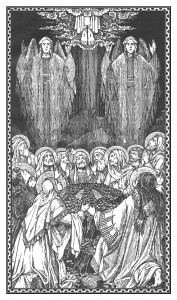
The Feast of the Ascension was Thursday. You may have missed it, however; it is a feast largely ignored by the Church. It passes by and we seldom, if ever, give any thought to it. In the Sunday rota it is noted only as the day after which the Seventh Sunday of Easter comes: that’s exactly how today’s collect is titled in The Book of Common Prayer, Seventh Sunday of Easter: The Sunday after Ascension Day. Kind of sad, because the Ascension really is the last event of the Incarnation, the last scene of the last act of the great drama which is “the Christ event.” Fortunately, this year (Year A of the Revised Common Lectionary) we have actually heard the story of the Ascension from the Book of Acts. This is not the case in the other two years of the rotation; in years B and C the Ascension isn’t even mentioned in any of the Sunday readings.

The story of Christ’s Ascension is told not only in Acts, which we heard this morning, it is also found in the Gospels of Mark and Luke. Mark’s account is brief, a single verse: “So then the Lord Jesus, after he had spoken to them, was taken up into heaven and sat down at the right hand of God.” (Mk 16:19) Luke’s is also short: “He led them out as far as Bethany, and, lifting up his hands, he blessed them. While he was blessing them, he withdrew from them and was carried up into heaven.” (Lk 24:50-51).

Although neither Matthew’s Gospel nor John’s mention the Ascension event itself, both include prophetic references to it. According to Matthew, in his trial before the High Priest just before his Crucifixion, Jesus said, “I tell you, from now on you will see the Son of Man seated at the right hand of Power and coming on the clouds of heaven.” (Mt 26:64) In John’s Gospel, after the Resurrected Jesus tells Mary Magdalene not to cling to him, he gives her a message for the Apostles: “Go to my brothers and say to them, ‘I am ascending to my Father and your Father, to my God and your God.'” (Jn 20:17) So the fact of Jesus’ Ascension is well attested by Christian Scripture.

This Jesus, whom the powers of his age had (to use Dr. Angelou’s poetic language) tried to “write down in their history with bitter, twisted lies,” had tried to “tread in the very dirt” — this Jesus rose, not only from the grave into a new earthly existence, but into heaven. This Jesus, whom they “wanted to see broken, with bowed head and lowered eyes, with shoulders falling down like teardrops, weakened by his soulful cries” — this Jesus rose into very center of the Godhead. This Jesus, whom they “killed with their hatefulness” rose “out of the huts of the Hebrews’ history of shame,” from Israel’s past, a past “rooted in pain,” “bringing the gifts that his ancestors gave;” he is “the dream and the hope” of every human being enslaved to sin and death. He is our hope and he rose. He ascended into heaven taking our humanity into the very presence of God Almighty.

If the Incarnation (meaning the whole of Jesus’ earthly being, the entire time of God’s being in the flesh on earth) were viewed as a stage play, the drama of salvation would be seen in this way:

Act One — In the Nativity, God becomes a human being offering great promise to humankind.
Act Two — In the life of Jesus, God fully enters human existence in all its aspects making clearer the meaning of the promise.
Act Three — In the death and resurrection of Jesus, God defeats death and opens the way of eternal life to all human beings setting the scene for fulfillment of the promise.
Act Four — In the Ascension, the story comes full circle as a human being becomes God bringing the promise of the Nativity to fruition.
(Pentecost and all that follows it are the epilogue, just as the story of Israel and the words and works of the Prophets are the prologue.)

The Ascension is the denouement of the entire story but, unfortunately, most of the audience, thinking the play concluded, left after Act Three; some may even have left in the middle of that act. The climax of the drama played out on Thursday to a largely empty theater.

One of the Episcopal Church’s collects for today says: “We believe your only-begotten Son our Lord Jesus Christ to have ascended into heaven, so we may also in heart and mind there ascend.” (BCP 1979, page 226) I think this prayer gets it slightly wrong. Our ascension with Jesus is not a future thing that we “may” later attain. Rather, in Jesus’ Ascension we all have already ascended. It is not only Christ’s humanity but our humanity that ascended into heaven. God has already seated us in the heavenly places in Christ Jesus; our ascension is not so much an experience to be attained, but a reality to be experienced. As St. Athanasius famously put it, “God became man that man might become God.” This is known theologically as the theosis or deification of humanity, and in the Ascension of Jesus it has already happened.

So here we are, deified human beings capable, as Jesus told us, of doing the very works that he did and, in fact, of doing greater works because he has ascended to the Father and he will do whatever we ask in his name — at least that’s what he promised in the Gospel lesson from John we heard in church two weeks ago (Jn 14:12-13) — but do we actually do them? Do we do the works of power and witness to the truth of the Gospel? Let’s be honest and admit that we usually don’t.

We don’t because we’re a lot like the eleven guys standing on that hilltop in Bethany “gazing up toward heaven.” Like them, as Prof. James Holbert of the Perkins School of Theology has written, “We are too enamored of the ascending Jesus, our necks strained as we peer upward, hoping for a further sign, for a magic act, for a cloud spelling out ‘I love you.'”

Ascension WoodcutIt’s my favorite part of the story, really, because it demonstrates just how human the Apostles really were, how much like us. It’s this part of the story that is depicted in the woodcut on the cover of our bulletins. There they are looking up, Jesus’ feet just disappearing, when the “two men” (probably angels) appear and ask them why they are staring into space. In our modern vernacular, the two angels tell them, “Don’t just stand there. Do something!”

Prof. Holbert paraphrases and analyzes what the angels say in this way:

“Why do you stand looking into heaven?” Did you not pay attention to him just a few moments ago? He said, ‘Go,’ and you are rooted on this spot, looking longingly for some further word from him. He will come back in the same way that he went, but you need ask no further questions about when, they imply. “When” is simply not the right question to ask.

Why in heaven’s name (I mean that quite literally!) do so many Christians then spend vast amounts of time, inordinate amounts of energy, immoderate amounts of speculation, asking precisely that very question? We have been asked to be “his witnesses” to the world, not his calculators for his return. It remains a thorough mystery to me why this is so, and has been so throughout Christian history.

But I suppose I do know the answer. It is far safer, far less demanding, to be a speculator than a witness. Speculators write books of calculations, hold seminars that attract thousands, rake in untold piles of loot, while prognosticating a certain time for Jesus’ return. Witnesses, on the other hand, just witness to the truth of the gospel: the truth of justice for the whole world, the love of enemies, and the care for the marginalized and outcast. As Acts 1 makes so clear, the world needs far fewer speculators and far more witnesses. (Speculators or Witnesses)

Which brings me to our five high school graduates . . . . You have finished that part of your education which society has made mandatory. Whatever you do from now on is up to you. You may, if you and your families decide, continue your education at college or university; you may continue it in trade or vocational school; you may continue it as an apprentice in a skilled trade. You may, alternatively, decide to enter the work force immediately and skip any further formal education and training, opting instead for what is known as “on the job training.” And you could, although no one here would recommend it or be happy if you did so, opt to do none of these things and, instead, become a bum, a grifter, a burden on society, in which case you will learn the hard and dangerous lessons of the streets.

Whatever you choose to do, you may have noted that every path means continuing to learn. I hope, as I’m sure everyone here and your parents hope, that you will learn the lessons of faith, hope, and love.

We hope that you will learn the lessons that Dr. Angelou learned and tried to teach us through her poetry — if people tell lies about you, rise above it; if people try to tread you in the dirt, rise above it; if they want to see you broken and weeping, disappoint them and rise above it; if they try to shoot you with their words, cut you with their eyes, or kill you with their hatefulness, rise above it.

We hope that you will learn to be, as Prof. Holbert said, witnesses “to the truth of the gospel: the truth of justice for the whole world, the love of enemies, and the care for the marginalized and outcast,” that you will learn to be (as the Letter of James puts it) “doers of the word, and not merely hearers.” (James 1:22)

That is our hope for you and our prayer.

And now I have a word for the parents of our graduates. I’ve been where you are now, twice. When our eldest, our son Patrick, entered college he went away to the University of the South in Sewanee, Tennessee. We drove him down to Sewanee and, with other freshman parents, we attended a meeting with the school’s president while our children took part in orientation activities. At the end of our meeting, the president was quite blunt: he basically said, “Go away. Get off campus. Let go of your sons and daughters.” Like Mary Magdalene, we were being told not to cling, not to hold on. So we left that meeting, found our son, and said good-bye. After he hugged us both, he turned and walked down the street toward to his dormitory, and he never looked back.

I stood there watching him go and, like those guys on the Mount of Olives, I wanted him to look back; I was “hoping for a further sign, for a magic act, for a cloud spelling out ‘I love you.'” Like them, I didn’t get it. I suppose the Apostles realized at some point as they stared into the sky that their friend, their rabbi, was no longer the man they thought they knew; he was something more. He was, and is, God. Standing on that campus lane at Sewanee, I knew that this young man was no longer the child I thought I knew; he was something more. He was, and is, an adult.

Both of our children, Patrick and Caitlin, are adults. So are yours. I’m proud to say that both of ours are college graduates and, though Caitlin is not working in her chosen field (yet), both are fully employed, productive members of society. So will yours be.

So don’t cling to them and don’t just stand there watching them go away, fading into the distance. You have things to do because, like them, like those eleven guys on that hillside in Bethany, like everyone of us, you too are called to be witnesses “to the truth of the gospel: the truth of justice for the whole world, the love of enemies, and the care for the marginalized and outcast,” to be “doers of the word.”

So graduates, parents of graduates, everyone . . . Remember the implication of the angels at the Ascension.

Don’t just stand there. Do something!

Experience the reality of the Ascension. Christ’s Ascension, our Ascension, your Ascension!

Rise!

Rise!

Rise!

Amen.

====================

A request to my readers: I’m trying to build the readership of this blog and I’d very much appreciate your help in doing so. If you find something here that is of value, please share it with others. If you are on Facebook, “like” the posts on your page so others can see them. If you are following me on Twitter, please “retweet” the notices of these meditations. If you have a blog of your own, please include mine in your links (a favor I will gladly reciprocate). Many thanks!

====================

Father Funston is the rector of St. Paul’s Episcopal Church, Medina, Ohio.

Memorial Day at Church – Sermon for the Sixth Sunday of Easter (May 26, 2014)

====================

On the Sixth Sunday of Easter, May 25, 2014, this sermon was offered to the people of St. Paul’s Episcopal Church, Medina, Ohio, where Fr. Funston is rector.

(The lessons for the day were: Acts 17:22-31; Psalm 66:7-18; 1 Peter 3:13-22; and John 14:15-21. These lessons can be read at The Lectionary Page.)

====================

Memorial Day Cemetery FlagsI’m going to do something I have never done before! I’m going to read someone else’s sermon. While I was pondering these lessons, doing the usual research, and thinking about what to say, I came upon a superb sermon preached on Memorial Day weekend three years ago when, as today, the lesson from Acts was the story of St. Paul preaching at the Areopagus. The preacher was the Rev. Kurt Wiesner who is the rector of All Saints Episcopal Church in Littleton, New Hampshire, and whom many of us remember from his tenure as curate at our own Trinity Cathedral. This is what Kurt had to say and I earnestly commend his thoughts to you:
[The sermon as originally posted on the internet can be found on Fr. Wiesner’s blog One Step Closer: Religion & Popular Culture.]

Memorial Day in Church — (A sermon preached Sunday of Memorial Day Weekend, 5/29/2011)

Contrary to the assumptions of many, Memorial Day is not officially a celebration of the church. Unlike Independence Day and Thanksgiving Day (both which I have talked about in the past), it is not on our church calendar, and there is no prayer in our Prayerbook to mark this day. It did not come from the church, nor was it formally adopted by it.

Robert Bellah writes that sociologists have suggested that America has a secular “civil religion” –- one with no association with any religious denomination or viewpoint –- that has incorporated Memorial Day as a sacred event. Our American tradition includes an obligation to honor the sacrifices made by our nation to earn our freedom. With the Civil War, a new theme of death, sacrifice and rebirth enters the civil religion. Memorial Day gave ritual expression to these themes, integrating the local community into a sense of nationalism. The American civil religion in contrast to that of France was never anticlerical or militantly secular; in contrast to Britain it was not tied to a specific denomination like the Church of England. Instead, Americans borrowed selectively from different religious traditions in such a way that the average American saw no conflict between the two, thus mobilizing deep levels of personal motivation for the attainment of national goals. (Civil Religion in America, by Robert Bellah, 1967. Used by Wikipedia)

This cannot completely explain why the church has not officially adopted Memorial Day: after all, the church has taken and adapted plenty of public events and celebrations in the past. Perhaps it’s only a matter of time. Then again, one could argue that every day is a Memorial Day in the church.
Regardless, this morning I want to share with you some Memorial Day history, which comes mostly from the Wikipedia Memorial Day entry:

Our tradition of Memorial Day comes from the time after the Civil War, honoring the soldiers who had died by decorating their graves with flags or flowers. By 1865 the practice of decorating soldiers’ graves had become widespread in the North. The first known observance was in Boalsburg, Pennsylvania, on October, 1864, and each year thereafter. Similar events followed around the northern states on various scales.

In Charleston, South Carolina, in 1865, freed enslaved Africans celebrated at the Washington Race Course, today the location of Hampton Park. The site had been used as a temporary Confederate prison camp for captured Union soldiers in 1865, as well as a mass grave for Union soldiers who died there. Immediately after the cessation of hostilities, freedmen exhumed the bodies from the mass grave and reinterred them in individual graves. They built a fence around the graveyard with an entry arch and declared it a Union graveyard. On May 1, 1865, a crowd of up to ten thousand, mainly black residents, including 2800 children, proceeded to the location for events that included sermons, singing, and a picnic on the ground.

Beginning in 1866 the southern states had their own Memorial Days. The earliest Confederate Memorial Day celebrations were simple, somber occasions for veterans and their families to honor the day and attend to local cemeteries.

General John A. Logan may be most responsible for growth of a particular holiday. On May 5, 1868, in his capacity as commander-in-chief of the Grand Army of the Republic -– the organization for Northern Civil War veterans -– Logan issued a proclamation that “Decoration Day” should be observed nationwide. It was observed for the first time on May 30 of the same year; the date was chosen because it was not the anniversary of a battle.

There were events in 183 cemeteries in 27 states in 1868, and 336 in 1869. The northern states quickly adopted the holiday; Michigan made “Decoration Day” an official state holiday in 1871 and by 1890 every northern state followed suit. The ceremonies were sponsored by the Women’s Relief Corps, which had 100,000 members.

The Decoration Day speech became an occasion for veterans, politicians and ministers to commemorate the war -– and at first to recall the atrocities of the enemy. They mixed religion and celebratory nationalism and provided a means for the people to make sense of their history in terms of sacrifice for a better nation, one closer to their God. People of all religious beliefs joined together, and the point was often made that the German and Irish soldiers had become true Americans in the “baptism of blood” on the battlefield.

By the end of the 1870s the rancor was gone and the speeches praised the soldiers of both the Union and Confederacy. In 1882, the name of Decoration Day was formally changed to Memorial Day in “memory” and ‘honor” of those who gave their lives fighting for a common cause, America.

This name, however, did not become more common until after World War II and was not declared the official name by Federal law until 1967.

Many Americans observe Memorial Day by visiting cemeteries and memorials. A national moment of remembrance takes place at 3 p.m. local time. Another tradition is to fly the flag of the United States at half-staff from dawn until noon local time. The half-staff position remembers the more than one million men and women who gave their lives in service of their country. At noon their memory is raised by the living, who resolve not to let their sacrifice be in vain, but to rise up in their stead and continue the fight for liberty and justice for all. The National Memorial Day Concert takes place on the west lawn of the United States Capitol the Sunday before Memorial Day. The concert is broadcast on PBS and NPR. Music is performed, and respect is paid to the men and women who died in war.

There have, however, been a number of the historical problems concerning Memorial Day. Many of the celebrations have included a demonization of whatever is the perceived other side: not just concerning the Civil War, but the world conflicts that have followed. Certain ideologies have upended Memorial Day at different times. Continuing from Wikipedia:

In many southern locations in the 1890s from the consolatory emphasis of honoring soldiers to public commemoration of the Confederate “Lost Cause”. Changes in the ceremony’s hymns and speeches reflect an evolution of the ritual into a symbol of cultural renewal and conservatism in the South.
By the 1950s, the theme of Memorial Day had become more geared towards American exceptionalism and understood duty to uphold freedom in the world.

There have also been challenges beyond nationalism. The tradition has become permanently linked to sporting events. One of the longest-standing traditions is the running of the Indianapolis 500, the auto race has been held in conjunction with Memorial Day since 1911, run on the Sunday preceding the Memorial Day holiday. The Coca-Cola 600 stock car race has been held later the same day since 1961. The Memorial Tournament golf event has been held on or close to the Memorial Day weekend since 1976.

On June 28, 1968, the Congress passed the Uniform Holidays Bill which moved three holidays from their traditional dates to a specified Monday in order to create a convenient three-day weekend. The holidays included Washington’s Birthday, Veterans Day, and Memorial Day. The change moved Memorial Day from its traditional May 30 date to the last Monday in May. The law took effect at the federal level in 1971. This change is still controversial. The VFW stated in a 2002 Memorial Day Address:

Changing the date merely to create three-day weekends has undermined the very meaning of the day. No doubt, this has contributed a lot to the general public’s nonchalant observance of Memorial Day. (David Mechant, April 28, 2007, “Memorial Day History”, in the Wikipedia entry)

While the actual significance of the original date is debatable, it is pretty clear that Memorial Day Weekend’s role as the unofficial start of summer has come to dominate the observance. And I don’t think it’s a stretch to say that, in the vocabulary of many, the phrase “Memorial Day” include the word “sale.”

As I said at the beginning, Memorial Day is not officially a day marked by the Episcopal Church. Certainly remembering those who have given their lives in service is appropriate for church communities to do, and explains why plenty of individual churches celebrate the day.

Perhaps some of what the church has to offer Memorial Day can be found in Paul’s insightful preaching in the Book of Acts this morning (Acts 17:22-31). Paul observes the many religious practices of the Athenians. He does not spend it time condemning what is wrong with their practice. Instead, he lifts up the Athenians pursuit of religious understanding, and building on their creativity and passion, preaches about God “…in whom we live and move and have our being”. (Acts 17:28)

Perhaps it is the role of the church to not only help remember what is good in Memorial Day … honoring those who died in service to their country … but to also lift up the day as something more: articulating a vision of a world that so values peoples’ lives as dwelling in God, that violence towards others becomes unacceptable.

Perhaps this is why I find the [hymn from the United Methodist Hymnal], A Song of Peace, so appropriate:

This is my song, O God of all the nations,
A song of peace for lands afar and mine;
This is my home, the country where my heart is;
Here are my hopes, my dreams, my holy shrine:
But other hearts in other lands are beating
With hopes and dreams as true and high as mine.

My country’s skies are bluer than the ocean,
And sunlight beams on clover leaf and pine;
But other lands have sunlight too, and clover,
And skies are everywhere as blue as mine;
O, hear my song, Thou God of all the nations,
A song of peace for their land and for mine.

This is my song, O God of all the nations,
A song of peace for (people) in every place;
And yet I pray for my beloved country
The reassurance of continued grace:
Lord, help us find our oneness in the Savior,
In spite of differences of age and race.
[From the United Methodist Hymnal (Stanzas 1 & 2 by Lloyd Stone, Stanza 3 by Georgia Harkness)]

========================

That is Kurt’s sermon…. to which I want to add just a brief postscript, beginning with a personal story:

From 1972 to 1974, I was the youth minister at St. Peter’s Episcopal Church in Del Mar, California, where Fr. Tally Jarrett, a former military chaplain who had served in Germany, was the rector. Fr. Tally had absolutely no musical talent or skill, and seldom used hymns in his sermons, so (unlike me) he did not select the hymns for worship; he left that up to the Choir Director. (I select the hymns, but I leave the selection of preludes, postludes, voluntaries, and anthems up to Bertie.)

One Sunday we had a guest preacher, the local Reformed Jewish rabbi, and I was on the schedule as the chalice bearer for the service. As we lined up in the back of the church for the procession, the organist struck the opening notes of the first hymn, Glorious Things of Thee Are Spoken. The words were written by John Newman, the same man who wrote Amazing Grace, but the hymn is set to the tune Austria by Franz Joseph Haydn. That tune is also the music for Das Lied der Deutschen, the German national anthem. Fr. Tally heard that tune start up, looked at the rabbi, and turned beet red with embarrassment; the rabbi just laughed and said, “Don’t worry about it! It’s a lovely tune.”

Thursday evening I was here in the church and heard the choir practicing their anthem . . . which turns out to be a choral arrangement of that hymn. I chuckled remembering that Sunday morning back in Del Mar and it occurred to me how similar to that event the singing of that tune, the melody of the national anthem of our sworn World War II enemy, on Memorial Day is. Some of us who fought against Germany in WW2 ourselves or whose fathers fought in that theatre, as did mine, might find it odd to do so. I find it particularly appropriate; a reminder that we have gotten past that conflict and that our former enemy is now our ally.

I would ask you to pay particular attention to the final verse that the choir will sing:

Savior, since of Zion’s city
I through grace a member am,
Let the world deride or pity,
I will glory in your name.
Fading are the worldlings’ pleasures
All their boasted pomp and show;
Solid joys and lasting treasures
None but Zion’s children know.

This, as Fr. Wiesner suggested, is what the church can lift up and articulate on Memorial Day, a “vision of a world that so values peoples’ lives as dwelling in God, that violence towards others becomes unacceptable,” a vision of a world in which all can enjoy the “solid joys and lasting treasures” of peace and good will.

Let us pray:

O Judge of the nations, we remember before you with grateful hearts the men and women of our country who in the day of decision ventured much for the liberties we now enjoy. Grant that we may not rest until all the people of this and every land share the benefits of true freedom and gladly accept its disciplines. This we ask in the Name of Jesus Christ our Lord. Amen.

====================

A request to my readers: I’m trying to build the readership of this blog and I’d very much appreciate your help in doing so. If you find something here that is of value, please share it with others. If you are on Facebook, “like” the posts on your page so others can see them. If you are following me on Twitter, please “retweet” the notices of these meditations. If you have a blog of your own, please include mine in your links (a favor I will gladly reciprocate). Many thanks!

====================

Father Funston is the rector of St. Paul’s Episcopal Church, Medina, Ohio.

So Many Martyrs – Sermon for the Fifth Sunday of Easter, RCL Year A – May 18, 2014

====================

This sermon was preached on the Fifth Sunday of Easter, May 18, 2014, at St. Paul’s Episcopal Church, Medina, Ohio, where Fr. Funston is rector.

(The lessons for the day were: Acts 7:55-60; Psalm 31:1-5,15-16; 1 Peter 2:2-10; and John 14:1-14 . These lessons can be read at The Lectionary Page.)

====================

Lynching of Jesse WashingtonDoes the name “Jesse Washington” mean anything to you? It’s unlikely that it does. If I tell you that Jesse Washington died in 1916 in Waco, Texas, would that spark any memory? Have you ever been taught about the incident in which Washington was killed? Have you ever heard of what came to be called “The Waco Horror?”

Probably not. It’s not one of the incidents of American history that gets regularly taught in our schools. If I hadn’t taken a course in African American history when I was a college sophomore in 1970, I wouldn’t know anything about the death of Jesse Washington on May 15, 1916. It’s not the sort of story that makes a white person comfortable. But I do know about it, and the fact that its anniversary falls during the week when I was preparing a sermon on, among other passages from Scripture, Luke’s description of the martyrdom of Stephen in the Book of Acts struck me as significant. Both Stephen and Jesse Washington were murdered by mobs because they were different.

Jesse Washington was a 17-year-old African American farmhand. On May 8, 1916, he was accused of raping and murdering Lucy Fryer, the wife of his white employer in Robinson, Texas, not far from Waco. Jesse and his entire family (his parents and a brother) were questioned; the others were released, but Jesse was not. He was taken to Dallas, where he eventually signed a confession which some legal historians believed was coerced. There was little, if any, evidence that he was actually guilty.

Washington was tried for murder in Waco, in a courtroom filled with locals who had been provoked by local newspaper reports which included lurid, and demonstrably false, details about the crime. His defense counsel entered a guilty plea and Washington was quickly sentenced to death, but he had no opportunity to appeal.

After his sentence was pronounced, the teenager was dragged out of the courtroom and lynched in front of city hall. Over 10,000 spectators, including city officials and police, gathered to watch. Members of the mob castrated the boy, cut off his fingers, and hung him (still alive) over a bonfire. He was repeatedly lowered into the fire and raised again to prolong his agony and death. After he finally succumbed, the fire was extinguished and Jesse Washington’s charred torso was dragged through the town; parts of his body were actually sold as souvenirs. A professional photographer took pictures as the lynching progressed; these were printed and sold as postcards in Waco.

As a Christian society, we remember Stephen as the first Christian martyr and as a hero of our faith; his is a unique story told in the Book of Acts. As a Christian society, we don’t remember Jesse Washington, at all; he’s just one of thousands who were lynched. Historical reports indicate that between 1882 and 1968 there were over 4,700 lynchings in the United States. One history text estimates that between 1882 and 1930 in America at least one black person was lynched every week. (Tolnay, S., & E.M. Beck, A Festival of Violence, University of Illinois Press, 1992, p. ix) We know the numbers, but we don’t know their names.

We Americans, however, aren’t even in the minor leagues when it comes to martyring people for being different. Writing about Stephen’s death, Professor Daniel Clendenin reminds us that there have been so many more martyrs, that martyrdom is not ancient history. It is a very contemporary and present reality:

Millions more have been martyred for reasons other than religion — for their ethnicity (Jews, Armenians, Tutsis), for economic ideology (farmers, land holders), social prejudice (intellectuals, artists), race (American blacks), and gender (women around the world like the inspirational Malala Yousafzai of Pakistan).

Christians are just one group among many that honors their martyrs. Very few times, places or peoples have been spared mass murder.
If you can bear to read it, I recommend the book by Daniel Jonah Goldhagen, Worse Than War; Genocide, Eliminationism, and the Ongoing Assault on Humanity (2009). Goldhagen estimates that between 127–175 million people were “eliminated” in the last century.

These people came from all regions of the world, and from all social, economic and political groups. The vast majority of these victims were killed in their own countries, by their fellow citizens, by willing and non-coerced murderers, and almost never with any substantial dissent. Eliminationism is thus “worse than war.”

The numbers are mind-numbing, and therein lies our challenge. They bring to mind the infamous remark by [Joseph] Stalin in 1947 about the famine in Ukraine that was killing millions: “If only one man dies of hunger, that is a tragedy. If millions die, that’s only statistics.” (The Stoning of Stephen)

Clendenin concludes, “The martyrdom of Stephen disabuses us of a sentimental gospel. It roots us in the real world of industrial scale slaughter. The one man Stephen helps us to remember the individual humanity of the millions of people we might otherwise forget.”

Now I want to draw our attention away from mass murder and martyrdom, and focus instead, for a moment, on one another. I’d like you for just a few seconds to look around the room, and just take note of who and what you see here. (A short, silent pause)

What did you see? A bunch of living stones? The members of a holy priesthood? A chosen race? A royal priesthood? A people chosen and named by God? This is what Peter says we should see, the building material for a spiritual house, eternal in the heavens, not made with hands, that mansion in which there are many rooms where Jesus assures his disciples there is a place for all of us. But is that how we see one another?

Philip asked Jesus to show them the Father and Jesus replied, “Have I been with you all this time, Philip, and you still do not know me? Whoever has seen me has seen the Father. How can you say, ‘Show us the Father’?” I sometimes wonder if Jesus’ answer would perhaps have been different if Philip had asked, “Show us God.”

In the creation story in the first chapter of Genesis we are told, “God created humankind in his image, in the image of God he created them; male and female he created them.” (Gen 1:27) If Philip had asked Jesus, “Show us God,” might Jesus not have said, “Look around you, Philip.” Archbishop Desmond Tutu is fond of reminding people of those words from Genesis and suggesting that we should genuflect to one another! In a paper entitled Religious Human Rights and the Bible, he wrote:

The life of every human person is inviolable as a gift from God. And since this person is created in the image of God and is a God carrier a second consequence would be that we should not just respect such a person but that we should have a deep reverence for that person. The New Testament claims that the Christian person becomes a sanctuary, a temple of the Holy Spirit, someone who is indwelt by the most holy and blessed Trinity. We would want to assert this of all human beings. We should not just greet one another. We should strictly genuflect before such an august and precious creature. The Buddhist is correct in bowing profoundly before another human as the God in me acknowledges and greets the God in you. This preciousness, this infinite worth is intrinsic to who we all are and is inalienable as a gift from God to be acknowledged as an inalienable right of all human persons. (Emory International Law Review, Vol. 10 (1996): 63-68)

Which brings me back to Stephen and Jesse Washington, and to a strange little short story by the author Shirley Hardie Jackson entitled The Lottery that was first published in The New Yorker in June, 1948.

Set in a small, contemporary American town, a small village of about 300 residents, the story concerns an annual ritual known as “the lottery” which is practiced to ensure a good harvest; one character quotes an old proverb, “Lottery in June, corn be heavy soon.” As the story opens, the locals are excited but a bit anxious on the eve of the lottery. Children are gathering stones as Mr. Summers and Mr. Graves make the paper slips for the drawing and draw up a list of all the families in town.

When they finish the slips and the list, the men put them into a black box, which is locked up in the safe at a local coal company. The next morning the townspeople gather at 10 a.m. in order to have everything done in time for lunch. First, the eldest male of each family in town draws a slip; there’s one for every household. Bill Hutchinson gets the one slip with a black spot, meaning that his family has been chosen. In the next round, each member of the Hutchinson family draws a slip, and Bill’s wife Tessie gets the black spot. Each villager then picks up a stone and they surround Tessie, and the story ends as Mrs. Hutchinson is stoned to death while the paper slips are allowed to fly off in the wind.

Shortly after it was published, Ms. Jackson said of her story that she had hoped that by setting the particularly brutal ancient rite of stoning (the same thing that was done to Stephen) in the present she would shock her readers with “a graphic dramatization of the pointless violence and general inhumanity in [our] own lives.” (San Francisco Chronicle, July 22, 1948.) Her story suggests that we human beings are more capable of honoring our rituals and our preconceptions than we are of honoring one another.

I think the true stories of Stephen of Jerusalem, of Jesse Washington of Waco, Texas, and of those millions of martyrs who have been “eliminated” amply demonstrate that she was right. Not only are we more capable of honoring our rituals and prejudices that we of honoring one another, we are demonstrably willing to murder one another to protect them.

We are because when we look around at our fellow human beings we do not see one another as divine; we do not see living stones; we do not see members of a royal priesthood. Blinded, or perhaps just numbed, by familiar ritual, by preconception, by the simple human need to conform, we do not appreciate one another as fellow citizens of a holy nation, “chosen and precious in God’s sight,” as bearing the image of God.

“Have I been with you all this time, Philip, and you still do not know me?” Jesus asked. I’m not the least bit surprised in Philip, however; we human beings, made in the image of God, have been with each other for a long, long time, and we still do not know each other. Dr. Clendenin suggested that the martyrdom of Stephen helps us to remember the individual humanity of the millions of unnamed martyrs we might otherwise forget; may it also help us to remember the divinity of each of them and of each other.

Let us pray:

O God, you made us in your own image and redeemed us through Jesus your Son: Look with compassion on the whole human family; take away the arrogance and hatred which infect our hearts; break down the walls that separate us; unite us in bonds of love; and work through our struggle and confusion to accomplish your purposes on earth; that, in your good time, all nations and races may serve you in harmony around your heavenly throne; through Jesus Christ our Lord. Amen. (For the Human Family, Book of Common Prayer, Episcopal Church, 1979, page 815)

====================

A request to my readers: I’m trying to build the readership of this blog and I’d very much appreciate your help in doing so. If you find something here that is of value, please share it with others. If you are on Facebook, “like” the posts on your page so others can see them. If you are following me on Twitter, please “retweet” the notices of these meditations. If you have a blog of your own, please include mine in your links (a favor I will gladly reciprocate). Many thanks!

====================

Father Funston is the rector of St. Paul’s Episcopal Church, Medina, Ohio.

Jesus the Jedi – Sermon for the 3rd Sunday of Easter (Year A) – May 4, 2014

====================

This sermon was preached on the Third Sunday of Easter, May 4, 2014, at St. Paul’s Episcopal Church, Medina, Ohio, where Fr. Funston is rector.

(The lessons for the day were: Acts 2:14a,36-41; Psalm 116:1-3,10-17; 1 Peter 1:17-23; and Luke 24:13-35. These lessons can be read at The Lectionary Page.)

====================

Broken BreadSince the early 1970s this day, on the Episcopal Church calendar, this day on which we hear the story of Jesus’ appearance to the two disciples on the road to Emmaus has been known as Star Wars Sunday. It’s because Jesus is very much like a Jedi in this story. I mean, think about it . . .

In the Star Wars movies, Luke Skywalker is mentored first by Obiwan Kenobi, who dies, then by Yoda, who also dies. But both Obiwan and Yoda come back! They appear to Luke and others after their deaths, continue to teach and give sage counsel, and disappear. That’s what happens with Jesus in the story Luke tells us this morning.

It’s still Easter Sunday. (For us, we’re three weeks down the road, but for them it’s the afternoon of the same day on which Mary Magdalene and the others found the empty tomb.) Two disciples, one named Cleopas and the other unnamed (let’s call him “Bob” — although some feminists scholars suggest that the reason this disciple is not named is because she is a woman, so it might be “Bobbie”) are on their way to a village called Emmaus. Luke tells us this village is seven miles from Jerusalem; that’s a long walk — two or three hours. Sometime during this long afternoon journey, they are joined by a stranger whom they do not recognize; the stranger, Luke reveals, is Jesus but Cleopas and Bob can’t recognize him. They have a long talk with him about all the thing that have happened in Jerusalem in recent days, and he gives them sage counsel about the meaning of scripture, particularly the messianic prophecies. They arrive in Emmaus early in the evening and encourage their traveling companion to join them at dinner.

They sit down at an inn for the evening meal and the stranger takes the lead. He takes the bread served by the innkeeper, offers a blessing, and breaks the bread. Now, Cleopas and Bob realize who this is. As he does the same thing he had done with his followers just a few days before, their memory is tweaked and their eyes are opened (which suggests that Cleopas and Bob were in the upper room in Jerusalem on Thursday evening). That’s when they recognize him; that’s when they think they’ve figure out who he is — he’s Jesus the Jedi. And that’s when Jesus vanishes.

Why do you suppose that is? Why does Jesus disappear?

Well . . . let me remind you of what happened earlier in the day as the story is told by John. Mary Magdalene came to the tomb early in the morning, found it empty, and told Simon Peter. Peter and the disciple whom Jesus loved (another unnamed follower!) also found it empty, and then returned to their home to tell the others. Mary, however, hung behind and encountered Jesus but, like Cleopas and Bob on the road to Emmaus, she did not recognize him; she thought he was the gardener. Only when he addressed her by name (perhaps because of the tone of his voice) was something in her memory triggered and she realized who he was. She called him “Rabbouni” (which means teacher) and apparently fell at his feet and grabbed hold of them, for Jesus says to her, “Don’t hold on to me.” I think he did so for the same reason he disappeared from the table at the Emmaus inn.

Similarly, remember what happened before they arrived in Jerusalem, when Jesus took Peter and James and John up the mount of the Transfiguration. While they were on the holy mountain, the three disciples witnessed Jesus in conversation with Elijah and Moses. Peter wanted to memorialize the event by building booths, monuments to concretize the moment. Jesus said, “No. We’re not going to do that.” Again, I think for the same reason he disappeared in Emmaus.

That reason is that we cannot pin Jesus down. Jesus cannot be contained; he will not fit neatly into our boxes. When we think we have him figured out, we find out we are wrong. Jesus . . . God is bigger than any notion of him we may have; God is bigger than our conceptions, bigger than our doctrines, bigger than our creeds. And every encounter with Jesus is singular and unique. We cannot hold onto him; we cannot concretize and cast the moment in stone.

We just sang as our sequence hymn the old chestnut In the Garden, and that hymn makes this very point. We, the singer, say that we would like to stay there in that garden, but Jesus will not allow that:

I’d stay in the garden with Him,
Though the night around me be falling,
But He bids me go; through the voice of woe
His voice to me is calling.

We cannot pin him down! We cannot cast the moment in stone. When we think we’ve got hold of him, we find we are wrong; he disappears and what we are left with are our own notions, our own ideas, our own doctrines, our boxes. Our boxes, however, are too small; God is too big for them.

And the chorus of the hymn reminds us of the singularity and uniqueness of every meeting with our Lord:

And the joy we share as we tarry there,
None other has ever known.

Every time we encounter Jesus, the experience is unique; none other (not even our earlier selves) has ever had that experience before.

I think that is why it is significant that Cleopas and Bob recognized Jesus as he broke bread. Every loaf of bread is unique, similar perhaps to other loaves but never, ever identical. And every occasion on which bread is share is singular and unique. It may be a family meal or a celebration of the Eucharist; it may be a formal banquet or just friends having a bite. Whatever the circumstances, the situation is one unto itself, not like any other, never to be repeated.

A couple of Christmases ago, Evelyn gave me a set of books about the elements of the Eucharist. One volume is entitled The Spirituality of Wine; the other, which I have here, is The Spirituality of Bread by Donna Sinclair. The author is a Christian (in fact, I think she is an Anglican). I’d like to read you some of what she has to say about the symbolism of bread. About bread and community, she writes:

Jesus may have been lent significance by his association with other gods of bread. But that doesn’t acount for the power of his celebration, which persists daily around the world.

Everywhere, the words are similar: “He took a loaf of bread and after blessing it he broke it, gave it to them and said, ‘Take, this is my body.'” And, everywhere, people line up, blue-jean clad or robed, young or old, to receive bits of bread; or they sit in pews and pass tiny chunks on a plate; or they stand in a circle and murmur a blessing as a broken loaf moves from hand to hand.

Sometimes they gather around a sickbed.

Once, I sat in a circle of friends, in a smoky cabin in the bush, after a weekend of tending a woodstove and talking about dreams. We passed the bread around as gently as if it were the heart of the other, which it was.

The ritual has power. I get uneasy if I think I might be left out. Once, reporting on an event, I slipped up to take a photo of Archbishop Desmond Tutu serving Communion, and then paused anxiously. He winked and held out the bread.

Perhaps inclusion is this ceremony’s strength. This bread offers an enormous community, a family that stretches around the world and through the centuries. We don’t want to be left out.

We don’t want to be left out because we don’t want to miss the opportunity for that unique and singular encounter with Christ. Every celebration of Eucharist, like every sharing of bread and every meeting with Jesus, is a moment unto itself never to be repeated, never to be duplicated. We realize that in some way, that this encounter with Christ in the breaking of the bread will never happen again, and we don’t want to be left out.

With regard to bread and sacrifice, Ms. Sinclair writes:

The celebration of Communion is also a powerful experience of metaphor. Bread as body. Wine as blood. Love as sacrifice.

In the Jesus story, it is clear that love has great requirements. There is a price to pay, in an oppressive era, for feeding the unwanted.

It may help to see another story, that of the Celtic Earth goddess Tailtiu, queen of the Fir Bolg, one of the ancient peoples of pre-Christian Ireland.

When Tailtiu saw that her people were starving after an insufficient grain harvest, she took up an axe and, for a solid year, cleared a forest: “the reclaiming of meadowland from even wood by Tailtiu, daughter of Magmor,” is the way it is reported by the anonymous bard of The Dindsenchas, poems about Irish place names.

After the trees had been cut down, “roots and all, out of the ground,” the land became “a plain blossoming with clove,” presumably suitable for planting grain. But the cost was appalling. Tailtiu’s heart “burst in her body from the strain beneath her royal vest,” the bard says. The Celts loved their sacred groves, and the destruction to the enchanted richness of her forest must have broken Tailtiu’s heart.

Aware that she is dying, her courtiers gather around, and Tailtiu whispers her last command. She wants funeral games to be held in her honour each year, just before the harvest. And they are to be peaceful, she says, “without sin, without fraud, without reproach, without insult, without contention, without seizure, without theft.”

Thanks to her faithful foster-child Lugh (later associated with a bountiful harvest), Tailtiu’s wish came to pass. There was always an “unbroken truce” at her fair, and “men went in and came out without any rude hostility. Corn and milk in every stead, peace and fair weather for its sake, were granted to the heathen tribes of the Greeks for maintaining of justice.”

Tailtiu had given up her beloved forest and her life for a vision not too different from that of Archbishop Oscar Romero or of Mondawmin, who brought corn to the Ojibway. “Unbroken truce” and “corn and milk in ever stead,” represent the commonwealth of peace, the kingdom Jesus told his friends was close by. New parents get a glimpse of this kingdom looking at their tiny baby. Their sudden understanding that they would do anything to keep this child safe is the closest we can come, perhaps, to understanding the sacrifice that is part of love’s potential.

Perhaps that’s the power of Communion bread. Some say that it commemorates Jesus offering himself as a sacrifice for our sins, but I don’t think so. I would be appalled by a god who asked for the death of his child, or any child. But like any parent, I believe I would die for my children’s lives, even as absurdly grown-up as they are now.

Perhaps this bread simply expresses our wish to live little closer to the ideal of Tailtiu, Jesus, or Mondawmin, who died to give their people enough to eat. None of us can stand up to greed or selfishness as strongly as we wish. But eating this ceremonial bread with others, who also want to be just and loving, makes us brave enough to try.

Maybe that’s why I am sometimes overwhelmed at these ceremonies. Maybe I am simply terrified by the high sacrifices love assumes. Certainly the part most touching to me in the story of my own bread-god, Jesus, is not his death, but his constant focus on compassion. “Love one another as I have loved you,” he commands. “Love your enemies.”

Every encounter with this God who commands us to love, every encounter with love is unique and singular. Every encounter with this God who commands us to love, every encounter with love is larger than we can describe. We cannot constrain love in our boxes. Whatever our notions, our doctrines, our creeds, our understandings . . . they are too small to contain love, to pin love down, to hold onto and control love. When we try, love disappears, and that is why Jesus disappeared from the dinner table in that inn in Emmaus.

Now . . . I have to confess that, on the church’s calendar, this really isn’t Star Wars Sunday. But as every Star Wars aficionado knows, today is Star Wars Day: “May the Fourth be with you.”

But may Jesus the Jedi . . . Jesus, known in the breaking of the bread . . . Jesus, whom we cannot hold onto and pin down . . . Jesus, unique and singular . . . may Jesus be with you. Amen.

====================

A request to my readers: I’m trying to build the readership of this blog and I’d very much appreciate your help in doing so. If you find something here that is of value, please share it with others. If you are on Facebook, “like” the posts on your page so others can see them. If you are following me on Twitter, please “retweet” the notices of these meditations. If you have a blog of your own, please include mine in your links (a favor I will gladly reciprocate). Many thanks!

====================

Father Funston is the rector of St. Paul’s Episcopal Church, Medina, Ohio.

« Older posts Newer posts »