Occasional thoughts of an Anglican Episcopal priest

Category: Sermons (Page 34 of 40)

Lousy Soil or Lousy Sowing? – From the Daily Office – January 23, 2013

From the Gospel according to Mark:

Jesus explained the Parable of the Soils: “The sower sows the word. These are the ones on the path where the word is sown: when they hear, Satan immediately comes and takes away the word that is sown in them. And these are the ones sown on rocky ground: when they hear the word, they immediately receive it with joy. But they have no root, and endure only for a while; then, when trouble or persecution arises on account of the word, immediately they fall away. And others are those sown among the thorns: these are the ones who hear the word, but the cares of the world, and the lure of wealth, and the desire for other things come in and choke the word, and it yields nothing. And these are the ones sown on the good soil: they hear the word and accept it and bear fruit, thirty and sixty and a hundredfold.”

(From the Daily Office Lectionary – Mark 4:14-20 (NRSV) – January 23, 2013.)

The Sower by Van GoghIt’s a familiar enough parable, this story of the farmer who sows his seed only to have most of it fail to produce for one reason or another. Jesus’ use of the broadcasting seed as a metaphor for preaching is reassuring to those of us who preach on a regular basis. It seems to say it isn’t our fault if what we preach has little or no impact on the hearers; it’s the fault of the “soils” into which we are sowing – maybe “Satan” snatched it away, or maybe the hearers have no “depth”, or maybe they are just too concerned with “cares of the world”.

Or maybe we really are lousy preachers.

The task of ordained ministry is centered, at least in part, on the Word. The ministry of the clergy in many traditions is specifically referred to as a “ministry of Word and Sacrament.” A few years ago, an ecumenical group of pastors called The Eleison Group said that the clergy’s “primary responsibility is sharing the gospel of Jesus Christ with our congregations, our communities, and our world.” We who are ordained are expected to be wordsmiths and public speakers. The care with which we use words reflect not just upon us or upon the church; it reflects also upon the message we proclaim. “A bad book about the love of God remains a bad book,” wrote Thomas Merton. “[M]en pick up these books and say: If the ones who say they believe in God cannot find anything better than this to say about it, their religion cannot be worth much.” It is wrong to say of such readers that they have fallen prone to Satan, or that they lack depth, or that they are too concerned with worldly cares.

But Jesus’ point in the parable is well-taken. Communication is a two-way street. Even the best preacher can fail if she does not take into account the situation of her audience. It is the responsibility of the preacher to figure out what sort of “soil” the listener might be. In the mixed crowd of a congregation there will be some of all types, so preaching styles must vary; different texts must be chosen (the lectionary accomplishes this for those in such traditions); methods of delivery must be engaging and, frankly, entertaining; new technologies must be used. There are different kinds of “soils” and we must employ different kinds of techniques when “sowing” the Word. Sometimes we will fail, and sometimes it will not be our fault. But Jesus’ metaphor does not relieve the sower of all responsibility; the parable of the sower is not a blanket pardon from the sin of lousy preaching. No farmer knowingly wastes his seed on stony or weed-infested ground; no sower throws his seed where he expects the birds to immediately eat it up (nor does he fail to take precautions to keep the birds away). If any farmers do act thusly, they are lousy farmers and deserve the poor crops they get.

Preachers who fail to carefully prepare their homilies, who do not strive for excellence, are likely to get similar results. They have only themselves to blame, not the “soils” where they are sowing their seeds.

====================

A request to my readers: I’m trying to build the readership of this blog and I’d very much appreciate your help in doing so. If you find something here that is of value, please share it with others. If you are on Facebook, “like” the posts on your page so others can see them. If you are following me on Twitter, please “retweet” the notices of these meditations. If you have a blog of your own, please include mine in your links (a favor I will gladly reciprocate). Many thanks!

====================

Father Funston is the rector of St. Paul’s Episcopal Church, Medina, Ohio.

Four Christmas Poems – Meditation for Christmas Day – December 25, 2012

====================

This meditation was offered on Christmas morning, December 25, 2012, at St. Paul’s Episcopal Church, Medina, Ohio, where Fr. Funston is rector.

(Revised Common Lectionary, Christmas, Proper Set III: Isaiah 52:7-10; Psalm 98; Hebrews 1:1-12; and John 1:1-14. These lessons can be read at The Lectionary Page.)

====================

Icon of the Nativity of Christ

Light Looked Down by Laurence Housman

Light looked down and beheld Darkness.
“Thither will I go,” said Light.
Peace looked down and beheld War.
“Thither will I go,” said Peace.
Love looked down and beheld Hatred.
“Thither will I go,” said Love.
So came Light and shone.
So came Peace and gave rest.
So came Love and brought life.
And the Word was made flesh and dwelt among us.

====================

====================

Praise for the Incarnation by John Newton

Sweeter sounds than music knows
Charm me in Immanuel’s name;
All her hopes my spirit owes
To his birth, and cross, and shame.

When he came, the angels sung,
“Glory be to God on high;”
Lord, unloose my stamm’ring tongue,
Who should louder sing than I?

Did the Lord a man become,
That he might the law fulfil,
Bleed and suffer in my room,
And canst thou, my tongue, be still?

No, I must my praises bring,
Though they worthless are and weak;
For should I refuse to sing,
Sure the very stones would speak.

O my Saviour, Shield, and Sun,
Shepherd, Brother, Husband, Friend,
Ev’ry precious name in one,
I will love thee without end.

====================

I Heard the Bells on Christmas Day by Henry Wadsworth Longfellow

I Heard the Bells on Christmas Day
Their old familiar carols play,
And wild and sweet the words repeat
Of peace on earth, good will to men.

I thought how, as the day had come,
The belfries of all Christendom
Had rolled along the unbroken song
Of peace on earth, good will to men.

And in despair I bowed my head:
“There is no peace on earth,” I said,
“For hate is strong and mocks the song
Of peace on earth, good will to men.”

Then pealed the bells more loud and deep:
“God is not dead, nor doth he sleep;
The wrong shall fail, the right prevail,
With peace on earth, good will to men.”

Till, ringing, singing, on its way,
The world revolved from night to day,
A voice, a chime, a chant sublime,
Of peace on earth, good will to men!

====================

On the Mystery of the Incarnation by Denise Levertov

It’s when we face for a moment
the worst our kind can do, and shudder to know
the taint in our own selves, that awe
cracks the mind’s shell and enters the heart:
not to a flower, not to a dolphin,
to no innocent form
but to this creature vainly sure
it and no other is god-like, God
(out of compassion for our ugly
failure to evolve) entrusts,
as guest, as brother,
the Word.

Purify Our Conscience – Sermon for Advent 4, Year C – December 23, 2012

====================

This sermon was preached on Sunday, December 23, 2012, at St. Paul’s Episcopal Church, Medina, Ohio, where Fr. Funston is rector.

(Revised Common Lectionary, Advent 4, Year C: Micah 5:2-5a; Psalm 80:1-7; Hebrews 10:5-10; and Luke 1:39-55. These lessons can be read at The Lectionary Page.)

====================

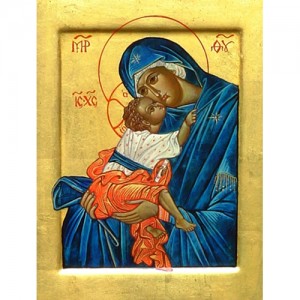
Orthodox Icon of the MadonnaI want to ask you to read along as I re-read the collect for the day, the particular prayer of the Fourth Sunday in Advent: “Purify our conscience . . . . ” That’s enough, just those three words: “Purify our conscience . . . . ” Don’t you think that’s asking a lot of God? I mean really . . . purify the human conscience, that place in ourselves where we know all the wrongs we have done. Tall order, purifying that! But that’s what the prayer asks and in doing so it draws on the language of the Letter to Hebrews from which our second lesson today is taken.

Our reading came from Chapter 10 of the letter, but what we heard is only small part of a longer section dealing with the efficacy of sacrifice, a section that begins in Chapter 9. There we read these words:

For if the blood of goats and bulls, with the sprinkling of the ashes of a heifer, sanctifies those who have been defiled so that their flesh is purified, how much more will the blood of Christ, who through the eternal Spirit offered himself without blemish to God, purify our conscience from dead works to worship the living God! For this reason he is the mediator of a new covenant . . . . (Heb. 9:13-15a)

But what is the conscience?

The dictionary tells us that the conscience is that “inner sense of what is right or wrong in one’s conduct or motives; the complex of ethical and moral principles that controls or inhibits the actions or thoughts of an individual.” (dictionary.com) Another definition comes from the devotional text My Utmost for His Highest compiled from the lectures of the British Baptist educator Oswald Chambers:

Conscience is that ability within me that attaches itself to the highest standard I know, and then continually reminds me of what that standard demands that I do. It is the eye of the soul which looks out either toward God or toward what we regard as the highest standard. This explains why conscience is different in different people. If I am in the habit of continually holding God’s standard in front of me, my conscience will always direct me to God’s perfect law and indicate what I should do. The question is, will I obey? I have to make an effort to keep my conscience so sensitive that I can live without any offense toward anyone. I should be living in such perfect harmony with God’s Son that the spirit of my mind is being renewed through every circumstance of life, and that I may be able to quickly “prove what is that good and acceptable and perfect will of God” (Romans 12:2 ; also see Ephesians 4:23).

So, then, our conscience is that sense within us which, if it is pure, directs us to do that which God asks of us. But note what our prayer asks of God . . . that the purification of our conscience has to happen everyday: “Purify our conscience, Almighty God, by your daily visitation . . . ” and then the prayer goes on to sound an Advent note ” . . . that your Son Jesus Christ, at his coming, may find in us a mansion prepared for himself.”

I was a great fan of Charles Schultz’s cartoon Peanuts. I recall a Sunday installment in Lucy and Charlie Brown were talking about cruise ships. Lucy was holding forth giving, as she was wont to do, her unflappable opinion: “You know,” she says to Charlie Brown, “there are two kinds of people who go on cruise ships. There are some people who face their deck chairs toward the stern so that they can see where they have been, and there are others who face their deck chairs toward the bow so that they can see where they are going. Now,” she asks Charlie Brown, “on the great cruise ship of your life, how do you face your deck chair?” Charlie Brown thinks for a moment, then says, “I can’t get mine unfolded!”

Focusing our conscience like “the eye of the soul,” as Chambers said, so that it looks outward toward God whom we beseech to purify it daily, is like getting our deck chair unfolded and faced toward the bow of the ship so we can see where we’re going, so that we are prepared for Jesus. I think that’s really what today’s Psalm is all about, too, especially the refrain that is repeated twice in the portion we read and is repeated again in the whole Psalm: “Restore us, O God of hosts; show the light of your countenance, and we shall be saved.” Purify our conscience so that we are prepared for our savior, for Jesus.

The great example of that preparation is the virgin Mary. Her trip to the hill country of Judea about which we heard in today’s Gospel lesson took place almost immediately after the angel Gabriel had visited her to inform her that she would be the mother of the savior. Her willing response to that news, of course, was, “Here am I, the servant of the Lord; let it be with me according to your word.” (Luke 1:38) If we are honest in our prayer that God purify our consciences each day, then we must be willing to follow Mary’s example and accept whatever God wills for us; when God makes God’s daily visitation to us, our response must echo hers, “Let it be with me according to your word.”

The German medieval mystical theologian put it this way: “We are all meant to be mothers of God. What good is it to me if this eternal birth of the divine Son takes place increasingly, but does not take place within myself? And, what good is it to me if Mary is full of grace if I am not also full of grace? What good is it to me for the Creator to give birth to his Son if I do not also give birth to him in my time and my culture? This, then, is the fullness of time: When the Son of Man is begotten in us.”

So it is that we pray today, “Purify our conscience, Almighty God, by your daily visitation,” that we like Mary may be bearers of the Eternal Word. Amen.

A Holy and a Broken Hallelujah – Sermon for Advent 3, Year C – December 16, 2012

====================

This sermon was preached on Sunday, December 16, 2012, at St. Paul’s Episcopal Church, Medina, Ohio, where Fr. Funston is rector.

(Revised Common Lectionary, Advent 3, Year C: Zephaniah 3:14-20; Canticle 9 (The First Song of Isaiah, Ecce Deus, Isaiah 12:2-6); Philippians 4:4-7; and Luke 3:7-18. These lessons can be read at The Lectionary Page.)

====================

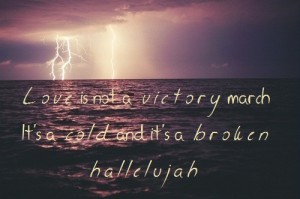
Broken Hallelujah LyricDid you pay attention to the words of the song we just sang as our sequence hymn? Listen to them again:

Comfort, comfort ye my people,
Speak ye peace, thus saith our God;
Comfort those who sit in darkness,
Mourning ‘neath their sorrows’ load . . . .

(Hymn 67, The Hymnal 1982)

These are God’s words to the prophet Isaiah; we find them in the 40th chapter of Isaiah. They are God’s instructions to Isaiah, but I think every priest hears them personally when we are called on to minister to someone in times of trouble and loss. “Comfort, comfort my people; comfort those who are in sorrow.”

Since Friday morning when I, like many others, sat in stunned silence struggling to understand the horror of what had just happened at Sandy Hook Elementary School in Newtown, Connecticut, I have had a recurring vision of Christmas presents under Christmas trees in darkened homes, presents that will never be unwrapped. I see mothers and fathers sitting in that darkness mourning beneath a load of sorrow I don’t think I could ever comprehend, and I wonder if I as a priest or as a friend could speak any word of comfort to them. I have known the pain and brokenness of losing loved ones; I have known the sadness that comes with the death of parents and siblings. But I can only imagine (and I’m sure completely inadequately) the grief and agony a parent must feel when his or her child has been murdered; I can only imagine how broken those parents’ hearts must be, how broken they must feel. I don’t know if I could offer any comfort to them.

I have spent the past 48 hours following the news reports, weeping, screaming at the television, reading the statements of bishops and other clergy, enraged at the injustice of it, angry because as a society we seem unwilling (not incapable, unwilling) to do anything about the epidemic of gun violence that seems to sweep unchecked across our country.

This is not the way we are supposed to be on this, the Third, Sunday of Advent! In the tradition of the church, today is known as Gaudete Sunday or “Rejoicing Sunday” because in the medieval church the introit, the first words of the Mass, was Gaudete in Domino semper: iterum dico, gaudete, the first words of our epistle lesson this morning: “Rejoice in the Lord always; again, I say, rejoice.” The same theme is struck in the Old Testament reading from the Prophet Zephaniah and in the Gradual taken from the Prophet Isaiah; these readings are meant to emphasize our joyous anticipation of the Lord’s coming. “Rejoice and exult with all your heart,” Zephaniah cries out, but when our hearts are broken how are we to do that? Here in the depths of dealing with a senseless act of brutality, there is damned little rejoicing in our broken hearts, there is damned little comfort. We are in the midst of a murderous gun violence epidemic and I find it hard to rejoice.

Consider what has gone on in just the past week: last Sunday a man fatally shot his security-officer wife, tried to kill another person, and then killed himself in an employee parking lot at Cleveland-Hopkins Airport; on Tuesday a masked gunman killed two people and seriously injured another in a Portland, Oregon, shopping mall; on Friday, the Sandy Hook Elementary School killings, the second worst mass shooting at a school in U.S. history; and yesterday, a gunman shot three people in a hospital in Birmingham, Alabama. Earlier this year we saw fatal mass shootings in Minneapolis, in Tulsa, in a Sikh temple in Wisconsin, in a theater in Colorado, in a coffee bar in Seattle, and in a college in California. It is painfully clear that this is an epidemic of violence, that all is not well in our country. Like our hearts, our society is broken.

According to the Centers for Disease Control, there are about 31,000 deaths from firearms annually in our country. Of those, 500 are accidental; another 300 or so are considered “legal” as the result of law enforcement actions; and the nature of about 200 cannot be determined. That means that about 30,000 intentional, illegal, fatal shootings occur in the United States in a year’s time; 62% of those are suicides; 38% are murders.

Speak ye to Jerusalem
of the peace that waits for them;
tell her that her sins I cover,
and her warfare now is over.

As someone who, everyday, tries to speak the word of God to people who need to hear it, I don’t know that I can do that! I don’t know if I could comfort those parents mourning beneath their dark load of sorrow, and I don’t know how I could tell you that our warfare, our plague of gun violence is over! Our warfare is not over; the slaughter goes on . . . one or two people here, thirteen theater-goers there, twenty children in Connecticut . . . the massacre continues more than 11,000 times a year. Yes, it is painfully clear that this is an epidemic of violence, that all is not well in our country. Like our hearts, our society is broken.

John the Baptizer warned the people who came to him that all was not well in their society, that it was broken. “Do not,” he told them, “begin to say to yourselves, ‘We have Abraham as our ancestor.'” Don’t think that because you are who you are that all is well and that all will be well; it is not and it will not be. Our society is broken! “And the crowds asked him, ‘What then should we do?'” John’s answer was simplicity itself – do what you know to be right. If you have two coats, if you have extra food, and your neighbor has none, share. If you have taken on the job of tax collector, or if you are a soldier entitled to ask citizens for support, collect no more than you should, ask no more than is proper. Just do what you know to be right, do what you know ought to be done.

Every time one of these mass shootings occurs there is an outpouring of public grief, and there are expressions of sorrow and sympathy. Every time this has happened, however, we have been told that it is not the appropriate time to talk about strengthening our nation’s gun control laws; we are told that it is too soon to talk about doing something about gun violence; we are told that we have to give the families of the victims time to heal. But as John the Baptizer said to those who came to him at the Jordan, the time is now – “Even now,” he said, “the ax is lying at the root of the trees . . . .” There is no time like the present to do what we know to be right, to do what we know ought to be done.

I believe that that talk about time to heal is a sham. I don’t think anyone ever “heals” from the death of a loved one; one remains broken. I know that I have never “healed” from the deaths of my parents or of my brother or of any other person I loved; forever, after each death, there is a part of me that is and will always be broken. As a parent, I am very sure I would never “heal” from the murder of my child; I would be forever broken. But I know that life goes on and, through the grace of God, we are given the strength to live it, even as wounded, as broken, as broken-hearted as we may be. As Isaiah said, “Surely, it is God who saves me; I will trust in him and not be afraid. For the Lord is my stronghold and my sure defense, and he will be my Savior.” The one who was broken on Calvary’s tree was broken that I, in my brokenness, might be made whole. Through his brokenness, in our brokenness, we are given the peace of God which passes all understanding.

Life goes on, and by the grace of our Savior we are given the strength to live it, and in it to do what we know to be right, to do what we know ought to be done. The only question is whether we have the will to do it.

Make ye straight what long was crooked,
make the rougher places plain;
let your hearts be true and humble,
as befits his holy reign.

Have we the will to do what we know to be right, to make what is crooked straight, to make what is rough plain? Are our hearts, broken though they may be, true and humble as befits our Savior’s holy reign?

Many of you know that I’m a great fan of the singer-songwriter Leonard Cohen and many of you are familiar with his song Hallelujah. In it there is this great line:

Love is not a victory march
It’s a cold and it’s a broken Hallelujah

And again, later in the song, the singer says of love,

It’s not a cry you can hear at night
It’s not somebody who has seen the light
It’s a cold and it’s a broken Hallelujah

In the funeral liturgy of our church, near the end of the service, the priest stands at the body of the deceased and says, “All of us go down to the dust; yet even at the grave we make our song: Alleluia, alleluia, alleluia.” When each of those twenty children, each of those seven adults are buried, their families will hear those as cold and broken Hallelujahs! But as our Advent hymn reminds us in its conclusion,

For the glory of the Lord
now o’er the earth is shed abroad,
and all flesh shall see the token
that the word is never broken.

Our hearts may be broken; our lives may be broken; our society may be broken, but God’s word, God’s promise is never broken. The Word made flesh, Jesus Christ, he was broken . . . broken on the Cross that we might be made whole. Risen unbroken though still bearing the scars of our brokenness, he will return again so that we might sing not a broken, but a whole Hallelujah, a holy Hallelujah, so that we might “rejoice in the Lord always.”

I still don’t know if I could comfort those grieving parents, but I do know that I believe in God, that I believe God’s promise, and that I believe in Jesus Christ, the One who was broken that we might be made whole. It is his birth and its promise of wholeness that we prepare to celebrate in this Advent season. And because I believe, I know that I could, at least, be with those families in this time of grief, that I could sit with them, and that I could assure them in words just slightly changed from the end of Mr. Cohen’s song . . . .

There’s a blaze of light in every word
It doesn’t matter which you heard
The holy or the broken Hallelujah.
* * * *
And even though it all went wrong
We’ll stand before the Lord in song
With nothing on our tongue but Hallelujah!

What Is the Crying? – Sermon for Advent 2, Year C – December 9, 2012

====================

This sermon was preached on Sunday, December 9, 2012, at St. Paul’s Episcopal Church, Medina, Ohio, where Fr. Funston is rector.

(Revised Common Lectionary, Advent 2, Year C: Baruch 5:1-9; Canticle 16 (The Song of Zechariah, Benedictus Dominus Deus, Luke 1: 68-79); Philippians 1:3-11; and Luke 3:1-6. These lessons can be read at The Lectionary Page.)

====================

John the Baptist

What is the crying at Jordan?
Who hears, O God, the prophecy?
Dark is the season, dark our hearts
and shut to mystery.

Who then shall stir in this darkness,
prepare for joy in the winter night?
Mortal, in darkness we lie down, blindhearted,
seeing no light.

Lord, give us grace to awake us,
to see the branch that begins to bloom;
in great humility is hid all heaven
in a little room.

Now comes the day of salvation,
in joy and terror the Word is born!
God comes as gift into our lives;
oh let salvation dawn!

(Words: Carol Christopher Drake)

What is the crying at Jordan? What is the crying in New York? What is the crying at Arlington? What is the crying in Southern California? What is the crying at Checkpoint 18 outside of Kabul? What is the crying in Medina? What is that crying?

“Take off the garment of your sorrow and affliction,” wrote Baruch, “and put on forever the beauty of the glory from God.” This is a time and a season when we expect to leave behind our sorrows and our afflictions; we expect to feel happiness and joy, and if we don’t we feel guilty because that’s what your supposed to feel at Christmas, right? But the truth is that for many this is a time and a season when sorrow and affliction are felt most acutely. That crying is the voice of those feeling the cold hand of death and the emptiness of loss in this season of joy and celebration.

This is a time and a season when death and loss can and do really hit home. Nine days ago, a week ago Friday, we received word that Nancy Lawrence, a long-time, life-time member of this congregation had passed away. Even though her last several months of life were, frankly, awful and everyone who has known Nancy is relieved that she is no longer suffering, still any death is an occasion of sadness. For many this is a time and a season when sorrow and affliction are felt most acutely.

This past Friday, day before yesterday, I got word in the evening that Deborah Griffin Bly, a woman I’ve known and whose music I have enjoyed for seventeen years had died. She was one of the singing duet called “The Miserable Offenders” and it was she and her partner who introduced me to that exquisite piece of poetry and its musical setting, Hymn 69, in our hymnal. Deb and I were part of community of Anglicans online that extends around the world; through it we have had nearly a thousand mutual friends. For many this is a time and a season when sorrow and affliction are felt most acutely.

Thirteen years ago, on the longest night of the year, the winter solstice, December 21, my mother passed away. Losing a parent is one of life’s hardest lessons, and never a good prelude to Christmas, and every year after the joyous holiday is also a reminder of the most profound loss. For me, as for many, this is a time and a season when sorrow and affliction are felt most acutely.

And, yet, Baruch writes, “Take off the garment of your sorrow and affliction, and put on forever the beauty of the glory from God.”

In the current issue of the magazine The Christian Century, Lutheran pastor Peter Marty tells of preaching a Christmas Eve sermon in which he made “reference to a little boy in a rough section of Trenton, New Jersey, whose body was found stuffed in a bag under a fire escape.” At the conclusion of the service a woman “told [him] in the receiving line that mention of children being murdered had no place in a Christmas sermon. [She said,] ‘I will never set foot in this church again.'” (December 12, 2012, Vol. 129, No. 25, page 10) I don’t know if I would mention a murder in a Christmas sermon, but I think we all need to remember that for many this time of year is not a “holly, jolly” season.

As we get ready for whatever good times we anticipate, as we prepare to celebrate the Messiah’s birth, let’s remember that unless we see the shadow of the cross falling on the crib we are not seeing Christmas clearly. Jesus did not enter this world just to be a cute little baby; he grew up! He lived in a time of political turmoil in a land oppressed by the military might of the Roman Empire. He taught a subversive “good news” that offended both that Empire and the religious establishment of his own country which sought to appease it. His truth would lead to his arrest and he would suffer and die on a cross. That he did so and rose from the dead so that our sins might be forgiven and we might enter into the Kingdom of God is why Christmas is special. Christmas Eve might not be the time or place to make mention of the murder of children, but our time of preparing to appreciate Christmas is a time to appreciate the reality of death and suffering, the reality of sorrow and affliction.

Traditionally, on this Second Sunday of Advent (and again next week on the Third Sunday) we focus our attention on John the Baptist, the forerunner who was the voice crying in the wilderness. His was the voice crying at Jordan, “In the desert, make straight a pathway for our God.” We turned our attention toward John this morning by saying together the words of the song his father, the priest Zechariah, sang at his birth. It’s a great canticle, and I love its final words:

In the tender compassion of our God
the dawn from on high shall break upon us,
To shine on those who dwell in darkness and the shadow of death,
and to guide our feet into the way of peace.

They are words that speak especially to those for whom this is a time and a season when sorrow and affliction are felt most acutely.

They are also words that speak to and for all of us, because we all dwell in darkness and the shadow of death. At one time or another, we all, as that marvelous poem says, lie down in darkness, blind-hearted, seeing no light. At one time or another, we all, as the Psalmist so eloquently put it, walk through the valley of the shadow of death. But we need fear no evil for as John the Baptist, cried out at Jordan

Every valley shall be filled,
and every mountain and hill shall be made low,
and the crooked shall be made straight,
and the rough ways made smooth;
and all flesh shall see the salvation of God.

It is for and through those for whom this is a time and a season when sorrow and affliction are felt most acutely that the real meaning of Advent comes through. Only a very shallow and superficial understanding of the story of the Savior’s birth would lead us to think that the Christmas for which we prepare is only about happiness. Christmas is about real life – yes, it is about joy, but it is also about sorrow; yes, it is about birth, but it is also about death; yes, it is about redemption, but it is also about affliction. It is about God coming to us incarnate in Jesus to give us life, real life, and that abundantly. It is about Christ crucified, risen, and ascended returning for us in glory. When we realize this and are enabled to give thanks for the birth of Christ and to look forward to his triumphant return even in the midst of death and loss, even as we live with profound sorrow and affliction, it is then that the dawn from on high breaks upon us brings us. It is then that we harvest the “righteousness that comes through Jesus Christ;” it is then that we see salvation; it is then that we put on forever the beauty of the glory from God.

Let us pray:

O God of grace and glory, as we continue to prepare to celebrate the birth of our Savior, as we await his return in glory, we remember before you our loved ones departed. We thank you for giving them to us, their families and friends, to know and to love as companions on our earthly pilgrimage. In your boundless compassion, comfort us when we are overcome by sorrow and affliction. Give us faith to know that the valley of the shadow of death shall be filled, that your dawn will break upon us to guide our feet into the way of peace, so that in quiet confidence we may continue our course on earth, until, by your call, we shall see your salvation and be reunited with those who have gone before; through Jesus Christ our Lord. Amen.

Pluck the Fruit, Pay Attention: Sermon for Advent 1, Year C – December 2, 2012

====================

This sermon was preached on Sunday, December 2, 2012, at St. Paul’s Episcopal Church, Medina, Ohio, where Fr. Funston is rector.

(Revised Common Lectionary, Advent 1, Year C: Jeremiah 33:14-16; Psalm 25:1-9; 1 Thessalonians 3:9-13; and Luke 21:25-36. These lessons can be read at The Lectionary Page.)

====================

Fig Tree (Ficus Carica)“The days are surely coming….”

“Be blameless before our God and Father at the coming of our Lord Jesus….”

“There will be signs in the sun, the moon, and the stars….”

“Heaven and earth will pass away….”

The End Is Near!

We don’t actually pay much heed or give much credence to crazy talk like that now, do we? We’ve heard plenty of preachers on street corners, on the radio, on the television predicting the end of the world. Remember Harold Camping last year? And, of course, the so-called Mayan prediction that we all have only nineteen days left now. We’ve heard these sorts of things often enough over the years that we just don’t pay any attention to them.

On top of that, we’ve become thoroughly scientific and modern. Everything has an explanation. We know how the world works. And we’ve turned all of it into a product; everything is for sale in one way or another. There seems to be no more mystery in anything. Our materialistic progress has almost overshadowed any sense of the spiritual. We have analyzed, demystified, commodified, and commercialized everything. In 1802 William Wordsworth wrote a sonnet bemoaning exactly that:

The world is too much with us; late and soon,
Getting and spending, we lay waste our powers;
Little we see in Nature that is ours;
We have given our hearts away, a sordid boon!
This Sea that bares her bosom to the moon,
The winds that will be howling at all hours,
And are up-gathered now like sleeping flowers,
For this, for everything, we are out of tune;
It moves us not. – Great God! I’d rather be
A Pagan suckled in a creed outworn;
So might I, standing on this pleasant lea,
Have glimpses that would make me less forlorn;
Have sight of Proteus rising from the sea;
Or hear old Triton blow his wreathed horn.

“Great God! I’d rather be a Pagan!” wrote Wordsworth more than 200 years ago. We modern Christians, he said, “have given our hearts away. We are out of tune” with the rhythms of the world. We no longer see the signs in the natural world. But here they are in scripture, the signs of the end of the world, reportedly predicted by Jesus himself. “Look at the fig tree and all the trees,” he says, “as soon as they sprout leaves you can see for yourselves and know that summer is already near. So also, when you see these things taking place [these signs in the sun, the moon, and the stars], you know that the kingdom of God is near.”

We human beings, whether Pagan or Christian, have proven incredibly bad at understanding the signs of the times insofar as they apply on a global, or universal, or apocalyptic scale. We keep getting it wrong. You’ve probably heard someone say something like this: “The Earth is degenerating today. Bribery and corruption abound. Children no longer obey their parents, and it is evident that the end of the world is fast approaching.” Those particular words were found inscribed on a clay tablet from ancient Assyria, a tablet dating from about 2800 BC, and there are similar words on a grafitto on a wall in ancient Pompeii – so I’m not sure Wordsworth was all that right about the pagans. They weren’t any better at it than we are.

But here’s the thing. Jesus didn’t tell us to look at the forest. He told us to look at the trees, at individual trees, at the fig tree in particular. The end of the world doesn’t come, or at least it hasn’t come, in a big global, universal apocalypse. It comes to each of us individually. Today is the end of the world, right now, for somebody. All over the world, today is the day of judgment. For thousands, possibly millions, of individual people today is the end of the world; they will die today. For millions of others, there will be some important turning point their lives. For each of those people, the end – in some way or another – is close at hand.

Why do you suppose church tradition has us thinking about such things at the beginning of the Christian year, the First Sunday of Advent, with only twenty-two days until Christmas Eve, getting ready for one of the most joyous events of our year? Well, it’s because Advent isn’t just about getting ready for Christmas; it’s not even primarily about getting ready for Christmas. It’s about getting ready for Christ’s Return; it’s about getting ready for the Second Coming. Advent, in fact, means “coming” and the season is about getting ready for the coming of Judgment Day, the end of this life.

And how do we do that? By paying attention and by praying. As Jesus says, “Be alert at all times, praying . . . . ”

During this season while we get ready for Christmas, try not to get all caught up in the commodification and commercialization of everything. A friend of mine, Fr. Marshall Scott, who’s a hospital chaplain in Kansas City, commented recently, “It seems to me that the problem is not too little Christ in Christmas. The problem is too many ads in Advent.” Don’t get caught up in all of that! Take a breath; pay attention to the rest of life. I’m tempted to say, “Pay attention the real things in life.” Take time to pray, today; take time to give thanks, today. Because, although it sounds like a cliché, it’s the truth of Advent, today may be the end. And if it is, be assured that at the end stands Jesus.

So live expectantly; fill each day with meaningful activity. “Stand up and raise your heads, because your redemption is drawing near.”

The 20th Century poet Denise Levertov penned an answer to Wordsworth. Where he wrote, ” The world is too much with us,” in her poem O Taste and See she wrote, “The world is not with us enough.” This is her poem:

The world
is not with us enough.
O taste and see
the subway Bible poster said,
meaning The Lord, meaning
if anything all that lives
to the imagination’s tongue,
grief, mercy, language,
tangerine, weather, to
breathe them, bite,
savor, chew, swallow, transform
into our flesh our
deaths, crossing the street, plum, quince
living in the orchard and being
hungry, and plucking
the fruit.

That is Advent’s message: taste and see, bite and savor, cross the street, pluck the fruit, stand up, raise your head, pay attention, be alert. Amen.

The Most Important Election . . . NOT! – Sermon for Election Day – November 6, 2012

====================

This sermon was preached on Tuesday, November 6, 2012, at St. Paul’s Episcopal Church, Medina, Ohio, where Fr. Funston is rector.

(Lessons selected for the Mass were Isaiah 26:1-8, Romans 13:1-10, and Mark 12:13-17, from the Episcopal Book of Common Prayer’s lectionary for various occasions, “For the Nation”; the gradual, Psalm 146, was selected by the preacher.)

====================

Romney Campaign Button "Most Important Election"“This election is the most important, ever. If that candidate is elected, it will be the end of the world!” The first time I heard that was during the campaign of the first presidential election I paid attention to: the race between John F. Kennedy and Richard Nixon in 1960. I heard it as my family watched the televised debate; it was said by my older brother who was then a freshman studying history and political science at the University of Texas, so of course he knew everything. “That candidate,” by the way, was Richard Nixon. We heard it again in 1964; remember the television commercial with the little girl plucking petals from a daisy and the atomic explosion? “If Barry Goldwater is elected,” it suggested none too subtly, “it will be the end of the world.” We hear it every election, “This election is the most important election of our lifetimes.” And, to be honest, that is a correct statement. Those in the past are no longer important; they’re done and other with. Only this election can impact the future so, at this time, up to now, it is the most important. But truth be told . . . none of them, including this election, are really all that important in the grand scheme of things.

In the Daily Office Lectionary of the Episcopal Church, the cycle of bible readings to be read each morning, today’s New Testament reading was from the Book of Revelation which records the vision St. John of Patmos had of “the new Jerusalem,” of heaven. In the lesson, this is what John reports:

I saw what appeared to be a sea of glass mixed with fire, and those who had conquered the beast and its image and the number of its name standing beside the sea of glass with harps of God in their hands. And they sing the song of Moses, the servant of God, and the song of the Lamb:
“Great and amazing are your deeds,
Lord God the Almighty!
Just and true are your ways,
King of the nations!
Lord, who will not fear
and glorify your name?
For you alone are holy.
All nations will come
and worship before you,
for your judgments have been revealed.” (Revelation 15:2-4)

This song of praise was a wonderful reminder with which to begin Election Day: God is the king of the nations; he alone is holy. As we went to the polls today, we were casting our ballots for political leaders, not religious ones, and certainly not a savior. Today we chose between candidates for various offices, all of whom are simply human beings like ourselves, fallible human beings whom we hope will strive to overcome whatever their faults and frailties may be, and govern to the best of their abilities. Whether the candidates for whom you or I happened to vote are elected is not, at this point, of any real importance; what is of importance is that we respect and honor our system of governance, and support and pray for whichever candidates are ultimately placed in office.

The Psalm which we recited just a few minutes ago reminds us:

Put not your trust in rulers, nor in any child of earth, for there is no help in them.
When they breathe their last, they return to earth, and in that day their thoughts perish.
(Ps. 146:2-3, BCP version)

We are admonished not to rely, although we surely do, on our earthly leaders. We repose more trust, and certainly more expectation, than we ought in our elected leaders, forgetting that they are no different from, nor more perfect than we.

This evening we do not celebrate nor do we extol any political party, any platform, any candidate, any elected office holder. Instead, we give thanks for the freedoms we enjoy, for the country we love, and for the electoral process which allows us to maintain both through peaceful changes in government. We give thanks for the wisdom of our Founding Fathers, for the insight of the framers of the Constitution, for the bravery and sacrifice of those who have defended our rights and liberties, and for the commitment of our fellow citizens who have participated in our democracy and voted in this election. We give thanks for all these things to the one upon whom all this rests, to the one who is the foundation of our existence, to the one who is our ultimate concern, to the one in whose service we find perfect freedom.

When we gather to give thanks for and to pray for our national life, the lectionary of our church asks us to hear and consider the story of the Pharisees and Herodians asking Jesus about taxes: Is it lawful to pay them to Caesar? To which Jesus’ makes his famous reply, “Render to Caesar the things that are Caesar’s and to God the things that are God’s.” This gospel story, says theologian Daniel Deffenbaugh

. . . calls us to be neither enemies of the state nor its staunch allies. Rather, we should think of ourselves, in the words of Stanley Hauerwas, as “resident aliens. ” We do not refuse to give to the emperor the things that are the emperor’s, even when – much to our dismay – their utilization defies our most deeply held convictions. This is as true of the right as it is of the left, and in this we can take some solace. But the affections of our hearts and minds must always, and with greater fervor, be focused on the more urgent clause in Jesus’ directive: “give to God the things that are God’s.” (Allies or Enemies?

This, he says, leaves us in a “posture of perpetual discernment,” constantly trying to distinguish our steadfast devotion to God from our obligations to the nation.
The Cathechism of the Roman Catholic Church interprets this gospel tale as teaching that we should “give to God everything, but give Caesar his due.” Thus, we are called to take part in our national culture for the common good. “It is necessary that all participate, each according to his position and role, in promoting the common good. This obligation is inherent in the dignity of the human person.” (CCC 1913) To the best of our ability, we should all participate in the public arena for the good of the society. Jesus’ answer to the Pharisees and Herodians gives each person freedom to act in that public sphere, but with that freedom come awesome responsibilities, none more awesome than the privilege and obligation to participate in democratic elections, even if we do so in a “posture of perpetual discernment.”

We do our best in that state of constant decision-making. We study the issues and the candidates. We make our choices. We participate in the public arena. We vote. And then we trust . . . not in rulers, not in political parties, not in the candidates, not in any child of earth . . . We render our trust not to Caesar nor anything that is Caesar’s, but to God. It is not that our vote is unimportant, but it is not of ultimate concern.

In the Anglican Communion on November 6, we commemorate one of our greatest theologians, Archbishop William Temple, who served as Archbishop of Canterbury near the Second World War. He served in that post only two years, from his appointment in 1942 to his death in October, 1944. He served in the episcopate for 23 of his 63 years, first as Bishop of Manchester, then as Archbishop of York, and finally in the See of Canterbury. Throughout his life, he was a prolific author of philosophy and theology.

While serving in York, he addressed the 1938 Lambeth Conference, the decennial gathering of Anglican bishops, with these words which, I think, are a good reminder for us today:

While we deliberate, God reigns.
When we decide wisely, God reigns.
When we decide foolishly, God reigns.
When we serve God in humble loyalty, God reigns.
When we serve God self-assertively, God reigns.
When we rebel and seek to withhold our service, God reigns –
The Alpha and the Omega, which is and which was,
And which is to come, the Almighty.

John of Patmos in his apocalypse, the Psalmist in Psalm 146, Archbishop Temple in his address to the gathered bishops . . . they all remind us that no matter how we decide, no matter who is elected today, God reigns. As the graphic on the cover of our bulletin says, “No matter who is president, Jesus is king.”

Let us pray.

O God of light and love, inspire us, we pray, that we may rejoice with courage, confidence, and faith in the Word made flesh, Jesus our King, and that through our participation in our national culture and our democratic processes we may establish that society which has justice for its foundation and love for its law; through the same Jesus Christ, our Lord, who lives and reigns with you and the Holy Spirit, one God, now and for ever. Amen.

====================

A request to my readers: I’m trying to build the readership of this blog and I’d very much appreciate your help in doing so. If you find something here that is of value, please share it with others. If you are on Facebook, “like” the posts on your page so others can see them. If you are following me on Twitter, please “retweet” the notices of these meditations. If you have a blog of your own, please include mine in your links (a favor I will gladly reciprocate). Many thanks!

====================

Father Funston is the rector of St. Paul’s Episcopal Church, Medina, Ohio.

Unbind Him, and Let Him Go! – Sermon for All Saints Sunday – November 4, 2012

====================

This sermon was preached on Sunday, November 4, 2012, at St. Paul’s Episcopal Church, Medina, Ohio, where Fr. Funston is rector.

(Revised Common Lectionary, All Saints, Year B: Isaiah 25:6-9; Psalm 24; Revelation 21:1-6a; and John 11:32-44. These lessons can be read at The Lectionary Page.)

====================

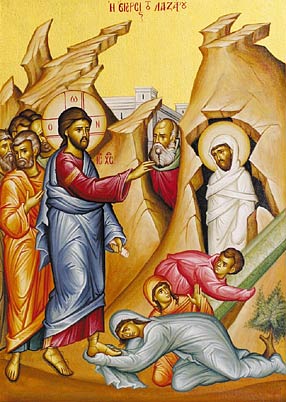
Orthodox Icon of the Raising of LazarusToday, following church tradition, we step away from the calendar of Ordinary Time and, instead, commemorate the Feast of All Saints. That festival is specifically held on November 1, but tradition allows us to celebrate the saints also on the Sunday after that date, so here we are.

Anglicans and Episcopalians for generations have been used to hearing the Beatitudes from Matthew’s gospel (Matt. 5:1-12) or the similar Blessings-and-Woes from Luke’s version (Luke 6:20-26), but since the adoption of the Revised Common Lectionary we also, every three years, hear the story of the raising of Lazarus from the gospel according to John. The listings of who is blessed in the other two gospels make sense as lessons for this day; the story of Lazarus, not so much. It may make us wonder why those who created our new lectionary made that choice.

Unfortunately, there are no easy answers to that question, if there are any answers at all. The development of the lectionary is a creature of time and custom as much as it is of purposeful selection. Lectionaries develop over the centuries. Typically, a lectionary will go through the scriptures in a logical pattern, and also include selections chosen by the community for their appropriateness to particular occasions. The ecumenical scholars who set up our current lectionary looked back over these centuries of development and selected lessons which had the broadest consensus for use on particular days, like today’s celebration of the feasts.

But why that consensus may exist is lost in time. There are no legislative notes indicating why communities thought a particular lesson, like the story of Christ raising Lazarus, fit a particular feast, such as All Saints Day. We who have inherited the tradition must read the lessons and figure out their message for ourselves. On a feast day, the Prayer Book gives us some filters, if you will, to aid in our reflections and our understanding; these are the collect (or prayer) of the day and the “proper preface” said (or chanted) before the Great Thanksgiving. Let’s take a look at the collect again:

Almighty God, you have knit together your elect in one communion and fellowship in the mystical body of your Son Christ our Lord: Give us grace so to follow your blessed saints in all virtuous and godly living, that we may come to those ineffable joys that you have prepared for those who truly love you; through Jesus Christ our Lord, who with you and the Holy Spirit lives and reigns, one God, in glory everlasting. Amen. (BCP Page 245)

The focus of the prayer is the “communion and fellowship” of the saints, the community of the church, which is “knit together . . . in the mystical body” of Christ, which shares in “virtuous and godly living” and together enjoys the “ineffable joys” of eternal life. Likewise the preface focuses on the community:

For in the multitude of your saints you have surrounded us with a great cloud of witnesses, that we might rejoice in their fellowship, and run with endurance the race that is set before us; and, together with them, receive the crown of glory that never fades away. (BCP Page 380)

The emphasis is on the “great cloud of witnesses” (a phrase borrowed from the Letter to the Hebrews 12:1) who rejoice in fellowship and together are crowned with unfading glory.

So in our contemplation of any of the lessons for today, we should look for the ways in which the lesson exemplifies or speaks to the community of faith, and in the raising of Lazarus that comes at the end of the story: “The dead man came out, his hands and feet bound with strips of cloth, and his face wrapped in a cloth. Jesus said to them, ‘Unbind him, and let him go’.” (John 11:44)

“Unbind him, and let him go!” These may be the most powerful words in the story, because with them Jesus not only frees Lazarus, he empowers the community of faith. The community assists in the resurrection; it is the task of the People of God to complete the action of Resurrection. Jesus has called Lazarus out of the tomb, but he is still wearing the clothing of death, his funeral wrappings; the community removes those burial shrouds and dresses him for life.

I love that old Southern Harmony hymn we sang in procession today, especially the chorus which says

As I went down in the river to pray,
Studying about that good ol’ way
And who shall wear the robe and crown?
Good Lord, show me the way.
(“Down in the River to Pray”)

“Who shall wear the robe and crown?” is a reference to the vision of St. John of Patmos recorded in the Book of Revelation, a vision of heaven where “there was a great multitude that no one could count, from every nation, from all tribes and peoples and languages, standing before the throne and before the Lamb, robed in white, with palm branches in their hands.” (Rev. 7:9)

Last Thursday, which was actually All Saints Day, one of the lessons for the Daily Office of Morning Prayer was from the apocryphal book of Second Esdras. In it Ezra reports seeing a similar vision of heaven.

I, Ezra, saw on Mount Zion a great multitude that I could not number, and they all were praising the Lord with songs. In their midst was a young man of great stature, taller than any of the others, and on the head of each of them he placed a crown, but he was more exalted than they. And I was held spellbound. Then I asked an angel, “Who are these, my lord?” He answered and said to me, “These are they who have put off mortal clothing and have put on the immortal, and have confessed the name of God. Now they are being crowned, and receive palms.” Then I said to the angel, “Who is that young man who is placing crowns on them and putting palms in their hands?” He answered and said to me, “He is the Son of God, whom they confessed in the world.” So I began to praise those who had stood valiantly for the name of the Lord. (2 Esdras 2:42-47)

This vision differs from that in Revelation in that the presence of the Son of God is among the crowd, crowning them and putting the palms in their hands. I have to say, I rather prefer this vision to John’s because of that difference. There is something compelling about the Son of God being there with the saints, not high and exalted on a throne, as the Lamb is in the oracle of Revelation, but down with the people. This seems much more like the Jesus described in the Gospels, much more like the God he revealed.

This vision of Christ with the masses, yielding his glory and mixing in with his people, seems somehow quite in keeping with our celebration of all the saints. Today we don’t commemorate only those whose names are known, those who are portrayed in art with golden halos, those in whose particular memory churches and schools are dedicated; today we commemorate those whose names are not known. Ezra’s vision in Second Esdras of Christ mingling with these unknown but godly people appeals to me.

An early 20th Century Roman Catholic Lithuanian archbishop, George Matulaitis, once wrote:

May our model be Jesus Christ: not only working quietly in His home at Nazareth, not only Christ denying Himself, fasting forty days in the desert, not only Christ spending the night in prayer; but also Christ working, weeping, suffering; Christ among the crowds; Christ visiting the cities and villages. (Renovator of the Marians)

This is the Christ of Ezra’s vision; this is the Christ of the saints whom we remember today, Christ among the crowds. Indeed, John of Patmos in our reading from Revelation today describes God among the people: “[God] will dwell with [mortals] as their God; they will be his people, and God himself will be with them; he will wipe every tear from their eyes.” (Rev. 21:3-4)

When Jesus, this Christ among the crowds, this God dwelling with mortals, tells those around him, “Unbind him, and let him go” he is speaking not only to them, but also to us. When we hear those words we should remember another time when he empowered his church to unbind others. In Matthew’s gospel, in conversation with Peter, Jesus said: “I will give you the keys of the kingdom of heaven, and whatever you bind on earth will be bound in heaven, and whatever you loose on earth will be loosed in heaven.” (Matt. 16:19)

And again later to the apostles he said: “Truly I tell you, whatever you bind on earth will be bound in heaven, and whatever you loose on earth will be loosed in heaven.” (Matt. 18:18)

Here the Greek verb luo is translated as “loosen”, but it is the same word in our reading today translated as “unbind”. We have the power and the obligation to unbind and set others free. “Unbind him, and let him go” is Christ’s empowering command to all the saints everyday. It is Christ’s command to us to unbind others and give them their freedom; this is Christ among the crowds, God dwelling with God’s people, showing us the way that we and others can wear the robe and crown.

We unbind others and set them free when we work to alleviate the desperate plight of those who lack material means of survival, whether they are in our own communities, on the Gulf Coast or the eastern seaboard, or in distant countries. We unbind others and set them free when we act to console a brother or sister crushed by loss or fear or despair. We unbind others and set them free when we strive to empower rather than intimidate. We unbind others and set them free when we commit ourselves to justice for all, not merely for ourselves. We unbind others and set them free when we extend to others the mercy we have received from God. Whenever and wherever we find someone bound by sin or system or circumstance, we are to unbind them and set them free, not keep them tangled up in the old affairs, the old clothing, the old funeral wrappings of sin and death; those burial shrouds constrict them and damage everyone. Whenever and wherever we find someone struggling to be free, we are to unbind them and let them go so that we may all wear the robe and crown.

Today we commemorate all the saints, that great cloud of witnesses, that great multitude that no one can count wearing their robes and crowns, the community of the church throughout time and space charged with, committed to, and constantly striving to unbind others and set them free. Amen.

====================

A request to my readers: I’m trying to build the readership of this blog and I’d very much appreciate your help in doing so. If you find something here that is of value, please share it with others. If you are on Facebook, “like” the posts on your page so others can see them. If you are following me on Twitter, please “retweet” the notices of these meditations. If you have a blog of your own, please include mine in your links (a favor I will gladly reciprocate). Many thanks!

====================

Father Funston is the rector of St. Paul’s Episcopal Church, Medina, Ohio.

The Patients of Job: Part Four – “Can You Love What You Can’t Control?” – Sermon for Pentecost 22, Proper 25B – October 28, 2012

====================

This sermon was preached on Sunday, October 28, 2012, at St. Paul’s Episcopal Church, Medina, Ohio, where Fr. Funston is rector.

(Revised Common Lectionary, Proper 25B: Job 42:1-6,10-17; Psalm 34:1-8; Hebrews 7:23-28; and Mark 10:46-52. These lessons can be read at The Lectionary Page.)

====================

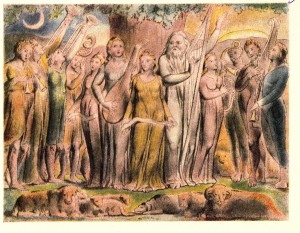
"So the Lord blessed the latter end of Job more than the beginning" by William BlakeSo here we are at the end of the Book of Job and the last of our sermons in this series entitled The Patients of Job. Let’s review the lessons we have learned, the spiritual remedies we have found in the medicine chest of this book.

First, in the introductory scenes in which the character God gave Satan leave to torment Job in ways he did not deserve, we learned that stuff sometimes happens in a person’s life, as it does in the story of Job, that he or she does not merit and for which he or she is not to blame! Stuff sometimes happens in your life that you do not deserve, and you are not to blame for it! The first bit of medicine we found in the Book of Job was the lesson to give up the “Why me? What have I done to deserve this?” ways of thinking, and stop beating ourselves up over things we can’t control! We also learned from the first part of Job’s story that life is a set of questions and that if there is truth to be found in this book, or in any of the books of the Bible, it is to be found in the process of struggling with those questions.

You’ll remember that, in the second reading we heard from this book, Job had decided to take God to court but had a problem: he didn’t know where to find God. In contemplating Job’s quandary, we recalled that our Christian faith assures us that in our times of pain and suffering, God comes to us in the loving acts of others. In illness, for example, God comes to us in the ministrations of the medical professionals who treat us. In emotional distress, God comes to us through those who offer us encouragement. In moments of deep need, God is there in a mysterious way through those who care for us. This gives us hope and courage. We need not cry out as Job did, “Oh, that I knew where I might find him;” (23:3) God knows where to find us. This is the balm for our souls, the spiritual medicine that we found in our second lesson from the Book of Job, that in our times of need, God knows were to find us and that, indeed, God does come to us.

In our third reading, last week, God spoke to Job but did not directly answer Job’s legal complaints. Instead, God’s response to Job was an invitation to us to participate in creation, to get creative. God let Job and us know that the answer to life’s problems is to get creative, to do something unexpected, to think outside the box. That is spiritual medicine for us because neither our problems, nor our world, nor our God will fit neatly into our preconceived boxes.

So those are the Book of Job’s spiritual medicines so far: stuff happens – don’t let it get you down; life is a bunch of questions, not a set of answers; God knows where to find us; and think outside the box.

Between last week’s lesson and this week’s reading, God continues to speak to Job about creation, describing its wildness, its beauty, and its uncontrollable nature; in Chapters 40 and 41, God specifically mentions the great bests Behemoth and Leviathan which cannot be captured and which overwhelm any who see them. The descriptions of nature in these ending chapters are suffused with the love that God has for God’s creation. This overwhelming and uncontrollable world which God created and which God loves is the answer God gives to Job’s self-pitying “Why me?” a question which clearly makes no sense in such a world.

Which brings us to the end and the epilogue but, frankly, these don’t make much sense. They seem to contradict everything we’ve learned so far. The whole book up to this point has seemed to be an argument against the old “wisdom religion” with its system of retributive justice, its idea that God rewards the righteous and punishes the wicked, that whatever happens to you, good or bad, is because you deserve it, so just accept it. But here at the end of the book that seems to be exactly what is happening: Job is rewarded for his righteousness by being reimbursed for his losses. “The Lord restored the fortunes of Job . . . the Lord gave Job twice as much as he had before.” Furthermore, God replaces Job’s ten dead children with ten new children, as if children are fungible commodities. Eliphaz, Bildad, and Zophar seem to have been right all along.

But if that’s what this Book of Job is all about, then it offers no spiritual medicines to us at all, for we know that the world simply doesn’t work that way! The righteous aren’t always rewarded; the wicked aren’t always punished; in fact, it’s all too often the other way around. If we read the end of the story in that way, we must be missing something. And indeed we are.

The lesson to be learned here requires that we compare the Job who is “restored” with the Job who existed before all of his losses. That earlier Job was a man who sought to control his world. We are told that that Job “would rise early in the morning and offer burnt offerings according to the number [of his children]; for Job said, ‘It may be that my children have sinned, and cursed God in their hearts.’ This is what Job always did.” (1:5) The restored Job, having been shown how uncontrollable the world is, turns loose of control; even before his death would require him to, he gives an inheritance to his children, his daughters as well as his sons. (42:15)

Ellen F. Davis, Professor of Bible and Practical Theology at Duke University Divinity School, in her book Getting Involved with God: Rediscovering the Old Testament (Cowley:Cambridge, MA, 2001), characterizes God’s speeches to Job, just the opening part of which we heard in last week’s reading, as posing for Job and us this question: “Can you love what you do not control?” (pg. 140)

You may be familiar with a popular saying that goes something like this: “If you love something, set it free. If it comes back, it’s yours. If it doesn’t, it never was yours.” God’s admonitions to Job and his restoration of Job’s fortunes affirm the first part of that, but call into the question the bits about return. The point here seems to be that even if it does return, it was never yours, at least it was never yours to control. In God’s descriptions of nature, of the unruliness of the weather, of the harshness of the wilderness, of the violence of the seas, of the wildness of the beasts, God made it clear that God made Creation wild and free, but God nonetheless loves Creation. This new, restored Job has learned to love his family in the same way, respecting their dignity and freedom, not seeking to control their world.

So the lesson for us to learn, the spiritual medicine for us at the end of the book, like the first lesson at its beginning, has to do with our lack of control. From the early scenes, we learned to accept that we cannot control the world; at the end, we learn to love it anyway. Love it even its most out-of-control, darkest times, because the lesson at the end of this Book of Job tells us that when the dark, uncontrollable night is over, the sun always rises. There is always the promise of hope. That is not only the balm at the end of Job’s story, it is the recurring message of the story of God and God’s People told again and again.

In the time of Noah, it rained for forty days and forty nights; water covered the earth for nearly a year. There was nothing Noah and his family could do about it; they were not in control. But, eventually, the dry land appeared again and God hung a rainbow in the sky.

For generations, the Hebrews were slaves in Egypt. There was nothing they could do about; they were not in control. But then God sent Moses and they were freed.

For forty years they wandered the desert because they were not in control, but eventually Moses led them to, and Joshua led them into, the Promised Land.

The Babylonians sacked Jerusalem and carried away the leaders and a goodly portion of God’s People to Babylon. They were exiled for seventy years; there was nothing they could do about it; they were not in control. But, eventually, God raised up Cyrus the Persian who defeated the Babylonians and set the Israelites free to return and rebuild.

Bartimaeus was blind. There was nothing he could do about it; he was not in control. But, eventually, the Son of God happened by and his sight was restored.

The Son of God himself was beaten, mocked, crucified and killed, laid in a tomb that was not his own. There was nothing he could do about it; he had given up control. But, eventually, there was Easter!

The last verse of the Book of Job as we have received it is, “And Job died, old and full of days.” But in some Greek-language texts there is one more verse added, “And it is written that he will rise again with those whom the Lord raises up.” The end of the Book of Job is a reminder to love what we cannot control, to love what is wild and free, because as bad as things may get, as dark and out-of-control as they may be, eventually there will be something very much like resurrection. And that is balm for our souls, that we like Job “will rise again with those whom the Lord raises up.” Amen.

====================

A request to my readers: I’m trying to build the readership of this blog and I’d very much appreciate your help in doing so. If you find something here that is of value, please share it with others. If you are on Facebook, “like” the posts on your page so others can see them. If you are following me on Twitter, please “retweet” the notices of these meditations. If you have a blog of your own, please include mine in your links (a favor I will gladly reciprocate). Many thanks!

====================

Father Funston is the rector of St. Paul’s Episcopal Church, Medina, Ohio.

The Patients of Job: Part Three – “What Is Half of 11?” – Sermon for Pentecost 21, Proper 24B – October 21, 2012

====================

This sermon was preached on Sunday, October 21, 2012, at St. Paul’s Episcopal Church, Medina, Ohio, where Fr. Funston is rector.

(Revised Common Lectionary, Proper 24B: Job 38:1-7,34-41; Psalm 104:1-9,25,37b; Hebrews 5:1-10; Mark 10:35-45. These lessons can be read at The Lectionary Page. At St. Paul’s Parish, the whole of Job 38 was read as the Old Testament lesson.)

The illustrations which follow in this sermon were presented as PowerPoint slides during the homily.

====================

This is our third installment in the sermon series The Patients of Job and we begin with a diagnostic question: What is half of 11?

Job 38:1-7, (34-41) Psalm 104:1-9, 25, 37b  or  Isaiah 53:4-12 Psalm 91:9-16  Hebrews 5:1-10 Mark 10:35-45

Think about that for a while and we will return to this question in a moment. First, however, we need to catch ourselves up-to-date on the story of Job.

When we left Job last week, he and his friends Eliphaz, Bildad, and Zophar had had a long conversation about Job’s condition, his various misfortunes, and his own purity or blameworthiness; they then waxed philosophical about a hypothetical and stereotypical wicked man, being rather unclear whether that man was, in fact, Job. We were left with Job determined to take God to court where he would plead his innocence, but in something of a quandary because he was unsure where to find God.

Despite his confusion and bewilderment about the whereabouts of the Almighty, Job then spends the next nine chapters laying out his case. Bildad interrupts him briefly, but other than that the three friends do not speak further. There is a brief excursus in Chapter 28 about creation and wisdom, and scholars are unsure if Job is actually the speaker of that portion; it may be that this is one of the friends or even the narrator of the story speaking, but the text is unclear. When Job finishes, a newcomer begins to speak, Elihu the son of Barachel the Buzite. He comes on the scene unannounced, expresses his anger at Job and his friends because of their lack of understanding about God, and picks holes in some of their arguments. Most scholars think this a later addition to the book because Elihu’s speeches really add nothing and interrupt the flow between Job’s final speech and the appearance of the character God whose first speech in response to Job we heard today as our Old Testament reading. (I asked our lector to read the whole of Chapter 38, not simply the selected verses required by the Lectionary.)

My friend and colleague Steve _________, who is now the priest-in-charge of St. Bartholomew’s Episcopal Church in Mayfield Village, recently characterized the Book of Job, and this chapter of it in particular as “Job asking, ‘Why am I, a righteous man, suffering so?’ and God’s answer is ‘I am God and you are not.'” As Steve noted, that is not an entirely satisfying answer! I’ve often thought of the book and God’s answer in even less positive terms; it has frequently seemed to me that God’s response is (pardon the expression!), “Who the hell are you?”

But as I re-read the whole of the story in preparation for these sermons, and again as I have written each homily, I think that Steve and I have been wrong about this story. I don’t think God’s answer is either “I’m God and you’re not” or “Who the hell are you?” I think God’s answer is “What is half of 11?” And, again, I’ll come back to that.

I mentioned Chapter 28 earlier; that chapter really sets the background for God’s response to Job in this chapter. Chapter 28 has been called “one of the most exquisite poetic compositions of the entire Bible” (New Interpreters Bible, Vol. IV, Abingdon Press:1996, p. 528); I encourage you to read it! In Chapter 28, the speaker (whether Job or someone else) addresses the paradox of wisdom which cannot be found because it is everywhere. “Surely there is a mine for silver, and a place for gold to be refined,” it begins. (v. 1) “But where shall wisdom be found?” it asks, “And where is the place of understanding?” (v. 12) In what is really a hymn to wisdom and creation, the speaker sings of precious metals and prized gemstones, of the animals of nature, of the phenomena of weather, and of God who understands the way of wisdom because God “looks to the ends of the earth, and sees everything under the heavens.” (v. 24) Human beings, says the speaker, find wisdom through participation in creation in two particular ways. First, by what the speaker calls “the fear of the Lord,” a biblical term for piety or prayerful mindfulness; second, through “departure from evil,” which is to say moral action and uprightness. In these ways, human beings participate in the integrity of creation and understand the interrelatedness of all things; in a word, human beings find wisdom through creation and in creativity. This, then, is the background for what God says to Job in Chapter 38.

Job has laid out his legal case and made his arguments. God appears on the scene and rather than answer the lawsuit, he turns the tables on Job and starts asking him a lot of questions about nature. He asks about the seas, about wild animals, about storms and clouds and thunder, but says not a word about any of the points Job has laid out so carefully in his legal case . . . not a word. Instead, God’s address to Job is characterized by an “unrelenting use of rhetorical questions: ‘Who?’ ‘Where?’ ‘How?’ ‘What . . . can you . . . have you . . . do you know?'” (N.I.B., p. 598)

“What,” says God, “is half of 11?” Well, not actually. “What is half of 11?” is a question asked by my friend John O’Keefe. And, of course, we all know the answer, don’t we? Half of 11 is 5.5. You take 11; you divide it by 2; you get 5-and-a-half. Done.

5.5

But are we? In John’s book, The Church Creative (CreateSpace:2012), he suggests we ought to open ourselves to considering the question “What is half of 11?” from different and unexpected perspectives. (See also John’s website, The Church Creative.)

What if we visualize or understand this question not as “What is half of the number 11?” but “What is half of a character made up of two 1s, two vertical strokes?” Then half of 11 is . . .

1

. . . and the second half is . . .

1 & 1

Or what if we think not in Arabic numerals but in the Roman numerals?

What Is Half of XI?

Then the first half of XI is an X . . .

X

. . . and the second half is an I.

X & I

Or, we could just slice the figure horizontally so that there’s a top half . . .

Top of XI

. . . and a bottom half.

Top & Bottom of XI

Here’s another thought. Think in terms of words, not numbers. “What is half of e-l-e-v-e-n?”
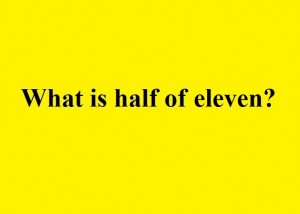
What is half of eleven?

Obviously, the first half is “e-l-e” . . .

ele

. . . and the second, “v-e-n”.

ele & ven

Or, half of the word “eleven” is made up of the vowel “e” . . .

eee

. . . and the other half is made up of consonants.

eee & lvn

I suggest to you that God’s numerous rhetorical questions are meant to get Job to look at himself, his situation, his losses, and his current condition, from a different perspective, to understand God in a different way. God’s response to Job is like asking “What is half of 11?”

Just like us, when we read that question as being only and solely a math problem, Job has a particular way of seeing the world, a particular way of understanding reality, a particular way of understanding God. His frame of reference, if you will, was the social structure of his world, the village, clan, and family structure within which his life was lived. Job’s theological imagination was framed by that structure; the metaphors through which he sought to understand God came from that structure. Just as Job, acting as a person of honor, would hear and respond to a complaint from one of his employees or one of his children, so he believed God would hear and respond to his case. “Job’s image of God is developed out the highest and best values of his society, values that Job has always tried to embody.” (N.I.B., p. 556) This is fully in keeping with the Biblical tradition of “thinking about God by means of metaphors drawn largely from the realm of human relations.” (Ibid.) The problem, of course, is that such metaphors are limited and inadequate. God is not simply an ideal human person; God is “wholly other”, and God will not fit completely into the neat and tidy lines of our metaphors. Job is only partially correct about God. God will (and does) deal with Job as a loving Parent might deal with a child, but not in the way Job anticipates.

My daughter Caitlin recently shared with me an essay she wrote for one of her college courses. In it she related a story about my uncle, who was a very talented professional artist, teaching her to draw. This is her story:

My great uncle Richard was the first person to let me loose with a tool and tell me that I had the power to create “Art”. Sitting under an orange tree in my Grammy’s backyard, he handed me some colored pencils and told me to draw my favorite thing; at the time it was flowers. My geometric and organic patterns turned into a kid’s rendition of paisley. Once I got that flower thing down I wanted to move on to something more awesome. I couldn’t think of what to draw, so Uncle Richard decided to teach me a Surrealist technique to ease the imagination process. He told me to take a black pen, and without thinking about it too much, draw one continuous line all over the paper, “Just scribble it all up.”

After I scribbled the most extreme mess on the page, he told me to “make the ends meet.” I found the point at which I began my crazy doodle, connected the dots and then colored in the shapes between the lines with a myriad of color as he suggested. The great American painter Jasper Johns said the way to make art is to “Do something, then do something to that, then do something to that.”

My uncle had my daughter do something like this . . .

Squiggle

. . . and then do something like this to it.

Squiggle Colored-in

In this way, Uncle Richard taught Caitlin that she had (as she put it) “the power to create.” It must have worked; last year Caitlin painted this watercolor . . .

Red Snapper, copyright 2012, Caitlin Funston

and, with it, won a scholarship at the University of Missouri.

God’s response to Job, all those rhetorical questions – “Who?” “Where?” “How?” “What . . . can you . . . have you . . . do you know?” – were God’s way of getting Job to “just scribble it all up,” of getting Job to stop being confined within the lines and limits and inadequacies of his metaphors, of getting Job to think creatively, of helping Job to find wisdom by participating in the integrity of creation and through understanding of the interrelatedness of all things. God’s response was not asking Job “Who the hell are you?” and God wasn’t answering his complaint with “I’m God and you’re not.” God was, however, saying, “I’m God but not in anyway you’ve ever considered, understood, or even imagined.” God was saying, “Neither I nor the world I created will fit within the neat lines of your metaphorical box.”

God’s response to Job is an invitation, and therein is the balm for us as “Patients of Job”, the prescription for whatever sickens our souls, for remedy for whatever ails our realities. God’s response is an invitation to Job and to us to participate in creation, to “scribble it all up,” to do something, then do something to that, then do something to that, to answer “What is half of 11?” in unexpected ways, to be creative in our problem solving. The answer to Job’s problem is not to sit on his pile of ashes moaning and complaining, disputing legalisms and “did I deserve it?”s with his friends; the answer to Job’s problem is not to sit on his pile of ashes framing legal arguments and preparing to sue God! The answer to Job’s problem is to get creative, to do something unexpected, to think outside the box. And that is spiritual medicine for us because, just like Job’s, neither our problems, nor our world, nor our God . . .
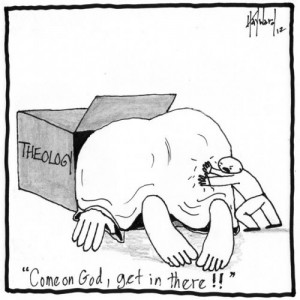
"Come on God, Get In There!!"

. . . will fit in our neat metaphorical boxes. Amen.

« Older posts Newer posts »