 Therefore, since we are surrounded by so great a cloud of witnesses, let us also lay aside every weight and the sin that clings so closely, and let us run with perseverance the race that is set before us, looking to Jesus the pioneer and perfecter of our faith, who for the sake of the joy that was set before him endured the cross, disregarding its shame, and has taken his seat at the right hand of the throne of God. (From the Daily Office Readings, Feb. 22, 2012, Hebrews 12:1-14)
Category: Spirituality (Page 112 of 116)
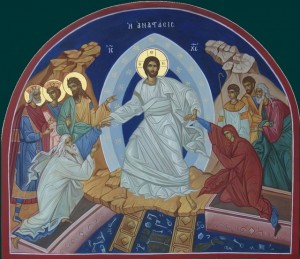 For his sake I have suffered the loss of all things, and I regard them as rubbish, in order that I may gain Christ and be found in him, not having a righteousness of my own that comes from the law, but one that comes through faith in Christ, the righteousness from God based on faith. I want to know Christ and the power of his resurrection and the sharing of his sufferings by becoming like him in his death, if somehow I may attain the resurrection from the dead. (From the Daily Office Readings, Feb. 21, 2012, Philippians 3:8b-11)
 If then there is any encouragement in Christ, any consolation from love, any sharing in the Spirit, any compassion and sympathy, make my joy complete: be of the same mind, having the same love, being in full accord and of one mind. Do nothing from selfish ambition or conceit, but in humility regard others as better than yourselves. Let each of you look not to your own interests, but to the interests of others. Let the same mind be in you that was in Christ Jesus. (From the Daily Office Readings, Feb. 20, 2012, Philippians 2:1-5)
 Now the Lord is the Spirit, and where the Spirit of the Lord is, there is freedom. And all of us, with unveiled faces, seeing the glory of the Lord as though reflected in a mirror, are being transformed into the same image from one degree of glory to another; for this comes from the Lord, the Spirit. (From the Daily Office Readings, Feb. 19, 2012, 2 Cor. 3:17-18)
 “We know love by this, that he laid down his life for us – and we ought to lay down our lives for one another. How does God’s love abide in anyone who has the world’s goods and sees a brother or sister in need and yet refuses help? Little children, let us love, not in word or speech, but in truth and action.” (From the Daily Office Readings, Feb. 18, 2012, 1 John 3:16-18)
On Sunday, February 12, 2012, the reading from the Hebrew Scriptures for Christian churches which use the Revised Common Lectionary (the Episcopal Church being one of them) was the story of Naaman, a general from the country of Aram (modern day Syria). Naaman is a leper who comes to Israel and is cured when, following instructions of Elisha the prophet, he bathes in the River Jordan. Here is how the story is related in the first half of the fifth chapter of the Second Book of Kings:
Naaman, commander of the army of the king of Aram, was a great man and in high favor with his master, because by him the LORD had given victory to Aram. The man, though a mighty warrior, suffered from leprosy. Now the Arameans on one of their raids had taken a young girl captive from the land of Israel, and she served Naaman’s wife. She said to her mistress, “If only my lord were with the prophet who is in Samaria! He would cure him of his leprosy.” So Naaman went in and told his lord just what the girl from the land of Israel had said. And the king of Aram said, “Go then, and I will send along a letter to the king of Israel.”
He went, taking with him ten talents of silver, six thousand shekels of gold, and ten sets of garments. He brought the letter to the king of Israel, which read, “When this letter reaches you, know that I have sent to you my servant Naaman, that you may cure him of his leprosy.” When the king of Israel read the letter, he tore his clothes and said, “Am I God, to give death or life, that this man sends word to me to cure a man of his leprosy? Just look and see how he is trying to pick a quarrel with me.”
But when Elisha the man of God heard that the king of Israel had torn his clothes, he sent a message to the king, “Why have you torn your clothes? Let him come to me, that he may learn that there is a prophet in Israel.” So Naaman came with his horses and chariots, and halted at the entrance of Elisha’s house. Elisha sent a messenger to him, saying, “Go, wash in the Jordan seven times, and your flesh shall be restored and you shall be clean.” But Naaman became angry and went away, saying, “I thought that for me he would surely come out, and stand and call on the name of the LORD his God, and would wave his hand over the spot, and cure the leprosy! Are not Abana and Pharpar, the rivers of Damascus, better than all the waters of Israel? Could I not wash in them, and be clean?” He turned and went away in a rage. But his servants approached and said to him, “Father, if the prophet had commanded you to do something difficult, would you not have done it? How much more, when all he said to you was, `Wash, and be clean’?” So he went down and immersed himself seven times in the Jordan, according to the word of the man of God; his flesh was restored like the flesh of a young boy, and he was clean. (2 Kings 5:1-14 [NRSV])
That’s where the RCL leaves the story, with Naaman cleansed by the mighty power of God. Great story! Wonderful story! A miracle healing that proves the power of God. It fits well with the gospel lesson appointed for the day from Mark’s Gospel:
A leper came to Jesus begging him, and kneeling he said to him, “If you choose, you can make me clean.” Moved with pity, Jesus stretched out his hand and touched him, and said to him, “I do choose. Be made clean!” Immediately the leprosy left him, and he was made clean. After sternly warning him he sent him away at once, saying to him, “See that you say nothing to anyone; but go, show yourself to the priest, and offer for your cleansing what Moses commanded, as a testimony to them.” But he went out and began to proclaim it freely, and to spread the word, so that Jesus could no longer go into a town openly, but stayed out in the country; and people came to him from every quarter. (Mark 1:40-45 [NRSV])
Another wonderful story of the healing power of God.
But … I’m troubled by the fact that the reading from the Hebrew Scriptures ends where it does. As the story continues in the rest of 2 Kings 5, we find that Naaman, inspired by his healing, has become a follower of Yahweh. Here’s the rest of Naaman’s interaction with Elisha in 2 Kings 5:
Then he returned to the man of God, he and all his company; he came and stood before him and said, “Now I know that there is no God in all the earth except in Israel; please accept a present from your servant.” But he said, “As the Lord lives, whom I serve, I will accept nothing!” He urged him to accept, but he refused. Then Naaman said, “If not, please let two mule-loads of earth be given to your servant; for your servant will no longer offer burnt offering or sacrifice to any god except the Lord. But may the Lord pardon your servant on one count: when my master goes into the house of Rimmon to worship there, leaning on my arm, and I bow down in the house of Rimmon, when I do bow down in the house of Rimmon, may the Lord pardon your servant on this one count.” He said to him, “Go in peace.” (2 Kings 5:15-19a [NRSV])
Naaman is presented with the moral and religious dilemma of doing something his king will demand (joining him in worship of Rimmon) which he knows is abhorrent to his new allegiance, Yahweh. He basically asks Elisha if God will forgive this, to which Elisha merely responds, “Go in peace.” I assume that means not to worry, that Yahweh is a forgiving god and will not find fault in Naaman, but one must admit that it is ambiguous. This is a dilemma that we face on a daily basis – demands of employers, schools, sports teams, friends, governments, family, etc. which are at odds with the dictates of religion. – The reading as it stands leaves us with Naaman fully cleansed by God, but the rest of the fifth chapter of 2 Kings leaves us with a very different Naaman, a Naaman troubled by the conflict between the requirements of faith and the demands of the world.
Now what I find fascinating is not the first similarity between Naaman and the unnamed leper in Mark’s story, i.e., that they are cured, but rather the second similarity, that they are both confronted with religious proscriptions! Naaman somehow knows that he is not to worship other gods; someone somewhere at sometime has told him of Yahweh’s first commandment to his people, “I am the Lord your God, who brought you out of the land of Egypt, out of the house of slavery; you shall have no other gods before me. You shall not make for yourself an idol, whether in the form of anything that is in heaven above, or that is on the earth beneath, or that is in the water under the earth. You shall not bow down to them or worship them.” (Exodus 20:2-5a [NRSV]) Naaman knows that his king will demand that he do something which will violate this command and he wants to be assured that in breaking it he will not be punished (perhaps by loss of his cure?). The leper in the gospel story also knows of a command; he’s given one point-blank by Jesus, “See that you say nothing to anyone…” (Mark 1:44 [NRSV]) But he goes right out and breaks it! “He went out and began to proclaim it freely, and to spread the word, so that Jesus could no longer go into a town openly, but stayed out in the country; and people came to him from every quarter.” (Mark 1:45)
Two responses to religious proscription. What are we to make of these? How are we to form some sort of understanding of our response to the demands of faith, the demands of religion when scripture gives us two such widely varying examples … and, in truth, there are three. We’ve not yet finished the fifth chapter of the Second Book of Kings, for the story of Elisha and Naaman is not finished until Elisha’s servant Gehazi is dealt with. What an interesting contrast there is between the servants of Naaman, who are not followers of Yahweh, and Gehazi, who allegedly is!
The chapter concludes with this vignette:
But when Naaman had gone from him a short distance, Gehazi, the servant of Elisha the man of God, thought, “My master has let that Aramean Naaman off too lightly by not accepting from him what he offered. As the Lord lives, I will run after him and get something out of him.” So Gehazi went after Naaman. When Naaman saw someone running after him, he jumped down from the chariot to meet him and said, “Is everything all right?” He replied, “Yes, but my master has sent me to say, ‘Two members of a company of prophets have just come to me from the hill country of Ephraim; please give them a talent of silver and two changes of clothing.'” Naaman said, “Please accept two talents.” He urged him, and tied up two talents of silver in two bags, with two changes of clothing, and gave them to two of his servants, who carried them in front of Gehazi. When he came to the citadel, he took the bags from them, and stored them inside; he dismissed the men, and they left. He went in and stood before his master; and Elisha said to him, “Where have you been, Gehazi?” He answered, “Your servant has not gone anywhere at all.” But he said to him, “Did I not go with you in spirit when someone left his chariot to meet you? Is this a time to accept money and to accept clothing, olive orchards and vineyards, sheep and oxen, and male and female slaves? Therefore the leprosy of Naaman shall cling to you, and to your descendants forever.” So he left his presence leprous, as white as snow. (2 Kings 19b-27 [NRSV])
So we have three responses to the demands of religion when set at odds with the demands of the world:
- Naaman’s response which is to seek forgiveness (even before being placed in the position of disobeying the religious command);
- The leper’s response which is to freely and openly disobey the command (here in obedience to a perhaps over-riding sense of duty to spread the Good News);
- Gehazi’s response to furtively disobey (and then lie when caught).
So what are we to do? What are we to make of these? How are we to form some sort of understanding of how we are to make religious decisions, ethical decisions when scripture gives us such widely varying examples? Well, clearly, we are not to do what Gehazi the servant did, but that still leaves us with little guidance.
The truth is that Scripture is not a rule book and does not give us clear guidance; we have to use our minds or, as our Anglican theological convention would put it, we have to turn to tradition (the discernment of the church throughout the ages) and reason (our own rational faculties informed by experience and inspired by the guidance of the Holy Spirit).
A framework for ethical or religious decision-making might include these steps. First, recognize whether it is an ethical issue: Is it a situation in which your decision could be damaging to some individual (including yourself) or to some group? Is it a decision which involves a choice between a good and bad alternative, or between two goods or maybe even between two bads? Is it an issue about more than what is legal or what is most efficient? Is it a question about balancing the demands of religion against the demands of the world?
Second, get the facts. What are the relevant facts of the case? What do you not known? Is there more to learn about the situation? Do you know enough to make a decision? What individuals and groups have an important stake in the outcome? Should they be consulted? Are some concerns more important? Why? What are your options for action? Have you identified creative options?
The third step is to evaluate your options by considering them in light of one or more of the following questions which represent the five different philosophical approaches to ethical decision-making:
- The utilitarian approach asks which the outcome will provide the most good or do the least harm, or, to put it differently, which option will produces the greatest balance of good over harm.
- According to a second approach, the most ethical action is the one that best protects the moral rights of those affected, so the question to ask is, “Which option best respects the rights of all who have a stake?”
- The third approach, based on the philosophy of Aristotle and other Greek, argues that all equals should be treated equally, or at least fairly based on some defensible standard. So the evaluative question is, “Which action will treat those involved equally or proportionately?”
- Greek philosophers also contrived the notion that life in community is a good unto itself and our actions should contribute to that life, so the “common good” approach asks which option would best serve the community as a whole, not just some of its members?
- The fifth method of making an ethical or religious decision has been called “the virtue approach”. According to this approach, the ethical decision is the one which will accomplish the highest potential of our character and accord with the classic virtues: truth, beauty, honesty, courage, compassion, generosity, tolerance, love, fidelity, integrity, fairness, self-control, and prudence. The evaluative question is, “Which option leads me to act as the sort of person I want to be?”
It is this fifth method of making a decision that most accords with our faith. But Christian morality is more than a commitment to some general, universal good, and it is about more than making decisions. The virtues are God-given qualities which we learn in the community of faith; they are the fruits of the Spirit given to the church. These virtues do not come about simply by making right decisions. They are learned skills developed in the process of character formation, in the process of learning to live in accordance with God’s will. It is the cultivation and exercise of these virtues within the community of faith that makes one a moral person; it is more than mere decision-making.
To be a follower of Yahweh and, specifically for us, to be a Christian is not principally about making ethical decisions; it is not about deciding to obey certain commandments or rules. It is about becoming a disciple, someone for whom the center of creation is the Creator. Our decisions will then reflect who we really are. The basic moral or ethical question for a follower of Yahweh, for a Christian is not, “What am I to do?” but “Who am I to be?” It is what theologian and ethicist Stanley Hauerwas calls “narrative ethics” as opposed to “decisionist ethics”. It is, he says, about entering into God’s story. As another theologian has said, it is about giving up being the star of one’s life’s story and allowing God to take center stage. God has invited us into God’s story, but God is always the star of that story. By learning to be his disciples, by finding our life in God’s narrative, we find our way into the moral life; we find that the decisions become less important because doing the right thing simply becomes a natural thing, part of the narrative. This is why Jesus, when challenged about the priority of the commandments, was able to say that there are only two important ones: Love God and love your neighbor. Enter into this narrative of love and everything else falls into place.
Deciding and doing are important, but the first ethic question for a follower of Yahweh is not “What ought we to do?” It is “What ought we to be?” And this brings us back to the two lepers in today’s lessons. The leper whom Jesus healed acted on the wrong question. Instead of entering into Jesus’ story and carrying forward the narrative Jesus was living out, he decided to do what called attention to himself, to remain the star of his story, to tell his own self-centered narrative of healing and, as a result, “Jesus could no longer go into a town openly.”
Naaman, on the other hand, entered into the story of the God of Israel and, becoming part of that story, recognized his need to conform to it. He moved from a self-centered narrative of which he was the star and entered into God’s narrative, the story which would create in him the character God would call him to be, and so the prophet bids him, “Go in peace.”
Stories of miracle cures are wonderful! They prove the mighty power of God. But the last half of the fifth chapter of 2 Kings is much more challenging than the first and much more instructive as we struggle to live into our parts in God’s story!
 Well, here we are, all ready to hear what it is the preacher said. Mark has told us that this preacher taught with authority and not like other teachers the people may have heard, so we have taken our bulletins and used them to mark our place in the Prayer Book; we have settled comfortably into our pews; we are ready to hear the wisdom this Jesus had to offer.
Mark has told us that Jesus “taught as one having authority, and not as the scribes.” At first this may seem to us a bit strange; we ask, “Don’t the scribes have authority? Aren’t they the scholars of the law? Licensed by the priests in the temple to teach the people? Don’t they have authority to speak for the religious establishment? What does Mark mean by this distinction between Jesus as one with ‘authority’ and the scribes as something else?”
It helps, I think, to look briefly as the Greek word Mark uses, the word translated as “authority.” It is exousian. This is a compound word made up of the prefix ex, which means “out of” or “from”, and the word ousian which, among other things, means “being” or “substance”. This compound word (Strong’s Lexicon tells us) refers to “the ability or strength with which one is endued.” In other words, this is not delegated authority, such as the scribes possessed; Jesus’ authority comes from the core of his being – it comes from Who he is!
So Mark has us all prepared to listen: this Jesus really knows his stuff – he teaches with authority – we’d best pay attention to what he said!
And then Mark doesn’t tell us! He changes the subject and tells us about this crazy, demon-possessed interrupter.
Mark is very cagey; this author knows exactly what he is doing. He knows all too well that when a writer reports what someone else has said, the focus of the reader’s attention shifts away from the speaker to the words which were spoken. We human beings almost immediately cease to pay attention to the speaker and, instead, to try to parse out the meaning of the words spoken, to lock them down and bind them up, to cast the words (especially the words of someone like Jesus) in stone or to interpret them into a rule that we can apply for all time.
Some of you know that I’m a fan of the now-disbanded English comedy group Monty Python’s Flying Circus. They make this very point in their movie Life of Brian. For those of you who don’t know the movie, it’s the life story of another baby born in another stable laid in another manger, a baby named “Brian” who grows up sort of just a step behind Jesus. At one point in the movie, Brian is at the edge of the crowd at the Sermon on the Mount; he is so far away from Jesus that those around him can hardly hear what Jesus is saying. When Jesus says, “Blessed are the peacemakers,” someone asks what he said and a discussion ensues:
Man #1: I think it was “Blessed are the cheesemakers.”
Woman: Ahh, what’s so special about the cheesemakers?
Man #2: Well, obviously, this is not meant to be taken literally. It refers to any manufacturers of dairy products.
Mark knows that exactly this would happen if he were to report what Jesus said in the synagogue in Capernaum that long-ago sabbath. He knows that if he were to tell us whatever it was that Jesus taught to that congregation, whatever it may have been that Jesus said to the demon-possessed man or to the demon, we would tie it up in a hard-bound book and preserve it and make it last and eventually twist it around someway so that it became both more and less than what it originally was, so that it became more important than the Person who said it. But the important thing, the true thing, the Truth is not what was said but Who said it; not the message, but the Messenger; not the proposition, but the Person. Mark wants us to focus on the Word, not his words.
I pretty regularly read a blog by a Presbyterian pastor named Mark Sandlin. His blog is called The God Article. Recently he published this graphic:

Mark the evangelist doesn’t tell us what Jesus said because he knows that someone (probably a lot of us) knowing what Jesus said would claim to know “the truth”, try to force someone else to follow that “truth”, and thereby demonstrate that we really hadn’t found the Truth at all!
And that’s really what Paul is writing to the Corinthians about in today’s epistle reading. At first reading it seems to be about dietary rules. After all, Paul is answering the question, “Is it OK to eat meat which has been sacrificed to pagan gods?”
Here’s the deal … the Corinthian church was in an uproar, just going crazy because some people were doing just that. Corinth was a crossroads city, a major commercial center. People from all over the known world, people with all sorts of religions, gathered there. Some of those religions involved (as Judaism did in the Jerusalem temple) the sacrifice of animals on the altars of their idols. The clergy who conducted those sacrifices supported themselves by later selling the meat from those sacrificed animals. Some in the Corinthian church believed that the meat was “tainted” spiritually by having been so used and that eating it “tainted” the soul of the consumer; other church members thought that was nonsense – they knew better! they knew “the truth”! And they were going to act on that “truth”, on that knowledge and, in a sense, force the rest of the church to go along with them. But “knowledge puffs up,” as Paul put it so bluntly; it does not build up (love does that).
So let me ask you this … Well, first let me ask you something else?
What’s the opposite of black? (The congregation suggests “white”.) Is it? What about charcoal grey, or pearl grey, or chartreuse, or puce….? What’s the opposite of up? (The congregation suggests “down”.) Well…. what about diagonal? or sideways? or circular?
So what I was going to ask is this … What’s the opposite of truth? (Someone in the congregation suggests “lies”.) That’s what we think, isn’t it? That the opposite of truth is falsehood? But what these bits of Scripture today show us is that the opposite of truth is craziness!
While I was preparing for today I read a sermon on this gospel passage by the dean of the cathedral in Atlanta, Georgia, the Very Rev. Samuel Candler. In that sermon, Dean Candler wrote:
I have served five churches in my ordained life, and it never fails. In every place I have ever ministered, just when things are beginning to go right, the crazies show up. Just when I am having a delightful conversation, some crazy person interrupts. Just when the committee has reached a spectacular decision, the crazy one jumps up to speak. Just when it looks like the entire congregation is happy, the crazies show up angry and upset.
It’s the same way in other institutions besides churches. We ask ourselves, “How in the world did that crazy person get into this group?” We even find usually reasonable people suddenly acting crazy. It happens in our families. We ask our lover, “Where did that crazy comment come from?” (Day 1 Sermon: January 29, 2006)
Whenever the Truth begins to really hold sway, the craziness comes. That’s what happened in Corinth, all that craziness around what to eat and whether it’s OK to eat something. That’s what the lesson from Deuteronomy warns about. What God said to Moses there can be paraphrased, “I’ll be sending someone to speak truth, but in the meantime a lot of other people will show up talking crazy! They’ll claim to represent other gods, or they’ll claim to represent me but say things I couldn’t possibly have anything to do with; they’ll just be talking crazy!” And that’s what happened in the Capernaum synagogue that sabbath. Truth began to hold sway, and craziness walked in and interrupted.
We all have craziness in our lives. As Dean Candler said, it happens all the time. Some craziness is easy to identify: addiction to drugs or alcohol, medical problems, worries about money. Some isn’t so easy to peg: an over-weaning attachment to the past perhaps, or an excessive concern about the future, or an over-acquisitiveness of money and possessions. Whatever … there are all sorts of idols to which we can become attached, all sorts of craziness that can infect our lives. If Mark had told us what Jesus said to the demon-possessed man, someone might try to tell us that that is the answer to our craziness … which, of course, it wouldn’t be: it was the answer to his craziness, not to ours. But someone would try to tell us that if we just believe what Jesus taught or said that day in the synagogue ….
There was a Lutheran seminary professor named Gerhard Frost who died in 1988. Dr. Frost, in addition to being a theologian, was also a poet. I thought of his work and one poem in particular as I contemplated today’s lessons. The poem is entitled Loose-Leaf:
When your options are either
to revise your beliefs
or to reject a person,
look again.Any formula for living
that is too cramped
for the human situation
cries for rethinking.Hardcover catechisms
are a contradiction
to our loose-leaf lives.(Gerhard E. Frost, Seasons of a Lifetime, p. 57, Augsburg Fortress: Minneapolis 1987)
That’s the genius of Mark, that “hardcover catechisms are a contradiction to our loose-leaf lives.” If Mark had written down what Jesus taught that congregation or what Jesus said to the demon-possessed man or to the demon, human beings would have tightly bound those words; they would have become “hardcover catechisms”. They would have become a message more important than the Messenger; the what would have overshadowed the Who; the proposition of belief would have obscured the Person before us. But as Paul wrote to the Corinthians, it is not knowledge that overcomes craziness; it is Love – Love in the Person of Jesus Christ who is the Truth. In a way never meant by those who usually say it, it’s not what you know, it’s Who you know!
We live loose-leaf lives into which craziness comes in all sorts of ways. Open the binder of your loose-leaf life and make room for Truth. We may not know what Truth spoke to the craziness in the synagogue, but we can be sure that Truth will always speak to the craziness in our lives. Open the binder of your loose-leaf life and let Truth speak to you. Amen.
This sermon has been taken down for editing – it will be back up shortly.
As many of you know, I have a tradition of keeping my eye open, while doing my Christmas shopping, for some object to use as a physical illustration for this annual event, this sermon on the Nativity of Our Lord and Savior Jesus Christ. Over the years, these illustrative objects have included a pair of Christmas stockings, a Christmas banner with the greeting misspelled, and a stuffed frog wearing a Santa hat. Finding and using the annual “focus object” has become a source of great fun for me and I hope for the congregations who’ve been subjected to my preaching.
 Over the past ten days or so I have been required almost every day to visit one of our larger local grocery stores, one which has a center section devoted to seasonal merchandise. On each visit as I walked through that section, one item on a top shelf kept catching my attention, but each time I declined to buy it. Every day I would go away and wonder why I was attracted to that particular thing, and those contemplations made their way into my notes for this homily.
Finally, yesterday I went to the store and bought it – meet Frosty the Snowman.
Our son, Patrick, will be ordained to the priesthood on January 7, 2011, at Grace Cathedral in Topeka, Kansas. Since being ordained a deacon last June, Patrick has been serving as chaplain at the Seabury Academy, a private Episcopal middle- and high-school in Lawrence, Kansas. On Sundays, he has ministered in a variety of congregations in northeastern Kansas and will continue to do so once ordained a priest.
As I look forward to the New Year, it is Patrick’s new ministry that is foremost in my mind and so I share with you an open letter to him:
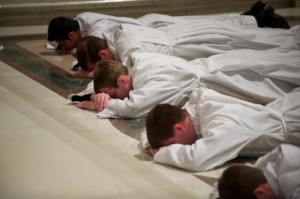 Dear Patrick,
The mix of emotions I am experiencing as we get close to your priestly ordination is beyond description: joy, pride, fear, apprehension, love, and many other feelings. You have already started on the great, often exciting, frequently troubling, occasionally maddening journey of ordained ministry: I am praying for God’s guidance as you continue the journey. I hope you don’t mind if I publicly share with you a few words of advice. I have made many mistakes in ministry, so I hope my experience can be useful to you.
First, preach the word honestly and genuinely; preach it as you understand it. Writing to the young bishop Timothy, St. Paul asserted that all Scripture is inspired by God, and thus he admonished Timothy to proclaim the gospel whether it was popular or not, and whether it was convenient or not. There will be many words that you can preach and teach, but never stray from the gospel as you know it.
Second, love the people committed to your care. I’m talking about agape, Patrick, not mushy sentimentality. Respect them, guard their dignity; if you disagree with them, try to do so without being disagreeable; be genuine with and to them. I have spent many hours with several clergy, both Episcopalians and those of other traditions. Many of these good men and women are hurting. They are cynical about ministry and the local church. They have been criticized and hurt by church members many times. I often find myself sharing their cynicism, their hurt, and their anger. When you feel this way, take some time for yourself; talk to a friend; seek the advice of a colleague; rely on your bishop. Try as hard as you can to not reflect your hurt back to the people you serve.
Patrick, ministry is tough; it’s demanding and it’s often painful. If you haven’t already, you soon will find out that you can’t please everyone. But you must struggle to not become cynical. You must love the people you have been called to serve – no matter what. You must try to love unconditionally as Christ loved me and you. Jesus didn’t give up on us. He loves us even when we aren’t loveable. Try to reflect that in your ministry.
A friend of mine once characterized priestly ministry as “being required to be with people in their worst nightmares, but being privileged to also share their greatest joys.” Let the nightmares go and hang on for dear life to the joys, my son.
Third, stay connected to your colleagues in ministry. Be a part of a clergy discussion group; work with a spiritual director. Ordained ministry can be and often is a lonely calling and, certainly, there are times when one needs solitude. But there will be more times when you will need the support of those who share this calling.
Fourth, make your family a priority. You and Michael are still newlyweds, and she needs and deserves your attention. The work of ordained ministry is never done, so don’t think that 80 hours a week at the school or the church is necessary to stay caught up. Accept the reality that you will never catch up fully. God willing, you will soon be a father yourself (very soon if this would-be grandfather had his choice). They will need their father, and Michael needs her husband.
One of the most heartbreaking aspects of my ministry is that I know that I failed to heed this advice myself. I spent too much time trying to be the perfect rector, trying to grow our parish in Kansas, and too little time with you and your sister as you grew up. (Truth be told, I still do that – I still spend too much time trying to be the perfect rector and I still fail at it. It’s hard to break old habits.) I’m very proud of the way you have both turned out, but I can take very little credit for that.
Patrick, you have many great days ahead of you. The church is an imperfect but wonderful gift from God. You have so much to offer, but keep your priorities in order and don’t squander your gifts. Spend time with God. Spend time with colleagues. Especially spend time with your family. Tell others the Good News of Jesus. Preach the Word. And love your students and, when you move into parish ministry, your church members with joy and acceptance.
Patrick, I am here if you ever need me. But even if you can’t call me for advice and conversation, our heavenly Father is always there for you. Remember what Paul wrote to the Church in Rome: “I am convinced that neither death, nor life, nor angels, nor rulers, nor things present, nor things to come, nor powers, nor height, nor depth, nor anything else in all creation, will be able to separate us from the love of God in Christ Jesus our Lord.” (Romans 8:38-39)
I love you, my son.
Dad
My New Year’s Resolution is try to follow my own advice. I trust that the members of my parish will remind me when I fail to do so; they always do.


