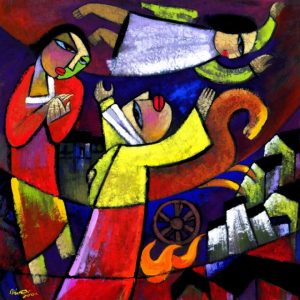
 “The Lord your God will raise up for you a prophet like me from among your own people; you shall heed such a prophet.”[1] So said Moses in his farewell address to the Hebrews, to those who were about to enter the Promised Land and begin to become the nation of Israel. As that nation grew and developed it was ruled by tribal leaders and “judges,” by military leaders and priests, by kings (who were occasionally themselves ruled by queens), some of whom were mostly good and others of whom were mostly not-so-good. Throughout all that time, God raised upon not merely “a prophet,” but many prophets: Samuel, Ezekiel, Elijah, Elisha, Isaiah, Jeremiah, Micah, Hosea, Amos, and many, many others.
And there were others who claimed to be prophets but turned out to be either false prophets or prophets of other gods. These were the ones of whom God decreed through Moses, “Any prophet who speaks in the name of other gods, or who presumes to speak in my name a word that I have not commanded the prophet to speak—that prophet shall die.”[2] The Hebrew Scriptures tell us of some of these prophets and their deaths: I think particularly of the 450 prophets of Ba’al who served Queen Jezebel with whom Elijah did battle. When their god failed them the people rose up at Elijah’s bidding and killed them.
 A couple of months ago, I was part of a conversation among several parishioners about the set-up for our celebrations of the Nativity. We looking at our plans for Christmas services, and a member of our altar guild exclaimed, “That’s the problem! Things are always changing around here!”
 Introductory Comment:
 Why do we do this? Why do we gather when a loved one dies and hold assemblies like this? Most human beings believe that death is not the end of the person who has passed away. Except for the few human beings who really strongly subscribe to an atheist philosophy, and they truly are a minority of our race, everyone on earth belongs to some faith group which teaches that we continue on, whether it is by reincarnation or in the Elysian Fields or the happy hunting grounds, as a guiding ancestral spirit or at rest in the presence of our Lord. So why do we do this?
 Christmas is now done. It ended Friday on Twelfth Night. I am sure than none of you, good Anglican traditionalists that we all are, put away any of your decorations before then, but have by now put them all away.
  “In the beginning was the Word . . . .” The Prologue of John’s Gospel echoes the opening words of the Bibe, “In the beginning God said . . . .” Our God is a god who communicates, who speaks, whose Word creates.
  One of the commentaries I read this week about our gospel lesson was written by a Lutheran serminary professor named Jan Schnell Rippentrop. She noted three things about John the Baptizer’s self-description in the Fourth Gospel:

