Occasional thoughts of an Anglican Episcopal priest

Category: Theology (Page 21 of 95)

Act Three (Pt 1): Fully Human – Easter Vigil 2017

====================

A homily offered by the Rev. Dr. C. Eric Funston at the Great Vigil of Easter, Saturday, April 15, 2017, to the people of St. Paul’s Episcopal Church, Medina, Ohio, where Fr. Funston is rector.

(The lessons for the service are from the Revised Common Lectionary: Genesis 1:1-2:4a; Exodus 14:10-31,15:20-21; Proverbs 8:1-8,19-21,9:4b-6; Zephaniah 3:14-20; Psalm 114; Romans 6:3-11; and St. Matthew 28:1-10. These lessons can be read at The Lectionary Page.)

====================
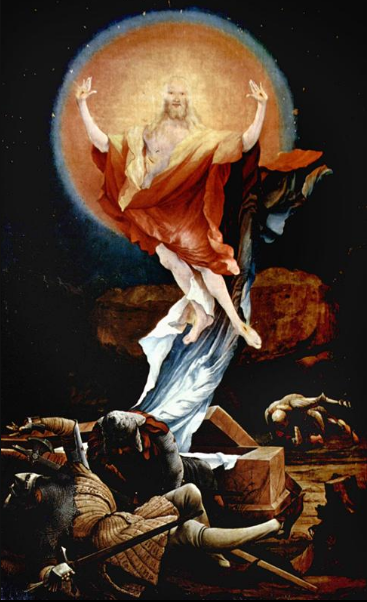
Two weeks ago, the Sunday lectionary treated us to the entire long Gospel lesson of the story of Jesus’ raising of Lazarus and then last week the Daily Office lectionary repeated it in smaller bits over the course of several days. Last Sunday I suggested that Holy Week and Easter can be conceived as a three-act drama to which the Triumphal Entry of Palm Sunday is an overture.

The Lazarus story, like last Sunday’s Gospel, is part of that overture, the introduction to the three-act drama of celebration in which we have participated this week and in which we have come, this evening, to the third and final act. Lazarus has been much on my mind as we have prepared for this Easter celebration and for the baptisms we have just performed. I believe the story of Lazarus’ raising has much to teach us about what we have done here tonight in this third act, this Baptismal Vigil, this liturgy of welcoming and inclusion.

Lazarus was the brother of Mary and Martha of Bethany; they are a family which figures prominently in the Gospels as friends of Jesus. They are clearly people who believe in Jesus and in his mission, but their belief is much, much more than simply signing on to his program, a new approach to religion. This family really seems to know Jesus; he apparently stayed with them on several occasions. He lodged with them, ate with them, taught in their home. When word is sent to Jesus that Lazarus is ill, Lazarus is described to him as “he whom you love.” (John 11:3) Lazarus and his sisters are close to Jesus; they are practically family, may even be family.

As the story of Lazarus raising is told, the family is described as accompanied by “Jews.” That has always struck me as a bit odd. After all, aren’t they all Jews? Mary, Martha, Lazarus, Jesus, the whole lot of them? Of course they are! So many scholars suggest that we should better understand John’s term Ioudaiou to mean “Judeans,” that is people native to the Jerusalem area; these scholars suggest that Mary, Martha, and Lazarus, like Jesus, were Galileans who had moved to Judea and been accepted into this southern community. This strengthens the suggestion that they may have been members of Jesus’ extended family.

Next, when both of the sisters greet Jesus (Martha’s greeting is earlier in the story), the very first thing each says is, “If you had been here, he wouldn’t have died.” (John 11:21 & 32) Not “Hi, how are you?” Not “Welcome back.” Not “I’m so sorry we have to tell you.” What the sisters say is not really a greeting; it’s an angry, accusative confrontation. “You could have prevented this!”

We’re told that Jesus’ response to this is that he is “greatly disturbed in spirit and deeply moved.” That’s a fine translation, but it’s also a bit misleading. The Greek word rendered “disturbed” very literally means he “snorted with anger”; and the word translated “deeply moved” means “stirred up” and implies a certain physicality, not simply an emotion. Jesus response to the sisters’ confrontations, to Lazarus’ death, to the whole situation is to become indignant and sick to his stomach.

The Lazarus story contains the shortest verse in the New Testament, famously rendered in the King James Version with only two words, “Jesus wept.” Some of the Judeans, John tells us, interpreted this as a sign of Jesus’ love for Lazarus; “See how he loved him!” they said. While I’ve no doubt that that is true, I suggest that, since John describes Jesus as angry and physically sick, we might consider another way to understand what is happening in this story.

We have just baptized four children and, together with them, we have affirmed the Baptismal Covenant beginning with a recitation of the Apostle’s Creed in which we will claim that Jesus, the Son of God, was “conceived by the power of the Holy Spirit and born of the Virgin Mary” (BCP 1979, p 304). In the Nicene Creed, which we recite most Sundays during the Holy Eucharist, we go further and declare that he “became incarnate . . . and was made man,” that is, that he became a flesh-and-blood human being. (BCP 1979, p 358). In the Definition of Chalcedon, which you can find on page 864 of the Prayer Book, the church goes even beyond that and asserts its conviction that Jesus is “truly [human] . . . like us in all respects, apart from sin.”

I believe that standing before that tomb where his beloved friend Lazarus had been buried four days earlier, feeling the anger and frustration of his close friends Mary and Martha, surrounded by Judeans muttering “couldn’t he have prevented this,” and perhaps physically exhausted from traveling from the other side of the Jordan valley where he was when he got the news, Jesus’ humanity hit him like a ton of bricks. In that moment, everything that it meant to be human came crashing in on him: the way human beings settle for easy answers, half-truths, and superficial relationships; the injustice, oppression, and exploitation we impose on one another; the pain, rejection, hunger, and war we endure . . . but, also, the love, friendship, community, family, support, and every other good thing about being a human being; it all come together in that moment standing at that grave.

Why do I think that? Because that’s what I feel every time I stand at a grave. The first time I did that, I was 5-1/2 years old. I remember standing between my mother and my paternal grandmother watching two members of the US Army fold the flag that had draped my father’s coffin, feeling loss, grief, anger, confusion, and emotions I couldn’t even name. But there was also the love of family, pride in my father’s military service, a sense of community with extended family and friends, all the comfort that comes from our common humanity. And every time I have stood beside a grave, I have felt that again, and I can surely imagine that our Lord experienced something very like that. No wonder Jesus – the sorrowful-but-also-angry and stirred-up Jesus, the knowing-he-too-might-soon-be-dead Jesus, the fully-human, like-us-in-all-respects Jesus – wept.

We should feel that same way when we welcome a new member into the household of God through the Sacrament of Baptism. Symbolically, baptism is burial; in the oldest tradition of the church, full immersion baptism, we go down under the water in the same way a body is buried in the earth, then we come up out of the water as Lazarus came from his tomb, as Jesus came from his grave. Baptism is death, burial, and restoration to life all encapsulated in one short liturgical act. As St. Paul asks in his letter to the Romans which was read just a few minutes ago, “Do you not know that all of us who have been baptized into Christ Jesus were baptized into his death?” The Prayer Book says in the blessing of the baptismal water, “In it we are buried with Christ in his death.”

St. Paul’s assurance that “if we have been united with him in a death like his, we will certainly be united with him in a resurrection like his,” is echoed by the Prayer Books bold promise that by baptism we share in Jesus’ resurrection, and that “through it we are reborn by the Holy Spirit.” (BCP 1979, p 306) As Jesus called for Lazarus to be unbound from his funeral wrappings, as Jesus himself rose and set aside his shroud, through Holy Baptism our Lord calls us “from the bondage of sin into everlasting life” (ibid), into a new life of full humanity joined with those whom the Psalmist describes as having “clean clean hands and a pure heart, [those] who have not pledged themselves to falsehood nor sworn by what is a fraud, [those who] shall receive a blessing from the Lord and a just reward from the God.” (Ps 24:4-5)

The Creation story in Genesis tells us that “God created humankind in his image, in the image of God he created them; male and female he created them.” (Gn 1:27) The story of the Fall reminds us that somehow that divine likeness has been marred, that on our own we fail to live up to that image; we fail to fully live up to the potential God created in humankind. Through baptism, the divine image is restore; through our baptism into the life, death, and resurrection of Jesus Christ, a process of transformation begins and God restores us to who and what we were meant to be – fully human.

When we baptized these children, we asked them and their baptismal sponsors (and we asked ourselves) some questions which are taken directly from the Apostle’s Creed, to which I referred earlier. These questions began with the words, “Do you believe . . . .”

A few years ago a colleague of mine said that he had once asked his congregation, when reciting the Nicene Creed, to say “We trust in” instead of “We believe in” since the original Greek could have been translated either way. He said he wondered if the church would be less fragmented if we had used “trust.” He suggested that there might have been far less of, “You don’t believe exactly what I believe, so I’m out of here,” or, “You don’t believe exactly what I believe, so you are out of here.” When we ask those questions of baptismal candidates and their Godparents, when we say the creeds ourselves, are expressing a deep affirmation of community whether we say, “We believe in . . .” or “We trust in . . .” Maybe we don’t “believe” exactly the same things that others here believe, but we all trust in the same God.

In that same conversation, another priest objected to what he called the distinction between “faith as trust and faith with content.” “It’s always struck me as a strange distinction,” he said. “If, for example, faith as trust is about relationship [and not about content], it is like someone saying to a prospective marriage partner, ‘I love you and I want to marry you, but I’m not certain who you are.’” I suggested to him, however, and I suggest to you now that this distinction really doesn’t exist, that faith as trust or as relationship necessarily implies and includes “faith with content.” One cannot place trust in another person, such as the Father, the Son, and the Holy Spirit named in the Creed, without assenting to that person’s existence and properties; to say, “I trust you” or “I love you” and not also agree that you exist makes very little sense.

This is why we ask those questions of baptismal candidates. When we say, “Do you believe in” the three Persons of the Holy Trinity, we are not merely asking if the candidates (and the congregation who join them in answering) are assenting to certain doctrines about them; we are asking if they claim to be in a relationship of trust and love with God the Holy Trinity, and through God with the full community of human beings whom God loves and whom God has redeemed in all that long salvation history that we have heard read from the Hebrew Scriptures this evening. When we baptized these children, when we baptize any new member of the Christian community, we recognize them as part of that fully human community whom God invites to “lay aside immaturity, and live, and walk in the way of insight” (Prov 9:6), whom God promises to save, and gather, and bring home, and restore. (Zeph 3:19-20)

That full human community relationship, I believe, is why Jesus wept. To be sure, he grieved the death of his friend Lazarus, but he knew he was about to do something to change that; there was no reason to cry about that. But that in-rushing crash of realization of what it is to be a human being, of what it is to be fully human, that is enough to make anyone cry. The story of the raising of Lazarus is a story about Jesus’ full humanity, the full humanity he shares with and promises to us, the full humanity which gathered with friends and family at the Last Supper in the first act of this drama of redemption, the full humanity which was arrested and brutalized and crucified in the second act, the full humanity whose Resurrection we celebrate in this, the third act, the feast of Easter. It is into that Easter promise that we have baptized Kadence, Bryce, Hadley, and Joseph this evening. And that is why the Lazarus story figures so prominently in the church’s preparations for Holy Week and Easter, part of the overture of this three-part drama of redemption!

In the words of a popular Franciscan blessing, let us pray that, as these children grow into the full humanity into which they are initiated today, God will bless them with discomfort at easy answers, half-truths, and superficial relationships, so that they may live deep within their hearts; that God will bless them with anger at injustice, oppression, and exploitation of people, so that they may work for justice, freedom, and peace; that God will bless them with tears to shed for those who suffer from pain, rejection, hunger, and war, so that they may reach out their hands to comfort others and turn their pain into joy; and that God bless them with enough foolishness to believe that they can make a difference in this world, so that they can do what others claim cannot be done, to bring justice, kindness, and love to all.

As they have been buried with Christ, they have begun to share in his Resurrection; may God bless them with the gift and the commission to be, like Christ, fully human. Amen.

====================

Father Funston is the rector of St. Paul’s Episcopal Church, Medina, Ohio.
Intermission: We Cannot Know – Holy Saturday 2017

====================

A meditation offered by the Rev. Dr. C. Eric Funston on Holy Saturday, April 15, 2017, to the people of St. Paul’s Episcopal Church, Medina, Ohio, where Fr. Funston is rector.

(The lessons for the day are from the Revised Common Lectionary: Lamentations 3:1-9, 19-24; Psalm 31:1-4,15-16; 1 Peter 4:1-8; and St. Matthew 27:57-66. These lessons can be read at The Lectionary Page.)

====================

Today is Holy Saturday, perhaps the least thought upon, least looked upon day in the Easter Triduum. A moment when the pomp and majesty of events ceases; no betrayals, no protestations of loyalty, no meaningful dinner, no demonstrations of servanthood, no admonitions to love, no agony, no dying, and, as yet, no rising — merely dormancy on all fronts. It is the Intermission of the three-act drama of Redemption.

A time, as poet Emily Polis Gibson quoting T.S. Eliot says is a time to Be Still and Wait:

I said to my mind, be still, and wait without hope

For hope would be hope for the wrong thing; wait without love
For love would be love of the wrong thing; yet there is faith
But the faith and the hope and the love are all in the waiting.
Wait without thought, for you are not ready for thought:
So the darkness shall be light, and the stillness the dancing.
~T. S. Eliot, from “East Coker,” The Four Quartets

This in-between day
after all had gone so wrong
before all will go so right,
puts us between the rock
and the hard place:
all hope, love and faith is squeezed from us.
Today we are flattened,
dried like chaff,
ground to pulp,
our destiny with death sealed.

We lie still
like sprinkled spices
trying to delay
inevitable decay,
wrapped up tight
stone cold
and futile.
The rock is rolled into place
so we lie underneath,
crushed and broken.
We are inside,
our bodies like His.
We are outside,
cut off and left behind.
We cannot know about tomorrow,
we do not fathom what is soon to come:
the stone lifted and rolled away,
the separation bridged,
the darkness giving way to light,
the crushed and broken rising to dance,
and the waiting stillness stirring, inexplicably,
to celebrate new life.

“We cannot know about tomorrow . . . . ” Poet and essayist Aaron Brown says that Holy Saturday “dwells in [the] place where words fail, between the bookends of suffering and resurrection. When the defiance of loss gives way to numbness, we are left in a space where time seems to slow, indeed seems to stop altogether.” (Brown) It is truly an intermission.

And yet it is not a time of inactivity. While we, the actors and cast of the yearly remembrance of the drama seem to languish, our faith teaches that the one who has died is active. We confess in each recitation of the Creed that “he descended to the dead.” It is the time called “the harrowing of hell” when the souls of the righteous dead are freed. An ancient anthem of the day sings

Our shepherd, the source of the water of life, has died.
The sun was darkened when he passed away.
But now man’s captor is made captive.

This is the day when our Savior broke through the gates of death.
He has destroyed the barricades of hell,
overthrown the sovereignty of the devil.
This is the day when our Savior broke through the gates of death.
(Responsory, Roman Rite Morning Prayer, Saturday of the Three Days)

The protagonist died, but the drama is not ended. This is merely Intermission, time to gather strength and prepare for the third act. Let us pray:

All-powerful and ever-living God, your only Son went down among the dead and rose again in glory. In your goodness raise up your faithful people, buried with him in baptism, to be one with him in the eternal life of your kingdom, where he lives and reigns with you and the Holy Spirit, one God, forever and ever. Amen.

====================

Father Funston is the rector of St. Paul’s Episcopal Church, Medina, Ohio.

Act Two: Do You Love Me? – Good Friday 2017

====================

A homily offered by the Rev. Dr. C. Eric Funston on Good Friday, April 14, 2017, to the people of St. Paul’s Episcopal Church, Medina, Ohio, where Fr. Funston is rector.

(The lessons for the day are from the Revised Common Lectionary: Isaiah 52:13-53:12; Hebrews 10:16-25; Psalm 22; and St. John 18:1-19:42. These lessons can be read at The Lectionary Page.)

====================

On Palm Sunday, I suggested that we think of Holy Week and Easter as a three-act drama beginning with an Overture on Palm Sunday. Last night, we took part in the first act. The analogy of the Three Holy Days (or “Triduum”) to a play breaks down if we think of ourselves as the “audience.” We are not the audience.

The audience of worship is God. The one, holy, blessed, and glorious Trinity, Father, Son, and Holy Spirit, God is the audience. We, all of us, are the actors. We, all of us, are the cast.

So, here we are . . . . the second act . . . .

In the first act of the drama of redemption, Love tried to teach his lesson through bread and wine, through water and basin, through garden prayer, and through willing surrender to corrupt authority. The Body and Blood symbolically broken, the Body washing other bodies, the Blood sweated out in agonized prayer, these did not suffice and so, betrayed and exhausted, he surrendered. Whether or not he knew what would ultimately happen is irrelevant. He could do nothing else – if he were to remain faithful to his God, faithful to his values, faithful to his principles, faithful to his mission, he could do nothing else. And so now, in the second act, the incarnate Creator is prisoner to Destruction, now Life is condemned to death by Death.

In the beginning he had been tempted by riches, by power, by idolization; all these had been offered in the desert. Now how great the temptation must have been to simply give up! Poet Denise Levertov ponders this allure in her poem Salvator Mundi: Via Crucis

Maybe He looked indeed
much as Rembrandt envisioned Him
in those small heads that seem in fact
portraits of more than a model.
A dark, still young, very intelligent face,
A soul-mirror gaze of deep understanding, unjudging.
That face, in extremis, would have clenched its teeth
In a grimace not shown in even the great crucifixions.
The burden of humanness (I begin to see) exacted from Him
That He taste also the humiliation of dread,
cold sweat of wanting to let the whole thing go,
like any mortal hero out of his depth,
like anyone who has taken herself back.
The painters, even the greatest, don’t show how,
in the midnight Garden,
or staggering uphill under the weight of the Cross,
He went through with even the human longing
to simply cease, to not be.
Not torture of body,
not the hideous betrayals humans commit
nor the faithless weakness of friends, and surely
not the anticipation of death (not then, in agony’s grip)
was Incarnation’s heaviest weight,
but this sickened desire to renege,
to step back from what He, Who was God,
had promised Himself, and had entered
time and flesh to enact.
Sublime acceptance, to be absolute, had to have welled
up from those depths where purpose
drifted for mortal moments.
(In The Stream & the Sapphire: Selected poems on religious themes [New Directions Books: 1997])

In this second act of the drama of redemption, it is faith and will which prevail, the faith and will of Jesus who did not step back, who did not give in to the human longing to simply cease.

In this second act of the drama all that has gone before is recapitulated; all that we saw in yesterday’s first act, the supper in the upper room, the act of servanthood taught there, the agonized prayer in the garden, the willing surrender to unjust authority, and more. Not just yesterday’s first act, but all that has gone before from our first act of defiance in the first garden. Poet Ross Miller reminds us of that bond in his brief verse entitled Tau

That dreadful beam
that Jesu bore
knot made from pine
but ancient tree
that bore a bitter fruit

That pole on which it hung
he hung
knot made from pine
undying tree of life
that bears forever fruit

Take and eat – the Serpent cried
You shall not die
You shall be
like God
We bit
The Servant took those twisted words
held them on the knotted wood
Take and eat – the Servant cries
You shall not die
You shall be
like me
(Found in 2012 at Stations of the Cross (www.stations.org.nz) a no-longer-working site)

We shall be like him! It is here on the cross in this second act that the promise of the Incarnation, the guarantee of the Nativity is made good. Then we sang

Great little One! whose all-embracing birth
Lifts Earth to Heaven, stoops Heaven to Earth.
(In The Holy Nativity of Our Lord God: A Hymn Sung as by Shepherds, Richard Crashaw [1613-49])

Here on the cross, indeed, God “gathers up all things in Christ, things in heaven and things on earth.” (Eph. 1:10) And here on the cross, in an act of faithfulness and will, he died. Here on the cross, in this final fact of human existence, truly “God became man so that man might become a god.” (St. Athanasius, De Incarnatione)

But his death, we know, cannot be the end of the story. This is only the second act of a three-act drama. So his body must be taken down; it must be dealt with in the appropriate way.
Composer Jimmy Owens paints the picture in his cantata No Other Lamb:

They took Him down,
His poor dead body,
and prepared Him for His burial.

They took Him down,
His poor pale body
drained of life, ashen, and stained
with its own life-blood.

His healing hands, now pierced and still;
Serving hands, that broke five loaves
to feed five thousand;
Holy hands, often folded in fervent prayer;
Poor gentle hands, now pierced and still.

His poor torn feet, now bloodied and cold;
Feet that walked weary miles
to bring good news to broken hearts
Feet once washed in penitent’s tears;
Poor torn feet, now bloodied and cold.

His kingly head, made for a crown,
now crowned – with thorns.
His poor kingly head, crowned with thorns.

His gentle breast, now pierced by
spear-thrust, quiet and still;
His poor loving breast.

His piercing eyes, now dark and blind;
Eyes of compassion, warming the soul;
Fiery eyes, burning at sin;
Tender eyes, beckoning sinners;
His piercing eyes, now dark and blind.

His matchless voice, fountain of the Father’s
thoughts, stopped –
and stilled – to speak no more.
Silence now, where once had flowed
Wisdom and comfort, Spirit and life;
His matchless voice; stilled, to speak no more.

They took Him down,
His poor dead body,
and prepared Him for his burial.
(They Took Him Down in No Other Lamb [Lillenas Publishing Co.])

And so the second act comes to a close, the body is laid in a tomb and as the rock is rolled to seal it, the now-torn curtain descends. We are left in the darkness of our hearts to contemplate our place in this drama. With poet Luci Shaw we realize that we just may be Judas or Peter….

because we are all
betrayers, taking
silver and eating
body and blood and asking
(guilty) is it I and hearing
him say yes
it would be simple for us all
to rush out
and hang ourselves
but if we find grace
to cry and wait
after the voice of morning
has crowed in our ears
clearly enough
to break our hearts
he will be there
to ask each again
do you love me?
(Judas, Peter in A Widening Light: Poems of the Incarnation [Regent College Publishing, 1997])

====================

Father Funston is the rector of St. Paul’s Episcopal Church, Medina, Ohio.

Act One: Use Your Towel – Maundy Thursday 2017

====================

A homily offered by the Rev. Dr. C. Eric Funston on Maundy Thursday, April 13, 2017, to the people of St. Paul’s Episcopal Church, Medina, Ohio, where Fr. Funston is rector.

(The lessons for the day are from the Revised Common Lectionary: Exodus 12:1-14; Psalm 116:1,10-17; 1 Corinthians 11:23-26; and St. John 13:1-17,31b-35. These lessons can be read at The Lectionary Page.)

====================

On Palm Sunday, I suggested that we think of Holy Week and Easter as a three-act drama beginning with an Overture on Palm Sunday. Today, we take part in the first act. The analogy of the Three Holy Days (or “Triduum”) to a play breaks down if we think of ourselves as the “audience.” We are not the audience.

The audience of worship is God. The one, holy, blessed, and glorious Trinity, Father, Son, and Holy Spirit, God is the audience. We, all of us, are the actors. We, all of us, are the cast.

So, here we are….

Act One, Scene One: The curtain rises. We see a group of people gathered in an upper room somewhere in Jerusalem.

A meal is in progress… we wonder if it might be a seder, the ritual meal of remembrance of the Passover. We don’t really know; the playwrights have not made this clear and the theater critics, the scholars, debate the issue.

Three of the story-tellers suggest that it is. Luke and Matthew based their stories on Mark’s, so to be honest there aren’t three stories, there’s only one that would make us think that this supper is a seder.

However, the fourth, John, tells the tale very differently. John doesn’t even seem to care about the dinner – he spends no time at all describing the meal; for him, it’s not important. What’s important is what happened afterward.

So as we continue this three-act drama of redemption let’s just assume that that Matthew, Mark, and Luke are correct and what we see in this first scene of the first act is, indeed, a seder.

Those present are prepared to do all that is laid out in the instructions in the book of Exodus; they have worn their sandals; they carry their staffs; they expect to eat of roasted lamb and unleavened bread and bitter herbs. They anticipate spending the night in remembrance of that which happened generations before in Egypt. If we can imagine that they celebrate as modern Jews celebrate, they are gathered in that upper room, those serving the meal coming and going, and a breeze blowing through the open windows. They are following along in their prayer books, the Haggadah; they expect the youngest among them to ask the questions, beginning with “Why is this night different from all other nights?” They know that the head of the household, their rabbi Jesus, will answer those questions in the prescribed way and tell the story of the Passover.

So, when the youngest asks “Why do we eat the broken matzah?” they expect Jesus to answer “This is the bread of our affliction; the unleavened bread of poverty, baked and eaten in haste,” but instead he takes the bread, brakes it and says, “This bread is my body, given for you.”

They look up startled, glancing at one another, murmuring to each other, “What is he talking about? That’s not here! That’s not the right answer. Where is he? What page is he on?” But the moment passes, the meal moves on.

At the end he takes up the fourth and final cup of wine, the kiddush cup, which recalls God’s promise, “I will acquire you as a nation; you will be my people and I will be your God.” As before, they expect Jesus to say the prescribed prayer, “Blessed are you, O Lord our God, sovereign of the universe, creator of the fruit of the vine,” but instead they hear, “This cup is my blood!” “What?!” They look at one another in disbelief. “What is he saying???”

It is for Jesus and his disciples one of those fleeting opportunities when, because of the pupils’ confusion or frustration or grasping for understanding, the teacher can pass on to the students new information, new values, new moral understanding, a new behavior, a new skill, a new way of seeing and coping with reality; it is what we have come to call “the teachable moment” and so he teaches, yet again, “Remember! Remember,” he says, “Love one another as I have loved you.”

The curtain falls as Jesus continues to teach; the disciples look mystified.

Act One, Scene Two: The curtain rises again. We see the same group of people gathered in the same upper room somewhere in Jerusalem.

The meal is over, the dishes have been cleared. The disciples are arguing among themselves about who is the greater among them. Jesus looks frustrated and troubled; the teachable moment has passed and the disciples clearly have not understood! They just haven’t gotten it.

“Look,” he says, “the greatest among you must become like the youngest, and the leader like one who serves. For who is greater, the one who is at the table or the one who serves? Is it not the one at the table? But I am among you as one who serves. Here, let me show you what I mean.” Getting up from the table, he takes off his robe, picks up a basin of water and a towel, and begins to wash and dry their feet.

As many of you know, I am a fan of science fiction, so when I hear about towels, one of the first things I think of is the late Douglas Adams’ hilariously funny novel, The Hitchhiker’s Guide to the Galaxy. The book begins seconds before Earth is demolished to make way for a galactic freeway, when the protagonist Arthur Dent is plucked off the planet by his friend Ford Prefect, a researcher for a revised edition of The Hitchhiker’s Guide to the Galaxy who has been posing for the last 15 years as an out-of-work actor. The one thing Prefect makes sure that Dent brings with him is a towel. Quoting from the guidebook, he explains that a towel is the one, crucial, indispensable necessity that the intergalactic traveler must bring along on any journey:

A towel (says The Hitchhiker’s Guide) is about the most massively useful thing an interstellar hitchhiker can have . . . . you can wrap it around you for warmth . . . . you can lie on it on . . . brilliant marble-sanded beaches . . . . you can sleep under it beneath the stars . . . . use it to sail a mini-raft down a slow river . . . . wet it for use in hand-to-hand combat; wrap it round your head to ward off noxious fumes . . . . you can wave your towel in emergencies as a distress signal, and of course dry yourself off with it if it sill seems to be clean enough.

Any man who can hitch the length and breadth of the galaxy, rough it, slum it, struggle against terrible odds, win through, and still know where his towel is is clearly a man to be reckoned with.

John tells us that Jesus made use of the towel to dry the disciples’ feet and then said, “I have set you an example, that you also should do as I have done to you.” It has occurred to me that The Hitchhiker’s Guide suggests many other ways in which we might use a towel in following Jesus’ lead.

When we baptize someone here at St. Paul’s Parish, the altar guild supplies towels for them to be dried with; I often joke about getting those towels back. But now it seems to me that we might better give them to the newly baptized with an admonition to follow Jesus’ example of loving service. The towel of service just might be the one, crucial, indispensible necessity that the Christian traveler should bring along on his or her journey through life. It just may be the most massively useful thing we can have as we serve others. We can wash and dry their feet; we can wrap them in warmth; we can provide a comfortable place to sleep; we can help them on a journey; we can protect them; we can signal to them and for them in emergencies; we can clothe the naked, swaddle a baby, comfort the sick. I’m sure you can come up with many more uses, small and large, for a towel and, by extension, for your heart, for your life, and for your willing hands.

That Jesus made use of the towel in the context of the Lords’ Supper is a really important point. There used to be what some thought of as a silly and useless bit of priestly vesture worn at Communion called a “maniple.” It looked sort of like a short stole and was made of the same material as the stole and chasuble. It was worn over the left forearm and looked like, and in fact was meant to symbolize, the sort of towel or table napkin often worn by the wait-staff in fancy restaurants, a symbol of service. Anglican clergy stopped wearing maniples long ago and Roman Catholic priests were allowed to discontinue them in 1967, one of the minor reforms of the Second Vatican Council.

In abandoning that symbolic vestment, however, we may have lost a reminder that, in addition to being called to follow Jesus along the way of the cross, we are also called to follow him in his use of the towel! Just as Jesus said, “Take up your cross and follow me,” he might also have said, “Take up your towel and follow me.” In fact, he did when he said, “I have set you an example, that you should also do as I have done to you.”

Perhaps we no longer use the maniple as a priestly vestment because the ministry of Christian servanthood which it represents is not limited to clergy; it is the ministry of all baptized people. “Will you seek and serve Christ in all persons, loving your neighbor as yourself?” we are asked in the liturgy of baptism, and every person present answers, “I will, with God’s help.” This servant ministry is one which we all share, just as this meal of Bread and Wine, of Christ’s Body and Blood, is one which we all share.

The disciples, however, don’t get the opportunity to serve one another, for this second scene ends with Jesus, visibly agitated, declaring, “One of you will betray me.” As the curtain goes down, the disciples are looking puzzled and Judas Iscariot is leaving.

Act One, Scene Three: The curtain rises again. We see a garden and an olive grove just outside of Jerusalem. Jesus is there, accompanied by Peter, James, and John. “Stay here,” he tells them, “Stay awake while I go over there to pray.” As they settle themselves, he moves away from them, and collapses in a heap, sobbing: “O God … Father, let this pass!”

Three times he returns to find them asleep; three times they rise looking sheepish and embarrassed; twice he tells them again to try to stay awake as he goes away still pleading with God for a way out. “Enough,” he says the third time, “Enough! We’re leaving.”

When they look back on that night, how must they feel? When we look back, how should we feel? Poet Mary Oliver offers a glimpse in her poem Gethsemane:

The grass never sleeps.
Or the roses.
Nor does the lily have a secret eye that shuts until morning.
Jesus said, wait with me. But the disciples slept.

The cricket has such splendid fringe on its feet,
and it sings, have you noticed, with its whole body,
and heaven knows if it ever sleeps.

Jesus said, wait with me. And maybe the stars did,
maybe the wind wound itself into a silver tree,
and didn’t move, maybe the lake far away,
where once he walked as on a blue pavement,
lay still and waited, wild awake.

Oh the dear bodies, slumped and eye-shut, that could not
keep that vigil, how they must have wept,
so utterly human, knowing this too
must be part of the story.

Yes, this too, our utterly human inability to fully keep company with our Lord, this too must be part of the story when it is told, part of the third scene of the first act of this drama that is retold again and again. This minor, little betrayal is as much a part of the story as Judas’ treachery which now plays out.

Scene Three ends as Jesus is arrested and taken away off-stage. In the wings, a trivial side-story plays out as Judas dies, either by hanging himself (as Matthew asserts) or by falling and suffering some sort of rupture (as Luke portrays in the Book of Acts). In any event, Judas dies and, in the church’s eyes, is condemned.

The Scottish poet Robert Williams Buchanan, in a very long elegy entitled The Ballad of Judas Iscariot, tells the tale of the soul of Judas carrying his body in search of a burial place, only to have it rejected by even the worst of places in all creation. Eventually, he comes to a banquet hall where a wedding feast is waiting to get started. The guests (that is, the church), recognizing Judas, demand that he be “scourged away,” but the Bridegroom has a different idea:

The Bridegroom stood in the open door,
And he waved hands still and slow,
And the third time that he waved his hands
The air was thick with snow.

And of every flake of falling snow,
Before it touched the ground,
There came a dove, and a thousand doves
Made sweet sound.

‘Twas the body of Judas Iscariot
Floated away full fleet,
And the wings of the doves that bare it off
Were like its winding-sheet.

‘Twas the Bridegroom stood at the open door,
And beckon’d, smiling sweet;
‘Twas the soul of Judas Iscariot
Stole in, and fell at his feet.

“The Holy Supper is spread within,
And the many candles shine,
And I have waited long for thee
Before I poured the wine!”

The supper wine is poured at last,
The lights burn bright and fair,
Iscariot washes the Bridegroom’s feet,
And dries them with his hair.

We sometimes use a Scottish invitation to Communion which comes from the ecumenical monastic community on the island of Iona:

The table of bread and wine is now to be made ready.
It is the table of company with Jesus,
And all who love him.
It is the table of sharing with the poor of the world,
With whom Jesus identified himself.
It is the table of communion with the earth,
In which Christ became incarnate.
So come to this table,
You who have much faith
And you who would like to have more;
You who have been here often
And you who have not been for a long time;
You who have tried to follow Jesus,
And you who have failed;
Come. It is Christ who invites us to meet him here.

All who have faith; all who would like to have more; all who have been to Communion often; all who have not been for a long time; all who have tried to follow Jesus (in the way of the cross or the way of the towel); all who have failed to do so. In other words, as John of Patmos witnessed in his vision recorded in the Book of Revelation, everyone is called to the Supper of the Lamb; everyone is invited to the Wedding Feast! Even the disciples who fell asleep in the garden; even Judas Iscariot!

In this, the first act of the drama of redemption, Jesus has gathered his disciples. He has gathered us at the table that in the upper room. He has shared Bread and Wine. He washed and dried feet. He has given us the New Commandment: “Love one another.” He has said, “I have set you an example.” He might well have said, “Take up your towel and use it.”

The Hitchhiker’s Guide says your towel can be used as a signal. So take up your towel; wave it so that all may see, and when you have their attention, invite them into this drama of redemption in which, tonight, we witness and take part in the first of three acts. Say to them, with Jesus, “Come! Come to this table! . . . . We have waited long for thee!”

====================

Father Funston is the rector of St. Paul’s Episcopal Church, Medina, Ohio.

Redemption: Drama in Three Acts (Sermon for Palm Sunday, 9 April 2017)

====================

A homily offered by the Rev. Dr. C. Eric Funston on Palm Sunday, April 9, 2017, to the people of St. Paul’s Episcopal Church, Medina, Ohio, where Fr. Funston is rector.

(The lessons for the day are from the Revised Common Lectionary, Year A, with the addition of a reading from the prophet Zechariah: at the Liturgy of the Palms: Zechariah 9:9-12; at the Liturgy of the Word: Isaiah 50:4-9a, Psalm 31:9-16, Philippians 2:5-11, and St. Matthew 21:1-11; following the distribution of Communion, St. Matthew 26:14-27:66. Most of these lessons can be read at The Lectionary Page.)

====================

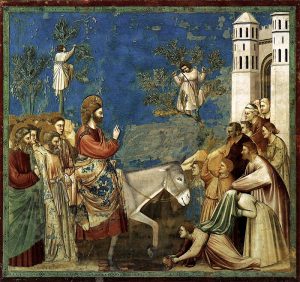
Redemption is a drama in three acts – three acts and a brief intermission – today the prelude, the overture, an introduction encapsulating the story to be fleshed out as the action proceeds. Jesus and his companions enter the city of Jerusalem from the east while the Roman governor, Pilate, makes his annual procession into the city in pomp and circumstance from the west.

The crowds welcome Jesus, singing “Hosannas” (a Jewish word meaning “Save us, we pray!”). We can perhaps hear a chorus, as in the Greek theater, singing sentiments later put into writing by the English philosopher journalist G.K. Chesterton:

O God of earth and altar,
bow down and hear our cry,
our earthly rulers falter,
our people drift and die;
the walls of gold entomb us,
the swords of scorn divide,
take not thy thunder from us,
but take away our pride.

Jesus, eschewing pride and showing a different way, enters the city on a donkey.

Later in the week, Act One, Scene One – An upper room somewhere in Jerusalem.

In the first act, Jesus shares a Passover meal with his friends. He knows, although they seem not to, that this will be their last formal meal together. At supper he tries to explain to them what he believes is going to happen and how he hopes they’ll remember him. He uses bread and wine to make his point, but they don’t seem to understand. In fact, as the scene ends, they are arguing about their relative ranks! Who among them will be the greatest? The curtain falls on a frustrated rabbi.

Act One, Scene Two – the same upper room somewhere in Jerusalem.

Dinner is over, so Jesus tries something else. Taking on the role of a servant, he kneels down and washes their feet, but they still don’t get it. Later they would begin to understand; later they would re-enact Jesus’ actions and ponder them again and again, trying to more fully understand him. We, too, are pondering; we, too, grope for understanding.

Act One, Scene Three – a garden outside the city walls at Gethsemane.

Depressed and agonizing, feeling he has failed, knowing his actions of the past three years are leading inexorably to a final “showdown” with the political authorities, Jesus prays to be delivered from the inevitable. He asks his closest friends to stay awake with him, but they cannot. Falling asleep as he prays, they abandon him emotionally just as they will abandon him physically. Soldiers enter the scene led by one of Jesus’ own friends, Judas from the village of Kerioth. After a brief struggle in which a servant is injured, Jesus surrenders. His friends scatter and even deny knowing him. We hear the chorus sing more of Chesterton’s words:

From all that terror teaches,
from lies of tongue and pen,
from all the easy speeches
that comfort cruel men,
from sale and profanation
of honour and the sword,
from sleep and from damnation,
deliver us, good Lord!

Act Two – another place outside the city, a hill called “the place of a skull.”

Jesus, struggling under the weight of a cross, staggers up the hill from the city to the summit. Once there, he is nailed to the cross he has dragged along the way. The crowd jeers, the soldiers mock, his friends (so few of them now) weep. Speaking from the cross as he dies, “Forgive them…. It is finished.” His friends take his body and seal it in a borrowed tomb. What more is there to do? It certainly seems to be the end. What more could possibly come after the death of the drama’s protagonist?

Intermission – another garden occupied by a sealed tomb.

The characters have all left. The stage is as bare and as silent as a grave. Is this intermission or has the drama concluded? The principal’s death certainly seems to have ended things! The silence of Holy Saturday is profound; it is palpable; it is pregnant with uncertainty. What does all that has come before mean? How can there possibly be anything more after this?

Act Three – the same garden, the tombstone rolled away.

What seemed to be a tragedy at the end of the second act turns out to be a comedy. The tomb is empty! There are angels where there should be mourners! There are only folded linens where there should be a body! Confusion mixes with relief, disbelief encounters faith, death is overcome by life. The joke is on the powers of evil, but what does it all mean? Many who have missed the first two acts of this drama arrive to see the end of the story, but can one truly appreciate the momentous conclusion without having lived through it all? Can one really get the punchline without hearing the whole story?

As the drama ends, Jesus’ friends and others who now believe are moving into the world, a world they will change, a world to which they will bring a message of love and a vision of peace. The chorus sings the last of Chesterton’s verses, a triumphant supplication to the conqueror of death:

Tie in a living tether
the prince and priest and thrall,
bind all our lives together,
smite us and save us all;
in ire and exultation
aflame with faith, and free,
lift up a living nation,
a single sword to thee.

The story of our Lord’s Resurrection, the story of redemption is a drama in three acts. Today, only the overture . . . don’t miss the whole story!

====================

Father Funston is the rector of St. Paul’s Episcopal Church, Medina, Ohio.

Living Water: Sermon for Lent 3, RCL Year A (19 March 2017)

overflowingwellToday the lectionary gives us two stories about water. The first set in the Sinai desert where the Hebrews found themselves exhausted, thirsty, and more than a little bit feisty and quarrelsome demanding water from Moses and from God; the second set at a well in a Samaritan village where Jesus, “tired out by his journey” (Jn 4:6, NRSV), encountered a lone woman and asked her for a drink.

I sometimes think that we take the biblical metaphor water way too lightly. We live in a world which is water-abundant. Here in NE Ohio we are surrounded by the stuff! There’s that big lake up to the north of us; there are rivers and streams running nearby; and I’ll bet most of us live in neighborhoods where some of our neighbors have ponds in their back yards. There’s water everywhere.

Even in the sorts of desert places I lived as a young adult along the Southern California coast there is an abundance of water. There’s all that salt water in the ocean, of course, but that won’t sustain human life. What there is is water brought in by aqueduct from the Sacramento River or piped in from the Colorado River; without that Los Angeles and Orange and San Diego Counties could not sustain the populations that presently live there.

Continue reading

We Were There: Sermon for Lent 2 (RCL Year A) – 12 March 2017

====================

A homily offered by Mr. Donald Romanik, President of the Episcopal Church Foundation, on the Second Sunday in Lent, March 12, 2017, to the people of St. Paul’s Episcopal Church, Medina, Ohio. Mr. Romnanik led a Vestry Retreat for the Parish the previous two days and graciously agreed to preach the sermon for our congregation on Sunday morning.

(The lessons for the day are from the Revised Common Lectionary, Year A: Genesis 12:1-4a; Psalm 121; Romans 4:1-5,13-17; and St. John 3:1-17. These lessons can be read at The Lectionary Page.)

====================

We-Were-There-at-Pearl-HarborWhen I was child in my tween years, I spent a lot of time at the Public Library checking out stacks of books, with that wonderful musty library smell, to read under the big oak tree in our back yard on hot summer days. As I was a U.S. history buff both then and now, I gravitated toward a series of children’s books whose titles began with the phrase – “we were there”. For example, We Were There at Lexington and Concord, We Were There at Battle of Gettysburg and my favorite – We Were There at Pearl Harbor. The books had the same two characters – a boy and a girl around my age at the time, who happened to be living right in the middle of these key historic events. They often performed semi-heroic acts and were usually honored or congratulated by some famous person at the end of the book.

In addition to making these historic events come more alive, I was intrigued by the idea of actually being present during important times in human history and trying to imagine what I would see, say or do had I been there. I also engaged in this same exercise with bible stories, especially those involving Jesus. What would it be like to be living in first century Palestine and experience Jesus first hand? Which characters in the New Testament did I most identify with? And it was not just about being present during the most significant events in the life of Christ – his birth, death or resurrection. Sometimes I would just want to follow him along the way and watch him preach, teach and heal. And unlike the two protagonists in the “We were there” series, I didn’t even have to do or say anything – just be an innocent bystander or a proverbial fly on the wall.

Today’s Gospel passage would be a good time for me to be a fly on the wall in order to overhear the conversation between Jesus and Nicodemus. Like much of the Gospel of John, this passage is not about the action, it’s about the dialogue and Jesus has the principal speaking part. Furthermore, there isn’t a lot to see because it’s dark since Nicodemus comes to Jesus at night. So let’s set the scene and try to think about what we would hear and experience had we been there.

So far in John’s narrative, after being heralded by John the Baptist, Jesus does two main things – turning water into wine at the wedding feast and driving the moneychangers out of the temple in Jerusalem right before the Passover. Both of these events illustrate how God was acting out God’s purpose in the world in the person of Jesus – the wine as a symbol of God’s abundance and grace and the temple event suggesting that animal sacrifices were no longer necessary because human salvation was now assured through the cross and resurrection. It is with this background and in this context that Nicodemus comes to see Jesus.

In addition to dialogue, John is a master of dramatic setting and vivid imagery. Note that Nicodemus arrives at night with all of its connotations of darkness and secrecy. Nicodemus begins his encounter with a bold affirmation that clearly Jesus must have been sent by God as evidenced by his God-like actions and signs. In a somewhat typical John-like non-sequitur, Jesus responds with a pronouncement that no person can see or experience the kingdom unless being born from above, or, in some translations, born again. This is followed by back and forth interactions, confusion on part of Nicodemus on the difference between spirit and flesh, and Jesus’ somewhat glib comment that a Jewish leader and a learned scholar should be much more knowledgeable and astute. But Nicodemus’s apparent ignorance or naiveté provides Jesus with the perfect opportunity to proclaim the bold reality that the Son of Man has come from heaven to be lifted up as a sign that God loves the world and that whoever believes will have eternal life. Jesus invokes the image of Moses lifting up the serpent in the desert and portends his own lifting up on the cross at Calvary. We then hear one of the most famous and beloved passages in the Bible: “For God so loved the world that he gave his only Son, so that everyone who believes in him may not perish but have eternal life.”

All we know of Nicodemus in the Bible is contained in the Gospel of John. Nicodemus is described as a Pharisee, that group of Jews who were fastidious in keeping the letter of the law and often opposed Jesus throughout his ministry, especially when they felt he did not share their legalistic and ideological purity. Jesus criticized Pharisees on several occasions especially for their blatant hypocrisy. Nicodemus was also a member of the Sanhedrin in Jerusalem which was the final court of appeals for matters relating to Jewish law and tradition. It was the Sanhedrin that condemned Jesus to death but ultimately needed the approval of Pilate since the death penalty was beyond their jurisdiction under Roman law.

John reports that Nicodemus came to speak to Jesus at night. Some scholars speculate that since he was a Jewish leader and official, Nicodemus was afraid, or at least embarrassed, to be seen with Jesus in broad daylight. But given his position on the Sanhedrin, wasn’t it perfectly appropriate for Nicodemus to question Jesus in order to assess his theological credentials? No one should have been able to question Nicodemus’ authority or motivation for being there although his opening comment that Jesus must have been sent from God could have raised a few eyebrows back at the temple. Clearly, Nicodemus was as least curious about Jesus if not somewhat intrigued by and attracted to his ministry. Interestingly, after this incredible explanation by Jesus of his role as the Son of Man who came to reveal and demonstrate God’s love and the promise of new life, Nicodemus has no response. In fact, he simply disappears from the scene and presumably goes back to his former role as a member of the establishment – not yet ready to accept Jesus or to make a commitment to follow him and embrace his message of love. Perhaps after this encounter Nicodemus decided that he just wasn’t as curious or interested in Jesus as he thought he would be. As innocent bystanders and flies on the wall, all we are left with at the end of this passage is Jesus’ incredibly profound words.

Nicodemus reappears at two later points in John’s Gospel. In Chapter 7 he is sitting as a member of the Sanhedrin – that official body that condemns Jesus to die and offers a somewhat half-hearted defense that Jesus should at least have the right to defend himself and respond to the charges against him. In Chapter 20, however, Nicodemus accompanies Joseph of Arimathea, another secret follower of Jesus, and contributes an exorbitant quantity of spices for Jesus’ ritual burial. Can we assume that by the time of the crucifixion Nicodemus finally gets it and accepts Jesus as his Lord? Does Nicodemus finally have the conversion experience of being born from above and now able to experience God’s kingdom of love?

This passage from John’s Gospel is often used by fundamentalist, evangelical Christians to support their belief in the necessity of an actual and affirmative conversion experience – being born again – in order to be a true follower of Christ. But I think this approach sells these words of Jesus short and oversimplifies the concept of conversion. I’m sure there may be some people who truly have a dramatic experience of being born again into a new life in Christ. For most of us, including our friend Nicodemus, the process of discipleship moves much more slowly, and, may take an entire lifetime in order to be truly realized.

Let’s look at these famous words of Jesus once again – “God so loved the world that he gave his only son.” Jesus did not say that God was responding to the pleas of anguish from humankind or was acting from a sense of justice, power or expectation. God does not ask the world whether it wants to be loved. God just goes ahead and loves, and not only loves, but gives his only beloved Son over to death. God’s sending Jesus to our broken world was an act of unconditional love – plain and simple. God loves us whether we like it or not. In light of this love, however, we are called to accept it, embrace it and share it with others or, in the alternative, run away screaming. For it is virtually impossible to remain neutral or ambiguous in light of such Godly extravagance and abundance.

Notwithstanding a vivid imagination and my “we were there” reading memories from childhood, I was not present at Lexington and Concord, the Battle of Gettysburg or at Pearl Harbor on December 7, 1941. But, while I was not present with Nicodemus when he had his conversation with Jesus at night, attempted to defend him at his trial and helped prepare him for burial after his brutal passion and death, I feel that I and all of us have a lot in common with this famous Pharisee.

Ultimately, like Nicodemus, we have to choose to be followers of Christ fully mindful that the process is not easy, predictable, linear or quick. And that’s why we have Lent. Lent provides us with an incredible opportunity to step back, take a deep breath, appreciate God’s unconditional love and contemplate God’s ultimate act of redemption. What we learn from Nicodemus this morning is that being born from above takes time. And what we learn from Jesus’ interaction with Nicodemus is that God is infinitely patient, does not expect us to be perfect, loves us unconditionally and is waiting for us with open arms – dramatically symbolized by the open arms of Jesus on the cross. Amen.

====================

Donald Romanik is the President of the Episcopal Church Foundation.

Shortcut: Sermon for the First Sunday in Lent, Year A (5 March 2017)

====================

A homily offered by the Rev. Dr. C. Eric Funston on the First Sunday in Lent, March 5, 2017, to the people of St. Paul’s Episcopal Church, Medina, Ohio, where Fr. Funston is rector.

(The lessons for the day are from the Revised Common Lectionary, Year A: Genesis 2:15-17;3:1-7; Psalm 32; Romans 5:12-19; and St. Matthew 4:1-11. These lessons can be read at The Lectionary Page.)

====================

shortcutsThe First Sunday in Lent … that’s today. That means we get the story of Jesus being chased into the desert by the Holy Spirit after his baptism by John in the River Jordan, the story of Jesus being accosted in the desert by the Tempter (whom Matthew in our Gospel text today also names “the devil” – in Greek the word is diabolos meaning “accuser”), the story of Jesus refusing to give into the three temptations. We always get some version of this story on the First Sunday in Lent. And this year the Lectionary gives us a double-whammy of temptation by linking that familiar gospel tale with the equally family story of Eve and the serpent and the fruit of the tree of the knowledge of good and evil, the so-called “apple.”

Temptation writ large . . . and in reading these stories again and again over the week, I kept coming back to a single question, “What exactly is temptation?”

My colleague David Henson, in the on-going online dialog we clergy seem to have about preaching and the lessons given us to preach about, was addressing the dualistic nature of the gospel lesson, how it can be wrongly understood to suggest that God and the Tempter are equals. He rightly observed that the story of Christ’s temptations can encourage us to think that there

. . . are two powerful deities – God and Satan, good and evil – commanding from the two opposing fronts of heaven and hell and warring against each other for the territory of earth and for the soul of humankind. (The Rev. David Henson, Facebook posting, March 4, 2017)

And he correctly pointed out that that would be a gross distortion of the Christian understanding of God and creation. The Tempter, the Accuser, Satan, the Devil, the wily old serpent, is not God’s equal! In the course of that discussion, David said that one reason this story can encourage that incorrect dualistic thinking is that

. . . ultimately it makes folks profoundly uncomfortable to consider Jesus being tempted — really, really, really — wanting these things, really feeling the seductive call of comfort, power, and security.

We don’t want to think of the Savior of the world, the Incarnate Son of God, as temptable.

David’s comments, however, really stirred up for me this question about what temptation really is.

Another clergy friend, Nurya Love Parish, is an Episcopal priest who like me was born and raised in Las Vegas and who, also like me, was wasn’t raised in the church. She wrote in an article in a recent issue of The Christian Century that the three temptations offered to Jesus “stand for pride, power, and possession.” She said that when she first realized that, having read it in another essay during her pre-Christian life,

I didn’t know much about Jesus, the devil, or that desert, but I knew pride. I knew the desire for power; I knew the wish for possessions. I was familiar with all of them, from painful experience.

All of a sudden the story wasn’t just about Jesus; it was about me, too. And not just me: it was about all humanity. I knew from the history books and the newspapers that we all struggle with pride, power, and possession. People and nations fight, kill, and die over who is worthy of respect, who gets control, and who owns what. The more I thought about it, the more these three simple words seemed to be at the heart of the human experience. (Living by the Word)

When I read what Nurya wrote, I thought it was spot on, and I still do, but it occurred to me that pride, power, and possession don’t really help us, or at least they don’t help me, to understand today’s other temptation story, the tale of Eve (and Adam) and the serpent and the so-called “apple.” If the temptations of Christ represent pride, power, and possession, what does the temptation of the proto-parents in Eden represent?

Well, in the midst of contemplating that, I was also doing my reading for the Education for Ministry seminar group that I participate in each week at the Cathedral, and in this week’s readings I was reminded of the theological focus of our study this year, the idea of “deification” or (to give it its technical Greek name) theosis.

Way back in the Second Century, the Bishop of Lyons in what is now France, a man named Irenaeus, wrote a book entitled Against All Heresies (Adversus omnes Haereses) in which he said, “The sure and true Teacher, the Word of God, Jesus Christ our Lord, on account of his immense love was made what we are, so that we might become what he is.” A later bishop, Athanasius of Alexandria, about 150 years later wrote, “God became human that humans might become God.” (De Incarnatione) What these ancient writers are saying is that the ultimate end of human beings is union with the divine. This is what is meant by “deification” or theosis.

You will remember, I’m sure, the words of Genesis in which the creation of humankind is described, “God created humankind in his image, in the image of God he created them.” (Gen 1:27) The Russian Orthodox theologian Paul Evdokimov says that our creation in the image of God predestines us to theosis. Our creation in God’s image gives us a built-in longing to be united with our Creator, an innate desire for deification.

The the late-17th Century French philosopher Blaise Pascal wrote about this longing in this way:

What else does this craving, and this helplessness, proclaim but that there was once in man a true happiness, of which all that now remains is the empty print and trace? This he tries in vain to fill with everything around him, seeking in things that are not there the help he cannot find in those that are, though none can help, since this infinite abyss can be filled only with an infinite and immutable object; in other words by God himself. (Pensées VII[425])

Pascal’s formulation has been summarized by the often-heard comment that we human beings have a “God-shaped hole” in us.

So it seems to me that the temptation of Eve (and Adam) is the attempt to take a shortcut to the human destiny of deification. This is what the wily serpent promises her, “You will not die; . . . when you eat of [the fruit] your eyes will be opened, and you will be like God.” (Gen 3:4-5) You will have taken a shortcut to theosis!

Shortcuts are also what the Tempter offers to Jesus.

Have you ever baked bread? I used to bake bread every week. Back in my college days, I lived in a house with six other guys, nine dogs, and a cat. We shared the cooking responsibilities (well, the guys did – the dogs and the cat, not so much). I took on the task of making our breads. I loved to bake bread; there is something intensely satisfying about it. It’s a process: the measuring, the mixing, letting the dough rise, punching it down to rise again, forming and proofing the loaves, and then the oven . . . and what comes out! It’s heaven! I love it. I wish I had the time to do it now. The Accuser’s suggestion that Jesus turn stones into bread is a shortcut temptation; forget the process, skip the work and the effort, go straight to that wonderful stuff that comes out of the oven.

The proposal that he throw himself off the pinnacle of the Temple in a show of religious power is another temptation to shortcut. Do that, make a big splashy show of being divine, and you won’t have to go through the laborious, frustrating, and frankly painful process of calling, teaching, and leading disciples. The idea that Jesus might accept political domination of the world is nothing more than the temptation to shortcut the process of being and setting a moral example, of being and showing the love and life of God in human form.

Just as, for Eve (and Adam) the temptation to eat the fruit was a temptation to shortcut the long process of learning and growing into unity and community with their God, into theosis or deification, for the Son of God the Devil’s offerings of power, pride, and possession were temptations to shortcut the process of being incarnate, of taking part in those things which my friend Nurya correctly tagged as being “at the heart of the human experience.”

So it occurred to me that that is what temptation is. That there is really only one temptation – the shortcut. That every temptation boils down to what we in the modern world have come to call “instant gratification.”

I don’t spend all my reading time on the Bible, on Education for Ministry, or on theology. I actually do take time to read for fun and currently my leisure reading is a collection of novellas by the famous science fiction writer Ursula Leguin. They have been gathered into a single volume entitled The Found and the Lost. One of the stories is a first-person narrative called A Woman’s Liberation and tells the tale of woman raised in slavery who gains freedom and becomes a scholar. At one point, describing her education, she writes,

What I loved to learn was history. I had grown up without any history. There was nothing [where I lived] but the way things were. Nobody knew anything about any time when things had been different. Nobody knew there was any place where things might be different. We were enslaved by the present time. (Ursula Leguin, The Found and the Lost, Saga Press, New York:2016, page 389)

This is what the temptations of Eve (and Adam) and of Jesus represent: entrapment in a dead-end present where the process of growth, like the yeast in the bread, like the gathering of a community of disciples, like human development into theosis, is cut short.

To be sure, Jesus told us to live in the present. “Do not worry about tomorrow,” he said, “for tomorrow will bring worries of its own. Today’s trouble is enough for today.” (Mat 6:34) But the reason he gave that instruction was clear: he said, “Do not worry, saying, ‘What will we eat?’ or ‘What will we drink?’ or What will we wear?’ For . . . your heavenly Father knows that you need all these things. But strive first for the kingdom of God and his righteousness, and all these things will be given to you as well.” (Mat 6:31-33) Do not be enslaved by the present time; do not live in a dead-end present where you have filled your “God-shaped hole” with instant gratification because of worry over pride, power, and possession.

Live in an open-ended present where things might be different, an open-ended present that leads to the kingdom of God and his righteousness, an open-ended present that leads to deification.

So . . . I think that’s the answer to my question, “What is temptation?” Temptation is a shortcut that leads to entrapment in a dead-end present. This is why Lent is a season, a process that begins with the story of Jesus’ temptation. It reminds us to live in the open-ended present where the yeast can rise, where the community can form, where becoming is as important as being.

God became human . . . and refused the temptation to shortcut that process . . . that humans might become gods . . . despite Eve’s (and Adam’s) giving into the temptation to shortcut that process. Live into that process; live in the open-ended present, the open-ended Presence of God. Amen.

====================

Father Funston is the rector of St. Paul’s Episcopal Church, Medina, Ohio.

Listen to Him! – Sermon for the Last Sunday after Epiphany, 26 February 2017

====================

A homily offered by the Rev. Dr. C. Eric Funston on the Last Sunday after the Epiphany, February 26, 2017, to the people of St. Paul’s Episcopal Church, Medina, Ohio, where Fr. Funston is rector.

(The lessons for the day are from the Revised Common Lectionary, Year A: Exodus 24:12-18; Psalm 2; 2 Peter 1:16-21; St. Matthew 17:1-9. These lessons can be read at The Lectionary Page.)

====================

transfiguration_wLGHere we are at the end of the first period of what the church calls “ordinary time” during this liturgical year, the season of Sundays after the Feast of the Epiphany during which we have heard many gospel stories which reveal or manifest (the meaning of epiphany) something about Jesus. On this Sunday, the Sunday before Lent starts on Ash Wednesday, we always hear some version of the story of Jesus’ Transfiguration, a story so important that it is told in the three Synoptic Gospels, alluded to in John’s Gospel, and mentioned in the Second Letter of Peter.

Six days before, Jesus had had a conversation with the Twelve in which he’d asked them who they thought he was. They had said that other people thought Jesus might be a prophet and that some thought he might even be Elijah returned from Heaven or John the Baptizer returned from the dead. Jesus put them on the spot, though, and asked, “But who do you say I am?” (Mt 16:15; cf Mk 8:29; Lk 9:20) Peter answered, “You are the Messiah.”

Then they had an argument. Jesus congratulated Peter for his astute answer and then tried to explain to him and the others what that would mean predicting his own death in Jerusalem. Peter, headstrong and outspoken, had contradicted Jesus and vowed that they would never let that happen. That’s when Jesus called him “Satan” and told Peter to stop obstructing him. “Get behind me,” he said. (Mt 16:23) Then he told the rest of them that to be his disciple would mean suffering and probably death. “If any want to become my followers, let them deny themselves and take up their cross and follow me.” (Mt 16:25)

Continue reading

Be Holy, Be Perfect – Sermon for Epiphany 7, 19 February 2017

====================

A homily offered by the Rev. Dr. C. Eric Funston on the 7th Sunday after the Epiphany, February 19, 2017, to the people of St. Paul’s Episcopal Church, Medina, Ohio, where Fr. Funston is rector.

(The lessons for the day are from the Revised Common Lectionary, Year A: Leviticus 19:1-2,9-18; Psalm 119:33-40; 1 Corinthians 3:10-11,16-23; and St. Matthew 5:38-48. These lessons can be read at The Lectionary Page.)

====================

pinkperfectionWhen the Prayers of the People are offered later in this service you will hear a name you’ve never heard before, and you will hear that the person named was buried in our memory garden this week, and you will wonder, “Who is Indra?” (“Indra” is not the child’s real name.)

Indra was born on February 1, 2017. And Indra died on February 1, 2017. Whether she was stillborn or expired a few minutes after her birth is unknown. Indra suffered Turner Syndrome and was born in her parents’ automobile as they were driving to the Emergency Room. In any event, she was not living when they got to the hospital.

Because of her father’s cultural traditions, the family was not involved in her burial and do not know the whereabouts of her ashes. Only the funeral director and I were present. It was the shortest, simplest funeral I’ve ever conducted, but in many ways it was perhaps the saddest and hardest burial I have done in 27 years of ordained ministry.

I was going to start this sermon with the declaration that being a priest is hard, but then I was asked to handle Indra’s burial and I thought perhaps that telling you about her and her funeral would illustrate that better than my simply whining to you about how hard it is to be priest.

It’s not this stuff, this Sunday stuff, that is hard. This is easy. Just follow the Prayer Book, follow the Lectionary, choose some hymns that fit the lessons, ask David to pick some other music, say a few words about Scripture, and share some Bread and some Wine. That’s easy.

And funerals and weddings are usually pretty much the same. Just follow the recipe; like cooking, it all pretty much takes care of itself.

But, sometimes, it’s not. Funerals usually aren’t hard, but Indrah’s fast, simple, no-family-to-deal-with burial was incredibly hard.

Sitting with someone in hospital who is facing their death is hard; sitting with a family whose loved one is facing death is even harder. Counseling two people getting married is hard; counseling two people getting divorced is harder. Getting over being angry with God is hard; helping someone else get over being angry with God is harder.

I don’t really know how handles those situations. I don’t really know how to do this stuff and I’m never sure I’ve done it right. If putting together a Sunday service is like cooking, this sort of stuff is more like baking. I was tempted to say there are no rule books for this sort of thing, but the truth is that there are lots books. There are lots of recipes. There are too many, in fact, and they seem to all give contradictory advice.

I say it’s like baking because I am always looking for the secret to flaky pie crusts or to a successful soufflé. One of my grandmothers swore by using lard in her crusts; the other used butter. My mother said to use vinegar in the dough, but my aunt insisted that ice water was the trick. And as hard as making a good pie crust is, baking a soufflé is even worse. Follow the recipe, but get the slightest thing just a wee bit “off” and what might have been a glorious dessert is a hopeless disaster, and more often than not, you have no idea what you did wrong.

Some of being a priest, a lot of being a priest actually, is like making pie crust or baking a souffle. Do it right – everything is great. Do the slightest thing wrong – it’s a complete mess. And constantly live in fear of that slight, wrong thing.

I think the priests in Solomon’s Temple had it easier. They had Leviticus. Most of us aren’t very familiar with Leviticus. It is, for the most part, a book of rules, of very detailed rules. So we don’t read it in church very much.

We Episcopalians are fond of saying that our worship is among the most biblical of all Christian denominations. We are often criticized for not taking the Bible more seriously and those not familiar with our liturgy accuse us of ignoring it. When that happens, we often fire back that our Prayer Book is about 80% scriptural and that we read through the Bible using a Lectionary so that (and I’ve heard clergy say this) “we read all of the Bible in three years.”

Except that’s not true. We don’t read all those genealogies. There are some of the Psalms that we don’t consider appropriate for Sunday worship, although we do read them in the Daily Offices. And there’s Leviticus from which we read, I think, only two short lessons in the whole three years of the Lectionary cycle. Today is one of those two times. Nonetheless, it is a book worth knowing and knowing about. I commend it to you; it is especially good for reading late at night when you can’t get to sleep . . . .

Very briefly, this is what you’ll find in Leviticus. First, there are six chapters on various kinds of offerings and sacrifices, then two chapters instructing priests how to handle all the different sorts of offerings and sacrifices. This is followed by four chapters on the history of the Aaronic priesthood.

Next are five chapters on uncleanness with which the Temple priests were expected to deal, unclean animals, the uncleanliness of women caused by childbirth, various unclean diseases (such as leprosy) and how the priests were to cleans them, if possible, and (my favorite) unclean bodily discharges. (Maybe the Temple priests didn’t have it easier, after all. I’m quite happy that you don’t come to me with your unclean diseases, your weeping ulcerous sores, and your other bodily discharges! That would be really hard . . . .)

After the uncleanness chapters, there is one chapter detailing the Day of Atonement.

Then comes something scholars call “the Holiness Code,” ten chapters for the not-priests, for the people of God. Ten chapters of practical rules for living a righteous life. One of them, from which we heard today, concerns neighborliness and begins with this admonition, “You shall be holy, for I the Lord your God am holy.”

Do you know why I became a priest? Yes, I had that sense of call and went through the discernment “process” and all of that (twice, actually, but that’s another story). But . . . really . . . when I look back on it, I realize that I left my life as a trial lawyer and went into the ordained ministry because, as hard as it is, it’s easier than being a lay person. As hard as it sometimes is to be a priest, to be a “professional Christian” in the church, it’s harder still to be a lay Christian in the world.

There are no good rule books for priests, or too many contradictory rule books, but there are expectations and there are permissions. There is a stereotype and there are prescribed situations. There is “safety within the walls” of the church, within the set of circumstances in which a priest finds him- or herself.

That’s not true in the world. In the the wide open, free wheeling, anything-can-come-at-you-world where you not-priests have to do your ministry, you have the much harder job.

You can tell that just by look at the Book of Leviticus: there are five chapters of rules for priests, but there are ten for the not-priests! The people of God have twice as much to do as the priests of God.

And you can tell it just by reading the Catechism of the Episcopal Church (it’s in the Prayer Book back around page 845 or so, in that part of the book no one ever seems to open). It asks there who the ministers of the Church are and answers that it’s everyone: lay persons, bishops, priests, and deacons. The ministry of priests, it says, is to “share with the bishop in the overseeing of the Church; to proclaim the Gospel; to administer the sacraments; and to bless and declare pardon in the name of God.” (Book of Common Prayer, page 856)

That’s a piece of cake when you compare it to the ministry of the laity. According to the Catechism, your job, oh People of God, is “to represent Christ and his Church; to bear witness to him wherever [you] may be; and, according to the gifts given [you], to carry on Christ’s work of reconciliation in the world; and to take [your] place in the life, worship, and governance of the Church.” (BCP, page 855) Now that is hard work!

The Jewish bible scholar and rabbi Jacob Milgrom said that the point of the Book of Leviticus is that holiness is not the responsibility of priests alone. In this book, and especially in the Holiness Code, “the domain of the sacred expands, embracing the entire land, not just the sanctuary, and all of Israel, not just the priesthood.” Israel, he said, attains holiness and priests strive to sustain it. (Milgrom, J., Leviticus: A Book of Ritual and Ethics, Fortress Press, Minneapolis:2004, pp 175, 178)

Although priests are not allowed by the rules in Leviticus to make any mistake, attaining holiness takes a lot more work than sustaining it. What we priests do in the sanctuary merely sustains holiness; what the People of God do in the world, that is how holiness is attained. That’s much, much harder!

It takes love … It takes loving even people we don’t really like, even people we can’t stand! Indeed, the word used in Hebrew text is not exactly “neighbor;” it is not limited to those who are geographically nearby. The Hebrew word is more akin to “fellow” and seems to be much more expansive. Thus, when a lawyer questions Jesus about the Law, Jesus is able to cite the rule from Leviticus (19:18), “You shall love your neighbor as yourself” and then illustrate it with a story involving someone from another country, a hated foreigner, the Good Samaritan. (See Luke 10:25–37)

In our Gospel lesson today, Jesus quotes (or, actually, misquotes) the same verse from Leviticus, adding words that aren’t in the original: “You have heard that it was said,” he says, “‘You shall love your neighbor and hate your enemy.'” (Mt 5:43)

Now to be fair to Jesus, he doesn’t actually say he’s quoting Leviticus, just “you have heard it said.” That last bit about hating enemies could just be a rabbinic gloss; it could just be folk wisdom. In any event, it was (and is) the way people act. Jesus acknowledges human nature by beginning this bit of the Sermon on the Mount (and that’s what this is, the end of the first chapter of that long sermon) with commentary on what’s called “the lex talionis,” that eye-for-an-eye rule. But the lex talionis isn’t about enemies; that’s a rule of justice not of war. “An eye for an eye” deals with retribution toward a neighbor who has violated social norms. Jesus dispenses with that (saying, basically, don’t follow the lex talionis, don’t seek retribution or revenge) and now moves beyond it; he leaves the neighborhood, so to speak.

Jesus says, “Love your enemies. Love those whom you fear, even those you think might kill you, even the hated foreigner.” He’s saying that “enemy” is not really a separate class, that the world isn’t divided into neighbors and enemies. Although some people would like to do that, although some people have always done that (it’s human nature, after all), the world isn’t carved up that way. Jesus is saying (I think) that “enemies” are simply a class of “neighbors;” that enemies and neighbors are all “fellows;” that the division – neighbors here, enemies there, those we’re unsure about in some holding pen over there – doesn’t hold water.

And then, echoing Leviticus’ “Holiness Code,” especially the first verses of the neighborliness rules of Chapter 19 – “Be Holy because God is holy” – Jesus says, “Be perfect, therefore, as your heavenly Father is perfect.” (Mat 5:48)

That’s heavy stuff! And remember the Leviticus command and Jesus’ admonition are not directed to the priests; these are directives for the whole People of God, for the laity.

It’s hard work . . . but as Kathryn Schifferdecker, who teaches Old Testament at Luther Seminary in St. Paul, Minnesota, says these verses are as much promise as command:

“You shall be holy.” It is both command and promise. And to believe that promise is to begin to be formed into the people God calls us to be, a people living out in our day-to-day lives genuine love for God and for our neighbors. (Working Preacher)

You will be holy. You will be perfect. It’s a promise – so act on the promise; live as if you believe the promise. And keep this in mind, “holiness” is just another way to say “wholeness” and “perfection” is just another way to say “completion.” The promise of holiness is an instruction to strive for wholeness; the promise of perfection is a command to work toward completion.

What Leviticus and Jesus ask of us is that we be fully human, that we be as whole and complete a human being as each of us can be. And the way we do that is to love our neighbor, even the neighbor who seems to be our enemy, even the neighbor of whom we are afraid, even the neighbor we think may kill us.

When I was kid, I helped my stepdad restore old homes. I think my parents invented to the practice of “flipping,” buying old fixer-uppers, rehabbing them, and then selling them hopefully at a profit. From the time I was about 10 years old until I went away to college, we lived and fixed up in a different house every year. The last thing we would do was to paint the interiors. My stepdad encouraged me to do that very neatly and carefully because, he would say (and I had no idea that he was referencing scripture), “Paint covers a multitude of sins.”

He was parodying the First Letter of Peter, “Love covers a multitude of sins (4:8).” Peter goes on to say, “Serve one another with whatever gift each of you has received (v. 10).” Just be human, be yourself, be the best you you can be, loving your neighbor and using whatever gifts you have been given. I know that’s hard; it’s really hard. But with the help and grace of God, you can do it.

“You shall be holy, for I the Lord your God am holy.” “Be perfect, as your heavenly Father is perfect.” It is a promise more than it is a command. With the help and grace of God you will be holy; you will be perfect.

And the glorious thing is – the Gospel truth is – that through the grace of God you already are!

Amen!

(Note: The illustration is Camelia Japonica, “Pink Perfection,” a camellia cutlivar dating from the late 18th Century; it was one of the most popular flowers of the Victorian Age.)

====================

Father Funston is the rector of St. Paul’s Episcopal Church, Medina, Ohio.

« Older posts Newer posts »