====================
This sermon was preached on the 26th Sunday after Pentecost, November 17, 2013, at St. Paul’s Episcopal Church, Medina, Ohio, where Fr. Funston is rector.
(The Revised Common Lectionary, Proper 28C: Isaiah 65:17-25; Canticle 9 (Isaiah 12:2-6); 2 Thessalonians 3:6-13; and Luke 21:5-19. These lessons can be read at The Lectionary Page.)
====================
 “You shall draw water with rejoicing from the springs of salvation.”
Their placement in the Book of Isaiah suggests that these words were written early in the career of the first prophet whose writings are collected into this book (there are three), a time when Judah had been conquered by and was a tributary-state of the Assyrian Empire. In the first eleven chapters of the book, Isaiah had prophesied against the Jewish people and the nation’s leaders, condemning their failure to follow God’s Law, their failure to take care of the widows, the orphans, the poor, the resident alien. He had even given his son a prophetic name, Maher-shalal-hash-baz — meaning “He has made haste to the plunder!” — to reflect God’s judgment against them. Isaiah prophesied of desolation and loss, and those prophecies seemed to have come true. It was a time such as Jesus describes in the Gospel today, a time when nation had risen against nation, kingdom against kingdom. Yet, in the midst of it, Isaiah offers this song of hope.
“You shall draw water with rejoicing from the springs of salvation.”
I once worked with a man who blew, as the saying goes, hot and cold. If you asked him, “How’s it going?” you’d get one of two responses. If things were OK, he’d say, “God’s in his heaven and all’s right with the world.” But on another day he’d answer, “The world’s going to Hell in a hand-basket!” There was no in-between with him, no shades of gray, no shades of anything! Either everything was great, or everything was awful. Isaiah’s message in our Gradual today is a message that even when everything is awful, even if the world is going to Hell in a hand-basket, God’s still in his heaven, God’s still in charge and eventually all will be right with the world.
“You shall draw water with rejoicing from the springs of salvation.”
One of the things we preachers do is look back to see if we said anything about a Biblical text the last time it came up on the lectionary rotation, so that is what I did. The last time we had the First Song of Isaiah as part of our Sunday worship, it was the Sunday following the Sandy Hook School shooting in Newtown, Connecticut. I didn’t preach on this particular text that Sunday, but it would have been a fitting text; it is a message of reassurance for the worst of times.
“You shall draw water with rejoicing from the springs of salvation.”
So . . . there are three themes or images in this one verse that I’d like to explore with you today: drawing water, rejoicing, and the springs of salvation. And I want to begin with the middle one because that is the way Isaiah begins.
Chapter 12 is only six verses long but, for some reason, when it is used liturgically as a canticle, the first verse is dropped off: we begin with Verse 2, “Surely, it is God who saves me . . . . ” But Isaiah began his song this way: “You will say in that day: I will give thanks to you, O Lord, for though you were angry with me, your anger turned away, and you comforted me.” (v 1) “I will give thanks to you, O Lord . . . .”
This is more than a polite “Thank You” note. This is a song of praise that describes, that would accompany a physical expression of gratitude. The Hebrew word here is yadah, which signifies the stretching out of one’s hands in thanks while singing.
It’s like . . . do you know the 1964 movie Zorba the Greek? It’s based on a novel of the same name by Nikos Kazantzakis. It is the story of Basil, a young English-Greek intellectual played by Alan Bates, and his encounter with a vibrant Greek peasant, Alexis Zorba, the title character; it is a story full of betrayal, death, and failure. But, at the end, as Basil is preparing to leave Crete (where the story is set) and return to Oxford, he asks Zorba to teach him to dance. What follows is this wonderful scene in which Anthony Quinn, who plays Zorba, lifts his hands and begins slowly to demonstrate the sirtaki. The music, by Mikis Theodorakis, builds as Quinn and Bates dance, with their hands raised, faster and faster, laughing, and overcoming all the darkness and tragedy that has gone before. That is yadah!
That theme is continued in this pivotal verse: “You shall draw water with rejoicing from the springs of salvation.” The word yadah is not repeated; here we have another word sawsone, which means “joyfulness,” or “mirth,” or even “giddiness,” translated in our Prayer Book text as “rejoicing.” Nonetheless, the meaning is the same: an exultant joy which requires physical expression.
“You shall draw water with rejoicing” — with dancing and singing and laughter and giddiness — “from the springs of salvation.”
The next image to consider is the drawing of water from a well. That’s not something many of us are familiar with, even if we live on farm properties with wells those wells are equipped with electric pumps and we get our water from a tap at the sink; we just turn a handle and the water comes out. Not so in Isaiah’s day or in Jesus’ time, nor even for some of our grandparents. In those days you took your bucket to the well and you lowered down, filled it, drew it up (not with a turn crank, by the way, but by brute strength), and then you carried it into the home, however far away that might be.
That day to day reality would most certainly have been in the minds of Isaiah’s first audience, but perhaps for them it would have been overshadowed by memories of an annual ritual. An important part of the celebration called Sukkoth or the Feast of Tabernacles was the “Festival of Water-drawing.” In this ritual, on each morning of the seven days of Sukkoth, a young priest would take a golden pitcher to the Pool of Siloam and fill it with water. He would then carry the water in a procession with lighted torches up to the Temple where the water was poured upon the altar, and the people broke out into jubilant song and dance.
The ritual of water-drawing was a reminder that God’s Presence is as fundamental and basic to human life as the water that falls from the sky or springs up from the earth. Life-giving water symbolizes God’s power. The image here is of water flowing with abundance, spilling over, and flowing out to the whole earth. In Isaiah’s song, the ritual of water-drawing leads directly to the proclamation of good news to all nations. The good news of God’s salvation cannot be contained; it must reach out to all the world.
Now something lost in the English translation is Isaiah’s use of singular and plural “yous,” his address is first to individuals and then to the community as a whole. In the ritual of water-drawing, it was the priest who drew the water as representative of the community, but in Isaiah’s song the “you” in this verse is addressed to each individual. “You shall draw water . . . .” — not the priest on your behalf — not the community of which you are a part — but you individually, you personally, you shall draw from the well of living water. Each of us goes to the well-spring individually . . . but what a mess it would be if we all showed up and tried to do that at the same time without any coordination!
As I thought about that, I remembered an old Chinese proverb I learned in Asian folklore course in college: Qi shang ba xia, literally, “seven up, eight down.” The full saying is, “My heart has fifteen buckets, seven up, eight down.” The image is from a folktale of fifteen people at a community well, all trying to draw water; seven with their buckets going up and eight going down, all clanging and banging against one another, spilling the water and achieving nothing. It refers to a person or a community faced with a time of uncertainty, fear, or turmoil. The English equivalent is “to be all sixes and sevens,” to be in a general state of confusion and disarray, possibly even a condition of irreconcilable conflict.
That certainly cannot be what Isaiah had in mind with his image of each of drawing out water individually! Surely there is here a lesson about working together in community! Remember that though each of us draws from the well we do so together, with yadah and sawsone, with that thankfulness and joy that expresses itself in dancing. Like Zorba and Basil dancing the sirtaki together, we work together so that our buckets are not “seven up, eight down,” not banging against one another and spilling their water uselessly, but all filled, drawn up, and poured out in proclamation of God’s good news. We never go to the well alone; we go together, and together we fill and draw out our buckets in a purposeful and concerted dance of joyful abundance.
“You” — each of you individually, but all of you together — “shall draw water with rejoicing” — with dancing and singing and laughter and giddiness — “from the springs of salvation.”
Which brings us to the last image of this verse: the springs of salvation.
While reviewing the commentaries and study guides about this text, I came across an alternative translation: “With great joy, you people will get water from the well of victory.” (CEV) At first blush, “well of victory” and “springs of salvation” seem like very different images! Salvation is something we receive, something that God gives us. Victory is something achieved, something that we do ourselves! But when I went to my Hebrew lexicon, I discovered that, indeed, the Hebrew word used here has been translated in other circumstances as “victory” (Psalm 20:5) and also as “prosperity” (e.g., Job 30:1) or as “deliverance” (e.g., Psalm 3:2). The well of God’s grace produces all of these things: deliverance, salvation, prosperity, victory.
In John’s Gospel we are told a story of Jesus meeting a Samaritan woman at the communal well in the city of Sychar. He asked her to draw him a drink from the well, and when she expressed surprise that a Jewish man would ask that of a Samaritan woman . . .
Jesus answered her, “If you knew the gift of God, and who it is that is saying to you, “Give me a drink,’ you would have asked him, and he would have given you living water.” The woman said to him, “Sir, you have no bucket, and the well is deep. Where do you get that living water? Are you greater than our ancestor Jacob, who gave us the well, and with his sons and his flocks drank from it?” Jesus said to her, “Everyone who drinks of this water will be thirsty again, but those who drink of the water that I will give them will never be thirsty. The water that I will give will become in them a spring of water gushing up to eternal life.” The woman said to him, “Sir, give me this water, so that I may never be thirsty or have to keep coming here to draw water.” (John 4:10-15)
The word used by the Prophet Isaiah, the word translated as “salvation,” as “victory,” as “prosperity,” as “deliverance,” is also a Name. The word is yeshu’ah; the name we translate as “Jesus.”
Even when the enemy (whoever or whatever that may be) has invaded and all seems to be desolation and loss . . . even when nations rise against nations and kingdoms against kingdoms . . . even when the world seems to be going to hell in a hand-basket . . . even in a time of unfathomable tragedy and grief, Isaiah’s words comfort and reassure us. They are a promise of “buoyant and determined hope that refuses to give in to debilitating present circumstances.” (Walter Brueggemann)
“You” — each of you, each of us individually, but all of us together —
“shall draw water” — living water —
“with rejoicing” — with dancing and singing and laughter and giddiness —
“from the springs of salvation” — from the wellspring who is Jesus.
Let us pray:
Lord Jesus, you promised that you would give to any who asked living water gushing up to eternal life: Make us thirsty for that living water that we may love God with our whole heart and soul and mind, that we may rejoice in your victory and salvation with dancing and singing and laughter, that we may fill our buckets with your abundant prosperity and may pour out your good news for all the world, that we may love our neighbor as ourselves; in your Holy Name we pray. Amen.
====================
A request to my readers: I’m trying to build the readership of this blog and I’d very much appreciate your help in doing so. If you find something here that is of value, please share it with others. If you are on Facebook, “like” the posts on your page so others can see them. If you are following me on Twitter, please “retweet” the notices of these meditations. If you have a blog of your own, please include mine in your links (a favor I will gladly reciprocate). Many thanks!
====================
Father Funston is the rector of St. Paul’s Episcopal Church, Medina, Ohio.
 Both my father and my father-in-law were veterans of World War II. My father was gravely injured in France — while he was running from his position as a forward artillery spotter to convey information for the gunners (running because his radio had malfunctioned and he had vital data to convey), shrapnel entered the bottom of his right foot, exited, entered and exited his calf, then entered his thigh and damaged the bone. Wounded, he made it to a place where his information could be transmitted. He was eventually evacuated to England, underwent surgery, and was sent home to the States for therapy and convalescence. He was nearly always in pain from those injuries and frequently found relief in a bottle; it was that drinking that eventually killed him when he lost control of his car in a single-vehicle accident.
 Today is the first Sunday in November which means that instead of the normal sequence of lessons for Ordinary Time, we are given the option of reading the lessons for All Saints Day, which falls every year on November 1. So today we heard a very strange reading from the Book of Daniel, a to-my-ear very troubling gradual psalm (in which we sing of wreaking vengeance on the nations and punishment on the peoples, of binding king in chains, and of inflicting judgment on the nobles bound in iron), a bit of Paul’s letter to the Church in Ephesus extolling the riches of the inheritance of the saints, and to Luke’s version of the Beatitudes in which Jesus not only blesses the poor, the hungry, and the weeping, he sighs woefully over the future plight people like ourselves – the comparatively wealthy, those whose bellies are full, and those in relatively good state of mind.
 The saints whom we celebrate on this day (and the many who are given special days of individual recognition) were people who tried to live according to the Bible as they understood its teachings. Like us, they read it and encountered those troubling visions, those petulant patriarchs, those bloodthirsty psalms, and somehow looked past them and through them to see the God of faith, the God who Incarnate in Jesus said, “Love your enemies, do good to those who hate you, bless those who curse you, pray for those who abuse you.” We extoll the virtues of those saint and we celebrate their lives and their witness because they help us to do the same. By their lives and their examples, they clean the windshield for us; they clean away the bug blood and the mud, so that we no longer focus on the window, but on the God the window shows us.
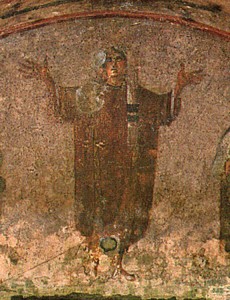 We are straying from our usual lectionary path today because it is one of our Children’s Sundays and we have some younger kids reading the lessons at the 10 a.m. service. So, instead of a long reading from the prophet Joel (RCL Year C, Track 1), we have a brief lesson from the Book of Ben Sira, which is sometimes called Ecclesiasticus. (RCL Year C, Track 2) We thought it would be easier for a child to read.
  “The days are surely coming, says the Lord, when I will . . . watch over [the house of Israel and the house of Judah] to build and to plant. * * * I will put my law within them, and I will write it on their hearts; and I will be their God, and they shall be my people.”
 I bring you greetings from the people of St. Paul’s Parish, Medina, Ohio, where I am privileged to serve as rector. Nearly all the active members of our congregation know and respect Patrick, and have asked me to convey their congratulations to him and to you, together with the assurance of their prayers, as you continue together in a new ministry only recently begun. Of course, none of them know Sandy, but we offer our greetings and prayers for her diaconal ministry among you, as well.
 In the original Star Trek series, the crew’s uniforms were color coded: gold uniforms were command; red uniforms were engineering and security; and blue uniforms were science and medical. Parish ministry entails all three. So, Patrick, I have a little gift for you — a set of three pairs of official Star Trek color-coded uniform socks to remind you of these aspects of pastoral ministry.
 Which brings us, at last, to the blue uniforms, the science and medical corps of the star ship. Mr. Spock the Science officer and Doctor “Bones” McCoy always wore blue. One of the ancient terms that we still use for pastoral ministry is “the cure of souls,” the word “cure” having pretty much the same meaning as it has in medicine. Broadly speaking, this ministry is the care, protection, and oversight of the nourishment and spiritual well-being of the souls committed to the pastor’s care; it may be shared with others, with deacons or with lay ministers, but it is truly the ministry of the parish priest. It is in this “blue shirt” ministry that those wonderful, painful, joyful, intimate moments of grace that I spoke of earlier will happen.
 How do we maintain our established convictions and carry our old confessions into new, uncertain, and sometimes unsettling circumstances? It’s an unavoidable question, one which we answer all the time, even if we aren’t aware that we are doing so. It is the question to which both our Old Testament lesson and our reading from the Pastoral Epistles offer answers and, interestingly but not surprisingly (this is, after all, the Bible), the answers are contradictory.
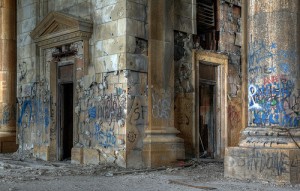 We live in a country where there are cities once full of people now sitting lonely: we sit here today less than 200 miles by turnpike from Detroit, where the picture on the cover of our bulletin was taken, a city which has been described as looking as if it had been bombed in a war! Just yesterday, Salon reported that in the United States there are 14 million unoccupied residences. Six months ago, “Detroit had more than 83,000 unoccupied residential addresses. That constitutes nearly 25 percent of the city’s potential housing stock. New Orleans had 44,000, for 21 percent. Cleveland had 41,000, or 19 percent.” (
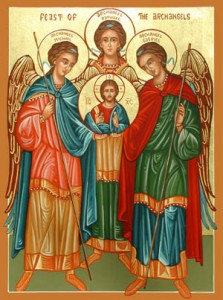 We are stepping out of the “common of time,” away from the progression of lessons assigned for the Sundays of Ordinary Time, and instead celebrating the Feast of Michaelmas, known variously as the Feast of Saint Michael the Archangel or as the Feast of Saints Michael, Gabriel, Uriel, and Raphael, or as the Feast of the Archangels, or as the Feast of Saint Michael and All Angels (the latter being the preferred Anglican name for this commemoration). The only reason we are doing so is a personal conceit of your rector; Michaelmas, the 29th of September, just happens to be my birthday. Today I am celebrating the 30th anniversary of my twenty-eleventh birthday. I’ll get back to that in a moment, but first . . . a word about Michaelmas.
 As you know, we now have an Education for Ministry seminar group working in this parish. Eight of us began meeting two weeks ago and we will have our first working session tomorrow night. One of the things that EFM encourages students to do is explore their personal spiritual autobiographies using a variety of formats and tools, and then share as much of that autobiography with the seminar group as they are comfortable doing. Each of the four years begins with the sharing of spiritual autobiographies, and the seminar group’s mentor or facilitator is asked to lead off.

