Occasional thoughts of an Anglican Episcopal priest

Category: Theology (Page 80 of 95)

A Gospel That Makes a Difference – From the Daily Office – January 28, 2013

From the Letter to the Galatians:

I am astonished that you are so quickly deserting the one who called you in the grace of Christ and are turning to a different gospel — not that there is another gospel, but there are some who are confusing you and want to pervert the gospel of Christ.

(From the Daily Office Lectionary – Galatians 1:6-7 (NRSV) – January 28, 2013.)

Diversity LogoI confess to a certain fondness for the Galatians. I’ve never been a really big fan of Paul the Apostle and I sometimes wistfully wonder how our Christian faith might have developed if he had not been its principal post-Ascension spokesperson. What if the Johanine community that produced the Gospel of John and the three letters that also bear his name had been more prominent? What if James and his insistence on works of mercy because “faith, if it has no works, is dead” (James 2:17) had been more influential than Paul’s assertion to the Romans that salvation is “by grace, it is no longer on the basis of works” (Romans 11:6)? Well, we’ll never know . . . but apparently the Galatians were listening to someone suggest an alternative to Paul’s understanding of the Christian gospel and, as a result, he wrote them this letter. Anybody that could so upset Paul that he would call them “you foolish Galatians” (Gal. 3:1) gets high marks in my book! That the Galatians were also Celts with whom I, as an Irish-American, share an ethnic heritage gives them additional credit.

But I have to admit that Paul does have a point about “a different gospel” and that “there is [not] another gospel.” What there are are differing interpretations of the gospel, different understandings of its import, different emphases on points of its message. What I really don’t like about what Paul is saying is the implication that his and his interpretation only is correct and that, therefore, anyone who disagrees with him “wants to pervert the gospel of Christ.” I believe it is entirely possible to have disagreement on this things, to have unity without uniformity. In fact, I would say it’s desirable, but here in his letter to the Celts of Asia Minor Paul doesn’t seem to think so.

Elsewhere Paul used the metaphor of the body when he tried to share with the church in Corinth the fundamental importance of unity. In the body metaphor in the 12th chapter of the First Letter to the Corinthians, Paul demonstrates how a body is made up of diverse members: “If all were a single member, where would the body be? As it is, there are many members, yet one body. The eye cannot say to the hand, ‘I have no need of you,’ nor again the head to the feet, ‘I have no need of you.'” (1 Cor. 12:19-21) Unity among diverse elements comes through inclusion of the various members of the body of Christ in deep sharing and mutual responsibility.

Of course, Paul was thinking of varying and diverse roles within the body of a congregation – apostle, evangelist, pastor, catechist, preacher, and so forth. He does not extend the body metaphor to those with differing opinions about the nature of faith, the person of Christ, the doctrine of atonement, the nature of salvation, and so forth. How much more lively might the church be if he had? How much more lively might the church be if we would?

If instead of thinking of the church as a community in which to find “the right answers,” we thought of it as a community in which to explore questions, how much more relevant and helpful to people’s lives might it be? So long as unity is seen as uniformity, we will be stuck trying to find (or convince others of) right answers. But if we can see unity in diversity, we will be able to hear a variety of responses; some responses will be useful for some seekers, and others will be useful for others. None will be “right” and none will be “wrong,” but all will be relevant.

This must be the church’s quest in the 21st Century, unity in diversity which makes the gospel relevant in the lives of all. No longer should we hear anyone address another as “you stupid Galatian!” No longer should we hear anyone condemned as “perverting the gospel.” We are not to preach “a different gospel,” but we are to offer a gospel that, with all its varied emphases and diverse applications, makes a difference.

====================

A request to my readers: I’m trying to build the readership of this blog and I’d very much appreciate your help in doing so. If you find something here that is of value, please share it with others. If you are on Facebook, “like” the posts on your page so others can see them. If you are following me on Twitter, please “retweet” the notices of these meditations. If you have a blog of your own, please include mine in your links (a favor I will gladly reciprocate). Many thanks!

====================

Father Funston is the rector of St. Paul’s Episcopal Church, Medina, Ohio.

Rector’s Address: “The Dream” by Wesley Frensdorff – Conversion of St. Paul (tr.) – January 27, 2013

====================

This address was given on Sunday, January 27, 2013, at St. Paul’s Episcopal Church, Medina, Ohio, where Fr. Funston is rector. The day was celebrated as the Patronal Feast of the parish by translating the Feast of the Conversion of St. Paul from January 25 to this, the closest following Sunday. Rather than preach on the propers of the day (Epiphany 3) or of the translated feast, Fr. Funston offered this assessment of the parish and how well it meets the vision of The Dream, a prophetic piece of prose written more than thirty years ago by the late Wesley Frensdorff, one-time bishop of the Episcopal Diocese of Nevada.

(Lessons for the Conversion of St. Paul according to the practice of the Episcopal Church: Acts 26:9-21; Psalm 67; Galatians 1:11-24; and Matthew 10:16-22. These lessons can be read at The Lectionary Page.)

====================
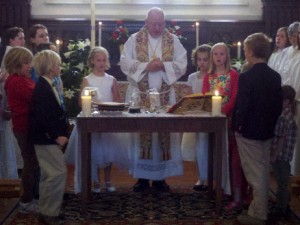
Fr. Funston assisted at the Communion Table by children of St. Paul's ParishMore than thirty years ago, a bishop named Wesley Frensdorff set out his vision for the church in a piece of writing he title simply The Dream. Wes Frensdorff was a good friend to Evelyn and to me. He was her parish priest when she was a child, and her boss when she was the director of the Diocese of Nevada’s summer camp. He officiated at our wedding, and is the person who spoke for God and hounded me into eventually becoming a clergyman. As my Rector’s Report, I’d like to share his dream with you, adding my own brief comments as to how I see this church meeting his vision.

Bishop Frensdorff begins . . .

Let us dream of a church . . .
in which all members know surely and simply God’s great love, and each is certain that in the divine heart we are all known by name.
in which Jesus is very Word, our window into the Father’s heart; the sign of God’s hope and his design for all humankind.
in which the Spirit is not a party symbol, but wind and fire in everyone; gracing the church with a kaleidoscope of gifts and constant renewal for all.

I think that is the sort of church we at St. Paul’s Parish are, a congregation which knows God and God’s Son and in which everyone’s gifts and ministries are welcomed, empowered, and celebrated. We have just received written and oral reports on the many and varied ways in which those gifts and ministries are embodied in our parish.

The bishop continues . . .

A church in which . . .
worship is lively and fun as well as reverent and holy; and we might be moved to dance and laugh; to be solemn, cry or beat the breast.
people know how to pray and enjoy it – frequently and regularly, privately and corporately, in silence and in word and song.
the Eucharist is the center of life and servanthood the center of mission: the servant Lord truly known in the breaking of the bread, with service flowing from worship, and everyone understanding why worship is called a service.

I believe we are such a congregation. We have affirmed often that we are a Eucharisticly-centered parish, a prayerful people, and a place of service. We have an active parish prayer chain; we have groups which meet weekly to read spiritual writings or study the Holy Scriptures (and I wish there were more of those); we have just instituted a new chapter of the Order of the Daughters of the King, whose ministry is one of intentional prayer. This is a parish with an active corporate and individual prayer life.

Let us dream of a church . . .
in which the sacraments, free from captivity by a professional elite, are available in every congregation regardless of size, culture, location, or budget.
in which every congregation is free to call forth from its midst priests and deacons, sure in the knowledge that training and support services are available to back them up.
in which the Word is sacrament too, as dynamically present as bread and wine; members, not dependent on professionals, know what’s what and who’s who in the Bible, and all sheep share in the shepherding.
in which discipline is a means not to self-justification but to discipleship, and law is known to be a good servant but a poor master.

I believe we are or are becoming such a congregation. We are a parish in which leadership of worship is shared, in which many study the Holy Scriptures (though I wish more would do so), and in which the discipline of the Christian life is a matter of trust and grace. This is a parish in which the “sheep share in the shepherding;” in addition to our Lay Eucharistic Visitors, we have many in our congregation who’s personal ministry is keeping in touch with those they may not see in church, those whom they know to be in need of a friendly visit, those who may not speak up when they are lonely. It is a delight to be the priest in a place where many share the pastoral service which is the ministry of the priesthood of all believers.

A church . . .
affirming life over death as much as life after death, unafraid of change, able to recognize God’s hand in the revolutions, affirming the beauty of diversity, abhorring the imprisonment of uniformity, as concerned about love in all relationships as it is about chastity, and affirming the personal in all expressions of sexuality;
denying the separation between secular and sacred, world and church, since it is the world Christ came to and died for.

I believe we are such a congregation. We are a parish which welcomes all regardless of race, origin, or sexuality; we are a parish in a tradition which boldly proclaims that creation is good and which seeks to husband and enhance that goodness.

A church . . .
without the answers, but asking the right questions; holding law and grace, freedom and authority, faith and works together in tension, by the Holy Spirit, pointing to the glorious mystery who is God.
so deeply rooted in gospel and tradition that, like a living tree, it can swing in the wind and continually surprise us with new blossoms.

I believe we are such a congregation. St. Paul’s Parish is a household which welcomes the seeker, the questioner, the curious, and the new, offering not easy, black-and-white answers, but responses and exploration in a community of questioners.

Let us dream of a church . . .
with a radically renewed concept and practice of ministry, and a primitive understanding of the ordained offices.
where there is no clerical status and no classes of Christians, but all together know themselves to be part of the laos – the holy people of God.
a ministering community rather than a community gathered around a minister.
where ordained people, professional or not, employed or not, are present for the sake of ordering and signing the church’s life and mission, not as signs of authority or dependency, nor of spiritual or intellectual superiority, but with Pauline patterns of “ministry supporting church” instead of the common pattern of “church supporting ministry.”
where bishops are signs and animators of the church’s unity, catholicity, and apostolic mission, priests are signs and animators of her Eucharistic life and the sacramental presence of her Great High Priest, and deacons are signs and animators – living reminders – of the church’s servanthood as the body of Christ who came as, and is, the servant slave of all God’s beloved children.

I hope we are becoming such a congregation in such a diocese. We have affirmed and celebrated today the ministry of many of God’s people through the activities and outreach of this parish. I look forward to a time when there may be one or more additional priests to animate (as Bishop Frensdorff put it) our Eucharistic life, when there may be one or more deacons to animate our life of service and servanthood, but whether we have those or not, we are now a community which, nourished on Christ’s Body and Blood, is corporately and individually reaching out in service to our community. The Free Farmers’ Market is our largest and most active corporate outreach ministry; but we have many members who are active in public service as hospital and hospice volunteers, as board members of charities, as tutors, and in a variety of other ways. Their public service is a testament to the Christian witness of this church to which they belong.

Let us dream of a church . . .
so salty and so yeasty that it really would be missed if no longer around; where there is wild sowing of seeds and much rejoicing when they take root, but little concern for success, comparative statistics, growth or even survival.
a church so evangelical that its worship, its quality of caring, its eagerness to reach out to those in need cannot be contained.

I believe we are becoming such a congregation. At a recent meeting of leadership in this parish, one of our people said, “I’m looking forward to failing!” What he meant was that he looks forward to us going out into the community around us with (as the bishop says) “little concern for success,” simply going out and getting something done, spreading the Gospel without worrying about the final outcome, which is always and ever in God’s hands.

A church . . .
in which every congregation is in a process of becoming free – autonomous – self-reliant – interdependent, none has special status: the distinction between parish and mission gone.
where each congregation is in mission and each Christian, gifted for ministry; a crew on a freighter, not passengers on a luxury liner.
of peacemakers and healers abhorring violence in all forms (maybe even football), as concerned with societal healing as with individual healing; with justice as with freedom, prophetically confronting the root causes of social, political, and economic ills.
which is a community: an open, caring, sharing household of faith where all find embrace, acceptance. and affirmation.
a community: under judgment, seeking to live with its own proclamation, therefore, truly loving what the Lord commands and desiring his promise.

I believe this is what we meant when we declared, as a congregation, that St. Paul’s Parish’s reason for being is “to set hearts on fire for Jesus” and that our mission is “to advance the Kingdom of God through liturgical worship, spiritual education, personal growth, and service to others.”

And finally, let us dream of a people
called to recognize all the absurdities in ourselves and in one another, including the absurdity that is Love,
serious about the call and the mission but not, very much, about ourselves,
who, in the company of our Clown Redeemer can dance and sing and laugh and cry in worship, in ministry, and even in conflict.
[Frensdorff was a great lover of clowns who often used the clown as a metaphor or illustration in his preaching about Jesus.]

I recently read an essay entitled Why Does God Need the Church? by Ragan Sutterfield, an Episcopalian who lives in Arkansas. Sutterfield’s answer is that God needs the church “to be God’s real presence in the world . . . a radical and amazing call for a group of people.” But, he wrote, “we need to realize . . . that the buildings, the ecclesial bodies, the liturgies, the hierarchies, the bishops, the priests, the laity, the budgets, etc, etc, etc, are only valuable as parts of the church in so far as they are fulfilling the mission of God. And . . . God’s mission is not nice services for nice people in nice buildings.” (Emphasis added.)

Sutterfield, I think, is echoing Bishop Frensdorff’s vision. In doing so, Sutterfield, proposed two new ways to think of our church congregations. First, as “icon” – an icon, he says, is an image that sparks the imagination to move beyond the image and see God. The question we must ask ourselves is “Are we such a community? Looking at us, visiting us, worshiping with us, being served by us, and serving with us, are others moved beyond us to see God?” I believe that we are such a community and I hope that others see through us in that way.

Sutterfield’s second new image of the church is as a “dojo.” A dojo, as you probably know, is “a practice community within martial arts – it is the place where adherents to a specific form come together to learn how to be better practitioners, both from each other and from recognized masters of the form.” It is, simply put, the place and community where people come to get better at what they do. In the church-as-dojo, the congregation becomes the place where we come together to work at becoming more Christ-like. The church becomes a place where we come not to sing some nice songs and hear an occasionally good sermon, but a community with which we gather to explore the faith with one another, recognizing that some among us are more practiced than we may be, challenging each other and learning from one another how better to practice the way of Jesus.

Sutterfield concludes with a vision not too much different from Bishop Frensdorff’s:

Imagine a church where, after a few months of regularly attending, you are able to recognize that you are less angry than you used to be. Imagine a church that shows you how to forgive the person who hurt you most profoundly. Imagine a church that measures your love of God as Dorothy Day did hers, by how much you love the person you love least. Imagine a church that loves you for who you are, away from all of the facades of the self, and teaches you how to love.

I believe that St. Paul’s Parish is and is constantly becoming such a place and such a community. The reports we have received today, the leadership our vestry and officers provide, the ministries of all of our members, all demonstrate that that is so, and for that I am grateful to each of you and to God.

Let us pray:

Almighty and everliving God,
ruler of all things in heaven and earth,
hear our prayers for this parish family.
Strengthen the faithful, arouse the careless, and restore the penitent.
Grant us all things necessary for our common life,
and bring us all to be of one heart and mind
within your holy Church;
through Jesus Christ our Lord. Amen.

Will you turn to the prayers page of the Annual Journal and join me in the “Disturb us, Lord” prayer attributed to Sir Francis Drake which our Inviting the Future Committee adopted as the guiding prayer for our capital project. After the prayer, we’ll sing I Have Decided to Follow Jesus (which is on the back cover of the Journal) and stand adjourned.

Disturb us, Lord, when we are too well pleased with ourselves, when our dreams have come true because we have dreamed too little, when we arrived safely because we have sailed too close to the shore.

Disturb us, Lord, when, with the abundance of things we possess, we have lost our thirst for the waters of life. Having fallen in love with life, we have ceased to dream of eternity and in our efforts to build a new earth, we have allowed our vision of the new Heaven to dim.

Disturb us, Lord, to dare more boldly, to venture on wider seas where storms will show your mastery; where losing sight of land, we shall find the stars.
We ask you to push back the horizons of our hopes; and to push us into the future in strength, courage, hope, and love. Amen.

Even More God Is Our Mother – From the Daily Office – January 26, 2013

From the Prophet Isaiah:

Listen to me, O house of Jacob,
all the remnant of the house of Israel,
who have been borne by me from your birth,
carried from the womb;
even to your old age I am he,
even when you turn grey I will carry you.
I have made, and I will bear;
I will carry and will save.

(From the Daily Office Lectionary – Isaiah 46:3-4 (NRSV) – January 26, 2013.)

Stone Sculpture, Motherhood, Artist UnknownAs anyone who knows me will testify, I am no Calvinist! But hats off to John Calvin who wrote about these verses, “God has manifested himself to be both Father and Mother so that we might be more aware of God’s constant presence and willingness to assist us.” (Commentaries, Vol. 8, Baker Books:2005) Isaiah’s words on behalf of God are among the strongest maternal images of God in Holy Scripture. Just three chapters later, speaking through the prophet, God will ask and declare, “Can a woman forget her nursing child And have no compassion on the son of her womb ? Even these may forget, but I will not forget you.” (49:14-15) And, again, Calvin wrote, “God did not satisfy himself with proposing the example of a father, but in order to express his very strong affection, he chose to liken himself to a mother, and calls His people not merely children, but the fruit of the womb, towards which there is usually a warmer affection.”

So forgive Calvin his use of the masculine pronoun and laud him for his forward thinking and astute observation of God’s Motherhood. Would that modern American Christians would follow his lead! I can’t count the number of times I’ve seen something from the conservative wing of the Church (from Orthodox, Roman Catholic, Anglican, and Protestant writers) decrying maternal metaphors as “Gnostic” or “pagan”. How sad that a theological tradition rooted in Scripture (and developed by preachers as early as Augustine of Hippo and John Chrysostom) should be ignored, devalued, debased, and rejected by so many. By doing so, they accomplish two things: they run the risk of alienating women (and, in fact, have done so), and they fail to communicate with those for whom the “fatherhood” metaphor is problematic. How much better might the church address the modern world if it remembered the words of Pope John Paul I that “we are the objects of undying love on the part of God. . . God is our father; even more God is our mother.” (Spoken at the time of the Camp David peace accords.)

My own biological father, of whom I have only vague memories, was an alcoholic whose most influential action contributing to the formation of his sons’ lives (at least my own, if not my late brother’s) was killing himself in a single-vehicle roll-over accident while driving drunk when I was 5-1/2 years old. When my mother remarried five years later, it was to a man to whom I could not relate at all for several years (though we became quite close once I’d been an adult for while); because of that strained relationship, at age 14 I chose to move away from home. Thus, I am one of those for whom the “fatherhood” metaphor is not all that significant. My best parental memories are of a strong and resourceful single mother; God described as “our true Mother in whom we are endlessly born and out of whom we shall never come” (Dame Julian of Norwich) makes a whole lot of sense to me.

This Isaiah passage resonates for me, and I am grateful to Calvin and Julian of Norwich, to Augustine and Chrysostom, and to John Paul I for developing the maternal metaphor. “Even more God is our mother.”

====================

A request to my readers: I’m trying to build the readership of this blog and I’d very much appreciate your help in doing so. If you find something here that is of value, please share it with others. If you are on Facebook, “like” the posts on your page so others can see them. If you are following me on Twitter, please “retweet” the notices of these meditations. If you have a blog of your own, please include mine in your links (a favor I will gladly reciprocate). Many thanks!

====================

Father Funston is the rector of St. Paul’s Episcopal Church, Medina, Ohio.

Employers and Employees – From the Daily Office – January 25, 2013

From the Letter to the Ephesians:

Slaves, obey your earthly masters with fear and trembling, in singleness of heart, as you obey Christ; not only while being watched, and in order to please them, but as slaves of Christ, doing the will of God from the heart. Render service with enthusiasm, as to the Lord and not to men and women, knowing that whatever good we do, we will receive the same again from the Lord, whether we are slaves or free. And, masters, do the same to them. Stop threatening them, for you know that both of you have the same Master in heaven, and with him there is no partiality.

(From the Daily Office Lectionary – Ephesians 6:5-9 (NRSV) – January 25, 2013.)

Victorian Child Labor PhotographSo let’s admit right off the bat that we have a problem here. Where the progressives and liberals among us would much prefer to read Paul condemning the institution of slavery, he does not. Instead, he simply admonishes slaves to be good slaves and masters to be good masters, and even goes so far as to analogize a Christian’s relationship with God (or Jesus) to slavery. This just doesn’t sit well in the modern mind and provides plenty of ammunition for those whom Friedrich Schleiermacher addressed as religion’s “cultured despisers.” We would much rather Paul hadn’t said this.

But he did. So what to think of it . . . .

First off, the Greek here is doulos which is most often translated as “slave” as it is here, but it can also refer to a bond-servant, a servant for hire, or to someone who is devoted to another without regard of his or her own interests (the last often metaphorically). It’s unlikely that Paul intended this as either a comment on non-slavery employment relationships or as a metaphorical statement, but we can certainly read it in those ways in our modern context.

Secondly, and this encourages us to read this text as applicable to modern employee-employer relations, the institution of slavery in the First Century Roman empire was an economic, not a racial, reality. We modern Americans, influenced by our own history, hear racial overtones in these verses, but they are not really there. In ancient Rome slaves might be prisoners of war, sailors captured and sold by pirates, slaves bought outside Roman territory, or even the children of desperately poor Roman citizens sold into bond-servanthood by their parents. Further, slaves were commonly and even rather frequently freed; a slave could buy his or her own freedom.

So if we read this text as referring not only to the First Century practice of slavery, but applying also to any economic institution wherein one person works at the behest of and for the benefit of another, it provides guidance for theological critique of contemporary employment practices and related laws. It requires the church to question any employment situation in which workers are inadequately paid, where worker safety is at risk, or which threatens to damage the family life or welfare of the worker and his or her dependents.

In fact, the long struggle to recognize and protect workers’ rights finds its genesis in this and similar biblical texts. In Great Britain and in our own country during the 18th and 19th Centuries (and even into the early 20th Century), children worked in mines and factories; all laborers worked six-day weeks and often 16- to 18-hour days; working conditions were often dangerous; and on-the-job death was a common occurrence. Fans of the series Downton Abbey (or earlier dramas such as Upstairs, Downstairs) need only think of the way in which the servants’ life is portrayed to see a small (and very toned-down) illustration of what a worker’s life was like, always at the beck-and-call of the employer.

The anti-slavery movement in Britain became the movement to bring about just and equitable labor laws, to prevent children from working, to reduce the work day to ten hours per day, and to make employers responsible for working conditions. That movement spread to the United States. In both Britain and America, it was driven by Christians, many of them Christian socialist Anglo-Catholics in the Church of England and the Episcopal Church, who read these texts as demanding the ends they sought.

So we need not apologize to our “cultured despisers” for Paul’s words about slavery. Instead, we are called like our forebears in the faith to see in them our call to champion workers’ rights and just labor laws.

====================

A request to my readers: I’m trying to build the readership of this blog and I’d very much appreciate your help in doing so. If you find something here that is of value, please share it with others. If you are on Facebook, “like” the posts on your page so others can see them. If you are following me on Twitter, please “retweet” the notices of these meditations. If you have a blog of your own, please include mine in your links (a favor I will gladly reciprocate). Many thanks!

====================

Father Funston is the rector of St. Paul’s Episcopal Church, Medina, Ohio.

Then A Miracle Occurs – From the Daily Office – January 24, 2013

From the Gospel according to Mark:

Jesus said, “The kingdom of God is as if someone would scatter seed on the ground, and would sleep and rise night and day, and the seed would sprout and grow, he does not know how. The earth produces of itself, first the stalk, then the head, then the full grain in the head. But when the grain is ripe, at once he goes in with his sickle, because the harvest has come.”

(From the Daily Office Lectionary – Mark 4:26-29 (NRSV) – January 24, 2013.)

And then a miracle occurs cartoonMy late brother had a cartoon cut from some magazine taped to the door of his university office (he was a professor of political science and constitutional law) for years. I suspect it came from either Playboy or The New Yorker, but I really don’t know. It depicted two scientists working at a chalk board. To their left on the board was a complicated looking mathematical formula and to their right, another one. Connecting the two sets of numbers were arrows drawn from and to the words, “The a miracle occurs.” One of the scientists speaking to the other says, “I think you should be more specific here in step two.” (Of course, I’ve been able to find the cartoon on the internet and will post it with this meditation.)

That bit of scientific humor came to mind when I read this parable. I know this parable is meant to portray the church, the work of discipleship, the eschatological reality of the last judgement, etc. However, I am fascinated by the actual reality of planting seed, growing a crop, and harvesting the result, and Jesus’ words, “He does not know how!” 2,000 years after he spoke those words we truly still do “not know how” plants go from seed to harvest. We know a lot more of the “how” than we did, but we still don’t really have a clue what’s going on. We can name the elements and chemicals involved; we can describe the interactions and processes; we can pretty much point to the genes and DNA code that produce the end characteristics of the particular species. But when it comes right down to it, we don’t know how or why it happens, and we can’t actually produce it from scratch. We could mix all the constituent elements and chemicals together in exactly the right proportions and all we’ll have is a batch of chemicals, not a seed or plant or harvestable fruit.

Some day, perhaps, but not now. Research scientists keep pushing back the horizons of our knowledge, but there is still something we don’t know. Australian physicist Paul Davies put it this way in his book The Fifth Miracle, “Scientists still can’t quite put their finger on exactly what it is that separates a living organism from other types of physical objects.” Elsewhere, in an article in the journal BioSystems, Davies has said, “Living systems form a very special subset among the set of all complex systems. Biological complexity is distinguished by being information-based complexity, and a fundamental challenge to science is to provide an account of how this unique information content and processing machinery of life came into existence.”

In other words, the “how” (and especially the “why”) of what happens between planting of seed and harvesting of fruit remains a mystery. And, Dr. Davies helps frame the question: “Given a soup of classical molecular building blocks, how did this mixture ‘discover’ the appropriate extremely improbable combination by chance in a reasonable period of time?” I applaud the efforts of scientists to figure that out. I came across Dr. Davies’ writings because of my interest in quantum mechanics and string-theory; he proposes that quantum processes are at work in the origins of life. It’s an interesting hypothesis and might go a long way in answer the “how” question. It won’t, I don’t think, answer the “why”.

From my perspective (which I know some of my less religious friends and colleagues think is naive), what we don’t know (both the “how” and the “why”) is the second step in the cartoon’s equation. What we don’t know is the miracle that occurs, the miracle that occurred when the first primordial organism developed in the original soup of elements and chemicals way back when in the history of our earth.

It seems to me that this “then a miracle happens” unknown element is present in other parts of our existence, as well.

Two people meet, then a miracle happens – they fall in love. Sure, there’s a lot of interplay of pheromones and hormones and brain chemistry and what-not; we know a lot of the “how”, but we don’t know the “why”. Why these two and not those two, why each of these with the other and not with some other person, why sometimes two people once in love find themselves no longer so . . . . It’s in the second step, “then a miracle occurs.”

A human being grows to maturity and develops the ability to paint beautiful portraits or landscapes, to sculpt exquisite models of the human form, to write entertaining scripts, or to pen moving poetry. We can talk of environment and education and innate artistic ability; we can describe the “how” of her up-bringing and her craft. But we cannot answer the question “why” this person develops these talents and her sibling did not. It’s in the second step, “then a miracle occurs.”

The cartoon is right; we can’t just leave it at that! We need to be more specific in step two. So I cheer on the scientists who are seeking the answers. But I also celebrate the mysterious and the miraculous, and cheer on the mystics, the religious, the spiritual, the artists, the poets, the priests, and all the other seekers after truth. Let’s all try to learn what’s going on when a miracle occurs.

====================

A request to my readers: I’m trying to build the readership of this blog and I’d very much appreciate your help in doing so. If you find something here that is of value, please share it with others. If you are on Facebook, “like” the posts on your page so others can see them. If you are following me on Twitter, please “retweet” the notices of these meditations. If you have a blog of your own, please include mine in your links (a favor I will gladly reciprocate). Many thanks!

====================

Father Funston is the rector of St. Paul’s Episcopal Church, Medina, Ohio.

Lousy Soil or Lousy Sowing? – From the Daily Office – January 23, 2013

From the Gospel according to Mark:

Jesus explained the Parable of the Soils: “The sower sows the word. These are the ones on the path where the word is sown: when they hear, Satan immediately comes and takes away the word that is sown in them. And these are the ones sown on rocky ground: when they hear the word, they immediately receive it with joy. But they have no root, and endure only for a while; then, when trouble or persecution arises on account of the word, immediately they fall away. And others are those sown among the thorns: these are the ones who hear the word, but the cares of the world, and the lure of wealth, and the desire for other things come in and choke the word, and it yields nothing. And these are the ones sown on the good soil: they hear the word and accept it and bear fruit, thirty and sixty and a hundredfold.”

(From the Daily Office Lectionary – Mark 4:14-20 (NRSV) – January 23, 2013.)

The Sower by Van GoghIt’s a familiar enough parable, this story of the farmer who sows his seed only to have most of it fail to produce for one reason or another. Jesus’ use of the broadcasting seed as a metaphor for preaching is reassuring to those of us who preach on a regular basis. It seems to say it isn’t our fault if what we preach has little or no impact on the hearers; it’s the fault of the “soils” into which we are sowing – maybe “Satan” snatched it away, or maybe the hearers have no “depth”, or maybe they are just too concerned with “cares of the world”.

Or maybe we really are lousy preachers.

The task of ordained ministry is centered, at least in part, on the Word. The ministry of the clergy in many traditions is specifically referred to as a “ministry of Word and Sacrament.” A few years ago, an ecumenical group of pastors called The Eleison Group said that the clergy’s “primary responsibility is sharing the gospel of Jesus Christ with our congregations, our communities, and our world.” We who are ordained are expected to be wordsmiths and public speakers. The care with which we use words reflect not just upon us or upon the church; it reflects also upon the message we proclaim. “A bad book about the love of God remains a bad book,” wrote Thomas Merton. “[M]en pick up these books and say: If the ones who say they believe in God cannot find anything better than this to say about it, their religion cannot be worth much.” It is wrong to say of such readers that they have fallen prone to Satan, or that they lack depth, or that they are too concerned with worldly cares.

But Jesus’ point in the parable is well-taken. Communication is a two-way street. Even the best preacher can fail if she does not take into account the situation of her audience. It is the responsibility of the preacher to figure out what sort of “soil” the listener might be. In the mixed crowd of a congregation there will be some of all types, so preaching styles must vary; different texts must be chosen (the lectionary accomplishes this for those in such traditions); methods of delivery must be engaging and, frankly, entertaining; new technologies must be used. There are different kinds of “soils” and we must employ different kinds of techniques when “sowing” the Word. Sometimes we will fail, and sometimes it will not be our fault. But Jesus’ metaphor does not relieve the sower of all responsibility; the parable of the sower is not a blanket pardon from the sin of lousy preaching. No farmer knowingly wastes his seed on stony or weed-infested ground; no sower throws his seed where he expects the birds to immediately eat it up (nor does he fail to take precautions to keep the birds away). If any farmers do act thusly, they are lousy farmers and deserve the poor crops they get.

Preachers who fail to carefully prepare their homilies, who do not strive for excellence, are likely to get similar results. They have only themselves to blame, not the “soils” where they are sowing their seeds.

====================

A request to my readers: I’m trying to build the readership of this blog and I’d very much appreciate your help in doing so. If you find something here that is of value, please share it with others. If you are on Facebook, “like” the posts on your page so others can see them. If you are following me on Twitter, please “retweet” the notices of these meditations. If you have a blog of your own, please include mine in your links (a favor I will gladly reciprocate). Many thanks!

====================

Father Funston is the rector of St. Paul’s Episcopal Church, Medina, Ohio.

Jesus Is Crazy – From the Daily Office – January 22, 2013

From the Gospel according to Mark:

Then [Jesus] went home; and the crowd came together again, so that they could not even eat. When his family heard it, they went out to restrain him, for people were saying, “He has gone out of his mind.”

(From the Daily Office Lectionary – Mark 3:19b-21 (NRSV) – January 22, 2013.)

Buddy Jesus from the movie DogmaMark, Matthew, and John all report that on another occasion Jesus commented, “Prophets are not without honor except in their own country and in their own house.” One can’t get much more dishonored that being accused of being crazy!

I was at meeting today where the issue of evangelism was discussed – we were being honest, I think, in referring to it as “marketing” and using a marketing analysis of how we can go about putting the gospel before others.

At one point during the discussion, one of our number referred to a part of the market as “the crazies,” by which he meant those going through crises in their life: divorce, death of a loved one, loss of a job, alcoholism or other addiction (their own or someone else’s), etc. There are numerous disruptions, dysfunctions, crises, tragedies, and catastrophes that can lead to craziness in a family. What, he asked, can we offer to those facing “the crazies”?

We can offer Jesus whose family and friends thought he was “out of his mind”; we can offer the Jesus who is crazy! We have a crazy savior who is with us in the midst of the craziness. Of course, by calling Jesus “crazy,” I’m not saying Jesus was insane. C.S. Lewis, in Mere Christianity, addressed that issue when he suggested that in thinking about who Jesus was and is, we only three choices — (1) Jesus was mad. Only a madman would make some the outlandish statements Jesus made; (2) He was lying. He might or might not have believed what he said about himself, but regardless they were not true; or (3) What he said was and is true and he is the Son of God, the Incarnate Lord who came from heaven to live among us, who died on the cross, rose from the dead, and ascended into heaven opening the way of salvation to us. This is how Lewis makes this profound logical argument.

I am trying here to prevent anyone saying the really foolish thing that people often say about Him: “I’m ready to accept Jesus as a great moral teacher, but I don’t accept His claim to be God.” That is the one thing we must not say. A man who was merely a man and said the sort of things Jesus said would not be a great moral teacher. He would either be a lunatic – on the level with a man who says he is a poached egg – or he would be the devil of hell. You must take your choice. Either this man was, and is, the Son of God: or else a madman or something worse.

You can shut Him up for a fool, you can spit at Him and kill Him as a demon; or you can fall at His feet and call Him Lord and God. But let us not come with any patronizing nonsense about His being a great human teacher. He has not left that open to us. He did not intend to.

No, when I say that Jesus is “crazy,” I’m not thinking he was nuts. Rather, I’m remembering a character from a television show from my childhood – The Life and Loves of Dobie Gillis. Bob Denver played the beatnik character Maynard G. Krebs. When Maynard really liked something, he would say, “That’s like crazy, man!” That’s what I think about Jesus; he’s like crazy, man. And he’s with us when things go crazy!

====================

A request to my readers: I’m trying to build the readership of this blog and I’d very much appreciate your help in doing so. If you find something here that is of value, please share it with others. If you are on Facebook, “like” the posts on your page so others can see them. If you are following me on Twitter, please “retweet” the notices of these meditations. If you have a blog of your own, please include mine in your links (a favor I will gladly reciprocate). Many thanks!

====================

Father Funston is the rector of St. Paul’s Episcopal Church, Medina, Ohio.

One Today – From the Daily Office – January 21, 2013

From the Letter to the Ephesians:

There is one body and one Spirit, just as you were called to the one hope of your calling, one Lord, one faith, one baptism, one God and Father of all, who is above all and through all and in all.

(From the Daily Office Lectionary – Ephesians 4:4-6 (NRSV) – January 21, 2013.)

One SunI held off offering a meditation on this Inauguration Day, the Martin Luther King, Jr., holiday, for a variety of reasons. Throughout the day, however, this particular bit of St. Paul’s Letter to the Church at Ephesus kept returning to my mind. The Episcopal Church uses this in dialogue form in our baptismal liturgy, so it is familiar to us. The idea that we are all in some way united is a part of our Anglican ethos.
In the celebration of President Barack Obama’s second inauguration, poet Richard Blanco focused also on our unity. I think his poem bears repeating here in celebration of unity.

One Today by Richard Blanco

One sun rose on us today, kindled over our shores,
peeking over the Smokies, greeting the faces
of the Great Lakes, spreading a simple truth
across the Great Plains, then charging across the Rockies.
One light, waking up rooftops, under each one, a story
told by our silent gestures moving behind windows.

My face, your face, millions of faces in morning’s mirrors,
each one yawning to life, crescendoing into our day:
pencil-yellow school buses, the rhythm of traffic lights,
fruit stands: apples, limes, and oranges arrayed like rainbows
begging our praise. Silver trucks heavy with oil or paper —
bricks or milk, teeming over highways alongside us,
on our way to clean tables, read ledgers, or save lives —
to teach geometry, or ring-up groceries as my mother did
for twenty years, so I could write this poem.

All of us as vital as the one light we move through,
the same light on blackboards with lessons for the day:
equations to solve, history to question, or atoms imagined,
the “I have a dream” we keep dreaming,
or the impossible vocabulary of sorrow that won’t explain
the empty desks of twenty children marked absent
today, and forever. Many prayers, but one light
breathing color into stained glass windows,
life into the faces of bronze statues, warmth
onto the steps of our museums and park benches 2
as mothers watch children slide into the day.

One ground. Our ground, rooting us to every stalk
of corn, every head of wheat sown by sweat
and hands, hands gleaning coal or planting windmills
in deserts and hilltops that keep us warm, hands
digging trenches, routing pipes and cables, hands
as worn as my father’s cutting sugarcane
so my brother and I could have books and shoes.

The dust of farms and deserts, cities and plains
mingled by one wind — our breath. Breathe. Hear it
through the day’s gorgeous din of honking cabs,
buses launching down avenues, the symphony
of footsteps, guitars, and screeching subways,
the unexpected song bird on your clothes line.

Hear: squeaky playground swings, trains whistling,
or whispers across café tables, Hear: the doors we open
for each other all day, saying: hello / shalom,
buon giorno / howdy / namaste / or buenos días
in the language my mother taught me — in every language
spoken into one wind carrying our lives
without prejudice, as these words break from my lips.

One sky: since the Appalachians and Sierras claimed
their majesty, and the Mississippi and Colorado worked
their way to the sea. Thank the work of our hands:
weaving steel into bridges, finishing one more report
for the boss on time, stitching another wound
or uniform, the first brush stroke on a portrait,
or the last floor on the Freedom Tower
jutting into a sky that yields to our resilience.

One sky, toward which we sometimes lift our eyes
tired from work: some days guessing at the weather
of our lives, some days giving thanks for a love
that loves you back, sometimes praising a mother
who knew how to give, or forgiving a father
who couldn’t give what you wanted.

We head home: through the gloss of rain or weight
of snow, or the plum blush of dusk, but always — home,
always under one sky, our sky. And always one moon
like a silent drum tapping on every rooftop
and every window, of one country — all of us —
facing the stars
hope — a new constellation
waiting for us to map it,
waiting for us to name it — together.

We are one today.

====================

A request to my readers: I’m trying to build the readership of this blog and I’d very much appreciate your help in doing so. If you find something here that is of value, please share it with others. If you are on Facebook, “like” the posts on your page so others can see them. If you are following me on Twitter, please “retweet” the notices of these meditations. If you have a blog of your own, please include mine in your links (a favor I will gladly reciprocate). Many thanks!

====================

Father Funston is the rector of St. Paul’s Episcopal Church, Medina, Ohio.

Choose a Party over Purity – Sermon for the 2nd Sunday after Epiphany – January 20, 2013

====================

This sermon was preached on Sunday, January 20, 2013, at St. Paul’s Episcopal Church, Medina, Ohio, where Fr. Funston is rector.

(Revised Common Lectionary, Epiphany 2, Year C: Isaiah 62:1-5; Psalm 96:1-10; 1 Corinthians 12:1-11; John 2:1-11. These lessons can be read at The Lectionary Page.)

====================

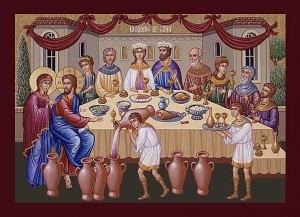
Icon of the Wedding Feast of CanaIn our gospel lesson today, Jesus turns water into wine. He does so, somewhat unwillingly it seems, because he and his mother are at a wedding banquet and the couple is about to run out of wine for their guests. Mary brings this to Jesus’ attention because she apparently believes he can do something to save the hosts from embarrassment. At first, however, he seems disinclined to do anything about it. Not the least bit phased by her son’s reluctance, Mary tells the servants to do whatever he tells them, and she goes back to the party. I have always imagined that as she turned away Mary gave Jesus the same sort of look my mother would give me when I tried to not do as she wanted, the same sort of look I’ve seen my wife give our children. So . . . Jesus turns water into wine, and (as you will see) not just any water into not just any wine, but really good wine! Now, one supposes that Jesus could have done something else to assist the wedding couple, but he chooses to do this, to turn water into wine.

Wine is a very special sort of drink, especially in the Jewish tradition and, thus, in our own Christian faith. Wine gets a special mention in Psalm 104, which is a long song of praise to God for all the things God has created, especially those things that are good for human beings. Along about the middle of the psalm, the singer gives praise to the Almighty that among the “plants to serve mankind” are those from which we get “wine to gladden our hearts.” (Ps 104:15-16) In Jewish tradition, grape wine is considered such a gift to humankind that it alone of all alcoholic beverages has a special prayer of thanksgiving: Barukh atah Adonai Eloheinu Melekh ha’olam, bo’re p’ri ha’gafen (“Blessed are you, O Lord our God, Sovereign of the universe, who creates the fruit of the vine”).

I would like you to keep that in mind. I’ll return to the subject of wine and glad hearts in a short while, but first I want to share with you a news story that crossed my desk a couple of days after Christmas. It is from the Jewish publication, The Tablet:

Climate change has been blamed for a host of devastating events, from Hurricane Sandy to the evaporation of Greenland’s glaciers. But earlier this year, a dramatic weather event had a small but important impact on the Jewish community: In July, as a drought brought the effects of global warming to the Midwest, the only mikveh in Omaha, Neb., went dry.

The mikveh, a ritual bath, is an essential part of any Orthodox Jewish community, so when one goes dry, it’s a serious issue — especially in Omaha, where the next nearest mikveh is a state away. “The mikveh is one of the most basic institutions of any Jewish community,” explained Jonathan Gross, the rabbi of Beth Israel Synagogue, Omaha’s Orthodox congregation. “How are you supposed to have young families if you don’t have a mikveh?”

Refilling a mikveh isn’t a simple matter of turning on a faucet; there are rules about what kind of water can and cannot be used. The community in Omaha prayed for rain – one of the approved methods for replenishing the water in a mikveh – and their prayers were eventually answered. But by the time those rains came, another solution was already in place, a solution that involved one ton of ice.

Mikvehs typically serve multiple purposes. The first and most important is as a place for women to purify themselves after completing their menstrual cycles; immersion in a mikveh is a critical part of the laws of Taharot HaMishpacha, family purity, and without immersion a woman is forbidden to have sex with her husband. New vessels, like pots and pans, must be immersed before they can be considered kosher and thus usable. And converts need to immerse to conclude their conversions. Customarily, men also dunk, before holidays and before their wedding day, although this isn’t mandated by modern Jewish law.

Like many mikvehs, the Omaha Community Mikvah is composed of two below-ground pools. The first pool fills with rainwater through a hole in the roof, and the second, larger pool is used for the actual bathing. To be considered halachically valid, a mikveh is required to have at least 40 se’ah of natural water. A se’ah, a unit of halachic measurement, corresponds to roughly five gallons of water, according to one stringent opinion – meaning that 200 gallons of natural water are required for a kosher mikveh. The water must fill the mikveh through naturally occurring sources, either by rain or through a connection to a spring or river. Water that is transported to the mikveh through direct human means – in buckets, for instance – is called she’uvim, drawn water, and cannot be used to fill a mikveh. Tap water is also forbidden, though this wasn’t always the case—and tap water can be added to the mikveh once the required 200 gallons of natural water are present.

[Preacher’s Note: The author is being generous in equating 40 se’ah to 200 gallons. A se’ah is 12.128 litres. Doing the math yields a more accurate conversion of 40 se’ah to just under 130 gallons. This is the approximate volume of water changed to wine in today’s gospel lesson. See The Jewish Encyclopedia.]

In July, Omaha’s mikveh was accidentally emptied when a maintenance crew member thought that cleaning the mikveh meant emptying it completely. In most circumstances, a mikveh can be refilled relatively easily through rain or snow, but this summer’s drought made that impossible. “Had this happened in January with all the snow we would have been filled up in a week!” Gross lamented on his blog.

The mikveh was out of service for almost two months. Women traveled to the next closest mikveh in Des Moines, Iowa, or Kansas City, Kan., each more than two hours away. Dishes went unpurified. The receptionist at the Rose Blumkin Jewish Home, where Omaha’s mikveh is located, received calls every time it rained an inch, asking if the pool had somehow miraculously filled. As the weeks passed, different ideas were thrown around: The supervising rabbi of the mikveh suggested the community pray for rain. They did. Another rabbi tried to open up a larger hole in the roof to allow more water, but that didn’t work. Some scientific-minded congregants suggested lighting giant Bunsen burners, evaporating water and then allowing it to condense over the mikveh; this was deemed impractical and was never tried.

The town finally turned to Rabbi Yaakov Weiss, 34, the pastoral service coordinator of the Blumkin Home and one of the supervisors of the mikveh. Another rabbi brought up the idea of using ice to fill the mikveh, and Weiss began looking into it. Using ice was a sort of loophole or leniency: Since the ice was solid and not liquid, if it was moved into the mikveh while still in its frozen state, when it melted it would be considered non-she’uvim water, and the mikveh would be kosher. This procedure, while not common, is almost universally accepted.

“I know it had been done in Nova Scotia once, but I had never heard much about it prior or since,” Weiss said.

Weiss called Rabbi Hershel Schachter and Rabbi Zvi Sobolofsky, two important legal minds at Yeshiva University in New York. They referred him to a mikveh expert, Rabbi Yirmiya Katz, who went through the exact requirements of filling the mikveh with ice.

Weiss’ first thoughts were to use the large ice machines in the Blumkin Home, but that plan was quickly vetoed since the ice would have melted too much by the time they put it in the mikveh. Weiss, with Katz’s help, figured out that he’d need a lot of very frozen ice put in the mikveh very fast.

Weiss called every ice company in Omaha (“Did you know that while there are many ice companies – Arctic Ice, Omaha Ice, Glacier Ice – they are all actually the very same place?” he wrote on Gross’ blog) and finally found one that could deliver the required amount: 250 10 pound blocks of ice. The ice was paid for by the Jewish Federation of Omaha, on whose campus the Blumkin Home is located.

On Friday, Aug. 24, Weiss and a group of volunteers wearing special gloves that wouldn’t melt the ice amassed outside the mikveh at 8:15 in the morning. But the truck showed up an hour late, and by the time Weiss opened the first package, the ice melted in his hands.

“Apparently this was their version of solid blocks of ice: It was a block of crushed ice pushed together in a brick,” explained Weiss. “It doesn’t stay as cold as a real block of ice.”

Weiss went back to the drawing board where he found Muzzy Ice, an ice company that makes blocks of ice for ice sculptures. He had found them earlier but decided against using them given the large size of their ice blocks. “I didn’t want to risk damaging our mikveh,” Weiss said, but he relented once he realized that was the only option.
Three weeks later, on Sept. 11, a Muzzy Ice truck pulled up to the mikveh. Inside the truck were seven 300-pound blocks of ice. An extra 100 pounds of dry ice was shoved inside the truck to ensure that nothing melted.

In less than an hour, staff members of the Jewish Federation moved the ice into the mikveh. Along the way, little pieces of ice would chip off and fall on the stairs; Weiss and a colleague would rush to pick them up to make sure that the chips wouldn’t liquefy and contaminate the mikveh water. “It was very intense and very stressful,” recalled Weiss. “[But] it was quite an experience. I’ve never dealt with a ton of ice in a small contained area.”

Once all seven 300 pound blocks were moved, the question became how long the ice would take to melt. Estimates ranged from two days to a week.

They never got to find out.

The next evening a huge torrential storm hit the Midwest. In several hours, the bor z’reih, the place where the rainwater collected, was filled to capacity and the first pool was filled. “I went in the next day and said, ‘Wow.’ ” Weiss told me. “Now our only problem was our mikveh was filled with ice.”

Both Weiss and Gross said that the whole effort pulled Omaha’s roughly 6,000 Jews together and led to a newfound curiosity about the mikveh, even among those who don’t really use it.

“Was it a waste of energy and time? Or conversation and money?” Weiss considered. “We often say that our efforts and actions have repercussions for good and bad and perhaps this was a repercussion. It’s a community mikveh and it’s integral to us. Perhaps by showing how much it means to us, I think . . . we saw a response or sign from God. For our action, we have God’s reaction: ‘I’ll give you the rainfall you were looking for.’ ” (The Day the Mikveh Went Dry, The Tablet, December 27, 2012)

I wanted to read that article to you because it gives you a picture of how seriously the Orthodox Jews of our time treat what John in today’s gospel lesson calls “the Jewish rites of purification.” Modern Orthodox Judaism is the direct descendent of, and the closest thing we have in our world to, the village religion of Jesus’ time and place. The seriousness with which the Orthodox Jews of Omaha, Nebraska, dealt with the filling of their mikvah gives us clue to how gravely the Jews of Cana, and Jesus himself, would have regarded the 130 or so gallons of water that Jesus just sort of willy-nilly turns into wine for the wedding banquet.

OK. Yes, I’m being facetious. There is nothing willy-nilly about this. Jesus isn’t just turning water into wine. Jesus is doing something called an “enacted parable”. An “enacted parable” is one told through actions rather than words. The prophet Hosea, for example, married a prostitute to illustrate the unfaithfulness of Israel; the prophet Jeremiah wore a yoke to symbolize the oppression of the Babylonians. An “enacted parable” has been described as “an extravagant action which upsets the conventions of life” (A. Richardson, Westminster Dictionary of Christian Theology, Westminster:1983, p. 426). This is precisely what Jesus is doing when he changes the water of ritual purification into wine to celebrate newlywed love; he is upsetting the religious conventions of Jewish life.

Jesus is enacting the distinction that St. Paul will later explicate into a theological contrast between Law and Grace. Now don’t get me wrong, Jesus is not overthrowing the Jewish religion! Jesus was, himself, a good and faithful Jew, and the Law’s insistence upon ritual purity is not, in and of itself, a bad thing. But the point Jesus seems to be making here is that given a choice between Law and love . . . choose love! Given a choice between worrying about water for purification on the one hand or enjoying wine to gladden the heart on the other . . . choose gladness. By changing the water intended for the mikvah into wine for the party, Jesus is saying that joy ranks higher in the scheme of things than purity. Given a choice between celebration and seriousness, says this action . . . choose celebration.

Judaism, of course, is not a religion entirely of Law, ritual purity, and seriousness. As anyone who has been to a Passover supper or a Chanukah party or a Jewish wedding feast knows, there are occasions of great merriment and fun, of joy and celebration. Here, at the beginning of his public ministry, the Son of God makes it plain, that these are the higher ranking values of the reign of God. He will do so again at the end of his earthly life when, in the joyful context of the Passover banquet, he will take bread and wine, wine which gladdens the human heart, and tell his friends to do the same again and again, “whenever you do it,” in his memory.

One of my very favorite motion pictures is Auntie Mame starring Rosalind Russell; I just love that movie. There is a scene in it in which Mame is speaking to her stenographer Miss Agnes Gooch (played by Peggy Cass):

Mame — Oh, Agnes! Here you’ve been taking my dictations for weeks and you haven’t gotten the message of my book: live!
Agnes — Live?
Mame — Yes! Live! Life’s a banquet and most poor suckers are starving to death!

I want to suggest to you today that Mame was preaching the gospel, that that is a Christian sentiment fully in keeping with miracle at the Wedding in Cana of Galilee, that it is a Christian sentiment fully in keeping with Lord’s Passover supper in the Upper Room, that it is a Christian sentiment fully in keeping with our weekly gathering for the Lord’s Supper in Holy Communion.

Choose wine over water, choose love over Law, choose gladness over worry, choose joy over gravity, choose celebration over seriousness, choose a party over purity! Life’s a banquet! Enjoy it! Amen.

Far More Than We Can Ask Or Imagine – From the Daily Office – January 19, 2013

From the Letter to the Ephesians:

Now to him who by the power at work within us is able to accomplish abundantly far more than all we can ask or imagine, to him be glory in the church and in Christ Jesus to all generations, for ever and ever. Amen.

(From the Daily Office Lectionary – Ephesians 3:20-21 (NRSV) – January 19, 2013.)

IMAGINATION by archanNEpiscopalians who say the Daily Office are familiar with this text; a variation of it is one of the options for the Grace at the end of both Morning and Evening Prayer. Each time I recite those words at the end of the office, I am reminded how limited our imaginations are!

Yesterday, I wrote here about seeking ways to incorporate the cutting-edge practices of the “emerging church” into the life and ministry of the “inherited church”. I received one response which asked, “so there is no place for people who have grown up in the Church, then?” Of course there is, I replied. Something new is not a threat to that which is old, it is simply new. Are our imaginations are so limited that we cannot envision there being something new in the church without also thinking that means the loss of something old and valued? Are our churches and church structures so limited that they cannot encompass both old and new together?

We are bounded by our questions; our imaginations are limited by what we ask. It is not without good reason that St. Paul phrased this doxology to say that God can accomplish “more than we can ask or imagine.” What we ask limits what we can imagine. How we ask frames our expectations. The sorts of questions we pose determine the limits of our thinking. When we ask the right questions, we get the right answers; with the right questions, we expand our thinking and with expanded thinking, we broader horizons.

There are many trite and hackneyed sayings about imagination: “All things are possible to those who believe.” — “What the mind can conceive, it can achieve.” The thing about the trite and the hackneyed, however, is that it’s true; we say these things again and again because we recognize their validity. Just consider what human imagination has wrought: humankind has gone to the moon; heavier-than-air contraptions carry human beings through the sky at supersonic speeds; kidneys, lungs, hearts, hands, and faces have been transplanted from one body to another; we carry small light-weight devices with which we can access all the knowledge human beings have ever accumulated. These things were the stuff of science fiction not too long ago; they are now science fact.

So why is our imagination so limited when it comes to the future of the church? In our spiritual and religious life we should be even more imaginative. “Ask, and it will be given you; search, and you will find; knock, and the door will be opened for you.” (Matthew 7:7) Ask anything you like, said Jesus. Tell trees to be uprooted! Cause mountains to be thrown into the sea! For God’s sake, use your imagination! We are made, the Genesis story tells us, in the image of God. The novelist Henry Miller once wrote, “Imagination is the voice of daring. If there is anything godlike about God, it is that. He dared to imagine everything.” If there is anything godlike about us, it is that we have that same voice of daring. “Use it,” is the command of our Lord.

God is able to do far more than we can ask or imagine. The funny thing is, so are we.

====================

A request to my readers: I’m trying to build the readership of this blog and I’d very much appreciate your help in doing so. If you find something here that is of value, please share it with others. If you are on Facebook, “like” the posts on your page so others can see them. If you are following me on Twitter, please “retweet” the notices of these meditations. If you have a blog of your own, please include mine in your links (a favor I will gladly reciprocate). Many thanks!

====================

Father Funston is the rector of St. Paul’s Episcopal Church, Medina, Ohio.

« Older posts Newer posts »