Occasional thoughts of an Anglican Episcopal priest

Category: Theology (Page 94 of 95)

He Will Not Let Your Foot Be Moved – From the Daily Office – August 21, 2012

From the Psalms:

I lift up my eyes to the hills;
from where is my help to come?

My help comes from the Lord,
the maker of heaven and earth.

He will not let your foot be moved
and he who watches over you will not fall asleep.

Behold, he who keeps watch over Israel
shall neither slumber nor sleep;

The Lord himself watches over you;
the Lord is your shade at your right hand,

So that the sun shall not strike you by day,
nor the moon by night.

The Lord shall preserve you from all evil;
it is he who shall keep you safe.

The Lord shall watch over your going out and your coming in,
from this time forth for evermore.

(From the Daily Office Lecionary – Psalm 121 (BCP Version) – August 21, 2012)

Rocky Mountain TrailI think this may be my favorite psalm. It is the psalm appointed for use on the feast of St. Francis of Assisi. It is one of the psalms approved in The Book of Common Prayer for use at a funeral; it was selected by my mother to be used at her funeral.

It is one of the most intimate of the psalms for it constantly names God; each time the words “the Lord” appear in this English translation, the Hebrew actually sets out the Tetragrammaton, YHWH, the Name of God. The translation follows the Jewish custom of never saying that Name, of replacing the Name with other words to avoid any hint of familiarity with or disrespect for the Lord. Although I understand the piety behind that tradition, I find it here to be a bit sad, for in following it one loses the intimacy which makes this psalm so powerful.

As a college student, one of my recreations was hiking and camping; my circle of friends and I would take off for some wilderness area or mountain range for a weekend, backpacking all of our needs and supplies, exploring trails and seeing sights many people never see. In Southern California, many of the mountain trails are quite treacherous. The soil is rocky and loose and one can easily slip and lose one’s footing. The pathways are not unlike those of the Holy Land – steep, rocky, covered with loose stones and gravel, footing unsure. For safety and support, we often walked close together, helping one other up or down steep slopes.

I thought of those hikes recently when, in my own backyard (which is on a rather steep slope) I slipped while doing yard work, went down, and tore the meniscus of my right knee necessitating surgery. No one else was home and I had to crawl back to the house by myself. If that had happened in the Southern California wilderness, it could have been disastrous. That’s why we supported one another, and that’s why the third verse of this psalm speaks so loudly to me. “He will not let your foot be moved.” Yahweh is with us, close to us, supporting us in the same way my hiking companions were with me on those college-day backpacking trips.

And that’s why I find it sad that the psalm does not name God. You don’t refer to or address the one who supports you along a steep, slippery slope by formal titles. Your companion on the difficult path is your buddy, your friend, your intimate companion. As the opening anthem of the Burial Office in The Book of Common Prayer says of God, he is “my friend and not a stranger.” He is Yahweh, and he will not let my foot be moved.

====================

Father Funston is the rector of St. Paul’s Episcopal Church, Medina, Ohio.

Preaching Like Stephen, Making People Angry – From the Daily Office – August 20, 2012

From the Acts of the Apostles:

When they heard these things, they became enraged and ground their teeth at Stephen. But filled with the Holy Spirit, he gazed into heaven and saw the glory of God and Jesus standing at the right hand of God. “Look,” he said, “I see the heavens opened and the Son of Man standing at the right hand of God!” But they covered their ears, and with a loud shout all rushed together against him. Then they dragged him out of the city and began to stone him; and the witnesses laid their coats at the feet of a young man named Saul. While they were stoning Stephen, he prayed, “Lord Jesus, receive my spirit.” Then he knelt down and cried out in a loud voice, “Lord, do not hold this sin against them.” When he had said this, he died. And Saul approved of their killing him.

(From the Daily Office Lecionary – Acts 7:54-8:1 – August 20, 2012)

Martyrdom of Saint StephenSaint Stephen, one of the first deacons of the church, has just preached a sermon in which he has reminded his hearers, Jewish authorities in Jerusalem, that the Jews had a history of mistreatment of prophets, Their ancestors, he has said, “killed those who foretold the coming of the Righteous One, and now [his listeners] have become his betrayers and murderers.” No wonder they were angry with him.

I’m increasingly coming to the opinion that Christian preaching ought to anger those who hear it. If it doesn’t make them angry at the preacher, it should make them angry at someone or something else, angry enough to do something . . . though maybe not a fatal stoning.

We who preach the gospel of Jesus Christ should have the courage and conviction of Stephen, if not that of Jesus himself. There is a lot in our society that needs to be “called out” – the obvious racism of the way Ohio’s voting hours are being limited, for example, or the obvious sexism of a senate candidate in another state who can conceive of something he labels “legitimate rape” or the callous disregard for the needs of poor children deprived of nutrition be the defunding of school meal programs. These are not merely political issues; these are moral, ethical, and spiritual issues about which the church – and the church’s preaches – need to speak out. There are no “merely political” issues; every issue has moral, ethical, and spiritual dimensions, and of those the gospel has much to say. It will not say it to our world, however, unless preachers address the issues. And if that makes someone angry, so much the better.

A 19th Century Chicago journalist named Finley Peter Dunne wrote under the pseudonym of an Irish bartender named Mr. Dooley. One of Mr. Dooley’s observations concerned the role of the press:

Th’ newspaper does ivrything f’r us.
It runs th’ polis foorce an’ th’ banks,
commands th’ militry,
controls th’ ligislachure,
baptizes th’ young,
marries th’ foolish,
comforts th’ afflicted,
afflicts th’ comfortable,
buries th’ dead,
an’ roasts thim aftherward.

In the 1960 movie Inherit the Wind, Gene Kelly played an H.L. Mencken-like newspaper editor saying, “It is the duty of a newspaper to comfort the afflicted and afflict the comfortable.” Clare Booth Luce used a variation of this sentiment in her eulogy for Eleanor Roosevelt and numerous churchmen, including Reinhold Niebuhr, have applied similar words to the Christian faith, arguing that the preacher’s job, indeed the very nature of the gospel, is to comfort the afflicted and afflict the comfortable. Our job as ministers of the gospel is to offer hope and consolation to those who are hurting, while standing strong against the evils of injustice and oppression and selfish pursuit. And if that makes someone angry, so much the better.

The first deacon, Stephen, should be the patron saint of this kind of preaching, of which there should be much, much more.

====================

Father Funston is the rector of St. Paul’s Episcopal Church, Medina, Ohio.

Lady Wisdom & Questions God Is Never Going to Ask – Sermon for Pentecost 12, Proper 15B – August 19, 2012

====================

This sermon was preached on Sunday, August 19, 2012, at St. Paul’s Episcopal Church, Medina, Ohio, where Fr. Funston is rector.

(Revised Common Lectionary, Proper 15B: Proverbs 9:1-6; Psalm 34:9-14; Ephesians 5:15-20; and John 6:51-58)

====================
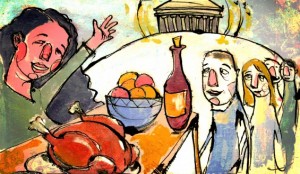
Proverbs 9 by David WierzbickiAs I may have mentioned here before, I spent many of my childhood summers in the southeastern Kansas town of Winfield with my paternal grandparents, C.E. and Edna Funston. Winfield was my parents’ hometown, both of them were raised there and my mother had been born there. Her maternal grandparents, Hinrich and Harmke Buss, were immigrants from that area of Germany right next to Holland called “Ostfriesland”. My father was born in Dodge City, and he and his folks moved to Winfield when he was just a few months old; they were relative newcomers but my grandfather soon became a prominent citizen.

Anyway, one of the things I remember about Winfield is the way newcomers, or anyone someone was meeting for the first time, were almost invariably asked two questions. I once discussed this with a friend who was born and raised in South Carolina and she said it was the same in her hometown, that these are what she called “very Southern questions.” That makes sense because in an odd way, southeastern Kansas is much more Southern than it is midwestern. My mother used to all that part of Kansas “lap land” – meaning that it is were Oklahoma and Arkansas lap over into Kansas.

So there were these two questions that people asked when first meeting another person. The first was, “Who are your people?” Winfield was an agricultural center and not much else. There was no industry or manufacturing that would bring people to town. There was farming and the businesses that support farming, all of which were family owned. So if somebody new came to town to work in on a farm or in a farm-supporting business, it was assumed you must be part of the family. So, who are your people? The answer placed you in a particular social context. So I would say, “Well, my mother is Betty Sargent, one of the Buss cousins.” Anyone local would then know I was a descendant of Henry Buss. My greatgrandfather had had two families. One set of children were born to first wife Mary – she had 14 kids who lived; another set of 13 living children were born to Harmke, my greatgrandmother. According to his obituary, all of those children were alive when Henry died and he left approximately 200 acres of land to each of them. Doing the math, you get the idea that he had acquired a lot of farmland (something over 5,000 acres) and that he (and his children after him) were influential in the local economy. As I mentioned before, on the paternal side my grandparents were comparatively new to the town, but they had become very active members of the Methodist Church and my grandfather, an active Mason, had risen in those ranks as well. So if I continued to my inquirer, “And my father is C.E. and Edna Funston’s youngest son,” he or she would immediately know I was related to a Past Master of the Lodge and an elder in the Methodist Church.

Because of that, I wasn’t often asked the second question, “Where do you go to church?” But I could have been because it really wasn’t a given that I would have been a Methodist. The Busses were members of the Dutch Reformed Church and the Sargents belonged to the Disciples of Christ; I could have been either of those – but the truth was, except for those summer months with the Funstons at the Methodist Church, I really didn’t go to church as a kid.

In any event, those questions served to place someone in a social context, to define in the questioner’s mind who they were and where the fit. And the truth is they aren’t just “Kansas questions” or “Southern questions”. They are everywhere questions. In the fall of 2005, Evie and I took our first trip to Ireland and, as part of that trip, visited County Donegal as I was in search of Funstons in the area where I believe my Funston great-greatgrandfather originated. In Donegal Town itself, we happened to stop into a woolen sweater store run by a man named Sean McGinty. Mr. McGinty asked about our trip and I was explaining to him my family connection to the area. He turned to his wife Mary and said, “You’re from Pettigo; weren’t there some Funstons in Pettego.” She thought for a moment and replied, “Yes . . . . but they weren’t our people.” — They weren’t our people, meaning they weren’t Roman Catholic. The Irish Funstons were and still are Church of Ireland – Anglicans . . . Protestants. “Who are your people?” “Where do you go to church?” They or something like them are human questions; the help us to put people in their place, to categorize one another, to define each other. They are human questions.

But they are not God’s questions! Long before St. Paul would write to the Galatians that in Christ “there is neither Jew nor Greek, there is neither slave nor free man, there is neither male nor female,” (Gal. 3:28) the compiler of the Book of Proverbs would make the same point in the 8th and 9th Chapters of that book, part of which we read today. In these chapters we read of Lady Wisdom, one of the most intriguing characters in all of the Old Testament. In the 8th Chapter, before the part we heard this morning, she tells us herself:

When [God] established the heavens, I was there, when he drew a circle on the face of the deep, when he made firm the skies above, when he established the fountains of the deep, when he assigned to the sea its limit, so that the waters might not transgress his command, when he marked out the foundations of the earth, then I was beside him, like a master worker; and I was daily his delight, rejoicing before him always, rejoicing in his inhabited world and delighting in the human race. (Prov. 8:27-31)

She was, she tells us, a “master worker” helping God to create all that is. And in our reading this morning from Chapter 9, we see her as “the hostess with the mostest” who is ready to throw a party, to do the honors at a great feast. She has “slaughtered her animals, she has mixed her wine, she has . . . set her table,” and she sent her servants out to invite her guests. In fact, she herself stands in her doorway, in the highest places of the town calling,

“You that are simple, turn in here!” To those without sense she says, “Come, eat of my bread and drink of the wine I have mixed. Lay aside immaturity, and live, and walk in the way of insight.” (Prov. 9:4-6)

Note that she doesn’t ask, “Who are your people? Where do you go to church?” She doesn’t ask if any are Jew or Greek, slave or free, black or white, straight or gay, Republican or Democrat, Catholic or Protestant, none of that matters . . . all she asks is that we be “simple” and “without sense.”

Now that’s a bit disconcerting and, frankly, I think the translation belies the true meaning of the invitation. The Hebrew here is, “Mi-phethi yasur henah chasar-leb ‘am’rah lo.” The word translated as “simple” (and sometimes as “naive”) is phethi. It’s root is the word pawthaw, which means “wide open”. An alternative and more positive understanding of this word is “open-minded”. The term “without sense” (sometimes rendered “lacking understanding”) is chasar-leb. Chasar means “without” or “lacking”. Leb (rendered here as “sense” or “understanding”) is most often translated as “heart” because in the ancient Hebrew understanding the heart was believed to be the seat of comprehension and emotion. This is not simple understanding or sense, this is passionate belief, enthusiastic commitment; in a negative sense we might say “bias” or “prejudice”.

Lady Wisdom is not inviting simpletons or the foolishly naive into her parlor; she is inviting the open-minded, those who have no preconceptions, no intolerant prepossessions. Lady Wisdom, God’s master worker, does not care if you are Jew or Greek, Irish or German, black or white or Asian or Native American, straight or gay or lesbian or transgendered, Democrat or Republican or Socialist or Libertarian. Lady Wisdom, God’s master worker, doesn’t care who your people are; she cares about whose you are! She doesn’t care where you go to church; she cares that you are the church, the People of God! She wants you to be open-minded, to come without prejudice or preconception. Her invitation is reminiscent of the Prophet Isaiah’s, “Come now, and let us reason together, saith the Lord.” (Isaiah 1:18 – KJV) She invites us to come and learn.

She has set her table; she is ready to host her party. “Come, [she says] eat of my bread and drink of the wine I have mixed. Lay aside immaturity, and live, and walk in the way of insight.” Lady Wisdom’s celebration is the marriage feast of the Lamb; her invitation is to that very supper Jesus would share with his disciples and shares with us throughout all the ages. St. Paul wrote to the Corinthians the words we recite each time we gather at this Table:

. . . that the Lord Jesus on the night when he was betrayed took a loaf of bread, and when he had given thanks, he broke it and said, “This is my body that is for you. Do this in remembrance of me.” In the same way he took the cup also, after supper, saying, “This cup is the new covenant in my blood. Do this, as often as you drink it, in remembrance of me.” (1 Cor. 11:23-2)

And here in John’s Gospel today he promises that “those who eat my flesh and drink my blood have eternal life, and I will raise them up on the last day; for my flesh is true food and my blood is true drink. Those who eat my flesh and drink my blood abide in me, and I in them.” (John 6:54-56)

To this Feast we are all invited without regard to who our people may be, without regard to where we go to church. To this Feast today we welcome Nathan Joseph Daley who is to be baptized. No one here will ask, “Who are your people?” but if anyone ever does, Nathan can answer “The People of God” . . . and if he wants to be more specific, he can say “The Episcopalians!” No one here will ask, “Where do you go to church?” but if anyone ever does, Nathan can answer, “St. Paul’s!”

Someone else may ask those questions of Nathan or of you or me, but God is never going to ask them! God will ask, “Are you open-minded? Are you free of bias and prejudice?” God will ask, “Are you filled with the Spirit? Do you sing psalms and hymns and spiritual songs? Do you sing and make melody to the Lord in your heart? Do you give thanks at all times and for everything in the name of our Lord Jesus Christ?” (Questions drawn from Ephesians 5:18-20) God will ask, “Do you seek and serve Christ in all persons, loving your neighbor as yourself? Do you strive for justice and peace among all people? Do you respect the dignity of every human being?” (Questions drawn from the Baptismal Covenant in the Book of Common Prayer, pg. 305)

With God’s help, Nathan and we will grow and learn to do these; through God’s grace, he and we will feast on Bread and Wine, and “lay aside immaturity, and live and walk in the way of insight.”

Let us pray:

Grant, Lord God, to Nathan who is about to be baptized into the death and resurrection of your Son Jesus Christ, and to those who already have been baptized, that, as we have put away the old life of sin, so we may be renewed in the spirit of our minds, lay aside immaturity, and live and walk in the way of insight, righteousness, and true holiness; through Jesus Christ our Lord, who lives and reigns with you, in the unity of the Holy Spirit, one God, now and for ever. Amen.

The Things We Do for Love – From the Daily Office – August 18, 2012

From the Book of Judges:

Delilah said to Samson, “Please tell me what makes your strength so great, and how you could be bound, so that one could subdue you.” Samson said to her, “If they bind me with seven fresh bowstrings that are not dried out, then I shall become weak, and be like anyone else.” Then the lords of the Philistines brought her seven fresh bowstrings that had not dried out, and she bound him with them. While men were lying in wait in an inner chamber, she said to him, “The Philistines are upon you, Samson!” But he snapped the bowstrings, as a strand of fibre snaps when it touches the fire. So the secret of his strength was not known.

(From the Daily Office Lectionary – Jugest 16:6-9 – August 18, 2012)

Samson and Dalilah, Max Liebermann, 1902It may be a sign of my age or a condemnation of my cultural up-bringing, but I cannot read any of the story of Samson and Delilah without hearing Tom Jones’ voice sining, “Why? Why? Why, Delilah? My, my, my Delilah?” Silly, I know, but it sort of fits with this bit from the Old Testament lesson from today’s lectionary readings.
We are told that Samson “fell in love with a woman in the valley of Sorek, whose name was Delilah,” (v. 4) and that she is then persuaded by the Philistine leadership to discover and disclose the source of Samson’s strength. So begins a series of events in which she asks Samson, he lies to her, she undertakes to betray him on the basis of the lie, and he overcomes the betrayal. After three such episodes, he finally tells her that he will lose his strength if a razor touches his head and the story proceeds as every Sunday School child remembers it.

Reading these three episodes of question, lie, and betrayal, Tom Jones’ lyric keeps ringing in my ears, “Why, why, why?” Why does Samson stay with or keep returning to this woman who is clearly in league with his enemies? Why?

I suppose the answer is in verse 4: “He fell in love with [her].” Love, or perhaps we should be honest and note that what this really is is lust or passion, does that to us; it blinds us to the faults in the beloved. “Love is blind” says the old shibboleth. Erotic love makes us overlook the obvious and do things that simply do not make sense.

One of my favorite songs of a bygone era is 10-CC’s Things We Do for Love:

Too many broken hearts have fallen in the river
Too many lonely souls have drifted out to sea
You lay your bets and then you pay the price
The things we do for love, the things we do for love

Communication is the problem to the answer
You’ve got her number and your hand is on the phone
The weather’s turned and all the lines are down
The things we do for love, the things we do for love

Like walking in the rain and the snow when there’s nowhere to go
When you’re feeling like a part of you is dying
And you’re looking for the answer in her eyes
You think you’re gonna break up
Then she says she wants to make up

Ooh you made me love you
Ooh you’ve got a way
Ooh you had me crawling on the floor

A compromise would surely help the situation
Agree to disagree but disagree to part
When after all it’s just a compromise
Of the things we do for love, the things we do for love
The things we do for love

Walking in the rain and the snow, crawling on the floor, returning again and again to a paramour whose clearly bent on betrayal . . . the soul in search of love will do a lot of silly and stupid things that make us ask “Why?” I think we know the answer, though; we’ve known it at least since St. Augustine of Hippo write his Confessions: “You have made us for yourself, Lord, and our hearts are restless until they rest in you.” Only in God do we find that love which does not betray.

====================

Father Funston is the rector of St. Paul’s Episcopal Church, Medina, Ohio.

Consequent Actions – From the Daily Office – August 13, 2012

From John’s Gospel:

Just as Moses lifted up the serpent in the wilderness, so must the Son of Man be lifted up, 15that whoever believes in him may have eternal life. For God so loved the world that he gave his only Son, so that everyone who believes in him may not perish but may have eternal life.

(From the Daily Office Lectionary – John 3:15-16 – August 13, 2012)

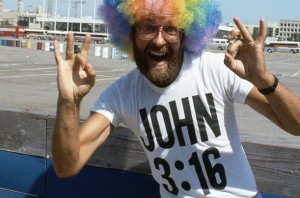
A very familiar quotation from Scripture that second verse: anyone who has ever attended a sporting event in the United States (or watched one on television) as seen someone holding up a sign with “John 3:16” emblazoned on it. Often that person is wearing a rainbow-colored “Afro” wig. Anytime I have witnessed that spectical I’ve wondered, “Has anyone ever become a follower of Jesus because of that sign?” I’m pretty certain the answer is “No.”

I’m also pretty certain that Jesus didn’t utter the words attributed to him in verse 16. I’m not alone in believing that, by the way. There are a lot of scholars who think that John’s quotation from Jesus ends with verse 15 and everything that follows is John’s commentary on what Jesus said, not the words of Jesus himself. That’s not the way most bible translations show it, however. In any event, whether the words of verse 16 are Jesus’ or John’s, another thing I’m pretty certain of is that they have nothing to do with getting into heaven!

That’s how most people understand this, I think, but I believe their understanding to be dead wrong. I use that term advisedly because the question really is about whether these words apply to what happens before we die or after we die. Believing in Jesus isn’t supposed to be some sort of eternal life insurance policy, a ticket to heaven, a pass into the new Jerusalem and all its loveliness as portrayed by another John in the Book of Revelation; it’s supposed to be about how we live in the present.

Believing in Jesus and gaining eternal life is supposed to be a present reality. “Eternal life” is John’s way of naming what the Synoptic Gospel writers called “the kingdom” (the kingdom of God or the kingdom of heaven, same thing). It’s the here-and-now transformed by our belief and not simply by our belief but by our action. We who believe in Jesus do not perish but have eternal life, life in the kingdom, because our belief compels us to work with God to create that life in the world in which we live. As another part of the Johannine literature puts it, “We know love by this, that he laid down his life for us — and we ought to lay down our lives for one another. How does God’s love abide in anyone who has the world’s goods and sees a brother or sister in need and yet refuses help? Little children, let us love, not in word or speech, but in truth and action.” (1 John 3:16-18)

In my faith tradition (the Episcopal Church) a public statement of faith at baptism is always followed by a public commitment to action. The candidate (indeed, the whole congregation) is asked if he or she believes in God the Father, God the Son, and God the Holy Spirit; the answers to these questions are simply the words of the Apostle’s Creed. The candidate and congregation are then asked to commit themselves to five consequent actions: to continue in the apostles’ teaching and fellowship, in the breaking of bread, and in the prayers; to persevere in resisting evil, and, whenever they fall into sin, to repent and return to the Lord; to proclaim by word and example the Good News of God in Christ; to seek and serve Christ in all persons, loving their neighbors as themselves; and to strive for justice and peace among all people, and respect the dignity of every human being. When asked if they will do each of these things, the candidate and the congregation respond, “I will, with God’s help.”

These are the consequences of belief in God in Jesus Christ. These are the consequent actions through which, in partnership with God, we bring the kingdom on earth as it is in heaven. These are the consequent actions through which, with God’s help, we live eternal life.

====================

Father Funston is the rector of St. Paul’s Episcopal Church, Medina, Ohio.

Traditional Biblical Marriage: Say What!? – From the Daily Office – August 9, 2012

From John’s Gospel:

Now Gideon had seventy sons, his own offspring, for he had many wives. His concubine who was in Shechem also bore him a son, and he named him Abimelech. Then Gideon son of Joash died at a good old age, and was buried in the tomb of his father Joash at Ophrah of the Abiezrites.

(From the Daily Office Lectionary – Judges 8:30-32 – August 9, 2012)

Wedding RingsOK. I know I shouldn’t get into this . . . I know that someone is going to give me a hard time; I can almost predict that someone will tell me they are planning to “leave the church” over this. But here goes.

I am sick and tired of hearing the words “traditional biblical marriage” bandied about by those who oppose the legal and religious recognition of the committed relationships of same-sex couples. Absolutely fed up with it. Because there is no such thing! Read these three verses from the Book of Judges slowly and carefully because they describe the marriage (or should one say marriages . . . or perhaps “sexual relations”) of one of the greatest heroes of the Bible. And what they describe is a far cry from what the proponents of so-called “traditional biblical marriage” think they are talking about about; Gideon was very definitely not in a “one man, one woman” marriage. The text doesn’t tell us how many wives he had, but with seventy sons I would estimated that he had at least fifteen if not a lot more! And he had at least one concubine! It’s entirely possible that he married his wives as part of some political arrangement with their families or tribes, and that it was his concubine who was his actual love interest.

I need not rehearse here the variety of marital arrangements one finds in the Holy Scriptures. Esther J. Hamori, Associate Professor of Hebrew Bible at Union Theological Seminary has already done a superb job of that in an article for the Huffington Post, Biblical Standards for Marriage. Suffice to say that there are all sorts of culturally conditioned settlements . . . and that’s the significant point, “culturally conditioned”. Our Bible does not and never has set down one sort of standard (for interpersonal relationships or for most other things) that is immutable and permanent; the Bible is a collection of stories of changing norms of behavior stretching over centuries. These changeable and changing behavioral norms may be grounded in a set of ethical or religious principles, but they adapt as cultures and conditions change.

I should also note, but will not dwell upon, the history of marriage (or “matrimony”) as a sacrament of the church. It wasn’t one for about the first millennium of the Christian era! The church wasn’t involved in overseeing marriages at all, but as the clergy became society’s record-keepers, and as the rising post-Empire royalty and aristocracy needed some control on the descent of property and titles, the church became involved. Initially it was only as record-keepers, but then ceremonies and rituals were devised and then, eventually, someone began theologizing about the marital estate and the church’s role in helping it be contracted . . . and, before you know it, Voila! It’s a Sacrament . . . and it’s “always” been one. And, of course, it is now incumbent upon all of society, not just the upper crust, to have church-approved marriages.

We live in a different world from Gideon, so fifteen wives and one or more concubines probably probably would not be an acceptable (or practical) living arrangement for a modern man. We live in a different world from medieval Europe. Marriage is no longer (usually) a political arrangement as it generally was in both those times; today, our concept of marriage honors the emotional attachment of the parties. Today, we know that that emotional attachment, that affective attraction is not universally a heterosexual one; we know that some definite percentage of the human species is affectively attracted to members of their same sex. We know that this is not a deviation from the norm; it is the norm. And knowing that, our culture is changing and the culturally conditioned normative behavior of marriage is changing with it.

The task ahead for religious people is not to insist upon enforcing as unchangeable the cultural norms of a long-departed world like Gideon’s. The task is, rather, to re-apply the underlying ethical and religious principles to our new situation. For Christians, this means looking to the two greatest commandments as stated by Jesus: Love God with all your heart, all your mind, and all your strength, and love your neighbor as yourself. (Matt. 22:37-40) Given that, how can we not re-assess our understanding of marriage? How can we not extend our blessing to the committed relationships of same-sex couples? How can we not give up some false notion of “traditional biblical marriage” and instead embrace Christ’s ethic of loving God and loving our neighbor?

====================

Father Funston in the rector of St. Paul’s Episcopal Church, Medina, Ohio.

God-Talk By Any Name – From the Daily Office – August 8, 2012

From John’s Gospel:

John testified, “I saw the Spirit descending from heaven like a dove, and it remained on him. I myself did not know him, but the one who sent me to baptize with water said to me, ‘He on whom you see the Spirit descend and remain is the one who baptizes with the Holy Spirit.’ And I myself have seen and have testified that this is the Son of God.”

(From the Daily Office Lectionary – John 1:32-34 – August 8, 2012)

I Love Theology T-shirtThe word appears twice in these three verses: testify. According to the dictionary it means to make a public declaration of belief, a statement of faith, an affirmation of fact. I wonder how many church members ever “testify” during the normal course of their daily lives. Not many, would be my guess. In fact, my initial response to my own question is “Damn few!” Members of the Episcopal Church are admittedly reticent to talk about religion, theirs or anyone elses.

We do not have a time during our worship when personal testimony is encouraged or invited. Since the earliest days of its existence, the Christian church has ritualized testifying by incorporating a corporate statement of faith, the Nicene Creed or the Apostle’s Creed, into the its liturgy. While this has had the salutary effect of unifying the church around a single set of understandings of God, it has also gotten Christians out of the habit of talking about God and faith in their own words; in other words, it has encouraged us to not testify.

The great re-awakenings of faith seem always to have started when someone started doing just that – talking about God. Giving up on the ritual, they simply gave utterance to the important questions in their lives and how God had helped or was helping or ought to help answer them. Martin Luther nailed his questions to a chapel door; John Wesley preached about his questions and answers in country fields; Jonathan Edwards and George Whitefield held emotional revivals encouraging others to talk about faith. Talking about God, that’s all they were doing.

There’s another word for that, by the way – theology – from two Greek words, theos and logos, god and word – words about God, theology, testifying; it’s all the same thing. People who testify, who talk about God in their lives, are simply doing theology.

I’ve a friend who thinks we need to change our worship to add a time for personal testimony, but I’m not convinced. If talking about God in church worked, it would already have worked because we talk about God a lot in church. Adding or taking away from what we do in church isn’t the answer. There are already plenty of churches doing that; it’s not our tradition and not our style and if we tried to do it, it wouldn’t be authentic. We should do what we do, but do it with greater integrity and better quality.

In The Church Creative: How To Be a Creative Gathering in the 21st Century, John C. O’Keefe makes the point that the answer to the question of increasing religious activity is not adding glitz to worship, the answer is reimagining God’s role in our lives – the answer is talking about God outside of church in everyday life.

When we think in terms of creativity and productive solutions we need to go beyond just hanging cool pictures, listening to different music, showing movie clips, developing a catchy sermon series, or using flood lights and fog machines in worship. It means we see things in a different way; we view life and issues we face from multiple directions and learn to re-imagine, rethink. (The Church Creative, page 186.)

We need to hear more people in more situations saying, “I myself have seen and have testified that this is the Son of God.” We need more God-talk by whatever name we call it.

====================

Father Funston in the rector of St. Paul’s Episcopal Church, Medina, Ohio. (Fr. Funston has no commercial interest in or connection to Zazzle or the I-Heart-Theology T-shirt; the link is provided simply to acknowledge the origin of the graphic.)

God, Words, Responsibility – From the Daily Office – August 6, 2012

John’s Gospel begins:

In the beginning was the Word, and the Word was with God, and the Word was God. He was in the beginning with God. All things came into being through him, and without him not one thing came into being. What has come into being in him was life, and the life was the light of all people. The light shines in the darkness, and the darkness did not overcome it.

(From the Daily Office Lectionary – John 1:1-5 – August 6, 2012)

Pulpit, Exeter CathdralReading these oh-so-familiar words in the introduction to John’s Gospel, I remember other words I read on another blog yesterday:

If the Church was meeting the deepest needs and yearnings of spiritual people, it would be a priority in their lives. But it is not, and it chooses to ignore everything except the obvious. Evelyn Underhill, the great Anglican mystic of the early 20th century, said that the “only really interesting thing about religion is God.” People aren’t staying away from the Church to play football or shop – they’re staying away because they aren’t finding God. (Do Anglican Churches Really Want to Survive?)

Reading those words I felt like I’d been gut punched, knifed, shot in the head. Not because they are wrong, but because I fear they are probably right, and I wonder what I and my fellow clergy have been doing for the past several decades.

Well, that’s not exactly true. When I read those words I didn’t wonder about other clergy at all . . . I just wondered about me. What have I been doing? Worship in the Episcopal Church takes the effort of lots of people – musicians, choir singers, lay assistants who read lessons, lead prayers, and help at the altar, sacristans who set things up and clean them up after its all done, ushers, greeters, and so forth . . . but it is the priest who designs the liturgy within the broad outlines of The Book of Common prayer, who presides at the altar, and who stands in the pulpit preaching the word. In 22 years of ordained ministry, I’ve done all of that and said a lot of words . . . a lot of words! If in what is happening on Sunday people are not finding God, it is in large part the priest’s responsibility, my responsibility.

Not solely the priest’s, by any means, but in large measure. Especially in a church which follows the catholic tradition of Holy Orders as sacramental and, by its rubrics and canons, makes the parish priest the final arbiter of all worship experiences. Yes, one could recruit and work with a worship committee, and yes, one does work with the musician and all those good volunteers, but in the final analysis, as our canons put it, the senior pastor has “full authority and responsibility for the conduct of the worship and the spiritual jurisdiction of the Parish.” There is even a canon declaring that, in regard to worship, the ordained minister in charge of a congregation, “shall have final authority in the administration of matters pertaining to music.” So I say again, if in what is happening on Sunday people are not finding God, it is in large part the priest’s responsibility.

In 22 years of ordained ministry I’ve said a lot of words, sung a lot of words, heard a lot of words, quoted a lot of words. I hope that God was in some of them.

====================

Father Funston in the rector of St. Paul’s Episcopal Church, Medina, Ohio.

Carb Loading on Jesus – From the Daily Office – August 5, 2012

From the Book of Judges:

Gideon went into his house and prepared a kid, and unleavened cakes from an ephah of flour; the meat he put in a basket, and the broth he put in a pot, and brought them to him under the oak and presented them. The angel of God said to him, “Take the meat and the unleavened cakes, and put them on this rock, and pour out the broth.” And he did so. Then the angel of the Lord reached out the tip of the staff that was in his hand, and touched the meat and the unleavened cakes; and fire sprang up from the rock and consumed the meat and the unleavened cakes; and the angel of the Lord vanished from his sight. Then Gideon perceived that it was the angel of the Lord; and Gideon said, “Help me, Lord God! For I have seen the angel of the Lord face to face.” But the Lord said to him, “Peace be to you; do not fear, you shall not die.” Then Gideon built an altar there to the Lord, and called it, The Lord is peace. To this day it still stands at Ophrah, which belongs to the Abiezrites.

(From the Daily Office Lectionary – Judges 6:19-24 – August 5, 2012)

It is intriguing how often in stories of Holy Scripture food plays a role. From the “apple” in the Garden, to Abraham offering a meal of cakes and meat to the three men (who turn out to God) at the Oaks of Mamre, to this story of Gideon, to David and his men eating the Bread of the Presence, to all the food items listed as items of sacrifice in Leviticus, the Old Testament (indeed, the whole Bible) is food focused. The People of God define themselves through the annual reenactment of a ritual meal celebrating the Passover; the new People of God define themselves (in my tradition and others) by the weekly reenactment of a ritual meal celebrating the death and Resurrection of Christ and anticipating his return. It’s intriguing but not surprising. The Jewish and Christian faiths are not, in the long run, about following rules of ritual or moral conduct; they are about being in an intimate relationship with that which is the source of being, that which we call “God” and address as “Father” or brother or redeemer. And, other than sex, there is probably no more intimate activity two or more people can share than eating together.

Today the gospel lesson for the Eucharist is from John’s lengthy “treatise on bread” section in which Jesus describes himself as the “bread of life,” an image which continues this focus on food. (John 6:24-35) My son Patrick was our guest preacher this morning; he extemporized a sermon around bread as a carbohydrate food. He called to mind the practice of long-distance competitive runners, the folks who run marathons and compete in triathlons, to “carb load”, involves greatly increasing the amount of carbohydrates you eat several days before a high-intensity endurance athletic event. The purpose is to increase the level of glycogen stored in one’s muscles. Usually, only enough glycogen to sustain 60-90 minutes of physical activity is stored, but through carbohydrate loading an athlete, particularly male athletes, can often double the glycogen in their systems.

Noting that the church is in a dynamic period of change, figuring out how it will minister in a new century in a radically different social context, Patrick suggested the period ahead of us is going to be like running a marathon. In the past, the church has been like a sprinter, dashing along quickly with this new program and then dashing again with another new program. But now, the long, hard sustained work of reimagining and restructuring for a new ministry paradigm requires that we “carb load” on the bread of life, Jesus our Lord. Only he can provide the life energy the church needs at this time in its existence.

As I listened to him preach, I thought of this Daily Office lesson and how Gideon’s altar is said to stand “to this day.” I firmly believe that the church will stand, in one way or another, through the years to come. It may not be very much like the church of my youth, or the church in which I currently minister. The era of the parish church, of the congregation with a dedicated single-purpose building, of the local church with a full-time paid priest may be coming to an end, but in some form or another the church will stand. It will endure. It will “run the race that set before us, looking to Jesus the pioneer and perfecter of our faith,” (Heb. 12:1-1) the bread of life which sustains us.

====================

Father Funston in the rector of St. Paul’s Episcopal Church, Medina, Ohio.

How Is It We Hear? – From the Daily Office – August 3, 2012

From the Book of Acts:

“How is it that we hear, each of us, in our own native language? Parthians, Medes, Elamites, and residents of Mesopotamia, Judea and Cappadocia, Pontus and Asia, Phrygia and Pamphylia, Egypt and the parts of Libya belonging to Cyrene, and visitors from Rome, both Jews and proselytes, Cretans and Arabs – in our own languages we hear them speaking about God’s deeds of power.”

(From the Daily Office Lectionary – Acts 2:8-11 – August 3, 2012)

These are the words spoken by the great crowd of Jews and others who thronged the streets of Jerusalem for the Festival of Shavu’ot when the Twelve, empowered by the Holy Spirit, begin to tell the story of Jesus in languages they had never before spoken. Shavu’ot is a celebration with both agricultural and historical significance in Judaism. It is known as the “festival of the first fruits,” a harvest feast when the first fruits were brought as offerings to the Temple; it is also known as the “festival of the giving of the Law,” a celebration of the handing down of Torah on Mt. Sinai. It was called Pentecost, a Greek word meaning “fiftieth”, because it always falls on the fiftieth day after the Passover. That year it fell on the fiftieth day after the Resurrection and, thus, the Christian feast of the Holy Spirit carries that name, as well.

Twenty centuries later, the Jews still celebrate Shavu’ot and Christians still celebrate Pentecost, but what a different world we inhabit. Can we still find meaning in the notion of offering the first fruits to God? Does the giving the Law still have significance? And what of all those languages and the Apostles’ unprecedented immediate linguistic skill?

For us North American Christians an agricultural feast seems a distant and remote idyllic pastoral fantasy. We are no longer connected to the land. Our culture has moved away from an agrarian basis, through the industrial revolution, even beyond a manufacturing basis; we now live in what is being called a “service economy”. We no longer generally produce anything tangible! What are the “first fruits” of non-productive labor in a service economy? It just boils down to money, I guess.

And what about the myth (a word I use with no disrespect intended and with no suggestion that the story’s point is untrue) of God giving the stone tablets to Moses? In a time when that Law has been largely set aside by Christians and even many Jews – in a time when most people have separated the secular civil laws of everyday life from religious observance and custom – in a time when we conceive of the law as something made (“like sausage”) by a group of bickering, nasty, polarized, do-nothing elected officials – in such a time, how are we to give thanks for “the law”? Do we even want to?

Which leaves me to ponder that gift of languages? There are still plenty of them and there are more, in a sense, than ever before; even as actual, spoken tongues die out for lack of use, new means of communication arise – emoticons and email abbreviations have birthed tweets and hashtags – Facebook and LinkedIn and their ilk are the new “crowded streets” – night-time Twitter conversations are held by church people discussing ways “social media” can be used to spread the Gospel – tongues of flame seem to dance on computer monitors and laptops, on tablets and smartphones.

How is it we hear? How is it we understand? How is it we grasp the ancient truths of receiving the Law, the offering the first fruits, experiencing God’s deed of power? I’ve no doubt that hearing and understanding and comprehension are going on . . . but I often wonder if the church (the institution, not the people) is playing any part in that process of communication and comprehension. I hope and pray the Holy Spirit will alight upon us all and give us the gifts we need to do so, so that all may hear and understand in whatever “language” they best comprehend.

====================

Father Funston is the rector of St. Paul’s Episcopal Church, Medina, Ohio.

« Older posts Newer posts »