Occasional thoughts of an Anglican Episcopal priest

Category: Daily Office (Page 22 of 70)

Curmudgeonly Conversations – From the Daily Office – May 21, 2014

From Book of Leviticus:

You shall each revere your mother and father, and you shall keep my sabbaths: I am the Lord your God.

(From the Daily Office Lectionary – Leviticus 19:3 (NRSV) – May 21, 2014)

Muppet Curmudgeons Statler and WaldorfTime for me to put on my curmudgeon hat and unload a rant I’ve been promising myself for the better part of two weeks. It’s a matter of respect for elders, so this verse which links reverence of parents with reverence of God is a perfect entrée for me to set down what’s been bugging me.

Three times in the past couple of weeks I answered our home phone and was immediately asked: “Is Charles there?” (I could go off on another tangent about telephone etiquette and how inappropriate and rude it is to respond to someone’s “hello” with this sort of question, but that’s a cranky-old-man discussion for another time.)

There’s only one Charles who lives in our home, me. I don’t use my first name, so I immediately know this is someone who doesn’t know me. Since the caller has not first identified herself — all three calls were from women and I think all were probably in their 20s or early 30s, I ask, “Who’s calling please?” In one case it was a charity seeking contributions; in the second it was a lawn service looking for customers; the third, a vendor of “retirement services,” whatever those are.

Once I ascertained who was calling, I responded as I usually do, “This is Mr. Funston. What can I do for you?” In every case, the young woman replied, “Well, Charles . . . .” And that’s when I began to think about someone’s lack of respect for elders (especially someone who has implied by his self-identification that this call is not a “first-name basis” conversation).

I’ll grant that the charity solicitor probably would have no way to know the age of the person she was called. The lawn service lady wouldn’t either, although the fact that she was calling homeowners might have suggested that many, if not most, of her contacts would be older than her. The lady drumming up business for “retirement services,” however, was surely calling a defined demographic: the cranky and curmudgeonly, the decrepit, those nearing the time of kicking the bucket, the people whose useful working life is coming to an end . . . in short, people older than her!

When did it become acceptable to call strangers, especially older strangers, by their first names? When did it become acceptable for people to adopt a false attitude of familiarity toward those, especially their elders, with whom they are not familiar at all? And (to quoted verse leads me to ask) is this failure of respect for others (especially elders) related to the amply demonstrated decrease in the percentage of the population which describe themselves as “religious”?

In William Langland’s 14th Century allegory of Christian maturation, The Vision of Piers Plowman, respect for elders is portrayed as one of the stages along the way to salvation, one through which the pilgrim must pass before being able to show respect for God. So I am clearly not the first to wonder about this relationship, the connection set out so plainly in the linkage made in this verse from Leviticus.

In the Muslim tradition of adab (which can be loosely translated as “etiquette,” “good manners,” or “proper behavior”), it is a sign of respect to the Creator when we respect and love others simply because, like us, they are human. It is a part of adab to let one’s elders speak first in daily conversations and situations. In Islamic tradition, the Prophet Mohammed is sometimes quoted as saying, “To show respect to an old Muslim with white hair manifests true respect for God.” In the Holy Qur’an, one can find a sentiment not dissimilar to today’s quoted verse from Leviticus; for example, “We have enjoined upon man care for his parents. * * * Be grateful to Me and to your parents.” (Surat Luqman 31:14)

Is there a connection between respect for one’s parents and other elders and respect for God? The holy texts suggest there is. Is there a relationship between a decline in respect for one’s elders and a decline in the population which is religious? One might need to have become a decrepit old curmudgeon to think so . . . so I guess I qualify and I do believe that.

What I can’t believe is how much I sound like my grandfathers! (I won’t get started on how contemporary parents — particularly my generation, the boomers — have failed to teach these things. That would keep me here all day and into next week!)

====================

A request to my readers: I’m trying to build the readership of this blog and I’d very much appreciate your help in doing so. If you find something here that is of value, please share it with others. If you are on Facebook, “like” the posts on your page so others can see them. If you are following me on Twitter, please “retweet” the notices of these meditations. If you have a blog of your own, please include mine in your links (a favor I will gladly reciprocate). Many thanks!

====================

Father Funston is the rector of St. Paul’s Episcopal Church, Medina, Ohio.

The Scapegoat – From the Daily Office – May 20, 2014

From Book of Leviticus:

When he has finished atoning for the holy place and the tent of meeting and the altar, he shall present the live goat. Then Aaron shall lay both his hands on the head of the live goat, and confess over it all the iniquities of the people of Israel, and all their transgressions, all their sins, putting them on the head of the goat, and sending it away into the wilderness by means of someone designated for the task. The goat shall bear on itself all their iniquities to a barren region; and the goat shall be set free in the wilderness.

(From the Daily Office Lectionary – Leviticus 16:20-22 (NRSV) – May 20, 2014)

ScapegoatThe scapegoat! One of the little-known but very often mentioned figures of the Old Testament is the scapegoat. If I were a betting man, I would bet that very few people actually know the origin of this term that nearly everyone has used at some time or another. Well, here it is in Israel’s ancient ritual of atonement.

The scapegoat is one of two that Aaron has taken from the flock for the atonement ritual. Part of yesterday’s Old Testament reading explained how he was to make the choice between the two:

He shall take the two goats and set them before the Lord at the entrance of the tent of meeting; and Aaron shall cast lots on the two goats, one lot for the Lord and the other lot for Azazel. Aaron shall present the goat on which the lot fell for the Lord, and offer it as a sin-offering; but the goat on which the lot fell for Azazel shall be presented alive before the Lord to make atonement over it, so that it may be sent away into the wilderness to Azazel. (Lev 16:7-10)

Who or what “Azazel” may be, or even what the word means, is a matter of debate and has been for centuries. Azazel is identified in the Talmud as a demon, and this understanding repeated in the pseudepigraphic apocalypse, the Book of Enoch. (Some elements of the recent Russell Crowe movie Noah, particularly “the Watchers” who assist Noah, were taken from this book.) But some scholars of the Hebrew language suggest that, instead, the word is an emphatic form of an ancient root, azel, which is believed to mean “to remove.” It may be what is called a “reduplicative intensive” meaning not merely “to remove,” but “to remove completely.”

If the goat is sent off into the desert to be eaten by a demon, that’s one thing. That means the innocent scapegoat, although set free, dies because of someone else’s wrong doing. But if there is no demon, if the goat is just set free “to remove completely” another’s fault, what does that mean? It occurs to me that (if there’s no demon to catch and destroy it) the goat gets away.

“You got away with it!” I remember childhood friends saying that to one another when we thought we had pulled the wool over our parents’ or teachers’ eyes, when we had committed some discretion and it apparently had gone unnoticed because no one was punished. “He got away with murder,” people said of O.J. Simpson. When someone “gets away” with something, we human beings both celebrate and revile that fact — I guess it depends on how flagrant the misdeed is.

The scapegoat, on Israel’s behalf, gets away with Israel’s sin (assuming no devouring demon). The sins aren’t actually removed, except in the sense that the goat carries them into the desert; what happens is that God choses not to notice them. In fact, God’s detailed directions for this ritual mean that God actively conspires with the People to let them, through the scapegoat, get away with their wrong-doings.

Rick Warren, author of The Purpose Driven Life, has suggested that, when we are baptized into the body of Christ, Jesus wraps us with his love, and that when God looks at us, God sees Jesus, sees Jesus’ perfection and, therefore, doesn’t see our sins. I’ve come to a rather different belief. I think God sees us in all our glorious imperfection; God is aware of our indiscretions and our short-comings. But God chooses to overlook them, just as God chose to let the Hebrews “get away” with their iniquities through the setting free of the scapegoat.

As an adult, I look back on the childhood misbehavior of me and my friends, and I now know perfectly well that we hadn’t fooled anyone. Our parents and our teachers knew what we were up to; they let us get away with it. They hoped (rightly, I hope) that we would grow up and put aside such behavior. I believe that that was God’s hope with respect to the Hebrews and is God’s hope with respect to human beings in general. God hopes we’ll grow up.

But the fact that we still create scapegoats sometimes makes me wonder.

====================

A request to my readers: I’m trying to build the readership of this blog and I’d very much appreciate your help in doing so. If you find something here that is of value, please share it with others. If you are on Facebook, “like” the posts on your page so others can see them. If you are following me on Twitter, please “retweet” the notices of these meditations. If you have a blog of your own, please include mine in your links (a favor I will gladly reciprocate). Many thanks!

====================

Father Funston is the rector of St. Paul’s Episcopal Church, Medina, Ohio.

What Is Joy? – From the Daily Office – May 19, 2014

From Book of Psalms:

The pastures of the wilderness overflow,
the hills gird themselves with joy,
the meadows clothe themselves with flocks,
the valleys deck themselves with grain,
they shout and sing together for joy.

(From the Daily Office Lectionary – Psalm 65:12-13 (NRSV) – May 19, 2014)

Joy Carved on StoneWhat is joy? A bible study group at church grappled with that question recently and I’m still thinking about the question, so these concluding verses of today’s evening psalm got my attention. It’s not just a matter of defining emotion. Joy is a religious attitude, a stance toward God mentioned numerous of times in the Holy Scriptures; according to St. Paul, it is one of the “fruits of the Spirit.” (Gal 5:22) It’s important to know what we mean when we name it.

In the bible study discussion, I found it amazing that, although “laughter” was mentioned as we tried to answer this question, the common synonyms “happiness,” “mirth,” “giddiness,” and the like (even “gladness”) were not. We wrestled with the issue by exploring such questions as: “When do you feel it?” “Who are you with?” “Where does it come from?” “Where are you when you know joy?” and a really tough one “How do you feel when you experience it?”

That question almost seems redundant, doesn’t it? But as we tried to answer that in some meaningful way another question was asked, “Did Jesus feel joy on the cross?”

Catholic philosopher Peter Kreeft says that joy “is more than happiness, just as happiness is more than pleasure. Pleasure is in the body. Happiness is in the mind and feelings. Joy is deep in the heart, the spirit, the center of the self.” If he’s right, and I think he is, then the answer to our question about Jesus must be “Yes.” Jesus felt joy on the cross!

Consider Christ’s “seven last words”:

“Father, forgive them; for they do not know what they are doing.” (Lk 23:34)
“Truly I tell you, today you will be with me in Paradise.” (Lk 23:43)
“Woman, here is your son” . . . “Here is your mother.” (Jn 19:26-27)
“My God, my God, why have you forsaken me?” (Mk 15:34; Mt 27:46)
“I am thirsty.” (Jn 19:28)
“It is finished.” (Jn 19:30)
“Father, into your hands I commend my spirit.” (Lk 23:46)

Read in this, the traditional order in which they are presented in Good Friday meditations, only one simply cannot be read or understood as containing any joy: Mark’s and Matthew’s report of his cry of despair, “Why have your forsaken me?”

Jesus had told his disciples that joy is the result of a relationship with God:

I am the true vine, and my Father is the vinegrower. He removes every branch in me that bears no fruit. Every branch that bears fruit he prunes to make it bear more fruit. You have already been cleansed by the word that I have spoken to you. Abide in me as I abide in you. Just as the branch cannot bear fruit by itself unless it abides in the vine, neither can you unless you abide in me. I am the vine, you are the branches. Those who abide in me and I in them bear much fruit, because apart from me you can do nothing. Whoever does not abide in me is thrown away like a branch and withers; such branches are gathered, thrown into the fire, and burned. If you abide in me, and my words abide in you, ask for whatever you wish, and it will be done for you. My Father is glorified by this, that you bear much fruit and become my disciples. As the Father has loved me, so I have loved you; abide in my love. If you keep my commandments, you will abide in my love, just as I have kept my Father’s commandments and abide in his love. (Jn 15:1-10)

He concluded this discourse saying to them, “I have said these things to you so that my joy may be in you, and that your joy may be complete.” (v. 11)

In the Psalms, the hills, the sheep, the trees, all of nature is described as experiencing and giving voice to joy. This makes sense only if joy is a relationship with God. On the cross, only once, only in that cry of “why have you forsaken me,” do we find Jesus unable to sense that connection. In fact, the “seven last words” in their traditional order evince the very human journey every person has experienced at one time or another during a time of trouble, a journey from trust in God (“Forgive them”) into the valley darkness where God seems absent and back out again with a renewed sense of kinship with God (“Into your hands, I commend my spirit”).

What is joy? A connection with God, a relationship in which we are fulfilled not by our own efforts, not by the circumstances in which we find ourselves, not by anything other than the Presence and grace of God. Even in the hardest and most troubling of situations, even hanging on a cross, we can know joy.

====================

A request to my readers: I’m trying to build the readership of this blog and I’d very much appreciate your help in doing so. If you find something here that is of value, please share it with others. If you are on Facebook, “like” the posts on your page so others can see them. If you are following me on Twitter, please “retweet” the notices of these meditations. If you have a blog of your own, please include mine in your links (a favor I will gladly reciprocate). Many thanks!

====================

Father Funston is the rector of St. Paul’s Episcopal Church, Medina, Ohio.

Psalms Are Not Science – From the Daily Office – May 17, 2014

From Book of Psalms:

For it was you who formed my inward parts;
you knit me together in my mother’s womb.
I praise you, for I am fearfully and wonderfully made.
Wonderful are your works; that I know very well.
My frame was not hidden from you,
when I was being made in secret,
intricately woven in the depths of the earth.
Your eyes beheld my unformed substance.
In your book were written
all the days that were formed for me,
when none of them as yet existed.

(From the Daily Office Lectionary – Psalm 139:13-16 (NRSV) – May 17, 2014)

Human FetusLet me make one thing clear: I do not want to get into the abortion debate! I never want to get into the abortion debate!
Whether and when to end a pregnancy is a personal and painful decision, one which I believe is ultimately to be made by one person, the pregnant one. Others may offer her advice and counsel, but when it comes right down to it no one other than her has any business making the decision. Abortion should not be a debate; it should be a private, medical decision by one person.

But I find myself rather frequently pummeled by those who do want to get into the abortion debate, beaten over the head by one side or the other with their particular arguments — most often, I must admit, by the so-called “Pro-Life” side. As a Christian pastor, I get mail, emails, and phone calls from (mostly) the anti-abortionists encouraging me to support their current efforts to restrict access to medically supervised termination of pregnancy.

And nearly every piece of literature they provide includes somewhere the assertion that “human life begins at conception.” And very often that statement is coupled with a citation to this part of Psalm 138.

So let’s make another thing clear: the psalms are not science. The Psalter is poetry and metaphor; the purpose of the psalms is primarily to praise God and secondarily to teach God’s people that the Almighty is to be praised because of the intimacy with which God loves us. These verses simply do not mean that God creates the inmost parts or the unformed substance of every fetus in every womb; nor do they address the issue of when human life begins! Even taken literally, all that this psalm is saying is that God made plans for David; it has nothing to do with when David’s, or any, life began or begins.

That is, basically, what the entire abortion controversy boils down to: when does human life begin? When does a fertilized ovum become a human person? That is a question with so many dimensions — theological, legal, moral, scientific, medical, spiritual, and more — that I’m not sure I can count them!

What I notice about these verses today is that all they name are the physical parts of the body: inmost parts, frame, substance. The spiritual aspect of human life is not mentioned; there is no thought given here to the soul, the spirit, the breath.

In Jewish and Christian theology a human person is only a human person when there is unity of the physical body with the spirit. In the Old Testament, the Hebrew noun nephesh is often translated as “soul,” but it is most often found in combination with adjective hayyah, meaning “living” or “alive.” In combination, the two are rendered “living being” or “soul alive,” but perhaps the best translation is “person.” There is human personhood only when there is both physical body and living spirit.

So when do they come together? The technical theological term is ensoulment. To ask “When does human life begin?” is to ask when ensoulment occurs.

In Jewish tradition, a baby is not considered to be a human person until its head emerges from the birth canal. According to the Talmud, “the fetus is the thigh of its mother,” which means that it is not considered an independent person until after birth. Indeed, some medieval Jewish sages held a child was not a bar kayyama or “lasting being,” i.e., a viable human being, until a month after being born. Obviously, traditional Jewish law and medieval Jewish wisdom did not give Psalm 138 the meaning our contemporary “Pro-Lifers” give it.

Christian tradition has been all over the board on the question.

Some sects (Mormons, for example — and another debate I don’t want to get into is whether members of the Latter-Day Saints are Christians) believe that the soul pre-exists the body, that God has parented or created numerous “spirit children” who await physical bodies in this world.

Some of the earliest theologians, e.g., Clement of Alexandria, Tertullian, and Gregory of Nyssa, taught that the egg and the sperm each carried a soul derived from the souls of the mother and the father, and that at conception these two proto-souls merged to form a new and distinct soul. This theory, called traducianism, is a direct and necessary development of the doctrine of Original Sin, which teaches that our sinful nature is passed from parent to child via concupiscence (sexual desire) and its (sinful?) satisfaction.

Interestingly, Augustine, who was responsible for much of the formulation of Original Sin, rejected traducianism; he favored what came to be known as Creationism, which is not the creationism which today does battle with evolutionary science.

Traducianism was rejected by the theologians of the Middle Ages — Thomas Aquinas, especially — and in favor of creationism. This view, based in part on Genesis 2:7 (“The Lord God formed man from the dust of the ground, and breathed into his nostrils the breath of life; and the man became a living being”) and Hebrews 12:9 (which distinguishes between our “human parents” and God who is the “Father of spirits”), holds that while the body is formed gradually the soul is directly created by God and enters the body when it is ready to receive it (a determination made by God).

Creationism was the accepted teaching of the church from the Fifth Century on . . . until recent times. In fact, from the late Middle Ages until the end of the 19th Century, the official teaching of the Roman Catholic Church (and the generally accepted position of most of Christianity) was that the soul enters the body of the fetus at the time of “quickening,” when the mother first feels movement.

So when does the soul enter the physical body? When does a fertilized ovum become a human person?

I don’t know.

Years ago I sat on a panel discussing abortion law and religion with an older colleague from the Eastern Orthodox tradition. He made this statement which I will never forget: “I would rather counsel a woman about legal abortion than bury a woman who’s resorted to an illegal one. And I’ve done both.” I have had to do the former, both before and after the procedure; that’s why I know so much (and so little) about this theology. Fortunately, unlike my colleague, I’ve not had to do the latter and I hope I never will.

I don’t know when “human life” begins, but I do know this: I do not want to get into the abortion debate, ever, even though I am often forced to. And I know this: abortion is a private, personal, and painful decision which is ultimately to be made by only one person, the pregnant one. And I know this: the psalms are not science.

====================

A request to my readers: I’m trying to build the readership of this blog and I’d very much appreciate your help in doing so. If you find something here that is of value, please share it with others. If you are on Facebook, “like” the posts on your page so others can see them. If you are following me on Twitter, please “retweet” the notices of these meditations. If you have a blog of your own, please include mine in your links (a favor I will gladly reciprocate). Many thanks!

====================

Father Funston is the rector of St. Paul’s Episcopal Church, Medina, Ohio.

Lust and Sepulchres – From the Daily Office – May 16, 2014

From Matthew’s Gospel:

Jesus said, “You have heard that it was said, ‘You shall not commit adultery.’ But I say to you that everyone who looks at a woman with lust has already committed adultery with her in his heart.”

(From the Daily Office Lectionary – Matthew 5:27-28 (NRSV) – May 16, 2014)

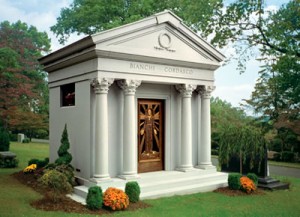
Private MausoleumIt has been almost 40 years since presidential candidate Jimmy Carter admitted to Playboy magazine, “I’ve looked on many women with lust. I’ve committed adultery in my heart many times. God knows I will do this and forgives me.” Caused quite a stir and, some say, marked the beginning of the erosion of presidential privacy, the start of an era of leadership toxicity in American politics when partisan reporters feel free to reveal any fact or rumor, no matter how irrelevant, if it will hurt a politician of the opposite party or position. I’m not sure that that’s the case; a good argument can be made that the current polarized, hyper-partisan atmosphere started building during the Nixon, or even Johnson, years. That, however, is not what I’m thinking about this morning.

I’m thinking about the impossibility of Jesus’ hyperbolic morality! To be honest, I think Mr. Carter was overstating the “looking with lust” thing. As I understand the Greek used here, epithumeo, what Jesus is talking about is passionate, heated, covetous desire. I can’t imagine that just looking at someone other than one’s life partner, appreciating their attractiveness, and acknowledging one’s own attraction (even with a little wistful wondering….) would rise to the level of “lust.” If it does, then I guess we’re all in trouble, because no one can live up to such a standard.

That Jesus is being hyperbolic is made clear by the fact that he goes on to counsel his followers to cut off their hands and pluck out their eyes if those members cause them to sin! I mean — come on, folks! — does anyone not suffering from a mental illness think Jesus was doing anything more than making a rhetorical point? I certainly don’t. But his rhetorical point, hyperbolic though it may be, needs to be taken seriously.

Thoughts and attitudes are as important as actions, for even if they do not directly control our actions they give them flavor and nuance. A husband may not often be “lustful” towards other women, one may never be unfaithful, but a regular habit of giving thought to the notion is a form of disrespect for one’s wife and may lead to more outright, more visible, and more damaging forms of disrespect. Further, such a regular habit and the attitude from which it springs cheapen the intimacy between spouses. Motives and motivations, and their authenticity, give substance and meaning to our actions; spousal intimacy that is not truly respectful of the spouse has little substance or meaning.

One of my favorite of Jesus’ similes is spoken to the scribes and the Pharisees later in Matthew’s Gospel, and I like it best in the Authorized translation: “Woe unto you, scribes and Pharisees, hypocrites! for ye are like unto whited sepulchres, which indeed appear beautiful outward, but are within full of dead men’s bones, and of all uncleanness.” (Mt 23:27, KJV) When inner motivation and outward action are not in harmony, when the action is inauthentic because the motivation dishonest, the action . . . no, the actor is a “whited sepulchre,” lovely in outward appearance but filled with rot.

I believe that Jesus’ hyperbolic language about lust makes the same point, and it applies not just to marriages, but to all human interactions and relationships. It may be hyperbole and it may be (indeed, it is) impossible to live up to it. Nonetheless, we must examine our thoughts and attitudes, our motives and motivations; we must look inside and work on our mindset so that our outward actions are authentic. Why? Well, one reason, as Jesus will shortly remind his listeners in a different context, is that our Father “who is in secret . . . sees in secret.” (Mt 6) A more important reason, however, is that anything less violates the second of the two great commandments: “You shall love your neighbor as yourself.” (Mt 22:39)

====================

A request to my readers: I’m trying to build the readership of this blog and I’d very much appreciate your help in doing so. If you find something here that is of value, please share it with others. If you are on Facebook, “like” the posts on your page so others can see them. If you are following me on Twitter, please “retweet” the notices of these meditations. If you have a blog of your own, please include mine in your links (a favor I will gladly reciprocate). Many thanks!

====================

Father Funston is the rector of St. Paul’s Episcopal Church, Medina, Ohio.

Howling and Prowling – From the Daily Office – May 15, 2014

From the Book of Psalms:

Each evening they come back, howling like dogs and prowling about the city.

(From the Daily Office Lectionary – Psalm 59:6 (NRSV) – May 15, 2014)

Feral Dog PackI usually prefer the Prayer Book Psalter to the NRSV translation of the Psalms, but in today’s readings I find the latter rather more compelling. The NRSV makes it clear who the “they” is in this verse (which is repeated again at verse 14). “They” are “the nations,” which in the Hebrew bible always refers to ethnic groups other than the tribes of Israel. The BCP version refers to “the ungodly,” which is decidedly unclear; it could refer to individuals and, further, could refer even to persons from within the Jewish people, neither of which understandings would be accurate.
With regard to this specific verse (which is numbered 7 or 16 in the BCP), the notion of returning late in the day from some unspecified and perhaps unknown other location is lost: “They go to and fro in the evening; they snarl like dogs and run about the city.” They (whoever they are) could have been at rest within the city during the day, but the Hebrew shuwb ‘ereb is clear: “They return at sunset.” The nations have been somewhere else during the light of day, but where is unknown (at least, it is not stated in the psalm).

The NRSV text is also much more poetic than the BCP version (which is something of a surprise, frankly). The evocative rhyming of “howling . . . and prowling” is so much more effective than “snarl . . . and run about.” It casts a disturbing vision of a dog pack roaming, possibly hunting, through the darkened city streets.

Dogs, of course, are considered unclean in Judaism. They are scavengers which will eat any sort of refuse and carrion, even excrement. Although mothers do tenderly care for their young, dogs do not pair bond and have no sexual loyalty. They urinate and defecate wherever they wish. Left on their own and untrained, dogs are pretty unsavory characters!

They also have a social order that is decidedly not a human one. 21st Century research into the organization of packs of both canis lupus (wolves) and canis familiaris (dogs) has demonstrated that the “alpha male” aggression-dominance model of pack behavior is nothing more than a human projection. Dog packs are (I use the word very loosely) organized in a much more fluid and changing way, a way not easily appreciated by human observers. For all intents and purposes, dog packs mostly appear to us to be disorganized mobs.

So these are the ungodly (to use the BCP’s word): gone when it is light, showing up in the darkness, decidedly unclean in their habits, leaderless, disorganized, and dangerous. They are like feral, untamed dogs. And, yet, dogs have shown themselves not only willing but eager to give up these ways! Dogs are more than happy to associate with humans, to acknowledge humans as their leaders, to behave in ways humans deem acceptable. And we have been happy to accept them on those terms as pets, as friends, and as co-workers.

Last Sunday’s Gospel lesson was from John — Jesus declaring himself to be the good shepherd. Shepherds are nearly always assisted by dogs to whom none of the negative characteristics implicit in this psalm could be ascribed. My pastoral theology instructor (as I told my congregation in my extemporaneous children’s sermon) objected to the word pastor as a descriptor of clergy; pastor, he pointed out, means “shepherd” and there is only one shepherd. Clergy, he insisted, should be thought of as sheepdogs.

The good shepherd made a few other claims for himself. “I am the light of the world,” for example, and “I am the way.” (Jn 9:5, 14:6) For those who are leaderless, living in darkness, howling and prowling the night-time streets, Jesus offers an alternative of light and direction.

Years ago, when I was a college student in southern California, my friends and I would visit the border towns of northern Mexico. There always seemed to be plenty of ownerless, feral dogs running about. From time to time, I would notice that a feral dog would gingerly approach and befriend (possibly another human projection) a domesticated dog and, with and through that dog, would approach its owner. More often than not they were kicked and shooed away, but occasionally the human would be willing to share some food; perhaps this was the beginning of a longer relationship — I don’t know; I never stuck around or went back to find out.

Remembering those wild dogs seeking, through a domestic dog, the friendship and protection of a human being . . . thinking about the picture of dogs set out in the psalm today . . . and putting meat on the bones of my theology professor’s objection to pastor, I think there is a lesson for me and my fellow sheepdogs here. Or, more correctly, there is a question: are we in the right place?

Are we (and the flocks we are tending) in the places where the howling and prowling, the wild and feral, the leaderless, those in darkness and hunger, can gingerly approach and possibly, through us, meet the good shepherd?

====================

A request to my readers: I’m trying to build the readership of this blog and I’d very much appreciate your help in doing so. If you find something here that is of value, please share it with others. If you are on Facebook, “like” the posts on your page so others can see them. If you are following me on Twitter, please “retweet” the notices of these meditations. If you have a blog of your own, please include mine in your links (a favor I will gladly reciprocate). Many thanks!

====================

Father Funston is the rector of St. Paul’s Episcopal Church, Medina, Ohio.

God’s Butt – From the Daily Office – May 14, 2014

From the Book of Exodus:

The Lord said to Moses, “I will do the very thing that you have asked; for you have found favor in my sight, and I know you by name.” Moses said, “Show me your glory, I pray.” And he said, “I will make all my goodness pass before you, and will proclaim before you the name, ‘The Lord’; and I will be gracious to whom I will be gracious, and will show mercy on whom I will show mercy. But,” he said, “you cannot see my face; for no one shall see me and live.” And the Lord continued, “See, there is a place by me where you shall stand on the rock; and while my glory passes by I will put you in a cleft of the rock, and I will cover you with my hand until I have passed by; then I will take away my hand, and you shall see my back; but my face shall not be seen.”

(From the Daily Office Lectionary – Exodus 33:17-23 (NRSV) – May 14, 2014)

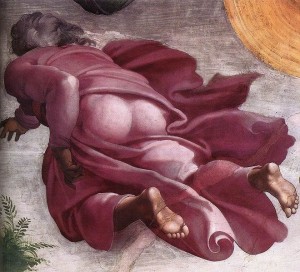
Detail of Sistine Chapel - God's backsideThe translators of the NRSV are a bunch of prudes; a better translation of the last verse of this section would be “. . . you shall see my butt.”

The term “my back” is a translation of the Hebrew term ‘achowr which, incidentally, is a plural noun; when this is used of an animal, the translation is usually “hindquarters” or something of that nature, which apparently is inappropriate with respect to God. In the 3rd Century Greek translation of the Old Testament, the Septuagint, it is translated into the odd construction ta hopiso mou, “the behinds of me.” When St. Jerome translated the Vulgate Latin version in the 4th Century, he also retained the plural, posteriora mea, “my posteriors.” The translators of the Authorized version of 1611 did so, as well, “my back parts.” In other words, my backside, my ass end, my buttocks!

So the NRSV editors are just a bunch of prudes! Or maybe they are just being prudish for a contemporary American audience which has become obsessed with . . . what? sex? nudity? titillation?

Recently there was a news article about an attractive 17-year-old young woman who was expelled from a homeschoolers’ prom event because, although her dress met the dress code requirements, it was considered to titillating for the fathers watching the dancers from the balcony! I hesitate to say that this event was billed as a dance for “Christian” homeschoolers, because the published reports reveal a good deal of unchristian behavior from the leering of the fathers to the disrespect shown the young lady and her escort by the chief chaperone of the event. (The Cleveland Plain Dealer‘s report yesterday of the incident is here.)

And the question of respect is really what this episode between Moses and God raises for me.

I’m not sure when the “look at God’s face and die” notion arose among the Hebrews, but it isn’t there in the earliest stories of the bible. Adam and Eve seem to carry on face-to-face conversations with God with no ill effect and, when God shows up in the guise of three strangers at the oaks of Mamre, Abraham sits and talks with them over a lamb dinner and does not succumb. But, in any event, the Hebrews somehow got the idea that one shows greatest respect for God by averting one’s gaze and thus this story and, later, Isaiah’s fear that he will die because of his experience in seeing a vision of God in the heavenly throne room: “Woe is me! I am lost, for I am a man of unclean lips, and I live among a people of unclean lips; yet my eyes have seen the King, the Lord of hosts!” (Isa 6:5)

Human cultures differ on how to show respect to elders. Some adopt this averted-gaze position; others (my forebears among them) insist on looking people in the eyes. I can remember quite vividly both of my grandfathers forcefully insisting that I look them squarely in the face when in conversation; looking away even briefly was considered either as disrespect or as possible evidence of untruthfulness.

What this suggests to me is that we humans don’t actually know how to respect one another! The story of the really (in my opinion) bad treatment of the young woman at the prom is simply more evidence of that. And, if we don’t know how to respect another human being, we certainly do not know how to respect God.

Respect requires maturity; showing proper respect to another person, human or god, is a mark of adulthood. Perhaps that is the point of today’s story of Moses and God, neither Moses nor the Hebrews (nor, for that matter, any of humanity) were yet mature enough to have a respectful face-to-face relationship with the Almighty, so God did what God could.

Moses is permitted to see God’s butt because God was lowering God’s self to develop a relationship with Moses and, through him and the Hebrews, with all humanity, a relationship that hopefully would grow and mature. In giving Moses this vision, God revealed both a special affection for his favorite and a hope for the eventual adulthood of the human race. The gaze of those lustful old men in the balcony focused on the young prom-goer’s butt suggests we still have a long way to go!

The indecorous nature of God’s backside reveals the extent to which God is willing to humble God’s self out of respect for human beings; someday, perhaps, we’ll learn to show respect as well.

====================

A request to my readers: I’m trying to build the readership of this blog and I’d very much appreciate your help in doing so. If you find something here that is of value, please share it with others. If you are on Facebook, “like” the posts on your page so others can see them. If you are following me on Twitter, please “retweet” the notices of these meditations. If you have a blog of your own, please include mine in your links (a favor I will gladly reciprocate). Many thanks!

====================

Father Funston is the rector of St. Paul’s Episcopal Church, Medina, Ohio.

I Don’t Know – From the Daily Office – May 13, 2014

From the Book of Exodus:

Moses said to Aaron, “What did this people do to you that you have brought so great a sin upon them?” And Aaron said, “Do not let the anger of my lord burn hot; you know the people, that they are bent on evil. They said to me, ‘Make us gods, who shall go before us; as for this Moses, the man who brought us up out of the land of Egypt, we do not know what has become of him.’ So I said to them, ‘Whoever has gold, take it off ‘; so they gave it to me, and I threw it into the fire, and out came this calf!”

(From the Daily Office Lectionary – Exodus 32:21-24 (NRSV) – May 13, 2014)

Golden Calf“I threw it into the fire, and out came this calf!”

I chuckle every time I read this story and get to this point. In fact, when the story of the golden calf has been read in church and the reader gets to Aaron’s disclamation of responsibility, I’ve been known to laugh out loud.

Once, years ago, in a bible study group reading Exodus, I asked, “How old was Aaron?” No one knew, but we were all pretty certain that Moses and his brother were not young children at the time of this story. Nonetheless, a young child is exactly what Aaron sounds like: “I threw the gold in the fire, and out came this calf!” No mention of his forming the mold, pouring the molten the gold, breaking the mold, polishing the casting, and all the rest that goes into the making of a metal statue. The calf just “came out.”

There was a phantom in our house when my children were very young. We’d find that someone had opened the orange juice and not only taken some, but also spilled a good deal on the kitchen counter and floor. “Who did this?” we would ask. “I don’t know,” would be the answer. The contents of my wife’s purse were spilled there was lipstick smeared on things. “Who did this?” we demanded of the little girl with red all over her face. “I don’t know,” she told us. Someone once tried to make sand castles in the cat box. “Who did this?” we asked the little boy with sand fingers. With a straight face he replied, “I don’t know.”

We never caught I Don’t Know doing any of these things (or many others), but there was plenty of evidence of his (or was it “her”?) existence. I Don’t Know was a very active sprite! Apparently, I Don’t Know was much older than we thought. He or she appears to have been with the Hebrews in the desert. — “Who made this golden calf?” — “I don’t know. I threw the gold in the fire and out came this calf!”

In the modern adult world, I Don’t Know has gotten more adapt at hiding his or her identity. “Who made that decision?” we ask. The answer is often one of I Don’t Know‘s alter egos: a committee, the vestry, the (unnamed) higher-ups, the council, management, the administration. Could it be that I Don’t Know is being scapegoated?

Imaginary friends are a healthy part of maturing. Research shows that children with imaginary companions tend to be less fearful, laugh more, smile more, engage more with peers, and are better able to imagine how someone else might think. An imaginary friend can aid a child to handle fear, explore ideas, or gain a sense of competence, but children with imaginary friends will sometimes blame them for misbehavior in an attempt to dodge the displeasure of adult authority. I Don’t Know is not exactly an imaginary friend, but disclaiming responsibility and deflecting blame is certainly child-like (if not childish) behavior.

“When I was a child, I spoke like a child,” wrote St. Paul, “I thought like a child, I reasoned like a child; when I became an adult, I put an end to childish ways.” (1 Cor 13:11) Jesus once told a story about someone who decided to stop blaming I Don’t Know. The man in the story “put an end to childish ways” and said to himself, “I will get up and go to my father, and I will say to him, ‘Father, I have sinned against heaven and before you.'” (Lk 15:18)

We human beings of all ages when challenged still seem invoke I Don’t Know to avoid personal responsibility on a pretty regular basis. Christian maturity, coming (as Paul said) “to the measure of the full stature of Christ,” (Eph 4:13) no longer laying things at the feet of I Don’t Know is something for which we all need to strive. We need to give up being like Aaron; we need to put an end to childish ways.

Is that going to happen on a general basis any time soon?

I could answer, “I don’t know.” But the truth is, I think I do.

====================

A request to my readers: I’m trying to build the readership of this blog and I’d very much appreciate your help in doing so. If you find something here that is of value, please share it with others. If you are on Facebook, “like” the posts on your page so others can see them. If you are following me on Twitter, please “retweet” the notices of these meditations. If you have a blog of your own, please include mine in your links (a favor I will gladly reciprocate). Many thanks!

====================

Father Funston is the rector of St. Paul’s Episcopal Church, Medina, Ohio.

Wrestling in Prayer – From the Daily Office – May 12, 2014

From the Letter to the Colossians:

Epaphras, who is one of you, a servant of Christ Jesus, greets you. He is always wrestling in his prayers on your behalf, so that you may stand mature and fully assured in everything that God wills.

(From the Daily Office Lectionary – Colossians 4:12 (NRSV) –May 12, 2014)

Hercules and Diomedes by Vincenzo de Rossi“Wrestling in his prayers” seems such an odd turn of phrase! Aren’t prayers supposed to be peaceful? The image of prayer as athletic competition (and vigorous, muscular, and very personal competition, at that) just seems contradictory. But the contradiction calls to mind two thoughts.
The first is that I remembered Jacob: “Jacob was left alone; and a man wrestled with him until daybreak. When the man saw that he did not prevail against Jacob, he struck him on the hip socket; and Jacob’s hip was put out of joint as he wrestled with him.” (Gen 32:24-25)

Doing early morning study of Koine Greek is probably a mistake . . . but I wondered, “Does Paul use the same word to describe Epaphras as the Septuagint uses to describe Jacob?” Short answer — no. Long answer — In Genesis, the wrestling contest is described using the word palaío; in Colossians, the word is agonizomai. The former is specific; the latter refers in general to athletic competition and may also mean “to struggle” or “to labor.”

Nonetheless, I wonder if Paul is calling Jacob’s late-night wrestling match with God to mind. If Jacob’s dream-time contest is a metaphor for prayer (and I think it is), then there is a striking contrast between first-party prayer (petition) which leaves the supplicant limping, and third-party prayer (intercession) which permits the subject to “stand mature and fully assured.” I don’t know what to make of this. Is there a suggestion that the prayers of others are more effective for our well-being than our own?

An Indian guru once said, “Prayer is not asking. It is a longing of the soul. It is daily admission of one’s weakness.” Was Jacob’s hip put out of joint by his encounter with God? Or was it always out of joint and the encounter merely led to a recognition or an admission of that fact? Prayer for oneself always does, in my experience, bring one up face-to-face with one’s own inadequacies. And, I have to say, I rely much more upon the prayers and prayerful support of others than upon my own. So perhaps there is something in the contrast Paul may be making.

The second, unrelated thought, is how often I struggle to find the “right words” with which to pray, both in private meditation and in public worship. As a priest, I am often asked to pray in public and, when that happens, I am grateful that, as an Episcopalian, I have been steeped in the language and cadences of The Book of Common Prayer. When I cannot think of anything original to say, I can rely on the prayerful words of generations of Anglicans and, from memory of the prayer book’s beautiful phrases, cobble something quickly together.

It is not always so in my private devotions. But that same Indian guru said of prayer, “It is better in prayer to have a heart without words than words without a heart.” So if my struggle to find the right words is unsuccessful, I just let it go and sit quietly, sure that God will understand me.

====================

A request to my readers: I’m trying to build the readership of this blog and I’d very much appreciate your help in doing so. If you find something here that is of value, please share it with others. If you are on Facebook, “like” the posts on your page so others can see them. If you are following me on Twitter, please “retweet” the notices of these meditations. If you have a blog of your own, please include mine in your links (a favor I will gladly reciprocate). Many thanks!

====================

Father Funston is the rector of St. Paul’s Episcopal Church, Medina, Ohio.

Grandparental Nicknames – From the Daily Office – May 10, 2014

From Matthew’s Gospel:

As he walked by the Sea of Galilee, he saw two brothers, Simon, who is called Peter, and Andrew his brother, casting a net into the lake — for they were fishermen.

(From the Daily Office Lectionary – Matthew 4:18 (NRSV) –May 10, 2014)

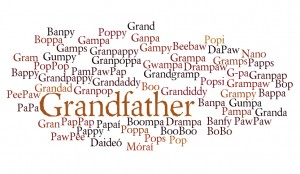
Grandfather NicknamesSometime this fall, probably during October, my wife and I will become grandparents for the first time. Last night, a friend asked, “What will you be called?” Because the question came out of the blue (we hadn’t been discussing children or grandchildren), I didn’t know what he was asking — and my face must have shown it. “As grandfather,” he clarified, “what will you be called as a grandparent?”

Good question. Is it really up to me? Do I get to say, “I want to be called [something]”? If so, I’d like to be called by one of the Irish nicknames: “Daideó” (pronounced “DAH-doe”) or “Móraí” (pronounced “MO-ree”) or “Papaí” (pronounced “PAH-pee”). The actual word for “grandfather” in Irish is seanathair which means “old father” or (in older Irish) “wise father”; an alternative is athair mór which means “great father” (“great” here is more akin to “big” than to “wonderful”).

But is it really up to me? Families have long-running traditions about naming grandparents, I think. Every grandmother (for the three generations I have known) on both sides of my family was known as “Grammy” — my mother called hers “Grammy Buss” and “Grammy Sargent”; mine were “Grammy Grace” and “Grammy Edna” (we were a less formal generation, I guess), and my mother was “Grammy Betty” to our children.

Grandfathers were less uniformly addressed. I don’t know what my greatgrandfathers were called; both were long dead when I was born. My maternal grandfather, Richard Sargent, was “Daddy Rich” (a combination of what my mother and grandmother called him); my paternal grandfather was “C.E.” (what everyone called him) or, less frequently, “Granddad.” My father was deceased when his grandchildren were born, so if he was referred to at all it was as “your grandfather, York”; my stepfather, Stan Shivers, was called “GrandStan” by my niece and nephew and my children.

One thing I’ve noticed is that the first-born grandchildren get to make the decision. My brother was nearly ten years older than me, and I had two older paternal cousins, so by the time I came along grandparental names were pretty much cast in stone. We have nieces and nephews several years older than our own children, so they had settled the issue on both sides long before our kids had a say.

All of this comes to mind this morning because of “Simon, who is called Peter.” It was Jesus who gave him that name: “I tell you, you are Peter, and on this rock I will build my church.” (Mt 16:18) For many years, I wondered why Jesus gave Simon this nickname and thought it was simply out of affection — it’s nearly the equivalent of “Rocky” and since Simon Peter often seems as dense as a bag of rocks, that made sense.

But I’ve come recently (while studying the prophets with an Education for Ministry group) to believe that Jesus is following in the tradition of Isaiah and, since he has no son to name, he is giving Simon a symbolic prophetic nickname in the same way that prophet named his children. Isaiah named his sons Shear-jashub, which means “the remnanet shall return,” and Maher-shalal-hash-baz, which means “he has hurried to plunder,” as signs against Judah and Jerusalem. I think Jesus gave Simon the new name Peter in a similar way, as a prophetic sign to the church.

Shear-jashub, Maher-shalal-has-baz, and Simon Peter had no say in the matter. So I still wonder with respect to this question of grandparental naming, is it really up to me?

And I wonder if grandparental naming is a prophetic activity. Does the name chosen shape the relationship? Does it portend what the relationship will be? Certainly, one would suspect that if a child is taught to call its grandfather “Grandfather,” that relationship will be rather different than that of a child who calls his or her grandfather “Grampa.” But do “Granddad” or “Papaí” or “Nano” shape the bond differently? And, if so, how?

This matter of choosing a grandparental nickname is serious stuff . . . assuming it really is up to me.

====================

A request to my readers: I’m trying to build the readership of this blog and I’d very much appreciate your help in doing so. If you find something here that is of value, please share it with others. If you are on Facebook, “like” the posts on your page so others can see them. If you are following me on Twitter, please “retweet” the notices of these meditations. If you have a blog of your own, please include mine in your links (a favor I will gladly reciprocate). Many thanks!

====================

Father Funston is the rector of St. Paul’s Episcopal Church, Medina, Ohio.

« Older posts Newer posts »