Occasional thoughts of an Anglican Episcopal priest

Category: Daily Office (Page 27 of 70)

Tedious Temptations – From the Daily Office – March 10, 2014

From the Gospel of Mark:

And the Spirit immediately drove him out into the wilderness. He was in the wilderness for forty days, tempted by Satan; and he was with the wild beasts; and the angels waited on him.

(From the Daily Office Lectionary – Mark 1:12-13 (NRSV) – March 10, 2014.)

Procrastination Cartoon by Dave WalkerJesus’ time of temptation in the desert is related by each of the Synoptic Gospels. Luke and Matthew give us a detailed account, noting that Satan tries to get Jesus to (a) turn stones into bread, (b) throw himself from the pinnacle of the Temple so as to demonstrate his power over the angels, and (c) worship Satan who promises him world domination. (We heard Matthew’s version on Sunday morning.)

Mark is typically terse giving none of those details: Jesus “was in the wilderness for forty days, tempted by Satan.” I prefer Mark’s version. The writer of the letter to the Hebrews says of Jesus that he “in every respect has been tested as we are, yet without sin.” (Heb. 4:15) It’s Mark’s Jesus that the writer is talking about.

Matthew’s and Luke’s Jesus faced temptations I will never face: I know darned good and well that I can’t eat rocks nor make them into anything edible no matter how hard I try; I’m much too afraid of heights to even get to the top of a church steeple let alone be tempted to some daredevil base-jumping stunt; and no one is ever going to suggest that I become a world dictator. My temptations are of a much more pedestrian sort.

I often face the temptation to sit on my butt and do nothing; faced with an onerous task, or a boring one, or just a mildly unpleasant one, I will be tempted to turn away from it for something more enjoyable. Mark’s Jesus might have thought about (I think probably did consider) that possibility out there “with the wild beasts.” Then there’s procrastination, the simply putting off of something until it just has to be done; maybe that’s why Mark’s Jesus was out there for forty days, just putting off doing what he knew he had to do. And there are so many more . . . the prosaic and unexciting tests of everyday existence.

By not getting into too much detail Mark lets us believe, Mark encourages us to believe, that Jesus is with us in those. That’s my Jesus, Mark’s Jesus, the one who in every respect was tested as I am, who faced the tedious temptations and didn’t give in.

====================

Father Funston is the rector of St. Paul’s Episcopal Church, Medina, Ohio.

Positively Lenten – From the Daily Office – March 7, 2014

From the Letter to the Philippians:

Finally, beloved, whatever is true, whatever is honorable, whatever is just, whatever is pure, whatever is pleasing, whatever is commendable, if there is any excellence and if there is anything worthy of praise, think about these things.

(From the Daily Office Lectionary – Philippians 4:8 (NRSV) – March 7, 2014.)

Orange and BananasIn thinking about yesterday’s readings, I suggested that the Lenten question we should be asking one another is not “What are you giving up?” but “What are you rejoicing about?” Along comes Paul today and tells the church in Caesarea Philippi, “Rejoice in the Lord always; again I will say, Rejoice” (v. 4) following up with this list of things to consider, things about which we might rejoice.

As a contrast, today’s Old Testament lesson is from the prophet Ezekiel and focuses our attention on a variety of things one can do in violation of the Law of Moses, things not honorable or just or commendable, and decrees the Lord’s displeasure in such things. The point of the prophet’s words on God’s behalf is turn us away from such things. The reading concludes:

Cast away from you all the transgressions that you have committed against me, and get yourselves a new heart and a new spirit! Why will you die, O house of Israel? For I have no pleasure in the death of anyone, says the Lord God. Turn, then, and live. (Ezek. 18:31-32)

I don’t think the prophet succeeds in redirecting our attention, however. The priest under whom I served my curacy was fond of saying, “What gets your attention gets you.” So, although I know the point of Lent is to “put [us] in mind of . . . the need which all Christians continually have to renew their repentance and faith” (BCP 1979, pg. 265), I think we might better focus our attention on the things Paul suggests rather than on our sinfulness.

As a Lenten discipline, I suggest focusing each day on one thing we find praiseworthy and honorable — today, for example, I have decided to rejoice in and give thanks for the good work of all the people who make it possible for me, on a cold, snow-covered morning in northeastern Ohio, to enjoy fresh fruit each morning. Yes, I know there are important environmental and social issues raised by our failure to “eat locally” and by our global food industry, but today I’m thankful for the orange and the banana and the kale that just went into my breakfast “smoothie” and for the people who made that possible.

Every dark cloud, it is said, has its silver lining. I choose to focus on the “silver lining” rather than on the “cloud;” perhaps if we do that more often we can do more about the “clouds.” After all that’s what we’re supposed to do in Lent, “turn from [our] wickedness and live.” (BCP 1979, pg. 269) As Johnnie Mercer wrote, “Accentuate the positive [and] eliminate the negative.” That’s positively Lenten!

====================

Father Funston is the rector of St. Paul’s Episcopal Church, Medina, Ohio.

Lenten Rejoicing – From the Daily Office – March 6, 2014

From the Prophet Habakkuk:

Though the fig tree does not blossom,
and no fruit is on the vines;
though the produce of the olive fails
and the fields yield no food;
though the flock is cut off from the fold
and there is no herd in the stalls,
yet I will rejoice in the Lord;
I will exult in the God of my salvation..

(From the Daily Office Lectionary – Habakkuk 3:17-18 (NRSV) – March 6, 2014.)

Dry Farm FieldsLent began yesterday and I heard the question at least 50 times: What are you giving up for Lent? It’s a legitimate question given that the church through the centuries has (in the words of the American Book of Common Prayer) invited her members “to the observance of a holy Lent . . . by prayer, fasting, and self-denial.” (BCP 1979, pg 264) We humans just tend to look on the negative side of things and focus on the sense of deprivation this tradition inspires.

Every year for longer than I have been ordained, I have tried to encourage my fellow Christians to see in the “giving up” a making room for something else. Giving up your favorite television program? You now have that hour each week for some other activity, reading the Bible maybe, or taking a walk and enjoying God’s creation. Not eating chocolates? What are you doing with the money saved? If the giving up creates space for something healthier or more productive, is it really privation? Oughtn’t we to give thanks for the opportunities, rather than bemoan the lost pleasures?

So, I’m glad to see my favorite bit of Habakkuk this morning. In a time of forced, not voluntary, privation, he could nonetheless give thanks, rejoice in the Lord, exult in God. That’s the example we should be following during Lent. The proper question is not, “What are you giving up?” The proper question is, “What are you rejoicing about?”

====================

Father Funston is the rector of St. Paul’s Episcopal Church, Medina, Ohio.

Temporary Reminder – From the Daily Office – March 5, 2014

From the Letter to the Hebrews:

Therefore, since we are surrounded by so great a cloud of witnesses, let us also lay aside every weight and the sin that clings so closely, and let us run with perseverance the race that is set before us . . . .

(From the Daily Office Lectionary – Hebrews 12:1 (NRSV) – March 5, 2014.)

Ashes on a ForeheadMany years ago, when I was a child growing up in Las Vegas, Nevada, my dad and I went fishing on Lake Mead. I was five years old, but already a pretty good swimmer. After we’d caught a few bass, we decided to go swimming.

I think we must have been somewhere near one of the marinas, because some time during that swim I encountered a slick of oil or motor fuel and found myself coated with a smell film of petroleum distillate of some sort. I tried several times to rinse it off, but once it got on my skin, it wasn’t coming off. My dad and I ruined a couple of my mother’s towels wiping it off, but it didn’t really wipe off.

On the drive home (the seat in my dad’s Thunderbird protected by another of my mom’s towels), the stuff dried, my skin got sticky and kind of stiff feeling. At home, my mother scrubbed me until my skin burned, but that petroleum odor still seemed to stick around for days – other people couldn’t smell it, but I sure could.

When I read this verse of the letter to the Hebrews, I think of that oily stuff — “the sin that clings so closely” — no matter how much rinsing, how much wiping, how much scrubbing, it’s still there. Others may not see it, but we can feel it. Others may not see it, but we can smell it. We know it’s there! The author of the letter encourages us to “lay it aside,” but that is easier said than done. On our own, we can’t lay it aside; we can’t rinse, wipe, or scrub it off. It is permanent! . . . Or is it?

Today is the Day of Ashes, that Wednesday forty days before Easter when we symbolize that sin and our own mortality with a smudge of oily ash on our foreheads — in the same place where the priest at our baptism or the bishop at our confirmation places a cross of oil marking us a Christ’s own, we are marked again with a reminder that we are nonetheless soiled by sin and liable unto death . . . Or are we?

The chrism, the holy oil marking us as an adopted child of God, is there first. Like a shield or a protective skin, it guards us from being permanently stained. Because of that protective buffer (what St. Paul might have called “the armor of light” — Romans 13:12 — or even “the whole armor of God” — Ephesians 6:11) the sin which clings so closely is not permanent; we are not permanently soiled and liable to death! Through the power of Christ, that sin can be set aside.

The smudge is merely a temporary reminder, not a permanent stain.

====================

Father Funston is the rector of St. Paul’s Episcopal Church, Medina, Ohio.

Shrove Tuesday Confession – From the Daily Office – March 4, 2014

From the Book of Proverbs:

Thus says the man: I am weary, O God,
I am weary, O God. How can I prevail?
Surely I am too stupid to be human;
I do not have human understanding.
I have not learned wisdom,
nor have I knowledge of the holy ones.
Who has ascended to heaven and come down?
Who has gathered the wind in the hollow of the hand?
Who has wrapped up the waters in a garment?
Who has established all the ends of the earth?
What is the person’s name?
And what is the name of the person’s child?
Surely you know!

(From the Daily Office Lectionary – Proverbs 30:1b-4 (NRSV) – March 4, 2014.)

Stained Glass Window Portraying ConfessionI am later than usual committing to “paper” my thoughts on a portion of today’s readings, but these first verses of the lesson from Proverbs have been with me all day. Today is Shrove Tuesday, the day before the season of Lent begins, a day on which in the 2,000-year tradition of the church the faithful are encouraged to meet with a priest and make their confessions. The name, “Shrove Tuesday,” comes from the old English verb “to shrive,” which means to absolve of sin.

Several days ago I sent out an email to the members of my parish advising them that they could, if they would like, make an appointment to offer their confession in the formal rite of the Sacrament of Reconciliation. I make that invitation every year. In ten years in this parish not a single person has approached me to hear their confession. I’m not surprised; the piety and devotional practice of what is, essentially, a Midwestern Protestant congregation is very different from the nosebleed-high, bells-and-smells, Anglo-Catholic piety and practice of my initial formation as an Episcopalian. These folks are very like my southern Methodist grandparents for whom the very idea of baring their souls to a priest was anathema.

So it’s been a very long time since I have heard someone say to God, through me as a priest, “I am weary, O God, I am weary. I am too stupid; I have not learned wisdom.” That, really, is what every confession boils down to — a recognition that I am burdened by something really incredibly stupid that I have done or failed to do, an acknowledgement that the result of that has wounded my spirit, and an action taken in hopes of relieving the pain of that wound. It isn’t necessary to do this in the formal confines of the confessional, nor is it necessary to do it in the presence of another human being. But sometimes it helps. Confession, like any prayer, is a conversation between the penitent and God; the confessor is there only to aid in the communication.

I’ve had people tell me that they’ve never done (or failed to do) anything that requires confession. I’m dumbfounded when I hear that . . . because I know for sure that I have! And I’ve heard enough confessions in my years as God’s priest to know that I’m not alone and my experience of my own sinfulness and stupidity (and that of others) pretty much convinces me that it is a universal human condition. We all, every single one of us, fall short of the mark. Every single one of us is in debt to God in some way. Very few of us (and certainly no one I know) has ascended to heaven; very few of us can gather the wind in our hands; very few of us can wrap the waters in their garments; and none of us established the ends of the earth. Perfection and universal knowledge is the providence of only one or two . . . definitely not me and, I’m pretty sure, not of anyone I’ve ever met on this earth.

It’s appropriate to acknowledge that occasionally, even if only once a year.

And now I must confess that I didn’t make an appointment with a priest to make my confession this year. I knew what my day would be like; I knew what was on my itinerary through this day. I started early and didn’t write this, my daily meditation, at the usual time — in fact, I didn’t think I’d write one at all. But something I thought would take more of my time than it did is now accomplished and I find myself with a few minutes to spare. So in the absence of a private time with my confessor . . .

Holy God, heavenly Father, you formed me from the dust in your image and likeness, and redeemed me from sin and death by the cross of your Son Jesus Christ. Through the water of baptism you clothed me with the shining garment of his righteousness, and established me among your children in your kingdom. But I have squandered the inheritance of your saints, and have wandered far in a land that is waste.

Especially, I confess to you and to the Church . . .

[Well, let’s just say that there have been some times when I have been too stupid to be human, when I have not had human understanding, when I have not learned wisdom . . . ]

Therefore, O Lord, from these and all other sins I cannot now remember, I turn to you in sorrow and repentance. Receive me again into the arms of your mercy, and restore me to the blessed company of your faithful people; through him in whom you have redeemed the world, your Son our Savior Jesus Christ. Amen. (BCP 1979, page 450)

I haven’t done any of those things the author of proverbs asks about, but I do know who has, and I know the name of that Person’s Child. And knowing that, I know that I am shriven. Thanks be to God!

====================

Father Funston is the rector of St. Paul’s Episcopal Church, Medina, Ohio.

New Worlds – From the Daily Office – March 3, 2014

From the Psalter:

The Lord is a friend to those who fear him
and will show them his covenant.

(From the Daily Office Lectionary – Psalm 24:13 (BCP Version) – March 3, 2014.)

Face to Face Silhouettes“Each friend,” wrote Anais Nin, “represents a world in us, a world possibly not born until they arrive, and it is only by this meeting that a new world is born.” If a new world is born of merely human friendships, it is certainly true of a friendship with God! When St. Paul wrote to the Corinthian church that “if anyone is in Christ, there is a new creation: everything old has passed away; see, everything has become new!” he was describing the friendship of God, that friendship which births a new world in us. (2 Cor. 5:17)

In the Episcopal Church, one of the options for the beginning of a funeral is the anthem set out at pages 491-92 of The Book of Common Prayer, which includes these lines adapted from the Book of Job:

As for me, I know that my Redeemer lives
and that at the last he will stand upon the earth.
After my awaking, he will raise me up;
and in my body I shall see God.
I myself shall see, and my eyes behold him
who is my friend and not a stranger.

The promise of today’s psalm is that God’s friendship is for the present, not something for which we must wait until “the last,” until God raises us up in the general resurrection.

The literature of friendship is vast and I’m not going to add much to it in a few lines of morning meditation. Nonetheless, it seems to me that the most important aspect of a true friendship is intimacy. I recall reading somewhere about the difference between “shoulder-to-shoulder” friendships (which make up the majority of friendships enjoyed by adult men) and “face-to-face” friendships (which are the sort most people say they want more of). The difference is found in responding to the ubiquitous question, “How are you?”

Shoulder-to-shoulder friends don’t expect — and cannot really handle — any answer other than “Fine!” Face-to-face friends expect an honest answer. God is a face-to-face friend. When God asks “How are you?” (which, by the way, God asks every morning) God expects a real response, an honest answer, the truth. When the psalmist wrote that God is “our refuge and strength, a very present help in trouble,” he was describing the friendship of God, and when (in the same psalm) he quoted God, “Be still, then, and know that I am God,” he was describing that intimacy which is the heart of face-to-face friendship. (Ps. 46:1 and 11)

Out of that intimacy, out of that friendship with God new worlds are born, everything becomes new. Today.

====================

Father Funston is the rector of St. Paul’s Episcopal Church, Medina, Ohio.

Mystical Jesus – From the Daily Office – March 1, 2014

From John’s Gospel:

Now among those who went up to worship at the festival were some Greeks. They came to Philip, who was from Bethsaida in Galilee, and said to him, “Sir, we wish to see Jesus.” Philip went and told Andrew; then Andrew and Philip went and told Jesus.

(From the Daily Office Lectionary – John 12:20-22 (NRSV) – March 1, 2014.)

Single Grain of WheatThis is such a great set up! Here are these Greeks (whether gentiles or Greek-speaking Jews of the Diaspora is unclear) who want to meet Jesus. They come to Philip who apparently speaks Greek and make their request. He goes to Andrew (another unclear thing: does he take the Greeks with him?) The two of them go see Jesus (with the Greeks?)

Now, how will Jesus respond?

If the Greeks are gentiles, will he respond as he did to the Syro-Phoenician woman: “It is not fair to take the children’s food and throw it to the dogs.” (Matt. 15:26)

Will he respond as he did to the centurion who sought healing for his servant: “Truly I tell you, in no one in Israel have I found such faith.” (Matt. 8:10)

If they are Jews, will he remind them of the Law as he did the rich young man who asked about eternal life: “You lack one thing; go, sell what you own, and give the money to the poor, and you will have treasure in heaven; then come, follow me.” (Mk. 10:21)

Will he welcome them and invite them to eat with him as he did the tax collectors and sinners? (Luke 15:1-2)

Uh . . . no. Not John’s Jesus. John’s Jesus goes off on some entirely self-centered tirade about glorification and grain dying and eternal life and his soul being troubled! John’s Jesus doesn’t respond to Andrew or Philip or the Greeks at all! I swear, there are times when Jesus as portrayed in the Fourth Gospel seems to be somewhere on the autism spectrum; his answers to inquiries are so far removed from the subject of the question one wonders if he even heard what was asked, or knows or cares who is asking. (This is one of those times!) Is this an accurate portrayal of the way Jesus interacted with people? Can this be historically factual?

So here’s my thought: the Jesus of the Fourth Gospel is not the historical Jesus. This Jesus is John’s attempt to communicate the spiritual nature of the resurrected and ascended Lord; this Jesus is a mystical reality not an historical portrait. L. William Countryman in The Mystical Way in the Fourth Gospel called Jesus’ strange, almost non-responsive, frequently offensive dialogs “obnoxious.” Although that’s a good description, I think they are almost hallucinatory. They twist the reader’s understanding of reality and open the reader’s mind to new possibilities. Would you see Jesus? Then consider a kernel of grain and how its life increases even though it dies? Would you see Jesus? Then follow Jesus, do as Jesus does, do what Jesus teaches. Would you see Jesus? Then listen for the voice of the Father. Jesus’s answers seem non-responsive, but they are gateways to new appreciations.

====================

Father Funston is the rector of St. Paul’s Episcopal Church, Medina, Ohio.

Philemon Pisses Me Off – From the Daily Office – February 28, 2014

From the Letter to Philemon:

I preferred to do nothing without your consent, in order that your good deed might be voluntary and not something forced. Perhaps this is the reason he was separated from you for a while, so that you might have him back for ever, no longer as a slave but as more than a slave, a beloved brother — especially to me but how much more to you, both in the flesh and in the Lord.

(From the Daily Office Lectionary – Philemon 14b-16 (NRSV) – February 28, 2014.)

Slave AuctionThere’s really very little in the Bible that makes me angry. I find a good deal to object to, to be annoyed by, and to wish wasn’t there, but very little that riles me. Paul’s letter to his friend Philemon, however, just plain pisses me off.

Paul has somehow encountered the runaway slave Onesimus while he, Paul, is imprisoned. Onesimus has become a follower of Christ like his owner, Paul’s friend Philemon, a leader of the Colossian church. Paul sends the slave back to his owner with this letter which can be interpreted as carrying a strong hint, but never actually saying, that Philemon should manumit Onesimus.

It is maddening that Paul apparently does not view slavery as incompatible with Christianity. Not once in this letter does Paul condemn slavery either in general or as it specifically applies to Onesimus. He does not try to persuade Philemon that Onesimus, “a beloved brother . . . in the Lord,” is deserving of his freedom. In failing to do so, Paul gives tacit approval to the economic institution of slavery.

He had done so before. In his first letter to the church in Corinth he wrote:

Let each of you remain in the condition in which you were called. Were you a slave when called? Do not be concerned about it. Even if you can gain your freedom, make use of your present condition now more than ever. For whoever was called in the Lord as a slave is a freed person belonging to the Lord, just as whoever was free when called is a slave of Christ. (1 Cor. 7:20-22)

Now I know that Paul expected the parousia to happen at almost any moment so staying in slavery, or in marriage, or in a single state, or whatever was not a big deal. And I know that in the Corinthian letter Paul was using slavery more as a metaphor or as an example to make a theological point. But . . . this text and especially the letter to Philemon were used for so long to justify the institution of slavery, the very idea that one human being owning another as a piece of property, was acceptable before God . . . and it just pisses me off that Paul didn’t demand of Philemon that he set Onesimus free. Every time I read the letter to Philemon I get angry!

====================

Father Funston is the rector of St. Paul’s Episcopal Church, Medina, Ohio.

Destructive Distractions – From the Daily Office – February 27, 2014

From the First Letter of John:

Little children, keep yourselves from idols.

(From the Daily Office Lectionary – 1 John 5:21 (NRSV) – February 27, 2014.)

Sumerian IdolsLast evening while driving home from the midweek Eucharist, I listened to a program on the local NPR station in which the host and a guest were discussing the internet coverage of news. One of the things mentioned was that the analytics on a British tabloid’s website had demonstrated that a story about Taylor Swift’s legs had garnered more “clicks” and more viewing time than a simultaneously run story about the world-wide affects of global climate change – something on the order of 400% more! The discussion continued with similar examples of stories about Kim Kardashian and her “rear end,” Justin Bieber’s legal problems, and more.
In the course of their conversation, the guest said, “Our idols are a distraction.” Encountering John’s final admonition in his first letter this morning, it occurs to me how “spot on” that comment is theologically. Although some may regard idols as evil, following the thought attributed to Solomon that “the worship of idols not to be named is the beginning and cause and end of every evil” (Wisd. 14:27), a more accurate description of an idol is that given by the Prophet Jeremiah: “Idols are like scarecrows in a cucumber field, and they cannot speak; they have to be carried, for they cannot walk. Do not be afraid of them, for they cannot do evil, nor is it in them to do good.” (Jer. 10:5) What they can do, however, is distract us and that distraction can be harmful.

This is the point made by Paul in the eighth chapter of his first letter to the church in Corinth in which he discusses the eating of food which has been offered to idols. He starts with the premise that idols are powerless: “we know that ‘no idol in the world really exists'” (v. 4) so there is no real harm in eating such food. But, he says, there are “weak” members of the community who “have become so accustomed to idols until now, they still think of the food they eat as food offered to an idol; and their conscience, being weak, is defiled.” (v. 7) If these less mature members see others eating food sacrificed to an idol and join in, they might because of their “weak consciences” be destroyed. (v. 11) The distraction of idols can be destructive.

And we have many idols to distract us. Taylor Swift and her legs, Kim Kardashian and her derriere, and Justin Bieber and his immature behavior might be obvious entertainment “idols,” but there are other less apparent distractions — sex, money, political power, career, sports, video games, pornography — we could compile a list of hundreds if not thousands of modern idols. “The human heart,” as John Calvin observed, “is a factory of idols.” These idols are distracting and deceptive. They deceive us so that we become preoccupied with them, our attention diverted away from more important pursuits.

From what do they distract us? From the two great commandments: Love of God and love of neighbor. They divert our attention and our energies away from the relationships that truly sustain us. Idols are not evil, but they are distracting. The distraction, as Paul warned, can be destructive. Following the two great commandments, we can gain uncommon blessings. We can find true happiness and achieve inner peace, but we have to be willing to avoid distractions, to keep ourselves from idols.

====================

Father Funston is the rector of St. Paul’s Episcopal Church, Medina, Ohio.

Political Calculation – From the Daily Office – February 26, 2014

From the Gospel of John:

You do not understand that it is better for you to have one man die for the people than to have the whole nation destroyed.

(From the Daily Office Lectionary – John 11:50 (NRSV) – February 26, 2014.)

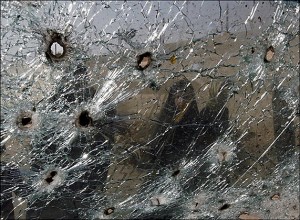
Broken GlassThe words of Caiaphas the high priest are reported by John as a prophecy that Jesus’ death would be an atoning sacrifice, that he would “die for the nation, and not for the nation only, but to gather into one the dispersed children of God.” (vv. 51-52) But I read them this morning as nothing more than political calculation.

More years ago than I care to remember I took a college class in political history. One of the things I learned is that nearly all decisions of government include two major components: political calculation, which is always based on past experience, and profound ignorance of current conditions and future potentials. Despite prodigious amounts of fact finding and data gathering, that ignorance remains a factor. There is always “one more fact” that could have been learned. And, more often than not, a “known fact” is not appreciated because prejudice, preconception, or inexperience blinds the decision-maker to its importance.

I suspect the lawmakers in Kansas and Arizona, where legislation has recently been enacted by one or both houses of the state legislatures permitting service providers, both private and public, to refuse service to gay, lesbian, and transgendered persons on the basis of “sincerely held religious belief,” have been surprised by the responses their actions elicited. They may have expected some reaction from the political left. It’s possible they anticipated some objection from more liberal religious bodies (such as the Episcopal Church). I don’t think they had a clue that the business community, represented by Apple, Delta, American Airlines, and other corporations, would oppose their action. I don’t know what data gathering they did before enacting those proposed laws, but they either failed to get the business data or failed to understand the data they got.

I could criticize what they did — these bills are, in my opinion, deeply flawed in several respects — but my thought today is that in our personal lives we do much the same thing. We make personal decisions on the basis of past experience in an atmosphere of profound ignorance; there is always something we don’t know. St. Paul was speaking of the eschaton, the end of time, about which we can know nothing when he wrote, “We see through a glass, darkly” (1 Cor. 13:12, KJV) but the truth is that our vision is always obscured. The glass through which we look at the present or the future is always darkened; there is always something we don’t see, some fact or bit of data of which we are ignorant either through lack or through misinterpretation.

So what does one do? Fail to decide? Fail to act? No, one cannot be paralyzed by fear. The only answer is to decide, to move forward in faith, to hope for the best. I don’t fault Caiaphas for his political calculation or for his ignorance; I am no different. I can hope I make better choices, but the process by which and environment in which human decisions are made has not changed in 2,000 years. Political calculation and profound ignorance are still the norm and probably will be until we get to the other side of Paul’s darkened glass.

====================

Father Funston is the rector of St. Paul’s Episcopal Church, Medina, Ohio.

« Older posts Newer posts »