From the Book of Proverbs:
Get wisdom; get insight: do not forget, nor turn away
from the words of my mouth.
Do not forsake her, and she will keep you;
love her, and she will guard you.
The beginning of wisdom is this: Get wisdom,
and whatever else you get, get insight.
Prize her highly, and she will exalt you;
she will honor you if you embrace her.
She will place on your head a fair garland;
she will bestow on you a beautiful crown.
(From the Daily Office Lectionary – Proverbs 4:5-9 (NRSV) – February 24, 2014.)
 My favorite thing in the Book of Proverbs is the personification of Lady Wisdom. Perhaps because of the further development of her portrait in Chapter 8, where she is said to have been with God in the moments of creation, “daily his delight, rejoicing before him always, rejoicing in his inhabited world and delighting in the human race” (vv. 30-31), I see her as young, slender, and athletic, her rejoicing being manifest as dance.
Many scholars have pointed out that in pre-Christian Judaism, wisdom (sophia) and word (logos) were nearly synonymous alternative descriptions of the creative and immanent power of God. Some have suggested that the Prologue to John’s Gospel could have been written: “In the beginning was Wisdom, and Wisdom was with God, and Wisdom was God.” However, John — as either proponent or victim of patriarchy (or both) — chose to use word rather than wisdom because of this personification of Lady Wisdom. Perhaps John felt it would have been awkward to speak of a female figure “being made flesh” in Jesus, a male.
Several years ago, the Cathedral of St. John the Divine in New York City created quite a stir by exhibiting a crucifix displaying a nude female body as the Christ figure — Christa by Edwina Sandys. Parks Morton, the dean of the cathedral, said at the time, “Christa simply reminded viewers that women as well as men are called upon to share the suffering of Christ.” I think, however, that the sculpture did more than that. It challenged preconceptions and established theologies; it made graphically visible the inherent sexism in the notion that the Second Person of the Trinity is “eternally masculine” as some Orthodox theologians argue.
I’ve often wondered how the Christian faith might have developed if John had embraced that awkwardness and used the term wisdom, instead. He did not, but we still can. We can still “get wisdom; get insight,” and she will lead us “in the paths of uprightness.” (Prov. 4:11) Along those paths we still have much to see, much to learn.
====================
Father Funston is the rector of St. Paul’s Episcopal Church, Medina, Ohio.
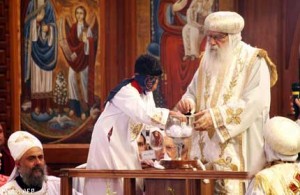 How does one “test the spirits”? How does one divine the promptings of the spirit or determine the will of God? That’s always the question we must face. In the ancient tabernacle, the high priest’s vestments included a breastplate in which he kept a couple of stones called the urim and the thummim (Exodus 28:30). What those were is a subject of much speculation, but one theory is that they were sort of like dice. The belief is that the high priest cast these dice to determine God’s guidance, to “test the spirit” when faced with a difficult decision.
 This, for me, is the issue of our day. It is the religious issue. It is the economic issue. It is the political issue. It is the moral issue. I think the answer to John’s question is, “It doesn’t.”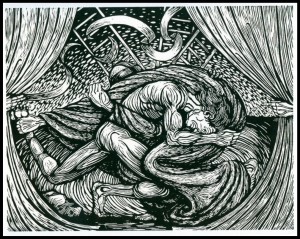
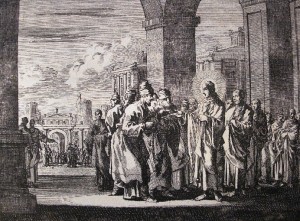 It has been said that all human communication, even at its best, is an approximation of meaning. This is especially true of religious communication which is almost always analogic. When we try to speak of God we mean both more and less than we say; when we listen to others speak of God, we understand both more and less than we hear.
  “The Lord watch between me and thee. . . . ” Years ago (several more than forty) I graduated from high school at the tender age of 16 and announced to my parents that I was getting married.
  There’s been a dust-up in the press recently. A lot of ink (mostly secular press ink) spilled on the question of camels in the Bible. This is because some scientific, archeological evidence has been turned up suggesting that camels have been only relatively recently domesticated in the regions of the eastern Mediterranean, nowhere near as far back as the stories of the patriarchs and matriarchs in the Books of Moses would put them. It is, says the scientific evidence, impossible that Jacob should have “set his children and his wives on camels” because there were no domesticated camels at the time, how ever far back we think that may have been.
 When I was studying for ordination, one of the more interesting thinkers I read was the French Reformed theologian Jacques Ellul. Ellul was a lawyer and a sociologist; he was heavily influenced by the work of Karl Barth and of Søren Kierkegaard. He adopted a dialectic approach to theology and argued that only such a method could lead to understanding of Scripture; we cannot understand the Biblical text, he asserted, except be seeing it as a network of contradictions, a history of crises and the resolution of the crises, a series of apparent abandonments and the hope which arises from and resolves the abandonment.
 A few days ago, the Kansas state house of representatives did a horrendous thing. They passed HB 2453 granting public and private employees the right to deny services, including unemployment benefits and foster care, to same-sex couples on the basis of “religious freedom.” When I read this morning’s words from St. Paul to the Romans, I wanted to address that legislation. However, two other Episcopalians had already done so with more authority than I could muster and said precisely what I would have wanted to say. The bishops of the Episcopal Diocese of Kansas and the Episcopal Diocese of Western Kansas issued a joint statement apropos of this legislation:
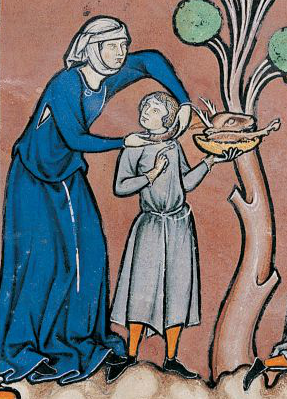 I suppose at one time or another everyone has felt what Rebekah expresses to Isaac in this verse. “If X (or Y or Z) happens, I’ll just die. My life will not be worth living.”

