From the Prophet Haggai:
Now therefore, thus says the Lord of hosts: Consider how you have fared. You have sown much, and harvested little; you eat, but you never have enough; you drink, but you never have your fill; you clothe yourselves, but no one is warm; and you that earn wages earn wages to put them into a bag with holes.
(From the Daily Office Lectionary – Haggai 1:5-6 (NRSV) – December 13, 2013.)
 It never ceases to amaze me how directly Scripture can speak to the present day! The admonition to “Consider how you have fared,” and its description of an economy in a shambles, where the people work but do not enjoy the produce of their labor, continue to be hungry and thirsty, cannot find warmth, and find their earnings dribbling away to nothing, could be addressed to anyone anywhere in today’s world, I think.
Haggai’s purpose in speaking his prophecy is to encourage the rebuilding of the Temple in the years immediately following the end of the Babylonian Exile, sometime around 520 BCE. His thesis seems to be that if the Jews can reclaim their spiritual center, in his eyes quite literally the physical center of the universe, the Temple of God, their lot will improve. It’s a good point, I think.
I’ve noticed over the past few days that a lot of people were remarking that today would be “Friday the 13th,” not a few with noticeable dread. Many of the same people regularly check their horoscopes and will make it a point of telling others, “I’m a Sagittarius,” or will explain someone’s behavior with, “Well, he IS a Leo!”
My late mother was one such person. She didn’t put much stock in concern about the number 13 (live and work in Las Vegas, Nevada, and you see and learn to dismiss a lot of that sort of thing), but she sure seemed to pay attention to astrology. She was a Cancerian; she constantly reminded my brother and me that he was a Leo and I, a Libra. Whatever personality traits we exhibited were explained by the stars! But all that changed when she entered her 70s.
Something else changed then, too. Her son became a priest. About a year after my ordination, my family and I were visiting my parents and I noticed on her nightstand a copy of The Book of Common Prayer, an old study bible that had been on their bookshelves unused for years, and a newcomer’s pamphlet from a local Episcopal Church. I picked up the BCP and walked into the living room.
“Uh . . . what’s this?” I asked innocently.
“Well,” she said in that almost-sarcastic tone of voice on which I think she had a trademark, “I guess you’re serious about this, so I thought I’d better check it out.”
And check it out she did. Both she and my step-father became official members of the Episcopal Church later that year. He became a regular handyman volunteer around the church, and she became an active member (and even an officer) in the Episcopal Church Women. They attended Mass every week, took part in social events, and worked in the church’s outreach ministry. Both pre-planned their memorial services using the burial rites of the Prayer Book, and their ashes are now together in the memory garden next to the larger church sanctuary their capital contributions help to build.
Here’s the interesting thing: after that day when she admitted she was “checking out” religious faith, I never again heard a word about horoscopes or the zodiac. God, Jesus, and the Christian faith had made astrology unnecessary in her life.
I have atheist and agnostic friends who will scoff at that. In their minds there is no difference between belief that the stars control our destiny and belief that there is a God who loves us. There is, however, a significant difference and it is exactly in that verb I just used – love. The stars, the number 13, rabbit’s feet and lucky clovers, the things of superstition are indifferent to human beings; God is never indifferent.
When we put the indifferent (indeed, the inanimate) at the center of our lives, life suffers. Whether that indifferent thing is a distant star or a bank account, a good luck piece or a career, that thing cannot give back any of our devotion. Center on the indifferent, we will sow much and harvest little. When God is at the center of life, our devotion is returned. Our hunger and our thirst are satisfied.
Haggai was on the right track and his prophecy does address our current situation. A religious re-centering was needed and perhaps the Temple was a visible sign of that re-centering of the returned exiles, but one does not really need a physical center. The people, each individually and all together as a society, needed a spiritual center. The people, each of us individually and all of us together as a society, still do.
It is Advent: the Advent call to self-examination continues in Haggai’s prophecy. What is at our spiritual center? As the morning psalm says today, God is our “strong rock, a castle to keep [us] safe,” and God will lead us and guide us. (Ps. 31:3)
====================
A request to my readers: I’m trying to build the readership of this blog and I’d very much appreciate your help in doing so. If you find something here that is of value, please share it with others. If you are on Facebook, “like” the posts on your page so others can see them. If you are following me on Twitter, please “retweet” the notices of these meditations. If you have a blog of your own, please include mine in your links (a favor I will gladly reciprocate). Many thanks!
====================
Father Funston is the rector of St. Paul’s Episcopal Church, Medina, Ohio.
 The devisers of our Episcopal Church Daily Office Lectionary were a clever bunch, weren’t they?
 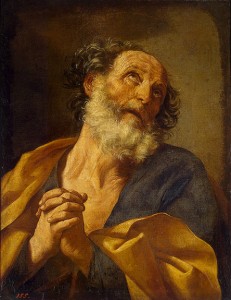 I thought, “Surely, this is wrong! There can’t be anything as weak and lifeless in Scripture (especially in the Psalms) as the plaintive little cry, ‘I’m sorry . . . .'” So instead of the New Revised Standard Version, I turned to The Book of Common Prayer, sure that I would find a stronger statement, perhaps “I repent.” But, no. The BCP version of this psalm is really even worse because it renders the verb in the future tense: “I will confess my iniquity and be sorry for my sin.” Come on! “I will be sorry”? Really?
 In truth, this is Amos objecting to Amaziah, the priest at Bethel, that he, Amos, is not an official prophet, not a member of one of the recognized or sanctioned schools of prophecy, but the first part of it has always sounded to me as if Amos is protesting his commission to prophesy, trying to get out of doing what God wants him to do. “Hey, that’s not what I do! I can’t be a prophet because I have these sheep and these figs to take care of!”
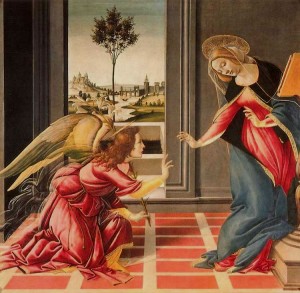 First, a confession: I’m not fond of the Book of Revelation. Although it has occasionally brilliant passages and some incredible metaphoric imagery, it is probably the most abused and misused piece of scripture in the entire Christian canon! I remember hearing or reading at one time that, during the formation of the canon, bishops in what is now the Eastern Orthodox wing of the church opposed the inclusion of this book. If that had been the way things went, it would have been relegated to that collection of interesting historical literature which includes The Shepherd of Hermas, The Didiche, and the Letters of Clement. But it wasn’t, so we have it and we have to take it seriously. (When dealing with the Apocalypse, it is well to remember the meme about Episcopalians, though: “We take the Bible too seriously to take it literally!”)
 I have a pair of cufflinks with part of this verse inscribed on them in Latin: “Sacerdos in Aeternum” (“Priest Forever”). They were given to me as an ordination present. I seldom have reason or opportunity to wear them as I don’t generally wear long-sleeved, let alone French-cuff, shirts. But yesterday I did.
 Nelson Mandela, an example of justice, courage, wisdom, patience, strength, love, hope, faith, forgiveness, and reconciliation, known to his countrymen and people of grace around the world as “Madiba,” died yesterday evening at the age of 95. His death was not unexpected; he had been ailing for quite a long time. This may be St. Nicholas Day, but really there’s no choice but to consider and write about Mr. Mandela!
 What a great couple of verses to illustrate metaphoric thinking!
  I’m sitting here this morning knowing full well that I should be writing something about Advent and, truth be told, there are other parts of today’s daily readings that would lend themselves to an Advent reflection. But…. yesterday a federal court in Michigan decreed that the city of Detroit could carry on with a restructuring of its debt through bankruptcy and, more importantly and more destructively, that among the obligations that could be discharged are its pension responsibilities to former municipal employees. I was deeply troubled by that news when I heard it yesterday morning and I’ve been pondering it since.
 This series of questions is asked by Amos just before he asks, “Does disaster befall a city unless the Lord has done it?” (v. 6b) He’s provoking his readers (originally, his listeners) to answer each preliminary question, “Of course not” so that their answer to his capper will also be “Of course not.”

