Occasional thoughts of an Anglican Episcopal priest

Category: Daily Office (Page 35 of 70)

Advent Anger – From the Daily Office – December 2, 2013

From the Psalter:

He whose throne is in heaven is laughing; the Lord has them in derision.

(From the Daily Office Lectionary – Psalm 2;4 (BCP Version) – December 2, 2013.)
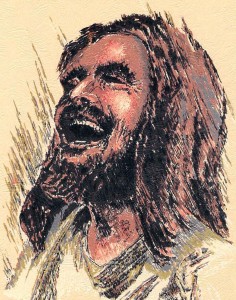
Laughing JesusIn the library of my parish church is a pen-and-ink drawing of Jesus laughing. It’s not a picture I particularly like, nor is it particularly well executed. In fact, if someone hadn’t told me that it is supposed to show Jesus laughing, I would have thought he was angry! Whenever I look at it, this verse from the Psalter comes to mind.

I think it’s hard for some people to conceive of Jesus (or God) showing emotions, particularly negative ones. I remember years ago (I was in my early 20s) listening to a meditation on anger at a church retreat. The priest offering the meditation said, “Jesus never displayed anger.” Really? I thought. What about that little incident in the Temple overturning tables and brandishing a whip? A false and mistaken idea that Jesus was never just plain mad, that God never gets royally pissed off does nothing more than create guilt in people who do (that would be everybody, I think).

One of the most interesting portrayals of the Lord in art that I have ever seen was a small hand-carved crucifix. The face of Jesus was contorted in obvious rage. I asked the artist about it and he told me it was how he saw Jesus saying, “Father, forgive them.” — “I think that what he is saying at that moment is, ‘You forgive them because, right now, I can’t! I have done everything you asked of me. I have taught them, healed them, exhorted them to proper conduct, shown them how to live, and this is what they do to me. I have run out of forgiveness. You do it!'” — I wish I’d been able to obtain that crucifix, but it wasn’t for sale.

I am quit certain that Jesus exhibited the full range of emotion, and I am equally certain that God does, as well. After all, Jesus was — is — God Incarnate. Furthermore, our faith teaches us that through his Ascension, Jesus has taken humanity into God’s heavenly domain; that includes everything it means to be human, including our emotions, positive and negative.

During these days of preparation for Christmas, this season the church calls “Advent,” emotions run high. For many people, sadness, anger, depression, a sense of loss, feelings of exclusion and betrayal may be the major emotions of the holidays. Laughing Jesus who looks to be angry, God laughing in derision, Jesus angry in the Temple, Jesus in exasperated rage on the cross . . . they should remind us that there should be no guilt in feeling these things. They are part of our humanity. Our human task is to accept them, work through them, and let go of them.

Lord, accept my Advent anger, my Christmas blues; help me lay them aside so that I may enter into the joy of your Incarnation.

====================

A request to my readers: I’m trying to build the readership of this blog and I’d very much appreciate your help in doing so. If you find something here that is of value, please share it with others. If you are on Facebook, “like” the posts on your page so others can see them. If you are following me on Twitter, please “retweet” the notices of these meditations. If you have a blog of your own, please include mine in your links (a favor I will gladly reciprocate). Many thanks!

====================

Father Funston is the rector of St. Paul’s Episcopal Church, Medina, Ohio.

Open Windows — From the Daily Office — November 29, 2013

From the Prophet Isaiah:

For the windows of heaven are opened, and the foundations of the earth tremble.

(From the Daily Office Lectionary – Isaiah 24:18b (NRSV) – November 29, 2013.)

Open WindowBlack Friday. The day after Thanksgiving Day in the United States. A day whose name comes from financial accounting and the ancient practice of recording profits in black ink, losses in red. Supposedly, at one time, this was the day when retail merchants who might have been running “in the red” the whole year would see themselves “in the black” at long last. I don’t know if that is still the case, but the name has stuck. Black Friday is the day after Thanksgiving Day.
I’m never sure what to do on Black Friday. I am definitely not going shopping. I hate shopping in the first place, and the idea of being shoved and jostled about by larger crowds than usual would just make it worse! Looking at the news coverage of Black Friday events, one could almost imagine Isaiah’s prophecy has come true. Under the onslaught of all those trampling feet, surely “the foundations of the earth tremble.”

Anyway, what to do? The dishes need to be done. The leftovers from yesterday need to be checked; were they put away properly? Should I start stewing the turkey carcass to make the soup which will be a staple for the next week or so? Should I just kick back and relax and read a good book? (“But don’t forget you need to finish your sermon for Advent 1,” says the small voice of conscience somewhere inside my head.)

Even more so than Thanksgiving Day itself, this is a day to give thanks, but not for gifts received. This day is a day to give thanks for a future of limitless possibility. Isaiah’s statement, “the windows of heaven are opened,” reminds of me of summer mornings when my mother would wake me up by coming in my room and throwing open the window. In the Nevada desert, it would already be warm even early in the morning. The dry desert breeze would carry away the slightly musty, not-very-chill air from the “swamp cooler” that had kept us cool through the night. The arid warmth would suggest so many things a boy freed from school might do. The open window, the open windows of heaven, inviting one into a future of limitless possibility.

I’m never sure what to do on Black Friday. There are so many options, so much possibility, so much to be thankful for.

====================

A request to my readers: I’m trying to build the readership of this blog and I’d very much appreciate your help in doing so. If you find something here that is of value, please share it with others. If you are on Facebook, “like” the posts on your page so others can see them. If you are following me on Twitter, please “retweet” the notices of these meditations. If you have a blog of your own, please include mine in your links (a favor I will gladly reciprocate). Many thanks!

====================

Father Funston is the rector of St. Paul’s Episcopal Church, Medina, Ohio.

Like a Lawnmower — From the Daily Office – November 28, 2013

From Matthew’s Gospel:

[Jesus said:] For the kingdom of heaven is like a landowner who went out early in the morning to hire laborers for his vineyard.

(From the Daily Office Lectionary – Matthew 20:1 (NRSV) – November 28, 2013.)

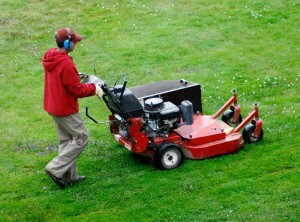
Man Mowing a LawnI had to read the first line of this familiar parable three or four times this morning before my eyes (it had to be my eyes; it couldn’t have been my brain) focused well enough to properly read the word landowner. On first reading, I read it as lawnmower.

“The kingdom of heaven is like a lawnmower . . . .”

What!?

I read it again; same thing! Shake my head; drink some coffee; look again. Oh! Landowner!

So I read the rest of the story about the vineyard owner hiring men in the morning, more at noon, a last bunch late in the day . . . and then paying them all the same wage. “So the last will be first, and the first will be last.” (v. 16) Nice counterpoint to the really awful bit of the First Letter of Peter appointed for today: “Slaves, accept the authority of your masters with all deference, not only those who are kind and gentle but also those who are harsh.” (1 Peter 2:18)

Although I really feel like I should be contemplating the issues of economic justice the two readings present, especially on Thanksgiving Day when I must acknowledge that I am so blessed and there are so many who aren’t, that has to be a conversation for another time. Meditating on the daily readings, I just kept coming back to my blurry-eyed misreading of the text.

“The kingdom of heaven is like a lawnmower . . . .”

Several weeks ago, back when it was warm and the grass was growing and it hadn’t rained for a few days so the dirt wasn’t spongy and the grass wasn’t too wet and I could mow the lawn, that’s what I was doing. Running the machine in long, curving swaths across our hillside back yard, I noticed a praying mantis in the piece I’d be covering in the next pass. The insect was bright green, about two inches long, and apparently injured.

Sure enough on my next pass there it was, right in front of the lawnmower. I disengaged the mower blade, disengaged the self-propelling mechanism, powered down the engine, set the brake, and walked around to scoop up the bug. I carried it to the edge of the lawn, to a flower bed where we have planted day lilies, forsythia, and butterfly bush, and set it among the plants. I hoped that I hadn’t been responsible for its injuries and that it would regrow whatever limb it was missing. (I think mantids are like crabs, that they can grow back whole limbs.) I walked back to the mower, re-engaged all the mechanisms, released the brake, and resumed my mowing.

So I think I can see how the kingdom of heaven might be like a lawnmower, if the word is understood to refer to the person doing the mowing, not to the machine.

I’m still working on the machine as a metaphor for heaven . . . I’ll probably be working on that one all day. Reading scripture in the early morning does that, sets my mind spinning and whirling and chopping away at these images, the ones actually in the bible and the extrabiblical ones my blurry-eyed imagination puts there. All day long. These images and metaphors challenge preconceptions, whack down received wisdom, pulverize prejudices, slice through both silly and profound notions, and mix my thoughts and the things I think I know all together in a rich mulch from which new ideas often grow and old ones give fruit.

Interestingly, a colleague yesterday commented on Facebook: “One of the things I am thankful for is the interesting dialogues and debates that can be fostered via Facebook. We may not always agree on any number of a wide variety of issues, but it is always interesting and informative to see the diversity of opinions that are offered on any number of topics from Ashes to Go, to politics, to how we prepare recipes, to how to approach some of the pressing social ills of our day, and so on and so forth. For me it helps further develop my own thoughts and perspective.” That’s my take on it, too, and it’s a lot like the processing I do as I reflect on biblical and extra-biblical metaphors; it all gets mashed together into a fertile mass.

So today while I’m at church presiding at the Eucharist, at home roasting a turkey, later in the day playing dominoes with friends, that’s what will be happening. I’ll be thinking about strange metaphors, about contemplation, about Facebook conversations, and what it all might teach, because “The kingdom of heaven is like a lawnmower . . . .”

Thanks be to God!

====================

A request to my readers: I’m trying to build the readership of this blog and I’d very much appreciate your help in doing so. If you find something here that is of value, please share it with others. If you are on Facebook, “like” the posts on your page so others can see them. If you are following me on Twitter, please “retweet” the notices of these meditations. If you have a blog of your own, please include mine in your links (a favor I will gladly reciprocate). Many thanks!

====================

Father Funston is the rector of St. Paul’s Episcopal Church, Medina, Ohio.

Just Deserts — From the Daily Office — November 27, 2013

From the Prophet Obadiah:

As you have done, it shall be done to you; your deeds shall return on your own head.

(From the Daily Office Lectionary – Obadiah 1:15b (NRSV) – November 27, 2013.)

Karma DominoesObadiah’s words (on behalf of God) are directed to the Edomites; this short (one-chapter) book is a rather dire prediction of the complete destruction Edom for the way it had dealt with Israel. Apparently it was correct for there seem to be no Edomites, nor any descendants of Edomites identifiable in the modern world.

On another level, however, it speaks to all of us about the reality of consequences. If one were going to paraphrase this verse in modern idiom, it might be rendered “What goes around, comes around.” St. Paul struck the same theme in his letter to the Galatians when he reminded them that “you reap whatever you sow.” (Gal. 6:7)

Our Hindu friends have a word for this concept – Karma. Of course, in Hindu belief, which accepts the idea of reincarnation, karmic activity may not happen in this life, but in a later life. That is not an option given Christians; we do not teach a circular, repeating conception of time, nor the doctrine of reincarnation. The biblical understanding of time is that it had a beginning, it will have an end, and we get one chance in this world to do what is right. One’s karmic just deserts are either received in this life, which was the teaching of the ancient “wisdom” version of the Jewish religion (and of the “prosperity gospel” preachers), or in the great here-after, which is the teaching of some Christian sects.

That latter belief, of course, gives rise to questions about heaven, hell, purgatory, reward, punishment, eternal damnation, eternal life in heaven . . . O dear!

I had a parishioner several years ago who, on a pretty regular basis, would ask, “What happens when we die? Where do we go?” I had a standard answer for her: “Martha,” I would say, “I don’t know. I haven’t been there yet.” I would tell her, though, that I have a hope and my hope is that Obadiah, the old “goes around comes around” proverb, St. Paul, and the doctrine of karma are wrong! I hope that what awaits us is not the justice promised by all of them, but the grace promised by the gospel.

That’s no reason not to pay attention to Obadiah’s and karma’s implied admonition to do and be good, however. In a less cosmic sense, what goes around does come around. Treat someone badly, you’re likely to be treated badly yourself. Treat someone well, you’re likely to get the same treatment. I may not know what happens when we die (yet), but I’m pretty sure about this.

So when all is said and done, when it comes to getting our just deserts and reaping what we sow, call it “karma” or “wisdom” or whatever, my advice is to live like it’s absolutely true, and hope to God it’s not!

====================

A request to my readers: I’m trying to build the readership of this blog and I’d very much appreciate your help in doing so. If you find something here that is of value, please share it with others. If you are on Facebook, “like” the posts on your page so others can see them. If you are following me on Twitter, please “retweet” the notices of these meditations. If you have a blog of your own, please include mine in your links (a favor I will gladly reciprocate). Many thanks!

====================

Father Funston is the rector of St. Paul’s Episcopal Church, Medina, Ohio.

Ransom Revisited — From the Daily Office — November 26, 2013

From the First Letter of Peter:

You know that you were ransomed from the futile ways inherited from your ancestors, not with perishable things like silver or gold, but with the precious blood of Christ, like that of a lamb without defect or blemish.

(From the Daily Office Lectionary – 1 Peter 1:18-19 (NRSV) – November 26, 2013.)

Handcuffs & MoneyI will go on record has being not an adherent of the ransom theory of the Atonement, which holds that the death of Christ was a ransom sacrifice in satisfaction for the bondage and debt on the souls of humanity as a result of inherited sin (another theory, “original sin,” with which I have some strong debate). It is unclear to me exactly who is the recipient of the ransom. Depending on who is setting out the argument, the ransom is usually said to have been paid either to Satan, which I think makes the ol’ devil rather bigger than he ought to be, or to God the Father, which makes the Almighty considerably less than we ought to think of God.

Here in this verse from Peter’s first letter, however, I find some redemption of the ransom theory. According to Peter, the ransom is not for “original sin,” nor are we ransomed from Satan; we are ransomed “from the futile ways inherited from [our] ancestors.” In other words, we are freed from “the way we’ve always done it before.”

Some people call the way we’ve always done it “tradition,” and to a certain extent some of that is true. Tradition, however, is not a straight-jacket; it doesn’t lock us into a rigid, unchanging status quo. When tradition is used to do that, it is more properly called “traditionalism.” The church historian Jaroslav Pelikan, in a 1983 lecture entitled The Vindication of Tradition, said, “Tradition is the living faith of the dead, traditionalism is the dead faith of the living. And, I suppose I should add, it is traditionalism that gives tradition such a bad name.”

Another word for the way we’ve always done it is “habit.” There are good habits, like brushing one’s teeth, and there are bad habits, like picking one’s nose in public. And there are really bad habits we call “addictions.” It is the bad habits and addictions, “the futile ways” of the past, from which Peter tells us we are ransomed by the blood of Christ.

That’s a ransom theory of the Atonement that makes sense to me. Christ sets us free from the way we’ve always done it before, free to try new things, free to experiment, free to grow.

====================

A request to my readers: I’m trying to build the readership of this blog and I’d very much appreciate your help in doing so. If you find something here that is of value, please share it with others. If you are on Facebook, “like” the posts on your page so others can see them. If you are following me on Twitter, please “retweet” the notices of these meditations. If you have a blog of your own, please include mine in your links (a favor I will gladly reciprocate). Many thanks!

====================

Father Funston is the rector of St. Paul’s Episcopal Church, Medina, Ohio.

Quick! Grab a Pruning-Hook! — From the Daily Office — November 25, 2013

From the Prophet Joel:

Proclaim this among the nations:
Prepare war,
stir up the warriors.
Let all the soldiers draw near,
let them come up.
Beat your ploughshares into swords,
and your pruning-hooks into spears;
let the weakling say, “I am a warrior.”

(From the Daily Office Lectionary – Joel 3:9-10 (NRSV) – November 25, 2013.)

Sword MakingRead it carefully, it’s not what you think it is. It’s not what you expect. It’s not a call to make agricultural implements out of the weapons of war . . . it is quite literally the opposite!

It’s another surreal moment with scripture, like that reading from Revelation we had a few days ago! It’s God saying precisely what we do not want God to say . . . but isn’t that the way with God?

And like Revelation is sometimes understood, these words from God spoken through the Prophet Joel are about the end times; they are about judgment. God is summoning the nations do battle with God! God is coming to pronounce and carry out judgment, so he is ironically calling the peoples of the world to defend themselves against God. Earlier Joel had used a courtroom and law case metaphor, so this is just an escalation of that call to present a defense.

“I’m comin’; you best get ready,” is what this prophecy says. “Defend yourselves!” Can we do so?

Can we defend the failure all around us to feed the poor? In a country where our elected leadership has cut food assistance to the poor by $40 million while continuing and expanding corporate subsidies to agribusiness (and other industries), can we do so?

Can we defend the failure all around us to house the homeless? In a country where there homes sitting vacant because of the “real estate bubble” and the “foreclosure crisis” while families live in their cars and camp under highway bridges, where there are in fact more vacant homes than there are families in need of housing, can we do so?

Can we defend the failure all around us to care for the widowed and the orphan? In a country where we spend more per capita on health care than nearly any other industrialized nation but rank 37th overall in health care outcomes and have the 46th ranked life-expectancy for an adult, can we do so?

Can we defend the failure all around us to honor human life? In a country that regularly sends unmanned aerial vehicles (otherwise known as “drones”) into foreign nations to murder perceived enemies (including our own citizens) without warning, where thousands die every year because we value the “right to bear arms” so highly that we will not enact even reasonable regulations for the ownership of firearms, can we do so?

Quick! Grab a pruning-hook! Start straightening and sharpening it, because I think we’re going to need more than a few spears.

====================

A request to my readers: I’m trying to build the readership of this blog and I’d very much appreciate your help in doing so. If you find something here that is of value, please share it with others. If you are on Facebook, “like” the posts on your page so others can see them. If you are following me on Twitter, please “retweet” the notices of these meditations. If you have a blog of your own, please include mine in your links (a favor I will gladly reciprocate). Many thanks!

====================

Father Funston is the rector of St. Paul’s Episcopal Church, Medina, Ohio.

Houses and Vineyards, Laws and Regulations – From the Daily Office – November 23, 2013

From the Prophet Isaiah:

They shall build houses and inhabit them;
they shall plant vineyards and eat their fruit.
They shall not build and another inhabit;
they shall not plant and another eat.

(From the Daily Office Lectionary – Isaiah 65:21-22 (NRSV) – November 23, 2013.)

House and VineyardThis part of Isaiah was written shortly after the return of the Jewish exiles from Babylon, which Cyrus of Persia had allowed in the middle of the 6th Century BCE. Isaiah (on God’s behalf) was promising two things with these images of laborers enjoying the fruits of their own efforts: first, that the people would no longer be (if not slaves) subjugated workers of foreign (or domestic) overlords and, second, that there would be peace. Israel’s and Judah’s history had been one of regular (if not constant) upheaval with invaders coming in and taking control of the vineyards and seizing the people’s lands and homes: the simple planting of vineyards with an expectation of enjoying the crop was a metaphor of peace and security.

As I read the words this morning in our modern context, I thought how inappropriate a metaphor this is for us. We no longer live in a world where enjoying the fruits of one’s own labor is the norm. We live in a world dominated by an economic system in which those who tend the vines and harvest the grapes are not those who enjoy the crop, those who build the houses are not those who will ultimately live in them; indeed, they are several levels of “production” and “marketing” away from those who do. The metaphorical vineyard workers and home builders of our society have no personal or emotional connection to the crops and the buildings; they work for a paycheck which, one hopes, will enable them to purchase other crops harvested by other workers and to live in other homes built by other builders.

Not that there is anything wrong with that system, so long as it is fairly administered. Fairness, justice, and peace are, after all, what this prophecy is really addressing. Any economic system that produces those fruits lives up to the biblical standard. But it takes laws and regulations (and law enforcement systems and regulatory agencies) to assure that human beings and their economies behave in such ways. Left to our own devices, we humans seldom do so, as the historical record makes painfully clear.

As so often happens, I could not help but think of two recent news reports when confronted with this witness of scripture, reports that clearly demonstrate the need for such laws and the need for vigilance by those (like me) who would insist that they are needed. The first was the news that a congress woman from another state has introduced a bill to abolish, as a matter of federal law, the requirement of overtime pay for those whose employers demand they work in excess of 40 hours per week. The second was a report yesterday that British authorities had found and freed three women who had been kept as domestic slaves (in London, for heaven’s sake!) for thirty years!

We are so far from the biblical standard of fairness and justice for laborers! So far! And at times we seem to be slipping further way. The prophecy promises that the time will come when workers will know justice and peace; present-day news reports show that that time hasn’t come yet.

Another prophet once asked “What does the Lord require of you?” and then answered his own question: “To do justice, and to love kindness, and to walk humbly with your God.” (Micah 6:8) Only when each person and the whole of society (through its laws, regulations, and law enforcement) does so can we be assured that workers will build houses and inhabit them, plant vineyards and eat their fruit.

====================

A request to my readers: I’m trying to build the readership of this blog and I’d very much appreciate your help in doing so. If you find something here that is of value, please share it with others. If you are on Facebook, “like” the posts on your page so others can see them. If you are following me on Twitter, please “retweet” the notices of these meditations. If you have a blog of your own, please include mine in your links (a favor I will gladly reciprocate). Many thanks!

====================

Father Funston is the rector of St. Paul’s Episcopal Church, Medina, Ohio.

Surreal Scripture – From the Daily Office – November 22, 2013

From the Book of Revelation:

Let the evildoer still do evil, and the filthy still be filthy, and the righteous still do right, and the holy still be holy

(From the Daily Office Lectionary – Revelation 22:11 (NRSV) – November 22, 2013.)

The Lovers by Rene MagritteToday is the 50th anniversary of the assassination of President John F. Kennedy. Like everyone who was even marginally grown up or conscious on that day, I know exactly where I was and what I was doing when it happened. It is one of those moments in time that are surreal in their clarity.

This verse from the Book of Revelation randomly and coincidentally shows up in the Daily Office Lectionary today. It strikes me as equally surreal. This is Jesus talking, Jesus ascended to heaven, Jesus the Incarnation of God, Jesus the Second Person of the Trinity, Jesus speaking from his heavenly throne, Jesus who in a verse or two will say, “I am the Alpha and the Omega, the first and the last, the beginning and the end.” (v. 13) What can it mean that Jesus says to “Let the evildoer still do evil, and the filthy still be filthy?” Doesn’t that run contrary to everything that he taught and lived on earth? What?

Anyone who knows me is aware that I have a streak of weirdness a mile wide. I love theater of the absurd (Eugene Ionesco and Samuel Beckett are among my favorite playwrights) and surrealist art (give me Salvador Dali and Rene Magritte over the “old masters” any day). That’s why I love the Book of Revelation.

I don’t love it in the way the folks that preach the Rapture and the Tribulation love it. I don’t love it in the way the authors of the Left Behind novels love it. I don’t love it in the way that people who predict the end of the world love it. I think are that is theological nonsense . . . or, more accurately, theological bullshit.

No, I love Revelation for the same reason I love absurdist theater and surrealism. There’s an old saw about random chance that if you put a bunch of monkeys in a room with a bunch of typewriters they would eventually produce the works of Shakespeare. I think if you put Ionesco, Beckett, Magritte, and Dali in a room together and told them to write something about the destruction and fall of the Roman Empire, they might come up with the Book of Revelation . . . .

Throughout my life, I have collected oddball memories that I keep saying I am going to put into a great novel, and I keep collecting potential titles for that novel – things people say or do that, heard out of context, challenge reality. Here are some of my potential titles:

“Hello spelled backwards is sweet roll.”

“Before you sink the Bismark, I need to brush my teeth.”

“My only regret was bronzing the kangaroo.”

Sorting cat food in the nude

This thing that John of Patmos says Jesus said seems to me to rank right up there with these potential titles. Like anything surrealistic, this admonition of the Risen and Ascended Christ to “let the evildoers do evil and let the filthy be filthy” challenges our perceptions of reality; it demands that we resolve contradictory perceptions. It demands that we make choices. It demands that we decide which group we are going to be in — the evildoers and the filthy, or the righteous and the holy. It demands that we change.

With surreal clarity, I remember exactly where I was and what I was doing when John F. Kennedy was killed. It was an event that awakened and transformed a nation. The Book of Revelation with surreal clarity demands that we awaken and transform ourselves . . . before we sink the Bismark or bronze the kangaroo.

====================

A request to my readers: I’m trying to build the readership of this blog and I’d very much appreciate your help in doing so. If you find something here that is of value, please share it with others. If you are on Facebook, “like” the posts on your page so others can see them. If you are following me on Twitter, please “retweet” the notices of these meditations. If you have a blog of your own, please include mine in your links (a favor I will gladly reciprocate). Many thanks!

====================

Father Funston is the rector of St. Paul’s Episcopal Church, Medina, Ohio.

Creating Community – From the Daily Office – November 21, 2013

From the Matthew’s Gospel:

Whoever welcomes one such child in my name welcomes me.

(From the Daily Office Lectionary – Matthew 18:5 (NRSV) – November 21, 2013.)

Creating CommunityI’m following a thread on a friend’s Facebook page about the future of the “institutional church,” by which I think the various participants mean their several denominations. (We are Episcopalians, Methodists, Presbyterians, Lutherans, etc., all of whom seem primarily to identify as Christians and only secondarily with the variety of polities, theologies, liturgical styles, and so forth we each prefer.) I suggested in the discussion that creating institutions is in the very nature of human beings; we create them, criticize them, tear them down, reform them, and recreate them, but we never escape from them. Another participant in response said, “I do not create community.”

“Really?” I thought as I read that. Then what is Jesus talking about when he bids us to welcome others? What is it that we are about when we enter a church fellowship? The other continued, “Community is right in front of us.” Now, that’s true. But do we not “create” a new community when we join that which pre-exists us? When we welcome the child in Christ’s name, we so alter the existing community that it is no longer the same, it is something new. It can never go back to, never again simply that which it was.

“See,” says the Lord, “I am making all things new.” (Rev. 21:5) We and our welcome are the tools which God uses to create new communities out of the old.

In that thread, I said, “I don’t despair of the institutional church; I believe it is in a state of flux and reform, but it will survive. We may not recognize it were we to come back in a 100 years or so, but it will be here.” Whether it will be Episcopalian or Presbyterian or Congregational or Methodist is anyone’s guess, but it will definitely be community created by human beings empowered by God and used for God’s purpose of making all things new.

====================

A request to my readers: I’m trying to build the readership of this blog and I’d very much appreciate your help in doing so. If you find something here that is of value, please share it with others. If you are on Facebook, “like” the posts on your page so others can see them. If you are following me on Twitter, please “retweet” the notices of these meditations. If you have a blog of your own, please include mine in your links (a favor I will gladly reciprocate). Many thanks!

====================

Father Funston is the rector of St. Paul’s Episcopal Church, Medina, Ohio.

Facebook friends with God – From the Daily Office – August 19, 2013

From the Second Book of Samuel:

Now Absalom had set Amasa over the army in the place of Joab. Amasa was the son of a man named Ithra the Ishmaelite, who had married Abigal daughter of Nahash, sister of Zeruiah, Joab’s mother.

(From the Daily Office Lectionary – 2 Samuel 17:24 (NRSV) – August 19, 2013.)

Social Media IconsReading a verse like this one from the Second Book of Samuel makes me feel like I’m sitting at my in-laws’ kitchen table, or even in my grandmother’s kitchen. Up until very recently, this is the way people connected with other people. I can hear my late father-in-law reminding my wife of someone in the small town where she was born and raised:

“Oh, you know Sally! She was married to Bob, Jim’s brother, and her uncle Fred was your second grade teacher’s (Mrs. Jones’s) husband’s brother-in-law, Bill. Mr. Jones’s sister Margaret was his first wife.”

Often as I listened to conversations like this I would find myself lost in the tangled web of interpersonal relationships, trying desperately to trace the connections between spouses, siblings, cousins, friends-of-the-family, business associates, church members, and the-people-we-don’t-know-but-talk-about that defined a person’s identity in the society of that small town and within my spouse’s extended community of family and friends.

With the advent of the internet, Facebook, Tumblr, Pinterest, Linked-In, Google+, and the list goes on . . . With the advent of social media and these means of connecting that are at once more direct but more tenuous, more easily understood but less well defined, how do we now understand personal identity or personhood?

Personhood is a social construct that entails the very relationships the writer of Second Samuel sought to portray, the relationships my father-in-law used to recall to my wife who Sally was. The ability to be in those relationships is one way to understand what it means to be a person. Personhood is defined by a human being’s ability to have relationships with other human beings and, from a theological standpoint, to enter into the special relationship human beings have with God.

Contemporary social media now allows me to be in relationship with more people more immediately than has ever been possible in the past. Some years ago in a course in pastoral practice, I read that the greatest number of close interpersonal relationships a clergy person can sustain is about fifty. We may “know” many more people, but the limit on the number of people with whom our face-to-face relationships can be meaningful in any particular sense is about fifty – maybe a little lower for an introvert like myself, possibly a little higher for an extrovert.

But now I have over 800 “friends” on Facebook and “know” maybe a similar number of additional Facebook users through discussion group pages . . . . “Oh, you know Eric! He’s friends with Michael, who’s in that glass collecting Facebook group started by Brad, who follows Sid on Twitter.”

We Christians are supposed to understand God through the metaphor of personhood — the Holy Trinity, a unity of three Persons (Father, Son, and Holy Spirit). When our understanding of personhood is stretched (and some might say “warped”) by new technologies of relationship, does our concept of God change? How do we understand God and God’s Personhood in this new digital age?

I don’t know. I don’t have an answer. But I know this: I’m not just Facebook friends with God.

====================

A request to my readers: I’m trying to build the readership of this blog and I’d very much appreciate your help in doing so. If you find something here that is of value, please share it with others. If you are on Facebook, “like” the posts on your page so others can see them. If you are following me on Twitter, please “retweet” the notices of these meditations. If you have a blog of your own, please include mine in your links (a favor I will gladly reciprocate). Many thanks!

====================

Father Funston is the rector of St. Paul’s Episcopal Church, Medina, Ohio.

« Older posts Newer posts »