From the Psalter:
They asked, and quails appeared, and he satisfied them with bread from heaven.
(From the Daily Office Lectionary – Psalm 105:40 (BCP Version) – May 16, 2013.)
 Once again I find this serendipitous connection between one verse in the Daily Office psalm and a news item in the daily papers. Psalm 105 is divided into two parts and our lectionary bids us read the first at Morning Prayer and the second at Evening Prayer. The psalm describes the Hebrews sojourn in Egypt. Part One (vv. 1-22) describes the captivity of Joseph and his later elevation to leadership in the pharaoh’s court, which occasioned the children of Israel taking refuge in “the land of Ham” where they were subsequently enslaved. Part Two (vv. 23-45) tells the story of Moses, the Exodus, and the Hebrews coming into the Promised Land.
So hunger and famine, deprivation and want surface as themes both as a cause of the Israelites residence and ensuing slavery in Egypt, and as a consequence of their journey through the Sinai desert escaping from that servitude. The quoted verse celebrates God’s provision of food during their desert trek.
In today’s Los Angeles Times there is an article which begins with this question, “What happens to the 40% of food produced but never eaten in the U.S. each year, the mounds of perfect fruit passed over by grocery store shoppers, the tons of meat and milk left to expire?”
Twice a month about 100 families line up in the parking lot and hallways of my church to receive a few bags of food. As a distribution point for the local food bank system, our pantry operation offers canned goods, fresh vegetables, meats, bread, and other staples, as well as such things as paper towels, toilet paper, and personal hygiene products, to those unable to afford them in the stores. On the last Saturday of each month we see our biggest crowds as the month’s Social Security, WIC, food stamps, and other assistance funds have diminished.
In light of that monthly experience, I read the L.A. Times’ opening question and all I can do is shake my head in wonder! 40% of food produced in this country is never eaten? And yet there are these hundreds of people lining up for a food hand-out in my church . . . and that scene is repeated across the country in countless venues, and on an almost daily basis. Something is wrong! Something is broken!
The partial answer to the Times’ question is that some of it goes into the production of electrical power. The article is about the Kroger grocery company (through its Ralph’s and Food4Less divisions) composting the “garbage” food and producing methane gas to power generators. While I applaud this environmentally sound disposal solution, I can’t help but wonder, “Wouldn’t it be better if the food didn’t go to waste? Wouldn’t it be better if, instead of allowing the food to become inedible, it was distributed to those who are hungry?”
In the story of the Exodus, the food provided by God – the quail and the manna – could not spoil because it could not be kept. It was to be gathered and eaten; whatever wasn’t eaten simply didn’t hang around – the quail flew off – the manna evaporated. So neither the psalm nor the longer story in Exodus provide guidance for what to do with leftovers. Common sense, I think, has to fill that in. And common sense, I think, suggests that instead of letting food go bad and become fodder for a methane generator, it ought to be used to feed the hungry. I also think that that would be more attuned to the Gospel imperative.
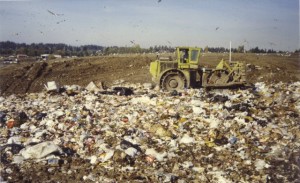
Turning old food into electricity is at least a sounder decision than that reported a few months ago in Augusta, Georgia, where the inventory of a bankrupt supermarket was simply thrown away – in the presence of hungry people hoping for a handout! The needy poor, according to an article in the Augusta Chronicle, stood in the parking lot and “watched marshals stand guard as food was tossed into the trash” and hauled away to the city dump. “Some people even followed the truck to the landfill and were still turned away,” GreenLeft reported.
God provided food for the people. God satisfied them with quail and bread. God still provides food for the people. How we use it or misuse it is up to us. We don’t seem to be doing a very good job. Something is wrong! Something is broken!
====================
A request to my readers: I’m trying to build the readership of this blog and I’d very much appreciate your help in doing so. If you find something here that is of value, please share it with others. If you are on Facebook, “like” the posts on your page so others can see them. If you are following me on Twitter, please “retweet” the notices of these meditations. If you have a blog of your own, please include mine in your links (a favor I will gladly reciprocate). Many thanks!
====================
Father Funston is the rector of St. Paul’s Episcopal Church, Medina, Ohio.
 There’s a homiletic maxim attributed to Karl Barth that clergy should preach with the Bible in one hand and a newspaper in the other. These days, that sort of describes how I say the Daily Office. I use my laptop computer (I’m still not hip enough to have a “tablet” device) to access the
  I’ve been thinking a lot about this listen to voices stuff. A few weeks ago, the Fourth Sunday of Easter (April 21, 2013), we heard one of the “good shepherd” lessons in which Jesus says, “My sheep hear my voice. I know them, and they follow me.” (John 10:27). Now, he says, we hear his voice in the voices of his apostles, those whom he has sent. (This verse is taken from his instructions to and commissioning of the Seventy who are sent out to preach the Good News and heal those who come to them.)
 Today’s Old Testament reading is a disturbing piece in which the Prophet Ezekiel is instructed to lie down for several days (in fact, for more than a year) as a sign of the number of years Israel and then Judah will be punished.
  As I read this verse from the Letter to the Hebrews, continuing education in the faith (an “adult Christian formation” program) has apparently been an issue in the church for quite a while. There is certainly a crisis of lifelong learning – or the lack of it – in the church today!
 I have an inch-long scar on the palm of my left hand; if I look closely, I can still see the pin-prick scars on either side of it which represent where the sutures that closed the wound were placed. The scar is just below my left pinky finger, which doesn’t work quite so well as my right pinky because underneath the scar the tendon was cut and had to be reconstructed. I’ve had this scar and this less-than-functional finger since I was not quite nine years old. It is a reminder of the need for boldness.
  It’s sort of the basic existential question, isn’t it? I mean it strikes me as equivalent to asking such questions as “What is the meaning of life? Who am I? What is my purpose? Is there a god, and, if so, what is God’s nature?” These are the questions that, in my life, occupy the “wee hours,” the dark times. I never seem to ask these questions when it’s bright and sunny, when it feels like “God’s in his heaven and all’s right with the world.” It’s when things aren’t right that these questions arise.
 There are a lot of people today who claim to be religious but do not bridle their tongues. Just spend a few hours searching the internet. Limit yourself even to Facebook. Plenty of “religious” people saying lots of, shall we say, non-religious things. I won’t say their religion is worthless, but I do wonder how much they actually value their religion and what it teaches.
 Recently, I sat down with a fellow clergy person, a cleric about my own age who is also a parent. We were talking about our kids and how there are times when, as mothers and fathers, we simply have to let go and let our children live their own lives and make their own mistakes. He made the interesting comment that, until he was parent to a maturing teenager, he hadn’t really understood what helplessness is. “As parents, ” he said, “we are essentially helpless.” This, he suggested, gives us a clue to understanding God.
 The first verse of this bit from John’s Third Letter brings to mind an old hymn, the first verse of which is

