Occasional thoughts of an Anglican Episcopal priest

Category: Daily Office (Page 48 of 70)

The Christmas Promise – From the Daily Office – December 24, 2012

From the Prophet Isaiah:

The wilderness and the dry land shall be glad,
the desert shall rejoice and blossom;
like the crocus it shall blossom abundantly,
and rejoice with joy and singing.
The glory of Lebanon shall be given to it,
the majesty of Carmel and Sharon.
They shall see the glory of the Lord,
the majesty of our God.

(From the Daily Office Lectionary – Isaiah 35:1-2 (NRSV) – December 24, 2012.)
 
Wide Open Desert HorizonI was born and raised in the desert. The image of wilderness and dry land blossoming is one that touches my heart and excites my imagination. I love the desert. I love its stark and barren beauty, when the rains of spring kiss it and it blossoms . . . there’s nothing like it anywhere else.

I live in north central Ohio now, near Cleveland. It’s a claustrophobic landscape to the desert-born. Instead of distant horizons, there are hills covered with trees. They’re lovely but they block one’s view of the distance; they’re close, sometimes too close.

Several weeks ago my wife and I traveled to the desert where we both were born and raised. It was a sad trip; her father had died and we were going to his funeral. Although it was an unhappy trip, there was a point driving on the interstate heading west out of the Wasatch Mountains of Utah when the wide-open desert opened up before us and my soul soared – I was home! The landscape stretched ahead of me unblocked by any hill, any tree, any obstruction; the horizon was distant and beckoning

Christmas is like that. The Infant comes to us in the desert of the Holy Land opening the future before us; the future stretches ahead unblocked, unobstructed, distant, and beckoning.

Christmas is a promise. The promise of a wide-open future. What becomes of that promise is up to us.

====================

A request to my readers: I’m trying to build the readership of this blog and I’d very much appreciate your help in doing so. If you find something here that is of value, please share it with others. If you are on Facebook, “like” the posts on your page so others can see them. If you are following me on Twitter, please “retweet” the notices of these meditations. If you have a blog of your own, please include mine in your links (a favor I will gladly reciprocate). Many thanks!

====================

Father Funston is the rector of St. Paul’s Episcopal Church, Medina, Ohio.

False Teachings and Guns – From the Daily Office – December 22, 2012

From the Letter of Jude:

You, beloved, must remember the predictions of the apostles of our Lord Jesus Christ; for they said to you, “In the last time there will be scoffers, indulging their own ungodly lusts.” It is these worldly people, devoid of the Spirit, who are causing divisions. But you, beloved, build yourselves up on your most holy faith; pray in the Holy Spirit; keep yourselves in the love of God; look forward to the mercy of our Lord Jesus Christ that leads to eternal life. And have mercy on some who are wavering; save others by snatching them out of the fire; and have mercy on still others with fear, hating even the tunic defiled by their bodies

(From the Daily Office Lectionary – Jude 1:17-23 (NRSV) – December 22, 2012.)

Glory in the SkySort of buried in Jude’s moralizing about false teachers and those who follow them is an Advent message: “Look forward to the mercy of our Lord Jesus Christ that leads to eternal life.” As I’ve been saying pretty consistently throughout the season, here and in my sermons, Advent is not so much about celebrating the birth of Jesus, wherever it was and whenever it was about 2,000 years ago, as it is about getting ready for his return, the parousia as seminary-educated folks like to say.

It’s kind of humorous that Jude’s letter with its warning about “worldly people, devoid of the Spirit, who are causing divisions” and others for whom we are to have mercy mixed with fear “hating even the tunic defiled by their bodies” should come up today. Yesterday, a lot of those very people were running around convinced the world was going to end because of the Mayan long calendar. It didn’t, we and they are still here . . . and don’t they have egg on their faces (or defilement on their tunics, as Jude might have said).

It is humorous, but it’s also a warning to us that Jude was right. We can be led astray by false and outlandish teachings. In the days since the tragedy in Newtown, Connecticut, there have been a lot of people saying a lot of things, some of which I agree with and some of which I don’t. And some who should know better have been saying things about the use of violence to curb violence. Even before the NRA’s spokesman yesterday suggested putting armed guards in every school (an idea I find repugnant), I heard Christian clergy suggest the same thing, or some variation on it (such as arming our school teachers).

I don’t want to get into the politics of gun control or the history and meaning of the U.S. Constitution’s Second Amendment. (Well . . . I do, but not here.) What I do want to suggest is that those clergy are not building themselves or other church members up on our most holy faith; I suggest that their teaching is false. As I understand the Christian faith, it is not about meeting violence with violence. The One whom we name “Prince of Peace” gave these instructions to his followers: “Love your enemies, do good to those who hate you, bless those who curse you, pray for those who abuse you. If anyone strikes you on the cheek, offer the other also; and from anyone who takes away your coat do not withhold even your shirt. Give to everyone who begs from you; and if anyone takes away your goods, do not ask for them again. Do to others as you would have them do to you.” (Luke 6:27-31) No matter how much I try, I cannot make those admonitions into any sort of support for taking up guns, for arming teachers, for adding to the surfeit of firearms already present in our culture.

Every Sunday, I end the Mass with these words from my parish’s patron saint: “Rejoice in hope, be patient in suffering, persevere in prayer. Bless those who persecute you; bless and do not curse them. Rejoice with those who rejoice, weep with those who weep. Live in harmony with one another; do not be haughty, but associate with the lowly; do not claim to be wiser than you are. Do not repay anyone evil for evil, but take thought for what is noble in the sight of all. If it is possible, so far as it depends on you, live peaceably with all. Do not be overcome by evil, but overcome evil with good.” (Romans 12:12,14-18,21)

So far as it depends on me to live peaceably with all, the one thing I cannot do is arm myself nor recommend that others be armed nor countenance those recommendations from others. The words I leave out of Paul’s encouragements to the Christians in Rome include these: “Beloved, never avenge yourselves, but leave room for the wrath of God; for it is written, ‘Vengeance is mine, I will repay, says the Lord.’ No, ‘if your enemies are hungry, feed them; if they are thirsty, give them something to drink; for by doing this you will heap burning coals on their heads.’” (Rom. 12:19-20) I cannot guarantee that I will never avenge myself, but I can take a step in that direction by not preparing in advance to do so.

I know that I have friends and parishioners who disagree with me and with our church’s official teaching on this point (which is in favor of strict gun regulation). I believe they are wrong, but I know they hold their views for what they believe to be good reasons. I can only hope they know the same of me and that we can come to some consensus in our country that honors all points of view and that, at the end of it all, at the parousia we will all “stand without blemish in the presence of God’s glory with rejoicing.” (Jude 1:24)

====================

A request to my readers: I’m trying to build the readership of this blog and I’d very much appreciate your help in doing so. If you find something here that is of value, please share it with others. If you are on Facebook, “like” the posts on your page so others can see them. If you are following me on Twitter, please “retweet” the notices of these meditations. If you have a blog of your own, please include mine in your links (a favor I will gladly reciprocate). Many thanks!

====================

Father Funston is the rector of St. Paul’s Episcopal Church, Medina, Ohio.

The World Didn’t End Today – From the Daily Office – December 21, 2012

From the Prophet Isaiah:

Therefore the Sovereign, the Lord of hosts,
will send wasting sickness among his stout warriors,
and under his glory a burning will be kindled,
like the burning of fire.
The light of Israel will become a fire,
and his Holy One a flame;
and it will burn and devour
his thorns and briers in one day.
The glory of his forest and his fruitful land
the Lord will destroy, both soul and body,
and it will be as when an invalid wastes away.
The remnant of the trees of his forest will be so few
that a child can write them down.

(From the Daily Office Lectionary – Isaiah 10:16-19 (NRSV) – December 21, 2012.)

 
The End of the World ImaginedThe world was supposed to end today. I slept in in hopes it would be gone before I got out of bed . . . but alas, it is still here and there are still laundry to be done and a dog who needs a bath and Christmas meals to be shopped for and sermons to be written.

I jest, of course. I didn’t really think the world would end. I had no faith in doomsday predictions based on a misunderstanding of the Mayan long calendar, any more than I believe the world will be destroyed by a collision with the invisible planet Nibiru. But having said that, I’m left open to this big, gaping question: Why, then, do I believe Isaiah? It’s a legitimate question – why believe one prophecy and not another?

The answer really boils down to what we mean by “prophecy”. The Mayan “prophecy” really wasn’t a prophecy at all, just the end of a calendar. The Mayans divided time into eras called “baktuns”. Based solely on mathematics and observation of the movement of celestial bodies, the so-called “long calendar” laid out the calculations for the length of the 13th Baktun, which ended today. The long calendar doesn’t say, in any way, that creation would also end; the rational implication of the long calendar is that the 14th Baktun would begin, but that’s not the way the nuttier folk among us took it.

The Nibiru “prophecy” is based on even less observable reality than the Mayan long calendar. It comes from the tortured and demonstrably inaccurate translations of ancient Babylonian and Sumerian texts by one Zecharia Sitchin, a proponent of the idea of “ancient astronauts”. The idea is that there is an invisible planet called “Nibiru” which circles through our solar system every 3,600 years and will eventually collide with Earth. The date of the collision has been recalculated and changed on several occasions.

This is what differentiates the Hebrew prophecies like Isaiah’s from the Mayan, Nibiru, and similar prophecies. The former are not based on mathematical calculations; the latter are. The former give voice to a moral sense of history; the latter give voice to a mechanistic model of the universe.

Isaiah and the other Hebrew prophets were not simply, nor even primarily, predicters of the future; they were historians, moralists, social critics, spokesmen for God. In general, one can outline a Hebrew prophet’s pronouncement sort of like this:

(a) In the past the People of God or their leaders or their enemies behaved in this manner.

(b) God responded to this behavior in this way. From this we know that . . .

(c) if the People of God or their leaders or their enemies continue to act as they currently are . . .

(d) then God will respond to this behavior in a similar way. On the other hand . . .

(e) if the People of God or their leaders or their enemies change their behavior . . .

(f) then God will change God’s mind and respond differently.

In other words, the prophecies of the Hebrew seers are conditional upon the moral behavior of human beings and a belief that the Creator of the universe also behaves in a moral way. I’ve heard it said that the role of a Hebrew prophet is not “foretelling” (predicting the future) but “forth telling” (speaking the word of God to God’s People in their time and place).

The Mayan calendar and the Nibiru prophecy are amoral; they simply assert that heavenly bodies (real or imagined) behave in certain ways and will continue to do so without regard to human or divine behavior. If they predict disaster (and it is by no means clear that they do – obviously the Mayan calendar did not), there is nothing anybody can do about it. And knowing about it offers us no moral guidance.The prophecies of Isaiah and other Hebrew prophets, on the other hand, are of a different sort. They provide us the same guidance they provided their original audiences: “God has dealt thusly with God’s People in the past; we can expect God to deal similarly with us; how, then, should we act?” Our specific reading today, a part of a pronouncement against the king of Assyria and in consolation to the People of Israel, is a reminder of the corrupting influence of political power and the dangers of political arrogance, a lesson we and our own leaders should often remember.

From the Mayan long calender we learn nothing of moral guidance; from the Nibiru prophecy we learn nothing except that poor scholarship produces ridiculous nonsense; from the prophecy of Isaiah, however, we learn that human political authority has its limits. This is why I trust in the prophecies of the Hebrew prophets, but not predictions of “the Mayan apocalypse.”

On the First Sunday of Advent this year, the Gospel lesson at the Holy Eucharist (Luke 21:25-36) included Jesus’ warning that before the end of time there would be “distress among nations” and that “people will faint from fear and foreboding.” These are much more important than “signs in the sun, the moon, and the stars,” though there may be those, as well. As Advent ends, let us pray for less distress, less fear, less foreboding, less political arrogance, less corruption . . . and let us give thanks that the world didn’t end today, even though we didn’t really think it would.

====================

A request to my readers: I’m trying to build the readership of this blog and I’d very much appreciate your help in doing so. If you find something here that is of value, please share it with others. If you are on Facebook, “like” the posts on your page so others can see them. If you are following me on Twitter, please “retweet” the notices of these meditations. If you have a blog of your own, please include mine in your links (a favor I will gladly reciprocate). Many thanks!

====================

Father Funston is the rector of St. Paul’s Episcopal Church, Medina, Ohio.

Advent Exclamations of Disappointment – From the Daily Office – December 20, 2012

From the Prophet Isaiah:

Ah, you who make iniquitous decrees,
who write oppressive statutes,
to turn aside the needy from justice
and to rob the poor of my people of their right,
that widows may be your spoil,
and that you may make the orphans your prey!
What will you do on the day of punishment,
in the calamity that will come from far away?

(From the Daily Office Lectionary – Isaiah 10:1-3a (NRSV) – December 20, 2012.)
 
Lonely Old WomanThe first word of this bit of Isaiah in Hebrew is often translated “Woe” but here in the New Revised Standard Version, it has been rendered “Ah”. The Hebrew is hôy ; it is a negative exclamation pronounced “oy!” Perhaps the “woe” translation is better. However, the construction “woe to you . . . . ” has taken on an oracular connotation to modern ears and that is not what the prophet is saying here. He will later make prediction about these oppressors, but for now he is simply making an indictment.
It is an indictment against the leaders of his own community. This is not a part of the prophet’s writings in which international politics play any part whatsoever; this is a complaint against his own people.

Whenever I read the prophets’ writings and they begin a statement with this Hebrew word hôy, I often wonder what tone of voice to use. I got a clue recently while talking to a Jewish friend.

My friend is a 75-year-old woman. She may be the only Jew in my small town; she claims to be but I don’t think she is. A couple of weeks ago, my friend and I were together with some other people at a luncheon. We were talking about the current “fiscal cliff” nonsense and the issue of whether Social Security and Medicare would be cut or otherwise changed. “Oy vey!” she said, “They’re going to rob us of our pensions!” She said it in that Jewish grandmother caricaturish voice that Jon Stewart sometimes mimics on his Daily Show television program.

I don’t know if the Hebrew word hôy is the origin of the Yiddish expression, “Oy vey!” But when I read this passage today, my friend’s comment and her tone of voice came immediately to mind. Think of Jon Stewart’s caricature, think of the cartoon character Zoidberg on Futurama, think of the character Howard Wolowitz’s never-seen mother on The Big Bang Theory, think of Judd Hirsch’s portrayal of Jeff Goldblum’s father in the movie Independence Day. Read Isaiah’s words in that tone of voice . . . a tone of exasperated disappointment, of deeply negative resignation, of an anger that can only be uttered in sorrow.

Last Friday the terrible tragedy at Sandy Hook Elementary School took place and in my sermon on Sunday (posted elsewhere on this blog) I said that I’d had a vision of unwrapped Christmas presents sitting under unlighted Christmas trees in darkened rooms. Today, similarly, I have a vision of the lonely elderly, the widowed sitting alone beside ancient menorahs or in rooms with a few tattered Christmas decorations. I know they are out there; I’ve visited them, as I know my colleagues in ordained ministry have all done. As Advent comes to a close this week and we put up our Christmas decorations (if they are not already up) and make our final preparations for Christmas, Isaiah’s prophecy reminds us of the plight of the elderly poor. They have been around a long long time . . . and so, apparently, have the political leaders “who make iniquitous decrees [and] write oppressive statutes.”

This Advent, this Christmas, and in the coming year . . . perhaps we should do more than simply utter exclamations of exasperated disappointment.

====================

A request to my readers: I’m trying to build the readership of this blog and I’d very much appreciate your help in doing so. If you find something here that is of value, please share it with others. If you are on Facebook, “like” the posts on your page so others can see them. If you are following me on Twitter, please “retweet” the notices of these meditations. If you have a blog of your own, please include mine in your links (a favor I will gladly reciprocate). Many thanks!

====================

Father Funston is the rector of St. Paul’s Episcopal Church, Medina, Ohio.

Defining God, or Not . . . . – From the Daily Office – December 19, 2012

From the Psalter:

The fool has said in his heart, “There is no God.”
All are corrupt and commit abominable acts;
there is none who does any good.
God looks down from heaven upon us all,
to see if there is any who is wise,
if there is one who seeks after God.
Every one has proved faithless;
all alike have turned bad;
there is none who does good; no, not one.

(From the Daily Office Lectionary – Psalm 53:1-3 (BCP 1979 Version) – December 19, 2012.)
 
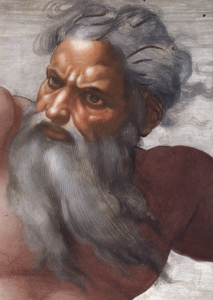
God as envisioned by MichelangeloRecently, following the tragedy in Newtown, Connecticut, a bunch of Christian “leaders” (Mike Huckabee, James Dobson, Bryan Fisher, to name a few) have basically said, “God has been taken out of the schools,” or “God has been taken out of our society,” or some variation on this theme. This, they say is, the reason the shooting at Sandy Hook Elementary School took place. Because of God’s supposed absence (voluntary on God’s part, it would seem) the horror took place. They seek to blame those who have “put God out,” but the way they make this argument really places the responsibility on God who apparently made the decision to stay away; either that or they are describing a God who is powerless in the face of some alleged official refusal to “allow God in” because our Constitution prohibits state-prescribed sectarian prayer in the schools.
Their alternative theory seems to be that because America now condones some sort of behavior to which these so-called “ministers” object (marriage equality, for example), or disallows some behavior they would champion (that state-sponsored school prayer, for example) God is punishing us. They seem to believe that God shares their judgement and is acting upon it . . . by killing children.

If any of this is true about God then I am in the class of fools who have said in their hearts, “There is no God” because I sure don’t believe in a God of the sort they seem to be describing.

But then, to be honest, I’m finding myself not believing in a lot of the Gods various people have described over the years. I read the atheist arguments of folks like scientist Richard Dawkins or the late journalist Christopher Hitchens; when I read their descriptions of God, I think “I don’t believe in that God, either.”

Recently, I’ve been thumbing through an old theology book, one that I think got me through my General Ordination Exam almost single-handedly (if that description can be applied to a book). It is Theological Outlines by Francis J. Hall (Morehouse-Barlow:1933). I found this description of God in the section on Divine Perfection:

By virtue of His infinite perfection, God is self-sufficient. Nothing is wanting to His essence which is needed for His blessedness. Neither His knowledge, nor His will, nor His love, depend upon the existence of the creature, but have sufficient scope for their activity in the eternal relations subsisting between the Persons of the Trinity. Creation is an act of the Divine will, not the result of necessity.

I read that and (guess what?) thought, “I don’t believe in that God!” I don’t believe in a God that has no need of God’s creation. I don’t believe in a God whose love has “sufficient scope for [its] activity” in God alone. The God I believe in wants to be in relationship with God’s creation! The God I believe in not only “looks down from heaven upon us all;” the God I believe in became one of us! The God I believe in was and is incarnate in Jesus Christ, lived in First Century Palestine, was crucified, died, was buried, and ascended to heaven, and yet is with us always, even to the end of the age. (Matt. 28:20) That is not a God in whom “nothing is wanting;” that is a God who wants to be with his creatures, with us!

That, I believe, is a God who wants to know, who lovingly hopes to know “if there is one who seeks after God.” That, I believe, is a God who, finding instead “ministers” like Huckabee who portray him as powerless or Dobson who make God into some kind of child-killing monster, finding atheists who make God into a caricature that no one actually accepts, finding theologians who describe God as some sort of theoretical philosophical construct with no needs, probably does conclude that “every one has proved faithless.”

Maybe as Christmas gets closer and Advent draws to an end, as we celebrate the birth of the God incarnate in Jesus, as we anticipate his return . . . maybe we could stop trying to define God and start trying to relate to God? Maybe we could turn our attention from describing God and instead simply try to do good? Let’s leave defining God up to God.

====================

A request to my readers: I’m trying to build the readership of this blog and I’d very much appreciate your help in doing so. If you find something here that is of value, please share it with others. If you are on Facebook, “like” the posts on your page so others can see them. If you are following me on Twitter, please “retweet” the notices of these meditations. If you have a blog of your own, please include mine in your links (a favor I will gladly reciprocate). Many thanks!

====================

Father Funston is the rector of St. Paul’s Episcopal Church, Medina, Ohio.

Advent Music, Advent Politics – From the Daily Office – December 18, 2012

From the Prophet Isaiah:

For a child has been born for us,
a son given to us;
authority rests upon his shoulders;
and he is named
Wonderful Counsellor, Mighty God,
Everlasting Father, Prince of Peace.
His authority shall grow continually,
and there shall be endless peace
for the throne of David and his kingdom.
He will establish and uphold it
with justice and with righteousness
from this time onwards and for evermore.
The zeal of the Lord of hosts will do this.

(From the Daily Office Lectionary – Isaiah 9:6-7 (NRSV) – December 18, 2012.)

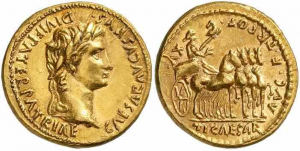
Roman Imperial CoinsI absolutely adore Handel’s Messiah. As a child in a non-church-going family (except during the summers when I lived with my Methodist grandparents), my introduction to these words from the Prophet Isaiah was through Handel’s music. My step-father, who had sung in high school choirs, would take me with him to community sing-alongs of the oratorio which churches in our area would offer during the Christmas holidays. Even now as I read these lines from Isaiah, I read them to music of Handel!

That’s a mistake. The beautiful notes of the oratorio mask the highly charged political nature of this prophecy and the titles by which the church has named Jesus of Nazareth. Two weeks ago on Sunday morning we read the evangelist Luke’s report of the ministry of John the Baptizer crying out in the wilderness. Luke tells us very specifically that it happened “in the fifteenth year of the reign of Emperor Tiberius, when Pontius Pilate was governor of Judea, and Herod was ruler of Galilee, and his brother Philip ruler of the region of Ituraea and Trachonitis, and Lysanias ruler of Abilene, during the high priesthood of Annas and Caiaphas . . . .” This grounds John in a specific place and time, a political place and time. The Nicene Creed does the same thing when it bids us to affirm as an article of faith that Jesus was “crucified under Pontius Pilate,” that his death took place within a specific political context, the hard and gritty reality of the Roman Empire.

When the first Christians used Isaiah’s prophetic titles as references to Jesus they were not making so much a religious or theological point as a political one. They were making a bold and provocative political declaration about the Roman emperors. The emperors claimed religious titles and expected to be worshiped. Coinage and documents from the reigns of both Augustus, Caesar at the time of Jesus’ birth, and Tiberius, Caesar when he was crucified, proclaim the emperors divine and give them such titles as Prince of Peace, Lord of Lords, King of Kings, Savior, and Son of God. The church’s transfer of these titles to Christ declared that the emperors’ claim was false, as false as the Roman Peace, the Pax Romana for which the emperors claimed credit.

The Pax Romana was, in fact, no peace at all! It was the conquering and occupation of non-Roman territories, as in Judea and Galilee. It was a state of constant warfare on the empire’s borders, as in Gaul and Britain. It was a sham. Giving Isaiah’s prophetic titles to Jesus was the early church’s way of making that clear. Declaring that Jesus would reign “from this time onwards and for evermore” was the church’s way of saying that the emperor would not!

As we prepare for Christmas, Advent’s call to calm reflection is as much a call to examine our politics as to examine our faith. As we prepare to welcome the Prince of Peace, the Lord of lords, the King of kings, Advent calls us to question the princes, the lords, the kings, the political leaders of our own time and place, at all points on the political spectrum, from Right to Left, Republican or Democrat, conservative or liberal. Do we have the courage of the early Christians to stand up to them, to declare that their “peace” is no peace and that their reign will not last?

Handel’s beautiful music can mask the political impact of Isaiah’s words, and all the music of the holiday season can lull us into complacency. But the message of Advent, even of the music of Advent, should remind us that our faith is not a fairy tale. Our faith is grounded in the hard and gritty reality of human politics.

====================

A request to my readers: I’m trying to build the readership of this blog and I’d very much appreciate your help in doing so. If you find something here that is of value, please share it with others. If you are on Facebook, “like” the posts on your page so others can see them. If you are following me on Twitter, please “retweet” the notices of these meditations. If you have a blog of your own, please include mine in your links (a favor I will gladly reciprocate). Many thanks!

====================

Father Funston is the rector of St. Paul’s Episcopal Church, Medina, Ohio.

Spiritual Fire Extinguisher? – From the Daily Office – December 17, 2012

From Luke’s Gospel:

Jesus came out and went, as was his custom, to the Mount of Olives; and the disciples followed him. When he reached the place, he said to them, “Pray that you may not come into the time of trial.” Then he withdrew from them about a stone’s throw, knelt down, and prayed, “Father, if you are willing, remove this cup from me; yet, not my will but yours be done.” Then an angel from heaven appeared to him and gave him strength. In his anguish he prayed more earnestly, and his sweat became like great drops of blood falling down on the ground. When he got up from prayer, he came to the disciples and found them sleeping because of grief, and he said to them, “Why are you sleeping? Get up and pray that you may not come into the time of trial.”

(From the Daily Office Lectionary – Luke 22:39-46 (NRSV) – December 17, 2012.)
 
Fire Extinguisher Use PosterWe are all, every American, still reeling from and trying to comprehend a tragedy. Twenty First Grade children, most age 6, and six teachers and school administrators were gunned down at an elementary school in Connecticut on Friday. There is not a person in this country, probably not a person in the world, who has not uttered some variation on “Father, if you are willing remove this cup . . . .” in the past 72 hours.
We would give anything to have those lives returned to us. But the cup was not to be taken from Jesus and the loss of those innocent lives will not be miraculously restored; the cup will not be removed.

And Christmas is still on the way. Today and tomorrow and the next I will be in my office preparing the liturgies of celebration. I will be reading the oh-so-familiar texts of Isaiah and Luke, contemplating what I might put into a sermon. I will be consulting with the staff musician about music for the Christmas Eve services and attending rehearsals of the choir and our brass ensemble. I will be in conversation with the altar guild director about flowers and vestments and the arrangement of the chancel for Christmas Eve. I will not be remembering or thinking about the children of Sandy Hook Elementary School.

I will, however, remember them and think deeply about them and their deaths at least twice each day for the foreseeable future. During these hours of disciplined prayer saying the Daily Offices of Matins and Vespers (Morning Prayer and Evening Prayer), reading the lessons of the daily lectionary, praying the Psalms; I cannot now foresee a day when they will not be remembered, as are the students at Columbine High School or Virginia Tech, or even those killed in the clock tower shootings at the University of Texas at Austin in 1966. (My late brother had been student at Austin and we were fearful that people we knew through him might have been among those shot.)

It is . . . perhaps “easy” is not the right word, but I can’t find the right word . . . to fall to our knees in prayer at times of crisis and I know of many who did, actually as well as metaphorically, in the past few days. Here in today’s gospel lesson, Jesus is doing the same. But prayer when we are desperate is empty and specious (and, frankly, dishonest) if it is not grounded in a disciplined habit of prayer . . . if we are not in the practice of spending time daily with God, in praise of God’s majesty, in thanksgiving for the blessings we have received, in petition for our everyday needs, in intercession for the needs of others. Prayer at a time of great distress, if it is not part of daily reverence, reduces God to nothing more than some sort of spiritual fire extinguisher, referred to in time of need, grabbed at in a moment of panic, expected to put out the blazing inferno of our trouble, but otherwise ignored.

I’m not suggesting that this would be true of God . . . but I think we all know what happens when fire extinguishers are ignored. The United States Fire Administration recommends an annual check to make sure that a fire extinguisher is not blocked by furniture, doorways, or any thing that might limit access in an emergency, that the pressure is at the recommended level, that all parts are operable and not damaged or restricted in any way, that hoses and nozzles are free of insects or debris, and that there are no any signs of damage or abuse, such as dents or rust, on the extinguisher. In the case of prayer and time with God, it’s not the “fire extinguisher” that needs to be checked, however, it’s the user, the pray-er. Are we blocked? Are we operating properly? Are we damaged by rust or abuse? Daily prayer checks these things and so much more.

Advent encourages us to develop, if we don’t already have, a custom of spending time with God every day. Advent teaches us to “get up and pray” every day. If we are not doing that, our prayer in time of crisis is simply grabbing at a spiritual fire extinguisher!

====================

A request to my readers: I’m trying to build the readership of this blog and I’d very much appreciate your help in doing so. If you find something here that is of value, please share it with others. If you are on Facebook, “like” the posts on your page so others can see them. If you are following me on Twitter, please “retweet” the notices of these meditations. If you have a blog of your own, please include mine in your links (a favor I will gladly reciprocate). Many thanks!

====================

Father Funston is the rector of St. Paul’s Episcopal Church, Medina, Ohio.

Good God, Do Easter! – From the Daily Office – December 16, 2012

From the Prophet Isaiah:

All hands will be feeble,
and every human heart will fail,
and they will be dismayed.
Pangs and agony will seize them;
they will be in anguish like a woman in labor.
They will look aghast at one another;
their faces will be aflame.

(From the Daily Office Lectionary – Isaiah 13:7-8 (NRSV) – December 16, 2012.)
 
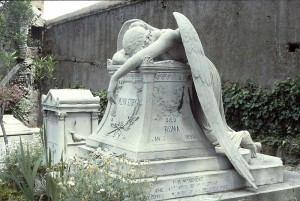
Angel of grief, a 1894 sculpture by William Wetmore StoryToday is the Third Sunday of Advent; in the tradition of the church it is known as Gaudete Sunday, Latin for “Rejoicing Sunday” so named because of the medieval introit to the Mass, “Gaudete in Domino semper: iterum dico, gaudete”, St. Paul’s words in the Letter to the Philippians, “Rejoice in the Lord always: again I say rejoice.” (4:4) (A reading from that very portion of Paul’s letter is this year’s epistle lesson for the Eucharist today; we will hear and consider those words at church this morning.)

But on Friday, at the Sandy Hook Elementary School in Newtown, Connecticut, twenty children and six of their teachers were gunned down by a 20-year-old man wielding two semi-automatic assault weapons. Before entering the school, if reports have been correct, he murdered his mother, and after killing the children, he shot himself. In the face of such insanity, how does one rejoice? Isaiah’s words of feebleness and failure, pangs and agony, anguish and faces aflame seem somehow so much more appropriate than Paul’s admonition to rejoice.

On Friday, following those tragic events, the Episcopal Peace Fellowship published this poem by Old Testament scholar Walter Brueggemann on its Facebook page. Entitled Grieving Our Lost Children, I offer it again here:

Another brutality,
another school killing,
another grief beyond telling . . .
and loss . . .
in Colorado,
in Wisconsin,
among the Amish
in Virginia.
Where next? (In Connecticut)

We are reduced to weeping silence,
even as we breed a violent culture,
even as we kill the sons and daughters of our “enemies,”
even as we fail to live and cherish and respect
the forgotten of our common life.

There is no joy among us as we empty our schoolhouses;
there is no health among us as we move in fear and bottomless anxiety;
there is little hope among us as we fall helpless before
the gunshot and the shriek and the blood and the panic: we pray to you only because we do not know what else to do.
So we pray, move powerfully in our body politic,
move us toward peaceableness
that does not want to hurt or to kill,
move us toward justice
that the troubled and the forgotten may know mercy,
move use toward forgiveness that we
may escape the trap of revenge.

Empower us to turn our weapons to acts of mercy,
to turn our missiles to gestures of friendship,
to turn our bombs to policies of reconciliation;
and while we are turning,
hear our sadness,
our loss,
our bitterness.

We dare to pray our needfulness to you because you have been there on that
gray Friday,
and watched your own Son be murdered
for “reasons of state.”

Good God, do Easter!
Here and among these families,
here and in all our places of brutality.

Move our Easter grief now . . .
without too much innocence –
to your Sunday joy.
We pray in the one crucified and risen
who is our Lord and Savior.

Good God, do Easter! It may be Advent. We may be getting ready for Christmas. But our hands are feeble; our hearts will fail; we are dismayed; our faces are aflame. Please God, do Easter!

====================

A request to my readers: I’m trying to build the readership of this blog and I’d very much appreciate your help in doing so. If you find something here that is of value, please share it with others. If you are on Facebook, “like” the posts on your page so others can see them. If you are following me on Twitter, please “retweet” the notices of these meditations. If you have a blog of your own, please include mine in your links (a favor I will gladly reciprocate). Many thanks!

====================

Father Funston is the rector of St. Paul’s Episcopal Church, Medina, Ohio.

Christmas Shopping with Peter – From the Daily Office – December 15, 2012

The following meditation was prepared before the news of yesterday’s tragic events in Newtown, Connecticut. I pray for the repose of the souls of all those who died and for comfort for their families, and I pray that this nation will come to its senses and enact reasonable and effective gun control legislation.

====================

From Luke’s Gospel:

Jesus said, “Simon, Simon, listen! Satan has demanded to sift all of you like wheat, but I have prayed for you that your own faith may not fail; and you, when once you have turned back, strengthen your brothers.” And he said to him, “Lord, I am ready to go with you to prison and to death!” Jesus said, “I tell you, Peter, the cock will not crow this day, until you have denied three times that you know me.”

(From the Daily Office Lectionary – Luke 22:21-24 (NRSV) – December 15, 2012.)
 
Holiday Shopping at the MallThis is the part of the Maundy Thursday – Good Friday story that breaks my heart! I so identify with Peter; he’s such a bumbling fool on so many occasions and Jesus just keeps on holding him close, knowing that eventually he will pull through. I know that I would have done no better than Peter in those dark hours of Thursday night. I might not even have done as well as he did; I’m not sure I’d have had the courage to follow Jesus into the high priest’s courtyard!

And now, during this season of Advent, do I do any better? The world around us is going mad with consumption. The malls are filled with shoppers buying garbage to give to people they probably don’t really like who probably don’t really want what they are buying and will probably return it or “regift” it. And I’m right out there with them – although so far I haven’t bought anything. I can’t, for the life of me, figure out what my wife or kids or friends would want to receive from me as a gift. Can I just tell them I love them and leave it at that? Can I just tell Jesus that?

I don’t. I go to the shopping centers and try to find that perfect gift for each family member; I seldom do and often end up getting nothing for anyone and feeling guilty about that in the end. Meanwhile, I melt into the crowd and wander the mall and drive the crowded streets and, just like Peter, I look like one of them. I emulate Peter and do not open my mouth. His accent gave him away as a Galilean — I might inadvertently hold forth with the cadences of the Book of Common Prayer or make some reference to orthodox theology and give myself away as a Christian, a follower of Jesus rather than a minion of Santa Claus. By my failure to say “Enough!” and fight against the commercial Christmas consumption madness, the avalanche of advertising that has annihilated Advent, I have denied Christ many more times than Peter ever did.

But I know what Peter did not yet know, that even my denial will not separate me from my Lord, that even shamed by my denial as I am, I can return to him and I will be received, welcomed, forgiven. And so today, after a Saturday of shopping surrounded by the crass commercialism of secular Christmas, blinded by holiday lights, deafened by the roar of the shopping crowd and the public address systems blaring Winter Wonderland, a Saturday spent joining Peter in silence and denial, I am still able to pray the evening Psalm –

Send out your light and your truth, that they may lead me,
and bring me to your holy hill and to your dwelling;
That I may go to the altar of God, to the God of my joy and gladness;
and on the harp I will give thanks to you, O God my God.

====================

A request to my readers: I’m trying to build the readership of this blog and I’d very much appreciate your help in doing so. If you find something here that is of value, please share it with others. If you are on Facebook, “like” the posts on your page so others can see them. If you are following me on Twitter, please “retweet” the notices of these meditations. If you have a blog of your own, please include mine in your links (a favor I will gladly reciprocate). Many thanks!

====================

Father Funston is the rector of St. Paul’s Episcopal Church, Medina, Ohio.

You Know, Sweetie, Jesus Did Grow Up – From the Daily Office – December 14, 2012

From Luke’s Gospel:

When the hour came, Jesus took his place at the table, and the apostles with him. He said to them, “I have eagerly desired to eat this Passover with you before I suffer; for I tell you, I will not eat it until it is fulfilled in the kingdom of God.” Then he took a cup, and after giving thanks he said, “Take this and divide it among yourselves; for I tell you that from now on I will not drink of the fruit of the vine until the kingdom of God comes.” Then he took a loaf of bread, and when he had given thanks, he broke it and gave it to them, saying, “This is my body, which is given for you. Do this in remembrance of me.” And he did the same with the cup after supper, saying, “This cup that is poured out for you is the new covenant in my blood.”

(From the Daily Office Lectionary – Luke 22:14-20 (NRSV) – December 14, 2012.)
 
Talladega Nights: The Ballad of Ricky Bobby Prayer SceneIn ten days we will begin our celebration of his birth, but the Daily Office lectionary today has us consider his last meal on the night before his death . . . .

When our son was born, my wife and I designed our own announcements. On the front we put a quotation from poet Carl Sandburg’s only novel: “A baby is God’s opinion that life should go on.” The birth of a baby is a marvelous event, a hopeful one, an occurrence that focuses on the future. During Advent the secular commercial world, buying into a certain sentimental spirituality, when it isn’t focused on the legend of Santa Claus, constantly reminds us that we are getting ready to celebrate the birth of a cherubic, rosy-cheeked baby. For some, it is difficult to move beyond that icon of hopefulness, that image of God’s opinion of continuation.

In the movie Talladega Nights: The Ballad of Ricky Bobby, the title character, played by Will Ferrell, is one of those. When the family gathers for a Thanksgiving meal, he offers a grace addressed to the Christmas cherub and a conversation ensues:

Ricky Bobby: Dear Lord baby Jesus, we thank you so much for this bountiful harvest of Domino’s, KFC, and the always delicious Taco Bell. I just want to take time to say “Thank you” for my family – my two sons, Walker, and Texas Ranger, or TR as we call him. And of course my red-hot smokin’ wife Carley, who is a stone cold fox. Dear tiny infant Jesus…

Carley Bobby: Hey, um… you know, Sweetie, Jesus did grow up. You don’t always have to call him “baby”. It’s a bit odd and off-puttin’ to pray to a baby.

Ricky Bobby: Well look, I like the Christmas Jesus best, and I’m sayin’ grace. When you say grace, you can say it to grown-up Jesus, or teenage Jesus, or bearded Jesus, or whatever you want.

Today’s gospel lesson reminds us, in the midst of our Christmas preparations, “You know, Sweetie, Jesus did grow up.” He lived the life of an itinerant preacher; he challenged the authorities; he was crucified; he died; he was buried; he rose from the dead; he ascended into heaven. On the night before he died, he had this meal with his friends. In her book The Spirituality of Bread (Northstone:2007, p. 146), Donna Sinclair writes, “The re-enactment of Jesus’ last conversation with his friends says that those who share a meal with the compassionate one can become just and brave agents of healing. Such bread offers the hope of human change. That’s why, over and over, I form a circle with my friends and say the words, ‘The bread of new life . . .'”

Advent prepares us to witness once again that baby whose birth was God’s opinion that not only should life go on, it should be redeemed. Advent prepares us for the return of the One who grew up and gave himself that life might be changed.

====================

A request to my readers: I’m trying to build the readership of this blog and I’d very much appreciate your help in doing so. If you find something here that is of value, please share it with others. If you are on Facebook, “like” the posts on your page so others can see them. If you are following me on Twitter, please “retweet” the notices of these meditations. If you have a blog of your own, please include mine in your links (a favor I will gladly reciprocate). Many thanks!

====================

Father Funston is the rector of St. Paul’s Episcopal Church, Medina, Ohio.

« Older posts Newer posts »