Occasional thoughts of an Anglican Episcopal priest

Category: Daily Office (Page 51 of 70)

Putting God to the Test – From the Daily Office – November 23, 2012

From the Prophet Malachi:

Will anyone rob God? Yet you are robbing me! But you say, “How are we robbing you?” In your tithes and offerings! You are cursed with a curse, for you are robbing me – the whole nation of you! Bring the full tithe into the storehouse, so that there may be food in my house, and thus put me to the test, says the Lord of hosts; see if I will not open the windows of heaven for you and pour down for you an overflowing blessing.

(From the Daily Office Lectionary – Malachi 3:8-10 (NRSV) – November 23, 2012)
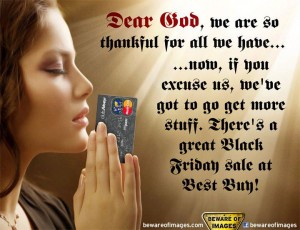
 
Dear God Black Friday memeThis “test me and see” verse is a favorite of preachers of the so-called “prosperity gospel” (of course, it’s not from a gospel, but that doesn’t seem to bother them). To have it turn up in the Daily Office readings the day after the United States celebrated Thanksgiving Day is a real eye-opener! On Face Book this morning, a humorous “meme”* showed up picturing a young woman at prayer holding a credit card with this caption: “Dear God, we are so thankful for all we have . . . now, if you excuse us, we’ve got to go get more stuff. There’s a great Black Friday sale at Best Buy!” Could there have been a better juxtaposition?

Malachi says pretty bluntly that we are robbing God. Stealing from God is not something to be taken lightly. Many preachers cite this text about robbing God in the context of stewardship sermons. We rob God, they say, when we deny God what is rightfully God’s. We rob God, they say, when we fail to tithe, to make an offering of 1/10, or 10%, of our income. But it seems to me Malachi is more concerned about attitude than with particular actions like paying or not paying the biblical tithe.

Essentially, it comes down to our attitude about who owns what. If we believe (as most Americans seem to) that we have earned all we have, that we are entirely responsible for our prosperity, then we will have an ungenerous attitude toward everyone, including God. If we take a step back and realize that God is responsible for our well-being, we are more likely to be generous. The question is, “Who owns my possessions, bank account, and even my life?” To whom are we truly thankful for what we have?

Jesus told a story about a rich man who had a lot of stuff, so much stuff that he had to build a bigger barn for it all. When he had built the barn and stored the stuff, he sat back content. But just then God said to him, “You fool! This very night your life is being demanded of you. And the things you have prepared, whose will they be?” (Luke 12:20) Jesus’ point (and Malachi’s) is that we have no control over our possessions, our money, or our life. Anything and everything may be lost at any time. The truth is that we don’t own anything, not even ourselves. God owns it all.

When we fail to use it to benefit others around us, when we fail to hold it in trust for God with the proper attitude of generosity, we rob God. If, on the other hand, we use what we have to do what good we can, if we have an attitude of gratitude (the one we claimed we had yesterday), we will benefit as much as if not more than those around us. “Put me to the test and see,” says God.

So, today, what’s it to be? Rush off to the Black Friday sales putting Thanksgiving behind us, or rather making thanksgiving a way of life, not just a day on the calendar? Either way, we put God to the test . . . .

*An internet meme is a concept that spreads via the internet often taking the form of a captioned image.

====================

A request to my readers: I’m trying to build the readership of this blog and I’d very much appreciate your help in doing so. If you find something here that is of value, please share it with others. If you are on Facebook, “like” the posts on your page so others can see them. If you are following me on Twitter, please “retweet” the notices of these meditations. If you have a blog of your own, please include mine in your links (a favor I will gladly reciprocate). Many thanks!

====================

Father Funston is the rector of St. Paul’s Episcopal Church, Medina, Ohio.

A Sober Thanksgiving Reminder – From the Daily Office – November 22, 2012

From the Letter of James:

Come now, you rich people, weep and wail for the miseries that are coming to you. Your riches have rotted, and your clothes are moth-eaten. Your gold and silver have rusted, and their rust will be evidence against you, and it will eat your flesh like fire. You have laid up treasure for the last days. Listen! The wages of the laborers who mowed your fields, which you kept back by fraud, cry out, and the cries of the harvesters have reached the ears of the Lord of hosts. You have lived on the earth in luxury and in pleasure; you have fattened your hearts on a day of slaughter.

(From the Daily Office Lectionary – James 5:1-5 (NRSV) – November 22, 2012)
 
Thanksgiving CornucopiaIt may be the United States’ holiday of Thanksgiving Day, but the Daily Office continues at this time of year delivering its message of repentance rather than encouraging thanksgiving. The Old Testament lesson is another from Malachi in which the Lord speaking to the priests says that he has spread dung on their faces and put them out of his presence! The gospel lesson from Luke has Jesus predicting the end of the world. And then there’s this epistle lesson which condemns the wealthy. Just not a lot of giving thanks!

On the other hand, Jame’s warning about the dangers of wealth is perhaps a fitting counterpoint to the day. During the past several days, the international news services to which I subscribe on the internet have shown pictures not seen on American television or in the US papers, pictures of dead Palestinian children stacked like so much cordwood in makeshift morgues, pictures of children in temporary hospitals missing legs and arms. My throat kept constricting and my tears kept flowing, and in the back of my mind I kept hearing a phrase my step-father often used – “And here we sit – fat, dumb, and happy.”

The President of Egypt and the American Secretary of State have, the news reports, brokered a ceasefire. It’s not peace, but at least the shelling and the missile launches have stopped. At least the 75,000 Israeli reservists activated by their government will not be leaving their families and marching into Gaza. For that we can and surely should be thankful.

I don’t mean to put a damper on the day, and the lectionary pointing us to James’s letter and the other lessons today is simply coincidence. But they are a reminder to pause in the midst of our family gatherings, to eschew being “fat, dumb, and happy,” and to think of things for which we should be truly thankful – love, peace, family, friends – not merely the stuff we possess – the riches, the clothes, the gold, the silver. A sober reminder to pause yet again and “pray for the peace of Jerusalem.” (Ps. 122:6)

====================

A request to my readers: I’m trying to build the readership of this blog and I’d very much appreciate your help in doing so. If you find something here that is of value, please share it with others. If you are on Facebook, “like” the posts on your page so others can see them. If you are following me on Twitter, please “retweet” the notices of these meditations. If you have a blog of your own, please include mine in your links (a favor I will gladly reciprocate). Many thanks!

====================

Father Funston is the rector of St. Paul’s Episcopal Church, Medina, Ohio.

Cheesy Tuna Surprise – From the Daily Office – November 21, 2012

From the Prophet Malachi:

A son honors his father, and servants their master. If then I am a father, where is the honor due to me? And if I am a master, where is the respect due to me? says the Lord of hosts to you, O priests, who despise my name. You say, “How have we despised your name?” By offering polluted food on my altar. And you say, “How have we polluted it?” By thinking that the Lord’s table may be despised. When you offer blind animals in sacrifice, is that not wrong? And when you offer those that are lame or sick, is that not wrong? Try presenting that to your governor; will he be pleased with you or show you favor? says the Lord of hosts.

(From the Daily Office Lectionary – Malachi 1:6-8 (NRSV) – November 21, 2012)
 
Wilted Flower ArrangementSeveral years ago I served in a small parish which had a very tight budget. Among its many cost-saving efforts was the reuse of altar flowers. Arrangements would be purchased and used on one Sunday, then quickly put away in the refrigerator in the basement kitchen to be used again the next week. Of course, they didn’t last as well as they might have been wished to (and some varieties of flower fared worse than others), so it was noticeable that they’d been around for awhile. In addition, if there’d been any sort of parish dinner in the interim so that food had been stored in the same refrigerator, they would often have taken on a bit of the odor of fried chicken or garlic or cheesy tuna surprise.
After holding my peace about this my first few weeks, I suggested to one of the older altar guild members, a woman about my mother’s age, a child of the depression, that it seemed to me that putting reused flowers at the altar was rather like offering a blemished cow. She looked at me with an expression that was both dumbfounded and angry – an interesting look to be sure. I explained the proscription of Jewish law against the offering for sacrifice of an animal that was defective in any way (see, e.g., Leviticus Ch. 3-5). She didn’t see the parallel but, because (as it turned out) she was the one who had come up with this money-saving scheme, she was fairly convinced the new priest in the parish was defective. Nonetheless, I held my ground and exercised my role as chief liturgist and insisted that if we were going to have flowers, they were going to be fresh. Better to have no flowers than a floral offering that was second-rate (and much better than flowers that smelled of cheesy tuna surprise).

We often run into this in the church, the giving of the less-than-good. Church youth group rooms and lounges are furnished with hand-me-down, out-of-fashion, and often badly worn furniture from someone’s recently redecorated home (or from someone’s recently deceased parent’s home). Clothing-for-the-poor drives amass large piles of worn out sport coats, scuffed shoes, and long out-of-date bell-bottom trousers. Recently, a box of food donated to our church’s food pantry ministry included a box of cereal that had been opened and partially consumed; I guess the donor had decided he or she didn’t like blueberry crunch whole grain healthfood breakfast food. We seem to have forgotten that the Bible commends the giving of unblemished offerings.

I’ve learned that if one challenges these less-than-perfect gifts the nearly universal justification for giving them is “Beggars can’t be choosers.” That may be true, but givers certainly can be! We who give can choose to give the very best, not our worn-out, cast-off hand-me-downs. The laws of the Old Testament, including these rules about blemished gifts, are meant to teach us to choose to do and to give that which is our best. The several Jewish laws, it is said, are where faithfulness to God is translated into action. When we strive to do our best to follow the ways revealed in Scripture, God’s words and God’s Word are etched into our hearts and become an intimate part of our identity, whether we are Jewish or Christian.

Since 1944, Hallmark Cards has used the sales pitch and slogan, “When you care enough to send the very best . . . . ” That’s what the rules concerning sacrifice of unblemished offerings are all about. They ask us whether we care enough to give the very best. What we give is a reflection of who we are. Are we people on whose hearts the Word of God is indellibly etched? Are we people for whom the Word of God is an intimate part of our identity? Do we stand, as our offering should stand, unblemished before God?

Or are we defective, or sick, or lame, or polluted . . . like last week’s flowers smelling of cheesy tuna surprise?

====================

A request to my readers: I’m trying to build the readership of this blog and I’d very much appreciate your help in doing so. If you find something here that is of value, please share it with others. If you are on Facebook, “like” the posts on your page so others can see them. If you are following me on Twitter, please “retweet” the notices of these meditations. If you have a blog of your own, please include mine in your links (a favor I will gladly reciprocate). Many thanks!

====================

Father Funston is the rector of St. Paul’s Episcopal Church, Medina, Ohio.

Faith in the Face of Nothing – From the Daily Office – November 20, 2012

From the Prophet Habakkuk:

Though the fig tree does not blossom,
and no fruit is on the vines;
though the produce of the olive fails
and the fields yield no food;
though the flock is cut off from the fold
and there is no herd in the stalls,
yet I will rejoice in the Lord;
will exult in the God of my salvation.

(From the Daily Office Lectionary – Habakkuk 3:17-18 (NRSV) – November 20, 2012)
 
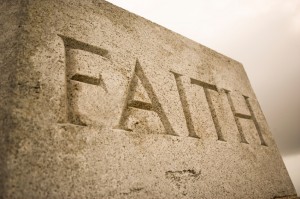
"Faith" Inscribed on a Granite BlockGiving thanks at a time privation, that’s what these two verses from Habakkuk’s prophecy are about. Habakkuk describes a situation in which he (and all the people of Jerusalem) have lost everything. Just look at what he lists in verse 17: figs, grapes, and olives, the year-round fruit crops of the area; the fields, which is to say the annual crops, the grains and staple foods; flock and herd, which means sheep and cows. All their their produce is gone, all their livestock are dead.

This is a society utterly destroyed. Habakkuk’s situation is worse than anything we can imagine in our time and place. In Habakkuk’s time, there was no “safety net”, no social service agencies, no homeless shelters, no food stamps, no church food pantries, no well-off relatives (everyone is suffering the loss of the crops and livestock). For Habakkuk and his kindred, this all means starvation. It means death. None of us, I’m sure, has ever been in quite the situation Habakkuk experiences, though I do know that many have, for example, faced death their own possible in the form of cancer or of battlefield danger, and others have handled the death of loved ones.

Nonetheless, in face of the virtual certainty of destruction, Habakkuk can say, “I will rejoice in God; I will give thanks to my Lord.” It is easy to give thanks and rejoice when we have things; Habakkuk does so when he has nothing. I think we sometimes confuse thankfulness for the things we receive from God for faith in God God’s-self. Habakkuk has no things to be thankful for; it is in God’s self that Habakkuk rejoices. It is in God, not God’s gifts that Habakkuk trusts. This is more than gratitude for stuff. This is more than optimism and positive thinking. This is faith.
====================

A request to my readers: I’m trying to build the readership of this blog and I’d very much appreciate your help in doing so. If you find something here that is of value, please share it with others. If you are on Facebook, “like” the posts on your page so others can see them. If you are following me on Twitter, please “retweet” the notices of these meditations. If you have a blog of your own, please include mine in your links (a favor I will gladly reciprocate). Many thanks!

====================

Father Funston is the rector of St. Paul’s Episcopal Church, Medina, Ohio.

Vision and Salt – From the Daily Office – November 19, 2012

From the Prophet Habakkuk:

The Lord answered me and said:
Write the vision;
make it plain on tablets,
so that a runner may read it.
For there is still a vision for the appointed time;
it speaks of the end, and does not lie.

(From the Daily Office Lectionary – Habakkuk 2:2-3a (NRSV) – November 19, 2012)
 
Vision Road SignThere are two passages of Scripture that I always think of when vestries or other church governing boards begin to discuss a vision for the church’s mission and ministry. One is the King James version of Proverbs 29:18a – “Where there is no vision, the people perish.” – the other is this passage from Habakkuk. I really like the image of the vision being written so large that someone running by can read it and make sense of it; the church’s vision needs to be as big, expansive, and attention-getting as a billboard.

To catch a fish, one must cast one’s line into the water in a manner that will attract the fish. To lead and perform an effective ministry, the church and its leadership must cast a vision of the future far and wide – write it large – in such a way as to attract and retain members and co-ministers who will see that vision through, buy into it, act upon it, make it a reality. Vision casting in the church means discerning God’s purpose for the church or program and then making it known. Vision, as Habakkuk makes clear, must be presented in a way that motivates, inspires, and encourages; the people rushing by, running to and fro attending to the demands of daily life, need to catch the vision and really believe in it.

The process is not easy, but it is necessary. In the absence of vision, as the verse from Proverbs says, the people perish. The parish perishes. I’m reading a book about church administration in which the author makes the point that a congregation needs direction, a vibrant energetic center of action and service to give the congregation its particular and peculiar identity. Without that God’s people are, as God’s Son said, like salt that has lost its savor.

Write God’s vision as big as a billboard! Without it, the church will founder and die; without it, the church is good for nothing but trampling under foot like unusable salt.

====================

A request to my readers: I’m trying to build the readership of this blog and I’d very much appreciate your help in doing so. If you find something here that is of value, please share it with others. If you are on Facebook, “like” the posts on your page so others can see them. If you are following me on Twitter, please “retweet” the notices of these meditations. If you have a blog of your own, please include mine in your links (a favor I will gladly reciprocate). Many thanks!

====================

Father Funston is the rector of St. Paul’s Episcopal Church, Medina, Ohio.

The Valley of Decision – From the Daily Office – November 17, 2012

From the Book of Joel:

Multitudes, multitudes,
in the valley of decision!
For the day of the Lord is near
in the valley of decision.

(From the Daily Office Lectionary – Joel 3:14 – November 17, 2012)
 
Desert HikingThe “valley of decision” is probably another name for the Valley of Jehoshaphat referred to in an earlier verse of this chapter of the Prophet Joel. Jehoshaphat (a Hebrew name pronounced “yeh-hoh-shah-faht”) is a compound word of two other Hebrew terms, Yahweh (one of the names of God) and shaphat (meaning “to judge” or “to decide”). Jehoshaphat, therefore, means “God will judge” or “God will decide”. Geographically, the valley of Jehoshaphat, the valley of decision, lies between the city of Jerusalem and the Mount of Olives.
It seems to me that the image, “the valley of decision,” makes a marvelous metaphor for the whole process of making judgments in life. We speak of “mountain-top experiences” to describe those “Aha! moments” when insight or revelation comes upon us suddenly; the metaphor of passing through a valley seems an apt image for the alternative of the mundane decision-making in which every person engages every day.

How do people make decisions? How do we sift through piles of information without being overwhelmed by the plethora of alternatives? What are the factors that lead us in a certain direction? As I pondered the image of the “valley of decision,” I recalled my college days when a weekend away with friends usually meant a back-packing foray into the Anza-Borrego Desert east of San Diego or the Agua Tibia Wilderness Area northeast of the city. Often these hiking excursions took us to places where few human beings had walked before; we had compasses and topological maps to guide us, but often there was no trail picked out by earlier hikers. We had to forge the trail ourselves. Often we found ourselves at the top of a hill overlooking a desert valley with no clear path. “How are we going to get down there?” was a frequent question.

Years after those college-day hikes, I went to graduate school and received a Master of Business Administration degree from the University of Nevada. Among the things we studied (and supposedly learned) were the steps of management decision-making. The decision-making process, we were taught, involves the following steps:

  1. Define the problem.
  2. Identify limiting factors.
  3. Develop potential alternatives.
  4. Analyze the alternatives.
  5. Select the best alternative.
  6. Implement the decision.
  7. Establish a control and evaluation system.

Standing at the top of a hill in the middle of the desert carrying a 50-pound pack at the end of a day of hiking, one does not stop to engage in that formal a process! Making our way downhill into the valley did mean carefully considering the path not only as a way down, but also as a potential exit route since we had no idea what we might find below or on the other side. However, we had to get down the hill and did so by making small, individual choices as we took each step down into the valley.

When we make big decisions, we do not have infinite resources and we frequently do not have a lot of time to gather information and analyze data. Furthermore, we human beings are significantly limited in the amount of complexity with which we can cope. So even though we may try to make decisions on the basis of some formal, rational process, we often resort to simplifying assumptions; we accept that our information is limited; and we settle for a less-than-thorough analysis of available data. We constantly use simplifying and confidence-sustaining mental short cuts that psychologists call “heuristics”; these reduce the complexity of our decision making. They are like the small individual choices we hikers made step-by-step going down into those desert valleys.

When we reached the bottom of the hill, when we were down in the valley, we had answered the question, “How are we going to get down there?” We had entered into and reached the bottom of our “valley of decision,” made the decision, not in one grand effort of rational analysis and pre-planning following the logical steps of that graduate school management class, but simply by taking a series of small steps.

Life is like that. There are very few mountain-top “Aha!” experiences. There are a lot of valleys of decision and not a few steep hills of decision, as well. We go through life taking small steps down into valleys and up onto hills, reaching decisions we may not even realize we are making. Everybody does it! Multitudes, multitudes are in the valley of decision every day.

====================

A request to my readers: I’m trying to build the readership of this blog and I’d very much appreciate your help in doing so. If you find something here that is of value, please share it with others. If you are on Facebook, “like” the posts on your page so others can see them. If you are following me on Twitter, please “retweet” the notices of these meditations. If you have a blog of your own, please include mine in your links (a favor I will gladly reciprocate). Many thanks!

====================

Father Funston is the rector of St. Paul’s Episcopal Church, Medina, Ohio.

Doubt and Double-Mindedness – From the Daily Office – November 15, 2012

From the Letter of James:

If any of you is lacking in wisdom, ask God, who gives to all generously and ungrudgingly, and it will be given you. But ask in faith, never doubting, for the one who doubts is like a wave of the sea, driven and tossed by the wind; for the doubter, being double-minded and unstable in every way, must not expect to receive anything from the Lord.

(From the Daily Office Lectionary – James 1:5-8 – November 15, 2012)
 
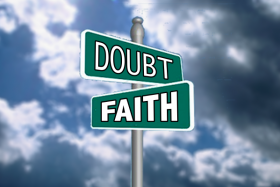
Road Signs at the Crossroads of Faith and DoubtI suppose I take issue with Scripture more often than I should, but this is one of those bits that I just can’t agree with. I vehemently disagree with James’s equation of “doubt” with what he calls “double-mindedness”. The Greek word translated “double-minded” is dipsuchos , from dis , meaning “twice,” and psuche , meaning “mind.” James use of it to describe someone who has doubts suggests that such a person is divided in his or her interests or loyalties, wavering, two-faced, and half-hearted.
When I think of those “qualities”, I think of hypocrisy, not doubt. That’s another Greek word. In the Greek theater, actors would speak (krinomai) from behind a mask (hypo). Together the Greek words for speak and mask form hupokrisis; from that we get our word “hypocrisy”. The dictionary defines “hypocrisy” thusly: “a pretense of having a virtuous character, moral or religious beliefs or principles, etc., that one does not really possess.” The thesaurus lists these synonyms: “affectation, bad faith, bigotry, cant, casuistry, deceit, deception, dishonesty, display, dissembling, dissimulation, double-dealing, duplicity, false profession, falsity, fraud, glibness, imposture, insincerity, irreverence, lie, lip service, mockery, pharisaicalness, pharisaism, phoniness, pietism, quackery, sanctimoniousness, sanctimony, speciousness, unctuousness.” This is all very different from doubt.

To doubt, says the dictionary, is “to be uncertain about; consider questionable or unlikely; hesitate to believe.” Doubt is an honest state of uncertainty, not the dishonest state of double-minded divided loyalties, not the hypocritical state of two-facedness. Unfortunately, James equation of doubt with “double-mindedness” and his contrast of doubt with faith (like the post-Resurrection story of “doubting Thomas”) unnecessarily villifies those who have legitimate questions, those who hestitate to believe because of genuine uncertainty.

But faith and doubt are not opposites! The current Pope once wrote a book entitled Introduction to Christianity in which, using a stageplay about a shipwrecked priest as a metaphor, he took up the question of belief, faith, and doubt. He wrote:

Just as the believer does not live immune to doubt but is always threatened by the plunge into the void, so now we can discern the entangled nature of human destinies and say that the nonbeliever does not lead a sealed-off, self-sufficient life either . . . Just as the believer is choked by the salt water of doubt constantly washed into his mouth by the ocean of uncertainty, so the nonbeliever is troubled by doubts about his unbelief, about the real totality of the world he has made up his mind to explain as a self-contained whole.

Faith is the decision to believe in the face of doubt. The atheist would say that religious faith is the choice to believe something for which there is no evidence; the believer would say that refusal to believe in God is itself a faith based on ignoring evidence. Both must admit that their belief or unbelief is subject to uncertainty. This is not double-mindedness. It is intellectual and spiritual honesty.

Faith and doubt are not opposites; they go hand in hand with one another. The very nature of faith requires that we acknowledge doubt, that we acknowledge that we believe with less than 100 percent certainty. We all wrestle with the challenges, questions, and blessings of life; faith in the midst of doubt and doubt examining faith are simply part of that struggle.

====================

A request to my readers: I’m trying to build the readership of this blog and I’d very much appreciate your help in doing so. If you find something here that is of value, please share it with others. If you are on Facebook, “like” the posts on your page so others can see them. If you are following me on Twitter, please “retweet” the notices of these meditations. If you have a blog of your own, please include mine in your links (a favor I will gladly reciprocate). Many thanks!

====================

Father Funston is the rector of St. Paul’s Episcopal Church, Medina, Ohio.

The Future of Sheep & Coins – From the Daily Office – November 14, 2012

From the Gospel of Luke:

Jesus told a parable: “What woman having ten silver coins, if she loses one of them, does not light a lamp, sweep the house, and search carefully until she finds it? When she has found it, she calls together her friends and neighbours, saying, ‘Rejoice with me, for I have found the coin that I had lost.’ Just so, I tell you, there is joy in the presence of the angels of God over one sinner who repents.”

(From the Daily Office Lectionary – Luke 15:8-10 – November 14, 2012)
 
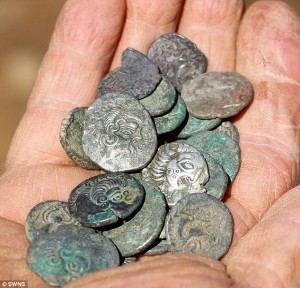
A Handful of Ancient CoinsThis story of the woman seeking her lost coin follows on the heels of the parable of the lost sheep in which the shepherd leaves the ninety-nine to seek the lost one. That story is much more familiar and, I suppose, is more popular because of romantic notions of some emotional bond between sheep and shepherd, supported no doubt by those lovely Sunday School images of Jesus carrying a lamb on his shoulders. As we modern (and now post-modern) 21st Century urban Christians have moved further and further from agrarian reality, those romantic misconceptions deepen and the less-palatable aspects of the parable’s metaphor are forgotten.

Sheep are not the shepherd’s beloved pets! He is not going to take the animal into his home (unless, perhaps, it is sick and needs to be nursed back to health). He is going to use the animal for his (or his employer’s) economic gain. At best, the sheep will be fleeced and/or milked on a regular basis. It will be bred and its lambs will be taken from it to be slaughtered for food, sold in the markets for profit. At the worst, it will find itself slaughtered, its meat sold as mutton, its hide used for leather. Surely these aspects of the sheep-shepherd relationship are outside the scope of Jesus’ metaphor; he did not mean us to see in them an analogy to the human-God relationship! And yet, there they are, background to the parable, limiting its scope and possibly confusing our understanding.

The parable of the woman seeking the lost coin is much more open ended, much richer in possibilities. Where the shepherd’s sheep have their limited future, the woman’s coins have a future that is wide open. What might she do with them? Anything! Taken to the marketplace, they could be spent with any vendor, purchase any product, follow any path of commerce. And the vendor then can similarly pass the coin on to any of a variety of other vendors, and so on into the future. Stretching before the coin I see a future filled with the branches of an unlimited decision tree, filled with unlimited possibilities, not unlike the myriad futures and alternative realities of quantum mechanics and superstring theory!

For the sheep . . . the future is fleecing and possibly slaughter. For the coin . . .the future is the multiverse! Of course, neither sheep nor coin has any say in what their future may be. As human co-creators with God, we do. Neither the sheep nor the coin has any choice in whether to cooperate with the shepherd or the woman. As human co-creators with God, we do. But like the sheep, we are not as knowledgeable as the shepherd; like the coin, we are not as wise as the woman. So like both, we must trust in the wiser, more knowledgeable Lord who saves us. A prayer in The Book of Common Prayer speaks of this; when I think of the future faced by either sheep or coin, I think of this prayer:

Almighty and eternal God, so draw our hearts to thee, so guide our minds, so fill our imaginations, so control our wills, that we may be wholly thine, utterly dedicated unto thee; and then use us, we pray thee, as thou wilt, and always to thy glory and the welfare of thy people; through our Lord and Savior Jesus Christ. Amen. (BCP 1979, Prayer 61, “Of Self-Dedication,” page 832)

====================

A request to my readers: I’m trying to build the readership of this blog and I’d very much appreciate your help in doing so. If you find something here that is of value, please share it with others. If you are on Facebook, “like” the posts on your page so others can see them. If you are following me on Twitter, please “retweet” the notices of these meditations. If you have a blog of your own, please include mine in your links (a favor I will gladly reciprocate). Many thanks!

====================

Father Funston is the rector of St. Paul’s Episcopal Church, Medina, Ohio.

Cooperating with Angels – From the Daily Office – November 13, 2012

From the Book of Revelation:

The angel said to me, “Write this: Blessed are those who are invited to the marriage supper of the Lamb.” And he said to me, “These are true words of God.” Then I fell down at his feet to worship him, but he said to me, “You must not do that! I am a fellow-servant with you and your comrades who hold the testimony of Jesus. Worship God! For the testimony of Jesus is the spirit of prophecy.”

(From the Daily Office Lectionary – Revelation 19:9-10 – November 13, 2012)
 
The Annunciation, fresco by Fra AngelicoPerhaps among the most familiar words from St. John’s apocalypse, “Blessed are they who are invited to the marriage feast of the Lamb.” They are used as a fraction anthem or invitation to communion in many churches. But in this brief passage from Revelation, the most powerful image for me today is the angel saying, “I am a fellow-servant with you and your brothers and sisters.”
All too often, I think, we go through our daily lives with no an awareness of, nor gratitude for the work of the holy angels in our midst and on our behalf. Modern Christians, especially Protestants and Anglicans, seem to be a reluctant to acknowledge the angelic ministry or to call upon the angels (or the saints) for help. But angels are God’s first creatures; created to sing God’s praise and glory, they are God’s ministering spirits, sent as messengers to God’s people (as Scripture witnesses again and again) and to assistance us as heirs of salvation. The effectiveness of the angels’ work in our lives depends upon our cooperation; the more we cooperate, the better.

So, how do we do that? How do we cooperate with the angels? At the very foundation of angelic cooperation is regular prayer and contemplation of God and God’s messengers. Openness of spirit and readiness of will are the proper attitudes of our prayer.

In Carmina Gadelica, a large collection of hymns, prayers, charms, poetry and rituals gathered from the people of the Highlands and islands of Scotland in the late 19th century by Alexander Carmichael, one finds this charming blessing, which we have used as a dismissal at church services:

The love and affection of the angels be to you.
The love and affection of the saints be to you.
The love and affection of heaven be to you,
To guard you and to cherish you.

We cooperate best with the angels when we accept their love and affection in the spirit of the Blessed Virgin: “Here am I, the servant of the Lord; let it be with me according to your word.” (Luke 1:38)

====================

A request to my readers: I’m trying to build the readership of this blog and I’d very much appreciate your help in doing so. If you find something here that is of value, please share it with others. If you are on Facebook, “like” the posts on your page so others can see them. If you are following me on Twitter, please “retweet” the notices of these meditations. If you have a blog of your own, please include mine in your links (a favor I will gladly reciprocate). Many thanks!

====================

Father Funston is the rector of St. Paul’s Episcopal Church, Medina, Ohio.

‘Til Earth and Heaven Ring – From the Daily Office – November 9, 2012

From the Book of Sirach:

Then the singers praised [God] with their voices
in sweet and full-toned melody.
And the people of the Lord Most High offered
their prayers before the Merciful One,
until the order of worship of the Lord was ended,
and they completed his ritual.

(From the Daily Office Lectionary – Sirach 50:18-19 – November 9, 2012)
 
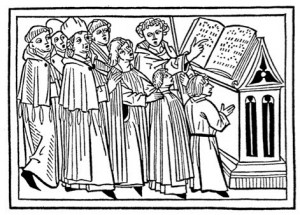
Engraving of a Latin ScholaChapter 50 of Ben Sira’s book is a description of a temple liturgy led by “the high priest, Simon son of Onias.” (v. 1) It is filled with poured-out wine, sumptuous vestments, the shouting of priests, the blowing of trumpets, the people falling on their faces. Not the sort of ho-hum run-of-the-mill worship service one finds in most Christian churches these days.

A committee in my parish is studying the whys and wherefores of worship, what we do, how and why we do it, how we might do it better. Music, to which these verses briefly refer, has been an on-going topic of discussion. Tastes in music vary, emotions around music are passionate, commitments to one style or another are rock-solid.

“Open the gates of hell,” a clergy colleague once quipped, “and out will march an army of music directors!” I’ve never had any conflict with the music directors with whom I’ve served, but I know clergy who have. I’ve heard tales of such conflicts from both sides, from musician friends and from clergy colleagues. Battles between clergy and musicians are not uncommon. Battles between worship leaders and congregations about music are also not uncommon. Changing, or even supplementing, a congregation’s musical repertoire is something to be approached with fear and trembling.

The purpose of music in worship is to bring glory to God; therefore, the hymns the congregation sings, and the anthems the choirs prepare, should be centered on God, aesthetically pleasing, and thoughtful. The musicians and choristers should be technically competent and well-rehearsed. The chief instrument in the worship of God should be the human voice. It is the one instrument we have in common and it is capable of great beauty and resonance. But the use of musical instruments should not be shunned; the Scriptures are filled with references to trumpets and horns, stringed instruments, drums, and other instruments. These add beauty and diversity to our songs. The style of music or the type of instrumentation does not matter; vibrancy, depth, and quality of performance do (at least for the anthems or other “performance pieces” that may be offered). For songs with words, whether performed by the choir or sung by the congregation, the theological content of the lyrics should also be of concern.

Some congregations are great at singing hymns; in other churches, only a few people dare to open their mouths. This is a great sadness. Everyone has a voice that was given them by God and God expects that voice to be used. In a former parish, we hung a sign in our entryway – “If you can’t sing good, sing loud!” – we invited everyone to sing. Whatever flaws our individual voices may have, when they are raised together in song those flaws disappear. When the Body of Christ sings, when every voice is lifted, the effect is wonderful and, I’m sure, pleasing to God. St. Augustine of Hippo is often quoted as having said “He who sings, prays twice.” Singing is much to be encouraged.

So, as that great and wonderful hymn by James Weldon Johnson says, “lift every voice and sing ’til earth and heaven ring!”

====================

A request to my readers: I’m trying to build the readership of this blog and I’d very much appreciate your help in doing so. If you find something here that is of value, please share it with others. If you are on Facebook, “like” the posts on your page so others can see them. If you are following me on Twitter, please “retweet” the notices of these meditations. If you have a blog of your own, please include mine in your links (a favor I will gladly reciprocate). Many thanks!

====================

Father Funston is the rector of St. Paul’s Episcopal Church, Medina, Ohio.

« Older posts Newer posts »