Occasional thoughts of an Anglican Episcopal priest

Category: Daily Office (Page 56 of 70)

Shout! Good Liturgy! – From the Daily Office – September 11, 2012

From the Psalms:

Clap your hands, all you peoples;
shout to God with a cry of joy.
* * *
God has gone up with a shout,
the Lord with the sound of the ram’s-horn.
Sing praises to God, sing praises;
sing praises to our King, sing praises.

(From the Daily Office Lectionary – Psalm 47:1,5-6 – September 11, 2012)
 
ShoutI love this Psalm – it’s about liturgy and worship, something dear to my heart!

There’s a children’s song based on this song that we used to sing in the Cursillo movement (maybe they still do – I haven’t been to a Cursillo event in years). Our church school children learned to sing it at Vacation Bible School this year and had a great time doing so. I went surfing through YouTube and found this recording of Pat Boone teaching it to some kids:

The song, like the Psalm, has great energy. I have no idea how the Psalm was performed in the Temple, but how could a Psalm that calls for clapping, shouting, playing trumpets, and singing praises not be vibrant and energetic. That’s how liturgy should be.

It doesn’t have to be all kids’ songs, however. This same Psalm was sat as a choral anthem by Ralph Vaughn Williams. Here’s a YouTube of Williams’ O, Clap Your Hands performed by the Louisville Collegiate Choir.

It, too, is vibrant and energetic, but totally unlike Pat Boone’s children’s tune. Vibrancy and energy is not a matter of “style”; it is an issue of authenticity, of life, in the liturgy.

I love good liturgy! Good liturgy involves clapping, singing, praising, and even shouting done with authenticity and feeling! I love good liturgy!

====================

Father Funston is the rector of St. Paul’s Episcopal Church, Medina, Ohio.

“Average Sunday Attendance” – From the Daily Office – September 10, 2012

From the Acts of the Apostles:

The next sabbath almost the whole city gathered to hear the word of the Lord. But when the Jews saw the crowds, they were filled with jealousy; and blaspheming, they contradicted what was spoken by Paul.

(From the Daily Office Lectionary – Acts 13:44-45 – September 10, 2012)
 
Forest“Average Sunday Attendance” – also known as “ASA” – has become a hot topic in church circles. It’s how we gauge the health of congregations, not that it’s a very good measure of that, but what other easily accessed metric to governing boards and denominational judicatories have? If the parish priest, pastor, senior minister, whatever he/she may be called is doing a good job, the assumption is, the pews are going to be full. So if we count the number of seats in the seats, voila! we know if things are good.

Well, maybe. I’m not convinced that attendance figures are that good a metric of clergy performance; I’m not even sure there is a metric that measures the effectiveness of pastoral ministry. But here’s an interesting observation. Go to Google. Put in “Average Sunday Attendance” as your search term. In the first several pages of search results, the majority of websites will be Episcopal Church related! We are obsessed with this measurement!

So, it’s a hot topic and one way it pops up is when folks compare attendance in traditional, so-called mainstream churches with the numbers who throng to revival-type events offered by popular evangelists. It’s one thing to compare our mainline, denominational parish ASA to the weekly attendance of a non-denominational evangelical congregation; there may even be some validity to such a comparison (though probably not as a measure of clergy competence). But comparing our weekly numbers to the crowds at a one-off rally-type event strikes me as less than legitimate.

That is what the Jewish synagogue leaders are doing in today’s lesson from the Book of Acts! Here in Chapter 13, Paul and Barnabas have come to the city of Antioch in Pisidia on what is basically a preaching mission. They are offering something new, something out of the ordinary, something which diverts from everyday run-of-the-mill existence, so they get big crowds. (Yes, I know that Luke ascribes the big numbers to the work of the Holy Spirit, but let’s just look at the story as secularists for a moment; the new thing gets a lot of attention.) The synagogue leaders, comparing their weekly sabbath attendance to the crowds coming to see the missionaries, are jealous. In their envy, the Jewish leaders impugn Paul’s and Barnabas’s message and are condemned here by Luke as blasphemers.

But Luke is making the same mistake the synagogue leaders are making, the same mistake we make when look to ASA as a metric of performance. Attendance figures don’t measure message; attendance figures don’t estimate effectiveness; attendance figures don’t rank repentance; attendance figures don’t calculate commitment. Attendance figures measure . . . attendance, that’s all! High attendance is good, but it doesn’t necessarily mean that people’s lives are being impacted. Personal lives are at least as important as the size of the crowds, if not more so! When we see only the aggregate numbers, the individuals get lost.

The focus on ASA blinds us to other measures, other metrics. It raises blood-pressure; it raises blinders; it raises barriers. Have you ever noticed something like this? – When I am angry or upset about something and my blood pressure goes up, my sense of hearing is affected. I don’t know what it is, but I hear something like a rushing wind inside my ears (maybe that’s the blood pressure) and it interferes with my hearing. That’s maybe what happened with the Jewish leaders. The synagogue leaders couldn’t hear the message preached by Paul and Barnabas because their of anger over the attendance figures; it interfered with their perception. To switch to visual metaphor, they couldn’t see the trees for the forest. Seems it’s the same today.

====================

Father Funston is the rector of St. Paul’s Episcopal Church, Medina, Ohio.

There Are Those Times – From the Daily Office – September 8, 2012

From the Book of Job:

Eliphaz the Temanite answered: “Can a mortal be of use to God? Can even the wisest be of service to him?”

(From the Daily Office Lectionary – Job 22:1-2 – September 8, 2012)
 
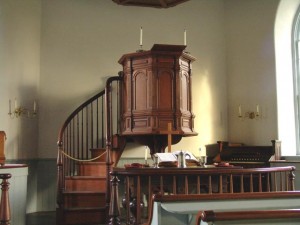
PulpitFrom time to time, people tell me that they have appreciated something I’ve said or done and I try to remember to say, “Thank you.” But inside, I really don’t think about compliments very much. It’s not that I don’t appreciated them, but I don’t do what I do to be complimented, and I really don’t think that I have much to do with it when whatever I do has gone well or had a positive impact on someone. I sort of take Paul’s attitude from the Letters to the Romans and the Galatians: “It is no longer I who live, but it is Christ who lives in me” (Gal. 20:2) and “I will not venture to speak of anything except what Christ has accomplished through me” (Rom. 15:18). So I do think, generally, that the answer to Eliphaz’s question is, “Yes.” Mortals can be of use to God. But there are times I would answer otherwise.

I’ve been a clergy person for not quite 21-1/2 years. I was ordained to the Sacred Order of Deacons on May 8, 1990, the Feast of Julian of Norwich; I was priested on June 21, 1991, the eve of the celebration of St Alban, first martyr of Britain. Before ordination, I was a lay preacher, a communion minister, a catechist, a seminarian. At the age of 21 (nearly 40 years ago) I was the youth minister in a major Southern California parish, and since then I have served the church in a variety of ways – vestry member, treasurer, diocesan chancellor (chief legal officer), diocesan trustee, standing committee member, various commissions and committees. Throughout those not-yet-ordained years I taught Sunday School, teen and adult education classes, and courses of ministry preparation for locally licensed ministers, and preached more than few sermons. Since ordination, I’ve done more of the same and preached a sermon nearly every week.

The message of those 22+ years of sermons can probably be boiled down to this: “In Christ Jesus, God loves and forgives you. Love and forgive one another.” I truly feel, all the flowery rhetoric aside, all the exigesis aside, all the sermon illustrations aside, that that simple message is what I’ve been trying to say every Sunday for more than two decades.

I don’t pay much attention to compliments or to critiques, frankly, but I do pay attention to behavior. When someone tells me they won’t do something for reasons having to do with a refusal to forgive, when someone fails to respond to a need, when someone treats another in ways that betray a lack of respect . . . and when those someones are people who’ve been listening to my sermons for a long time . . . that’s when I begin to feel that the answer to Eliphaz’s question is “No!” That’s when I begin to feel like maybe mortals, even wise mortals, just get in God’s way. That’s when I begin to feel like maybe that’s all I’ve done.

Of course, I know that’s not true, and I know when I feel that way that not too much time will pass before (in the words of today’s morning psalm) that God will turn my mourning into dancing, that God wil take off my sackcloth and clothe me with joy. (Psalm 30:11) Still . . . there are those times . . . .

====================

Father Funston is the rector of St. Paul’s Episcopal Church, Medina, Ohio.

Dealing with Grief – From the Daily Office – September 7, 2012

From the Psalms:

Have mercy on me, O LORD, for I am in trouble;
my eye is consumed with sorrow, and also my throat and my belly.
For my life is wasted with grief, and my years with sighing;
my strength fails me because of affliction, and my bones are consumed.

(From the Daily Office Lectionary – Psalm 31:9-10 (BCP versification) – September 7, 2012)
 
Tear of GriefThis was today’s morning psalm, about which I am writing late in the evening. Today’s meditation was delayed by sad news in our family: my wife’s father passed away early this morning. She was unable to be with him since we live far away from her original home where he had continued to reside. We are comforted that his wife (my spouse’s stepmother) and two of his sons were with him.

Grief is part of the human condition. None of us are immune to it, and the loss of a parent is one of the hardest grief’s to bear. Both of my parents have been gone for several years; my wife lost her mother 16 years ago (tomorrow is the anniversary of her death, as it happens).

So tonight . . . no pithy thoughts, no deep meditation. Just joining my wife in her grief. There is an old proverb (from Central America, I think): Grief shared is half grief; joy shared is double joy. I hope it’s true.

Most merciful God, whose wisdom is beyond our understanding: Deal graciously with my wife and her siblings in their grief. Surround them with your love, that they may not be overwhelmed by their loss, but have confidence in your goodness, and strength to meet the days to come; through Jesus Christ our Lord. Amen. (From the BCP 1979, page 494).

====================

Father Funston is the rector of St. Paul’s Episcopal Church, Medina, Ohio.

Crooked Lines – From the Daily Office – September 6, 2012

From the Book of Acts:

The magician Elymas (for that is the translation of his name) opposed them and tried to turn the proconsul away from the faith. But Saul, also known as Paul, filled with the Holy Spirit, looked intently at him and said, “You son of the devil, you enemy of all righteousness, full of all deceit and villainy, will you not stop making crooked the straight paths of the Lord?”

(From the Daily Office Lectionary – Acts 13:8-10 – September 6, 2012)
 
Tangled wiresAs I look at life, crooked lines abound. It’s what human beings do. Bar-Jesus (as the magician Elymas is also named in the Book of Acts) may have been making the straight crooked with evil intent, but I suspect that most human beings just do it out of habit, out of an inability to do anything else, out of (maybe) some sort of primate instinct to make a mess. My mother used to admonish me, in a lot of circumstances, “Don’t get bent out of shape!” At sixty years of age, I have come to suspect that there is no way to avoid life getting bent out of shape! Crooked lines abound.

Way back when I was in college I had a good friend whose job was taking care of the animals used in our psychology department’s experimental work. He took care of pigeons and rats and cats and all sorts of critters, including some kind of monkeys (don’t ask me what kind . . . I don’t think I ever knew). I remember once visiting him at work and watching the monkeys play. Someone had given them a length of copper house wire (that thick 12-gauge stuff) and they were happily bending it into a mass of crookedness, then trying (unsuccessfully) to straighten it out.

That, it seems, is what happens in life. We get our monkey hands on things, even things that are straight, and we bend them up. And then we can’t unbend them on our own. Have you ever tried to straighten a bent-up mess of wire by yourself? Can’t be done. But there is an old rabbinic proverb, “God writes straight with crooked lines.” With God’s help, things can get straightened out. Wire, lives, relationships, paths to salvation. I don’t think Paul really had to worry about Elymas; God can take care of God’s paths. It’s our crooked lines that we need to worry about; with God’s help, we need to get them worked out, straightened out, or at least a little bit untangled.

One of my favorite prayer resources is the book Celtic Daily Prayer from the Northumbria Community in England. In it there is this lovely prayer picking up on the rabbinic proverb, acknowledging the bent-out-of-shapeness of our lives, and seeking God’s help with straightening things out:

O God,
I cannot undo the past,
or make it never have happened!
– neither can You. There are some things
that are not possible even for You
– but not many!
I ask you,
humbly,
and from the bottom of my heart:
Please, God
would You write straight
with my crooked lines?
Out of the serious mistakes of my life
will You make something beautiful for You?
Teach me to live at peace with You,
to make peace with others
and even myself.
Give me fresh vision. Let me
experience Your love so deeply
that I am free to
face the future with a steady eye,
forgiven,
and strong in hope.
Amen.

====================

Father Funston is the rector of St. Paul’s Episcopal Church, Medina, Ohio.

The Eternal Now – From the Daily Office – September 5, 2012

From John’s Gospel:

Jesus said: “Your ancestor Abraham rejoiced that he would see my day; he saw it and was glad.” Then the Jews said to him, “You are not yet fifty years old, and have you seen Abraham?” Jesus said to them, “Very truly, I tell you, before Abraham was, I am.” So they picked up stones to throw at him, but Jesus hid himself and went out of the temple.

(From the Daily Office Lectionary – John 8:56-59 – September 5, 2012)
 
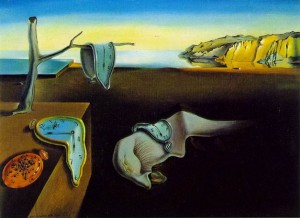
Salvador Dali, Persistence of TimeI’ve been sort of mulling this over all day. It’s one of those interesting mixed-tense things; Jesus uses the past tense for Abraham (“Abraham was”), but the present tense for himself (“I am”), while placing his presence before Abraham’s past. I think what he’s trying to do here his describe eternity. That’s not easy to do!

There was a sort of “pop theology” popular when I was getting my education for ordained ministry which made a distinction between two “kinds” of time: chronos (one of the Greek words for time) and kairos (another Greek word for time). The former is described as the former refers to our experience of sequential time; it is “human time.” It’s the time Steve Miller sang about with the lyric, “Time keeps on slippin’, slippin’, slippin’ into the future.” (Fly Like an Eagle) Kairos signifies a time of indeterminate nature in which something special happens; it is “God’s time.” It is, I suppose, eternity.

There’s a similar difference between “eternity” and “forever”, and I think it’s the same difference. “Forever” is an extension of sequential time. It’s the way in which time, as we experience, just keeps going on and on and on. But “eternity”, if it is kairos, is somehow outside of the linear sequence of our temporal experience. Eternity encompasses linear time. It was “before” time; it will be “after” time; it is “outside” of time. Forever might come to an end; it might slip into the future to point where it stops. Eternity or kairos, however, doesn’t, can’t, won’t – the concept of an end of eternity is meaningless.

Kairos or eternity, however, is also not the cyclical time of the Eastern religions. It isn’t the wheel of time or kalachakra of Hinduism and Buddhism. The problem (in my estimation) of that concept is that it makes existence seem a bit like a continuous-loop tape recording that plays over and over again, but never gets worn out. Nothing can be avoided; nothing can be changed. There is no final destination and, ultimately, there is no purpose to anything. As the French writer and filmmaker, Jean Cocteau said, “Nothing ever gets anywhere. The earth keeps turning round and gets nowhere.”

Cocteau, continued, however, “The moment is the only thing that counts,” and this (I believe) is where Jesus’ understanding and statement of who he was and is led him and leads us. When asked to teach his disciples to pray, Jesus taught them to focus on the moment: “Give us today our daily bread.” (Matt. 6:11; Luke 11:3) In the sermon on the mount he said, “Do not worry about tomorrow, for tomorrow will bring worries of its own. Today’s trouble is enough for today.” (Matt. 6:34) Rather than worry about one’s clothing or food or drink, he encouraged his followers to “strive first for the kingdom of God and his righteousness.” (v. 33) Be focused on the moment, the eternal now, eternity, kairos.

Ideas of past and future are just baggage. It has been said that depression results from trying to live in the past; anxiety comes from trying to live in the future. Psychologist Abraham Maslow said, “The ability to be in the present moment is a major component of mental wellness.” As Jesus made clear, it is a major component of spiritual wellness, too. Jesus ministry, among other things, was to bring eternity “into” time, kairos into chronos: “Before Abraham was, I am” is a statement of now, the eternal now, kairos.

====================

Father Funston is the rector of St. Paul’s Episcopal Church, Medina, Ohio.

Pray Naked – From the Daily Office – September 4, 2012

From the Book of Psalms:

Prove me, O Lord, and try me; test my heart and mind.

From the Book of Job:

Job answered: “But I would speak to the Almighty, and I desire to argue my case with God.”

(From the Daily Office Lectionary – Job 12:3; Psalm 26:2 – September 4, 2012)
 
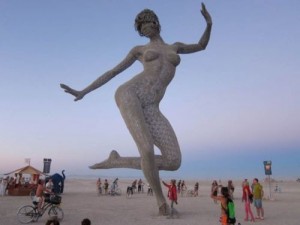
Bliss Dance, Statue at Burning Man Festival 2010 (Northern Nevada)This morning I was struck by the absolutely opposite attitudes displayed in these two readings. The morning psalm invites God to try the worshipper; the first reading of the day demands the right to try God. I think these poles really do represent the spiritual pendulum on which most humans swing; they circumscribe our ambivalent and ambiguous relationship with the Almighty.

At least they describe MY relationship with God! Some days my prayer life, my ministry, my personal life, my bodily feeling, all of it just seems great. “Bring it on, God! Whatever you want my to do today, I can handle it!” The next day I can feel just like Job: “Why me, God? I have been truly put-upon; I have been emotionally mistreated.” I come before God with the words of Moses:

Moses said to the Lord, “Why have you treated your servant so badly? Why have I not found favor in your sight, that you lay the burden of all this people on me? Did I conceive all this people? * * * I am not able to carry all this people alone, for they are too heavy for me. If this is the way you are going to treat me, put me to death at once – if I have found favor in your sight – and do not let me see my misery.” (Numbers 11:11-12,14-15)

I’m just like Job; I want to “speak [with God] and let come on me what may.” (Job 12:13) And so I do; I talk to God!

It’s called praying. Prayer comes in many forms. Whether I am telling God to “bring it on,” to test me, or whining about how hard it all seems and pleading my case, what I am doing is praying. Praying isn’t all praise and hallelujah; praying isn’t all supplication and intercession; praying isn’t all thanksgiving and gratitude. Praying runs the gamut of human emotion. Praying, at its best and most honest, is a conversation with God, baring the soul and the psyche in whatever condition they may be, trusting that God will handle them with love, gentleness, and care, sometimes tough love, sometimes a rough gentleness, but always with care.

This means that prayer is often difficult. It isn’t easy to bare the soul, to open the psyche, because there are things I’d rather not face. When I was in seminary, one of our classes in church history included a discussion of the ancient practice of nude baptism. Following that class, a group of us had some t-shirts made with the words “Pray Naked” emblazoned across the chest; they were certainly conversation starters when we wore them in public! They were a joke, but like most humor there is a kernel of seriousness buried therein. In genuine prayer we strip ourselves of all those things in our souls, our psyches our hearts which keep us from true openness before God, from true fellowship with Jesus.

Whether we are challenging God to try us, challenging God to be tried by us, pleading with God, praising God, thanking God, crying before God, or laughing with God, our souls, our hearts, the whole of our being should naked before God. Wherever you may be in the pendulum swing of your ambivalent and ambiguous relationship with God, pray naked!

====================

Father Funston is the rector of St. Paul’s Episcopal Church, Medina, Ohio.

What Is the Truth that Will Set Us Free? – From the Daily Office – September 3, 2012

From John’s Gospel:

Jesus said to the Jews who had believed in him, “If you continue in my word, you are truly my disciples; and you will know the truth, and the truth will make you free.”

(From the Daily Office Lectionary – John 8:31-32 – September 3, 2012)
 
Anglican Compass RoseLook at the Compass Rose emblem of the worldwide Anglican Communion and you will find these words, “The truth will make you free,” emblazoned on it in Greek. As an Anglican, I think that’s great. But there are times when Pilate’s question to Christ, “What is truth?” (John 18:38) makes a lot of sense! What is truth? What is this truth that will set us free?

It seems like a very simple question, but it isn’t simple at all. Many people confuse truth with facticity. The dictionary offers answers such as “conformity with fact or reality” and “actuality or actual existence”. But these definitions are unsatisfactory; they merely beg the question, encouraging us to ask, “What is fact? What is reality? What is actuality?” And then there is the issue of objectivity versus subjectivity How does individual perception affect “the truth”? Answers beget questions and more answers beget more questions. For the philosophically or religiously inclined, “truth” is just not that easy to nail down.

Philosophers have many theories of what the nature of truth is; they go by titles such as “the correspondence theory,” “the coherence theory,” or “the redundancy theory.” They apply argumentative techniques such as pragmatism, recurcivism, realism, deflationism, minimalism. Philosophical discussions of truth and last for hours and go nowhere. They’re fun, but in my opinion are ultimately fruitless. The question, “What is truth?” remains.

For the Christian, truth is not a concept, or an idea, or a philosophical theory. For the Christian, truth is a Person. “I am the way, the truth, and the life,” said Jesus. (John 14:6) Philosophers and skeptics will dismiss Jesus’ claim, but for the Christian, it answers Pilate’s question.

In Mere Christianity, C.S. Lewis wrote of Jesus: “We are faced, then, with a frightening alternative. This man we are talking about either was (and is) just what He said, or else a lunatic, or something worse. Now it seems to me obvious that He was neither a lunatic nor a fiend: and consequently, however strange or terrifying or unlikely it may seem, I have to accept the view that He was and is God. God has landed on this enemy-occupied world in human form.”

I can’t do better than that. What is this truth that will set us free? Jesus. Jesus is Truth.

====================

Father Funston is the rector of St. Paul’s Episcopal Church, Medina, Ohio.

We’ve Never Done It This Way Before! – From the Daily Office – September 1, 2012

From the Acts of the Apostles:

[Peter said to the circumcised:] “I remembered the word of the Lord, how he had said, ‘John baptized with water, but you will be baptized with the Holy Spirit.’ If then God gave them the same gift that he gave us when we believed in the Lord Jesus Christ, who was I that I could hinder God?” When they heard this, they were silenced.

(From the Daily Office Lectionary – Acts 11:16-18 – September 1, 2012)
 
Changing a Light BulbA couple of days ago I talked about Cornelius’s conversion from pagan to Christian through some time spent as a pious not-quite-proselyte Gentile. In today’s reading Peter defends his decision to baptize the Gentiles (Cornelius and his entire household) with this great question, “Who was I that I could hinder God?” It certainly shut down his critics!

How often do we stand in God’s way? Well, how often have you heard these words: “We’ve never done it this way before”? Or it’s more affirmatively stated equivalent, “We’ve always done it this way before”? Both usually said in that dismissive, fatally negative tone of voice.

“How many Episcopalians does it take to change a light bulb?”

“Change??!?!?!??!”

It happens again and again in our churches. Nearly everyone will acknowledge that we need new carpet for the Nave or the Parish Hall, but then someone will ask, “What’s wrong with our old carpet? I like the old carpet.” I once served a church where there was universal agreement on the need to replace the carpet in the worship space, and everyone agreed that it should be red (the color of the previous carpet), but the Vestry debated for six months about the shade of red! (Finally, a member of the board just went out and ordered the carpet and put all out of our misery!)

I read recently about a church where a recently deceased parishioner had left a bequest of $15,000 for a new prayer garden. The memorial committee met for months, but eventually disbanded because they couldn’t decide where to put it or what it would look like. “We’ve never done it this way before!”

Wouldn’t be great if that were a cry of delight and adventure instead of the fatally negative dismissal of change it usually is?

A few years ago my wife and I made our first trip overseas together to Ireland, a country neither of us had ever visited. Everything we did on that trip was something we had never done before. We had never before driven on the narrow back-country lanes of Ireland, the single-track roads where one might meet a flock of sheep or a herd of cows and have to back up a hundred yards or more to wide spot and let them pass before you could go on. We had never before climbed the cliffs of County Antrim and seen the Giants’ Causeway. We had never before eaten “the full Irish breakfast” with black pudding, baked beans, sauteed mushrooms, and grilled tomatoes added to our usual fare of bacon and eggs. For eighteen days we lived an almost hourly experience of never having done nearly everything this way before, and we loved it.

Wouldn’t it be great if folks in the church, instead of fearing change and difference, would greet new things with “We’ve never done it this way before!” as a cry of delight and adventure?

We always need to remember Jesus’ words, “You did not choose me but I chose you.” (John 15:16) We have been invited by God to a surprising adventure. Just like Peter we need to ask (some of us constantly), “Who am I to hinder God?” Ours is not to hinder God, but to follow God; not to stand in God’s way, but to journey in God’s way; not to say dismissively, “We’ve never done it this way before,” but to cry with delight and excitement, “We’ve never done it this way before!”

====================

Father Funston is the rector of St. Paul’s Episcopal Church, Medina, Ohio.

The Blameless Bagged at Sunrise – From the Daily Office – August 31, 2012

From the Psalms:

To the leader: according to The Deer of the Dawn. A Psalm of David.

(From the Daily Office Lectionary – Psalm 22, introduction – August 31, 2012)

 
Deer at SunriseEpiscopalians reciting the Daily Office usually read the Psalms from The Book of Common Prayer, not from the Bible. This can cause some confusion about psalm verses because the versification and number of verses in the BCP differs from that in most Bible translations. The Psalter used in Anglican prayer books, including that of the Episcopal Church (until the 1979 book) was based on Miles Coverdale’s translation of the Bible which predated the Authorized (King James) version by nearly 80 years. The Coverdale Psalter had been used in all editions of The Book of Common Prayer, back to the first in 1549; while some editorial changes were made, the basic versification and numbering was maintained and this was continued in the 1979 version, which is a new translation but follows the tradition of Coverdale. Although not metrical, the translation was rendered with chanting in mind.

I often take a look at the Psalms in the New Revised Standard Version (my preferred translation) to see what differences there might be. Among the things not included in the BCP’s Psalter are the introductory directions and titles found in the Psalms in the Bible, so it was the introduction to this evening’s Psalm that caught my attention today, particularly the image “the Deer of the Dawn.”

Not all of the Psalms have these introductory directions; in fact, the majority do not. Some of them are clearly musical instructions: “On stringed instruments” (Ps. 41, 54, 55, 61, and 67), “For flutes” (Ps. 5), “According to the Sheminith” (Ps. 6 and 12, apparently a reference to an eight-stringed instrument, or perhaps to a particular meter or octave); “For the harp” (Ps. 8 and 81 ). Fifteen of the Psalms (120-134) are titled “songs of ascent”, which may be a liturgical direction or a reference to particular festival usage. Several Psalms, like this one, have introductory authorship ascriptions: for example, many say “a psalm of David”; a few are labeled “a psalm of Asaph”.

A few psalms, like today’s, have lovely, poetic images in their introductory rubrics. Psalm 56 is labeled “concerning the silent dove afar off”; Psalms 45 and 69 are “for the lilies”; and Psalms 60 and 80 are described is “on the lily of the testimony.” Some believe these might be references to popular tunes to which the Psalm is to be sung, but no one really knows.

In any event, the image of the “deer of the dawn” caught me up today. Psalm 22 is familiar to most Christians because Jesus is said by Matthew and Mark to have quoted its first verse on the cross: “My God, my God, why have you forsaken me?” (Matt. 27:46; Mark 15:34) Psalm 22 is prescribed in the liturgy for Good Friday, and is sometimes recited during overnight prayer vigils on Maundy Thursday. But in none of those usages is the introductory rubric and this image, “the deer of the dawn,” mentioned; the introductory directions are not read as part of the liturgy.

I am not a hunter. I can safely say that I have never shot at a wild animal, ever. But I have many friends who are hunters and they tell me that dawn is the best time to go after deer. They tell that the earliest hours of the morning are when the deer are most active. Right around dawn is when they leave their beds and move to feeding areas. A spot near a trail between the two will give a hunter a good opportunity for an hour or two after sunrise. I believe this because our home backs up to a wooded easement a few miles in length and about 500 yards wide. I usually rise just about at dawn and as I get my first cup of coffee in the dim light of the kitchen, I can just make out the woods and any movement there may be. Frequently, a doe and one or more fawns or yearlings will be moving through the trees . . . often headed for our landscaping to munch on our hostas and other plants! (I have never shot at a wild animal . . . but I have been tempted.)

It seems somehow oddly appropriate that Jesus quoted from this Psalm and that it is used at late-night Maundy Thursday vigils and at Good Friday liturgies. Not simply because of Jesus’ words, nor because the Psalm includes such crucifixion-relevant language as

All who see me laugh me to scorn;
they curl their lips and wag their heads, saying,

“He trusted in the Lord; let him deliver him;
let him rescue him, if he delights in him.”

(and)

They stare and gloat over me;
they divide my garments among them;
they cast lots for my clothing.

(Ps. 22:7-8, 17)

But because of this almost-forgotten introductory image “the deer of the dawn.”

We are told in Mark 14 and Matthew 26 that after the passover supper, Jesus took Peter, James, and John to the garden at Gethsemane and spent some time in prayer. It has always seemed to me that this must have stretched over several hours and that his betrayal and arrest must have occurred in the early morning hours. The Temple authorities, soldiers, and police who came to get him chose a time and a place not unlike a deer hunter, a time when they would have the best opportunity to find him, the best shot to take him. Jesus is “the Lamb of God” but it seems he is also “the deer of the dawn,” the innocent taken in the quiet of the new day’s early hours, the blameless bagged at sunrise.

====================

Father Funston is the rector of St. Paul’s Episcopal Church, Medina, Ohio.

« Older posts Newer posts »