From the Book of Acts:
[Peter asked Cornelius,] “Now may I ask why you sent for me?’ Cornelius replied, “Four days ago at this very hour, at three o’clock, I was praying in my house when suddenly a man in dazzling clothes stood before me. He said, ‘Cornelius, your prayer has been heard and your alms have been remembered before God. Send therefore to Joppa and ask for Simon, who is called Peter; he is staying in the home of Simon, a tanner, by the sea.’ Therefore I sent for you immediately, and you have been kind enough to come. So now all of us are here in the presence of God to listen to all that the Lord has commanded you to say.”
(From the Daily Office Lectionary – Acts 10:29-33 – August 30, 2012)
 Judaism is not a missionary religion. It is, however, a proselytic religion. This means that Jews don’t go looking for converts, but those who come to them interested in becoming Jews are instructed and initiated; these initiates are called proselytes. Cornelius might have become a proselyte, but we know that he was not because if he had been, Peter would have had no issues with seeing him, meeting him, eating with him. Peter did have those issues initially, but then was shown the vision of unclean animals which he was told to eat. Peter interpreted that vision to mean that he should not treat non-Jews as unclean; it was the beginning of the Jewish Christian church welcoming non-Jews (“Gentiles”) as members.
Christianity is a missionary religion. Christians go looking for converts – or at least we’re supposed to and in the beginning we did. Someone may have told Cornelius about Jesus and about the followers of Jesus or, more likely, someone simply lived a Christian life. Cornelius had already been attracted to the Jewish religion and was following some of its practices, but the only way he could have become interested in hearing “all that the Lord had commanded Peter to say” was if someone had primed the pump, so to speak.
Once in a long while someone who is not a Christian will call me or will stop in the office and inquire about baptism (in fact, it happened quite recently, but that was the first time in several years). It always turns out that they have witnessed something in the life of a friend or family member that they find attractive – a way of handling misfortune, of dealing with the death of a loved one, of helping someone less fortunate than themselves. Having seen this, the inquirer has talked to the person and somehow in conversation they have learned that their friend or family member is a church member. Further conversation leads to further inquiry which leads eventually to me, to a conversation not unlike this conversation between Peter and Cornelius. When I’ve asked my version of “Why have you sent for me?” I’ve never been told about a vision of an angel in dazzling clothes, but I have been told about Christians testifying to their faith.
Christianity is a missionary religion, and occasionally Christians act like missionaries. When they do, Corneliuses show up.
====================
Father Funston is the rector of St. Paul’s Episcopal Church, Medina, Ohio.
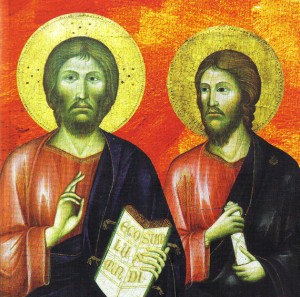 The picture of Jesus getting advice from his brothers just tickles me. John makes such a deal of it (while pointing out that his brothers did not believe in him – as the Messiah, I suppose – at the time). It seems so at odds with John’s otherwise oh-so-perfect, oh-so-divine Jesus!
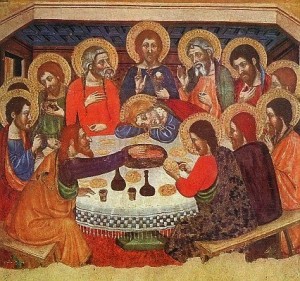 The Jews, John tells us, disputed among themselves as Jesus was delivering the lengthy dissertation on bread from which these statements come. Earlier he had introduced this idea that his flesh was bread to be eaten by his followers: “I am the living bread that came down from heaven. Whoever eats of this bread will live for ever; and the bread that I will give for the life of the world is my flesh.” (v. 51) The very idea of consuming human flesh is off-putting, even disgusting, and would have been extremely objectionable to the Jews; no wonder they grumbled and mumbled, complained and disputed. Even as a metaphor, the statement demands a lot from Jesus’ followers!
 Wow! Does this look familiar? The second chapter of Job begins with a scene nearly identical to that which we considered yesterday. Satan (with other heavenly beings) presents himself in the heavenly throne room and, once again, God and Satan have a conversation about Job and, once again, the bet is made. In fact, it’s sort of “double down” time! Yesterday, I argued that although the Book of Job is fiction it (like the other forms of literature found in Holy Scripture) embodies truth.
 A later selection from the Book of Job was called up by the Sunday Eucharistic Lectionary several weeks ago. In my sermon I said to the congregation that the Book of Job is fiction (which it is). You should have seen the look on one of my parishioners’ face! There’s a fellow in the congregation who is, shall we say, conservative with regard to the Bible. While I don’t believe he actually considers the Bible to be the inerrant word of God per se, he’s pretty sure that it is to be taken with the highest degree of certainty and words like “myth” or “fiction” applied to Scripture are not to his liking. I swear I thought he might have an apoplectic fit right there in his pew! But let’s be honest: do we really think that God and Satan are engaged (or have ever been engaged) in a game of chance involving the lives of human beings?
 Psalm 130 is one of the seven “pentitential psalms” of the church (Psalms 6, 32, 38, 51, 102, 130, and 143), a tradition that stretches back to the Sixth Century if not earlier. It is also one of the “songs of ascents” (Psalms 120-134) that are believed to have been sung by pilgrims making their way up to Jerusalem or possibly when climbing up the Temple Mount for festival celebrations. Somehow it strikes me as both odd and poignant that a song or poem beginning “Out of the depths” is called a song of “ascent” – from the deepest sloughs of despond the poet calls out the Highest. Ascent, indeed!
 I think this may be my favorite psalm. It is the psalm appointed for use on the feast of St. Francis of Assisi. It is one of the psalms approved in The Book of Common Prayer for use at a funeral; it was selected by my mother to be used at her funeral.
  Saint Stephen, one of the first deacons of the church, has just preached a sermon in which he has reminded his hearers, Jewish authorities in Jerusalem, that the Jews had a history of mistreatment of prophets, Their ancestors, he has said, “killed those who foretold the coming of the Righteous One, and now [his listeners] have become his betrayers and murderers.” No wonder they were angry with him.

