From the Book of Judges:
Delilah said to Samson, “Please tell me what makes your strength so great, and how you could be bound, so that one could subdue you.” Samson said to her, “If they bind me with seven fresh bowstrings that are not dried out, then I shall become weak, and be like anyone else.” Then the lords of the Philistines brought her seven fresh bowstrings that had not dried out, and she bound him with them. While men were lying in wait in an inner chamber, she said to him, “The Philistines are upon you, Samson!” But he snapped the bowstrings, as a strand of fibre snaps when it touches the fire. So the secret of his strength was not known.
(From the Daily Office Lectionary – Jugest 16:6-9 – August 18, 2012)
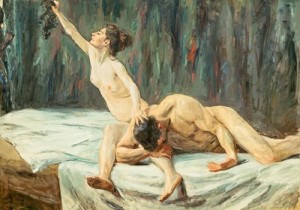 It may be a sign of my age or a condemnation of my cultural up-bringing, but I cannot read any of the story of Samson and Delilah without hearing Tom Jones’ voice sining, “Why? Why? Why, Delilah? My, my, my Delilah?” Silly, I know, but it sort of fits with this bit from the Old Testament lesson from today’s lectionary readings.
We are told that Samson “fell in love with a woman in the valley of Sorek, whose name was Delilah,” (v. 4) and that she is then persuaded by the Philistine leadership to discover and disclose the source of Samson’s strength. So begins a series of events in which she asks Samson, he lies to her, she undertakes to betray him on the basis of the lie, and he overcomes the betrayal. After three such episodes, he finally tells her that he will lose his strength if a razor touches his head and the story proceeds as every Sunday School child remembers it.
Reading these three episodes of question, lie, and betrayal, Tom Jones’ lyric keeps ringing in my ears, “Why, why, why?” Why does Samson stay with or keep returning to this woman who is clearly in league with his enemies? Why?
I suppose the answer is in verse 4: “He fell in love with [her].” Love, or perhaps we should be honest and note that what this really is is lust or passion, does that to us; it blinds us to the faults in the beloved. “Love is blind” says the old shibboleth. Erotic love makes us overlook the obvious and do things that simply do not make sense.
One of my favorite songs of a bygone era is 10-CC’s Things We Do for Love:
Too many broken hearts have fallen in the river
Too many lonely souls have drifted out to sea
You lay your bets and then you pay the price
The things we do for love, the things we do for loveCommunication is the problem to the answer
You’ve got her number and your hand is on the phone
The weather’s turned and all the lines are down
The things we do for love, the things we do for loveLike walking in the rain and the snow when there’s nowhere to go
When you’re feeling like a part of you is dying
And you’re looking for the answer in her eyes
You think you’re gonna break up
Then she says she wants to make upOoh you made me love you
Ooh you’ve got a way
Ooh you had me crawling on the floorA compromise would surely help the situation
Agree to disagree but disagree to part
When after all it’s just a compromise
Of the things we do for love, the things we do for love
The things we do for love
Walking in the rain and the snow, crawling on the floor, returning again and again to a paramour whose clearly bent on betrayal . . . the soul in search of love will do a lot of silly and stupid things that make us ask “Why?” I think we know the answer, though; we’ve known it at least since St. Augustine of Hippo write his Confessions: “You have made us for yourself, Lord, and our hearts are restless until they rest in you.” Only in God do we find that love which does not betray.
====================
Father Funston is the rector of St. Paul’s Episcopal Church, Medina, Ohio.
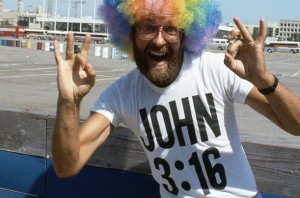 A very familiar quotation from Scripture that second verse: anyone who has ever attended a sporting event in the United States (or watched one on television) as seen someone holding up a sign with “John 3:16” emblazoned on it. Often that person is wearing a rainbow-colored “Afro” wig. Anytime I have witnessed that spectical I’ve wondered, “Has anyone ever become a follower of Jesus because of that sign?” I’m pretty certain the answer is “No.”
 This short passage from the Book of Acts describes the sort of world Jesus intended. Not just the sort of church . . . . the sort of world, the sort of human society, a complete community in which no one claims private ownership (it’s all God’s remember) and where there are no needy persons because what is needed is distributed equitably.
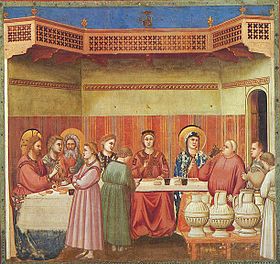 A year ago I was in Ireland, camped out in a cottage outside of the village of Banagher, County Offaly, on sabbatical. As my study project, I was translating old Irish hymns into metrical, rhyming English such that they could be sung to the music of the original. The hymns were published in the early 20th Century in a collection titled Dánta Dé Idir Sean agus Nuadh compiled by Uná ní Ógáin. Dánta Dé includes a communion hymn which elaborates on John’s story of the wedding feast; it is entitled The Blessed Wedding at Cana and is attributed to Maighréad ní Annagáin. I found I could not directly translate the hymn, so instead I wrote a poem of my own. Reading this story today, I recall working on that piece and offer it again.
 OK. I know I shouldn’t get into this . . . I know that someone is going to give me a hard time; I can almost predict that someone will tell me they are planning to “leave the church” over this. But here goes.
 Just a few days ago the Public Religion Research Institute issued a new report entitled A Generation in Transition: Religion, Values, and Politics among College-Age Millennials. A “millennial” is somone currently 18 to 24 years of age, the youngest cohort of adults. (From my point of view at nearly 60 years of age these are children; my son and daughter are both older than this group!) According to the report, these young adults are more likely then the general population to be religiously unaffiliated; one-quarter of them so identify themselves. Interestingly, most of those who do so were reared in religiously affiliated households. The greatest movement away from religious affiliation was seen among those raised in Catholic and white mainline Protestant families. It would appear that we have not been doing a very good job of teaching our children “that they in their turn might tell it to their children”!
 Reading these oh-so-familiar words in the introduction to John’s Gospel, I remember other words I read on another blog yesterday:
 It is intriguing how often in stories of Holy Scripture food plays a role. From the “apple” in the Garden, to Abraham offering a meal of cakes and meat to the three men (who turn out to God) at the Oaks of Mamre, to this story of Gideon, to David and his men eating the Bread of the Presence, to all the food items listed as items of sacrifice in Leviticus, the Old Testament (indeed, the whole Bible) is food focused. The People of God define themselves through the annual reenactment of a ritual meal celebrating the Passover; the new People of God define themselves (in my tradition and others) by the weekly reenactment of a ritual meal celebrating the death and Resurrection of Christ and anticipating his return. It’s intriguing but not surprising. The Jewish and Christian faiths are not, in the long run, about following rules of ritual or moral conduct; they are about being in an intimate relationship with that which is the source of being, that which we call “God” and address as “Father” or brother or redeemer. And, other than sex, there is probably no more intimate activity two or more people can share than eating together.
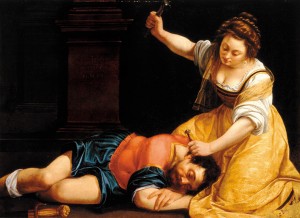 “Most blessed” be a murderess? What is this? Yesterday, a friend and colleague who was only a little older than I am passed away after several months of pancreatic cancer, so I’m a little sensitive on the subject of death this morning. So, really! What is this?

