St. Paul wrote ….
To the Jews I became as a Jew, in order to win Jews. To those under the law I became as one under the law (though I myself am not under the law) so that I might win those under the law. To those outside the law I became as one outside the law (though I am not free from God’s law but am under Christ’s law) so that I might win those outside the law. To the weak I became weak, so that I might win the weak. I have become all things to all people, so that I might by any means save some. I do it all for the sake of the gospel, so that I may share in its blessings.
(From the Daily Office Readings, Mar. 16, 2012, 1 Cor. 9:20-23)
 Confession time … this is one of those passages from the Pauline Epistles that makes me hate Paul. He’s such a self-important braggart! “Look at me,” he seems to be saying, “Look at all I’ve done, all the sacrifices I’ve made, all the effort I’ve put into sharing the Gospel with you! I am really the best evangelist there ever was!” ~ OK … I don’t hate Paul. I know he’s not really being an arrogant braggart in this letter … but doesn’t some of his writing sure seem that way? ~ What is going on here is that Paul is talking about flexibility! The Lord, speaking through the prophet Jeremiah, reminds us that we are clay in God’s hands: “Just like the clay in the potter’s hand, so are you in my hand, O house of Israel.” (Jer. 18:6b) It seems that many people think that once the clay is formed for a specific purpose and will never again be reshaped for anything else, but that’s not the way things work in life and especially not in ministry. Spiritual clay cannot be rigid; it must be flexible to be formed for one purpose and then reformed for a different type of work according to God’s will. When Jeremiah went to the potter’s house as God led him, he saw that the vessel the potter was making ended up being reworked into another vessel as seemed good to the potter. God then asked, “Can I not do the same with you?” (18:5-6a) It seems to me that Paul (in is own inimitable fashion) is simply saying that God worked and reworked him time and time again, and that he had learned to be flexible. ~ An old friend used to be the Altar Guild director in her church. On the wall of the sacristy she put up a poster of wheat blowing in the wind; the caption read, “Blessed are the flexible, for they will never be bent out of shape.”
 In between these two sections from Mark’s Gospel Jesus teaches a great crowd of people and then feeds them with five loaves of bread and two fish; the crowd “numbered five thousand men” and who knows how many women and children. But what draws my attention today are the words of Jesus, “Come away to a deserted place all by yourselves and rest a while” and Mark’s words at the end, “He made his disciples get into the boat and go [away]” and “he went up on the mountain to pray.” Lots and lots of ministry activity bracketed by “down time”, time away from the demands of the crowd, time to rest, time to pray, times of sabbath. Mark doesn’t actually call these “sabbath times”, but that’s what they were. Part of the genius of the Jewish faith (and, by extension from it and by the modeling of its Founder, of the Christian faith) is that the human need for rest is made sacred. “God blessed the seventh day and sanctified it, because in it He rested from all His work which God had created and made.” (Gen. 2:3) “Remember the sabbath day, to keep it holy. Six days you shall labor and do all your work, but the seventh day is a sabbath of the Lord your God ; in it you shall not do any work.” (Exod. 20:8-10) Jesus famously remarked, “The Sabbath was made for man, and not man for the Sabbath.” (Mark 2:27) Methodist writer Leonard Sweet interprets Jesus as meaning that it’s not so much that we keep the Sabbath, but that the Sabbath keeps us. It keeps us whole, keeps us sane, and keeps us spiritually alive. In today’s story from Mark’s Gospel we tend to focus on the feeding of the five thousand (the part I left out up above), but I’m beginning to believe that the really important part of the story are the “brackets”, the times of rest. Do not neglect to “come [or go] away to a desert place by yourselves and rest a while” on a regular basis!
 Every time I read this story, competing visions of the scene do battle in my imagination. First, there is the image of Rita Hayworth dancing the lascivious “dance of the seven veils” before Herod (played by Charles Laughton) in the movie Salomé (the name given Herod’s step-daughter by Flavius Josephus in his histories; her name is not mentioned in the Bible). If I recall correctly, there is a similarly sensual portrayal in the movie The Greatest Story Ever Told. The other image I see with my mind’s eye is of a much younger dancer, a pre-adolescent child. In the original Koine Greek, she is referred to as a korasion (vv. 22 and 28), the same word used in Monday’s gospel story of the healing of Jairus’s daughter. In that story the word is translated as “little girl” an applied to a child twelve years of age, a girl not yet old enough to be married. ~ As popular as the Rita Hayworth version is, I’d rather go with the little girl version. I’d rather not see the dance as part and parcel with the evil done to John the Baptist, which the lewdness of the strip-tease version suggests. I prefer to see this as a tale of innocence perverted, a child’s sweet gift of a simple dance taken advantage of by a scheming, vengeful adult, a cautionary tale (if you will) of purity sullied. Dance, in itself, should be thought of as a good thing. ~ When our son announced his engagement and then the couple announced their wedding date, and let us know that there would be a formal reception afterward with dancing, my wife and I decided to take ballroom dance classes. We discovered that dancing is not for sissies! It turned out to be darned difficult for rhythmically challenged folks like us; it also turned out to be fairly demanding physical exercise. But I enjoyed it and I’m glad we took the classes. I’m hoping we’ll take some more and make dancing a regular part of our lives. One should remember and heed the advice of St. Augustine (354-430):
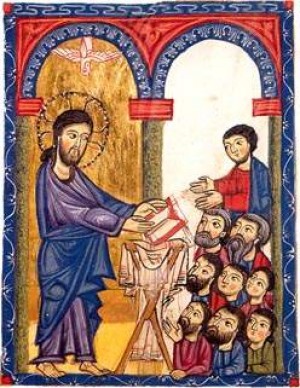 There is so much in this little story! It serves as a great illustration of two old sayings: “Familiarity breeds contempt” and “You can never go home again”. Jesus’ home-town friends were too familiar with him. They’d known him since he was a boy. He’d done the equivalent of delivering their papers, mowing their lawns, playing with their kids, climbing their trees. Those who were his own generation knew him as fellow student, someone they’d sat in synagogue with, a working stiff making chairs and tables in his father’s workshop. They couldn’t accept him as anything more or different, and certainly not as religious leader! Their familiarity with him bred their contempt of his ministry, and that contempt came out in the form of old rumors and gossip: “This is Mary’s son” not “This is Joseph’s son” … those old stories about his parentage. They took offense at him and they became offensive and contemptuous in return. After this incident, Jesus left Nazareth and never returned. Despite Jesus’ ministry, his gifts for teaching and preaching, his ability to heal, in Nazareth he could never be more than his family’s and his friends’ memories allowed: he was a carpenter, how could he ever be anything else? Sometimes you can’t go home again because people are blinded by their memories and only see what was “back in the day”. Jesus realized it was time to detach with love and walk away. ~ In the Episcopal Church, we have a special prayer or “collect” that is to be said at each celebration of the Eucharist; there is such a prayer for each weekday in Lent. The collect for today includes the petition, “Grant that we, to whom you have given a fervent desire to pray, may, by your mighty aid, be defended and comforted in all dangers and adversities.” Sometimes the adversities we face come from those whom we expect to be our greatest supporters, friends and family who can’t let go of prejudices, presuppositions, and presumptions. Sometimes the greatest source of comfort in those situations is distance. If we have to detach and walk away, this little story from Mark’s Gospel reminds us that Jesus has been there before and shares the pain of family separation with us.
 What is most interesting and empowering about this story of the healing of Jairus’s daughter told in today’s reading from Mark’s Gospel is its ending. Jesus goes to the girl, takes her by the hand and says, “Talitha cum,” which Mark tells us means “Little girl, get up.” But Mark also later tells us that the girl was twelve years old. She is an adolescent and this is significant: by Jewish tradition, a girl becomes a woman at twelve years and one day. So this young girl was poised at the very threshold of womanhood, of taking her place in the community as an adult. So not a little girl, but nearly a young woman, got up at Jesus’ command. Jesus then said to those around them, “Give her something to eat.” He doesn’t say to her, young adult though she may be, “Go and make your own breakfast.” Instead, he turns to her family and says, “Give her something to eat.” After the healing and lifting up of the one cured, Jesus commends her to the care and nurture of the community. ~ In our society, even the best of medical care comes to an end and, as with Jairus’s daughter, the patient’s family must take over. In The Book of Common Prayer, a prayer “for the aged” asks that God “give them understanding helpers” (BCP 1979, page 830); this story reminds us that not only the elderly, but also the very young and those in the prime of life may, from time to time, have need of assistance, may be patients in the midst of illness or recovering from expert medical care. As caregivers, we who are members of their family (or other nuclear community) are the experts in their history; we know a lot about our loved one and about their own abilities to provide care and a safe setting. Among the common care responsibilities we may all someday be handling for a family member as he or she recovers from illness, injury, or surgery are personal care (bathing, eating, dressing, toileting), household care (cooking, cleaning, laundry, shopping), healthcare (medication management, physician’s appointments, physical therapy, wound treatment, injections), and emotional care (companionship, meaningful activities, conversation). ~ The end of Mark’s story of the Jairus’s daughter’s healing reminds us that these are Christ-like ministries empowered by God, not simply onerous family burdens. In The Book of Common Prayer there is also a lovely prayer entitled “For strength and confidence” following the liturgy of Ministration to the Sick: “Heavenly Father, giver of life and health: Comfort and relieve your sick servant N., and give your power of healing to those who minister to his/her needs, that he/she may be strengthened in his/her weakness and have confidence in your loving care; through Jesus Christ our Lord. Amen.” (BCP 1979, page 459) This story from Mark’s Gospel reminds us that family members are included among those to whom we ask God to give the “power of healing.”
 To our ancient ancestors, living water was the very essence of chaos. The oceans and seas, their waves, swift flowing rivers, waterfalls, cataracts, even peaceful ponds and lakes were considered chaotic and dangerous; they were very difficult even for the gods to control. The gods did battle with them; when the gods had won, creation followed. For example, in Egyptian mythology in the beginning there was only the swirling watery chaos, called Nu; out of the chaotic waters rose the sungod, Atum (later identified as Ra or Kephri), who subdued the waters and created the first dry land. We find echoes of this in Genesis 1 where “the earth was a formless void and darkness covered the face of the deep, while a wind from God swept over the face of the waters.” (v. 2) God subdues the waters by first separating them and then gathering those under the firmament into seas. The Lord makes reference to this creation myth when he answers Job: “Who shut in the sea with doors when it burst out from the womb? – when I made the clouds its garment, and thick darkness its swaddling band, and prescribed bounds for it, and set bars and doors, and said, ‘Thus far shall you come, and no farther, and here shall your proud waves be stopped’?” (Job 38:8-11) Perhaps the disciples had this in mind when, boating on the Galilean lake with Jesus during a storm, they asked “Who then is this, that even the wind and the sea obey him?” (Mark 4:41) Here in Psalm 93, God wins definitively, establishing world order, which “shall never be moved” (v. 1); God’s order cannot be changed or defeated. God rules over all of creation, even the forces of chaos. Each of us is subject to the chaos of feelings and emotions, our subjective reactions to a particular event. These reactions are characterized by an absence of reasoning; they are rambunctious, even primal. It is not uncommon to hear someone say, “I can’t trust my feelings” or “My emotions got away from me.” Sometimes these intense feelings are accompanied by physical and mental activity. Emotions are impulses to act, the instant plans for handling life that evolution has instilled in us, and in any of us these primal, instinctive reactions can become chaotic and uncontrolled. Psalm 93 assures us that God is mightier than even these most powerful and unpredictably chaotic forces. God is the perfect outlet for our emotions. When you, or your family, or your friends can’t handle your emotions, God can. As The Book of Common Prayer‘s Collect for the Third Sunday in Lent assures us, God can “keep us both outwardly in our bodies and inwardly in our souls, that we may be defended from all adversities which may happen to the body, and from all evil thoughts which may assault and hurt the soul,” especially our chaotic emotions.
 This is a troubling text. Paul seems to be telling slaves to remain in their slavery, not to be concerned about their condition of servitude; this would say to others that they should not struggle for the liberation of slaves. Of course, Paul believed the end of this world was right around the corner and such earthly conditions as slavery or mastership would be abolished in his lifetime. He was wrong … so how does his text speak to us today? ~ Paul’s counsel to remain “in whatever condition you were called” should not be used as a justification for not seeking better circumstances for oneself and an improvement of one’s circumstances. Indeed, it is debatable that Paul even gave that advice to stay in one’s “condition” or “situation”. It is rather more probable, it seems to me, that his counsel is to remain steadfast in one’s conversion (Greek kalesis = calling) to Christian faith and brotherhood resisting the pressures of one’s prior status – slave or master, Jew or Greek, married or single, whatever that condition or status may be – and this might even mean a change in that circumstance. I am so persuaded by the arguments of S. Scott Bartchy, Professor of Christian Origins and the History of Religion, Department of History, UCLA. He has examined how the Greek word kalesis meaning “calling”, “invitation” or “summons” – correctly translated as vocatione by St. Jerome in the Vulgate and as “calling” (or “called”) in the Authorized Version – came to be translated in later English versions as “condition”. His surprising (and probably correct) conclusion is to blame Martin Luther and the influence of his German translation! Bartchy has argued that it is certain that Paul did not teach enslaved Christ-followers to “stay in slavery.” Rather, he exhorted them (and us) to “remain in the calling in Christ by which you were called.” Quite the opposite of a passive quietism accepting of unjust social institutions, Paul’s exhortation is to an active faith repenting our own “blindness to human need and suffering and our indifference to injustice and cruelty.” (From the American BCP’s Ash Wednesday Litany of Penitence, p. 268)
 Psalm 73 begins with a confession of green-eyed envy; the Psalmist acknowledges that he slipped and nearly stumbled away from faith because of his envy of the prosperous who “suffer no pain” and whose “bodies are sleek and sound.” This psalm brings in to sharp focus a complex and perplexing problems for persons of faith: the prosperity of the wicked and the suffering of the righteous. The Psalmist saw that “the wicked, always at ease, increase their wealth;” the wicked seem to be totally self-reliant and autonomous people. They seem not to need God; they are able to take care of themselves. It bothered the Psalmist that their lifestyle apparently works! Thus, he concluded that the attempt to lead a moral life is absolutely pointless; he despaired that it was in vain that he kept his heart clean and “washed my hands in innocence.” However, upon entering the temple he came to understand that the wicked wealthy will “come to destruction, come to an end, and perish from terror!” And so he comes to sing of his reliance on God, his strength and his portion for ever. At the end of the psalm, he vows to “speak of all God’s works in the gates of the city of Zion.” ~ In our society with such a deep division between rich and poor, between “the 1%” and the middle class, this psalm’s cries of envy and despair, I’m sure, speak to many, but I hope its reliance on the God of eternity, the God of hope speaks louder. “Whom have I in heaven but you? And having you I desire nothing upon earth.” The Psalmist, entering the sanctuary and changing his point of view from the worldly to the eternal, was led to see that no matter how things looked here in the temporal world his trust and confidence in God was the greatest gift of God’s grace, greater than any earthly wealth he could contemplate. A change of perspective, so that one views life through the lens of eternity, brings clarity of vision, both of the world around us and of our call to ministry in this world. It does not permit us to become embittered with green-eyed envy nor to sink into despair, but neither does it encourage us to accept wealth inequality and injustice with a promise of “pie in the sky by-and-by.” Rather, it admonishes us to “speak of all God’s works in the gates of the city.” And as St. Thomas Aquinas reminds us, “Mercy and truth are necessarily found in all God’s works” and “justice must exist in all God’s works.” (Summa Theologica, Question 21, Article 4) Psalm 73 in the Daily Office Lectionary during Lent echoes the exhortation of the Prophet Micah: “He has told you, O mortal, what is good; and what does the Lord require of you but to do justice, and to love kindness, and to walk humbly with your God?” (Micah 6:8)
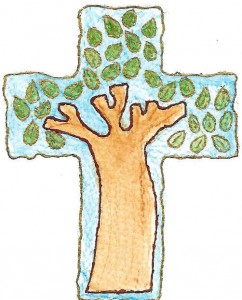 When I think about religion and trees, I remember that Evelyn Underhill, writing not about this parable but about St. Paul’s prayer in the Letter to the Ephesians that the church might be “rooted and grounded in love” (Eph. 3:17), wrote: “By contemplative prayer, I do not mean any abnormal sort of activity or experience, still less a deliberate and artificial passivity. I just mean the sort of prayer that aims at God in and for Himself and not for any of His gifts whatever, and more and more profoundly rests in Him alone: what St. Paul, that vivid realist, meant by being rooted and grounded. When I read those words, I always think of a forest tree. First of the bright and changeful tuft that shows itself to the world and produces the immense spread of boughs and branches, the succession and abundance of leaves and fruits. Then of the vast unseen system of roots, perhaps greater than the branches in strength and extent, with their tenacious attachments, their fan-like system of delicate filaments and their power of silently absorbing food. On that profound and secret life the whole growth and stability of the tree depend. It is rooted and grounded in a hidden world.” (Quoted in Radiance: A Spiritual Memoir of Evelyn Underhill, Bernard Bangley, ed. [Brewster, MA: Paraclete Press, 2004]). We see the tree, its trunk, its branches, its leaves; below in the soil, however, there is a huge unseen network of roots. Love and prayer are the earth which nourishes these roots. Referring Ms. Underhill’s metaphor to Jesus’ parable of the mustard seed, and understanding (as one interpretation of the image) the “kingdom of God” analogized to the tree which grows from it to be the church, we are left with the unmistakeable inference that it is our prayer life which provides the fruitful ground in which the church must grow. I am reminded of a story told by Martha Grace Reese in her book Unbinding the Gospel (Atlanta, GA: Chalice Press, 2008) that when she was consulted by a church growth committee and asked what they should do, she told them to do nothing but pray for at least three months. And I remember another church leader saying, “This year’s level of church growth cannot be sustained on last year’s level of prayer.” Active, sustained, community-wide prayer is an absolute necessity for the church to grow into the abundant, live-giving place where “the birds of the air can make nests in its shade.” The parable challenges us with the idea that God created the church (us) for the birds (those who are not us). Are our churches, through our love and prayers, places where the birds (the ones who are not us, may not be at all like us) can come and abide? Let us pray that they are.

