Revised Common Lectionary for the Great Vigil of Easter, Year B: Genesis 1:1-2:4a; Exodus 14:10-31; 15:20-21; Proverbs 8:1-8, 19-21;9:4b-6; Zephaniah 3:12-20; Psalm 114; Romans 6:3-11; Mark 16:1-8
 Some time in the late Fourth Century, St. John Chrysostom, Archbishop of Constantinople and an important Early Church Father known for his eloquence in preaching and public speaking (hence, the surname Chrysostom which means “golden-mouthed”), preached this sermon on Easter.
Since that time, throughout the Christian East, it has been a tradition to read this at the Great Vigil of Easter. It is known simply as “the Paschal Homily” and any Orthodox Christian who hears that title knows exactly what is meant.
I offer it to you this evening. (For those who have been following our “three-act drama of redemption” theme, the third-act sermon will be offered at tomorrow’s Festal Eucharist.)
Are there any who are devout lovers of God?
Let them enjoy this beautiful bright festival!Are there any who are grateful servants?
Let them rejoice and enter into the joy of their Lord!Are there any weary from fasting?
Let them now receive their due!If any have toiled from the first hour,
let them receive their reward.If any have come after the third hour,
let them with gratitude join in the feast!Those who arrived after the sixth hour,
let them not doubt; for they shall not be short-changed.Those who have tarried until the ninth hour,
let them not hesitate; but let them come too.And those who arrived only at the eleventh hour,
let them not be afraid by reason of their delay.For the Lord is gracious and receives the last even as the first.
The Lord gives rest to those who come at the eleventh hour,
even as to those who toiled from the beginning.To one and all the Lord gives generously.
The Lord accepts the offering of every work.
The Lord honours every deed and commends their intention.Let us all enter into the joy of the Lord!?
First and last alike, receive your reward.
Rich and poor, rejoice together!Conscientious and lazy, celebrate the day!
You who have kept the fast, and you who have not,
rejoice, this day, for the table is bountifully spread!Feast royally, for the calf is fatted.
Let no one go away hungry.Partake, all, of the banquet of faith.
Enjoy the bounty of the Lord’s goodness!Let no one grieve being poor,
for the universal reign has been revealed.Let no one lament persistent failings,
for forgiveness has risen from the grave.Let no one fear death,
for the death of our Saviour has set us free.The Lord has destroyed death by enduring it.
The Lord vanquished hell when he descended into it.
The Lord put hell in turmoil even as it tasted of his flesh.Isaiah foretold this when he said,
“You, O Hell, were placed in turmoil when he encountering you below.”?
Hell was in turmoil having been eclipsed.
Hell was in turmoil having been mocked.
Hell was in turmoil having been destroyed.
Hell was in turmoil having been abolished.
Hell was in turmoil having been made captive.Hell grasped a corpse, and met God.
Hell seized earth, and encountered heaven.
Hell took what it saw,
and was overcome by what it could not see.O death, where is your sting?
O hell, where is your victory?Christ is risen, and you are cast down!
Christ is risen, and the demons are fallen!
Christ is risen, and the angels rejoice!
Christ is risen, and life is set free!
Christ is risen,
and the tomb is emptied of its dead.For Christ, having risen from the dead,
is become the first-fruits of those who have fallen asleep.To Christ be glory and power forever and ever. Amen!
 Something strange is happening – there is a great silence on earth today, a great silence and stillness. The whole earth keeps silence because the King is asleep. The earth trembled and is still because God has fallen asleep in the flesh and he has raised up all who have slept ever since the world began. God has died in the flesh and hell trembles with fear.
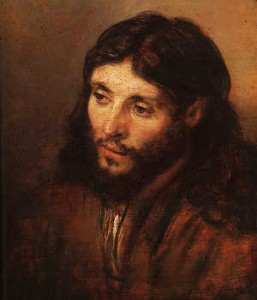 In the beginning he had been tempted by riches, by power, by idolization; all these had been offered in the desert. Now how great the temptation must have been to simply give up! Poet Denise Levertov ponders this allure in her poem Salvator Mundi: Via Crucis
 In this second act of the drama all that has gone before is recapitulated; all that we saw in yesterday’s first act, the supper in the upper room, the act of servanthood taught there, the agonized prayer in the garden, the willing surrender to unjust authority, and more. Not just yesterday’s first act, but all that has gone before from our first act of defiance in the first garden. Poet Ross Miller reminds us of that bond in his brief verse entitled Tau

 Act One, Scene One – Location: an upper room somewhere in Jerusalem.
 We have just read the simple, yet dramatic story of our Lord’s Passion as related in Mark’s Gospel. But we began our worship this morning with John’s story of Christ’s triumphal entry into Jerusalem. In the span of a few minutes we covered an entire week at the end of Jesus’ earthly life. Logic and reason cannot really make sense of this, and no ten-minute homiletic exegesis of these texts can help us comprehend the enormity of those events.
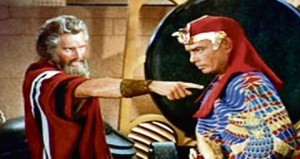 Why is Moses angry at Pharaoh? Moses (and God) have put the Egyptians through a series of miserable plagues. The people of the Nile valley have lived through water turning to blood killing all life in the river; invasions of frogs, lice, and flies; livestock diseases; painful, unhealing boils; hail and thunder; locusts; and unnatural darkness. Throughout the course of this series of events, there have been many times when Pharaoh seemed on the verge of releasing the Hebrews but then “the Lord hardened Pharaoh’s heart, and he did not let the sons of Israel go.” (Exod. 10:20) ~ Over the years, I’ve read a lot of commentary on this passage, the introduction to the slaughter of the first born which is context of the Passover. Wesley opined, “Moses hereupon was provoked to a holy indignation, being grieved, as our Saviour afterwards, for the hardness of [Pharaoh’s] heart.” Well, yeah, but who’s responsible for that? Over and over again the Scripture tells us it was God who hardened Pharaoh’s heart! Pharaoh’s not just obstinate, he’s manipulated into stubbornness by God himself! Why be angry at Pharaoh? ~ I don’t really think he is. I think he was mad at God…. ~ I think it’s OK to be mad at God. We have the freedom to express and respond to that emotion, to own up to our occasional anger with God. When parishioners come to me and “confess” being angry at God, I tell them it’s OK, that God is a big boy and can take their anger. The issue to be addressed is whether they can! Can they pray their anger honestly? Prayer is not always peaceful and serene and believing that ought to be can be a real obstacle to faith. But praying out one’s anger is unfamiliar territory; it feels awkward; it’s not much like any prayer we hear in church. ~ Do you remember the episode of The West Wing in which Pres. Bartlett’s secretary was killed by a drunk driver? Her funeral was held in the Washington National Cathedral (an Episcopal church, by the way). After the funeral, Bartlett stays behind in the quiet privacy of the cathedral to offer a personal prayer to God … not out of sadness or faith or hope. His prayer is offered out of anger. He begins by calling God a “son of a bitch” and a “feckless thug.” Then, good Roman Catholic that Josiah Bartlett was, he continued in Latin. Here’s what he said: “Am I really to believe that these are the acts of a loving God? A just God? A wise God? To hell with your punishments. I was your servant here on earth and I spread your word and I did your work. To hell with your punishments and to hell with you!” No amen – just a cigarette stamped out on the cathedral floor, after which Bartlett stalked out. Pretty clearly “in hot anger he left.” Praying our anger is not like any prayer we (usually) hear in church. ~ Scripture doesn’t tell us what Moses did in or with his anger, but we do know what followed. The story of Moses’ “hot anger” and what followed it affirms for us that anger, even anger at God, need not be destructive. It can be the source of a rebirth of hope; it can heighten our confidence in the future, and empower us to undertake the creation of a new reality. Appropriately and creatively channeled, anger, even anger at God, can lead us out of bondage and into freedom.
 I can’t read Paul’s words “treasure in clay jars” without thinking of this old Indian parable. ~ Once upon a time, there was a man who lived on a hillside high above the river. He had to fetch his water from the river every day. He did this with two large earthen jars slung from a yoke carried across his neck. The jars were heavy and it was a long path with many switchbacks down to the river, but the path was bordered by flowers and he didn’t mind the walk or the work at all. Both of the water jars were large and held several gallons, but there was a tiny crack in one so that the water would gradually leak out of that jar and splash on to the side on the path. The cracked jar was very sad that it lost half its water on the way back from the river each time. After many years the jar spoke to the man and apologized for being such a failure. “Why should you feel like that?” asked the man, ” I knew all about that crack; in fact, I made use of it.” “What do you mean?” asked the jar. “Well look,” he replied, “Do you see the flowers growing by the side of the path?” The jar looked and, sure enough, there were beautiful flowers growing all along the way. “Those flowers are there because I knew you had that small leak. I sowed some flower seeds along the side of the path and as I walked, the water leaking from your small crack watered them. For years now I’ve enjoyed those flowers as I walk, and I’ve been able to pick fresh flowers every day to decorate my home. I couldn’t have done that if you hadn’t watered them through that little crack. So, you see, I like you just the way you are. You are a very treasured water jar!” ~ Like the earthen jar carrying water, we carry in our cracked and faulty bodies the death of Jesus. And like the water that leaked from the jar, the life of Jesus flows out from us to accomplish his work in the world. This extraordinary power does not come from us, but we are the conduit (even and often when we don’t realize it). ~ As a preacher, I continue to relearn this each time someone refers to “something you said in a sermon”. I never remember my sermons! I look back on notes or scripted sermons from which I’ve preached and think, “Did I say that?” Apparently I did … and apparently it made a difference in someone’s life, watered some flowers along their path! So to preachers especially but to everyone, be assured – you are an earthen jar, probably a flawed one, carrying the death of Jesus in yourself that you may spread the life of Jesus to those around you, even though you may not realize it.
 Threading a needle…. That used to be a simple task for me. I was very, very near-sighted. I could barely see a school bus twenty feet away without my pop-bottle-bottom spectacles. But I could thread a needle! I could do anything that required close-up detail work; I had marvelous up-close vision. Then one day in 1995 (I think it was 1995) my mother saw my glasses. “Good Heavens! Are your eyes that bad?” – “Yes, Mother, they always have been.” – “Why don’t you have that Lasik surgery?” – “Because I can’t afford it, Mother.” – “You get it done. I’ll pay for it.” ~ (Side comment: My mother was a depression child born in 1919. As a result of spending her formative pre-teen and teen years in the years of the Great Depression, she was one of the most tightfisted people I’ve ever known when it came to spending money on herself or her spouse, my step-father. She would not spend a dime on her own healthcare, even when she felt badly. But she was generous to a fault with her children, her grandchildren, her friends, and her church. If she’d been less generous to us and more generous to herself, she might still be alive. But that’s another story.) ~ So I talked with my ophthalmologist, who had earlier been quite negative about PK and RK and other forms of keratotomy, and he thought Lasik would be a good option. He referred me to a surgeon. A couple of weeks later, I was able to do everything without glasses … everything except thread a needle. Now I needed a pair of dime-store “cheaters” to do what had once been easy, and even though I squinted and used those magnifying lenses I had difficulty. Getting anything through the eye of a needle, much less a camel, is no mean task! ~ About thirty years before that surgery, I visited the Cathedral at Chartres on my first trip to Europe. I was 16 years old at the time. I walked the labyrinth there. Since that first time I’ve walked many replicas of that deceptively simple path and other forms of labyrinth. Threading one’s way through the labyrinthine path requires concentration (especially in a cathedral full of tourists, but really at any time, even when completely alone). It is a careful endeavor not unlike threading a needle; one might even say it is a soulful endeavor. ~ Perhaps the most famous labyrinth in history or myth is the one built on Crete to house the Minotaur. King Minos’s daughter Ariadne fell in love with Theseus, an Athenian who was to be a sacrificial victim of the Minotaur. She gave Theseus a ball of thread to unwind as he made his way through the labyrinth, which showed him the path to by which he could leave once he had done battle with the beast (assuming he killed it, which he did). It was her thread of love which helped Theseus thread his way through the labyrinth. ~ Our walk through a spiritual labyrinth is said represent our way through life. Victor Hugo once said, “He, who every morning plans the transactions of the day, and follows that plan, carries a thread that will guide him through a labyrinth of the most busy life.” I’m not so sure that’s true, however; plans are too often subject to change! Like the odd turnings of the Chartres labyrinth, we meet with obstacles which change our direction; when we seem to be headed for our goal, suddenly the way changes; even though we squint and use magnifying glasses, the way through is unclear. We may not be able to follow our plans and we may not see the way ahead, but we are threaded through the unexpected and unknown path of life if we trust and rely on God’s guidance. Like Ariadne’s thread of love, God’s love threads us through life’s labyrinthine ways. Following God’s guidance is a careful, soulful endeavor, but “with God all things are possible.”
 Last Sunday the Year B Revised Common Lectionary for the 5th Sunday in Lent called for a reading from the Prophet Jeremiah which included these words from God, “I will put my law within them, and I will write it on their hearts.” (Jer. 3:33) My son Patrick, who is a priest in Kansas, preached
 “They did not understand … and were afraid to ask him.” I had really hoped when I first studied this passage some years ago that the word afraid was really something like “reluctant” or “hesitant” in the original Greek of the New Testament. But, in fact, the Greek word is phobeo, the adjectival form of the word from which we get phobia in English; it really is afraid. In fact, the principal meaning of the word is to fear something to the extent of fleeing! Only secondarily does it mean the extend reverence, veneration, or respect to something or someone. I trust that Mark means the latter emotion, but I’m not sure. ~ I know there are times when I am in conversation with someone, often with several someones, and something will be said that I don’t fully understand. My usual tactic is not to ask, but rather to smile and nod, to try to look sage, and to hope that further comments will clarify things for me. I don’t want to look stupid, after all! Maybe that’s what Mark is suggesting, that the disciples were afraid of looking like idiots…. ~ Isn’t that nearly a universal feeling? Human beings just seemed predisposed to fear looking stupid; we don’t like being wrong; we don’t want to be embarrassed; we’re afraid of failure; we are constantly worried about what others think of us, especially those we respect. There is one word that describes this human condition: anxiety. ~ Paul wrote about anxiety to the Philippians: “Do not worry about anything, but in everything by prayer and supplication with thanksgiving let your requests be made known to God. And the peace of God, which surpasses all understanding, will guard your hearts and your minds in Christ Jesus.” (Philip. 4:6-7) Paul makes it sound so simple, but even those who knew Jesus first-hand, who were with him day by day, found it hard to do. “They did not understand … and were afraid to ask him.” Don’t beat yourself up if you sometimes don’t understand. Don’t beat yourself up if you are sometimes anxious. But don’t be afraid to ask; make your requests known to God!


